A
PRESENTATION
ON
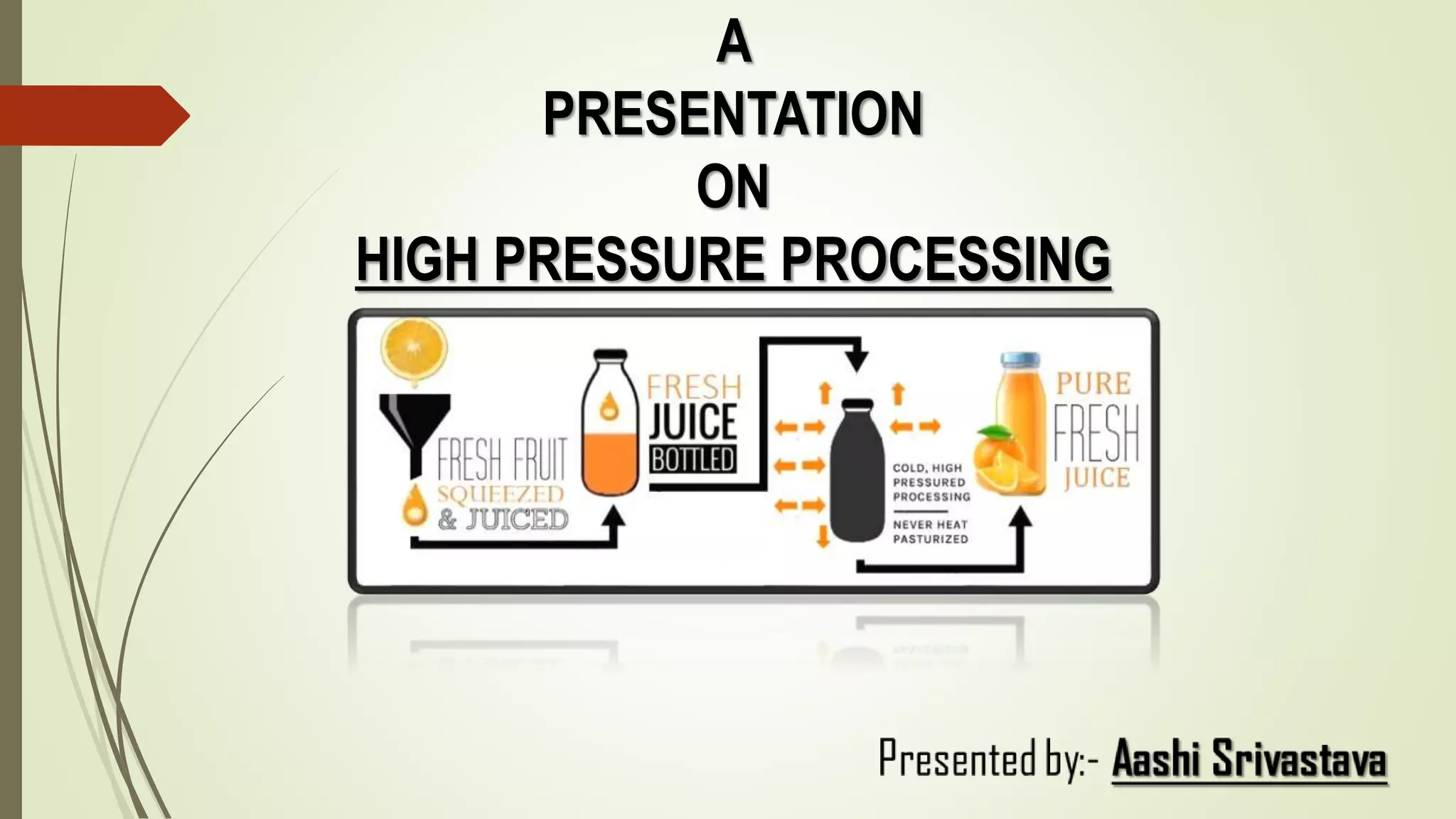
HIGH PRESSURE PROCESSING
CONTENT
1. Introduction.
2. History.
3. HPP- 3.1 Definition.
3.2Working.
3.3 HPP system.
3.4 HPP equipment.
4. Effect of Pressure on Microorganisms.
5. Principle.
6. Need of high Pressure processing.
7. Foods suitable for HPP.
8. Effects of HPP on Quality of food.
9. HPP Packaging Requirement.
10. Conclusion.
11. References.
Introduction
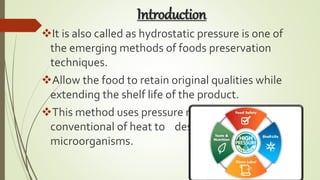
It is also called as hydrostatic pressure is one of
the emerging methods of foods preservation
techniques.
Allow the food to retain original qualities while
extending the shelf life of the product.
This method uses pressure rather than the
conventional of heat to destroy the
microorganisms.
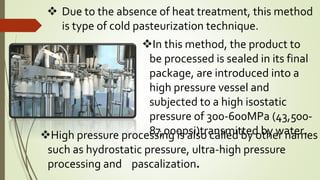
 Due to the absence of heat treatment, this method
is type of cold pasteurization technique.
In this method, the product to
be processed is sealed in its final
package, are introduced into a
high pressure vessel and
subjected to a high isostatic
pressure of 300-600MPa (43,500-
87,000psi)transmitted by water.
High pressure processing is also called by other names
such as hydrostatic pressure, ultra-high pressure
processing and pascalization.
HISTORY
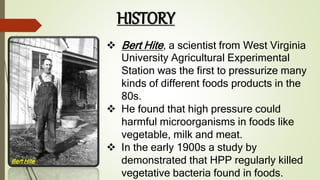
 Bert Hite, a scientist from West Virginia
University Agricultural Experimental
Station was the first to pressurize many
kinds of different foods products in the
80s.
 He found that high pressure could
harmful microorganisms in foods like
vegetable, milk and meat.
 In the early 1900s a study by
demonstrated that HPP regularly killed
vegetative bacteria found in foods.
Bert Hite
 Frist commercialized in Japan in the early
1990s for pasteurization of foods for chilled
storage.
 In Europe and the United States since 1996.
 In Australia since2001. and rapid
commercialization since 2000.
HIGH PRESSURE PROCESSING
High pressure processing (HPP) is a method of
preserving and sterilizing food, in which a product is
processed under very high pressure, leading to the
inactivation of certain microorganisms and enzymes in
the food.
In most of the high pressure processing operations, the
process is carried out between 300 to 600 MPa at room
temperature.
Depending on the composition of the product , due to
the effect of high pressure, the temperature of the
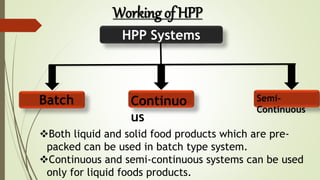
Working of HPP
HPP Systems
Continuo
us
Semi-
Continuous
Batch
Both liquid and solid food products which are pre-
packed can be used in batch type system.
Continuous and semi-continuous systems can be used
only for liquid foods products.
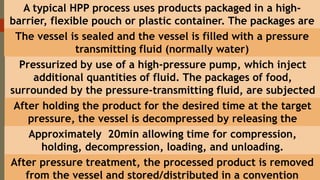
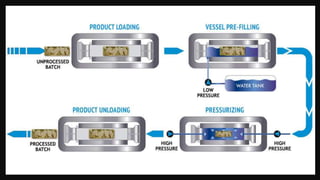
A typical HPP process uses products packaged in a high-
barrier, flexible pouch or plastic container. The packages are
loaded into the high-pressure chamber.
The vessel is sealed and the vessel is filled with a pressure
transmitting fluid (normally water)
Pressurized by use of a high-pressure pump, which inject
additional quantities of fluid. The packages of food,
surrounded by the pressure-transmitting fluid, are subjected
to the same pressure as exists in the vessel itself.
After holding the product for the desired time at the target
pressure, the vessel is decompressed by releasing the
pressure-transmitting fluid.
Approximately 20min allowing time for compression,
holding, decompression, loading, and unloading.
After pressure treatment, the processed product is removed
from the vessel and stored/distributed in a convention
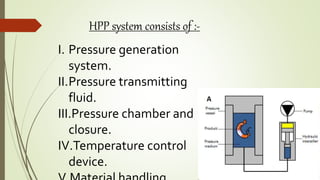
HPP system consists of :-
I. Pressure generation
system.
II.Pressure transmitting
fluid.
III.Pressure chamber and
closure.
IV.Temperature control
device.
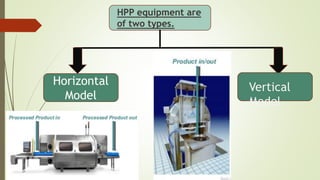
HPP equipment are
of two types.
Horizontal
Model
Vertical
Model
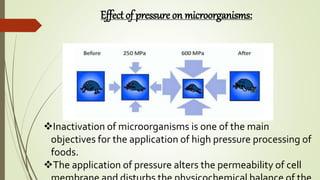
Effect of pressure on microorganisms:
Inactivation of microorganisms is one of the main
objectives for the application of high pressure processing of
foods.
The application of pressure alters the permeability of cell
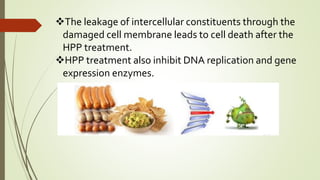
The leakage of intercellular constituents through the
damaged cell membrane leads to cell death after the
HPP treatment.
HPP treatment also inhibit DNA replication and gene
expression enzymes.
Principles of HPP
High pressure
processing
Le Chateliers
Principle
Isostatic Rule
Le chateliers Principle, states that, when a system at
equilibrium is disturbed the system responds in a way that
tends to minimize the disturbance.
The applied pressure enhances the reaction leading to
volume decrease.
Reactions are accompanied by decrease in volume will
enhanced by pressure.
Isostatic Rule states that pressure is
instantaneously and uniformly transferred
throughout the sample under pressure, whether
sample is in direct contact with the pressure
or hermetically sealed in a flexible package that
transmits pressure.
Pressure is transmitted in a uniform and quasi
instantaneous manner throughout the sample
independent of the size and shape of the
If a food product contains sufficient amount of
moisture, pressure will not damage the sample
long as the pressure is applied uniformly in all
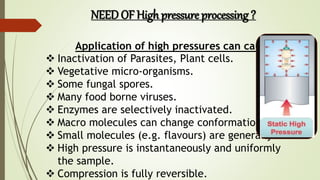
NEED OF High pressure processing ?
Application of high pressures can cause:-
 Inactivation of Parasites, Plant cells.
 Vegetative micro-organisms.
 Some fungal spores.
 Many food borne viruses.
 Enzymes are selectively inactivated.
 Macro molecules can change conformation.
 Small molecules (e.g. flavours) are generally
 High pressure is instantaneously and uniformly
the sample.
 Compression is fully reversible.
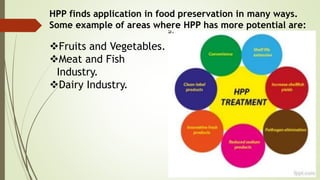
HPP finds application in food preservation in many ways.
Some example of areas where HPP has more potential are:
Fruits and Vegetables.
Meat and Fish
Industry.
Dairy Industry.
Inactivate microorganisms and quality-deteriorating
enzymes .
Higher sensorial, functional and nutritional values
improving food safety.
Puree, coulis, sauces, juices, smoothies, chunks,
ready-to-eat products, these are only some examples
wide range of fruit and vegetable products that can
processed by HPP.
One of the most successful commercial application
HPP nowadays is definitely preservative-free
(avocado puree with spices) because the process
maintains avocado flavour, texture, green colour
sacrificing food safety or shelf life (up to 6 weeks
chilled conditions).
deteriorating enzymes.
Maintaining high sensorial and nutritional
and improving food safety without the need of
additives or artificial preservatives.
Sliced ham, turkey or chicken cuts, ready-to-
products, whole pieces of cured ham, these are
some examples of products.
One of the most successful commercial
of HPP nowadays is easy shell opening of
easy meat extraction of crustacean products
helps in increasing the yield up to 45%.
Dairy Industry:
 Increased shelf-life (3 to 10 times longer than the same
without HPP stored at same temperature).
 Product Freshness.
 No impact on sensory, nutritional, or functional properties.
 Effective elimination of spoilage and pathogenic
 High Pressure Process Technology works especially well on
dairy products such as yogurt because most pressure-
spores are unable to survive in environments with low pH
The treatment is very effective on both solid and liquid
products. Since high pressure acts quickly and evenly,
size of a product’s container nor its thickness.
New trends in application of HPP :HPP is the best
option to preserve and respect the functionality of
thermosensitive bioactive components present in
Low-medium moisture, semi-solid/solid foods,
vacuum packaged:
Dry-cured or cooked meat products
Cheese
Fish, seafood, marinated products
Ready to eat meals, sauces
High moisture, solid foods, vacuum packaged:
Fruits, marmalades/jams
Vegetables
High moisture, liquid foods in plastic bottle/flexible
packaging:
Dairy products
FOODS suitable for HPP:
Solid foods with air included
 Bread and cakes
Mousse
Packaged foods in completely rigid packaging
Glass packaging
Canned foods
Foods with a very low water content
Spices
Dry fruits
Powders
effects of HPP on quality of food:
Effects on Food Colour & Flavour:
 Fresh or marinated meat: Iron in the
changes from ferrous to ferric and globin is
denatured-the red colour is lost.
 Cooked meat colour meat is largely
 Cooked meals are not affected.
 Fruits and Vegetables: Slight modification
 Fruit juices: Little or no affect.
 Flavours are mostly unaffected.
Effects on Food Texture:
 Slight softening in foods with cell wall
Effects on Fats and Lipids:
Reversible crystallization
Effects on Proteins and Enzymes:
Inhibition or stimulation of the enzymatic activity
(depending on processing conditions).
Proteins are partially denatured in products where
proteins have not been previously modified by
process such as heating, drying and fermentation
Pressures affects hydrophobic bonds and
interactions.
Pressure denaturation is complex, at pressures
Mpa denaturation usually irreversible.
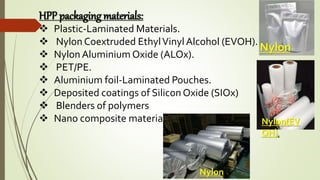
HPP packaging materials:
 Plastic-Laminated Materials.
 Nylon Coextruded EthylVinylAlcohol (EVOH).
 Nylon Aluminium Oxide (ALOx).
 PET/PE.
 Aluminium foil-Laminated Pouches.
 Deposited coatings of Silicon Oxide (SIOx)
 Blenders of polymers
 Nano composite materials
Nylon
Nylon
Nylon(EV
OH).
HPP PACKAGING REQUIRMENTS:
Flexible packaging (>15% volume contraction)
 Extra tight seals.
Rounded & reinforced edges.
Minimal head space.
 Modified Atmospheric Packaging (MAP) possible
Tear strength, puncture resistance and surface
smoothness generally not affected by HPP.
 Often flexible pouches or bottles are inserted in
secondary cardboard containers after processing.
Consumers: HPP is a consumer acceptable,
environmental friendly, scientifically recognized
to achieve higher quality in certain foods.
Processing: Pressure transmission is instantaneous,
uniform, short processing times, assured safety in
pack, suitable for solids and liquids.
Quality: Retains flavour and nutrition.
Environmentally: Safe and no process by products,
emissions.
Packaging: Package design, geometry and format
should be tailored for HPP, Packaging films and
structure generally survive HPP well, but MAP and
Conclusion
https://prezi.com/dtgk80590g0g/hiperbaric-applications-of-hpp/
http://www.hopefresh.com/
http://www.hiperbaric.com/en/hpp
http://www.suflux.com/EN/products/FoodIsostaticPress.html
http://www.promatecfoodventures.com/doc/FoodTechnology_1108feat_preserv
gfoods.pdf
http://www.thenfl.com/wp-content/uploads/High-Pressure-Processing-
Insights_20131.pdf
http://ohioline.osu.edu/fse-fact/pdf/0001.pdf
http://seafood.oregonstate.edu/.pdf%20Links/High-Pressure-Processing-
Basics.pdf
http://fshn.illinois.edu/food_processing_forum/presentations/c2_Dallas_present
ion.pdf
http://www.uniservices.co.nz/Portals/0/All%20One%20Pagers/High%20Pressure
References:
High Pressure Processing (HPP)

High Pressure Processing (HPP)

  • 1.
  • 2.
    CONTENT 1. Introduction. 2. History. 3.HPP- 3.1 Definition. 3.2Working. 3.3 HPP system. 3.4 HPP equipment. 4. Effect of Pressure on Microorganisms. 5. Principle. 6. Need of high Pressure processing. 7. Foods suitable for HPP. 8. Effects of HPP on Quality of food. 9. HPP Packaging Requirement. 10. Conclusion. 11. References.
  • 3.
    Introduction It is alsocalled as hydrostatic pressure is one of the emerging methods of foods preservation techniques. Allow the food to retain original qualities while extending the shelf life of the product. This method uses pressure rather than the conventional of heat to destroy the microorganisms.
  • 4.
     Due tothe absence of heat treatment, this method is type of cold pasteurization technique. In this method, the product to be processed is sealed in its final package, are introduced into a high pressure vessel and subjected to a high isostatic pressure of 300-600MPa (43,500- 87,000psi)transmitted by water. High pressure processing is also called by other names such as hydrostatic pressure, ultra-high pressure processing and pascalization.
  • 5.
    HISTORY  Bert Hite,a scientist from West Virginia University Agricultural Experimental Station was the first to pressurize many kinds of different foods products in the 80s.  He found that high pressure could harmful microorganisms in foods like vegetable, milk and meat.  In the early 1900s a study by demonstrated that HPP regularly killed vegetative bacteria found in foods. Bert Hite
  • 6.
     Frist commercializedin Japan in the early 1990s for pasteurization of foods for chilled storage.  In Europe and the United States since 1996.  In Australia since2001. and rapid commercialization since 2000.
  • 7.
    HIGH PRESSURE PROCESSING Highpressure processing (HPP) is a method of preserving and sterilizing food, in which a product is processed under very high pressure, leading to the inactivation of certain microorganisms and enzymes in the food. In most of the high pressure processing operations, the process is carried out between 300 to 600 MPa at room temperature. Depending on the composition of the product , due to the effect of high pressure, the temperature of the
  • 8.
    Working of HPP HPPSystems Continuo us Semi- Continuous Batch Both liquid and solid food products which are pre- packed can be used in batch type system. Continuous and semi-continuous systems can be used only for liquid foods products.
  • 9.
    A typical HPPprocess uses products packaged in a high- barrier, flexible pouch or plastic container. The packages are loaded into the high-pressure chamber. The vessel is sealed and the vessel is filled with a pressure transmitting fluid (normally water) Pressurized by use of a high-pressure pump, which inject additional quantities of fluid. The packages of food, surrounded by the pressure-transmitting fluid, are subjected to the same pressure as exists in the vessel itself. After holding the product for the desired time at the target pressure, the vessel is decompressed by releasing the pressure-transmitting fluid. Approximately 20min allowing time for compression, holding, decompression, loading, and unloading. After pressure treatment, the processed product is removed from the vessel and stored/distributed in a convention
  • 11.
    HPP system consistsof :- I. Pressure generation system. II.Pressure transmitting fluid. III.Pressure chamber and closure. IV.Temperature control device.
  • 12.
    HPP equipment are oftwo types. Horizontal Model Vertical Model
  • 13.
    Effect of pressureon microorganisms: Inactivation of microorganisms is one of the main objectives for the application of high pressure processing of foods. The application of pressure alters the permeability of cell
  • 14.
    The leakage ofintercellular constituents through the damaged cell membrane leads to cell death after the HPP treatment. HPP treatment also inhibit DNA replication and gene expression enzymes.
  • 15.
    Principles of HPP Highpressure processing Le Chateliers Principle Isostatic Rule Le chateliers Principle, states that, when a system at equilibrium is disturbed the system responds in a way that tends to minimize the disturbance. The applied pressure enhances the reaction leading to volume decrease. Reactions are accompanied by decrease in volume will enhanced by pressure.
  • 16.
    Isostatic Rule statesthat pressure is instantaneously and uniformly transferred throughout the sample under pressure, whether sample is in direct contact with the pressure or hermetically sealed in a flexible package that transmits pressure. Pressure is transmitted in a uniform and quasi instantaneous manner throughout the sample independent of the size and shape of the If a food product contains sufficient amount of moisture, pressure will not damage the sample long as the pressure is applied uniformly in all
  • 17.
    NEED OF Highpressure processing ? Application of high pressures can cause:-  Inactivation of Parasites, Plant cells.  Vegetative micro-organisms.  Some fungal spores.  Many food borne viruses.  Enzymes are selectively inactivated.  Macro molecules can change conformation.  Small molecules (e.g. flavours) are generally  High pressure is instantaneously and uniformly the sample.  Compression is fully reversible.
  • 18.
    HPP finds applicationin food preservation in many ways. Some example of areas where HPP has more potential are: Fruits and Vegetables. Meat and Fish Industry. Dairy Industry.
  • 19.
    Inactivate microorganisms andquality-deteriorating enzymes . Higher sensorial, functional and nutritional values improving food safety. Puree, coulis, sauces, juices, smoothies, chunks, ready-to-eat products, these are only some examples wide range of fruit and vegetable products that can processed by HPP. One of the most successful commercial application HPP nowadays is definitely preservative-free (avocado puree with spices) because the process maintains avocado flavour, texture, green colour sacrificing food safety or shelf life (up to 6 weeks chilled conditions).
  • 20.
    deteriorating enzymes. Maintaining highsensorial and nutritional and improving food safety without the need of additives or artificial preservatives. Sliced ham, turkey or chicken cuts, ready-to- products, whole pieces of cured ham, these are some examples of products. One of the most successful commercial of HPP nowadays is easy shell opening of easy meat extraction of crustacean products helps in increasing the yield up to 45%.
  • 21.
    Dairy Industry:  Increasedshelf-life (3 to 10 times longer than the same without HPP stored at same temperature).  Product Freshness.  No impact on sensory, nutritional, or functional properties.  Effective elimination of spoilage and pathogenic  High Pressure Process Technology works especially well on dairy products such as yogurt because most pressure- spores are unable to survive in environments with low pH The treatment is very effective on both solid and liquid products. Since high pressure acts quickly and evenly, size of a product’s container nor its thickness. New trends in application of HPP :HPP is the best option to preserve and respect the functionality of thermosensitive bioactive components present in
  • 22.
    Low-medium moisture, semi-solid/solidfoods, vacuum packaged: Dry-cured or cooked meat products Cheese Fish, seafood, marinated products Ready to eat meals, sauces High moisture, solid foods, vacuum packaged: Fruits, marmalades/jams Vegetables High moisture, liquid foods in plastic bottle/flexible packaging: Dairy products FOODS suitable for HPP:
  • 23.
    Solid foods withair included  Bread and cakes Mousse Packaged foods in completely rigid packaging Glass packaging Canned foods Foods with a very low water content Spices Dry fruits Powders
  • 24.
    effects of HPPon quality of food: Effects on Food Colour & Flavour:  Fresh or marinated meat: Iron in the changes from ferrous to ferric and globin is denatured-the red colour is lost.  Cooked meat colour meat is largely  Cooked meals are not affected.  Fruits and Vegetables: Slight modification  Fruit juices: Little or no affect.  Flavours are mostly unaffected. Effects on Food Texture:  Slight softening in foods with cell wall
  • 25.
    Effects on Fatsand Lipids: Reversible crystallization Effects on Proteins and Enzymes: Inhibition or stimulation of the enzymatic activity (depending on processing conditions). Proteins are partially denatured in products where proteins have not been previously modified by process such as heating, drying and fermentation Pressures affects hydrophobic bonds and interactions. Pressure denaturation is complex, at pressures Mpa denaturation usually irreversible.
  • 26.
    HPP packaging materials: Plastic-Laminated Materials.  Nylon Coextruded EthylVinylAlcohol (EVOH).  Nylon Aluminium Oxide (ALOx).  PET/PE.  Aluminium foil-Laminated Pouches.  Deposited coatings of Silicon Oxide (SIOx)  Blenders of polymers  Nano composite materials Nylon Nylon Nylon(EV OH).
  • 27.
    HPP PACKAGING REQUIRMENTS: Flexiblepackaging (>15% volume contraction)  Extra tight seals. Rounded & reinforced edges. Minimal head space.  Modified Atmospheric Packaging (MAP) possible Tear strength, puncture resistance and surface smoothness generally not affected by HPP.  Often flexible pouches or bottles are inserted in secondary cardboard containers after processing.
  • 28.
    Consumers: HPP isa consumer acceptable, environmental friendly, scientifically recognized to achieve higher quality in certain foods. Processing: Pressure transmission is instantaneous, uniform, short processing times, assured safety in pack, suitable for solids and liquids. Quality: Retains flavour and nutrition. Environmentally: Safe and no process by products, emissions. Packaging: Package design, geometry and format should be tailored for HPP, Packaging films and structure generally survive HPP well, but MAP and Conclusion
  • 29.