PRINCIPLES OF FOOD
PROCESSINGAND PRESERVATION
MODULE 7
BY: ISAAC DENGE
INTRODUCTION
Food Preservation is the science that deal in the process of prevention of
decay or spoilage of food thus allowing it to be stored in a safe condition for
future use.
The state in which any food may be retained over a period of time without
being contaminated by pathogenic organisms or chemicals without loosing
optimum qualities of color, texture, flavor and nutritive value.
Preservation ensures that quality, edibility, nutritive value and safety of any
food product remains intact.
WHY PRESERVE FOOD?
OBJECTIVES
Making food safe for consumption
Removal of unwanted matter from food
Increasing digestibility of food
Enhance flavor, color and taste
Improve texture and consistency
Minimize nutrient loss
Extending shelf life
IMPORTANCE
Increases shelf life of food.
Retain the quality of food (color, texture,
flavor, nutritional value).
Increase food supply
Adds variety to foods
Decreases food wastage
Make food available off season.
PRINCIPLES OF PRESERVATION
Inhibit or delay microbial decomposition- Keeping out microorganisms,
removal of microorganisms (filtration), hindering growth and activity of the
microorganisms (drying, low temperature, anaerobic conditions),Killing of
microorganisms by heat radiation.
Preservation or delay of by self decomposition – Destruction or inactivation of
food enzymes e.g. Blanching, Inhibit or delay of chemical reactions(non
enzymatic browning) like preservation of oxidation by means of an
antioxidants.
Prevention of damage caused by insects and rodents.
Prevention against losses due to mechanical causes.
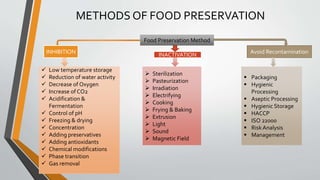
METHODS OF FOOD PRESERVATION
Food Preservation Method
INHIBITION
INACTIVATION
Avoid Recontaminati0n
 Low temperature storage
 Reduction of water activity
 Decrease of Oxygen
 Increase of CO2
 Acidification &
Fermentation
 Control of pH
 Freezing & drying
 Concentration
 Adding preservatives
 Adding antioxidants
 Chemical modifications
 Phase transition
 Gas removal
 Sterilization
 Pasteurization
 Irradiation
 Electrifying
 Cooking
 Frying & Baking
 Extrusion
 Light
 Sound
 Magnetic Field
 Packaging
 Hygienic
Processing
 Aseptic Processing
 Hygienic Storage
 HACCP
 ISO 22000
 RiskAnalysis
 Management
CAUSES OF FOOD SPOILGE
MICROBIOLOGICAL
 Microorganism
growth
 Off flavor
 Toxin production
ENZYMATIC
 Browning
 Color Change
 Off Flavor
CHEMICAL
 Color loss
 Flavor loss
 Non-enzymatic
browning
 Nutrient loss
 Redox Reactions
 Rancidity
PHYSICAL
 Collapse
 Controlled
release
 Crystallization
 Flavor
encapsulation
 Phase Changes
 Recrystallization
 Shrinkage
 Transport of
components
MECHANICAL
 Bruising due to
vibration
 Cracking
 Damage due to
pressure
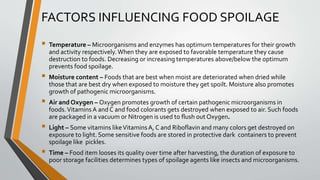
FACTORS INFLUENCING FOOD SPOILAGE
 Temperature – Microorganisms and enzymes has optimum temperatures for their growth
and activity respectively.When they are exposed to favorable temperature they cause
destruction to foods. Decreasing or increasing temperatures above/below the optimum
prevents food spoilage.
 Moisture content – Foods that are best when moist are deteriorated when dried while
those that are best dry when exposed to moisture they get spoilt. Moisture also promotes
growth of pathogenic microorganisms.
 Air and Oxygen – Oxygen promotes growth of certain pathogenic microorganisms in
foods.Vitamins A and C and food colorants gets destroyed when exposed to air. Such foods
are packaged in a vacuum or Nitrogen is used to flush out Oxygen.
 Light – Some vitamins likeVitaminsA, C and Riboflavin and many colors get destroyed on
exposure to light. Some sensitive foods are stored in protective dark containers to prevent
spoilage like pickles.
 Time – Food item looses its quality over time after harvesting, the duration of exposure to
poor storage facilities determines types of spoilage agents like insects and microorganisms.
PRESERVATION BY MOISTURE REDUCTION
• State of water in a food; Bound water- refers to water that unfreezeable,
immobile and non solvent and FreeWater. Bound water affects drying as more
energy is required to remove it.
• The main factors affecting the effective drying are moisture content and water
activity.
• Moisture is defined as the total water content in a food that may exist as bound
or free while Water Activity is the amount of free water present in a food that is
available for enzymatic activity or supports the growth of microorganisms
which leads to food spoilage.
• Food containing high water concentration are susceptible to deterioration by
microbial contamination and enzymatic activity.
• The water content of foods can be controlled by dehydration or by adding
solutes to the foods.
CONTROLINGWATER ACTIVITY
• Drying – Its based on the principle that microbes and enzymes requires optimal water for
their activity, therefore water is lowered below the optimum levels where their activity is
arrested.
• Dried or low moisture foods contain moisture <25% and Aw at 0.00-0.60.
• Intermediate moisture foods has moisture of 15%-50% and Aw 0.60-0.85
• Moisture can be removed through: Sun Drying or by use of Mechanical dryers such as
Spray drying used making milk powder.
• Concentration of moist foods by partial removal of water resulting to syrup-like products
like syrups, evaporated milk, tomato ketchup & condensed soups.
• Intermediate Moisture Foods are commercially prepared foods that contain moisture of
15-50% and Aw 0.60-0.85 with non refrigerated shelf life stability. IMFs has low moisture
and can be consumed without preparation examples honey, jams, cake, pastry.
• Low water activity is achieved by removal of water by adsorption/desorption or addition
of humectants such as glycerol, sorbitol in addition to sugar and salt.
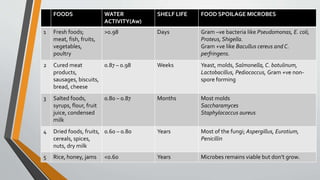
FOODS WATER
ACTIVITY(Aw)
SHELF LIFE FOOD SPOILAGE MICROBES
1 Fresh foods;
meat, fish, fruits,
vegetables,
poultry
>0.98 Days Gram –ve bacteria like Pseudomonas, E. coli,
Proteus, Shigella.
Gram +ve like Bacullus cereus and C.
perfringens.
2 Cured meat
products,
sausages, biscuits,
bread, cheese
0.87 – 0.98 Weeks Yeast, molds, Salmonella, C. botulinum,
Lactobacillus, Pediococcus, Gram +ve non-
spore forming
3 Salted foods,
syrups, flour, fruit
juice, condensed
milk
0.80 – 0.87 Months Most molds
Saccharamyces
Staphylococcus aureus
4 Dried foods, fruits,
cereals, spices,
nuts, dry milk
0.60 – 0.80 Years Most of the fungi; Aspergillus, Eurotium,
Penicillin
5 Rice, honey, jams <0.60 Years Microbes remains viable but don’t grow.
FOOD PRESERVATION BY IRRADIATION
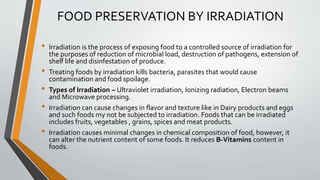
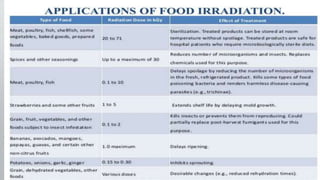
• Irradiation is the process of exposing food to a controlled source of irradiation for
the purposes of reduction of microbial load, destruction of pathogens, extension of
shelf life and disinfestation of produce.
• Treating foods by irradiation kills bacteria, parasites that would cause
contamination and food spoilage.
• Types of Irradiation – Ultraviolet irradiation, Ionizing radiation, Electron beams
and Microwave processing.
• Irradiation can cause changes in flavor and texture like in Dairy products and eggs
and such foods my not be subjected to irradiation. Foods that can be irradiated
includes fruits, vegetables , grains, spices and meat products.
• Irradiation causes minimal changes in chemical composition of food, however, it
can alter the nutrient content of some foods. It reduces B-Vitamins content in
foods.
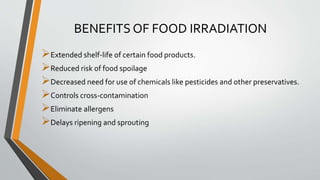
BENEFITS OF FOOD IRRADIATION
Extended shelf-life of certain food products.
Reduced risk of food spoilage
Decreased need for use of chemicals like pesticides and other preservatives.
Controls cross-contamination
Eliminate allergens
Delays ripening and sprouting
LIMITATIONS OF FOOD IRRADIATION
Irradiation causes undesirable food characteristics in some foods.
Irradiation destroys spore-forming microorganisms but are ineffective in
viruses.
Irradiated foods may form chemical transformations forming radiolytic
products.
Increased consumer cost.
Irradiation reduces the nutritional content of foods.
Irradiations does not eliminate any chemical in food.
Certain microorganism may undergo mutation due to exposure to radiations.
FOOD PRESERVATION BY FERMENTATION
• Fermented foods are those that are subjected to action of microorganism or
enzymes to get desirable biochemical changes and causes significant
modification in foods .
• Fermentation oftenly preserves a raw material, improving safety with regard to
food borne pathogens and increases shelf life.
• Lactic Acid Bacteria – Causes antimicrobial effects, chelates ferrous ions,
degrades nitrite and cholesterol and inhibits foodborne pathogens.
• LAB Antimicrobial Strains – L.plantarum, L.pentosus, L.paracasei
• All these strains are highly thermophilic (65-121c), acidity(pH-2-6)
MODIFIED ATMOSPHERE PACKAGING
Modifying the composition of the internal atmosphere of a package in
order to improve the shelf- life.
Done by Controlling the humidity levels and Atmospheric gas composition.
It reduces lipid oxidation reaction, maintains respiration, inhibits growth of
aerobic bacteria.
Modification generally lowers the Oxygen in the headspace of the package.
Oxygen can be replaced with Nitrogen, or comparatively inert gas or Carbon
iv oxide.
Types of MA –Active Modification; involves displacing the air with
controlled desired mixture of gases . Passive modification occurs as a
consequence of foods respiration and metabolism of microorganism
present in it.
CONTROLLED ATMOSPHERE PAKGING
• Concentration of Oxygen, Carbon dioxide, nitrogen as well as temperature
and humidity of a storage room is regulated
• Oxygen is reduced to 1.5-2% by replacing it with nitrogen and a little bit of
Carbon dioxide which is produced by fruits- apples and pears.
• Control insects and pests ->30%CO2, temperature <15c
• Disinfestation of dry grains – (<13% m.c) with CO2 at 25% eg legumes,
grains, oilseeds.
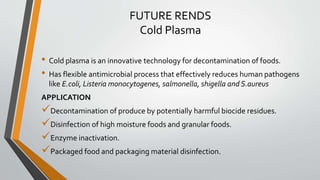
FUTURE RENDS
Cold Plasma
• Cold plasma is an innovative technology for decontamination of foods.
• Has flexible antimicrobial process that effectively reduces human pathogens
like E.coli, Listeria monocytogenes, salmonella, shigella and S.aureus
APPLICATION
Decontamination of produce by potentially harmful biocide residues.
Disinfection of high moisture foods and granular foods.
Enzyme inactivation.
Packaged food and packaging material disinfection.
FOOD PACKAGING
• Food packaging is defined as complex and dynamic system aiming at safely
prepare foods for transportation, distribution, storage, retailing, handling
and end-use and safely deliver these foods to the consumer in a sound
condition at a minimum cost.
• Packaging material varies depending on the nature of the product.
• Packaging also plays a role in advertisement and marketing of given food
product.
• Various materials used in packaging includes; rigid metal containers like
cans, drums. Flexible metals like alluminium foils. Glass jars and bottles.
Flexible plastics-pouches and wrappers. Rigid papers and woods like boxes.
• Multipliers laminates that combines paper, plastic and foil.
Requirements for a Packaging Material
• Non toxic
• Sanitary protection
• Moisture and fat protection
• Gas and odour protection
• Light protection
• Resistance to impact, tamper proof and transparency.
• Ease of opening, pouring features and reseal features
• Appearance and printability.
• Low cost.
• Size, shape and weight limitations
• Ease of disposal.

Food Processing and Preservation Presentation.pptx

  • 1.
    PRINCIPLES OF FOOD PROCESSINGANDPRESERVATION MODULE 7 BY: ISAAC DENGE
  • 2.
    INTRODUCTION Food Preservation isthe science that deal in the process of prevention of decay or spoilage of food thus allowing it to be stored in a safe condition for future use. The state in which any food may be retained over a period of time without being contaminated by pathogenic organisms or chemicals without loosing optimum qualities of color, texture, flavor and nutritive value. Preservation ensures that quality, edibility, nutritive value and safety of any food product remains intact.
  • 3.
    WHY PRESERVE FOOD? OBJECTIVES Makingfood safe for consumption Removal of unwanted matter from food Increasing digestibility of food Enhance flavor, color and taste Improve texture and consistency Minimize nutrient loss Extending shelf life IMPORTANCE Increases shelf life of food. Retain the quality of food (color, texture, flavor, nutritional value). Increase food supply Adds variety to foods Decreases food wastage Make food available off season.
  • 4.
    PRINCIPLES OF PRESERVATION Inhibitor delay microbial decomposition- Keeping out microorganisms, removal of microorganisms (filtration), hindering growth and activity of the microorganisms (drying, low temperature, anaerobic conditions),Killing of microorganisms by heat radiation. Preservation or delay of by self decomposition – Destruction or inactivation of food enzymes e.g. Blanching, Inhibit or delay of chemical reactions(non enzymatic browning) like preservation of oxidation by means of an antioxidants. Prevention of damage caused by insects and rodents. Prevention against losses due to mechanical causes.
  • 5.
    METHODS OF FOODPRESERVATION Food Preservation Method INHIBITION INACTIVATION Avoid Recontaminati0n  Low temperature storage  Reduction of water activity  Decrease of Oxygen  Increase of CO2  Acidification & Fermentation  Control of pH  Freezing & drying  Concentration  Adding preservatives  Adding antioxidants  Chemical modifications  Phase transition  Gas removal  Sterilization  Pasteurization  Irradiation  Electrifying  Cooking  Frying & Baking  Extrusion  Light  Sound  Magnetic Field  Packaging  Hygienic Processing  Aseptic Processing  Hygienic Storage  HACCP  ISO 22000  RiskAnalysis  Management
  • 6.
    CAUSES OF FOODSPOILGE MICROBIOLOGICAL  Microorganism growth  Off flavor  Toxin production ENZYMATIC  Browning  Color Change  Off Flavor CHEMICAL  Color loss  Flavor loss  Non-enzymatic browning  Nutrient loss  Redox Reactions  Rancidity PHYSICAL  Collapse  Controlled release  Crystallization  Flavor encapsulation  Phase Changes  Recrystallization  Shrinkage  Transport of components MECHANICAL  Bruising due to vibration  Cracking  Damage due to pressure
  • 7.
    FACTORS INFLUENCING FOODSPOILAGE  Temperature – Microorganisms and enzymes has optimum temperatures for their growth and activity respectively.When they are exposed to favorable temperature they cause destruction to foods. Decreasing or increasing temperatures above/below the optimum prevents food spoilage.  Moisture content – Foods that are best when moist are deteriorated when dried while those that are best dry when exposed to moisture they get spoilt. Moisture also promotes growth of pathogenic microorganisms.  Air and Oxygen – Oxygen promotes growth of certain pathogenic microorganisms in foods.Vitamins A and C and food colorants gets destroyed when exposed to air. Such foods are packaged in a vacuum or Nitrogen is used to flush out Oxygen.  Light – Some vitamins likeVitaminsA, C and Riboflavin and many colors get destroyed on exposure to light. Some sensitive foods are stored in protective dark containers to prevent spoilage like pickles.  Time – Food item looses its quality over time after harvesting, the duration of exposure to poor storage facilities determines types of spoilage agents like insects and microorganisms.
  • 8.
    PRESERVATION BY MOISTUREREDUCTION • State of water in a food; Bound water- refers to water that unfreezeable, immobile and non solvent and FreeWater. Bound water affects drying as more energy is required to remove it. • The main factors affecting the effective drying are moisture content and water activity. • Moisture is defined as the total water content in a food that may exist as bound or free while Water Activity is the amount of free water present in a food that is available for enzymatic activity or supports the growth of microorganisms which leads to food spoilage. • Food containing high water concentration are susceptible to deterioration by microbial contamination and enzymatic activity. • The water content of foods can be controlled by dehydration or by adding solutes to the foods.
  • 9.
    CONTROLINGWATER ACTIVITY • Drying– Its based on the principle that microbes and enzymes requires optimal water for their activity, therefore water is lowered below the optimum levels where their activity is arrested. • Dried or low moisture foods contain moisture <25% and Aw at 0.00-0.60. • Intermediate moisture foods has moisture of 15%-50% and Aw 0.60-0.85 • Moisture can be removed through: Sun Drying or by use of Mechanical dryers such as Spray drying used making milk powder. • Concentration of moist foods by partial removal of water resulting to syrup-like products like syrups, evaporated milk, tomato ketchup & condensed soups. • Intermediate Moisture Foods are commercially prepared foods that contain moisture of 15-50% and Aw 0.60-0.85 with non refrigerated shelf life stability. IMFs has low moisture and can be consumed without preparation examples honey, jams, cake, pastry. • Low water activity is achieved by removal of water by adsorption/desorption or addition of humectants such as glycerol, sorbitol in addition to sugar and salt.
  • 10.
    FOODS WATER ACTIVITY(Aw) SHELF LIFEFOOD SPOILAGE MICROBES 1 Fresh foods; meat, fish, fruits, vegetables, poultry >0.98 Days Gram –ve bacteria like Pseudomonas, E. coli, Proteus, Shigella. Gram +ve like Bacullus cereus and C. perfringens. 2 Cured meat products, sausages, biscuits, bread, cheese 0.87 – 0.98 Weeks Yeast, molds, Salmonella, C. botulinum, Lactobacillus, Pediococcus, Gram +ve non- spore forming 3 Salted foods, syrups, flour, fruit juice, condensed milk 0.80 – 0.87 Months Most molds Saccharamyces Staphylococcus aureus 4 Dried foods, fruits, cereals, spices, nuts, dry milk 0.60 – 0.80 Years Most of the fungi; Aspergillus, Eurotium, Penicillin 5 Rice, honey, jams <0.60 Years Microbes remains viable but don’t grow.
  • 11.
    FOOD PRESERVATION BYIRRADIATION • Irradiation is the process of exposing food to a controlled source of irradiation for the purposes of reduction of microbial load, destruction of pathogens, extension of shelf life and disinfestation of produce. • Treating foods by irradiation kills bacteria, parasites that would cause contamination and food spoilage. • Types of Irradiation – Ultraviolet irradiation, Ionizing radiation, Electron beams and Microwave processing. • Irradiation can cause changes in flavor and texture like in Dairy products and eggs and such foods my not be subjected to irradiation. Foods that can be irradiated includes fruits, vegetables , grains, spices and meat products. • Irradiation causes minimal changes in chemical composition of food, however, it can alter the nutrient content of some foods. It reduces B-Vitamins content in foods.
  • 13.
    BENEFITS OF FOODIRRADIATION Extended shelf-life of certain food products. Reduced risk of food spoilage Decreased need for use of chemicals like pesticides and other preservatives. Controls cross-contamination Eliminate allergens Delays ripening and sprouting
  • 14.
    LIMITATIONS OF FOODIRRADIATION Irradiation causes undesirable food characteristics in some foods. Irradiation destroys spore-forming microorganisms but are ineffective in viruses. Irradiated foods may form chemical transformations forming radiolytic products. Increased consumer cost. Irradiation reduces the nutritional content of foods. Irradiations does not eliminate any chemical in food. Certain microorganism may undergo mutation due to exposure to radiations.
  • 15.
    FOOD PRESERVATION BYFERMENTATION • Fermented foods are those that are subjected to action of microorganism or enzymes to get desirable biochemical changes and causes significant modification in foods . • Fermentation oftenly preserves a raw material, improving safety with regard to food borne pathogens and increases shelf life. • Lactic Acid Bacteria – Causes antimicrobial effects, chelates ferrous ions, degrades nitrite and cholesterol and inhibits foodborne pathogens. • LAB Antimicrobial Strains – L.plantarum, L.pentosus, L.paracasei • All these strains are highly thermophilic (65-121c), acidity(pH-2-6)
  • 16.
    MODIFIED ATMOSPHERE PACKAGING Modifyingthe composition of the internal atmosphere of a package in order to improve the shelf- life. Done by Controlling the humidity levels and Atmospheric gas composition. It reduces lipid oxidation reaction, maintains respiration, inhibits growth of aerobic bacteria. Modification generally lowers the Oxygen in the headspace of the package. Oxygen can be replaced with Nitrogen, or comparatively inert gas or Carbon iv oxide. Types of MA –Active Modification; involves displacing the air with controlled desired mixture of gases . Passive modification occurs as a consequence of foods respiration and metabolism of microorganism present in it.
  • 17.
    CONTROLLED ATMOSPHERE PAKGING •Concentration of Oxygen, Carbon dioxide, nitrogen as well as temperature and humidity of a storage room is regulated • Oxygen is reduced to 1.5-2% by replacing it with nitrogen and a little bit of Carbon dioxide which is produced by fruits- apples and pears. • Control insects and pests ->30%CO2, temperature <15c • Disinfestation of dry grains – (<13% m.c) with CO2 at 25% eg legumes, grains, oilseeds.
  • 18.
    FUTURE RENDS Cold Plasma •Cold plasma is an innovative technology for decontamination of foods. • Has flexible antimicrobial process that effectively reduces human pathogens like E.coli, Listeria monocytogenes, salmonella, shigella and S.aureus APPLICATION Decontamination of produce by potentially harmful biocide residues. Disinfection of high moisture foods and granular foods. Enzyme inactivation. Packaged food and packaging material disinfection.
  • 19.
    FOOD PACKAGING • Foodpackaging is defined as complex and dynamic system aiming at safely prepare foods for transportation, distribution, storage, retailing, handling and end-use and safely deliver these foods to the consumer in a sound condition at a minimum cost. • Packaging material varies depending on the nature of the product. • Packaging also plays a role in advertisement and marketing of given food product. • Various materials used in packaging includes; rigid metal containers like cans, drums. Flexible metals like alluminium foils. Glass jars and bottles. Flexible plastics-pouches and wrappers. Rigid papers and woods like boxes. • Multipliers laminates that combines paper, plastic and foil.
  • 20.
    Requirements for aPackaging Material • Non toxic • Sanitary protection • Moisture and fat protection • Gas and odour protection • Light protection • Resistance to impact, tamper proof and transparency. • Ease of opening, pouring features and reseal features • Appearance and printability. • Low cost. • Size, shape and weight limitations • Ease of disposal.