FOOD AND ENERGY
               FACT OR FICTION?
a.   Athletes need more proteins in their diets.
b.   The only salt in food is the one you add to
     it.
c.   As a part of a healthy diet, everyone
     should take vitamin supplements.
d.   You can go without water for longer than
     you can go without food.
WHY IS FOOD NEEDED?
• Remember homeostasis?
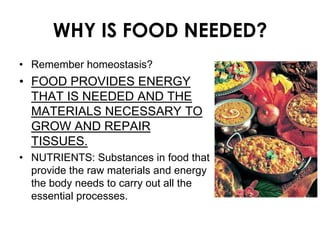
• FOOD PROVIDES ENERGY
  THAT IS NEEDED AND THE
  MATERIALS NECESSARY TO
  GROW AND REPAIR
  TISSUES.
• NUTRIENTS: Substances in food that
  provide the raw materials and energy
  the body needs to carry out all the
  essential processes.
NUTRIENTS
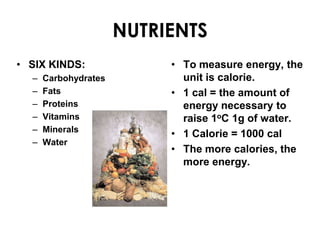
• SIX KINDS:               • To measure energy, the
  –   Carbohydrates          unit is calorie.
  –   Fats                 • 1 cal = the amount of
  –   Proteins               energy necessary to
  –   Vitamins               raise 1oC 1g of water.
  –   Minerals
                           • 1 Calorie = 1000 cal
  –   Water
                           • The more calories, the
                             more energy.
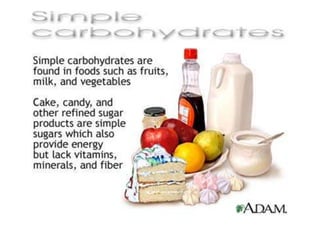
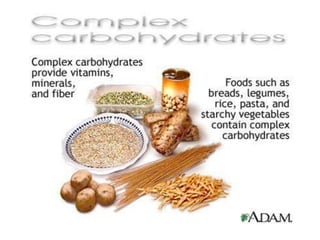
CARBOHYDRATES (CHO’s)
• Composed of Carbon, Hydrogen and
  Oxygen
• Major source of energy:
  – 1g CHO’s = 4000 calories
• Recommended ingestion: 50-60% of
  total Calories needed as CHO’s
• Classified in: Simple and Complex.
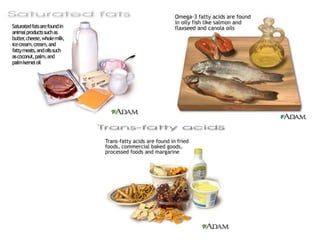
FATS
• High energy nutrients made of
  Carbon, Hydrogen and Oxygen; but has
  more than twice the energy of
  carbohydrates.
• Classified as:
   – Unsaturated: Liquid at room temperature.
   – Saturated: Solid at room temperature.
• No more than 30% of the Calories in your
  diet should come from fats.
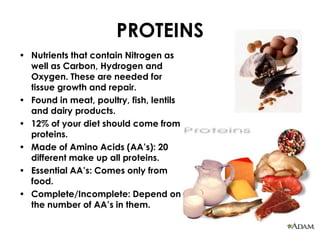
PROTEINS
• Nutrients that contain Nitrogen as
  well as Carbon, Hydrogen and
  Oxygen. These are needed for
  tissue growth and repair.
• Found in meat, poultry, fish, lentils
  and dairy products.
• 12% of your diet should come from
  proteins.
• Made of Amino Acids (AA’s): 20
  different make up all proteins.
• Essential AA’s: Comes only from
  food.
• Complete/Incomplete: Depend on
  the number of AA’s in them.
NEEDED IN SMALL AMOUNTS…


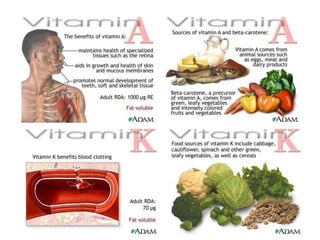
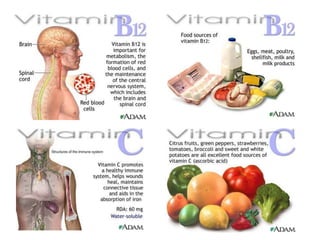
         VITAMINS                    MINERALS
• Act as helper molecules   • Nutrients NOT made by
  in chemical reactions       living things.
  inside the body.          • Found in plants or animals
• Water-soluble: You need     that eat plants.
  to ingest them daily      • Examples:
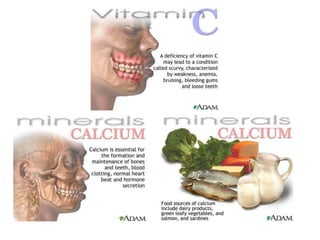
• Fat soluble: Can be          –   Calcium     Chlorine
  stored in fatty tissue.      –   Fluorine    Iodine
                               –   Potassium   Iron
                               –   Magnesium   Phosphorus
                               –   Sodium
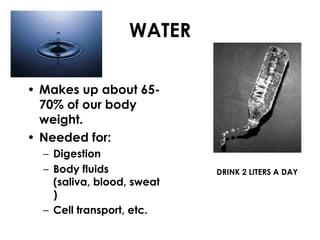
WATER

• Makes up about 65-
  70% of our body
  weight.
• Needed for:
  – Digestion
  – Body fluids             DRINK 2 LITERS A DAY
    (saliva, blood, sweat
    )
  – Cell transport, etc.
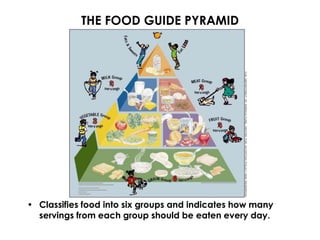
THE FOOD GUIDE PYRAMID


• Classifies food into six groups and indicates how many
  servings from each group should be eaten every day.
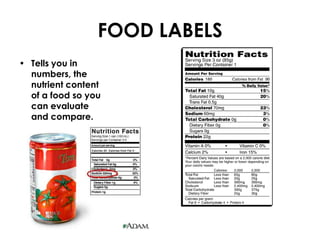
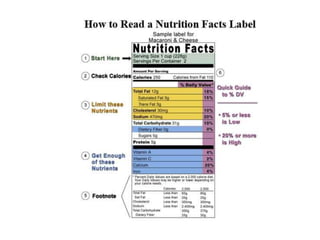
FOOD LABELS
• Tells you in
  numbers, the
  nutrient content
  of a food so you
  can evaluate
  and compare.
Food and energy

Food and energy

  • 1.
    FOOD AND ENERGY FACT OR FICTION? a. Athletes need more proteins in their diets. b. The only salt in food is the one you add to it. c. As a part of a healthy diet, everyone should take vitamin supplements. d. You can go without water for longer than you can go without food.
  • 2.
    WHY IS FOODNEEDED? • Remember homeostasis? • FOOD PROVIDES ENERGY THAT IS NEEDED AND THE MATERIALS NECESSARY TO GROW AND REPAIR TISSUES. • NUTRIENTS: Substances in food that provide the raw materials and energy the body needs to carry out all the essential processes.
  • 3.
    NUTRIENTS • SIX KINDS: • To measure energy, the – Carbohydrates unit is calorie. – Fats • 1 cal = the amount of – Proteins energy necessary to – Vitamins raise 1oC 1g of water. – Minerals • 1 Calorie = 1000 cal – Water • The more calories, the more energy.
  • 4.
    CARBOHYDRATES (CHO’s) • Composedof Carbon, Hydrogen and Oxygen • Major source of energy: – 1g CHO’s = 4000 calories • Recommended ingestion: 50-60% of total Calories needed as CHO’s • Classified in: Simple and Complex.
  • 7.
    FATS • High energynutrients made of Carbon, Hydrogen and Oxygen; but has more than twice the energy of carbohydrates. • Classified as: – Unsaturated: Liquid at room temperature. – Saturated: Solid at room temperature. • No more than 30% of the Calories in your diet should come from fats.
  • 9.
    PROTEINS • Nutrients thatcontain Nitrogen as well as Carbon, Hydrogen and Oxygen. These are needed for tissue growth and repair. • Found in meat, poultry, fish, lentils and dairy products. • 12% of your diet should come from proteins. • Made of Amino Acids (AA’s): 20 different make up all proteins. • Essential AA’s: Comes only from food. • Complete/Incomplete: Depend on the number of AA’s in them.
  • 10.
    NEEDED IN SMALLAMOUNTS… VITAMINS MINERALS • Act as helper molecules • Nutrients NOT made by in chemical reactions living things. inside the body. • Found in plants or animals • Water-soluble: You need that eat plants. to ingest them daily • Examples: • Fat soluble: Can be – Calcium Chlorine stored in fatty tissue. – Fluorine Iodine – Potassium Iron – Magnesium Phosphorus – Sodium
  • 14.
    WATER • Makes upabout 65- 70% of our body weight. • Needed for: – Digestion – Body fluids DRINK 2 LITERS A DAY (saliva, blood, sweat ) – Cell transport, etc.
  • 15.
    THE FOOD GUIDEPYRAMID • Classifies food into six groups and indicates how many servings from each group should be eaten every day.
  • 16.
    FOOD LABELS • Tellsyou in numbers, the nutrient content of a food so you can evaluate and compare.