Classes of food
 Importance of food:
a) Provides energy to carry out living processes and
functions
b) Provides energy to do work
c) Growth of new tissues and repair damaged tissues
d) Maintain good health and fight disease
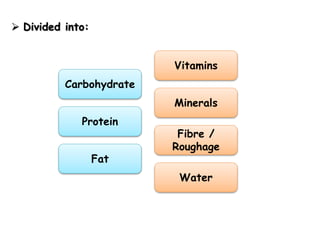
 Divided into:
Carbohydrate
Protein
Fat
Vitamins
Minerals
Fibre /
Roughage
Water
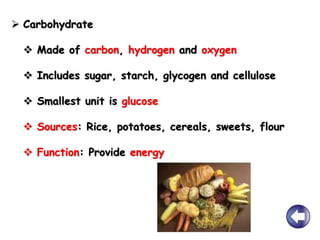
 Carbohydrate
 Made of carbon, hydrogen and oxygen
 Includes sugar, starch, glycogen and cellulose
 Smallest unit is glucose
 Sources: Rice, potatoes, cereals, sweets, flour
 Function: Provide energy
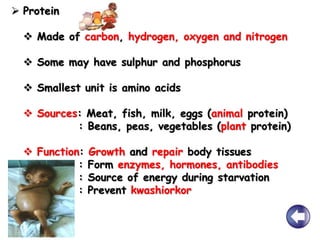
 Protein
 Made of carbon, hydrogen, oxygen and nitrogen
 Some may have sulphur and phosphorus
 Smallest unit is amino acids
 Sources: Meat, fish, milk, eggs (animal protein)
: Beans, peas, vegetables (plant protein)
 Function: Growth and repair body tissues
: Form enzymes, hormones, antibodies
: Source of energy during starvation
: Prevent kwashiorkor
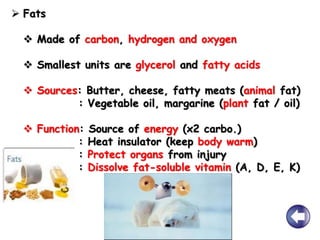
 Fats
 Made of carbon, hydrogen and oxygen
 Smallest units are glycerol and fatty acids
 Sources: Butter, cheese, fatty meats (animal fat)
: Vegetable oil, margarine (plant fat / oil)
 Function: Source of energy (x2 carbo.)
: Heat insulator (keep body warm)
: Protect organs from injury
: Dissolve fat-soluble vitamin (A, D, E, K)
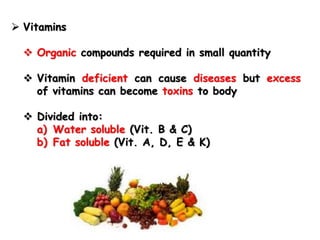
 Vitamins
 Organic compounds required in small quantity
 Vitamin deficient can cause diseases but excess
of vitamins can become toxins to body
 Divided into:
a) Water soluble (Vit. B & C)
b) Fat soluble (Vit. A, D, E & K)
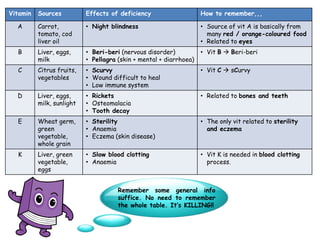
Vitamin Sources Effects of deficiency How to remember,,,
A Carrot,
tomato, cod
liver oil
• Night blindness • Source of vit A is basically from
many red / orange-coloured food
• Related to eyes
B Liver, eggs,
milk
• Beri-beri (nervous disorder)
• Pellagra (skin + mental + diarrhoea)
• Vit B  Beri-beri
C Citrus fruits,
vegetables
• Scurvy
• Wound difficult to heal
• Low immune system
• Vit C  sCurvy
D Liver, eggs,
milk, sunlight
• Rickets
• Osteomalacia
• Tooth decay
• Related to bones and teeth
E Wheat germ,
green
vegetable,
whole grain
• Sterility
• Anaemia
• Eczema (skin disease)
• The only vit related to sterility
and eczema
K Liver, green
vegetable,
eggs
• Slow blood clotting
• Anaemia
• Vit K is needed in blood clotting
process.
Remember some general info
suffice. No need to remember
the whole table. It’s KILLING!!
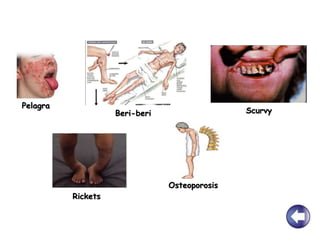
Beri-beri
Pelagra
Rickets
Scurvy
Osteoporosis
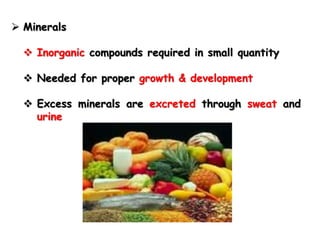
 Minerals
 Inorganic compounds required in small quantity
 Needed for proper growth & development
 Excess minerals are excreted through sweat and
urine
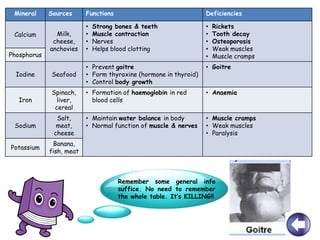
Mineral Sources Functions Deficiencies
Calcium Milk,
cheese,
anchovies
• Strong bones & teeth
• Muscle contraction
• Nerves
• Helps blood clotting
• Rickets
• Tooth decay
• Osteoporosis
• Weak muscles
• Muscle cramps
Phosphorus
Iodine Seafood
• Prevent goitre
• Form thyroxine (hormone in thyroid)
• Control body growth
• Goitre
Iron
Spinach,
liver,
cereal
• Formation of haemoglobin in red
blood cells
• Anaemia
Sodium
Salt,
meat,
cheese
• Maintain water balance in body
• Normal function of muscle & nerves
• Muscle cramps
• Weak muscles
• Paralysis
Potassium
Banana,
fish, meat
Remember some general info
suffice. No need to remember
the whole table. It’s KILLING!!
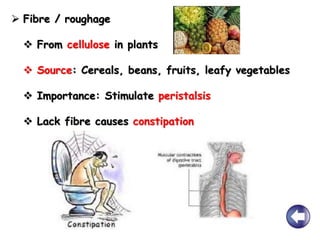
 Fibre / roughage
 From cellulose in plants
 Source: Cereals, beans, fruits, leafy vegetables
 Importance: Stimulate peristalsis
 Lack fibre causes constipation
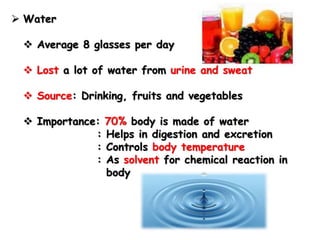
 Water
 Average 8 glasses per day
 Lost a lot of water from urine and sweat
 Source: Drinking, fruits and vegetables
 Importance: 70% body is made of water
: Helps in digestion and excretion
: Controls body temperature
: As solvent for chemical reaction in
body
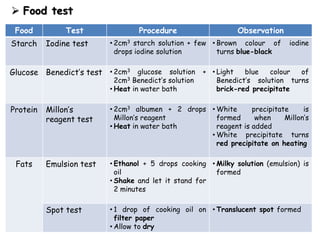
Food Test Procedure Observation
Starch Iodine test • 2cm3 starch solution + few
drops iodine solution
• Brown colour of iodine
turns blue-black
Glucose Benedict’s test • 2cm3 glucose solution +
2cm3 Benedict’s solution
• Heat in water bath
• Light blue colour of
Benedict’s solution turns
brick-red precipitate
Protein Millon’s
reagent test
• 2cm3 albumen + 2 drops
Millon’s reagent
• Heat in water bath
• White precipitate is
formed when Millon’s
reagent is added
• White precipitate turns
red precipitate on heating
Fats Emulsion test • Ethanol + 5 drops cooking
oil
• Shake and let it stand for
2 minutes
• Milky solution (emulsion) is
formed
Spot test • 1 drop of cooking oil on
filter paper
• Allow to dry
• Translucent spot formed
 Food test
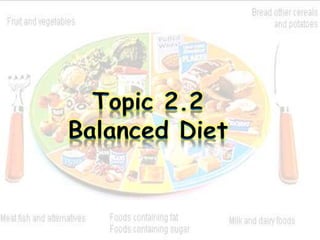
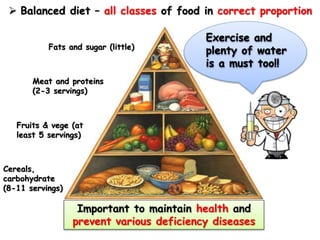
 Balanced diet – all classes of food in correct proportion
Cereals,
carbohydrate
(8-11 servings)
Fruits & vege (at
least 5 servings)
Meat and proteins
(2-3 servings)
Fats and sugar (little)
Exercise and
plenty of water
is a must too!!
Important to maintain health and
prevent various deficiency diseases
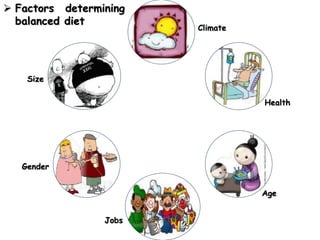
 Factors determining
balanced diet
Size
Gender
Jobs
Age
Health
Climate
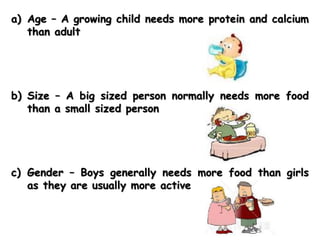
a) Age – A growing child needs more protein and calcium
than adult
b) Size – A big sized person normally needs more food
than a small sized person
c) Gender – Boys generally needs more food than girls
as they are usually more active
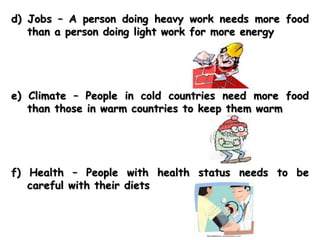
d) Jobs – A person doing heavy work needs more food
than a person doing light work for more energy
e) Climate – People in cold countries need more food
than those in warm countries to keep them warm
f) Health – People with health status needs to be
careful with their diets
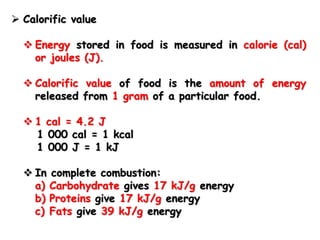
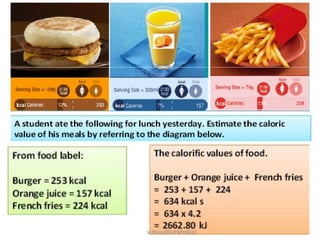
 Calorific value
 Energy stored in food is measured in calorie (cal)
or joules (J).
 Calorific value of food is the amount of energy
released from 1 gram of a particular food.
 1 cal = 4.2 J
1 000 cal = 1 kcal
1 000 J = 1 kJ
 In complete combustion:
a) Carbohydrate gives 17 kJ/g energy
b) Proteins give 17 kJ/g energy
c) Fats give 39 kJ/g energy
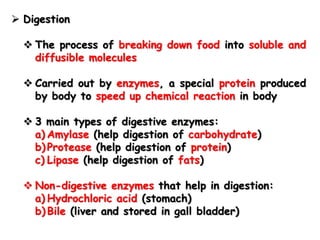
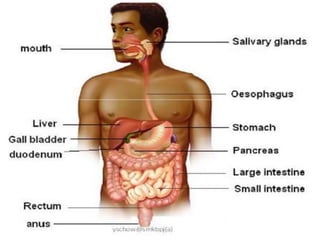
 Digestion
 The process of breaking down food into soluble and
diffusible molecules
 Carried out by enzymes, a special protein produced
by body to speed up chemical reaction in body
 3 main types of digestive enzymes:
a) Amylase (help digestion of carbohydrate)
b) Protease (help digestion of protein)
c) Lipase (help digestion of fats)
 Non-digestive enzymes that help in digestion:
a) Hydrochloric acid (stomach)
b) Bile (liver and stored in gall bladder)
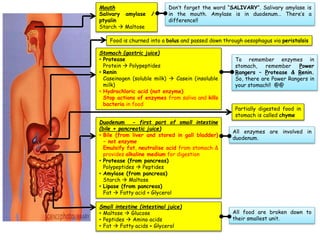
Mouth
Salivary amylase /
ptyalin
Starch  Maltose
Don’t forget the word “SALIVARY”. Salivary amylase is
in the mouth. Amylase is in duodenum… There’s a
difference!!
Stomach (gastric juice)
• Protease
Protein  Polypeptides
• Renin
Caseinogen (soluble milk)  Casein (insoluble
milk)
• Hydrochloric acid (not enzyme)
Stop actions of enzymes from saliva and kills
bacteria in food
To remember enzymes in
stomach, remember Power
Rangers – Protease & Renin.
So, there are Power Rangers in
your stomach!! @@
Duodenum - first part of small intestine
(bile + pancreatic juice)
• Bile (from liver and stored in gall bladder)
– not enzyme
Emulsify fat, neutralise acid from stomach &
provides alkaline medium for digestion
• Protease (from pancreas)
Polypeptides  Peptides
• Amylase (from pancreas)
Starch  Maltose
• Lipase (from pancreas)
Fat  Fatty acid + Glycerol
All enzymes are involved in
duodenum.
Small intestine (intestinal juice)
• Maltose  Glucose
• Peptides  Amino acids
• Fat  Fatty acids + Glycerol
All food are broken down to
their smallest unit.
Food is churned into a bolus and passed down through oesophagus via peristalsis
Partially digested food in
stomach is called chyme
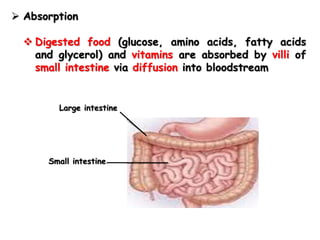
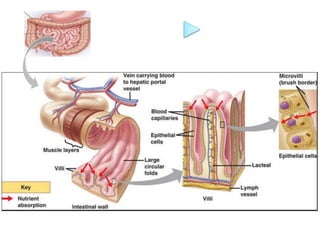
 Absorption
 Digested food (glucose, amino acids, fatty acids
and glycerol) and vitamins are absorbed by villi of
small intestine via diffusion into bloodstream
Large intestine
Small intestine
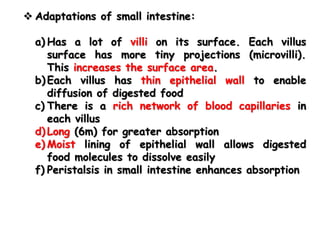
 Adaptations of small intestine:
a) Has a lot of villi on its surface. Each villus
surface has more tiny projections (microvilli).
This increases the surface area.
b) Each villus has thin epithelial wall to enable
diffusion of digested food
c) There is a rich network of blood capillaries in
each villus
d) Long (6m) for greater absorption
e) Moist lining of epithelial wall allows digested
food molecules to dissolve easily
f) Peristalsis in small intestine enhances absorption
 Reabsorption of water and defecation
 Undigested food, minerals and water enters large
intestine.
 Most water and minerals are reabsorbed in the
large intestine.
 As water is absorbed, the mixture becomes solid
waste known as faeces.
 Faeces is stored in rectum before being expelled
via anus. This process is known as defecation.
 Lack of fibre and water will cause constipation.
 What does healthy eating habits means to you?
 Some issues regarding healthy eating habits such as
vegetarians and health status.
 Effects of unhealthy eating habits.

Chap 2

  • 3.
    Classes of food Importance of food: a) Provides energy to carry out living processes and functions b) Provides energy to do work c) Growth of new tissues and repair damaged tissues d) Maintain good health and fight disease
  • 4.
  • 5.
     Carbohydrate  Madeof carbon, hydrogen and oxygen  Includes sugar, starch, glycogen and cellulose  Smallest unit is glucose  Sources: Rice, potatoes, cereals, sweets, flour  Function: Provide energy
  • 6.
     Protein  Madeof carbon, hydrogen, oxygen and nitrogen  Some may have sulphur and phosphorus  Smallest unit is amino acids  Sources: Meat, fish, milk, eggs (animal protein) : Beans, peas, vegetables (plant protein)  Function: Growth and repair body tissues : Form enzymes, hormones, antibodies : Source of energy during starvation : Prevent kwashiorkor
  • 7.
     Fats  Madeof carbon, hydrogen and oxygen  Smallest units are glycerol and fatty acids  Sources: Butter, cheese, fatty meats (animal fat) : Vegetable oil, margarine (plant fat / oil)  Function: Source of energy (x2 carbo.) : Heat insulator (keep body warm) : Protect organs from injury : Dissolve fat-soluble vitamin (A, D, E, K)
  • 8.
     Vitamins  Organiccompounds required in small quantity  Vitamin deficient can cause diseases but excess of vitamins can become toxins to body  Divided into: a) Water soluble (Vit. B & C) b) Fat soluble (Vit. A, D, E & K)
  • 9.
    Vitamin Sources Effectsof deficiency How to remember,,, A Carrot, tomato, cod liver oil • Night blindness • Source of vit A is basically from many red / orange-coloured food • Related to eyes B Liver, eggs, milk • Beri-beri (nervous disorder) • Pellagra (skin + mental + diarrhoea) • Vit B  Beri-beri C Citrus fruits, vegetables • Scurvy • Wound difficult to heal • Low immune system • Vit C  sCurvy D Liver, eggs, milk, sunlight • Rickets • Osteomalacia • Tooth decay • Related to bones and teeth E Wheat germ, green vegetable, whole grain • Sterility • Anaemia • Eczema (skin disease) • The only vit related to sterility and eczema K Liver, green vegetable, eggs • Slow blood clotting • Anaemia • Vit K is needed in blood clotting process. Remember some general info suffice. No need to remember the whole table. It’s KILLING!!
  • 10.
  • 11.
     Minerals  Inorganiccompounds required in small quantity  Needed for proper growth & development  Excess minerals are excreted through sweat and urine
  • 12.
    Mineral Sources FunctionsDeficiencies Calcium Milk, cheese, anchovies • Strong bones & teeth • Muscle contraction • Nerves • Helps blood clotting • Rickets • Tooth decay • Osteoporosis • Weak muscles • Muscle cramps Phosphorus Iodine Seafood • Prevent goitre • Form thyroxine (hormone in thyroid) • Control body growth • Goitre Iron Spinach, liver, cereal • Formation of haemoglobin in red blood cells • Anaemia Sodium Salt, meat, cheese • Maintain water balance in body • Normal function of muscle & nerves • Muscle cramps • Weak muscles • Paralysis Potassium Banana, fish, meat Remember some general info suffice. No need to remember the whole table. It’s KILLING!!
  • 13.
     Fibre /roughage  From cellulose in plants  Source: Cereals, beans, fruits, leafy vegetables  Importance: Stimulate peristalsis  Lack fibre causes constipation
  • 14.
     Water  Average8 glasses per day  Lost a lot of water from urine and sweat  Source: Drinking, fruits and vegetables  Importance: 70% body is made of water : Helps in digestion and excretion : Controls body temperature : As solvent for chemical reaction in body
  • 15.
    Food Test ProcedureObservation Starch Iodine test • 2cm3 starch solution + few drops iodine solution • Brown colour of iodine turns blue-black Glucose Benedict’s test • 2cm3 glucose solution + 2cm3 Benedict’s solution • Heat in water bath • Light blue colour of Benedict’s solution turns brick-red precipitate Protein Millon’s reagent test • 2cm3 albumen + 2 drops Millon’s reagent • Heat in water bath • White precipitate is formed when Millon’s reagent is added • White precipitate turns red precipitate on heating Fats Emulsion test • Ethanol + 5 drops cooking oil • Shake and let it stand for 2 minutes • Milky solution (emulsion) is formed Spot test • 1 drop of cooking oil on filter paper • Allow to dry • Translucent spot formed  Food test
  • 17.
     Balanced diet– all classes of food in correct proportion Cereals, carbohydrate (8-11 servings) Fruits & vege (at least 5 servings) Meat and proteins (2-3 servings) Fats and sugar (little) Exercise and plenty of water is a must too!! Important to maintain health and prevent various deficiency diseases
  • 18.
     Factors determining balanceddiet Size Gender Jobs Age Health Climate
  • 19.
    a) Age –A growing child needs more protein and calcium than adult b) Size – A big sized person normally needs more food than a small sized person c) Gender – Boys generally needs more food than girls as they are usually more active
  • 20.
    d) Jobs –A person doing heavy work needs more food than a person doing light work for more energy e) Climate – People in cold countries need more food than those in warm countries to keep them warm f) Health – People with health status needs to be careful with their diets
  • 21.
     Calorific value Energy stored in food is measured in calorie (cal) or joules (J).  Calorific value of food is the amount of energy released from 1 gram of a particular food.  1 cal = 4.2 J 1 000 cal = 1 kcal 1 000 J = 1 kJ  In complete combustion: a) Carbohydrate gives 17 kJ/g energy b) Proteins give 17 kJ/g energy c) Fats give 39 kJ/g energy
  • 24.
     Digestion  Theprocess of breaking down food into soluble and diffusible molecules  Carried out by enzymes, a special protein produced by body to speed up chemical reaction in body  3 main types of digestive enzymes: a) Amylase (help digestion of carbohydrate) b) Protease (help digestion of protein) c) Lipase (help digestion of fats)  Non-digestive enzymes that help in digestion: a) Hydrochloric acid (stomach) b) Bile (liver and stored in gall bladder)
  • 26.
    Mouth Salivary amylase / ptyalin Starch Maltose Don’t forget the word “SALIVARY”. Salivary amylase is in the mouth. Amylase is in duodenum… There’s a difference!! Stomach (gastric juice) • Protease Protein  Polypeptides • Renin Caseinogen (soluble milk)  Casein (insoluble milk) • Hydrochloric acid (not enzyme) Stop actions of enzymes from saliva and kills bacteria in food To remember enzymes in stomach, remember Power Rangers – Protease & Renin. So, there are Power Rangers in your stomach!! @@ Duodenum - first part of small intestine (bile + pancreatic juice) • Bile (from liver and stored in gall bladder) – not enzyme Emulsify fat, neutralise acid from stomach & provides alkaline medium for digestion • Protease (from pancreas) Polypeptides  Peptides • Amylase (from pancreas) Starch  Maltose • Lipase (from pancreas) Fat  Fatty acid + Glycerol All enzymes are involved in duodenum. Small intestine (intestinal juice) • Maltose  Glucose • Peptides  Amino acids • Fat  Fatty acids + Glycerol All food are broken down to their smallest unit. Food is churned into a bolus and passed down through oesophagus via peristalsis Partially digested food in stomach is called chyme
  • 28.
     Absorption  Digestedfood (glucose, amino acids, fatty acids and glycerol) and vitamins are absorbed by villi of small intestine via diffusion into bloodstream Large intestine Small intestine
  • 29.
     Adaptations ofsmall intestine: a) Has a lot of villi on its surface. Each villus surface has more tiny projections (microvilli). This increases the surface area. b) Each villus has thin epithelial wall to enable diffusion of digested food c) There is a rich network of blood capillaries in each villus d) Long (6m) for greater absorption e) Moist lining of epithelial wall allows digested food molecules to dissolve easily f) Peristalsis in small intestine enhances absorption
  • 32.
     Reabsorption ofwater and defecation  Undigested food, minerals and water enters large intestine.  Most water and minerals are reabsorbed in the large intestine.  As water is absorbed, the mixture becomes solid waste known as faeces.  Faeces is stored in rectum before being expelled via anus. This process is known as defecation.  Lack of fibre and water will cause constipation.
  • 34.
     What doeshealthy eating habits means to you?  Some issues regarding healthy eating habits such as vegetarians and health status.  Effects of unhealthy eating habits.