TRANSPORT SYSTEM IN
PLANTS
BY H.W CHINANGWE
CONTENTS
The role of the


STOMATA



XYLEM



PHLOEM



ROOT HAIRS



…and the effect of TRANSPIRATION on the above mentioned



EXTERNAL RESOURCES



BIBLIOGRAPHY
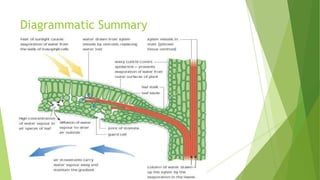
Diagrammatic Summary
The Transport System


Vascular plants transport systems consist of two main
systems which are the xylem and phloem.



Just like animals plants need food, sunlight, oxygen,
nitrogen, and other essential nutrients to survive.



These are obtain via the transport system in plants by
means of root pressure, cohesion-adhesion-tension
and transpiration.
XYLEM
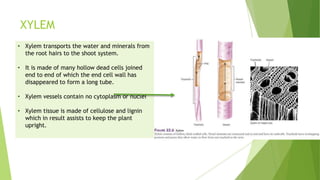
• Xylem transports the water and minerals from
the root hairs to the shoot system.
• It is made of many hollow dead cells joined
end to end of which the end cell wall has
disappeared to form a long tube.
• Xylem vessels contain no cytoplasm or nuclei
• Xylem tissue is made of cellulose and lignin
which in result assists to keep the plant
upright.
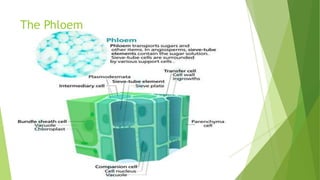
The Phloem


In vascular plants, phloem is the living tissue that carries
organic nutrients (known as photosynthate), in particular,
sucrose, a sugar, to all parts of the plant where needed. In
trees, the phloem is the innermost layer of the bark.



The phloem is concerned mainly with the transport of
soluble organic material made during photosynthesis. This
is called translocation.
The Phloem
Vascular bundles


Xylem and phloem tubes are normally found close
together, the arrangement of these tubes is called a
vascular bundle



In the root system vascular tissue is found at the centre



In the shoot system they are found near the outside edge
to help support the plant
Transport of water


Plants take in water from the soil through the root hairs
and it is carried in the xylem throughout the plant



Water is absorb by root hairs by means of osmosis.



The cytoplasm and cell sap inside it are quite
concentrated solutions and the water in the soil is
normally slightly diluted



Water therefore diffuses down its concentration gradient
through a partially permeable membrane
Transport of Water…


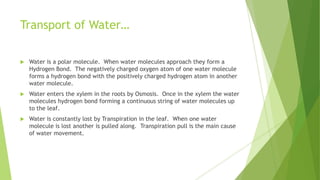
Water is a polar molecule. When water molecules approach they form a
Hydrogen Bond. The negatively charged oxygen atom of one water molecule
forms a hydrogen bond with the positively charged hydrogen atom in another
water molecule.



Water enters the xylem in the roots by Osmosis. Once in the xylem the water
molecules hydrogen bond forming a continuous string of water molecules up
to the leaf.



Water is constantly lost by Transpiration in the leaf. When one water
molecule is lost another is pulled along. Transpiration pull is the main cause
of water movement.
Transport of Water…
The Transpiration Stream
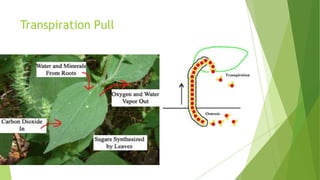
Transpiration Pull
What is Transpiration


The evaporation of water from the plant



Most of which takes place from the leaves through
the stomata



Guard cells around the stomata control the rate
of transpiration by opening and closing
What is Transpiration…
Transpiration






When water is lost through transpiration water from the xylem
vessel in the leaf will travel to the cells to replace it
Water is constantly being taken from the top of the xylem
vessel to supply the cells in the leaves
This reduces the pressure at the top of the xylem so water
flows up
This process is known as the transpiration stream, or
transpiration ‘pull’
Evaporation of water at the surfaces of the mesophyll cells
followed by loss of water vapour from plant leaves, through the
stomata
Effects That Affect Transpiration


Temperature



Humidity



Wind speed



Light intensity



Water supply
Transport of Food


TRANSLOCATION is the movement of sucrose and amino
acids in phloem, from regions of production to regions of
storage, or to regions of utilization in respiration or
growth.
Transport of Food…


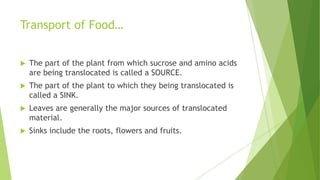
The part of the plant from which sucrose and amino acids
are being translocated is called a SOURCE.



The part of the plant to which they being translocated is
called a SINK.



Leaves are generally the major sources of translocated
material.



Sinks include the roots, flowers and fruits.
Transport of Food…










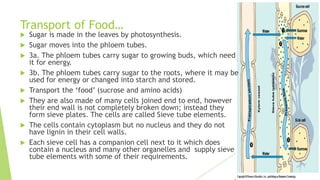
Sugar is made in the leaves by photosynthesis.
Sugar moves into the phloem tubes.
3a. The phloem tubes carry sugar to growing buds, which need
it for energy.
3b. The phloem tubes carry sugar to the roots, where it may be
used for energy or changed into starch and stored.
Transport the ‘food’ (sucrose and amino acids)
They are also made of many cells joined end to end, however
their end wall is not completely broken down; instead they
form sieve plates. The cells are called Sieve tube elements.
The cells contain cytoplasm but no nucleus and they do not
have lignin in their cell walls.
Each sieve cell has a companion cell next to it which does
contain a nucleus and many other organelles and supply sieve
tube elements with some of their requirements.
External Resources
External Resources…


ACTIVITY
BIBLIOGRAPHY


Slide share

http://www.slideshare.net/PreetiGhosh1/transport-in-plants-31618755 date visited:
2014/03/05


Google images

https://www.google.co.za/search?q=diagrammatic+summary+of+transport+in+plants&
safe=off&rlz=1C1CHNQ_enZA571&espv=210&es_sm=93&source=lnms&tbm=isch&sa=X&
ei=OAIXU53kKomAhAfUo4DACw&ved=0CAcQ_AUoAQ&biw=1280&bih=923
https://www.google.co.za/search?q=TRANSPORT+IN+PLANTS&safe=off&rlz=1C1CHNQ_
enZA571&espv=210&es_sm=93&source=lnms&tbm=isch&sa=X&ei=NfAWU574K46DhQfA7
4HABw&ved=0CAkQ_AUoAQ&biw=1280&bih=923#q=TRANSPORT+IN+PLANTS+HD&safe=o
ff&tbm=isch&facrc=_&imgdii=_&imgrc=NXvDsuELagB8wM%253A%3BQpc0WVCWGfcrM%3Bhttp%253A%252F%252Fesciencenews.com%252Ffiles%252Fimages%252F201105034
793340.jpg%3Bhttp%253A%252F%252Fesciencenews.com%252Farticles%252F2011%252F
05%252F03%252Ffirst.rainforests.arose.when.plants.solved.plumbing.problem%3B400%
3B300
Date visited: 2014/03/05


Mindset Learn Channel

https://www.mindset.co.za/learn/s22/t17358/t64388
http://www.mindset.co.za/creativecommons
Date visited: 2014/03/05
BIBLIOGRAPHY…


Campbell and Reece. (2010) Biology. 8th addition. Pearson International
Edition.



Taylor, D.J., Green, N.P.O. and G.W. Stout, 1998. Biological science 3rd
Edition. Cambridge University Press: London



Williamson J. .2010. life Science for Teachers FET Study Guide. University of
Johannesburg: Auckland park.

Transport system in plants

  • 1.
  • 2.
    CONTENTS The role ofthe  STOMATA  XYLEM  PHLOEM  ROOT HAIRS  …and the effect of TRANSPIRATION on the above mentioned  EXTERNAL RESOURCES  BIBLIOGRAPHY
  • 3.
  • 4.
    The Transport System  Vascularplants transport systems consist of two main systems which are the xylem and phloem.  Just like animals plants need food, sunlight, oxygen, nitrogen, and other essential nutrients to survive.  These are obtain via the transport system in plants by means of root pressure, cohesion-adhesion-tension and transpiration.
  • 5.
    XYLEM • Xylem transportsthe water and minerals from the root hairs to the shoot system. • It is made of many hollow dead cells joined end to end of which the end cell wall has disappeared to form a long tube. • Xylem vessels contain no cytoplasm or nuclei • Xylem tissue is made of cellulose and lignin which in result assists to keep the plant upright.
  • 6.
    The Phloem  In vascularplants, phloem is the living tissue that carries organic nutrients (known as photosynthate), in particular, sucrose, a sugar, to all parts of the plant where needed. In trees, the phloem is the innermost layer of the bark.  The phloem is concerned mainly with the transport of soluble organic material made during photosynthesis. This is called translocation.
  • 7.
  • 8.
    Vascular bundles  Xylem andphloem tubes are normally found close together, the arrangement of these tubes is called a vascular bundle  In the root system vascular tissue is found at the centre  In the shoot system they are found near the outside edge to help support the plant
  • 9.
    Transport of water  Plantstake in water from the soil through the root hairs and it is carried in the xylem throughout the plant  Water is absorb by root hairs by means of osmosis.  The cytoplasm and cell sap inside it are quite concentrated solutions and the water in the soil is normally slightly diluted  Water therefore diffuses down its concentration gradient through a partially permeable membrane
  • 10.
    Transport of Water…  Wateris a polar molecule. When water molecules approach they form a Hydrogen Bond. The negatively charged oxygen atom of one water molecule forms a hydrogen bond with the positively charged hydrogen atom in another water molecule.  Water enters the xylem in the roots by Osmosis. Once in the xylem the water molecules hydrogen bond forming a continuous string of water molecules up to the leaf.  Water is constantly lost by Transpiration in the leaf. When one water molecule is lost another is pulled along. Transpiration pull is the main cause of water movement.
  • 11.
  • 12.
  • 13.
  • 14.
    What is Transpiration  Theevaporation of water from the plant  Most of which takes place from the leaves through the stomata  Guard cells around the stomata control the rate of transpiration by opening and closing
  • 15.
  • 16.
    Transpiration      When water islost through transpiration water from the xylem vessel in the leaf will travel to the cells to replace it Water is constantly being taken from the top of the xylem vessel to supply the cells in the leaves This reduces the pressure at the top of the xylem so water flows up This process is known as the transpiration stream, or transpiration ‘pull’ Evaporation of water at the surfaces of the mesophyll cells followed by loss of water vapour from plant leaves, through the stomata
  • 17.
    Effects That AffectTranspiration  Temperature  Humidity  Wind speed  Light intensity  Water supply
  • 18.
    Transport of Food  TRANSLOCATIONis the movement of sucrose and amino acids in phloem, from regions of production to regions of storage, or to regions of utilization in respiration or growth.
  • 19.
    Transport of Food…  Thepart of the plant from which sucrose and amino acids are being translocated is called a SOURCE.  The part of the plant to which they being translocated is called a SINK.  Leaves are generally the major sources of translocated material.  Sinks include the roots, flowers and fruits.
  • 20.
    Transport of Food…         Sugaris made in the leaves by photosynthesis. Sugar moves into the phloem tubes. 3a. The phloem tubes carry sugar to growing buds, which need it for energy. 3b. The phloem tubes carry sugar to the roots, where it may be used for energy or changed into starch and stored. Transport the ‘food’ (sucrose and amino acids) They are also made of many cells joined end to end, however their end wall is not completely broken down; instead they form sieve plates. The cells are called Sieve tube elements. The cells contain cytoplasm but no nucleus and they do not have lignin in their cell walls. Each sieve cell has a companion cell next to it which does contain a nucleus and many other organelles and supply sieve tube elements with some of their requirements.
  • 21.
  • 22.
  • 23.
    BIBLIOGRAPHY  Slide share http://www.slideshare.net/PreetiGhosh1/transport-in-plants-31618755 datevisited: 2014/03/05  Google images https://www.google.co.za/search?q=diagrammatic+summary+of+transport+in+plants& safe=off&rlz=1C1CHNQ_enZA571&espv=210&es_sm=93&source=lnms&tbm=isch&sa=X& ei=OAIXU53kKomAhAfUo4DACw&ved=0CAcQ_AUoAQ&biw=1280&bih=923 https://www.google.co.za/search?q=TRANSPORT+IN+PLANTS&safe=off&rlz=1C1CHNQ_ enZA571&espv=210&es_sm=93&source=lnms&tbm=isch&sa=X&ei=NfAWU574K46DhQfA7 4HABw&ved=0CAkQ_AUoAQ&biw=1280&bih=923#q=TRANSPORT+IN+PLANTS+HD&safe=o ff&tbm=isch&facrc=_&imgdii=_&imgrc=NXvDsuELagB8wM%253A%3BQpc0WVCWGfcrM%3Bhttp%253A%252F%252Fesciencenews.com%252Ffiles%252Fimages%252F201105034 793340.jpg%3Bhttp%253A%252F%252Fesciencenews.com%252Farticles%252F2011%252F 05%252F03%252Ffirst.rainforests.arose.when.plants.solved.plumbing.problem%3B400% 3B300 Date visited: 2014/03/05  Mindset Learn Channel https://www.mindset.co.za/learn/s22/t17358/t64388 http://www.mindset.co.za/creativecommons Date visited: 2014/03/05
  • 24.
    BIBLIOGRAPHY…  Campbell and Reece.(2010) Biology. 8th addition. Pearson International Edition.  Taylor, D.J., Green, N.P.O. and G.W. Stout, 1998. Biological science 3rd Edition. Cambridge University Press: London  Williamson J. .2010. life Science for Teachers FET Study Guide. University of Johannesburg: Auckland park.