TThhee WWeellllnneessss DDiieett 
Good nutrition? 
Food that: 
1. Meets your physical 
needs for energy 
and nutrients 
2. Maintains or 
improves your 
energy balance 
3. Is enjoyable
Food: Our Energy Source 
Calorie: 
Kilocalorie (kcal), the amount of heat 
necessary to raise 1 kg of water 1 degree 
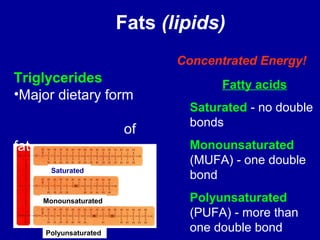
centigrade 
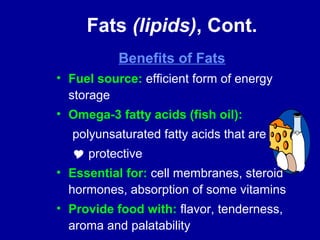
Caloric Density: 
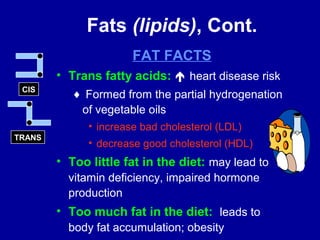
The relative number of calories per unit of 
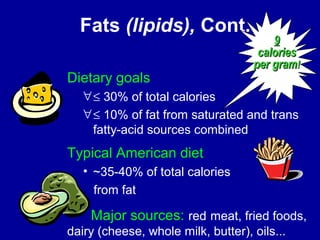
weight
Food: Our Energy Source 
Nutrient Density 
The relative amount of vitamins and 
minerals a food provides relative to its 
caloric content 
Empty Calories 
Derived from foods which are high in fat 
and/or sugar content but lack significant 
amounts of vitamins and minerals 
¨LOW NUTRIENT DENSITY 
¨HIGH CALORIC DENSITY
Nutrients for a Healthy Body 
Nutrients: 
Substances the body requires for 
energy, and for structural and 
regulatory purposes 
Macronutrients: 
water Micronutrients: 
carbohydrates vitamins 
fats minerals 
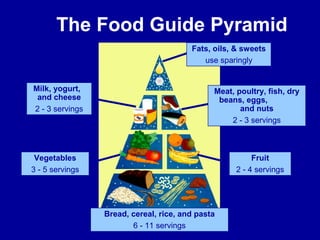
protein
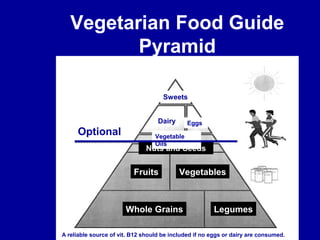
Water 
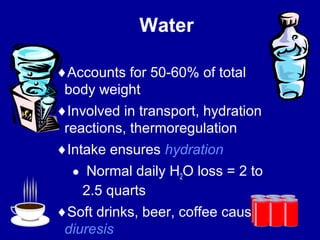
¨Accounts for 50-60% of total 
body weight 
¨Involved in transport, hydration 
reactions, thermoregulation 
¨Intake ensures hydration 
· Normal daily H2O loss = 2 to 
2.5 quarts 
¨Soft drinks, beer, coffee cause 
diuresis
Hydration During Exercise 
• As exercise intensity increases, so does 
water loss due to sweat 
¨Water loss due to sweat during 
exercise in hot weather can reach 2.8 
liters/hour 
• At the same time, electrolytes (Cl-, Mg++, 
K+, and Na+) are lost in the sweat
Hydration During Exercise 
• Proper hydration 
¨Maintains lower heart rate during 
exercise 
¨Maintains lower body temperature 
during exercise 
¨Results in lower percieved exertion 
during exercise
Hydration 
• Proper hydration for exercise lasting: 
¨< 1 hr, drink 500-1000 ml water containing 
30-50gm CHO 
¨1-3 hr, drink 800-1600ml water + 
electrolytes and 6% CHO 
¨>3 hr, drink 500-1000ml water + 
electrolytes and 6-8% CHO
Carbohydrates 
¨Essential for general metabolism, 
primary fuel source of the brain 
Simple carbohydrates 
¨Sugars (table sugar, fruit sugar) 
Complex carbohydrates 
¨Fiber (Grains, fruit, vegetables, 
legumes) 
¨Starch (Grains, pasta, bread, 
potatoes, legumes)
Fiber 
•Soluble 
•Barley, oats, fruits, legumes, sweet & 
white potatoes 
•Positive effect on blood cholesterol levels 
•May lower heart disease risk 
•Delay emptying of the stomach 
•Insoluble 
•Vegetables, whole wheat, wheat bran, 
and cereals 
•“Drano” effect 
•Protective for colon cancer
Carbohydrates, Cont. 
Dietary goal 
• 55-60% of total calories 
Typical American diet 
• 40-45% of total calories 
OOnnllyy 
44 ccaalloorriieess 
ppeerr ggrraamm!! 
Eat 5-9 servings fruits & 
veggies per day, and 6-11 
servings breads & cereals
A Little Exercise in Nutrition 
• Total dietary intake of 2400 calories 
• Goal is 60% carbohydrates 
• Out of 2400, how many calories 
should come from carbohydrates? 
• How many grams of Carbohydrates 
are required?
The answer…. 
• 2400 X 0.60 = 1440 calories 
• There are 4 calories per gram 
1440 cal/4 grams per cal = 360 grams 
1 cup of pasta = 40 grams
Fats (lipids) 
Triglycerides 
•Major dietary form 
of 
fat 
Saturated 
Monounsaturated 
Polyunsaturated 
Concentrated Energy! 
Fatty acids 
Saturated - no double 
bonds 
Monounsaturated 
(MUFA) - one double 
bond 
Polyunsaturated 
(PUFA) - more than 
one double bond
Fats (lipids), Cont. 
Benefits of Fats 
• Fuel source: efficient form of energy 
storage 
• Omega-3 fatty acids (fish oil): 
polyunsaturated fatty acids that are 
 protective 
• Essential for: cell membranes, steroid 
hormones, absorption of some vitamins 
• Provide food with: flavor, tenderness, 
aroma and palatability
Fats (lipids), Cont. 
FAT FACTS 
• Trans fatty acids:  heart disease risk 
¨ Formed from the partial hydrogenation 
of vegetable oils 
• increase bad cholesterol (LDL) 
• decrease good cholesterol (HDL) 
• Too little fat in the diet: may lead to 
vitamin deficiency, impaired hormone 
production 
• Too much fat in the diet: leads to 
body fat accumulation; obesity 
CIS 
TRANS
Fats (lipids), Cont. 
99 
ccaalloorriieess 
ppeerr ggrraamm!! 
Dietary goals 
"£ 30% of total calories 
"£ 10% of fat from saturated and trans 
fatty-acid sources combined 
Typical American diet 
• ~35-40% of total calories 
from fat 
Major sources: red meat, fried foods, 
dairy (cheese, whole milk, butter), oils...
Fats (lipids), Cont. 
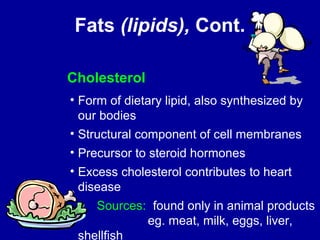
Cholesterol 
• Form of dietary lipid, also synthesized by 
our bodies 
• Structural component of cell membranes 
• Precursor to steroid hormones 
• Excess cholesterol contributes to heart 
disease 
Sources: found only in animal products 
eg. meat, milk, eggs, liver, 
shellfish
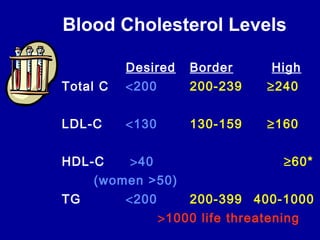
Blood Cholesterol Levels 
Desired Border High 
Total C <200 200-239 ³240 
LDL-C <130 130-159 ³160 
HDL-C >40 ³60* 
(women >50) 
TG <200 200-399 400-1000 
>1000 life threatening
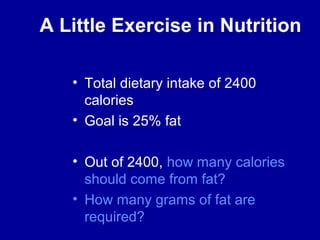
A Little Exercise in Nutrition 
• Total dietary intake of 2400 
calories 
• Goal is 25% fat 
• Out of 2400, how many calories 
should come from fat? 
• How many grams of fat are 
required?
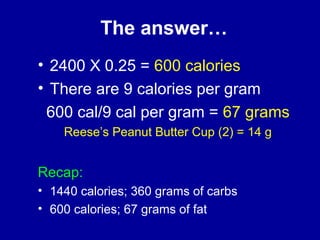
The answer… 
• 2400 X 0.25 = 600 calories 
• There are 9 calories per gram 
600 cal/9 cal per gram = 67 grams 
Reese’s Peanut Butter Cup (2) = 14 g 
Recap: 
• 1440 calories; 360 grams of carbs 
• 600 calories; 67 grams of fat
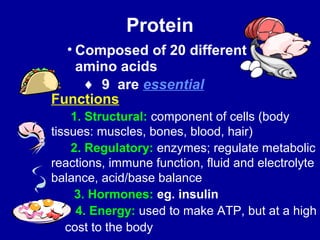
Protein 
• Composed of 20 different 
amino acids 
¨ 9 are essential 
Functions 
1. Structural: component of cells (body 
tissues: muscles, bones, blood, hair) 
2. Regulatory: enzymes; regulate metabolic 
reactions, immune function, fluid and electrolyte 
balance, acid/base balance 
3. Hormones: eg. insulin 
4. Energy: used to make ATP, but at a high 
cost to the body
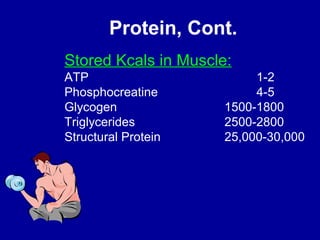
Protein, Cont. 
Stored Kcals in Muscle: 
ATP 1-2 
Phosphocreatine 4-5 
Glycogen 1500-1800 
Triglycerides 2500-2800 
Structural Protein 25,000-30,000
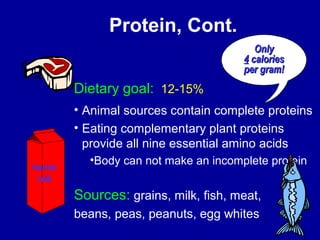
Protein, Cont. 
Dietary goal: 12-15% 
• Animal sources contain complete proteins 
• Eating complementary plant proteins 
provide all nine essential amino acids 
•Body can not make an incomplete protein 
Sources: grains, milk, fish, meat, 
beans, peas, peanuts, egg whites 
Nonfat 
milk 
OOnnllyy 
44 ccaalloorriieess 
ppeerr ggrraamm!!
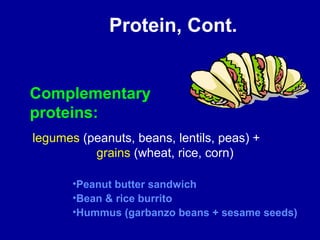
Protein, Cont. 
Complementary 
proteins: 
legumes (peanuts, beans, lentils, peas) + 
grains (wheat, rice, corn) 
•Peanut butter sandwich 
•Bean & rice burrito 
•Hummus (garbanzo beans + sesame seeds)
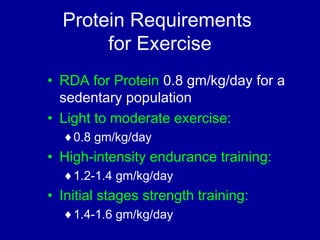
Protein Requirements 
for Exercise 
• RDA for Protein 0.8 gm/kg/day for a 
sedentary population 
• Light to moderate exercise: 
¨0.8 gm/kg/day 
• High-intensity endurance training: 
¨1.2-1.4 gm/kg/day 
• Initial stages strength training: 
¨1.4-1.6 gm/kg/day
Protein Requirements 
• Higher requirements for protein due to 
increased rate of oxidation of amino acids 
during exercise 
• Easily attained by consumption of 12% of 
kcals protein per day 
¨70 kg individual 
¨~2900Kcal/day (348 kcal protein) 
¨4 kcal/gm®87gm protein 
¨ 87gm/70kg ®1.2 gm/kg/day 
• Far exceeds the RDA of 0.8 gm/kg/day
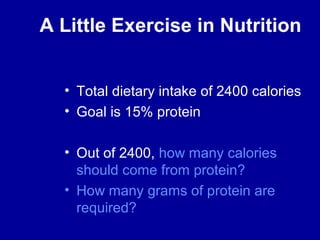
A Little Exercise in Nutrition 
• Total dietary intake of 2400 calories 
• Goal is 15% protein 
• Out of 2400, how many calories 
should come from protein? 
• How many grams of protein are 
required?
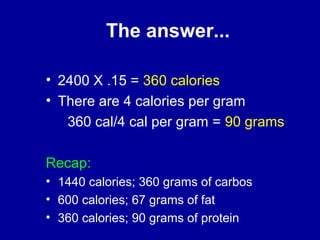
The answer... 
• 2400 X .15 = 360 calories 
• There are 4 calories per gram 
360 cal/4 cal per gram = 90 grams 
Recap: 
• 1440 calories; 360 grams of carbos 
• 600 calories; 67 grams of fat 
• 360 calories; 90 grams of protein
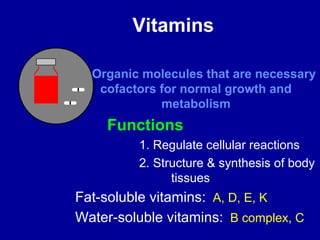
Vitamins 
Organic molecules that are necessary 
cofactors for normal growth and 
metabolism 
Functions 
1. Regulate cellular reactions 
2. Structure & synthesis of body 
tissues 
Fat-soluble vitamins: A, D, E, K 
Water-soluble vitamins: B complex, C
Vitamins, Cont. 
• Vitamins A, C, E are antioxidants. Prevent free 
radicals from damaging tissues; as in cancer, diabetes 
and CHD. 
• Vitamin A (beta-carotene): colorful fruits and 
vegetables (carrots, sweet potatoes, mangoes, 
apricots) 
• Vitamin C: RDA: 75 mg women, 90 mg men, 100 mg 
for smokers (citrus fruits, broccoli, leafy vegetables) 
• Linus Pauling Inst.: 200 mg 
• 8 oz orange juice=100 mg 
• Vitamin E: RDA: 15 mg 
• Linus Pauling Inst.-200mg, grain oils, wheat germ, 
nuts, seeds, liver and SUPPLEMENTS
Vitamins, Cont. 
• The B vitamins: generally involved in 
energy metabolism 
¨B-12: animal-derived foods (dairy,eggs), 
vegetarians may need fortified foods 
• Vitamin D: necessary to help calcium 
deposit in bones 
• Folic Acid (B vitamin): coenzyme; 
important in DNA synthesis 
¨Deficiency associated with birth defects and 
heart disease 
¨Fortification of flour
Minerals 
Functions 
1. Structural: bone, teeth, 
connective tissue, enzymes, 
hemoglobin 
2. Maintain water balance, nerve 
function, enzyme activity 
Important minerals 
•calcium, iron, sodium
Calcium 
• Osteoporosis = weak bones 
• Adequate calcium intake helps maximize 
bone density in youth 
RDA: 1200 mg/day (ages 19-24) 
800 mg/day (over 25) 
1500 mg/day for women 
Sources: dairy products, dark green leafy 
vegetables, calcium fortified foods 
Nonfat 
milk
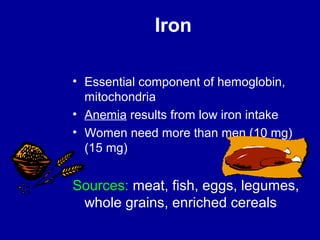
Iron 
• Essential component of hemoglobin, 
mitochondria 
• Anemia results from low iron intake 
• Women need more than men (10 mg) 
(15 mg) 
Sources: meat, fish, eggs, legumes, 
whole grains, enriched cereals
Iron 
• Iron deficiency is the most common 
nutrient deficiency in exercise 
• Causes 
¨inadequate intake 
¨loss in sweat, urine and feces 
¨hemolysis 
¨impaired absorption in athletes
Sodium 
• Electrolyte 
• Assists in transmission of nerve 
impulses 
• Assists in muscle contraction 
• Excessive intake can contribute to 
hypertension 
• Americans get too much! 
Recommendation: 2400-3000 mg/day
The Food Guide Pyramid 
Meat, poultry, fish, dry 
beans, eggs, 
and nuts 
2 - 3 servings 
Fruit 
2 - 4 servings 
Milk, yogurt, 
and cheese 
2 - 3 servings 
Vegetables 
3 - 5 servings 
Fats, oils, & sweets 
use sparingly 
Bread, cereal, rice, and pasta 
6 - 11 servings
Vegetarian Food Guide 
Pyramid 
Sweets 
Dairy Eggs 
Vegetable 
Oils 
Nuts and Seeds 
Fruits Vegetables 
Whole Grains Legumes 
Optional 
A reliable source of vit. B12 should be included if no eggs or dairy are consumed.
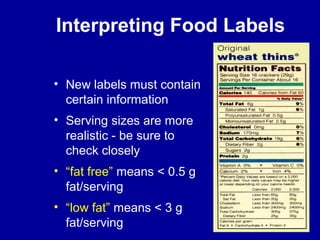
Interpreting Food Labels 
• New labels must contain 
certain information 
• Serving sizes are more 
realistic - be sure to 
check closely 
• “fat free” means < 0.5 g 
fat/serving 
• “low fat” means < 3 g 
fat/serving
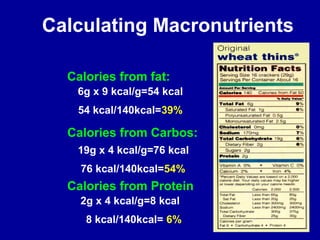
Calculating Macronutrients 
Calories from fat: 
6g x 9 kcal/g=54 kcal 
54 kcal/140kcal=39% 
Calories from Carbos: 
19g x 4 kcal/g=76 kcal 
76 kcal/140kcal=54% 
Calories from Protein: 
2g x 4 kcal/g=8 kcal 
8 kcal/140kcal= 6%
Next Time 
• In Lecture 
¨Body Composition and Weight 
Management - chapter 8 
¨Course Evaluations

Angela wellness diet

  • 1.
    TThhee WWeellllnneessss DDiieett Good nutrition? Food that: 1. Meets your physical needs for energy and nutrients 2. Maintains or improves your energy balance 3. Is enjoyable
  • 2.
    Food: Our EnergySource Calorie: Kilocalorie (kcal), the amount of heat necessary to raise 1 kg of water 1 degree centigrade Caloric Density: The relative number of calories per unit of weight
  • 3.
    Food: Our EnergySource Nutrient Density The relative amount of vitamins and minerals a food provides relative to its caloric content Empty Calories Derived from foods which are high in fat and/or sugar content but lack significant amounts of vitamins and minerals ¨LOW NUTRIENT DENSITY ¨HIGH CALORIC DENSITY
  • 4.
    Nutrients for aHealthy Body Nutrients: Substances the body requires for energy, and for structural and regulatory purposes Macronutrients: water Micronutrients: carbohydrates vitamins fats minerals protein
  • 5.
    Water ¨Accounts for50-60% of total body weight ¨Involved in transport, hydration reactions, thermoregulation ¨Intake ensures hydration · Normal daily H2O loss = 2 to 2.5 quarts ¨Soft drinks, beer, coffee cause diuresis
  • 6.
    Hydration During Exercise • As exercise intensity increases, so does water loss due to sweat ¨Water loss due to sweat during exercise in hot weather can reach 2.8 liters/hour • At the same time, electrolytes (Cl-, Mg++, K+, and Na+) are lost in the sweat
  • 7.
    Hydration During Exercise • Proper hydration ¨Maintains lower heart rate during exercise ¨Maintains lower body temperature during exercise ¨Results in lower percieved exertion during exercise
  • 8.
    Hydration • Properhydration for exercise lasting: ¨< 1 hr, drink 500-1000 ml water containing 30-50gm CHO ¨1-3 hr, drink 800-1600ml water + electrolytes and 6% CHO ¨>3 hr, drink 500-1000ml water + electrolytes and 6-8% CHO
  • 9.
    Carbohydrates ¨Essential forgeneral metabolism, primary fuel source of the brain Simple carbohydrates ¨Sugars (table sugar, fruit sugar) Complex carbohydrates ¨Fiber (Grains, fruit, vegetables, legumes) ¨Starch (Grains, pasta, bread, potatoes, legumes)
  • 10.
    Fiber •Soluble •Barley,oats, fruits, legumes, sweet & white potatoes •Positive effect on blood cholesterol levels •May lower heart disease risk •Delay emptying of the stomach •Insoluble •Vegetables, whole wheat, wheat bran, and cereals •“Drano” effect •Protective for colon cancer
  • 11.
    Carbohydrates, Cont. Dietarygoal • 55-60% of total calories Typical American diet • 40-45% of total calories OOnnllyy 44 ccaalloorriieess ppeerr ggrraamm!! Eat 5-9 servings fruits & veggies per day, and 6-11 servings breads & cereals
  • 12.
    A Little Exercisein Nutrition • Total dietary intake of 2400 calories • Goal is 60% carbohydrates • Out of 2400, how many calories should come from carbohydrates? • How many grams of Carbohydrates are required?
  • 13.
    The answer…. •2400 X 0.60 = 1440 calories • There are 4 calories per gram 1440 cal/4 grams per cal = 360 grams 1 cup of pasta = 40 grams
  • 14.
    Fats (lipids) Triglycerides •Major dietary form of fat Saturated Monounsaturated Polyunsaturated Concentrated Energy! Fatty acids Saturated - no double bonds Monounsaturated (MUFA) - one double bond Polyunsaturated (PUFA) - more than one double bond
  • 15.
    Fats (lipids), Cont. Benefits of Fats • Fuel source: efficient form of energy storage • Omega-3 fatty acids (fish oil): polyunsaturated fatty acids that are  protective • Essential for: cell membranes, steroid hormones, absorption of some vitamins • Provide food with: flavor, tenderness, aroma and palatability
  • 16.
    Fats (lipids), Cont. FAT FACTS • Trans fatty acids:  heart disease risk ¨ Formed from the partial hydrogenation of vegetable oils • increase bad cholesterol (LDL) • decrease good cholesterol (HDL) • Too little fat in the diet: may lead to vitamin deficiency, impaired hormone production • Too much fat in the diet: leads to body fat accumulation; obesity CIS TRANS
  • 17.
    Fats (lipids), Cont. 99 ccaalloorriieess ppeerr ggrraamm!! Dietary goals "£ 30% of total calories "£ 10% of fat from saturated and trans fatty-acid sources combined Typical American diet • ~35-40% of total calories from fat Major sources: red meat, fried foods, dairy (cheese, whole milk, butter), oils...
  • 18.
    Fats (lipids), Cont. Cholesterol • Form of dietary lipid, also synthesized by our bodies • Structural component of cell membranes • Precursor to steroid hormones • Excess cholesterol contributes to heart disease Sources: found only in animal products eg. meat, milk, eggs, liver, shellfish
  • 19.
    Blood Cholesterol Levels Desired Border High Total C <200 200-239 ³240 LDL-C <130 130-159 ³160 HDL-C >40 ³60* (women >50) TG <200 200-399 400-1000 >1000 life threatening
  • 20.
    A Little Exercisein Nutrition • Total dietary intake of 2400 calories • Goal is 25% fat • Out of 2400, how many calories should come from fat? • How many grams of fat are required?
  • 21.
    The answer… •2400 X 0.25 = 600 calories • There are 9 calories per gram 600 cal/9 cal per gram = 67 grams Reese’s Peanut Butter Cup (2) = 14 g Recap: • 1440 calories; 360 grams of carbs • 600 calories; 67 grams of fat
  • 22.
    Protein • Composedof 20 different amino acids ¨ 9 are essential Functions 1. Structural: component of cells (body tissues: muscles, bones, blood, hair) 2. Regulatory: enzymes; regulate metabolic reactions, immune function, fluid and electrolyte balance, acid/base balance 3. Hormones: eg. insulin 4. Energy: used to make ATP, but at a high cost to the body
  • 23.
    Protein, Cont. StoredKcals in Muscle: ATP 1-2 Phosphocreatine 4-5 Glycogen 1500-1800 Triglycerides 2500-2800 Structural Protein 25,000-30,000
  • 24.
    Protein, Cont. Dietarygoal: 12-15% • Animal sources contain complete proteins • Eating complementary plant proteins provide all nine essential amino acids •Body can not make an incomplete protein Sources: grains, milk, fish, meat, beans, peas, peanuts, egg whites Nonfat milk OOnnllyy 44 ccaalloorriieess ppeerr ggrraamm!!
  • 25.
    Protein, Cont. Complementary proteins: legumes (peanuts, beans, lentils, peas) + grains (wheat, rice, corn) •Peanut butter sandwich •Bean & rice burrito •Hummus (garbanzo beans + sesame seeds)
  • 26.
    Protein Requirements forExercise • RDA for Protein 0.8 gm/kg/day for a sedentary population • Light to moderate exercise: ¨0.8 gm/kg/day • High-intensity endurance training: ¨1.2-1.4 gm/kg/day • Initial stages strength training: ¨1.4-1.6 gm/kg/day
  • 27.
    Protein Requirements •Higher requirements for protein due to increased rate of oxidation of amino acids during exercise • Easily attained by consumption of 12% of kcals protein per day ¨70 kg individual ¨~2900Kcal/day (348 kcal protein) ¨4 kcal/gm®87gm protein ¨ 87gm/70kg ®1.2 gm/kg/day • Far exceeds the RDA of 0.8 gm/kg/day
  • 28.
    A Little Exercisein Nutrition • Total dietary intake of 2400 calories • Goal is 15% protein • Out of 2400, how many calories should come from protein? • How many grams of protein are required?
  • 29.
    The answer... •2400 X .15 = 360 calories • There are 4 calories per gram 360 cal/4 cal per gram = 90 grams Recap: • 1440 calories; 360 grams of carbos • 600 calories; 67 grams of fat • 360 calories; 90 grams of protein
  • 30.
    Vitamins Organic moleculesthat are necessary cofactors for normal growth and metabolism Functions 1. Regulate cellular reactions 2. Structure & synthesis of body tissues Fat-soluble vitamins: A, D, E, K Water-soluble vitamins: B complex, C
  • 31.
    Vitamins, Cont. •Vitamins A, C, E are antioxidants. Prevent free radicals from damaging tissues; as in cancer, diabetes and CHD. • Vitamin A (beta-carotene): colorful fruits and vegetables (carrots, sweet potatoes, mangoes, apricots) • Vitamin C: RDA: 75 mg women, 90 mg men, 100 mg for smokers (citrus fruits, broccoli, leafy vegetables) • Linus Pauling Inst.: 200 mg • 8 oz orange juice=100 mg • Vitamin E: RDA: 15 mg • Linus Pauling Inst.-200mg, grain oils, wheat germ, nuts, seeds, liver and SUPPLEMENTS
  • 32.
    Vitamins, Cont. •The B vitamins: generally involved in energy metabolism ¨B-12: animal-derived foods (dairy,eggs), vegetarians may need fortified foods • Vitamin D: necessary to help calcium deposit in bones • Folic Acid (B vitamin): coenzyme; important in DNA synthesis ¨Deficiency associated with birth defects and heart disease ¨Fortification of flour
  • 33.
    Minerals Functions 1.Structural: bone, teeth, connective tissue, enzymes, hemoglobin 2. Maintain water balance, nerve function, enzyme activity Important minerals •calcium, iron, sodium
  • 34.
    Calcium • Osteoporosis= weak bones • Adequate calcium intake helps maximize bone density in youth RDA: 1200 mg/day (ages 19-24) 800 mg/day (over 25) 1500 mg/day for women Sources: dairy products, dark green leafy vegetables, calcium fortified foods Nonfat milk
  • 35.
    Iron • Essentialcomponent of hemoglobin, mitochondria • Anemia results from low iron intake • Women need more than men (10 mg) (15 mg) Sources: meat, fish, eggs, legumes, whole grains, enriched cereals
  • 36.
    Iron • Irondeficiency is the most common nutrient deficiency in exercise • Causes ¨inadequate intake ¨loss in sweat, urine and feces ¨hemolysis ¨impaired absorption in athletes
  • 37.
    Sodium • Electrolyte • Assists in transmission of nerve impulses • Assists in muscle contraction • Excessive intake can contribute to hypertension • Americans get too much! Recommendation: 2400-3000 mg/day
  • 38.
    The Food GuidePyramid Meat, poultry, fish, dry beans, eggs, and nuts 2 - 3 servings Fruit 2 - 4 servings Milk, yogurt, and cheese 2 - 3 servings Vegetables 3 - 5 servings Fats, oils, & sweets use sparingly Bread, cereal, rice, and pasta 6 - 11 servings
  • 39.
    Vegetarian Food Guide Pyramid Sweets Dairy Eggs Vegetable Oils Nuts and Seeds Fruits Vegetables Whole Grains Legumes Optional A reliable source of vit. B12 should be included if no eggs or dairy are consumed.
  • 40.
    Interpreting Food Labels • New labels must contain certain information • Serving sizes are more realistic - be sure to check closely • “fat free” means < 0.5 g fat/serving • “low fat” means < 3 g fat/serving
  • 41.
    Calculating Macronutrients Caloriesfrom fat: 6g x 9 kcal/g=54 kcal 54 kcal/140kcal=39% Calories from Carbos: 19g x 4 kcal/g=76 kcal 76 kcal/140kcal=54% Calories from Protein: 2g x 4 kcal/g=8 kcal 8 kcal/140kcal= 6%
  • 42.
    Next Time •In Lecture ¨Body Composition and Weight Management - chapter 8 ¨Course Evaluations

Editor's Notes

  • #35 Osteoporosis refers to the slow demineralization and weakening of bones over time, which makes a person more susceptible to fractures This disease is much more prevalent in women than in men, especially after a women reaches menopause One of the best ways to prevent osteoporosis is by maximizing bone mass while you are young. This is important for both men and women Sufficient calcium intake, estrogen therapy in women (if necessary), and regular exercise are important factors to consider in peak bone mass attainment The RDA for calcium is 1200 mg/day for individuals aged 19 to 24, and 800 mg/day for people 25 and older Some experts who study bone density recommend 1500 mg/day for women throughout the lifetime, especially considering the fact that most women get less than 800 mg per day Good sources
  • #36 Iron is an essential component of the oxygen carrying molecule in the blood called hemoglobin, and also of the mitochondria in the muscles which generate ATP Since iron is necessary to carry oxygen in the blood properly, iron deficiency reduces the body’s ability to perform prolonged work or exercise Anemia refers to inadequate hemoglobin concentrations and is usually caused by insufficient iron intake The RDA for women is higher than that for men due to the fact that women lose iron during menstruation Animal sources of iron such as meat, fish, poultry, and eggs are absorbed more effectively by the body than plant sources, but the absorption of plant sources can be enhanced if eaten with vitamin C sources (citrus fruits, broccoli, cauliflower, strawberries, cataloupe)
  • #38 Sodium is one of the essential electrolytes in the body An electrolyte is an element which carries an electrical charge when dissolved, in this case, in our body’s water Electrolytes are very important in proper nerve conduction and muscle contraction, but excessive intake can cause problems Too many electrolytes cause the body to retain water, which can cause hypertention, or high blood pressure Most people are able to balance sodium intake with sodium excretion in the urine, but some individuals who are sodium sensitive have a harder time regulating water balance with excessive sodium on board Although there is no RDA for sodium, the American Heart Association recommends intake be less than 3000 mg per day. Most Americans consume between 4000 and 6000 mg per day We get about one-third of our sodium from table salt, another third from processed foods, and another third from naturally occurring sodium in foods
  • #39 The United States Department of Agriculture (USDA) has recently developed the Food Guide Pyramid as a simpler way to illustrate the healthy diet The amount of space each class of food takes up on the pyramid also reflects its importance in the diet To represent the fact that carbohydrates should comprise 55-60% of our total calories, the first two levels of the pyramid are comprised of the bread, cereal, rice, and pasta group, the vegetable group, and the fruit group Protein sources comprise the next level on the pyramid, the milk, yogurt, and cheese group and the meat and meat alternative group The tip of the pyramid represents added fats, oils, and sweets in our diet In addition, symbols representing fats and sugars which may already be added to foods in the lower categories have been added, emphasizing the importance of choosing the low fat options in these groups
  • #41 One of the best ways to determine if your diet is meeting the healthy requirements we’ve talked about is to read the nutritional labels on the foods you eat The Food and Drug Administration has recently implemented informative and easier to read and interpret Some of the changes they’ve implemented include the standardization and requirement of certain information such as the amount of fat, cholesterol, carbohydrate, sodium, and protein content in a single serving of the item, as well as the total number of calories and calories from fat the food contains. The label also tells you what percentage of a 2,000 calorie diet each nutrient in the food represents The serving sizes are more realistic The use of descriptive terms is now standardized, so that “fat free” now means that the food cannot contain more that 0.5 g of fat per serving, and “low fat” means that the food contains less than 3 grams of fat per serving
  • #42 One of the best ways to determine if your diet is meeting the healthy requirements we’ve talked about is to read the nutritional labels on the foods you eat The Food and Drug Administration has recently implemented informative and easier to read and interpret Some of the changes they’ve implemented include the standardization and requirement of certain information such as the amount of fat, cholesterol, carbohydrate, sodium, and protein content in a single serving of the item, as well as the total number of calories and calories from fat the food contains. The label also tells you what percentage of a 2,000 calorie diet each nutrient in the food represents The serving sizes are more realistic The use of descriptive terms is now standardized, so that “fat free” now means that the food cannot contain more that 0.5 g of fat per serving, and “low fat” means that the food contains less than 3 grams of fat per serving