Program: B.Sc Nursing, Second Year
BNSG-201 Nutrition & Biochemistry
Unit No.1. Introduction
Topic- :Micronutrients
Lecture No. 7
Dr. Sudharani B Banappagoudar
Professor, SONS/OBG
1
BNSG 201
NUTRITION - UNIT I
INTRODUCTION
2
BNSG 201
Outline
• Introduction
• Micronutrients
• Learning outcomes
• Exercise
• References
3
BNSG 201
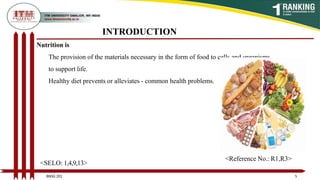
INTRODUCTION
4
BNSG 201
<SELO: 1,4,9,13>
<Reference No.: R1,R3>
What are Nutrients?
The foods we eat contain nutrients. Nutrients are substances required by the body to perform
its basic functions. Nutrients must be obtained from our diet, since the human body does not
synthesize or produce them. Nutrients have one or more of three basic functions: they
provide energy, contribute to body structure, and/or regulate chemical processes in the body.
These basic functions allow us to detect and respond to environmental surroundings, move,
excrete wastes, respire (breathe), grow, and reproduce. There are six classes of nutrients
required for the body to function and maintain overall health. These are carbohydrates,
lipids, proteins, water, vitamins, and minerals. Foods also contain non-nutrients that may be
harmful (such as natural toxins common in plant foods and additives like some dyes and
preservatives) or beneficial (such as antioxidants).
INTRODUCTION
Nutrition is
The provision of the materials necessary in the form of food to cells and organisms
to support life.
Healthy diet prevents or alleviates - common health problems.
5
BNSG 201
<SELO: 1,4,9,13>
<Reference No.: R1,R3>
Objectives
<SELO: 1,4,9,13> <Reference No.: R1,R2>
6
BNSG 201
By the end of this chapter, you will be able to:
• Describe Micronutrients
MICRONUTRIENTS
Micronutrients are vitamins and trace minerals.
Body requires them in very small amounts.
Vitamins are organic substances that we ingest with our foods, and that help to trigger other
reactions in the body.
7
BNSG 201
<SELO: 1,4,9,13>
<Reference No.: R1,R3>
MICRONUTRIENTS
Needed only in small amounts,
Deficiency leads to critical health problems.
Most of the diseases and conditions are due to deficiency of micronutrients.
WHO - Elimination of micronutrient deficiency, labour efficiency will increase multifold.
8
BNSG 201
<SELO: 1,4,9,13>
<Reference No.: R1,R3>
LIST OF MICRONUTRIENTS
MICRONUTRIENTS: VITAMINS
Vitamin A, Vitamin B,
Vitamin C, Vitamin D,
Vitamin E, Vitamin K and
Carotenoids.
9
BNSG 201
<SELO: 1,4,9,13>
<Reference No.: R1,R3>
LIST OF MICRONUTRIENTS
Minerals are - Boron, Calcium, Chloride, Chromium, Cobalt, Copper, Fluoride, Iodine, Iron,
Magnesium, Manganese, Molybdenum, Phosphorous, Potassium, Selenium, Sodium and Zinc.
10
BNSG 201
<SELO: 1,4,9,13>
<Reference No.: R1,R3>
LIST OF MICRONUTRIENTS
ORGANIC ACIDS
Acetic acid, Citric acid,
Lactic acid, Malic acid,
Choline and Taurine.
11
BNSG 201
<SELO: 1,4,9,13>
<Reference No.: R1,R3>
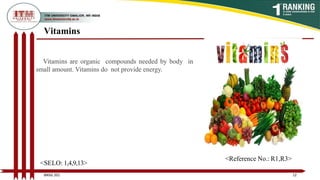
Vitamins
Vitamins are organic compounds needed by body in
small amount. Vitamins do not provide energy.
12
BNSG 201
<SELO: 1,4,9,13>
<Reference No.: R1,R3>
Functions
1. Helps to regulate many chemical processes in the body
2. It is an antioxidant
There are two types of vitamins
Fat soluble vitamins
Vitamin A, D, E, K(can be stored in body for later use)
Water soluble vitamins
Vitamin C and B(Easily absorbed and passed through body as waste)
13
BNSG 201
<SELO: 1,4,9,13>
<Reference No.: R1,R3>
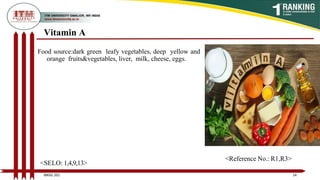
Vitamin A
Food source:dark green leafy vegetables, deep yellow and
orange fruits&vegetables, liver, milk, cheese, eggs.
14
BNSG 201
<SELO: 1,4,9,13>
<Reference No.: R1,R3>
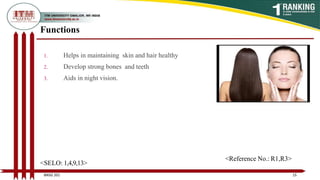
Functions
1. Helps in maintaining skin and hair healthy
2. Develop strong bones and teeth
3. Aids in night vision.
15
BNSG 201
<SELO: 1,4,9,13>
<Reference No.: R1,R3>
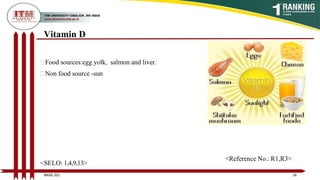
Vitamin D
Food sources:egg yolk, salmon and liver.
Non food source -sun
16
BNSG 201
<SELO: 1,4,9,13>
<Reference No.: R1,R3>
Functions
Building strong bones and teeth
Stimulate calcium absorption
17
BNSG 201
<SELO: 1,4,9,13>
<Reference No.: R1,R3>
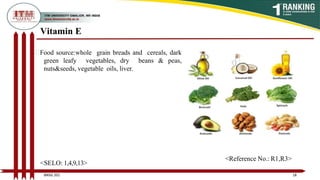
Vitamin E
Food source:whole grain breads and cereals, dark
green leafy vegetables, dry beans & peas,
nuts&seeds, vegetable oils, liver.
18
BNSG 201
<SELO: 1,4,9,13>
<Reference No.: R1,R3>
Functions
Helps to form red blood cells, muscles and other tissues.
Antioxidant
19
BNSG 201
<SELO: 1,4,9,13>
<Reference No.: R1,R3>
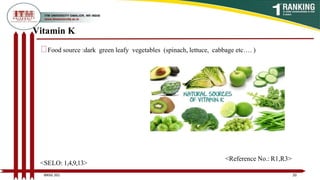
Vitamin K
Food source :dark green leafy vegetables (spinach, lettuce, cabbage etc…. )
20
BNSG 201
<SELO: 1,4,9,13>
<Reference No.: R1,R3>
Vitamin B
Food source:whole grain breads& cereals, peanut butter, nuts, meat, poultry, fish, eggs,
milk, dry beans and peas.
21
BNSG 201
<SELO: 1,4,9,13>
<Reference No.: R1,R3>
Functions
Helps in brain, nerves and muscle function
Helps the body to use the energy from foods we eat.
22
BNSG 201
<SELO: 1,4,9,13>
<Reference No.: R1,R3>
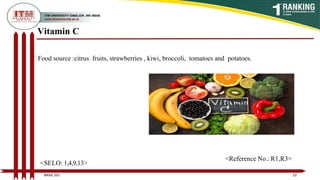
Vitamin C
Food source :citrus fruits, strawberries , kiwi, broccoli, tomatoes and potatoes.
23
BNSG 201
<SELO: 1,4,9,13>
<Reference No.: R1,R3>
Functions
Helps in wound healing
Helps in maintaining healthy bones, teeth and blood vessels
Helps to fight against infection.
24
BNSG 201
<SELO: 1,4,9,13>
<Reference No.: R1,R3>
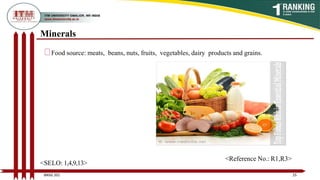
Minerals
Food source: meats, beans, nuts, fruits, vegetables, dairy products and grains.
25
BNSG 201
<SELO: 1,4,9,13>
<Reference No.: R1,R3>
Functions
The body depends on minerals for practically every process necessary for life
It becomes part of the body.
EXERCISE
27
BNSG 201
•Describe various micronutrients
LEARNING OUTCOMES
BNSG 201 28
The student explained about
• Different food regulation laws in India
Student effective learning outcome
1.Application of concepts of topic & it’s technological application.
2.Ability to interpret and analyze data into information and to design and conduct experiments.
3.Understanding available tools and products and ability to use it effectively.
4.Adaptive Thinking Skills
BNSG 201 29
Reference
1.Essentials of nutrition and biochemistry for basic B sc nursing I clement
2. Food & nutrition for nurses (B sc nursing) by Ruma Singh
3. A textbook of nutrition B.Sc(n) first year Darshan Soni
30
BNSG 201
BNSG 201 31

Micronutrients

  • 1.
    Program: B.Sc Nursing,Second Year BNSG-201 Nutrition & Biochemistry Unit No.1. Introduction Topic- :Micronutrients Lecture No. 7 Dr. Sudharani B Banappagoudar Professor, SONS/OBG 1 BNSG 201
  • 2.
    NUTRITION - UNITI INTRODUCTION 2 BNSG 201
  • 3.
    Outline • Introduction • Micronutrients •Learning outcomes • Exercise • References 3 BNSG 201
  • 4.
    INTRODUCTION 4 BNSG 201 <SELO: 1,4,9,13> <ReferenceNo.: R1,R3> What are Nutrients? The foods we eat contain nutrients. Nutrients are substances required by the body to perform its basic functions. Nutrients must be obtained from our diet, since the human body does not synthesize or produce them. Nutrients have one or more of three basic functions: they provide energy, contribute to body structure, and/or regulate chemical processes in the body. These basic functions allow us to detect and respond to environmental surroundings, move, excrete wastes, respire (breathe), grow, and reproduce. There are six classes of nutrients required for the body to function and maintain overall health. These are carbohydrates, lipids, proteins, water, vitamins, and minerals. Foods also contain non-nutrients that may be harmful (such as natural toxins common in plant foods and additives like some dyes and preservatives) or beneficial (such as antioxidants).
  • 5.
    INTRODUCTION Nutrition is The provisionof the materials necessary in the form of food to cells and organisms to support life. Healthy diet prevents or alleviates - common health problems. 5 BNSG 201 <SELO: 1,4,9,13> <Reference No.: R1,R3>
  • 6.
    Objectives <SELO: 1,4,9,13> <ReferenceNo.: R1,R2> 6 BNSG 201 By the end of this chapter, you will be able to: • Describe Micronutrients
  • 7.
    MICRONUTRIENTS Micronutrients are vitaminsand trace minerals. Body requires them in very small amounts. Vitamins are organic substances that we ingest with our foods, and that help to trigger other reactions in the body. 7 BNSG 201 <SELO: 1,4,9,13> <Reference No.: R1,R3>
  • 8.
    MICRONUTRIENTS Needed only insmall amounts, Deficiency leads to critical health problems. Most of the diseases and conditions are due to deficiency of micronutrients. WHO - Elimination of micronutrient deficiency, labour efficiency will increase multifold. 8 BNSG 201 <SELO: 1,4,9,13> <Reference No.: R1,R3>
  • 9.
    LIST OF MICRONUTRIENTS MICRONUTRIENTS:VITAMINS Vitamin A, Vitamin B, Vitamin C, Vitamin D, Vitamin E, Vitamin K and Carotenoids. 9 BNSG 201 <SELO: 1,4,9,13> <Reference No.: R1,R3>
  • 10.
    LIST OF MICRONUTRIENTS Mineralsare - Boron, Calcium, Chloride, Chromium, Cobalt, Copper, Fluoride, Iodine, Iron, Magnesium, Manganese, Molybdenum, Phosphorous, Potassium, Selenium, Sodium and Zinc. 10 BNSG 201 <SELO: 1,4,9,13> <Reference No.: R1,R3>
  • 11.
    LIST OF MICRONUTRIENTS ORGANICACIDS Acetic acid, Citric acid, Lactic acid, Malic acid, Choline and Taurine. 11 BNSG 201 <SELO: 1,4,9,13> <Reference No.: R1,R3>
  • 12.
    Vitamins Vitamins are organiccompounds needed by body in small amount. Vitamins do not provide energy. 12 BNSG 201 <SELO: 1,4,9,13> <Reference No.: R1,R3>
  • 13.
    Functions 1. Helps toregulate many chemical processes in the body 2. It is an antioxidant There are two types of vitamins Fat soluble vitamins Vitamin A, D, E, K(can be stored in body for later use) Water soluble vitamins Vitamin C and B(Easily absorbed and passed through body as waste) 13 BNSG 201 <SELO: 1,4,9,13> <Reference No.: R1,R3>
  • 14.
    Vitamin A Food source:darkgreen leafy vegetables, deep yellow and orange fruits&vegetables, liver, milk, cheese, eggs. 14 BNSG 201 <SELO: 1,4,9,13> <Reference No.: R1,R3>
  • 15.
    Functions 1. Helps inmaintaining skin and hair healthy 2. Develop strong bones and teeth 3. Aids in night vision. 15 BNSG 201 <SELO: 1,4,9,13> <Reference No.: R1,R3>
  • 16.
    Vitamin D Food sources:eggyolk, salmon and liver. Non food source -sun 16 BNSG 201 <SELO: 1,4,9,13> <Reference No.: R1,R3>
  • 17.
    Functions Building strong bonesand teeth Stimulate calcium absorption 17 BNSG 201 <SELO: 1,4,9,13> <Reference No.: R1,R3>
  • 18.
    Vitamin E Food source:wholegrain breads and cereals, dark green leafy vegetables, dry beans & peas, nuts&seeds, vegetable oils, liver. 18 BNSG 201 <SELO: 1,4,9,13> <Reference No.: R1,R3>
  • 19.
    Functions Helps to formred blood cells, muscles and other tissues. Antioxidant 19 BNSG 201 <SELO: 1,4,9,13> <Reference No.: R1,R3>
  • 20.
    Vitamin K Food source:dark green leafy vegetables (spinach, lettuce, cabbage etc…. ) 20 BNSG 201 <SELO: 1,4,9,13> <Reference No.: R1,R3>
  • 21.
    Vitamin B Food source:wholegrain breads& cereals, peanut butter, nuts, meat, poultry, fish, eggs, milk, dry beans and peas. 21 BNSG 201 <SELO: 1,4,9,13> <Reference No.: R1,R3>
  • 22.
    Functions Helps in brain,nerves and muscle function Helps the body to use the energy from foods we eat. 22 BNSG 201 <SELO: 1,4,9,13> <Reference No.: R1,R3>
  • 23.
    Vitamin C Food source:citrus fruits, strawberries , kiwi, broccoli, tomatoes and potatoes. 23 BNSG 201 <SELO: 1,4,9,13> <Reference No.: R1,R3>
  • 24.
    Functions Helps in woundhealing Helps in maintaining healthy bones, teeth and blood vessels Helps to fight against infection. 24 BNSG 201 <SELO: 1,4,9,13> <Reference No.: R1,R3>
  • 25.
    Minerals Food source: meats,beans, nuts, fruits, vegetables, dairy products and grains. 25 BNSG 201 <SELO: 1,4,9,13> <Reference No.: R1,R3>
  • 26.
    Functions The body dependson minerals for practically every process necessary for life It becomes part of the body.
  • 27.
  • 28.
    LEARNING OUTCOMES BNSG 20128 The student explained about • Different food regulation laws in India
  • 29.
    Student effective learningoutcome 1.Application of concepts of topic & it’s technological application. 2.Ability to interpret and analyze data into information and to design and conduct experiments. 3.Understanding available tools and products and ability to use it effectively. 4.Adaptive Thinking Skills BNSG 201 29
  • 30.
    Reference 1.Essentials of nutritionand biochemistry for basic B sc nursing I clement 2. Food & nutrition for nurses (B sc nursing) by Ruma Singh 3. A textbook of nutrition B.Sc(n) first year Darshan Soni 30 BNSG 201
  • 31.