1
OBJECTIVES
At the end of the unit, the students will be able to:
 Define nutrition and other related terms
 Understand mechanisms and principles underlying
nutritional health ,and malnutrition
 Explain common food sources of nutrients
 Identify how to assess dietary intake and nutritional status
 Understand epidemiology and consequences of malnutrition
in Ethiopia
 Explain Macro and Micro nutrient deficiencies of public
health importance in Ethiopia
2
OBJECTIVES….CONTINUED
 Public health interventions to address malnutrition
 Food and nutrition policies and programs in
Ethiopia
3
INTRODUCTION TO HUMAN NUTRITION
Nutrition:
 The science of food, the nutrients and other
substances there in, their action, interaction and
balance in relation to health and disease, and the
process of digestion and absorption food in the
body, it is also concerned with social, cultural and
physiological implications of food and eating. .
4
INTRODUCTION …
 Human nutrition
It deals with area of knowledge regarding the role of food in the
maintenance of good health.
Nutrition is a fundamental pillar of human life, health and
development across the life-span(Fetal development-Birth-
Infancy-Childhood-Adolescence-Adulthood-Old age).
5
INTRODUCTION …
 Public health nutrition
Is promotion & maintenance of nutrition related health &
wellbeing through organized efforts & informed choices of
society.
Studies relationship between dietary intake and disease;
Uses tools of nutritional epidemiology,
Knowledge applied for nutrition intervention to prevent
disease
6
INTRODUCTION …
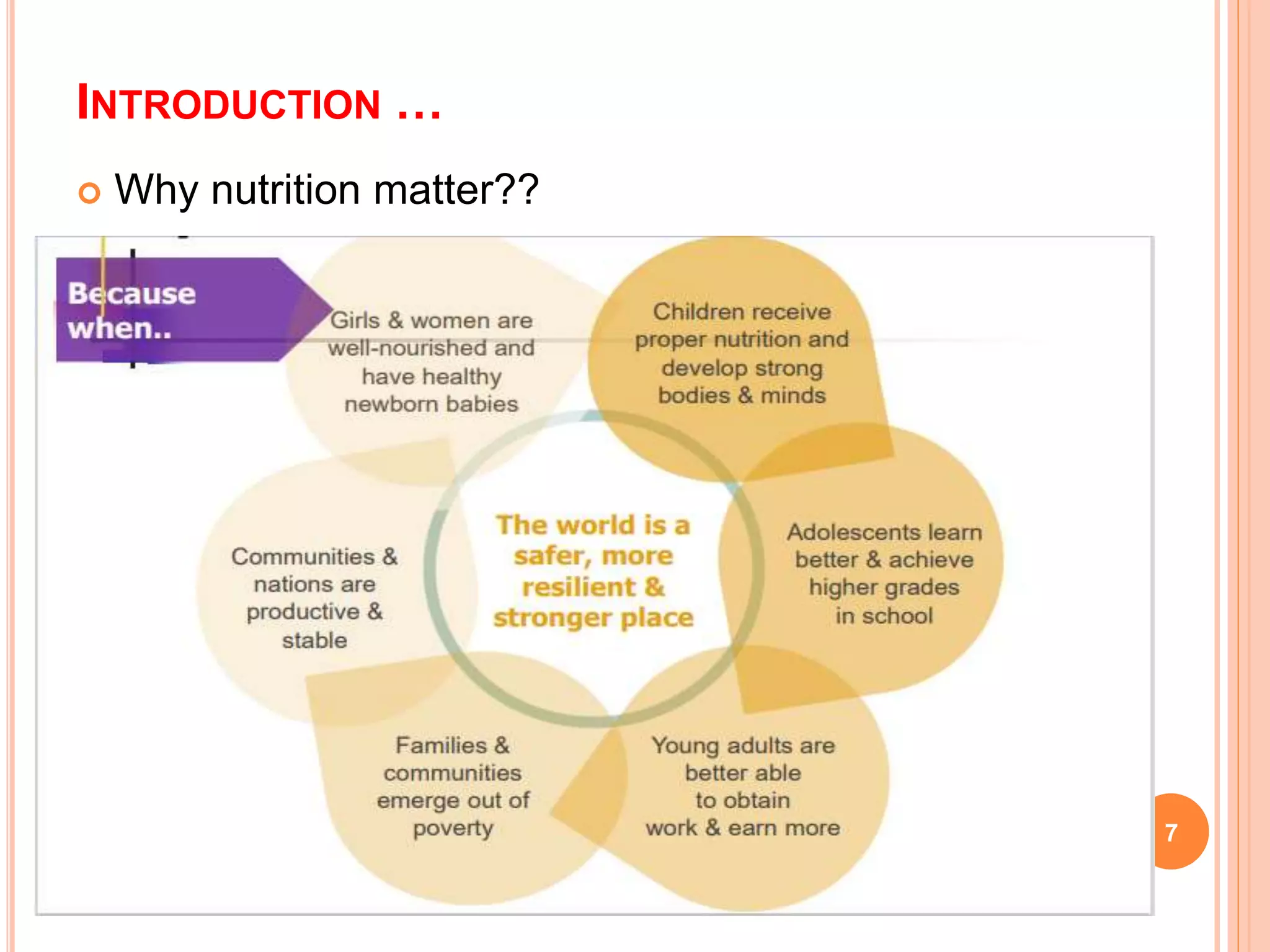
 Why nutrition matter??
7
INTRODUCTION …
What is food?
Food: anything solid or liquid that is edible as defined based on
specific culture, religion, etc.
Food is product derived from plants or animals that can be taken into
the body to yield energy and nutrients for the maintenance of life and
the growth and repair of tissues in order to:
 Provide energy to carry out several activities.
 Allow growth, repair or reproduction to proceed.
Supply substances, which normally regulate energy production.
process of growth/repair or reproduction.
8
INTRODUCTION …
Staple food: Food which form the largest part of nation’s
diet
Are plant origin & classified into three main groups:
 Grain & cereals
 Roots & tubers
 Starchy fruits
9
INTRODUCTION …
What are Nutrients?
Nutrient:
Foods are composed of many chemical substances critical
to human growth & function.
These critical chemicals are referred to as nutrients.
 Nutrients are chemical substances obtained from food and used
in the body to provide energy, structural materials, and regulating
agents to support growth, maintenance, and repair of the body's
tissues
10
INTRODUCTION …
Types of nutrients:
Essential nutrients:
• Absolutely necessary for growth, development &
maintenance
• Are not made in the body either at all or sufficiently to meet
physiological needs
Nonessential nutrients:
• Not necessarily essential for growth, development
• Are either synthesized in the body adequately 11
INTRODUCTION …
Nutrients can also be classified as:
Macronutrients
 Since “macro” means large, they are nutrients needed in
large amounts.
 Macronutrients are nutrients that provide calories/energy.
• Carbohydrate
• Protein
• Lipid
Micronutrients
• Vitamin
• Mineral
12
INTRODUCTION …
Diet:
 Pattern/style of food consumption followed by
population or an individual.
Is the sequence of meals in a day.
Some people may eat 1/2/3/4 times in a day,
Others may remain eating all the day round, etc.
13
INTRODUCTION …
Dietetics:
 Science/ art of applying the principles of nutrition in
feeding
 Use of diet in treatment and management of disease,
 Mainly based in hospitals,
14
THANK YOU !!
15

Lecture-4 Introduction to human nutrition-1.pptx

  • 1.
  • 2.
    OBJECTIVES At the endof the unit, the students will be able to:  Define nutrition and other related terms  Understand mechanisms and principles underlying nutritional health ,and malnutrition  Explain common food sources of nutrients  Identify how to assess dietary intake and nutritional status  Understand epidemiology and consequences of malnutrition in Ethiopia  Explain Macro and Micro nutrient deficiencies of public health importance in Ethiopia 2
  • 3.
    OBJECTIVES….CONTINUED  Public healthinterventions to address malnutrition  Food and nutrition policies and programs in Ethiopia 3
  • 4.
    INTRODUCTION TO HUMANNUTRITION Nutrition:  The science of food, the nutrients and other substances there in, their action, interaction and balance in relation to health and disease, and the process of digestion and absorption food in the body, it is also concerned with social, cultural and physiological implications of food and eating. . 4
  • 5.
    INTRODUCTION …  Humannutrition It deals with area of knowledge regarding the role of food in the maintenance of good health. Nutrition is a fundamental pillar of human life, health and development across the life-span(Fetal development-Birth- Infancy-Childhood-Adolescence-Adulthood-Old age). 5
  • 6.
    INTRODUCTION …  Publichealth nutrition Is promotion & maintenance of nutrition related health & wellbeing through organized efforts & informed choices of society. Studies relationship between dietary intake and disease; Uses tools of nutritional epidemiology, Knowledge applied for nutrition intervention to prevent disease 6
  • 7.
    INTRODUCTION …  Whynutrition matter?? 7
  • 8.
    INTRODUCTION … What isfood? Food: anything solid or liquid that is edible as defined based on specific culture, religion, etc. Food is product derived from plants or animals that can be taken into the body to yield energy and nutrients for the maintenance of life and the growth and repair of tissues in order to:  Provide energy to carry out several activities.  Allow growth, repair or reproduction to proceed. Supply substances, which normally regulate energy production. process of growth/repair or reproduction. 8
  • 9.
    INTRODUCTION … Staple food:Food which form the largest part of nation’s diet Are plant origin & classified into three main groups:  Grain & cereals  Roots & tubers  Starchy fruits 9
  • 10.
    INTRODUCTION … What areNutrients? Nutrient: Foods are composed of many chemical substances critical to human growth & function. These critical chemicals are referred to as nutrients.  Nutrients are chemical substances obtained from food and used in the body to provide energy, structural materials, and regulating agents to support growth, maintenance, and repair of the body's tissues 10
  • 11.
    INTRODUCTION … Types ofnutrients: Essential nutrients: • Absolutely necessary for growth, development & maintenance • Are not made in the body either at all or sufficiently to meet physiological needs Nonessential nutrients: • Not necessarily essential for growth, development • Are either synthesized in the body adequately 11
  • 12.
    INTRODUCTION … Nutrients canalso be classified as: Macronutrients  Since “macro” means large, they are nutrients needed in large amounts.  Macronutrients are nutrients that provide calories/energy. • Carbohydrate • Protein • Lipid Micronutrients • Vitamin • Mineral 12
  • 13.
    INTRODUCTION … Diet:  Pattern/styleof food consumption followed by population or an individual. Is the sequence of meals in a day. Some people may eat 1/2/3/4 times in a day, Others may remain eating all the day round, etc. 13
  • 14.
    INTRODUCTION … Dietetics:  Science/art of applying the principles of nutrition in feeding  Use of diet in treatment and management of disease,  Mainly based in hospitals, 14
  • 15.