MEAL PLANNING
Source: NIN –ICMR
BY: Pramod Machimada Appaiah
INTRODUCTION
 Nutrition is a basic human need and a prerequisite
to a healthy life.
 A proper diet is essential from the very early
stages of life for proper growth, development and
to remain active.
 Food consumption, which largely depends on
production and distribution, determines the health
and nutritional status of the population.
 Apart from supplying nutrients, foods provide
a host of other components (non-nutrient
phytochemicals) which have a positive impact
on health.
 Since people consume food, it is essential to
advocate nutrition in terms of foods, rather
than nutrients.
 Emphasis has, therefore, been shifted from a
nutrient orientation to the food-based
approach for attaining optimal nutritional
status.
 Dietary guidelines are a translation of
scientific knowledge on nutrients into specific
dietary advice.
 They represent the recommended dietary
allowances RDA of nutrients in terms of diets
that should be consumed by the population.
 The guidelines promote the concept of
nutritionally adequate diets and healthy
lifestyles from the time of conception to old
age.
 The major food issues of concern are
insufficient/ imbalanced intake of
foods/nutrients.
 The common nutritional problems of public
health importance in India are
Low birth weight
Protein energy malnutrition in children
Chronic energy deficiency in adults
Micronutrient malnutrition and
Diet-related noncommunicable diseases.
 The dietary guidelines emphasize promotion of
health and prevention of disease, of all age groups
with special focus on vulnerable segments of the
population such as infants, children and
adolescents, pregnant and lactating women and
the elderly.
 Other related factors, which need consideration
are physical activity, health care, safe water
supply and socio-economic development, all of
which strongly influence nutrition and health.
DIETARY GOALS
1. Maintenance of a state of positive health and
optimal performance in populations at large by
maintaining ideal body weight.
2. Ensuring adequate nutritional status for pregnant
women and lactating mothers.
3. Improvement of birth weights and promotion of
growth of infants, children and adolescents to
achieve their full genetic potential.
4. Achievement of adequacy in all nutrients and
prevention of deficiency diseases.
5. Prevention of chronic diet-related disorders.
6. Maintenance of the health of the elderly and
increasing the life expectancy
Principles of meal planning
 1.Meeting nutritional requirement: A good menu should
provide adequate calories, fat and proteins along with
minerals and vitamins. Energy distribution from
carbohydrate protein and fat would be 7:1:2 respectively.
The diet should contain basic four food groups.
 2. Meal pattern should fulfil the individual needs: Meal
pattern varies with age, occupation and life stages of an
individual or family members. Also individual likes and
dislikes, preferences like vegetarian or non-vegetarian,
religion, tradition and customs of individual should be
considered.
3.Meal plan should save time and energy
4.Meal planning should consider economic
constraint
5.Meal plan should give maximum nutrients: Losses
of nutrients during processing and cooking should
be minimized. Good quality protein should be
distributed in all meals.
6.Meals planned should provide variety
7.Meals should give satiety: Adequate protein, fat and
fiber should be provided to give satiety.
8.Meals should include locally available and seasonal
foods
9.Meals should include health foods: Ideal diets should
provide besides nutrients those bioactive chemicals
which can help to prevent and retard disease
processes.
DIETARY GUIDELINES
1. Eat variety of foods to ensure a balanced
diet.
2. Ensure provision of extra food and healthcare
to pregnant and lactating women.
3. Promote exclusive breastfeeding for six
months and encourage breastfeeding till two
years or as long as one can.
4. Feed home based semi solid foods to the
infant after six months.
5. Ensure adequate and appropriate diets for children
and adolescents, both in health and sickness.
6. Eat plenty of vegetables and fruits.
7. Ensure moderate use of edible oils and animal
foods and very less use of ghee/ butter/ vanaspati.
8. Avoid overeating to prevent overweight and
obesity.
9. Exercise regularly and be physically active to
maintain ideal body weight.
10. Restrict salt intake to minimum.
11. Ensure the use of safe and clean foods.
12. Adopt right pre-cooking processes and
appropriate cooking methods.
13. Drink plenty of water and take beverages in
moderation.
14. Minimize the use of processed foods rich in salt,
sugar and fats.
15. Include micronutrient-rich foods in the diets of
elderly people to enable them to be fit and active.
Nutritionally adequate food
 Nutrients that we obtain through food have vital
effects on physical growth and development,
maintenance of normal body function, physical
activity and health.
 NAF is needed to sustain life and activity.
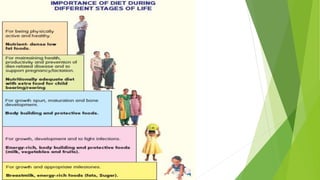
 Requirements of essential nutrients vary with age,
gender, physiological status and physical activity.
 Dietary intakes lower or higher than the body
requirements can lead to undernutrition (deficiency
diseases) or overnutrition (diseases of affluence)
respectively.
 Eating too little food during certain significant
periods of life such as infancy, childhood,
adolescence, pregnancy and lactation and eating too
much at any age can lead to harmful consequences.
 An adequate diet, providing all nutrients, is needed
throughout our lives.
 The nutrients must be obtained through a judicious
choice and combination of a variety of foodstuffs
from different food groups
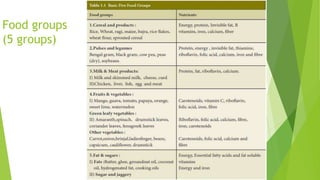
Food groups
(5 groups)
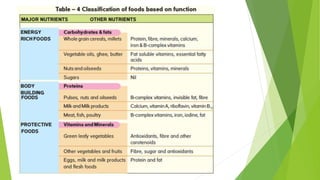
Food groups (4 groups)
FOOD GROUPS
1) Cereals and Pulse
2) Fruits and Vegetables
3) Milk and meat products
4) Fats and Sugars
It is the latest one from ICMR. It is similar to the 5
food group system . Only change is that pulses and
legumes is merged with cereals and millets
Balanced diet
 A balanced diet is one which provides all the nutrients in
required amounts and proper proportions.
 It can easily be achieved through a blend of the four
basic food groups.
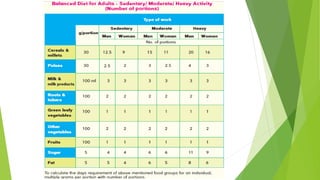
 The quantities of foods needed to meet the nutrient
requirements vary with age, gender, physiological status
and physical activity.
 A balanced diet should provide around 50-60% of total
calories from carbohydrates, preferably from complex
carbohydrates, about 10-15% from proteins and 20-30%
from both visible and invisible fat.
 In addition, a balanced diet should provide other
non-nutrients such as dietary fibre, antioxidants
and phytochemicals which bestow positive health
benefits.
 Antioxidants such as vitamins C and E, beta-
carotene, riboflavin and selenium protect the
human body from free radical damage.
 Other phytochemicals such as polyphenols,
flavones, etc., also afford protection against
oxidant damage. Spices like turmeric, ginger,
garlic, cumin and cloves are rich in antioxidants.
Nutrient requirements and
Recommended dietary allowances (RDA)
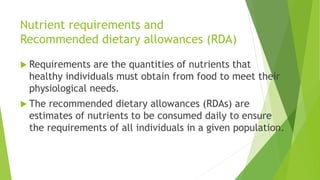
 Requirements are the quantities of nutrients that
healthy individuals must obtain from food to meet their
physiological needs.
 The recommended dietary allowances (RDAs) are
estimates of nutrients to be consumed daily to ensure
the requirements of all individuals in a given population.
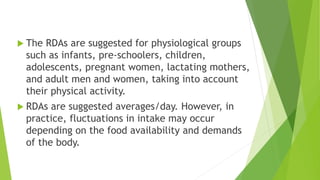
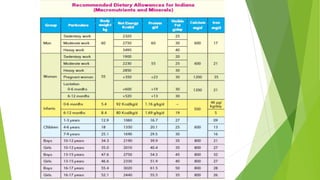
 The RDAs are suggested for physiological groups
such as infants, pre-schoolers, children,
adolescents, pregnant women, lactating mothers,
and adult men and women, taking into account
their physical activity.
 RDAs are suggested averages/day. However, in
practice, fluctuations in intake may occur
depending on the food availability and demands
of the body.
Meal planning/ Menu Planning (INDIA)

Meal planning/ Menu Planning (INDIA)

  • 1.
    MEAL PLANNING Source: NIN–ICMR BY: Pramod Machimada Appaiah
  • 2.
    INTRODUCTION  Nutrition isa basic human need and a prerequisite to a healthy life.  A proper diet is essential from the very early stages of life for proper growth, development and to remain active.  Food consumption, which largely depends on production and distribution, determines the health and nutritional status of the population.
  • 3.
     Apart fromsupplying nutrients, foods provide a host of other components (non-nutrient phytochemicals) which have a positive impact on health.  Since people consume food, it is essential to advocate nutrition in terms of foods, rather than nutrients.  Emphasis has, therefore, been shifted from a nutrient orientation to the food-based approach for attaining optimal nutritional status.
  • 4.
     Dietary guidelinesare a translation of scientific knowledge on nutrients into specific dietary advice.  They represent the recommended dietary allowances RDA of nutrients in terms of diets that should be consumed by the population.  The guidelines promote the concept of nutritionally adequate diets and healthy lifestyles from the time of conception to old age.
  • 5.
     The majorfood issues of concern are insufficient/ imbalanced intake of foods/nutrients.  The common nutritional problems of public health importance in India are Low birth weight Protein energy malnutrition in children Chronic energy deficiency in adults Micronutrient malnutrition and Diet-related noncommunicable diseases.
  • 6.
     The dietaryguidelines emphasize promotion of health and prevention of disease, of all age groups with special focus on vulnerable segments of the population such as infants, children and adolescents, pregnant and lactating women and the elderly.  Other related factors, which need consideration are physical activity, health care, safe water supply and socio-economic development, all of which strongly influence nutrition and health.
  • 7.
    DIETARY GOALS 1. Maintenanceof a state of positive health and optimal performance in populations at large by maintaining ideal body weight. 2. Ensuring adequate nutritional status for pregnant women and lactating mothers. 3. Improvement of birth weights and promotion of growth of infants, children and adolescents to achieve their full genetic potential.
  • 8.
    4. Achievement ofadequacy in all nutrients and prevention of deficiency diseases. 5. Prevention of chronic diet-related disorders. 6. Maintenance of the health of the elderly and increasing the life expectancy
  • 9.
    Principles of mealplanning  1.Meeting nutritional requirement: A good menu should provide adequate calories, fat and proteins along with minerals and vitamins. Energy distribution from carbohydrate protein and fat would be 7:1:2 respectively. The diet should contain basic four food groups.  2. Meal pattern should fulfil the individual needs: Meal pattern varies with age, occupation and life stages of an individual or family members. Also individual likes and dislikes, preferences like vegetarian or non-vegetarian, religion, tradition and customs of individual should be considered.
  • 10.
    3.Meal plan shouldsave time and energy 4.Meal planning should consider economic constraint 5.Meal plan should give maximum nutrients: Losses of nutrients during processing and cooking should be minimized. Good quality protein should be distributed in all meals.
  • 11.
    6.Meals planned shouldprovide variety 7.Meals should give satiety: Adequate protein, fat and fiber should be provided to give satiety. 8.Meals should include locally available and seasonal foods 9.Meals should include health foods: Ideal diets should provide besides nutrients those bioactive chemicals which can help to prevent and retard disease processes.
  • 12.
    DIETARY GUIDELINES 1. Eatvariety of foods to ensure a balanced diet. 2. Ensure provision of extra food and healthcare to pregnant and lactating women. 3. Promote exclusive breastfeeding for six months and encourage breastfeeding till two years or as long as one can. 4. Feed home based semi solid foods to the infant after six months.
  • 13.
    5. Ensure adequateand appropriate diets for children and adolescents, both in health and sickness. 6. Eat plenty of vegetables and fruits. 7. Ensure moderate use of edible oils and animal foods and very less use of ghee/ butter/ vanaspati. 8. Avoid overeating to prevent overweight and obesity. 9. Exercise regularly and be physically active to maintain ideal body weight. 10. Restrict salt intake to minimum.
  • 14.
    11. Ensure theuse of safe and clean foods. 12. Adopt right pre-cooking processes and appropriate cooking methods. 13. Drink plenty of water and take beverages in moderation. 14. Minimize the use of processed foods rich in salt, sugar and fats. 15. Include micronutrient-rich foods in the diets of elderly people to enable them to be fit and active.
  • 15.
    Nutritionally adequate food Nutrients that we obtain through food have vital effects on physical growth and development, maintenance of normal body function, physical activity and health.  NAF is needed to sustain life and activity.  Requirements of essential nutrients vary with age, gender, physiological status and physical activity.  Dietary intakes lower or higher than the body requirements can lead to undernutrition (deficiency diseases) or overnutrition (diseases of affluence) respectively.
  • 16.
     Eating toolittle food during certain significant periods of life such as infancy, childhood, adolescence, pregnancy and lactation and eating too much at any age can lead to harmful consequences.  An adequate diet, providing all nutrients, is needed throughout our lives.  The nutrients must be obtained through a judicious choice and combination of a variety of foodstuffs from different food groups
  • 17.
  • 18.
    Food groups (4groups) FOOD GROUPS 1) Cereals and Pulse 2) Fruits and Vegetables 3) Milk and meat products 4) Fats and Sugars It is the latest one from ICMR. It is similar to the 5 food group system . Only change is that pulses and legumes is merged with cereals and millets
  • 21.
    Balanced diet  Abalanced diet is one which provides all the nutrients in required amounts and proper proportions.  It can easily be achieved through a blend of the four basic food groups.  The quantities of foods needed to meet the nutrient requirements vary with age, gender, physiological status and physical activity.  A balanced diet should provide around 50-60% of total calories from carbohydrates, preferably from complex carbohydrates, about 10-15% from proteins and 20-30% from both visible and invisible fat.
  • 22.
     In addition,a balanced diet should provide other non-nutrients such as dietary fibre, antioxidants and phytochemicals which bestow positive health benefits.  Antioxidants such as vitamins C and E, beta- carotene, riboflavin and selenium protect the human body from free radical damage.  Other phytochemicals such as polyphenols, flavones, etc., also afford protection against oxidant damage. Spices like turmeric, ginger, garlic, cumin and cloves are rich in antioxidants.
  • 23.
    Nutrient requirements and Recommendeddietary allowances (RDA)  Requirements are the quantities of nutrients that healthy individuals must obtain from food to meet their physiological needs.  The recommended dietary allowances (RDAs) are estimates of nutrients to be consumed daily to ensure the requirements of all individuals in a given population.
  • 24.
     The RDAsare suggested for physiological groups such as infants, pre-schoolers, children, adolescents, pregnant women, lactating mothers, and adult men and women, taking into account their physical activity.  RDAs are suggested averages/day. However, in practice, fluctuations in intake may occur depending on the food availability and demands of the body.