CAS 06-101P
GROUP1
Chapter II
HUMAN
DEVELOPMENT
Submitted to:
Prof. Agnes Montalbo
Rizal Technological University
Submitted by:
Abesamis, Maria Sofia C.
Abeto, Ma. Mercedes P.
Aguila, Arjay D.
Alegre, Jenica R.
Aquino, Joegema A.
Areglado,Ivan Camille P.
Chapter II
NATURE AND NURTURE
NATURE refers to the
heredity
NURTURE refers to the
influence of
the environment
NATURE AND NURTURE
NATURE refers to the
heredity
NURTURE
refers to the
influence of
the environment
DEVELOPMENT –is a continuous
progression that occurs in an individual as
a result of maturation.
•
•
 COGNITIVE PROCESS – development gains from simple (concrete)
to the more complex one.
 MATURATION-refers to the chronological characteristic of
biological growth and development.
PERIODS OF
DEVELOPMENT
Reported by :
Ma. Mercedes P. Abeto
CAS-06-101P
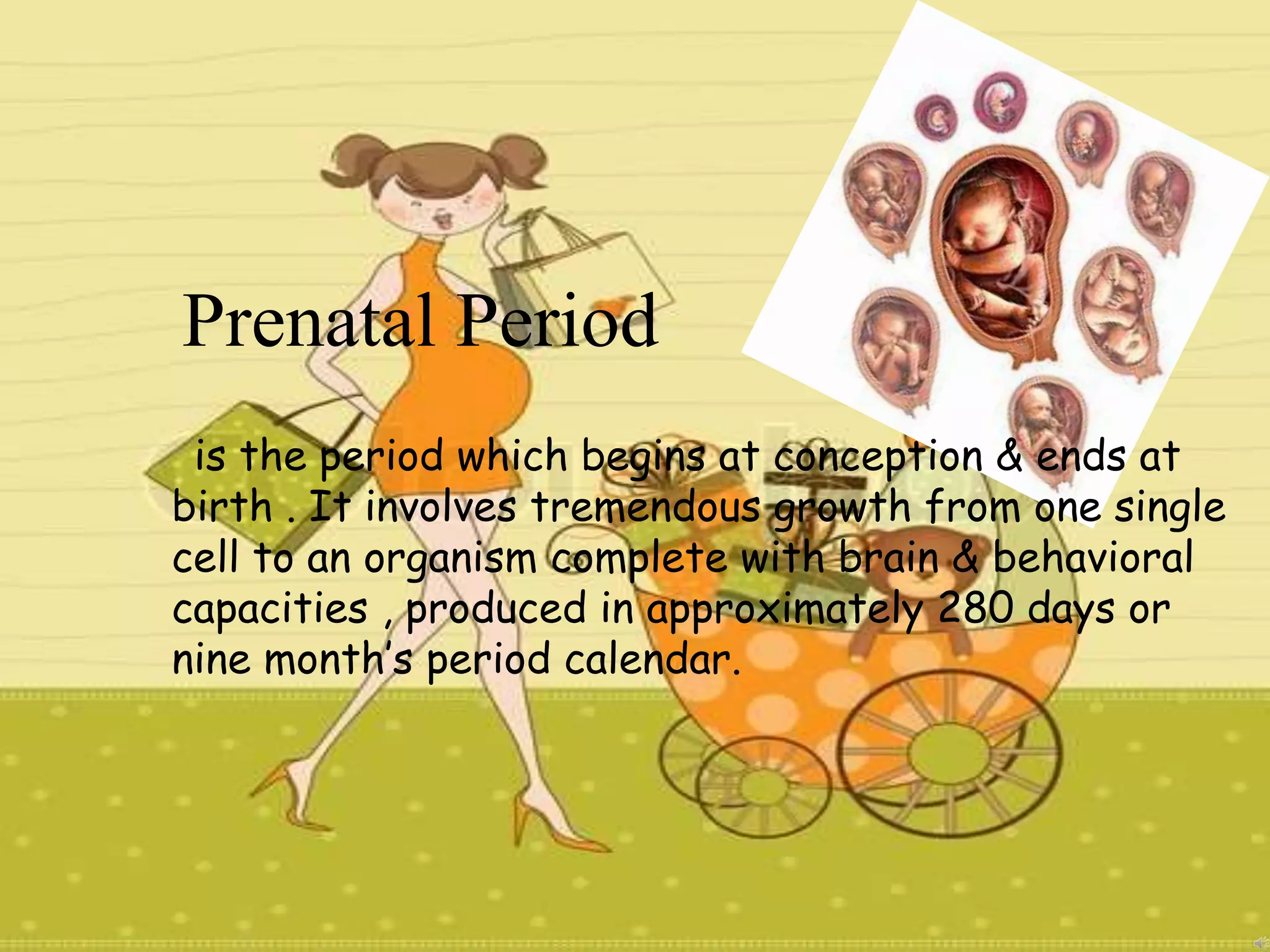
Prenatal Period
is the period which begins at conception & ends at
birth . It involves tremendous growth from one single
cell to an organism complete with brain & behavioral
capacities , produced in approximately 280 days or
nine month’s period calendar.
There are six characteristics to
be remembered during this period
that could affect the development
of the child in later years. They are
as follows :
1. During this period , the heredity endowment is already fixed
2. The sex of the newly created individual is fixed at the time
conception.
3. The mother’s favorable conditions during this period can fos
development, while the unfavorable conditions can hamper the
development of the child.
4. There is a rapid grow & development during this time.
5. Prenatal period is a time of many hazards, both physical
psychological.
6. This is the time when significant people from attitudes
newly created individuals.
Chromosomes
- Any of the rod shape or thread like DNA
containing structures of cellular organisms
that contain most or all of the genes of the organisms.
- Human body has a total of 46 chromosomes in each cell.
- 23 chromosomes come from the mother’s egg & 23 are f
father’s sperm.
- Dominant characteristics are determined by the 22 pairs o
chromosomes called autosomes while the last pair determines
of the person described as sex chromosomes.
Genes
- A part of DNA or RNA that contains
chemical information needed to make a
particular protein ( as an enzyme ) controlling or
influencing an inherited bodily trait. A gene is a molecular
unit of heredity of a living organism
DNA
- ( Deoxyribonucleic acid ) any of various
Nucleic acids that are usually the molecular
basis of heredity & are localized esp. in cell nuclei.
- The smallest particle of a substance that still has all the
properties of that substance.
- DNA consists of two strands , each composed of certain su
phosphates.
Determination of Gender
- Determination of the individual’s sex
would depend on the kind of spermatozoon
that unites with the ovum.
- XY then the baby is boy.
- XX then the baby is girl.
- The chromosomal portraits or karyotypes reveal that 22
pairs of chromosomes found in human beings.
Prenatal development is divided into
three periods :
1. The Germinal Period or the Zygote Period
- This is the start of fertilization & ends at second week
The size of the zygote is that of a pinhead.
- The zygote passes down the fallopian tube to the uterus.
It divides many times & the zygote attaches to the uterine w
• the blastocyst – inner layer of the cell
• the trophoblast – outer layer of the cell
2. The Embryonic Period
This refers to the period of prenatal development that
occurs from two to eight weeks after conception. This is the pe
of rapid cell division& differentiation. As the cell divides , the v
& major body structures are formed. As the zygote attaches th
wall , the zygote changes the embryo & forms three layers of th
• Embryo’s endoderm
• Ectoderm
• Mesoderm
Embryo’s layer’s forms the life support systems , the embryo al
& matures. These life support system include the placenta , the
cord & the amnion.
• Placenta – disk-shaped group of tissues
• Umbilical Cord- containing two arteries & one vein that connec
the placenta.
• Amnion- a bag or an envelope that contains a clear fluid in whi
developing embryo floats.
3. The Fetal Period
The actual fetal period starts
after 3 months when the baby can be called a fetus. By the fou
the baby develops the hair & nails. His genitals can be distingui
the kidneys give bodily fluids..
INFANCY
Infancy stage of human development
lasts from birth to approximately
two years of age.
Prepared by Ivan
Camille Areglado
CAS-06 101P
HAZARDS OF INFANCY
-UNFAVORABLE PRENATAL ENVIRONMENT
-A DIFFICULT AND COMPLICATED BIRTH
-A MULTIPLE BIRTH
-POSTMATURITY
-PREMATURITY
-INFANT MORTALITY
MAJOR REFLEXES PRESENT
IN FULL-TERM NEONATE
SURVIVAL REFLEX
-BREATHING REFLEX
-EYEBLINK REFLEX
-PUPILLARY REFLEX
-ROOTING REFLEX
-SUCKING REFLEX
-SWALLOWING REFLEX
PRIMITIVE REFLEXES
-BABINSKI REFLEX
-GRASPING REFLEX
-MORO REFLEX
-SWIMMING REFLEX
-STEPPING REFLEX
BABYHOOD
BABYHOOD IS FROM TWO
WEEKS TO TWO YEARS
OF LIFE SPAN.
HAZARDS IN BABYHOOD
THERE ARE CERTAIN HAZARDS THAT
ARE MORE COMMON DURING THIS
PERIOD THAN AT OTHER AGES.
-ILLNESSES AND ACCIDENTS
-CRIB DEATH
-MALNUTRITION
-FAILURE TO MASTER DEVELOPMENTAL TASK
-MOTOR DEVELOPMENT IS DELAYED
-SPEECH HAZARD
EARLY CHILDHOOD
THE AVERAGE CHILD
GROWS 2 ½ INCHES IN
HEIGHT AND GAINS
BETWEEN 5-6 POUNDS
A YEAR DURING EARLY
CHILDHOOD
WHY SOME CHILDREN
ARE UNUSUALLY SHORT ?
HERE ARE SOME REASONS WHY SOME
CHILDREN ARE UNUSUALLY SHORT
-CONGENITAL FACTORS WHICH ARE
GENETIC OR PARENTAL PROBLEM
-PHYSICAL PROBLEM OR EMOTIONAL DIFFICULTY
-GROWTH HORMONE DEFICIENCY
3 THEORIES COVERED IN
THIS STAGE
-PREOPERATIONAL
-SOCIAL CONSTRUCTIVIST APPROACH
-ZONE PROXIMAL DEVELOPMENT
-INFORMATION PROCESSING (EXECUTIVE ATTENTION AND
SUSTAINED ATTENTION)
Report by:
Maria Sofia C.
Abesamis
memory
The memory span in the
respect varies from one
individual to another. In
short term memory one
retain information for up to
30 seconds if there is no
practice of information.
Late childhood
 Its begin at 7 t0 12 or 13 years old.
 Changes in height and weight.
 For boys - running
speed and ability to
jump.
 For girls - rhythm and
ability to hop.
Gradually developed the
preoperational stage and
concrete stage..
Hazards of early and late
childhood
 Illness  Obesity
 Unattractiveness  accidents
 Akwardness  Homeliness
Puberty
 Cames from the word “pubertas” which
means AGE OF MANHOOD.
 Its an overlapping period..
 For girls at age of 11 to 15 years old.
 For boys at age of 12 to 16.
 Also the time of rapid growth and
changes.
 Changes in status toward to their
opposite sex.
 Also parent and children relationship
and regulation
 Among noticeable changes are sign of
sexual maturation and increases to their
height and weight.
 For female …
 enlargement of the breast
 pubic hair appearance.
 hair in armpit and hips become wider
than shoulder.
Menarche
 Its refers to a girl’s
menstruation.
 It starts at age of 11.
But sometimes its
start as earlier as 9
or late as 15.
 For boys at age by
14, they begin to
surpass girls.
Hormones are powerful
chemical substances secreted
by the endocrine glands..
Hypothalamus
Pituitary glands
Gonands (testes & ovaries)
Testosteron and estradiol
Hazards of puberty
 The hazards of puberty are due to slight
or major malfunctioning of the endocrine
glands that control the puberty growth
spurts and the sexual changes that take
place.
 Common psychology hazards….
 Underachivement
 Lack of preparation for the changes.
 Dissatisfied with their changed bodies
 Their acceptance approved sex roles
 The deviation in sexual maturing
Arjay D. Aguila
CAS-06-101P
The term adolescence comes from the Latin word
“Adolescere” which means “to grow to maturity”.
Adolescence Is the period between puberty to adulthood,
adolescence is divided into early and late adolescence.
Early adolescence is from 13-16 or 17 years and Late
adolescence covers the period from then to up to 18.
Starts in the age of 13 and ends up when you are 16 or
17. At this stage they are considered and labeled by
parents and teachers as a problem stage, because of
their inability to cope with their problem alone as well
as they believe they can. Physical changes in our body
starts to occur in this stage.
From 17 to 18 years old. In this stage a person starts to
face the reality that he is turning to be an adult.
Responsibilities comes in this stage like helping their
parents or those people around him/her. A person starts to
be matured in this stage he already know what is the right
or wrong thing to do.
~The physical hazards among adolescence are illness, physical
defects, clumsiness, awkwardness and sex-inappropriate body
build.
~Psychological hazards in adolescence are evidenced by their
immaturity in the areas of social behavior, sexual behavior, moral
and family relationships.
~Adulthood is divided into three stages. Early adulthood
is from 20 years old to 40 years of age, middle adulthood
is from 40-60 years of age, and the late adulthood or
senescence ranges from 60 to death.
Early adulthood is the stage of personal need for intimacy and
sex. Failure to achieve this need results in isolation and
avoidance, and as a result they strive for love ad compassion or
they will sublimate. The young adult learns that love and
compassion may be rewarding.
Physical unattractiveness
~are usually the common hazards in early
adulthood because this becomes detrimental to the
individuals personal and social adjustments.
In midlife, as in another age periods, individual
makes choices, select what to do, invest time and
resources, and evaluate what aspects of their lives
they need to change. This is the time when major
restructuring of time and reassessment of life’s
priorities takes place
One of the most visible signs in physical changes in
middle adulthood is physical appearance.
Vision and hearing are also affected in this stage.
The common hazards of middle adulthood that affect the social adjustment are
acceptance of the “rocking chair” philosophy, lack of social skills
preference for family contacts and financial problems.
Late adulthood is the closing period in the
life-span which begins at sixty years and
characterized by physical and psychological
changes that are leading to poor adjustments
and unhappiness.
There are notions that
women live longer than men.
Cancer of the respiratory system, motorcycle accidents, cirrhosis of the liver,
emphysema, and coronary heart disease are the leading causes of death for
men.
Common hazards in late
adulthood
~diseases, malnutrition, dental
disorders, accidents, poor eyesight,
loss of hearing, sensitivity to pain.
Presented by:
Joegema A. Aquino
Biological Theories of Aging
1. Cellular Clock
Theory
Leonard Hayflick(1997)
stated that cells can
divide a maximum of 75
to 80 times and become
less capable of dividing.
2. Free Radical Theory
States that people age because
when cells metabolize energy, the
by- product include unstable oxygen
molecules known as free radicals.
3. Mitochondrial Theory
State that aging is due to the
decay of mitochondria. It appear
that this decay is primarily due to
oxidative damage and loss of
critical micronutrients supplied by
the cell.
4. Hormonal Stress Theory
This theory argues that
aging in the body’s
hormonal system
can lower resistance
to stress and
increase the likelihood of
disease.
Theories of Development
Cognitive Development
by Jean Piaget
Cognitive development is
a study in development in terms of
information processing, conceptual
resources, perceptual skill, language
learning, and other aspects of brain
development ..It had four stages.
Cognitive Development
Sensorimotor
(Birth-2 yrs.)
Differentiates self from objects.
Recognizes self as agent of action
and begins to act intentionally.
Achieves object permanence.
Preoperational
(2-7 yrs.)
Learns to use language and to
represent objects by images
and words.
Thinking is still egocentric
Classifies objects by single
feature.
Concrete Operational
(7-11 yrs.)
Can think logically about
objects and events.
Achieves conservation of
number.
Classifies objects according
to several features.
Formal Operational
(11 yrs.-up)
Can think logically about
abstract proposition and test
hypotheses systematically.
Becomes concerned with the
hypothetical, the future and
ideological problems.
Psychoanalytic Theory
This theory was expounded by
Sigmund Freud. In this theory describe
development as primarily unconscious
and heavily colored by emotion. It also
emphasize that behavior is merely a
surface characteristic and that a true
understanding of development requires
analyzing the symbolic meaning of behavior
and the deep inner working of the mind.
Psychosexual Stages
Psychosexual Stages
and Characteristics
Oral Stage (Birth- 1 ½ yrs.)
- Infant’s pleasure centers on the mouth.
Anal Stage (1 ½ - 3 yrs.)
- Child’s pleasure focuses on the anus.
Phallic Stage (3-6 yrs.)
- Child’s pleasure focuses on the genitals.
Latency Stage (6 – Puberty)
- Child represses sexual interest and develops
social and intellectual skills.
Genital Stage (Puberty Onward)
- A time of sexual reawakening.
Erikson’s Psychosocial Theory/
Development Period
Erikson's stage theory
characterizes an individual
advancing through the eight
life stages as a function of
negotiating his or her
biological forces and
sociocultural forces.
Erikson VS Freud
Most of the theories of Erikson are
contrast to the theories of Freud.
Erikson VS Freud
Erik Erikson
it is social and
reflects a to affiliate
with other people.
developmental
change occurs
throughout the life
span.
Sigmund Freud
Human behavior is
sexual in nature.
basic personality is
shaped in the first
5 years of life.
Erikson VS Freud
Erik Erikson
emphasis the
importance of
both early and
the later
experiences.
Sigmund Freud
early
experience is
far more
important than
later ones.
Trust vs.
Mistrust
Infancy
(1st year)
Autonomy vs.
Shame and Doubt
Infancy
(1-3 yrs.)
Initiative vs.
Guilt
Early childhood
(Preschool yrs.
3-5 yrs.)
Industry vs.
Inferiority
Middle and late
childhood
(Elementary school
yrs. 6 to puberty.)
Psychosocial Stages and
Developmental Period
Identity vs.
Identity
Confusion
Adolescence
(10 -20 yrs.)
Intimacy vs.
Isolation
Early adulthood
(20 -40 yrs.)
Generativity vs.
Stagnation
Middle adulthood
(40- 60 yrs.)
Integrity vs.
Despair
Late adulthood
(60 onwards)
Psychosocial Stages and
Developmental Period
Vygotsky’s Sociocultural
Cognitive Theory
Lev Vygotsky believed
that children actively
construct their
knowledge. But he gave
more emphasis on social
interaction and culture as
an important role in the
cognitive development.
The Information –
Processing Theory
Machines “ Founding
Father” of the
information- processing
theory .None was more
important than the
computer. Individuals
develop a gradually
increasing capacity for
processing information.
FIN :D
Hope You Liked it and
Learned from it….

Human Development Psychology

  • 1.
  • 2.
    Submitted to: Prof. AgnesMontalbo Rizal Technological University Submitted by: Abesamis, Maria Sofia C. Abeto, Ma. Mercedes P. Aguila, Arjay D. Alegre, Jenica R. Aquino, Joegema A. Areglado,Ivan Camille P.
  • 3.
  • 5.
    NATURE AND NURTURE NATURErefers to the heredity NURTURE refers to the influence of the environment NATURE AND NURTURE NATURE refers to the heredity NURTURE refers to the influence of the environment
  • 6.
    DEVELOPMENT –is acontinuous progression that occurs in an individual as a result of maturation.
  • 7.
  • 8.
     COGNITIVE PROCESS– development gains from simple (concrete) to the more complex one.  MATURATION-refers to the chronological characteristic of biological growth and development.
  • 9.
    PERIODS OF DEVELOPMENT Reported by: Ma. Mercedes P. Abeto CAS-06-101P
  • 10.
    Prenatal Period is theperiod which begins at conception & ends at birth . It involves tremendous growth from one single cell to an organism complete with brain & behavioral capacities , produced in approximately 280 days or nine month’s period calendar.
  • 11.
    There are sixcharacteristics to be remembered during this period that could affect the development of the child in later years. They are as follows : 1. During this period , the heredity endowment is already fixed 2. The sex of the newly created individual is fixed at the time conception. 3. The mother’s favorable conditions during this period can fos development, while the unfavorable conditions can hamper the development of the child.
  • 12.
    4. There isa rapid grow & development during this time. 5. Prenatal period is a time of many hazards, both physical psychological. 6. This is the time when significant people from attitudes newly created individuals.
  • 13.
    Chromosomes - Any ofthe rod shape or thread like DNA containing structures of cellular organisms that contain most or all of the genes of the organisms. - Human body has a total of 46 chromosomes in each cell. - 23 chromosomes come from the mother’s egg & 23 are f father’s sperm. - Dominant characteristics are determined by the 22 pairs o chromosomes called autosomes while the last pair determines of the person described as sex chromosomes.
  • 14.
    Genes - A partof DNA or RNA that contains chemical information needed to make a particular protein ( as an enzyme ) controlling or influencing an inherited bodily trait. A gene is a molecular unit of heredity of a living organism
  • 15.
    DNA - ( Deoxyribonucleicacid ) any of various Nucleic acids that are usually the molecular basis of heredity & are localized esp. in cell nuclei. - The smallest particle of a substance that still has all the properties of that substance. - DNA consists of two strands , each composed of certain su phosphates.
  • 16.
    Determination of Gender -Determination of the individual’s sex would depend on the kind of spermatozoon that unites with the ovum. - XY then the baby is boy. - XX then the baby is girl. - The chromosomal portraits or karyotypes reveal that 22 pairs of chromosomes found in human beings.
  • 17.
    Prenatal development isdivided into three periods : 1. The Germinal Period or the Zygote Period - This is the start of fertilization & ends at second week The size of the zygote is that of a pinhead. - The zygote passes down the fallopian tube to the uterus. It divides many times & the zygote attaches to the uterine w • the blastocyst – inner layer of the cell • the trophoblast – outer layer of the cell
  • 18.
    2. The EmbryonicPeriod This refers to the period of prenatal development that occurs from two to eight weeks after conception. This is the pe of rapid cell division& differentiation. As the cell divides , the v & major body structures are formed. As the zygote attaches th wall , the zygote changes the embryo & forms three layers of th • Embryo’s endoderm • Ectoderm • Mesoderm
  • 19.
    Embryo’s layer’s formsthe life support systems , the embryo al & matures. These life support system include the placenta , the cord & the amnion. • Placenta – disk-shaped group of tissues • Umbilical Cord- containing two arteries & one vein that connec the placenta. • Amnion- a bag or an envelope that contains a clear fluid in whi developing embryo floats.
  • 20.
    3. The FetalPeriod The actual fetal period starts after 3 months when the baby can be called a fetus. By the fou the baby develops the hair & nails. His genitals can be distingui the kidneys give bodily fluids..
  • 21.
    INFANCY Infancy stage ofhuman development lasts from birth to approximately two years of age. Prepared by Ivan Camille Areglado CAS-06 101P
  • 22.
    HAZARDS OF INFANCY -UNFAVORABLEPRENATAL ENVIRONMENT -A DIFFICULT AND COMPLICATED BIRTH -A MULTIPLE BIRTH -POSTMATURITY -PREMATURITY -INFANT MORTALITY
  • 23.
    MAJOR REFLEXES PRESENT INFULL-TERM NEONATE SURVIVAL REFLEX -BREATHING REFLEX -EYEBLINK REFLEX -PUPILLARY REFLEX -ROOTING REFLEX -SUCKING REFLEX -SWALLOWING REFLEX
  • 24.
    PRIMITIVE REFLEXES -BABINSKI REFLEX -GRASPINGREFLEX -MORO REFLEX -SWIMMING REFLEX -STEPPING REFLEX
  • 25.
    BABYHOOD BABYHOOD IS FROMTWO WEEKS TO TWO YEARS OF LIFE SPAN.
  • 26.
    HAZARDS IN BABYHOOD THEREARE CERTAIN HAZARDS THAT ARE MORE COMMON DURING THIS PERIOD THAN AT OTHER AGES. -ILLNESSES AND ACCIDENTS -CRIB DEATH -MALNUTRITION -FAILURE TO MASTER DEVELOPMENTAL TASK -MOTOR DEVELOPMENT IS DELAYED -SPEECH HAZARD
  • 27.
    EARLY CHILDHOOD THE AVERAGECHILD GROWS 2 ½ INCHES IN HEIGHT AND GAINS BETWEEN 5-6 POUNDS A YEAR DURING EARLY CHILDHOOD
  • 28.
    WHY SOME CHILDREN AREUNUSUALLY SHORT ?
  • 29.
    HERE ARE SOMEREASONS WHY SOME CHILDREN ARE UNUSUALLY SHORT -CONGENITAL FACTORS WHICH ARE GENETIC OR PARENTAL PROBLEM -PHYSICAL PROBLEM OR EMOTIONAL DIFFICULTY -GROWTH HORMONE DEFICIENCY
  • 30.
    3 THEORIES COVEREDIN THIS STAGE -PREOPERATIONAL -SOCIAL CONSTRUCTIVIST APPROACH -ZONE PROXIMAL DEVELOPMENT -INFORMATION PROCESSING (EXECUTIVE ATTENTION AND SUSTAINED ATTENTION)
  • 31.
  • 32.
    memory The memory spanin the respect varies from one individual to another. In short term memory one retain information for up to 30 seconds if there is no practice of information.
  • 33.
    Late childhood  Itsbegin at 7 t0 12 or 13 years old.  Changes in height and weight.
  • 34.
     For boys- running speed and ability to jump.  For girls - rhythm and ability to hop.
  • 35.
    Gradually developed the preoperationalstage and concrete stage..
  • 36.
    Hazards of earlyand late childhood  Illness  Obesity
  • 37.
  • 38.
  • 39.
    Puberty  Cames fromthe word “pubertas” which means AGE OF MANHOOD.  Its an overlapping period..  For girls at age of 11 to 15 years old.  For boys at age of 12 to 16.
  • 40.
     Also thetime of rapid growth and changes.  Changes in status toward to their opposite sex.  Also parent and children relationship and regulation
  • 41.
     Among noticeablechanges are sign of sexual maturation and increases to their height and weight.  For female …  enlargement of the breast  pubic hair appearance.  hair in armpit and hips become wider than shoulder.
  • 42.
    Menarche  Its refersto a girl’s menstruation.  It starts at age of 11. But sometimes its start as earlier as 9 or late as 15.  For boys at age by 14, they begin to surpass girls.
  • 43.
    Hormones are powerful chemicalsubstances secreted by the endocrine glands.. Hypothalamus Pituitary glands Gonands (testes & ovaries) Testosteron and estradiol
  • 44.
    Hazards of puberty The hazards of puberty are due to slight or major malfunctioning of the endocrine glands that control the puberty growth spurts and the sexual changes that take place.
  • 45.
     Common psychologyhazards….  Underachivement
  • 46.
     Lack ofpreparation for the changes.
  • 47.
     Dissatisfied withtheir changed bodies
  • 48.
     Their acceptanceapproved sex roles
  • 49.
     The deviationin sexual maturing
  • 50.
  • 51.
    The term adolescencecomes from the Latin word “Adolescere” which means “to grow to maturity”. Adolescence Is the period between puberty to adulthood, adolescence is divided into early and late adolescence. Early adolescence is from 13-16 or 17 years and Late adolescence covers the period from then to up to 18.
  • 52.
    Starts in theage of 13 and ends up when you are 16 or 17. At this stage they are considered and labeled by parents and teachers as a problem stage, because of their inability to cope with their problem alone as well as they believe they can. Physical changes in our body starts to occur in this stage.
  • 53.
    From 17 to18 years old. In this stage a person starts to face the reality that he is turning to be an adult. Responsibilities comes in this stage like helping their parents or those people around him/her. A person starts to be matured in this stage he already know what is the right or wrong thing to do.
  • 54.
    ~The physical hazardsamong adolescence are illness, physical defects, clumsiness, awkwardness and sex-inappropriate body build. ~Psychological hazards in adolescence are evidenced by their immaturity in the areas of social behavior, sexual behavior, moral and family relationships.
  • 55.
    ~Adulthood is dividedinto three stages. Early adulthood is from 20 years old to 40 years of age, middle adulthood is from 40-60 years of age, and the late adulthood or senescence ranges from 60 to death.
  • 56.
    Early adulthood isthe stage of personal need for intimacy and sex. Failure to achieve this need results in isolation and avoidance, and as a result they strive for love ad compassion or they will sublimate. The young adult learns that love and compassion may be rewarding.
  • 57.
    Physical unattractiveness ~are usuallythe common hazards in early adulthood because this becomes detrimental to the individuals personal and social adjustments.
  • 58.
    In midlife, asin another age periods, individual makes choices, select what to do, invest time and resources, and evaluate what aspects of their lives they need to change. This is the time when major restructuring of time and reassessment of life’s priorities takes place
  • 59.
    One of themost visible signs in physical changes in middle adulthood is physical appearance. Vision and hearing are also affected in this stage. The common hazards of middle adulthood that affect the social adjustment are acceptance of the “rocking chair” philosophy, lack of social skills preference for family contacts and financial problems.
  • 60.
    Late adulthood isthe closing period in the life-span which begins at sixty years and characterized by physical and psychological changes that are leading to poor adjustments and unhappiness.
  • 61.
    There are notionsthat women live longer than men. Cancer of the respiratory system, motorcycle accidents, cirrhosis of the liver, emphysema, and coronary heart disease are the leading causes of death for men.
  • 62.
    Common hazards inlate adulthood ~diseases, malnutrition, dental disorders, accidents, poor eyesight, loss of hearing, sensitivity to pain.
  • 64.
  • 66.
    Biological Theories ofAging 1. Cellular Clock Theory Leonard Hayflick(1997) stated that cells can divide a maximum of 75 to 80 times and become less capable of dividing.
  • 67.
    2. Free RadicalTheory States that people age because when cells metabolize energy, the by- product include unstable oxygen molecules known as free radicals.
  • 68.
    3. Mitochondrial Theory Statethat aging is due to the decay of mitochondria. It appear that this decay is primarily due to oxidative damage and loss of critical micronutrients supplied by the cell.
  • 69.
    4. Hormonal StressTheory This theory argues that aging in the body’s hormonal system can lower resistance to stress and increase the likelihood of disease.
  • 70.
    Theories of Development CognitiveDevelopment by Jean Piaget Cognitive development is a study in development in terms of information processing, conceptual resources, perceptual skill, language learning, and other aspects of brain development ..It had four stages.
  • 71.
  • 72.
    Sensorimotor (Birth-2 yrs.) Differentiates selffrom objects. Recognizes self as agent of action and begins to act intentionally. Achieves object permanence.
  • 73.
    Preoperational (2-7 yrs.) Learns touse language and to represent objects by images and words. Thinking is still egocentric Classifies objects by single feature.
  • 74.
    Concrete Operational (7-11 yrs.) Canthink logically about objects and events. Achieves conservation of number. Classifies objects according to several features.
  • 75.
    Formal Operational (11 yrs.-up) Canthink logically about abstract proposition and test hypotheses systematically. Becomes concerned with the hypothetical, the future and ideological problems.
  • 76.
    Psychoanalytic Theory This theorywas expounded by Sigmund Freud. In this theory describe development as primarily unconscious and heavily colored by emotion. It also emphasize that behavior is merely a surface characteristic and that a true understanding of development requires analyzing the symbolic meaning of behavior and the deep inner working of the mind.
  • 77.
  • 78.
    Psychosexual Stages and Characteristics OralStage (Birth- 1 ½ yrs.) - Infant’s pleasure centers on the mouth. Anal Stage (1 ½ - 3 yrs.) - Child’s pleasure focuses on the anus. Phallic Stage (3-6 yrs.) - Child’s pleasure focuses on the genitals. Latency Stage (6 – Puberty) - Child represses sexual interest and develops social and intellectual skills. Genital Stage (Puberty Onward) - A time of sexual reawakening.
  • 79.
    Erikson’s Psychosocial Theory/ DevelopmentPeriod Erikson's stage theory characterizes an individual advancing through the eight life stages as a function of negotiating his or her biological forces and sociocultural forces.
  • 80.
    Erikson VS Freud Mostof the theories of Erikson are contrast to the theories of Freud.
  • 81.
    Erikson VS Freud ErikErikson it is social and reflects a to affiliate with other people. developmental change occurs throughout the life span. Sigmund Freud Human behavior is sexual in nature. basic personality is shaped in the first 5 years of life.
  • 82.
    Erikson VS Freud ErikErikson emphasis the importance of both early and the later experiences. Sigmund Freud early experience is far more important than later ones.
  • 84.
    Trust vs. Mistrust Infancy (1st year) Autonomyvs. Shame and Doubt Infancy (1-3 yrs.) Initiative vs. Guilt Early childhood (Preschool yrs. 3-5 yrs.) Industry vs. Inferiority Middle and late childhood (Elementary school yrs. 6 to puberty.) Psychosocial Stages and Developmental Period
  • 85.
    Identity vs. Identity Confusion Adolescence (10 -20yrs.) Intimacy vs. Isolation Early adulthood (20 -40 yrs.) Generativity vs. Stagnation Middle adulthood (40- 60 yrs.) Integrity vs. Despair Late adulthood (60 onwards) Psychosocial Stages and Developmental Period
  • 86.
    Vygotsky’s Sociocultural Cognitive Theory LevVygotsky believed that children actively construct their knowledge. But he gave more emphasis on social interaction and culture as an important role in the cognitive development.
  • 87.
    The Information – ProcessingTheory Machines “ Founding Father” of the information- processing theory .None was more important than the computer. Individuals develop a gradually increasing capacity for processing information.
  • 88.
    FIN :D Hope YouLiked it and Learned from it….