LESSON 2:
DEVELOPING
THE WHOLE
PERSON
How are you
today?
ADOLESCENCE
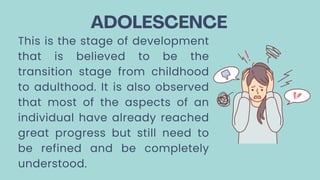
This is the stage of development
that is believed to be the
transition stage from childhood
to adulthood. It is also observed
that most of the aspects of an
individual have already reached
great progress but still need to
be refined and be completely
understood.
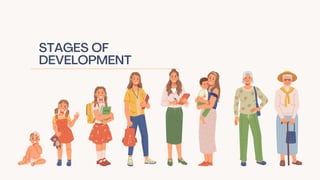
STAGES OF
DEVELOPMENT
PHYSIOLOGICAL
DEVELOPMENT
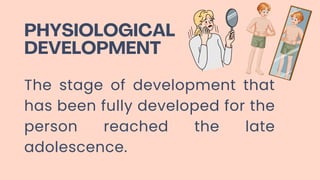
The stage of development that
has been fully developed for the
person reached the late
adolescence.
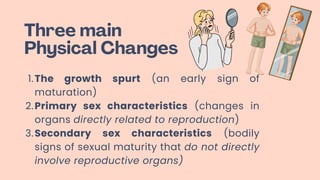
Three main
Physical Changes
The growth spurt (an early sign of
maturation)
1.
Primary sex characteristics (changes in
organs directly related to reproduction)
2.
Secondary sex characteristics (bodily
signs of sexual maturity that do not directly
involve reproductive organs)
3.
This is also known as intellectual changes. It is during
this stage that an adolescent is capable of using
his/her higher level of thinking. Rather than asking
questions of what, why, and how just like the most
children do during the childhood stage teenagers are
capable of making their hypothesis and investigate
for the truth and not being satisfied of believing
what is said to them.
COGNITIVE
DEVELOPMENT
STAGES OF COGNITIVE
DEVELOPMENT
SENSORIMOTOR STAGE : birth to 2 years old
1.
PREOPERATIONAL STAGE: ages 2 to 7 years old
2.
CONCREATE OPERATIONAL STAGE: ages 7 to 11
3.
FORMAL OPERATIONAL STAGE: ages 12 and up
4.
PSYCHOLOGICAL
DEVELOPMENT
Erik Erikson's Theory of development attempted
to explain the changes that occur in child's
psychosocial development while Lev Vygotsky
Theory of development concentrated on
psychological development.
PSYCHOLOGICAL
DEVELOPMENT
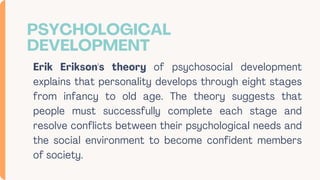
Erik Erikson's theory of psychosocial development
explains that personality develops through eight stages
from infancy to old age. The theory suggests that
people must successfully complete each stage and
resolve conflicts between their psychological needs and
the social environment to become confident members
of society.
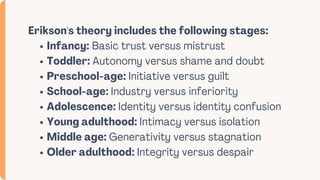
Erikson's theory includes the following stages:
Infancy: Basic trust versus mistrust
Toddler: Autonomy versus shame and doubt
Preschool-age: Initiative versus guilt
School-age: Industry versus inferiority
Adolescence: Identity versus identity confusion
Young adulthood: Intimacy versus isolation
Middle age: Generativity versus stagnation
Older adulthood: Integrity versus despair
PSYCHOLOGICAL
DEVELOPMENT
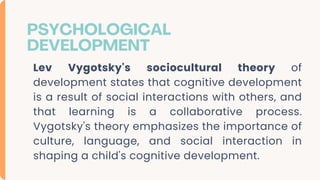
Lev Vygotsky's sociocultural theory of
development states that cognitive development
is a result of social interactions with others, and
that learning is a collaborative process.
Vygotsky's theory emphasizes the importance of
culture, language, and social interaction in
shaping a child's cognitive development.
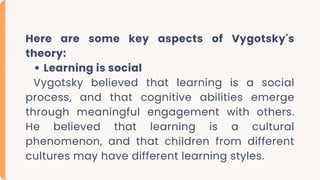
Here are some key aspects of Vygotsky's
theory:
Learning is social
Vygotsky believed that learning is a social
process, and that cognitive abilities emerge
through meaningful engagement with others.
He believed that learning is a cultural
phenomenon, and that children from different
cultures may have different learning styles.
Here are some key aspects of Vygotsky's
theory:
Learning is collaborative
Vygotsky believed that social negotiation is
essential for building knowledge and
understanding concepts. He believed that
learning is a process of acquiring knowledge,
beliefs, and problem-solving strategies through
interactions with others.
Here are some key aspects of Vygotsky's
theory:
Learning is guided
Vygotsky believed that learning is guided by
people in our lives who are in mentor-type roles,
such as teachers and parents. He believed that
children develop through interactions with
others who are "more knowledgeable".
Here are some key aspects of Vygotsky's theory:
Learning is scaffolded
Vygotsky believed that adults and peers can
provide support to guide children through tasks just
beyond their current capabilities. This is known as
scaffolding, and can involve modeling thinking or
behaviors, simplifying the student's role, or
providing a sounding board for students to discuss
their ideas.
Here are some key aspects of Vygotsky's theory:
Learning is supported by play
Vygotsky believed that play is important for
learning, and that children can stretch their
conceptual abilities and knowledge of the world
through playing and imagining.
SPIRITUAL
DEVELOPMENT
This stage of development helps
adolescents cope up with inner conflicts
they are struggling to overcome. It is in
the stage that they tend to think about so
many abstract things like asking about
life.
SOCIAL DEVELOPMENT
Lev Vygotsky's psychological
development emphasizes that
consciousness is the end of the
product of socialization. For him,
socialization is essential in cognitive
development.
SOCIAL DEVELOPMENT
He also explains that
cognitive development
may rely on the zone of
proximal development or
ZPD.
“Change can be scary, but you know
what’s scarier? Allowing fear to stop
you from growing, evolving, and
progressing.”
—Mandy Hal
WEEK 2 Personal Development Presentation.pdf

WEEK 2 Personal Development Presentation.pdf

  • 1.
  • 2.
  • 3.
    ADOLESCENCE This is thestage of development that is believed to be the transition stage from childhood to adulthood. It is also observed that most of the aspects of an individual have already reached great progress but still need to be refined and be completely understood.
  • 4.
  • 5.
    PHYSIOLOGICAL DEVELOPMENT The stage ofdevelopment that has been fully developed for the person reached the late adolescence.
  • 6.
    Three main Physical Changes Thegrowth spurt (an early sign of maturation) 1. Primary sex characteristics (changes in organs directly related to reproduction) 2. Secondary sex characteristics (bodily signs of sexual maturity that do not directly involve reproductive organs) 3.
  • 7.
    This is alsoknown as intellectual changes. It is during this stage that an adolescent is capable of using his/her higher level of thinking. Rather than asking questions of what, why, and how just like the most children do during the childhood stage teenagers are capable of making their hypothesis and investigate for the truth and not being satisfied of believing what is said to them. COGNITIVE DEVELOPMENT
  • 8.
    STAGES OF COGNITIVE DEVELOPMENT SENSORIMOTORSTAGE : birth to 2 years old 1. PREOPERATIONAL STAGE: ages 2 to 7 years old 2. CONCREATE OPERATIONAL STAGE: ages 7 to 11 3. FORMAL OPERATIONAL STAGE: ages 12 and up 4.
  • 9.
    PSYCHOLOGICAL DEVELOPMENT Erik Erikson's Theoryof development attempted to explain the changes that occur in child's psychosocial development while Lev Vygotsky Theory of development concentrated on psychological development.
  • 10.
    PSYCHOLOGICAL DEVELOPMENT Erik Erikson's theoryof psychosocial development explains that personality develops through eight stages from infancy to old age. The theory suggests that people must successfully complete each stage and resolve conflicts between their psychological needs and the social environment to become confident members of society.
  • 11.
    Erikson's theory includesthe following stages: Infancy: Basic trust versus mistrust Toddler: Autonomy versus shame and doubt Preschool-age: Initiative versus guilt School-age: Industry versus inferiority Adolescence: Identity versus identity confusion Young adulthood: Intimacy versus isolation Middle age: Generativity versus stagnation Older adulthood: Integrity versus despair
  • 12.
    PSYCHOLOGICAL DEVELOPMENT Lev Vygotsky's socioculturaltheory of development states that cognitive development is a result of social interactions with others, and that learning is a collaborative process. Vygotsky's theory emphasizes the importance of culture, language, and social interaction in shaping a child's cognitive development.
  • 13.
    Here are somekey aspects of Vygotsky's theory: Learning is social Vygotsky believed that learning is a social process, and that cognitive abilities emerge through meaningful engagement with others. He believed that learning is a cultural phenomenon, and that children from different cultures may have different learning styles.
  • 14.
    Here are somekey aspects of Vygotsky's theory: Learning is collaborative Vygotsky believed that social negotiation is essential for building knowledge and understanding concepts. He believed that learning is a process of acquiring knowledge, beliefs, and problem-solving strategies through interactions with others.
  • 15.
    Here are somekey aspects of Vygotsky's theory: Learning is guided Vygotsky believed that learning is guided by people in our lives who are in mentor-type roles, such as teachers and parents. He believed that children develop through interactions with others who are "more knowledgeable".
  • 16.
    Here are somekey aspects of Vygotsky's theory: Learning is scaffolded Vygotsky believed that adults and peers can provide support to guide children through tasks just beyond their current capabilities. This is known as scaffolding, and can involve modeling thinking or behaviors, simplifying the student's role, or providing a sounding board for students to discuss their ideas.
  • 17.
    Here are somekey aspects of Vygotsky's theory: Learning is supported by play Vygotsky believed that play is important for learning, and that children can stretch their conceptual abilities and knowledge of the world through playing and imagining.
  • 18.
    SPIRITUAL DEVELOPMENT This stage ofdevelopment helps adolescents cope up with inner conflicts they are struggling to overcome. It is in the stage that they tend to think about so many abstract things like asking about life.
  • 19.
    SOCIAL DEVELOPMENT Lev Vygotsky'spsychological development emphasizes that consciousness is the end of the product of socialization. For him, socialization is essential in cognitive development.
  • 20.
    SOCIAL DEVELOPMENT He alsoexplains that cognitive development may rely on the zone of proximal development or ZPD.
  • 21.
    “Change can bescary, but you know what’s scarier? Allowing fear to stop you from growing, evolving, and progressing.” —Mandy Hal