Stages Of
Development
SAJAY LAWRENCE. S
ENGLISH
INTRODUCTION
✣ Development means, “a progressive series of
changes that occur in orderly predictable
pattern as a result of maturation and
experience”.
✣ Development is continuous process from
conception to death.
✣ Developmental psychology is concerned with
the scientific understanding of age-related
changes in experience and behaviour.
2
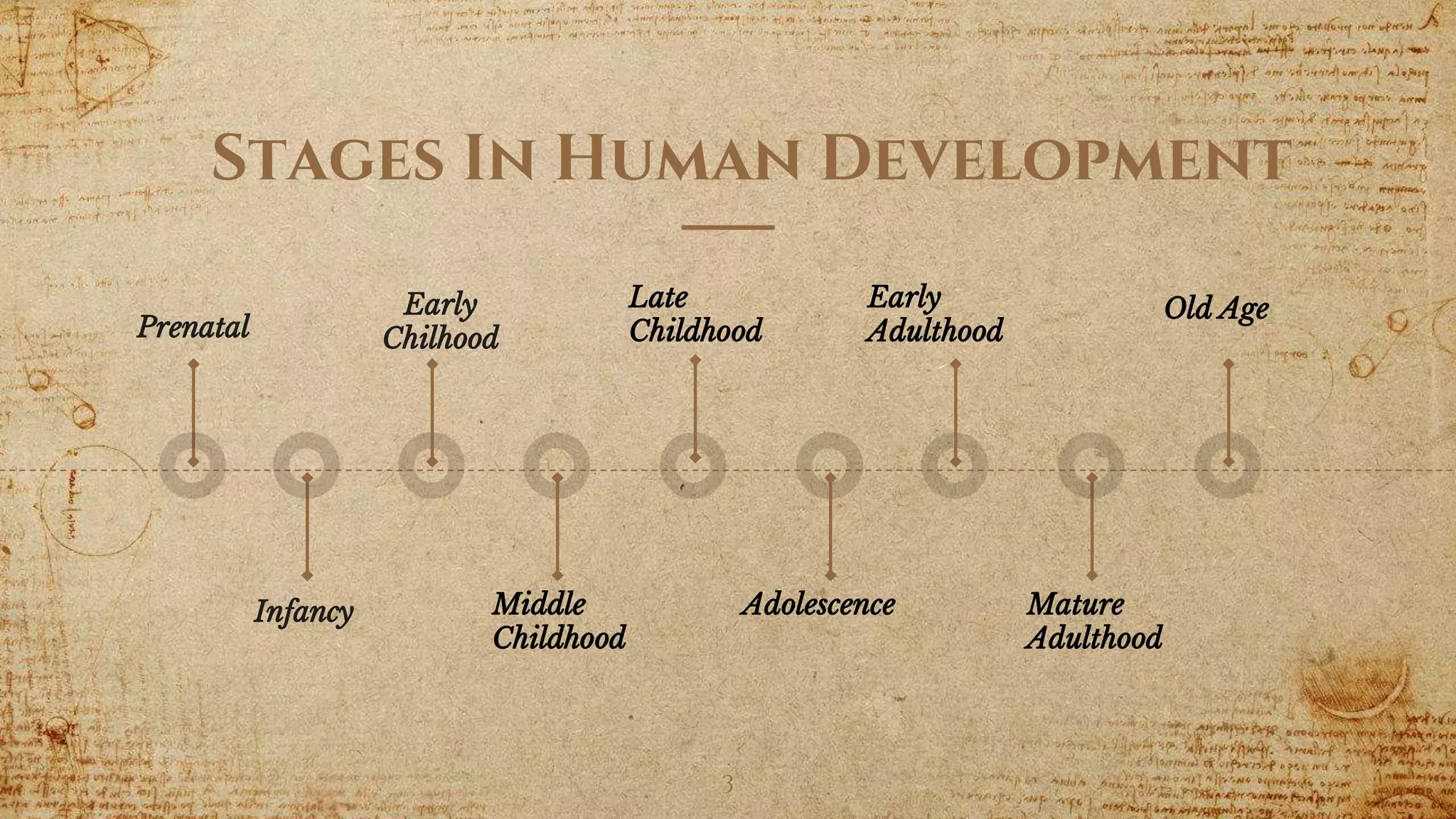
Stages In Human Development
Prenatal
Infancy
Early
Chilhood
3
Middle
Childhood
Late
Childhood
Adolescence
Early
Adulthood
Mature
Adulthood
Old Age
Prenatal Stage
✣ It is the period from conception to birth.
✣ The development of the brain is of particular
importance.
✣ At 22 weeks the fetus can react to acoustic
stimuli and can be studied.
✣ Development of speech is based on prenatal
learning.
✣ Babies can remember musical patterns they
hear in the womb.
4
Infancy
✣ This period extends from birth to 18 months
of age.
✣ The age of trust or mistrust.
✣ The child only needs nourishment and care.
✣ The newborn has to adjust with the
temperature changes.
✣ Learns to breath, deficate, suck and swallow.
✣ It is a time for radical adjustments.
5
Early Childhood
✣ This stage ranges from 18 months to 3 years.
✣ The muscular and nervous systems develops
remarkably by the second year.
✣ The child needs guidance as it learns to
distinguish right and wrong and begins to
develop conscience
✣ Gets ready to read and is able to speak
effectively by this stage.
6
Middle Childhood
✣ This stage extends from 3 to 5 years.
✣ It is at this time, the child’s willingness to try
new things is facilitated or inhibited.
✣ Can understand and express relationships
between the past and the future.
7
Late Childhood
✣ This period ranges from 5 to 12 years.
✣ The child develops greater attention span,
needs less sleep and gains rapidly in strength.
✣ The child learns to get along with age-mates
and learns physical skills necessary for
ordinary games.
✣ Spend more time in acquiring skills and need
accomplishment regardless of ablility.
8
Adolescence
✣ This period extends from 12 to 20 years.
✣ The individual attains puberty leading to
many changes in the individual’s sexual,
social, emotional and vocational life.
✣ Described as a period of storm and stress.
✣ Understanding and responding to the unique
developmental characteristics of young
adolescents is central among the tenants of
middle level education.
9
Early Adulthood
✣ This stage extends from 20 to 30 years.
✣ As an adult, the individual takes a firmer place
in society, usually holding a job, contributing
to community and maintaining a family and
care for offspring.
✣ Shows increase in leadership qualities.
10
Mature Adulthood
✣ This period ranges from 30 to 65 years of age.
✣ It is also called the ‘Middle Age’.
✣ One has to adjust to the deterioration of body
and strength of this age.
✣ The person becomes able enough to assist
teenage children to become responsible and
happy adults.
11
Old Age
✣ This stage is the extension after 65 years till
death.
✣ By this age people’s goals and abilities have
become more limited.
✣ Rapid decrease in strength.
12
Conclusion
It is important to consider the stages
of development in order to
understand developmental
psychology. People in similar
developmental stages display similar
psychological characteristics.
13
Stages of development

Stages of development

  • 1.
  • 2.
    INTRODUCTION ✣ Development means,“a progressive series of changes that occur in orderly predictable pattern as a result of maturation and experience”. ✣ Development is continuous process from conception to death. ✣ Developmental psychology is concerned with the scientific understanding of age-related changes in experience and behaviour. 2
  • 3.
    Stages In HumanDevelopment Prenatal Infancy Early Chilhood 3 Middle Childhood Late Childhood Adolescence Early Adulthood Mature Adulthood Old Age
  • 4.
    Prenatal Stage ✣ Itis the period from conception to birth. ✣ The development of the brain is of particular importance. ✣ At 22 weeks the fetus can react to acoustic stimuli and can be studied. ✣ Development of speech is based on prenatal learning. ✣ Babies can remember musical patterns they hear in the womb. 4
  • 5.
    Infancy ✣ This periodextends from birth to 18 months of age. ✣ The age of trust or mistrust. ✣ The child only needs nourishment and care. ✣ The newborn has to adjust with the temperature changes. ✣ Learns to breath, deficate, suck and swallow. ✣ It is a time for radical adjustments. 5
  • 6.
    Early Childhood ✣ Thisstage ranges from 18 months to 3 years. ✣ The muscular and nervous systems develops remarkably by the second year. ✣ The child needs guidance as it learns to distinguish right and wrong and begins to develop conscience ✣ Gets ready to read and is able to speak effectively by this stage. 6
  • 7.
    Middle Childhood ✣ Thisstage extends from 3 to 5 years. ✣ It is at this time, the child’s willingness to try new things is facilitated or inhibited. ✣ Can understand and express relationships between the past and the future. 7
  • 8.
    Late Childhood ✣ Thisperiod ranges from 5 to 12 years. ✣ The child develops greater attention span, needs less sleep and gains rapidly in strength. ✣ The child learns to get along with age-mates and learns physical skills necessary for ordinary games. ✣ Spend more time in acquiring skills and need accomplishment regardless of ablility. 8
  • 9.
    Adolescence ✣ This periodextends from 12 to 20 years. ✣ The individual attains puberty leading to many changes in the individual’s sexual, social, emotional and vocational life. ✣ Described as a period of storm and stress. ✣ Understanding and responding to the unique developmental characteristics of young adolescents is central among the tenants of middle level education. 9
  • 10.
    Early Adulthood ✣ Thisstage extends from 20 to 30 years. ✣ As an adult, the individual takes a firmer place in society, usually holding a job, contributing to community and maintaining a family and care for offspring. ✣ Shows increase in leadership qualities. 10
  • 11.
    Mature Adulthood ✣ Thisperiod ranges from 30 to 65 years of age. ✣ It is also called the ‘Middle Age’. ✣ One has to adjust to the deterioration of body and strength of this age. ✣ The person becomes able enough to assist teenage children to become responsible and happy adults. 11
  • 12.
    Old Age ✣ Thisstage is the extension after 65 years till death. ✣ By this age people’s goals and abilities have become more limited. ✣ Rapid decrease in strength. 12
  • 13.
    Conclusion It is importantto consider the stages of development in order to understand developmental psychology. People in similar developmental stages display similar psychological characteristics. 13