Course on Educational Psychology
By SMOEYURN PONG
Outline
• Human Development : Concept, Process,
• Personality : Concept, Traits, Sources
• Context of Human development
• Framework of Human Development.
Learning Objectives
 Describe the definition, process and kinds of
human development.
 Identify the human personality and traits.
 Explain the contexts influence the human
development and personality.
 Discuss the understanding of human
development and personality into the real life
and teaching career.
Human Development
 What is Development?
 What is Human Development?
 Human Development : is a pattern of
movement or change or growth that
begins at conception and continue
throughout the life span.
 Human development includes biological/
physical, socio-emotional, cognitive,
moral and linguistic growth or changes.
Human Developmental
Process
 Biological Processes : involve change in
the individual’s physical nature. Genes
inherited from parents, the development
of the brain, height and weight gains,
changes in motor skills and the
hormonal changes for puberty all reflect
the role of biological processes in
development.
Human Developmental
Process
 Socio-emotional Processes : involve
changes in the individual’s relationships
with other people, changes in emotions ,
feeling and personality. An infant's smile
in response to her mother, adolescent’s
joy, affection of couple, engagement of
adults… reflect the role of the socio
emotional development.
Human Developmental
Process
 Cognitive Processes : involve changes in
the individual’s thought, perception,
concept, memory, intelligence, language,
problem solving and metacognition…
 Putting together two-word sentence,
memorizing a poem, and reasoning.. all
reflect the role of cognitive process.
 Biological, cognitive and social-emotional
processes are intricately interwoven.
PERSONALITY
 Personality : distinctive and stable
pattern of behavior, thoughts, motives,
cognition and emotions that
characterizes an individual throughout
life.
• Trait : refers to enduring personal
characteristic, habitual way of
behaving, thinking, and feeling, that
reveal in a particular pattern of
behavior in a variety of situation.
Big Five Traits of
Personality
 Openness : Tendency to appreciate for
intellectual curiosity, variety of
experiences , preference of novelty and
imagination.
 Conscientiousness : Tendency to be
organized, show self-discipline, aim for
achievement and direct impulse.
 Extraversion : Tendency to engage with
the external world, have positive
emotion, sociability and assertiveness.
Big Five Traits of
Personality
 Agreeableness : Tendency to be coope-
rative, compassionate toward others,
value getting along with others and
willing to compromise their interest with
others.
 Neuroticism : Tendency to experience
negative emotions such as anger,
anxiety depression and vulnerability. It
is also called emotional instability.
Sources of Personality Development
Personality
Environment
(culture, family, life
experience, school)
Heredity/ Biology
(genetics, brain
Similarities Differences
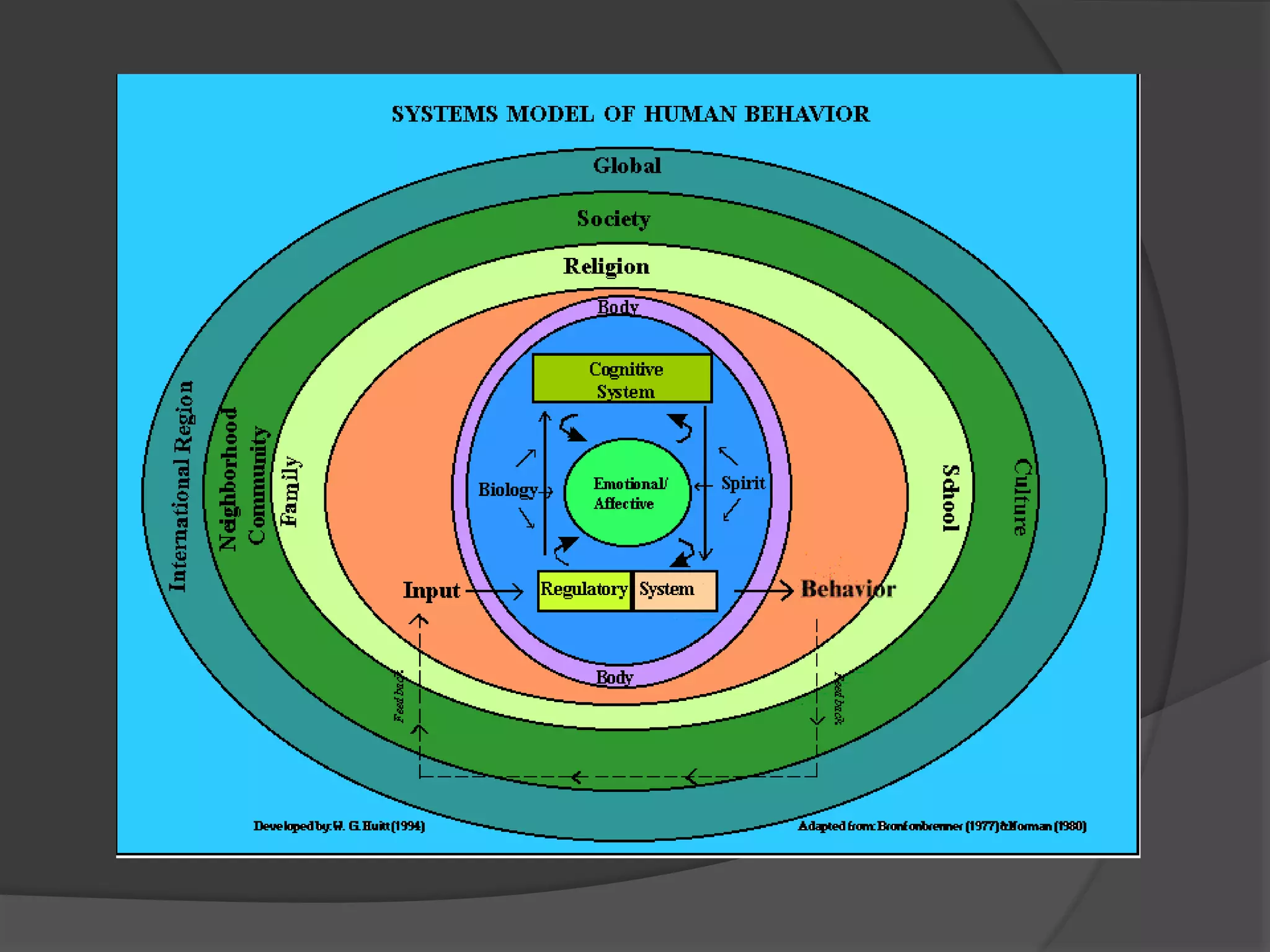
The Context of Human Development
Bronfenbrenner (1979) provides a theory
of the layers of context, environment, or
ecology of human development:
Microsystem
The most immediate and
earliest influences such as
family, school, religious
institutions and peer groups
and their interactions.
The Context of Human Development
Bronfenbrenner (1979) provides a theory
of the layers of context, environment, or
ecology of human development:
Mesosystem
An intermediate level of
influences such as local
neighborhood or
community, social
institutions and culture and
their interactions
The Context of Human Development
Bronfenbrenner (1979) provides a theory
of the layers of context, environment, or
ecology of human development:
Macrosystem
The most removed
influences such as
international region or
global changes and their
interactions.
The Context of Human Development
While we sometimes tend to focus on
family or school influences on human
development, we should always
remember that there are other
important influences. (W. Huitt, 1999)
Understanding
Human
Development
Physical
Development
Cognitive
Development
Social-
emotional
Development
Moral
Development
Linguistic
Development
Spiritual
Development
Personality
Development
Framework of Human Development
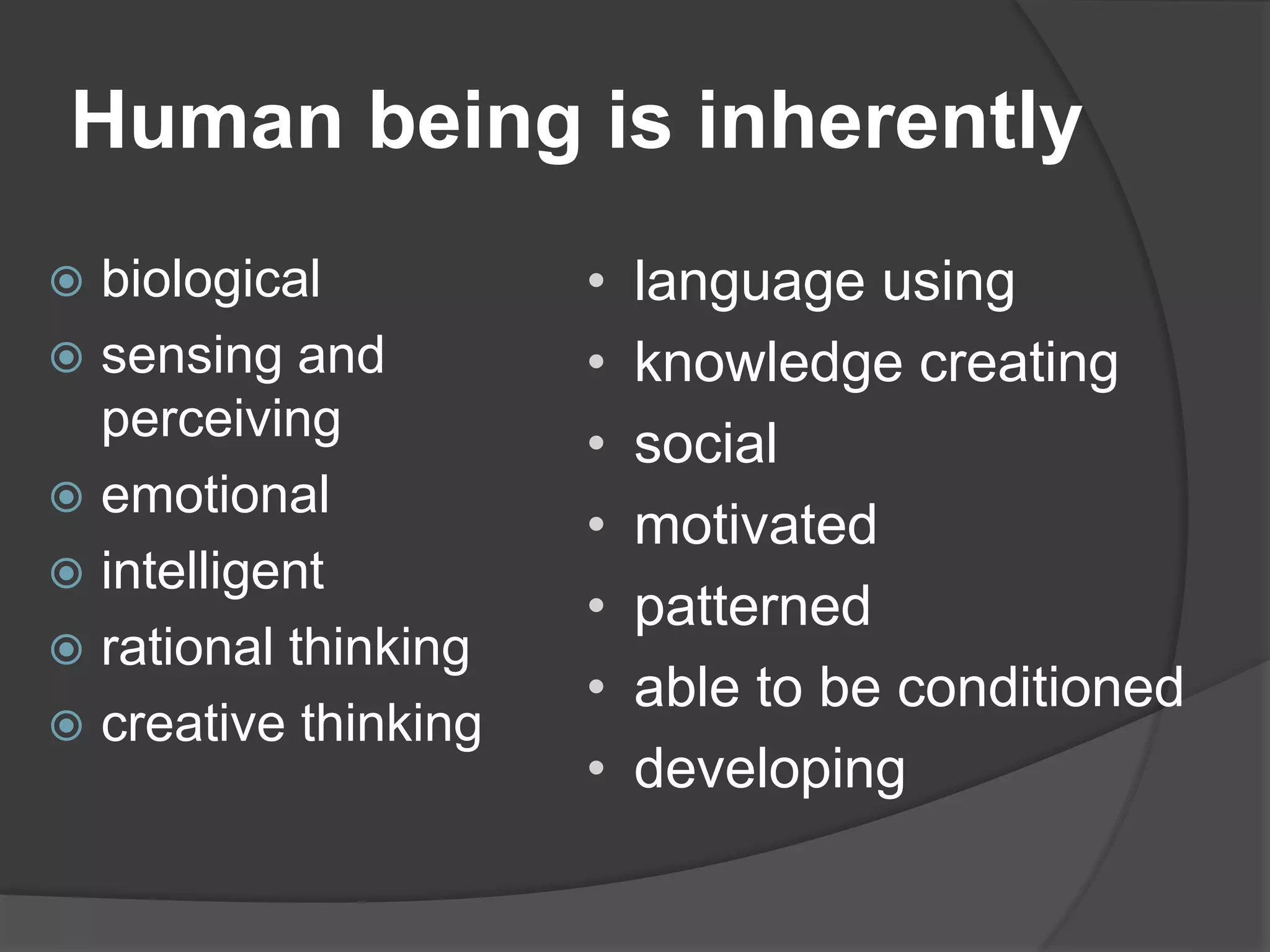
Human being is inherently
 biological
 sensing and
perceiving
 emotional
 intelligent
 rational thinking
 creative thinking
• language using
• knowledge creating
• social
• motivated
• patterned
• able to be conditioned
• developing
Review
 What is human development?
 What kinds of human development?
 What do the factors influence the human
development and personality?
 Why do we need to understand the human
development and personality?
Human Development

Human Development

  • 1.
    Course on EducationalPsychology By SMOEYURN PONG
  • 2.
    Outline • Human Development: Concept, Process, • Personality : Concept, Traits, Sources • Context of Human development • Framework of Human Development.
  • 3.
    Learning Objectives  Describethe definition, process and kinds of human development.  Identify the human personality and traits.  Explain the contexts influence the human development and personality.  Discuss the understanding of human development and personality into the real life and teaching career.
  • 4.
    Human Development  Whatis Development?  What is Human Development?  Human Development : is a pattern of movement or change or growth that begins at conception and continue throughout the life span.  Human development includes biological/ physical, socio-emotional, cognitive, moral and linguistic growth or changes.
  • 5.
    Human Developmental Process  BiologicalProcesses : involve change in the individual’s physical nature. Genes inherited from parents, the development of the brain, height and weight gains, changes in motor skills and the hormonal changes for puberty all reflect the role of biological processes in development.
  • 6.
    Human Developmental Process  Socio-emotionalProcesses : involve changes in the individual’s relationships with other people, changes in emotions , feeling and personality. An infant's smile in response to her mother, adolescent’s joy, affection of couple, engagement of adults… reflect the role of the socio emotional development.
  • 7.
    Human Developmental Process  CognitiveProcesses : involve changes in the individual’s thought, perception, concept, memory, intelligence, language, problem solving and metacognition…  Putting together two-word sentence, memorizing a poem, and reasoning.. all reflect the role of cognitive process.  Biological, cognitive and social-emotional processes are intricately interwoven.
  • 8.
    PERSONALITY  Personality :distinctive and stable pattern of behavior, thoughts, motives, cognition and emotions that characterizes an individual throughout life. • Trait : refers to enduring personal characteristic, habitual way of behaving, thinking, and feeling, that reveal in a particular pattern of behavior in a variety of situation.
  • 9.
    Big Five Traitsof Personality  Openness : Tendency to appreciate for intellectual curiosity, variety of experiences , preference of novelty and imagination.  Conscientiousness : Tendency to be organized, show self-discipline, aim for achievement and direct impulse.  Extraversion : Tendency to engage with the external world, have positive emotion, sociability and assertiveness.
  • 10.
    Big Five Traitsof Personality  Agreeableness : Tendency to be coope- rative, compassionate toward others, value getting along with others and willing to compromise their interest with others.  Neuroticism : Tendency to experience negative emotions such as anger, anxiety depression and vulnerability. It is also called emotional instability.
  • 11.
    Sources of PersonalityDevelopment Personality Environment (culture, family, life experience, school) Heredity/ Biology (genetics, brain Similarities Differences
  • 12.
    The Context ofHuman Development Bronfenbrenner (1979) provides a theory of the layers of context, environment, or ecology of human development: Microsystem The most immediate and earliest influences such as family, school, religious institutions and peer groups and their interactions.
  • 13.
    The Context ofHuman Development
  • 14.
    The Context ofHuman Development Bronfenbrenner (1979) provides a theory of the layers of context, environment, or ecology of human development: Mesosystem An intermediate level of influences such as local neighborhood or community, social institutions and culture and their interactions
  • 15.
    The Context ofHuman Development
  • 16.
    The Context ofHuman Development Bronfenbrenner (1979) provides a theory of the layers of context, environment, or ecology of human development: Macrosystem The most removed influences such as international region or global changes and their interactions.
  • 18.
    The Context ofHuman Development While we sometimes tend to focus on family or school influences on human development, we should always remember that there are other important influences. (W. Huitt, 1999)
  • 19.
  • 20.
    Human being isinherently  biological  sensing and perceiving  emotional  intelligent  rational thinking  creative thinking • language using • knowledge creating • social • motivated • patterned • able to be conditioned • developing
  • 21.
    Review  What ishuman development?  What kinds of human development?  What do the factors influence the human development and personality?  Why do we need to understand the human development and personality?