How to Use Visual Aids
• Introducing Visuals
• Commenting on Visuals
• Change and Development
Introducing Visuals
• Visuals are:
• Highly memorable
• Reduce the amount of talking
• Used to speak for you
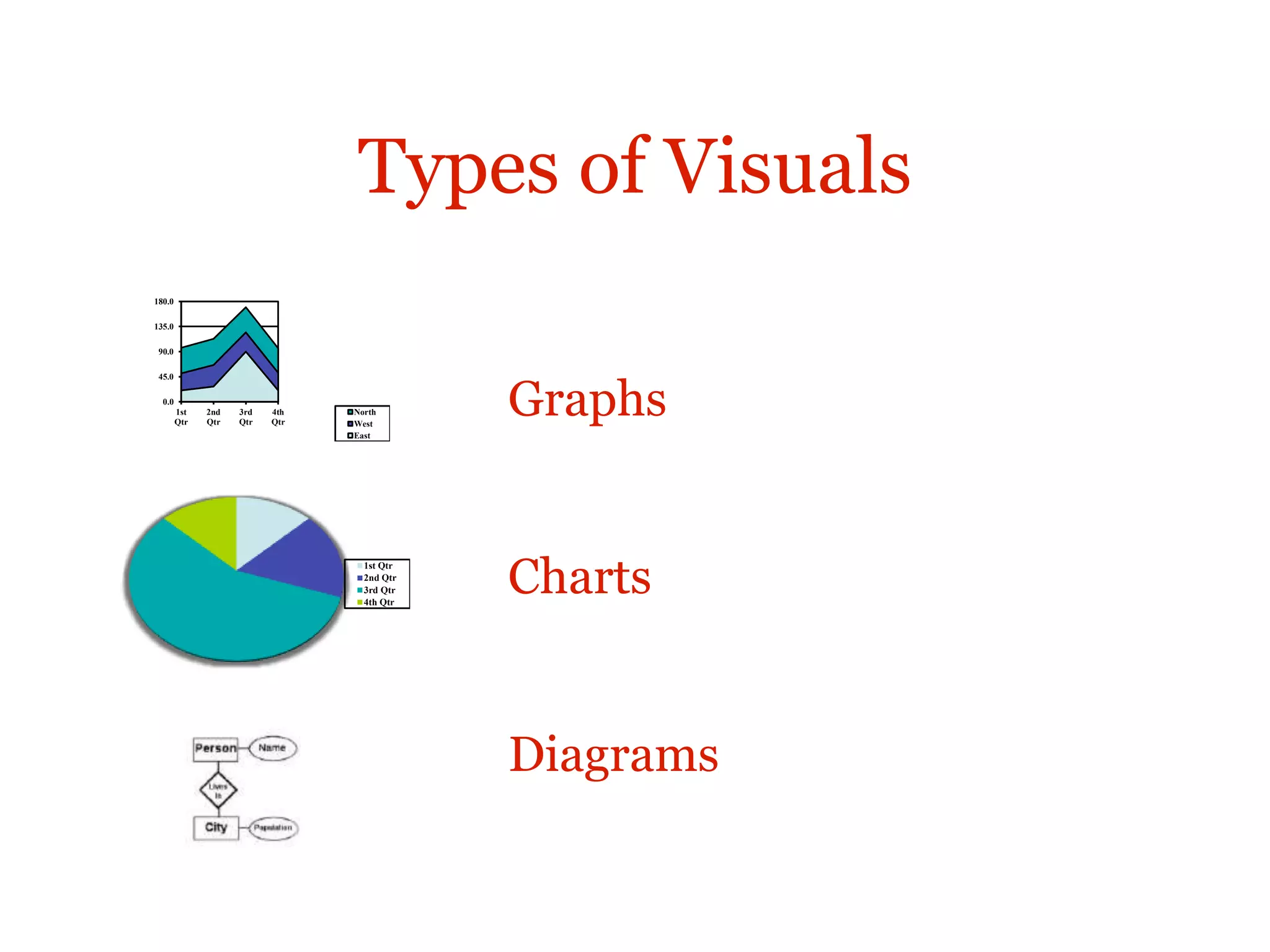
Types of Visuals
0.0
45.0
90.0
135.0
180.0
1st
Qtr
2nd
Qtr
3rd
Qtr
4th
Qtr
North
West
East
1st Qtr
2nd Qtr
3rd Qtr
4th Qtr
Graphs
Charts
Diagrams
Introducing Visuals
• If you don’t know the different types of visual,
simply say:
• Have/Take a look at this.
• As you can see here … and here … .
Commenting on Visuals
• Use visuals for situations, developments,
events and processes that would take a long
time to explain.
• Good visuals speak for themselves and
require little or no description.
Commenting on Visuals
• You often need to draw attention to one or
more key points before you discuss in more
detail:
• Highlights Which part of the visual
are most significant?
• Comments Why?
• Interpretations What conclusions can you
draw?
Commenting on Visuals
• Highlighting Important Information
• I’d like to look at …
• I’d like us to focus our attention on …
• I’d like you to think about…
• I’d like to point out …
• I’d like to draw your attention to …
Commenting on Visuals
• Commenting on Important Information
• As you can see, there …
• If you look at it more closely, you’ll …
• However you try to explain it, this is very
bad news.
• Whatever the reason for this, the
underlying trend is obvious.
• Whichever way you look at it, these are
some of our best results ever.
Commenting on Visuals
Interpreting Important Information
• I’m sure the conclusions to be drawn from
this are …
• I’m sure the lesson to be learned from this
is …
• I’m sure the implications of this are clear to
all of us.
• I’m sure the significance of this is …
• I’m sure the message here is …
Change and Development
• Vocabulary to talk about changes and
developments:
increase decrease shoot up plunge
rise fall take off slump
fluctuate recover pick up stabilize
level off remain peak hit a low
bottom out grow expand shrink
decline
Change and Development
• Vocabulary to talk about the scale or the speed
of the change and to comment on its
significance:
substantial rapid encouraging
slight spectacular disastrous
moderate disappointing steady
enormous
a(n) ……………… increase
Change and Development
• Except in complex technical and scientific
presentations, you don’t quote precise figures.
• Include important figures in a separate
handout or report at the beginning or end of
the presentation.
• When describing detailed visual aids, mention
overall trends and approximate figures.
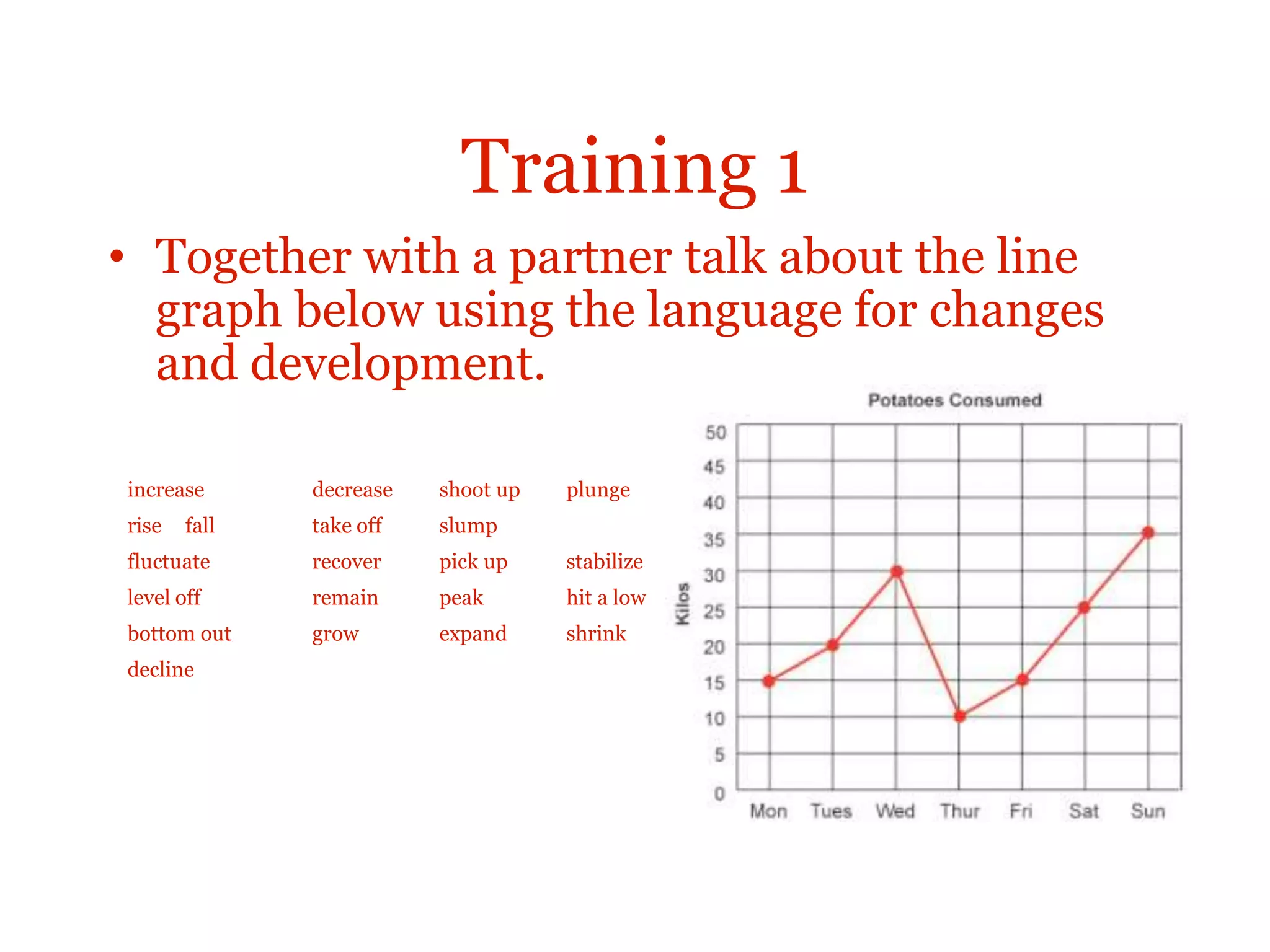
Training 1
• Together with a partner talk about the line
graph below using the language for changes
and development.
increase decrease shoot up plunge
rise fall take off slump
fluctuate recover pick up stabilize
level off remain peak hit a low
bottom out grow expand shrink
decline
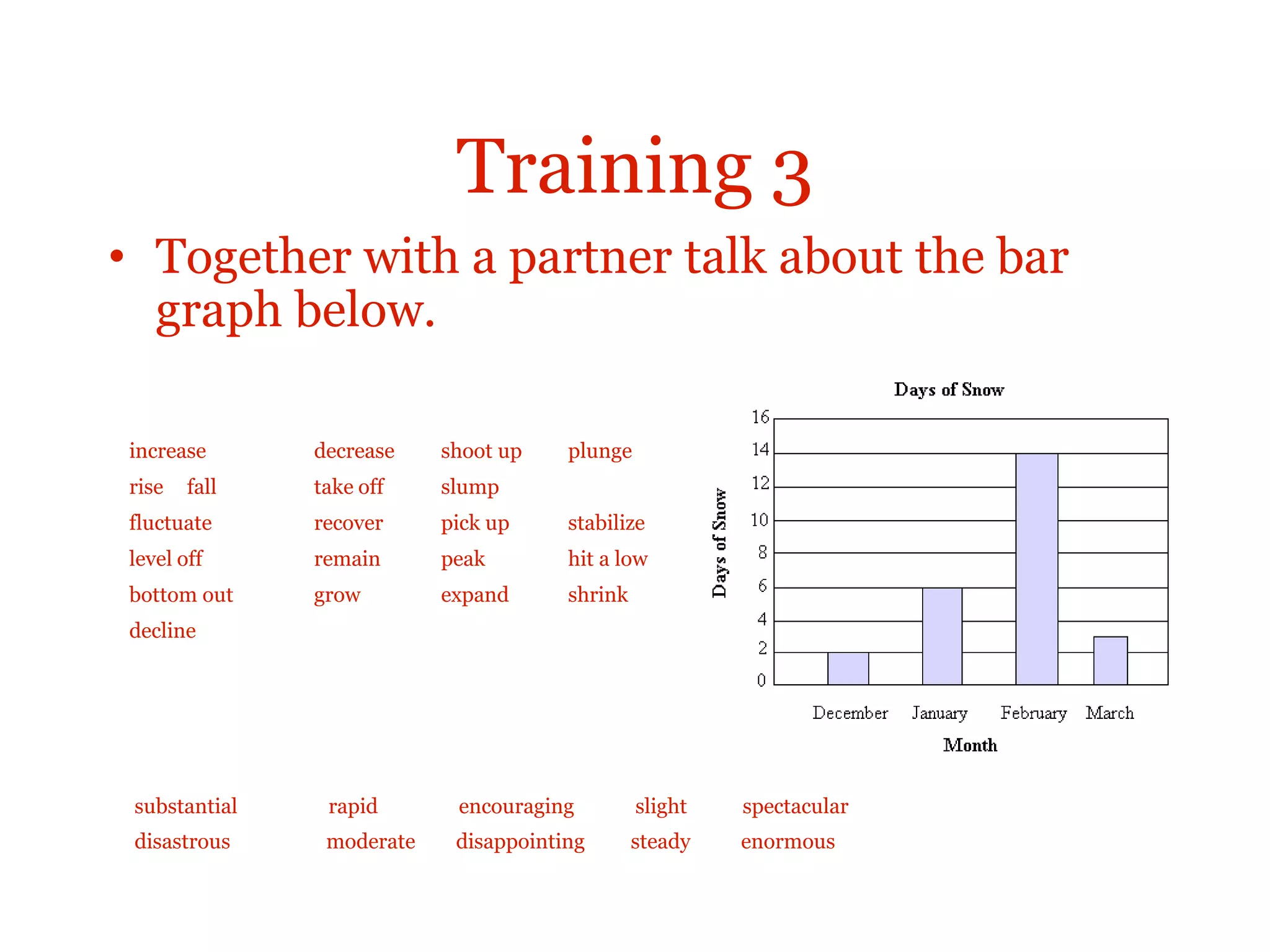
Training 3
• Together with a partner talk about the bar
graph below.
increase decrease shoot up plunge
rise fall take off slump
fluctuate recover pick up stabilize
level off remain peak hit a low
bottom out grow expand shrink
decline
substantial rapid encouraging slight spectacular
disastrous moderate disappointing steady enormous
Training (5)
Select a graph that is relevant to your field of
interest. Team up with a partner and, without
showing the graph, describe the the shape of
graph to him/her using the Language for
Change and Development that was discussed.
Your partner is going to recreate your graph
based on your instructions. After you have
finished, check the graph your partner drew and
compare. After you have finished, change roles.

How to use visual aids

  • 1.
    How to UseVisual Aids
  • 2.
    How to UseVisual Aids • Introducing Visuals • Commenting on Visuals • Change and Development
  • 3.
    Introducing Visuals • Visualsare: • Highly memorable • Reduce the amount of talking • Used to speak for you
  • 4.
  • 5.
    Introducing Visuals • Ifyou don’t know the different types of visual, simply say: • Have/Take a look at this. • As you can see here … and here … .
  • 6.
    Commenting on Visuals •Use visuals for situations, developments, events and processes that would take a long time to explain. • Good visuals speak for themselves and require little or no description.
  • 7.
    Commenting on Visuals •You often need to draw attention to one or more key points before you discuss in more detail: • Highlights Which part of the visual are most significant? • Comments Why? • Interpretations What conclusions can you draw?
  • 8.
    Commenting on Visuals •Highlighting Important Information • I’d like to look at … • I’d like us to focus our attention on … • I’d like you to think about… • I’d like to point out … • I’d like to draw your attention to …
  • 9.
    Commenting on Visuals •Commenting on Important Information • As you can see, there … • If you look at it more closely, you’ll … • However you try to explain it, this is very bad news. • Whatever the reason for this, the underlying trend is obvious. • Whichever way you look at it, these are some of our best results ever.
  • 10.
    Commenting on Visuals InterpretingImportant Information • I’m sure the conclusions to be drawn from this are … • I’m sure the lesson to be learned from this is … • I’m sure the implications of this are clear to all of us. • I’m sure the significance of this is … • I’m sure the message here is …
  • 11.
    Change and Development •Vocabulary to talk about changes and developments: increase decrease shoot up plunge rise fall take off slump fluctuate recover pick up stabilize level off remain peak hit a low bottom out grow expand shrink decline
  • 12.
    Change and Development •Vocabulary to talk about the scale or the speed of the change and to comment on its significance: substantial rapid encouraging slight spectacular disastrous moderate disappointing steady enormous a(n) ……………… increase
  • 13.
    Change and Development •Except in complex technical and scientific presentations, you don’t quote precise figures. • Include important figures in a separate handout or report at the beginning or end of the presentation. • When describing detailed visual aids, mention overall trends and approximate figures.
  • 14.
    Training 1 • Togetherwith a partner talk about the line graph below using the language for changes and development. increase decrease shoot up plunge rise fall take off slump fluctuate recover pick up stabilize level off remain peak hit a low bottom out grow expand shrink decline
  • 15.
    Training 3 • Togetherwith a partner talk about the bar graph below. increase decrease shoot up plunge rise fall take off slump fluctuate recover pick up stabilize level off remain peak hit a low bottom out grow expand shrink decline substantial rapid encouraging slight spectacular disastrous moderate disappointing steady enormous
  • 16.
    Training (5) Select agraph that is relevant to your field of interest. Team up with a partner and, without showing the graph, describe the the shape of graph to him/her using the Language for Change and Development that was discussed. Your partner is going to recreate your graph based on your instructions. After you have finished, check the graph your partner drew and compare. After you have finished, change roles.