Writing Reflective
     Reports
Writing Reflective Reports
•   The purpose of a reflective report is to help
    you learn from a particular practical
    experience. It will help you make
    connections between what you are taught in
    theory and what you need to practice. You
    reflect so that you can learn.
Writing Reflective Reports
•   In reflective writing, you are trying to write
    down some of the thinking that you have
    been through while carrying out a particular
    practical activity, such as writing an essay,
    teaching a class, or treating a patient.
    Through reflection, you should be able to
    make sense of what you did and why, and
    perhaps help yourself do it better next time.
Writing Reflective Reports
•   Your written reflection will also serve as a
    source of reference and evidence in the
    future.
Writing Reflective Reports
    Let us assume that you are reflecting on
    something you have done in class.
•   You will probably start by describing what
    you did.
•   You may then want to write about exactly
    how you did the activity, what methods you
    used.
•   You might then want to evaluate your
    performance. How well did you do?
Writing Reflective Reports
•   In order to do this, you need to consider
    what you have been taught. You may want
    to describe what the experts say.
•   You may then need to consider your
    reactions. How did/do you feel?
•   You might finish by considering how you
    would do it next time.
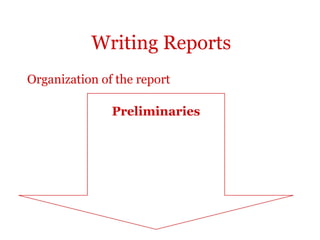
Writing Reports
Organization of the report

               Preliminaries
Writing Reflective Reports

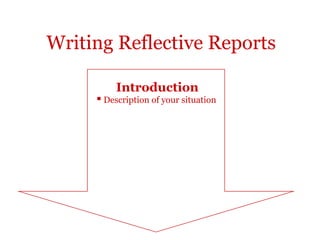
          Introduction
      Description of your situation
Writing Reflective Reports

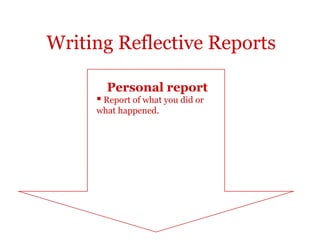
       Personal report
      Report of what you did or
     what happened.
Writing Reflective Reports

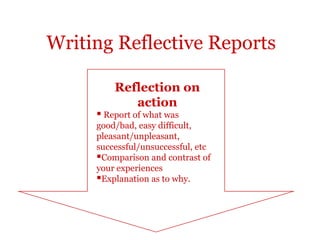
         Reflection on
            action
      Report of what was
     good/bad, easy difficult,
     pleasant/unpleasant,
     successful/unsuccessful, etc
     Comparison and contrast of
     your experiences
     Explanation as to why.
Writing Reflective Reports

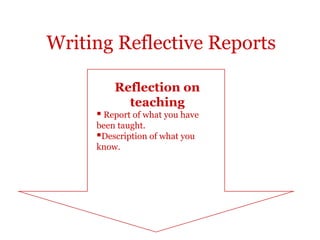
         Reflection on
           teaching
      Report of what you have
     been taught.
     Description of what you
     know.
Writing Reflective Reports

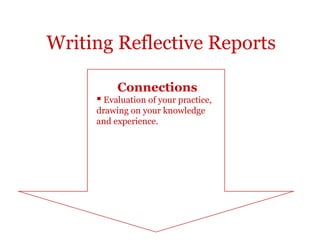
          Connections
      Evaluation of your practice,
     drawing on your knowledge
     and experience.
Writing Reflective Reports

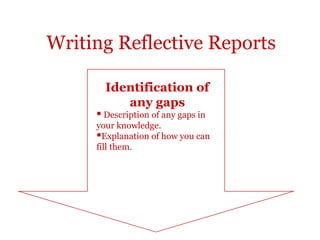
       Identification of
          any gaps
      Description of any gaps in
     your knowledge.
     Explanation of how you can
     fill them.
Writing Reflective Reports

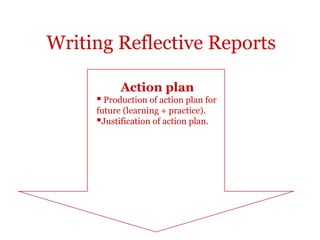
           Action plan
      Production of action plan for
     future (learning + practice).
     Justification of action plan.
Writing Reflective Reports

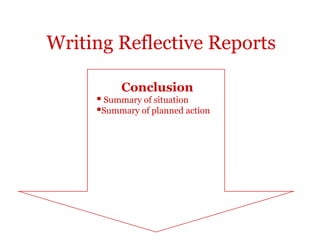
          Conclusion
      Summary of situation
     Summary of planned action
Writing Reflective Reports

        End matter

Reflective Reports

  • 1.
  • 2.
    Writing Reflective Reports • The purpose of a reflective report is to help you learn from a particular practical experience. It will help you make connections between what you are taught in theory and what you need to practice. You reflect so that you can learn.
  • 3.
    Writing Reflective Reports • In reflective writing, you are trying to write down some of the thinking that you have been through while carrying out a particular practical activity, such as writing an essay, teaching a class, or treating a patient. Through reflection, you should be able to make sense of what you did and why, and perhaps help yourself do it better next time.
  • 4.
    Writing Reflective Reports • Your written reflection will also serve as a source of reference and evidence in the future.
  • 5.
    Writing Reflective Reports Let us assume that you are reflecting on something you have done in class. • You will probably start by describing what you did. • You may then want to write about exactly how you did the activity, what methods you used. • You might then want to evaluate your performance. How well did you do?
  • 6.
    Writing Reflective Reports • In order to do this, you need to consider what you have been taught. You may want to describe what the experts say. • You may then need to consider your reactions. How did/do you feel? • You might finish by considering how you would do it next time.
  • 7.
    Writing Reports Organization ofthe report Preliminaries
  • 8.
    Writing Reflective Reports Introduction  Description of your situation
  • 9.
    Writing Reflective Reports Personal report  Report of what you did or what happened.
  • 10.
    Writing Reflective Reports Reflection on action  Report of what was good/bad, easy difficult, pleasant/unpleasant, successful/unsuccessful, etc Comparison and contrast of your experiences Explanation as to why.
  • 11.
    Writing Reflective Reports Reflection on teaching  Report of what you have been taught. Description of what you know.
  • 12.
    Writing Reflective Reports Connections  Evaluation of your practice, drawing on your knowledge and experience.
  • 13.
    Writing Reflective Reports Identification of any gaps  Description of any gaps in your knowledge. Explanation of how you can fill them.
  • 14.
    Writing Reflective Reports Action plan  Production of action plan for future (learning + practice). Justification of action plan.
  • 15.
    Writing Reflective Reports Conclusion  Summary of situation Summary of planned action
  • 16.