Writing Critically
    (Self-study version)
Writing Critically
    Writing critically means:

•  Analyzing your own work and others’
  – Examining and breaking information into
     parts
• Evaluating
  – Making judgements about the value of
     information, ideas or materials for a given
     purpose in a given context
Writing Critically
•    Presenting your point of view
    – Giving your opinion

•    Supporting your point of view
    – Supplying arguments and reasons for
       your opinion
Writing Critically
    In other words, you need to:

•   Consider different points of view and
    discuss their positive and negative aspects
•   On the basis of this discussion you choose a
    point of view and persuade the reader that
    your point of view is the correct one.
Support
•   Your opinions need to be supported
•   You need to provide evidence
•   You need to explain why the evidence
    supports your point of view
Your point of view
•       Make sure you clearly distinguish between:

    •     Your point of view
    •     Your evidence
    •     Your reasons for believing what you do.
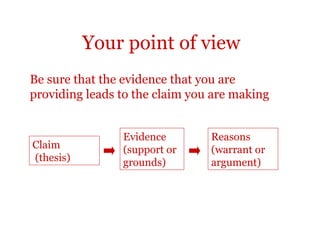
Your point of view
Be sure that the evidence that you are
providing leads to the claim you are making


                Evidence        Reasons
Claim           (support or     (warrant or
(thesis)        grounds)        argument)
Presenting your argument
•       You can present your argument in two ways:

    •     The inductive or balanced approach
    •     The deductive or persuasive approach
Presenting your argument
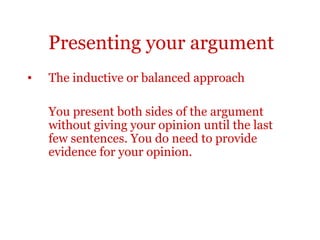
•   The inductive or balanced approach

    You present both sides of the argument
    without giving your opinion until the last
    few sentences. You do need to provide
    evidence for your opinion.
Presenting your argument
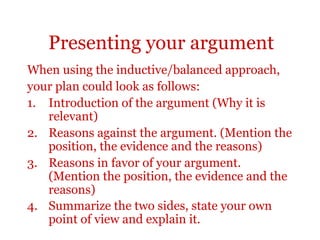
When using the inductive/balanced approach,
your plan could look as follows:
1. Introduction of the argument (Why it is
   relevant)
2. Reasons against the argument. (Mention the
   position, the evidence and the reasons)
3. Reasons in favor of your argument.
   (Mention the position, the evidence and the
   reasons)
4. Summarize the two sides, state your own
   point of view and explain it.
Presenting your argument
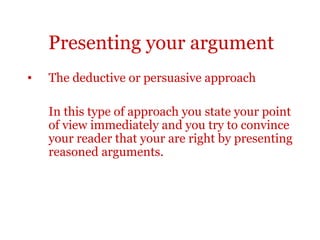
•   The deductive or persuasive approach

    In this type of approach you state your point
    of view immediately and you try to convince
    your reader that your are right by presenting
    reasoned arguments.
Presenting your argument
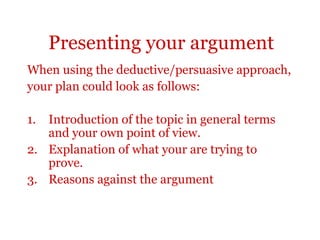
When using the deductive/persuasive approach,
your plan could look as follows:

1. Introduction of the topic in general terms
   and your own point of view.
2. Explanation of what your are trying to
   prove.
3. Reasons against the argument
Presenting your argument

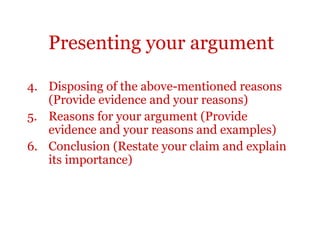
4. Disposing of the above-mentioned reasons
   (Provide evidence and your reasons)
5. Reasons for your argument (Provide
   evidence and your reasons and examples)
6. Conclusion (Restate your claim and explain
   its importance)
Giving reasons and explanations

   Writing critically means that you have to
   make connections between the ideas that
   you are presenting. You need to explain why
   things happen the way they do, giving
   reasons and examples.
Giving reasons and explanations

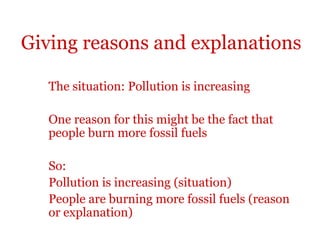
   The situation: Pollution is increasing

   One reason for this might be the fact that
   people burn more fossil fuels

   So:
   Pollution is increasing (situation)
   People are burning more fossil fuels (reason
   or explanation)
• Please do exercises 1,2 and 3 from
  ‘Writing Critically Exercises’ and check
  your answers with the answer key.
Arguing a point of view

Arguing means stating your claim (your
point of view). You need to support this by
giving evidence and reasons why you think
your evidence supports your claim. It is
likely that your claim is debatable. You may
believe in it, but other people may disagree
with you. The objective of your argument is
to prove to your reader that you are correct.
• Please do exercise 4 from ‘Writing
  Critically Exercises’ and check your
  answers with the answer key.
Arguing a point of view
Generalizations

The claim that you make will be quite
general and it is likely that it will apply to
other contexts and situations as well, not
just your own. Usually these generalizations
are written in the present tense.

The seems to be a important link between
nutrition and heart disease.
Arguing a point of view
Cautious language

It is important that you are careful about the
strength of your claims.

Obesity during childhood may lead to an
increase chance of becoming obese in later
life.

Most traffic accidents occur because of
fatigue or excessive alcohol consumption.
• Please do exercises 5 and 6 from
  ‘Writing Critically Exercises’ and check
  your answers with the answer key.
Evaluating a point of view
Besides stating your own point of view, you
need to comment and evaluate other
people’s ideas as well. For example, you may
want to use a point of view you have read
about in a scientific journal. It is important
that you explain why this point of view
supports, or doesn’t support your own.
Evaluating a point of view
    When evaluating a point of view or a
    conclusion, you need to:

•   Present the point of view
•   Comment on it positively or negatively.
• Please do exercises 7 and 8 from
  ‘Writing Critically Exercises’ and check
  your answers with the answer key.
Advantages and disadvantages
  One important way to evaluate a proposal or
  an idea is to look at its advantages and
  disadvantages.
• Please do exercises 9,10, and 11 from
  ‘Writing Critically Exercises’ and check
  your answers with the answer key.
Comparing and contrasting
When you are writing you do a lot more
than just give information. A common
function in writing is comparing and
contrasting, or writing about similarities
and differences. It is important that before
you start writing you decide which features,
items, or ideas you are going to compare
and organize them accordingly.
• Please do exercises 12,13, and 14 from
  ‘Writing Critically Exercises’ and check
  your answers with the answer key.
Providing support
The claims that you make in your
discussions need to be quite general. You
need to draw general conclusions that will
be valuable in solving problems in the
future. Again, these generalizations need to
be supported by examples, details, and
evidence.
• Please do exercises 15,16,17, and 18
  from ‘Writing Critically Exercises’ and
  check your answers with the answer
  key.
Drawing conclusions
After presenting your point of view,
evaluating the possible choices (all
supported with evidence), you need to come
to a conclusion. The main fuction of the
conclusion is to show that the main purpose
of the text has been achieved.
Drawing conclusions
    A concluding section should:

•   Repeat the issues raised in the introduction
•   Summarize the points made in the main
    body of your text
•   Come to a clear conclusion
Drawing conclusions
Many conclusions, especially in reports,
finish with recommendations or
suggestions. For example:

Further research is needed to determine
whether ….
• Please do exercise 19 from ‘Writing
  Critically Exercises’ and check your
  answers with the answer key.

Writing critically (self-study version)

  • 1.
    Writing Critically (Self-study version)
  • 2.
    Writing Critically Writing critically means: • Analyzing your own work and others’ – Examining and breaking information into parts • Evaluating – Making judgements about the value of information, ideas or materials for a given purpose in a given context
  • 3.
    Writing Critically • Presenting your point of view – Giving your opinion • Supporting your point of view – Supplying arguments and reasons for your opinion
  • 4.
    Writing Critically In other words, you need to: • Consider different points of view and discuss their positive and negative aspects • On the basis of this discussion you choose a point of view and persuade the reader that your point of view is the correct one.
  • 5.
    Support • Your opinions need to be supported • You need to provide evidence • You need to explain why the evidence supports your point of view
  • 6.
    Your point ofview • Make sure you clearly distinguish between: • Your point of view • Your evidence • Your reasons for believing what you do.
  • 7.
    Your point ofview Be sure that the evidence that you are providing leads to the claim you are making Evidence Reasons Claim (support or (warrant or (thesis) grounds) argument)
  • 8.
    Presenting your argument • You can present your argument in two ways: • The inductive or balanced approach • The deductive or persuasive approach
  • 9.
    Presenting your argument • The inductive or balanced approach You present both sides of the argument without giving your opinion until the last few sentences. You do need to provide evidence for your opinion.
  • 10.
    Presenting your argument Whenusing the inductive/balanced approach, your plan could look as follows: 1. Introduction of the argument (Why it is relevant) 2. Reasons against the argument. (Mention the position, the evidence and the reasons) 3. Reasons in favor of your argument. (Mention the position, the evidence and the reasons) 4. Summarize the two sides, state your own point of view and explain it.
  • 11.
    Presenting your argument • The deductive or persuasive approach In this type of approach you state your point of view immediately and you try to convince your reader that your are right by presenting reasoned arguments.
  • 12.
    Presenting your argument Whenusing the deductive/persuasive approach, your plan could look as follows: 1. Introduction of the topic in general terms and your own point of view. 2. Explanation of what your are trying to prove. 3. Reasons against the argument
  • 13.
    Presenting your argument 4.Disposing of the above-mentioned reasons (Provide evidence and your reasons) 5. Reasons for your argument (Provide evidence and your reasons and examples) 6. Conclusion (Restate your claim and explain its importance)
  • 14.
    Giving reasons andexplanations Writing critically means that you have to make connections between the ideas that you are presenting. You need to explain why things happen the way they do, giving reasons and examples.
  • 15.
    Giving reasons andexplanations The situation: Pollution is increasing One reason for this might be the fact that people burn more fossil fuels So: Pollution is increasing (situation) People are burning more fossil fuels (reason or explanation)
  • 16.
    • Please doexercises 1,2 and 3 from ‘Writing Critically Exercises’ and check your answers with the answer key.
  • 17.
    Arguing a pointof view Arguing means stating your claim (your point of view). You need to support this by giving evidence and reasons why you think your evidence supports your claim. It is likely that your claim is debatable. You may believe in it, but other people may disagree with you. The objective of your argument is to prove to your reader that you are correct.
  • 18.
    • Please doexercise 4 from ‘Writing Critically Exercises’ and check your answers with the answer key.
  • 19.
    Arguing a pointof view Generalizations The claim that you make will be quite general and it is likely that it will apply to other contexts and situations as well, not just your own. Usually these generalizations are written in the present tense. The seems to be a important link between nutrition and heart disease.
  • 20.
    Arguing a pointof view Cautious language It is important that you are careful about the strength of your claims. Obesity during childhood may lead to an increase chance of becoming obese in later life. Most traffic accidents occur because of fatigue or excessive alcohol consumption.
  • 21.
    • Please doexercises 5 and 6 from ‘Writing Critically Exercises’ and check your answers with the answer key.
  • 22.
    Evaluating a pointof view Besides stating your own point of view, you need to comment and evaluate other people’s ideas as well. For example, you may want to use a point of view you have read about in a scientific journal. It is important that you explain why this point of view supports, or doesn’t support your own.
  • 23.
    Evaluating a pointof view When evaluating a point of view or a conclusion, you need to: • Present the point of view • Comment on it positively or negatively.
  • 24.
    • Please doexercises 7 and 8 from ‘Writing Critically Exercises’ and check your answers with the answer key.
  • 25.
    Advantages and disadvantages One important way to evaluate a proposal or an idea is to look at its advantages and disadvantages.
  • 26.
    • Please doexercises 9,10, and 11 from ‘Writing Critically Exercises’ and check your answers with the answer key.
  • 27.
    Comparing and contrasting Whenyou are writing you do a lot more than just give information. A common function in writing is comparing and contrasting, or writing about similarities and differences. It is important that before you start writing you decide which features, items, or ideas you are going to compare and organize them accordingly.
  • 28.
    • Please doexercises 12,13, and 14 from ‘Writing Critically Exercises’ and check your answers with the answer key.
  • 29.
    Providing support The claimsthat you make in your discussions need to be quite general. You need to draw general conclusions that will be valuable in solving problems in the future. Again, these generalizations need to be supported by examples, details, and evidence.
  • 30.
    • Please doexercises 15,16,17, and 18 from ‘Writing Critically Exercises’ and check your answers with the answer key.
  • 31.
    Drawing conclusions After presentingyour point of view, evaluating the possible choices (all supported with evidence), you need to come to a conclusion. The main fuction of the conclusion is to show that the main purpose of the text has been achieved.
  • 32.
    Drawing conclusions A concluding section should: • Repeat the issues raised in the introduction • Summarize the points made in the main body of your text • Come to a clear conclusion
  • 33.
    Drawing conclusions Many conclusions,especially in reports, finish with recommendations or suggestions. For example: Further research is needed to determine whether ….
  • 34.
    • Please doexercise 19 from ‘Writing Critically Exercises’ and check your answers with the answer key.