Advanced Presentation Skills
Presented by
Waleed Abdallah
HR Manager
Objectives
• How to create an aim statement
• How to understand key facts about your
audience
• How to produce an outline scope
• How to draft your content
Presentation Types
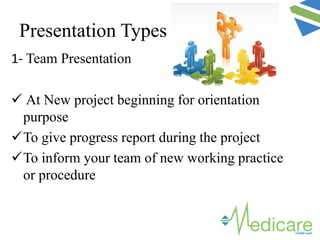
1- Team Presentation
 At New project beginning for orientation
purpose
To give progress report during the project
To inform your team of new working practice
or procedure
Presentation Types
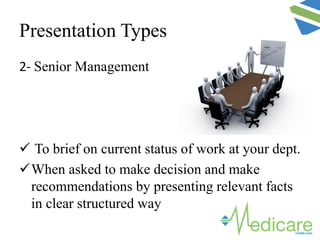
2- Senior Management
 To brief on current status of work at your dept.
When asked to make decision and make
recommendations by presenting relevant facts
in clear structured way
Presentation Types
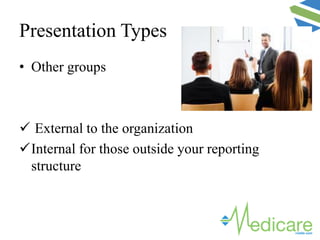
• Other groups
 External to the organization
Internal for those outside your reporting
structure
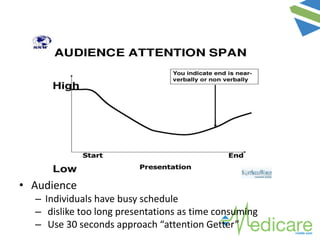
• Audience
– Individuals have busy schedule
– dislike too long presentations as time consuming
– Use 30 seconds approach “attention Getter”
1- Plan your presentation
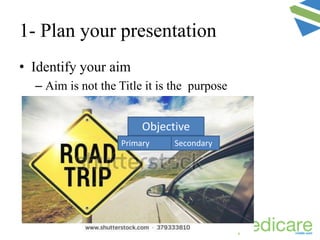
• Identify your aim
– Aim is not the Title it is the purpose
Primary Secondary
Objective
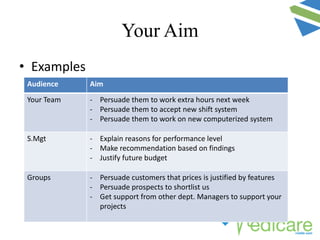
Your Aim
• Examples
Audience Aim
Your Team - Persuade them to work extra hours next week
- Persuade them to accept new shift system
- Persuade them to work on new computerized system
S.Mgt - Explain reasons for performance level
- Make recommendation based on findings
- Justify future budget
Groups - Persuade customers that prices is justified by features
- Persuade prospects to shortlist us
- Get support from other dept. Managers to support your
projects
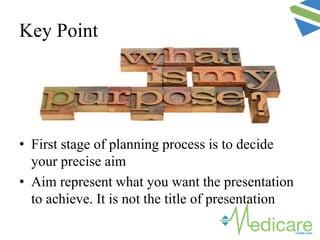
Key Point
• First stage of planning process is to decide
your precise aim
• Aim represent what you want the presentation
to achieve. It is not the title of presentation
Supportive Emotive
Reflective Directive
2- Know your audience types
Audience
Models
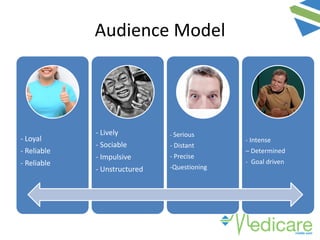
Audience Model
- Loyal
- Reliable
- Reliable
- Lively
- Sociable
- Impulsive
- Unstructured
- Serious
- Distant
- Precise
-Questioning
- Intense
– Determined
- Goal driven
Supportive Emotive
Reflective Directive
2- Know your audience
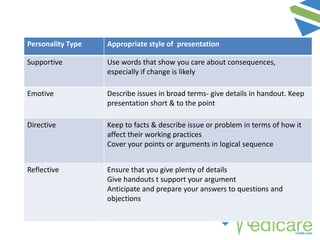
Personality Type Appropriate style of presentation
Supportive Use words that show you care about consequences,
especially if change is likely
Emotive Describe issues in broad terms- give details in handout. Keep
presentation short & to the point
Directive Keep to facts & describe issue or problem in terms of how it
affect their working practices
Cover your points or arguments in logical sequence
Reflective Ensure that you give plenty of details
Give handouts t support your argument
Anticipate and prepare your answers to questions and
objections
• Audience profile has limited use in real world
because audience are never just one type as
human personality is very complex to
understand.
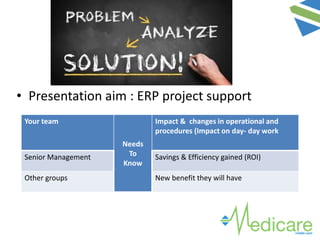
• Presentation aim : ERP project support
Your team
Needs
To
Know
Impact & changes in operational and
procedures (Impact on day- day work
Senior Management Savings & Efficiency gained (ROI)
Other groups New benefit they will have
Key points
• Take in consideration your audience and
existing knowledge level, level of interest
• Audience profile is important but you also
need to use common sense and experience
• Decide on the things that you want people to
remember from your presentation
• If your presentation is a part of larger event
you need to know what the content of other
presenters to avoid mismatch or replication
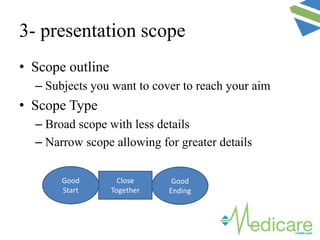
3- presentation scope
• Scope outline
– Subjects you want to cover to reach your aim
• Scope Type
– Broad scope with less details
– Narrow scope allowing for greater details
Good
Start
Good
Ending
Close
Together
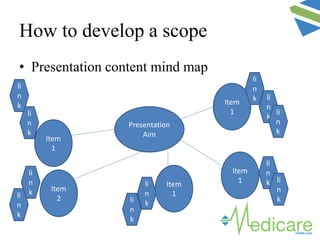
How to develop a scope
• Presentation content mind map
Presentation
Aim
Item
1
Item
2
Item
1
Item
1
Item
1
li
n
k
li
n
k
li
n
kli
n
k
li
n
k li
n
k
li
n
kli
n
k
li
n
k li
n
k
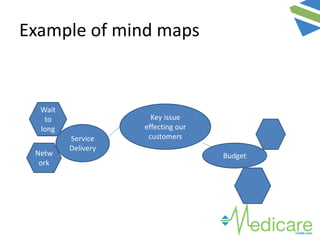
Example of mind maps
Key issue
effecting our
customersService
Delivery
Wait
to
long
Netw
ork
Budget
Key points
• Using your presentation aim and time allocated
will help you decide
– Do you need narrow scope or broad scope
• Mind maps can quickly and easily help you
make association as you bringing group topics
together without implying a hierarchy.
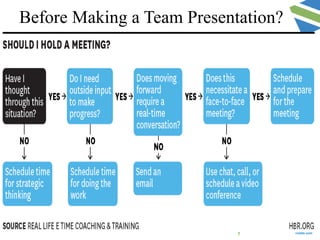
Before Making a Team Presentation?
Senior Management
• Preparing for a Senior Management
Presentation
–Understand the purpose of the meeting
–Working with your boss
–What to prepare
–How to rehearse
–It’s Showtime
Senior Management
• The senior manager may not have all of the
background on your project
–Limit how much background you need to supply in
order to tell your story.
- Your area of concern may only be a tiny part of the
senior manager’s scope;
–Keep it brief and use simple, declarative sentences
–Pause from time to time to allow questions and
interruptions —that will help to maintain attendees’
attention.
Senior Management
- Make sure that you have all of your facts; that project plans, timelines,
budgets, risk matrices and other working documents are up to date;–
Plan to provide status for all major project deliverables, and dates when
they will be complete.
–Be Transparent about project timeline slips, the reasons for those
slips, and your mitigation plans for getting them back on track. It is
better to be a project manager wrestling with a difficult situation
openly, than to present a rosy scenario and have it blow back on you
later
–Make sure that you are aware of any recent changes in your
organization that may affect your project, and that you are prepared to
address those changes either in your presentation, or during Q & A, if
asked
• Working with your boss
• Find out:
–The stated reason for the presentation
–What advice your boss has about how to present to the senior manager
- Are there any topics that you should defer to him or her?
–If, for example, you are in an IT department and your client is in a
business department, you should discuss with your boss whether your
client should attend; or at least, should be informed that this
presentation will be taking place.
–You may wish to capture any comments that your client would like
you to pass along in this presentation: their satisfaction, concerns, areas
in which they would like the senior manager to help. Sometimes, they
can provide talking points that are better coming from them than from
you.
Senior Management
Senior management
• What to prepare
• Background on the project; why it is necessary from a business context: who
requested it, business value, funding source
• Important topics to address
• Project objectives
• Project methods
• Project risks and issues, and mitigation strategy
• High-level view of your project plan(see Appendix)
• Project budget: estimated and actuals by month, and variances footnotes with
reasons for variances
• Time to completion —on track, delayed?
• Changes in resources?
• Risk register, including mitigations
• Current status of client relationships/satisfaction
• •Bring a set of project deliverables (e.g., Project Charter) as “leave-behinds”

Advanced presentation skills

  • 1.
    Advanced Presentation Skills Presentedby Waleed Abdallah HR Manager
  • 2.
    Objectives • How tocreate an aim statement • How to understand key facts about your audience • How to produce an outline scope • How to draft your content
  • 3.
    Presentation Types 1- TeamPresentation  At New project beginning for orientation purpose To give progress report during the project To inform your team of new working practice or procedure
  • 4.
    Presentation Types 2- SeniorManagement  To brief on current status of work at your dept. When asked to make decision and make recommendations by presenting relevant facts in clear structured way
  • 5.
    Presentation Types • Othergroups  External to the organization Internal for those outside your reporting structure
  • 6.
    • Audience – Individualshave busy schedule – dislike too long presentations as time consuming – Use 30 seconds approach “attention Getter”
  • 7.
    1- Plan yourpresentation • Identify your aim – Aim is not the Title it is the purpose Primary Secondary Objective
  • 8.
    Your Aim • Examples AudienceAim Your Team - Persuade them to work extra hours next week - Persuade them to accept new shift system - Persuade them to work on new computerized system S.Mgt - Explain reasons for performance level - Make recommendation based on findings - Justify future budget Groups - Persuade customers that prices is justified by features - Persuade prospects to shortlist us - Get support from other dept. Managers to support your projects
  • 9.
    Key Point • Firststage of planning process is to decide your precise aim • Aim represent what you want the presentation to achieve. It is not the title of presentation
  • 10.
    Supportive Emotive Reflective Directive 2-Know your audience types Audience Models
  • 11.
    Audience Model - Loyal -Reliable - Reliable - Lively - Sociable - Impulsive - Unstructured - Serious - Distant - Precise -Questioning - Intense – Determined - Goal driven
  • 12.
  • 13.
    Personality Type Appropriatestyle of presentation Supportive Use words that show you care about consequences, especially if change is likely Emotive Describe issues in broad terms- give details in handout. Keep presentation short & to the point Directive Keep to facts & describe issue or problem in terms of how it affect their working practices Cover your points or arguments in logical sequence Reflective Ensure that you give plenty of details Give handouts t support your argument Anticipate and prepare your answers to questions and objections
  • 14.
    • Audience profilehas limited use in real world because audience are never just one type as human personality is very complex to understand.
  • 15.
    • Presentation aim: ERP project support Your team Needs To Know Impact & changes in operational and procedures (Impact on day- day work Senior Management Savings & Efficiency gained (ROI) Other groups New benefit they will have
  • 16.
    Key points • Takein consideration your audience and existing knowledge level, level of interest • Audience profile is important but you also need to use common sense and experience • Decide on the things that you want people to remember from your presentation • If your presentation is a part of larger event you need to know what the content of other presenters to avoid mismatch or replication
  • 17.
    3- presentation scope •Scope outline – Subjects you want to cover to reach your aim • Scope Type – Broad scope with less details – Narrow scope allowing for greater details Good Start Good Ending Close Together
  • 18.
    How to developa scope • Presentation content mind map Presentation Aim Item 1 Item 2 Item 1 Item 1 Item 1 li n k li n k li n kli n k li n k li n k li n kli n k li n k li n k
  • 19.
    Example of mindmaps Key issue effecting our customersService Delivery Wait to long Netw ork Budget
  • 20.
    Key points • Usingyour presentation aim and time allocated will help you decide – Do you need narrow scope or broad scope • Mind maps can quickly and easily help you make association as you bringing group topics together without implying a hierarchy.
  • 22.
    Before Making aTeam Presentation?
  • 23.
    Senior Management • Preparingfor a Senior Management Presentation –Understand the purpose of the meeting –Working with your boss –What to prepare –How to rehearse –It’s Showtime
  • 24.
    Senior Management • Thesenior manager may not have all of the background on your project –Limit how much background you need to supply in order to tell your story. - Your area of concern may only be a tiny part of the senior manager’s scope; –Keep it brief and use simple, declarative sentences –Pause from time to time to allow questions and interruptions —that will help to maintain attendees’ attention.
  • 25.
    Senior Management - Makesure that you have all of your facts; that project plans, timelines, budgets, risk matrices and other working documents are up to date;– Plan to provide status for all major project deliverables, and dates when they will be complete. –Be Transparent about project timeline slips, the reasons for those slips, and your mitigation plans for getting them back on track. It is better to be a project manager wrestling with a difficult situation openly, than to present a rosy scenario and have it blow back on you later –Make sure that you are aware of any recent changes in your organization that may affect your project, and that you are prepared to address those changes either in your presentation, or during Q & A, if asked
  • 26.
    • Working withyour boss • Find out: –The stated reason for the presentation –What advice your boss has about how to present to the senior manager - Are there any topics that you should defer to him or her? –If, for example, you are in an IT department and your client is in a business department, you should discuss with your boss whether your client should attend; or at least, should be informed that this presentation will be taking place. –You may wish to capture any comments that your client would like you to pass along in this presentation: their satisfaction, concerns, areas in which they would like the senior manager to help. Sometimes, they can provide talking points that are better coming from them than from you. Senior Management
  • 27.
    Senior management • Whatto prepare • Background on the project; why it is necessary from a business context: who requested it, business value, funding source • Important topics to address • Project objectives • Project methods • Project risks and issues, and mitigation strategy • High-level view of your project plan(see Appendix) • Project budget: estimated and actuals by month, and variances footnotes with reasons for variances • Time to completion —on track, delayed? • Changes in resources? • Risk register, including mitigations • Current status of client relationships/satisfaction • •Bring a set of project deliverables (e.g., Project Charter) as “leave-behinds”