Advanced Presenting
Techniques
by
Piet van der Laan
Advanced Presenting
Techniques
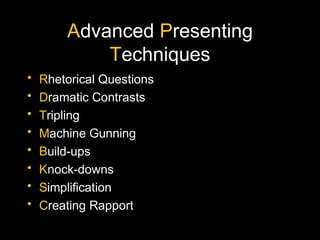
• Rhetorical Questions
• Dramatic Contrasts
• Tripling
• Machine Gunning
• Build-ups
• Knock-downs
• Simplification
• Creating Rapport
Advanced Presenting
Techniques
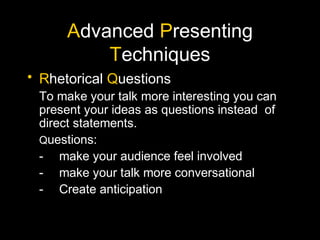
• Rhetorical Questions
To make your talk more interesting you can
present your ideas as questions instead of
direct statements.
Questions:
- make your audience feel involved
- make your talk more conversational
- Create anticipation
Advanced Presenting
Techniques
• Rhetorical Questions
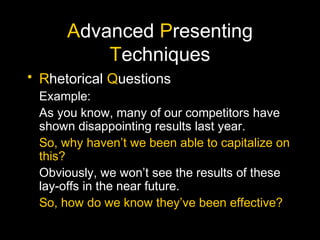
Example:
As you know, many of our competitors have
shown disappointing results last year.
So, why haven’t we been able to capitalize on
this?
Obviously, we won’t see the results of these
lay-offs in the near future.
So, how do we know they’ve been effective?
Advanced Presenting
Techniques
• Rhetorical Questions
Starting with a rhetorical question can be
used to create empathy.
Example:
So how big ARE the consequences of this
economic down-turn going to be?
They’re likely to be giGANtic
Advanced Presenting
Techniques
• Rhetorical Questions
So how big ARE the consequences of this
economic down-turn going to be?
They’re likely to be giGANtic.
- The adjective in the question is reinforced
with a stronger adjective in the answer.
- The verb and the strong adjective are
stressed.
Advanced Presenting
Techniques
• Rhetorical Questions
Rhetorical questions can be made more
powerful by repeating important words. This
can be done by using the following pattern:
Statement + Rhetorical Question + Answer
Advanced Presenting
Techniques
• Rhetorical Questions
Example:
The fact is that one of our competitors made
a take-over bid last week.(S) So WHAT CAN
BE DONE about this?(Q) WHAT CAN BE
DONE is keeping the share price high.(A)
The key words in the question are repeated in
the answer.
Advanced Presenting
Techniques
• Dramatic Contrasts
Dramatic contrasts can be used to reinforce a
point that’s being made.
Example:
A year ago we were the market leader.
Today we are on the verge of going under.
Making a point using two strongly opposing
ideas is a great way of getting the attention of
your audience.
Advanced Presenting
Techniques
• Dramatic Contrasts
Famous examples:
One small step for man, One giant leap for
mankind. (Neil Armstrong)
The difficult: that which can be done
immediately. The impossible: that which
takes a little longer. (George Santayana)
Advanced Presenting
Techniques
• Tripling
To make what you say more
memorable, your points can be chunked in
threes.
Examples:
Our service is swift, efficient, and
professional.
What’s needed now is time, effort, and
money.
Advanced Presenting
Techniques
• Machine-Gunning
Three points seem to be the most an
audience can remember.
Making it six, seven or eight will impress the
audience with the force of your overall
argument, even though they will forget some
of your points.
Advanced Presenting
Techniques
• Machine-Gunning
Example:
It is cheaper, newer, faster, bigger, clearer,
safer AND better designed. WHAT MORE
CAN I SAY!
The list of points should be delivered at speed
with each point stressed to create a machine-
gun effect. Bang, Bang, Bang!
Add a powerful remark at the end.
Advanced Presenting
Techniques
• Build-ups
An effective way of emphasizing a point is to
present several connected pieces of
information which build up to a short and
simple conclusion.
Advanced Presenting
Techniques
• Build-ups
Example:
As far as this contract in the Emirates is
concerned, we’re pretty tied up with a lot of
other projects at the moment, so there’s no
way we could meet their deadlines. We have
very little experience in this line of work,
anyway. And, to be honest, they’re not
prepared to pay us what we’d want ….
BASICALLY, its out of the question.
Advanced Presenting
Techniques
• Build-ups
As far as this contract in the Emirates is concerned, we’re pretty
tied up with a lot of other project at the moment, so there’s no
way we could meet their deadlines. We have very little
experience in this line of work, anyway. And, to be honest,
they’re not prepared to pay us what we’d want ….
BASICALLY, its out of the question.
The last sentence is a summary of the
situation in a word or a phrase. It is delivered
after a short pause.
Advanced Presenting
Techniques
• Knock-downs
Presenters who want to sound provocative
build up a series of points which seem to
oppose their main argument and then knock
them all down in a single sentence.
Advanced Presenting
Techniques
• Knock-downs
Example:
Of course, the experts said that a palm-top computer could
never succeed. They did market research which showed that
people would just see it as a gimmick. They said its memory
capacity would be too limited for serious business users. And
they did a feasibility study which showed that the keyboard
would be too small for even the fingers of a five-year old!
So, how come it sold more than a million units in the first year?
The presenter should pause before the final
knock-down?
Advanced Presenting
Techniques
• Simplification
General Rule:
The simpler what you say is, the more impact it wil
have.
Example:
Should we be thinking of expansion? No, that would
not be a good idea. Why wouldn’t it? Well, that should
be obvious. It’s much too risky.
Expansion? Not a good idea. Why? Obvious. Too
risky.
Advanced Presenting
Techniques
• Creating Rapport
Building up a good relationship or rapport with
your audience is important, especially in the
early stages of your presentation. Personality
plays a part, but some simple language
patterns help.
Advanced Presenting
Techniques
• Creating Rapport
1 Use the words we (all), us (all), our an ours as
much as possible.
Basically, we all share the same goal. And our
goals is increased profit.
2 Use question tags to push for agreement.
And we all know what that means, don’t we?
3 Use negative question forms to appeal to your
audience.
Haven’t we all had similar experiences at one
time or another?
These three things involve your audience.
Eye contact is also important.
Advanced Presenting
Techniques
• Creating Rapport
Using a few simple words and phrases which
do not mean very much will change the tone
of your presentation and make it less formal
and more friendly.
Examples:
You know, You see, As a matter of fact, Now,
Then, Well, Actually, OK
Advanced Presenting
Techniques
• Creating Rapport
Many of the best presentations sound more
like conversations. So during your talk keep
referring back to your audience as individuals.
Examples:
If you are anything like me ,…
And if I were to ask you ….
Now, I know what you’re thinking
But, you see
Let me ask you something
Questions?
This presentation was based on:
Presenting in English
By
Mark Powell

Advanced Presentation Techniques

  • 1.
  • 2.
    Advanced Presenting Techniques • RhetoricalQuestions • Dramatic Contrasts • Tripling • Machine Gunning • Build-ups • Knock-downs • Simplification • Creating Rapport
  • 3.
    Advanced Presenting Techniques • RhetoricalQuestions To make your talk more interesting you can present your ideas as questions instead of direct statements. Questions: - make your audience feel involved - make your talk more conversational - Create anticipation
  • 4.
    Advanced Presenting Techniques • RhetoricalQuestions Example: As you know, many of our competitors have shown disappointing results last year. So, why haven’t we been able to capitalize on this? Obviously, we won’t see the results of these lay-offs in the near future. So, how do we know they’ve been effective?
  • 5.
    Advanced Presenting Techniques • RhetoricalQuestions Starting with a rhetorical question can be used to create empathy. Example: So how big ARE the consequences of this economic down-turn going to be? They’re likely to be giGANtic
  • 6.
    Advanced Presenting Techniques • RhetoricalQuestions So how big ARE the consequences of this economic down-turn going to be? They’re likely to be giGANtic. - The adjective in the question is reinforced with a stronger adjective in the answer. - The verb and the strong adjective are stressed.
  • 7.
    Advanced Presenting Techniques • RhetoricalQuestions Rhetorical questions can be made more powerful by repeating important words. This can be done by using the following pattern: Statement + Rhetorical Question + Answer
  • 8.
    Advanced Presenting Techniques • RhetoricalQuestions Example: The fact is that one of our competitors made a take-over bid last week.(S) So WHAT CAN BE DONE about this?(Q) WHAT CAN BE DONE is keeping the share price high.(A) The key words in the question are repeated in the answer.
  • 9.
    Advanced Presenting Techniques • DramaticContrasts Dramatic contrasts can be used to reinforce a point that’s being made. Example: A year ago we were the market leader. Today we are on the verge of going under. Making a point using two strongly opposing ideas is a great way of getting the attention of your audience.
  • 10.
    Advanced Presenting Techniques • DramaticContrasts Famous examples: One small step for man, One giant leap for mankind. (Neil Armstrong) The difficult: that which can be done immediately. The impossible: that which takes a little longer. (George Santayana)
  • 11.
    Advanced Presenting Techniques • Tripling Tomake what you say more memorable, your points can be chunked in threes. Examples: Our service is swift, efficient, and professional. What’s needed now is time, effort, and money.
  • 12.
    Advanced Presenting Techniques • Machine-Gunning Threepoints seem to be the most an audience can remember. Making it six, seven or eight will impress the audience with the force of your overall argument, even though they will forget some of your points.
  • 13.
    Advanced Presenting Techniques • Machine-Gunning Example: Itis cheaper, newer, faster, bigger, clearer, safer AND better designed. WHAT MORE CAN I SAY! The list of points should be delivered at speed with each point stressed to create a machine- gun effect. Bang, Bang, Bang! Add a powerful remark at the end.
  • 14.
    Advanced Presenting Techniques • Build-ups Aneffective way of emphasizing a point is to present several connected pieces of information which build up to a short and simple conclusion.
  • 15.
    Advanced Presenting Techniques • Build-ups Example: Asfar as this contract in the Emirates is concerned, we’re pretty tied up with a lot of other projects at the moment, so there’s no way we could meet their deadlines. We have very little experience in this line of work, anyway. And, to be honest, they’re not prepared to pay us what we’d want …. BASICALLY, its out of the question.
  • 16.
    Advanced Presenting Techniques • Build-ups Asfar as this contract in the Emirates is concerned, we’re pretty tied up with a lot of other project at the moment, so there’s no way we could meet their deadlines. We have very little experience in this line of work, anyway. And, to be honest, they’re not prepared to pay us what we’d want …. BASICALLY, its out of the question. The last sentence is a summary of the situation in a word or a phrase. It is delivered after a short pause.
  • 17.
    Advanced Presenting Techniques • Knock-downs Presenterswho want to sound provocative build up a series of points which seem to oppose their main argument and then knock them all down in a single sentence.
  • 18.
    Advanced Presenting Techniques • Knock-downs Example: Ofcourse, the experts said that a palm-top computer could never succeed. They did market research which showed that people would just see it as a gimmick. They said its memory capacity would be too limited for serious business users. And they did a feasibility study which showed that the keyboard would be too small for even the fingers of a five-year old! So, how come it sold more than a million units in the first year? The presenter should pause before the final knock-down?
  • 19.
    Advanced Presenting Techniques • Simplification GeneralRule: The simpler what you say is, the more impact it wil have. Example: Should we be thinking of expansion? No, that would not be a good idea. Why wouldn’t it? Well, that should be obvious. It’s much too risky. Expansion? Not a good idea. Why? Obvious. Too risky.
  • 20.
    Advanced Presenting Techniques • CreatingRapport Building up a good relationship or rapport with your audience is important, especially in the early stages of your presentation. Personality plays a part, but some simple language patterns help.
  • 21.
    Advanced Presenting Techniques • CreatingRapport 1 Use the words we (all), us (all), our an ours as much as possible. Basically, we all share the same goal. And our goals is increased profit. 2 Use question tags to push for agreement. And we all know what that means, don’t we? 3 Use negative question forms to appeal to your audience. Haven’t we all had similar experiences at one time or another? These three things involve your audience. Eye contact is also important.
  • 22.
    Advanced Presenting Techniques • CreatingRapport Using a few simple words and phrases which do not mean very much will change the tone of your presentation and make it less formal and more friendly. Examples: You know, You see, As a matter of fact, Now, Then, Well, Actually, OK
  • 23.
    Advanced Presenting Techniques • CreatingRapport Many of the best presentations sound more like conversations. So during your talk keep referring back to your audience as individuals. Examples: If you are anything like me ,… And if I were to ask you …. Now, I know what you’re thinking But, you see Let me ask you something
  • 24.
  • 25.
    This presentation wasbased on: Presenting in English By Mark Powell