ELT Methodology
Teaching Speaking
FROM THEORY TO PRACTICE


  Instructor: Dr. Hanita Hassan
Speaking Group Feb,2011

 Ehsan Ataei 1-9
 Saeid Farid 10-15
 Vijaya Govind 21-27
 Mehrnoosh Jebelli 28-34
 Somaye Mirzababaie 16-20
Teaching Listening and Speaking
From Theory to Practice
(Speaking part)

Jack C. Richards
First published 2008
Teaching Speaking (TS)
  Speaking is the most important skill among other
   skills
  Learner’s judgments and self-evaluation is based
   on their speaking
  It is a tough job for teachers to engage student to
   speak, because there are some barriers and
   affective filters
  You can write or read or learn grammar or listen
   individually but you can not speak with your self
   so teaching speaking needs more consideration
Approaches in TS
•   Teachers and textbooks make use of a variety of
Approaches, ranging from Direct Approaches
focusing on specific features of oral Interaction
(e.g., Turn-taking, Topic management, and
questioning strategies) to Indirect Approaches that
create conditions for oral interaction through Group
Work, Task work, and other strategies (Richards,
1990).
We will discuss over task based approach in oral
communication in an academic setting in India as
an example later.
Features of Spoken Discourse
 •Composed of idea units (conjoined short phrases and
 clauses)
 •May be planned (e.g., a lecture) or unplanned (e.g.,
 a conversation)
 •Employs more vague or common words than
 written language
 •Contains slips and errors reflecting online
 processing
 •Involves reciprocity (i.e., interactions are jointly
 constructed)(A relation of mutual dependence, action or
 influence)
 •Shows variation (e.g., between formal and casual
 speech),
 •reflecting speaker roles, speaking purpose, and the
 context
Conversational routines

• Fixed expressions, or “routines,” that often has
   specific functions

• There are routines for beginnings and endings of
   conversations, for leading into topics, and for moving
   away from one topic to another.

 Let me think about it.

 I‟ll be with you in a minute.

 It doesn‟t matter.
Pawley and Syder (1983) suggest that native speakers

have a repertoire of

thousands of routines like these, that their use in

appropriate situations creates

conversational discourse that sounds natural and

native-like, and that they have to be learned and used

as fixed expressions.
Styles of speaking
Style of speaking is appropriate to the particular
circumstances.
Different styles of speaking reflect the roles, age,
sex, and status of participants in interactions and
also reflect the Expression of politeness.
I guess it must be quite late now?
You wouldn’t have the time, would you?
Lexical, phonological, and grammatical changes
may be involved in producing a Suitable style of
speaking, as the following alternatives illustrate:
 Have you seen the boss? / Have you seen the manager?
(lexical)
Whachadoin? / What are you doing? (phonological)
Functions of speaking
Interactional functions deal with social relations
Transactional functions deal with exchange of information

            Three-part version of
         Brown and Yule’s framework
         Talk as interaction
         Talk as transaction
         Talk as performance
Talk as interaction
It is in the form of conversation related to social
function like Greetings, engage in small talk,
recount.

 Main Features
• Has a primarily social function
• Reflects role relationships
• Reflects speaker‟s identity
• May be formal or casual and Reflects degrees
  of politeness
• Uses conversational register
• Focus on participants and their social needs
• Interactive, requiring two-way participation
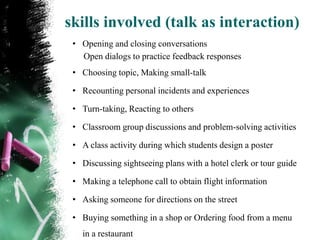
skills involved (talk as interaction)
 • Opening and closing conversations
   Open dialogs to practice feedback responses
 • Choosing topic, Making small-talk

 • Recounting personal incidents and experiences

 • Turn-taking, Reacting to others

 • Classroom group discussions and problem-solving activities

 • A class activity during which students design a poster

 • Discussing sightseeing plans with a hotel clerk or tour guide

 • Making a telephone call to obtain flight information

 • Asking someone for directions on the street

 • Buying something in a shop or Ordering food from a menu
   in a restaurant
Talk as transaction

Include greetings, small talk, compliments,
personal recounts, and narratives
focus is on what is said or done.
Communication is more important than fluency
or accuracy.
Talking as transaction
First type
giving and receiving information
(asking someone for directions describing how to use
something–sharing opinions and ideas–discussing plans)
 Accuracy may not be a priority, as long as
  information is successfully communicated or
  understood.
Second type
obtaining goods or services
(checking into a hotel or ordering food in a restaurant)
 Focus on message not the participants.
skills involved in using talk for transactions
Explaining a need or intention.
Not dependent on grammatical accuracy
• Information-gap activities
• Role plays
• Group discussions
Teaching talk as transaction
Talk as transaction is more easily planned since
current communicative materials
are a rich resource of group activities,
information-gap activities, and role
plays
Role-play activities are another familiar technique
for practicing real-world transactions and
typically involve the following steps:
 Preparing
 Modeling and eliciting
 Practicing and reviewing
a role play using cue cards or realia to provide
language and other
support.
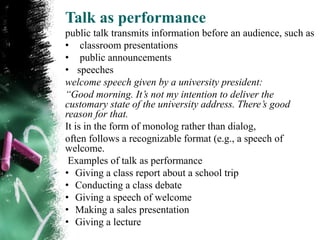
Talk as performance
public talk transmits information before an audience, such as
• classroom presentations
• public announcements
• speeches
welcome speech given by a university president:
“Good morning. It’s not my intention to deliver the
customary state of the university address. There’s good
reason for that.
It is in the form of monolog rather than dialog,
often follows a recognizable format (e.g., a speech of
welcome.
 Examples of talk as performance
• Giving a class report about a school trip
• Conducting a class debate
• Giving a speech of welcome
• Making a sales presentation
• Giving a lecture
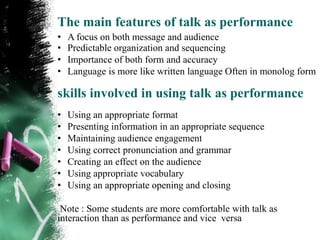
The main features of talk as performance
•   A focus on both message and audience
•   Predictable organization and sequencing
•   Importance of both form and accuracy
•   Language is more like written language Often in monolog form

skills involved in using talk as performance
•   Using an appropriate format
•   Presenting information in an appropriate sequence
•   Maintaining audience engagement
•   Using correct pronunciation and grammar
•   Creating an effect on the audience
•   Using appropriate vocabulary
•   Using an appropriate opening and closing

 Note : Some students are more comfortable with talk as
interaction than as performance and vice versa
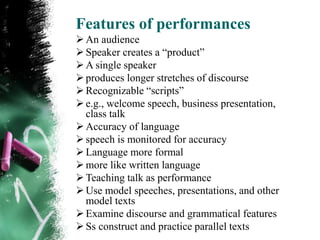
Features of performances
 An audience
 Speaker creates a “product”
 A single speaker
 produces longer stretches of discourse
 Recognizable “scripts”
 e.g., welcome speech, business presentation,
  class talk
 Accuracy of language
 speech is monitored for accuracy
 Language more formal
 more like written language
 Teaching talk as performance
 Use model speeches, presentations, and other
  model texts
 Examine discourse and grammatical features
 Ss construct and practice parallel texts
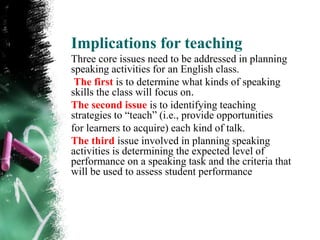
Implications for teaching
Three core issues need to be addressed in planning
speaking activities for an English class.
 The first is to determine what kinds of speaking
skills the class will focus on.
The second issue is to identifying teaching
strategies to “teach” (i.e., provide opportunities
for learners to acquire) each kind of talk.
The third issue involved in planning speaking
activities is determining the expected level of
performance on a speaking task and the criteria that
will be used to assess student performance
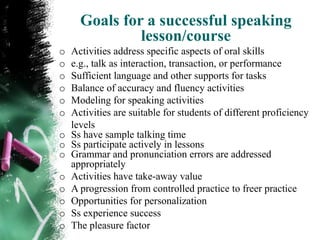
Goals for a successful speaking
               lesson/course
o   Activities address specific aspects of oral skills
o   e.g., talk as interaction, transaction, or performance
o   Sufficient language and other supports for tasks
o   Balance of accuracy and fluency activities
o   Modeling for speaking activities
o   Activities are suitable for students of different proficiency
    levels
o   Ss have sample talking time
o   Ss participate actively in lessons
o   Grammar and pronunciation errors are addressed
    appropriately
o   Activities have take-away value
o   A progression from controlled practice to freer practice
o   Opportunities for personalization
o   Ss experience success
o   The pleasure factor
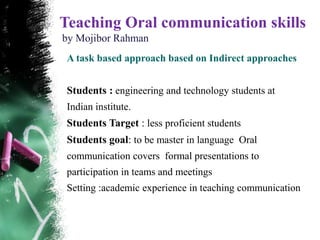
Teaching Oral communication skills
by Mojibor Rahman
 A task based approach based on Indirect approaches


 Students : engineering and technology students at
 Indian institute.
 Students Target : less proficient students
 Students goal: to be master in language Oral
 communication covers formal presentations to
 participation in teams and meetings
 Setting :academic experience in teaching communication
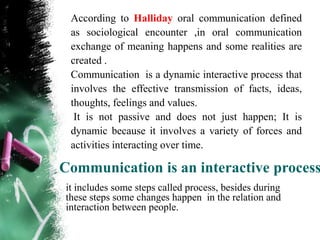
According to Halliday oral communication defined
 as sociological encounter ,in oral communication
 exchange of meaning happens and some realities are
 created .
 Communication is a dynamic interactive process that
 involves the effective transmission of facts, ideas,
 thoughts, feelings and values.
  It is not passive and does not just happen; It is
 dynamic because it involves a variety of forces and
 activities interacting over time.

Communication is an interactive process
it includes some steps called process, besides during
these steps some changes happen in the relation and
interaction between people.
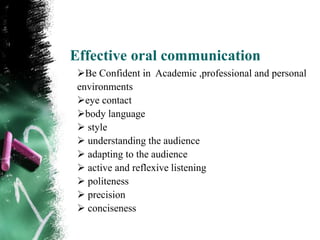
Effective oral communication
 Be Confident in Academic ,professional and personal
 environments
 eye contact
 body language
  style
  understanding the audience
  adapting to the audience
  active and reflexive listening
  politeness
  precision
  conciseness
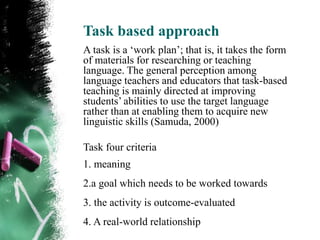
Task based approach
A task is a „work plan‟; that is, it takes the form
of materials for researching or teaching
language. The general perception among
language teachers and educators that task-based
teaching is mainly directed at improving
students‟ abilities to use the target language
rather than at enabling them to acquire new
linguistic skills (Samuda, 2000)

Task four criteria
1. meaning
2.a goal which needs to be worked towards
3. the activity is outcome-evaluated
4. A real-world relationship
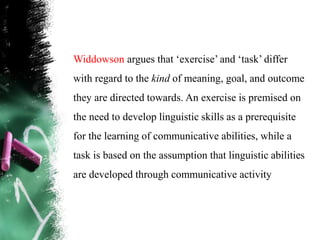
Widdowson argues that „exercise‟ and „task‟ differ
with regard to the kind of meaning, goal, and outcome
they are directed towards. An exercise is premised on
the need to develop linguistic skills as a prerequisite
for the learning of communicative abilities, while a
task is based on the assumption that linguistic abilities
are developed through communicative activity
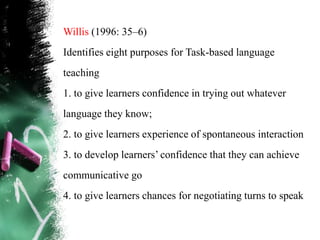
Willis (1996: 35–6)
Identifies eight purposes for Task-based language
teaching
1. to give learners confidence in trying out whatever
language they know;
2. to give learners experience of spontaneous interaction
3. to develop learners‟ confidence that they can achieve
communicative go
4. to give learners chances for negotiating turns to speak
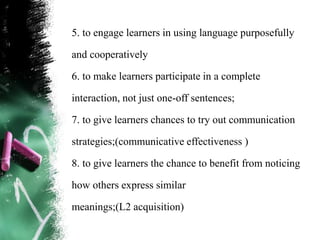
5. to engage learners in using language purposefully

and cooperatively

6. to make learners participate in a complete

interaction, not just one-off sentences;

7. to give learners chances to try out communication

strategies;(communicative effectiveness )

8. to give learners the chance to benefit from noticing

how others express similar

meanings;(L2 acquisition)
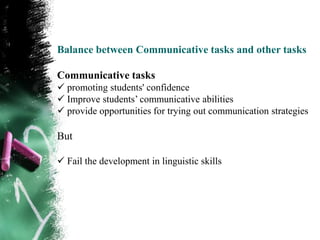
Balance between Communicative tasks and other tasks

Communicative tasks
 promoting students' confidence
 Improve students‟ communicative abilities
 provide opportunities for trying out communication strategies

But

 Fail the development in linguistic skills
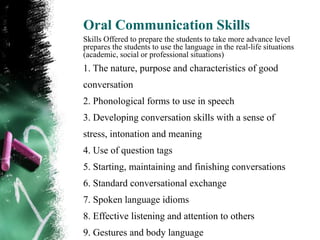
Oral Communication Skills
Skills Offered to prepare the students to take more advance level
prepares the students to use the language in the real-life situations
(academic, social or professional situations)
1. The nature, purpose and characteristics of good
conversation
2. Phonological forms to use in speech
3. Developing conversation skills with a sense of
stress, intonation and meaning
4. Use of question tags
5. Starting, maintaining and finishing conversations
6. Standard conversational exchange
7. Spoken language idioms
8. Effective listening and attention to others
9. Gestures and body language
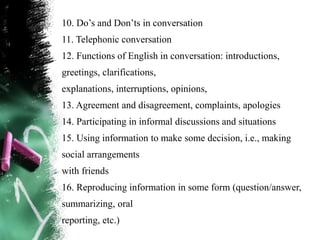
10. Do‟s and Don‟ts in conversation
11. Telephonic conversation
12. Functions of English in conversation: introductions,
greetings, clarifications,
explanations, interruptions, opinions,
13. Agreement and disagreement, complaints, apologies
14. Participating in informal discussions and situations
15. Using information to make some decision, i.e., making
social arrangements
with friends
16. Reproducing information in some form (question/answer,
summarizing, oral
reporting, etc.)
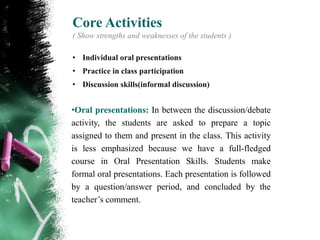
Core Activities
( Show strengths and weaknesses of the students )

• Individual oral presentations
• Practice in class participation
• Discussion skills(informal discussion)


•Oral presentations: In between the discussion/debate
activity, the students are asked to prepare a topic
assigned to them and present in the class. This activity
is less emphasized because we have a full-fledged
course in Oral Presentation Skills. Students make
formal oral presentations. Each presentation is followed
by a question/answer period, and concluded by the
teacher‟s comment.
In class participation (Role-play): For this activity, the
students are asked to make group of three to five
students. In the beginning The teacher listens the
performances of the students and comments on the
individual performances. He points out the errors of the
individual students. At the end of the semester, students
are assessed using these tasks

Discussion/debate: This core activity runs every week. The
students are engaged in a formal/informal discussion/debate
activity on an assigned topic. This activity is completely
student-led, i.e., students play all the roles (conductor,
observer, group presenter, and participating members).It is
more appropriate to call this activity a "discussion/debate"
activity because it includes both group discussions and
debates, including a little bit of oral presentation.
Conclusion
activity in speaking divided to
interactions, transactions, or performances
 Always Consider
    •Model of activities
    •Divided activity stages
    •Needed language support
    •Needed resources
    •Needed learning arrangements
    •Expected level of performance
    •Time and ways of feedback
    •task-based approach in teaching oral communication has
    much potential, but it has a long way to go.
    •majority of the Students understand the tasks and found the
    experience to be rewarding, interesting, and educationally
    beneficial.
    •Students involved in the task because the tasks were giving
    the feeling of real life situation
    • Their final performances were much improved(70 percent
    students scored grade „A‟)
    •Problems in carrying out these tasks: Sometimes it went out
    of control from the hand of students or from the hand of the
    teacher.
Reasons for poor speaking skills


•   Lack of curriculum emphasis on speaking skills
•   Teachers 'limited English proficiency
•   Class conditions do not favor oral activities
•   Limited opportunities outside of class to practice
•   Examination system does not emphasize oral skills

Elt methodology teaching speaking

  • 1.
    ELT Methodology Teaching Speaking FROMTHEORY TO PRACTICE Instructor: Dr. Hanita Hassan
  • 2.
    Speaking Group Feb,2011 Ehsan Ataei 1-9  Saeid Farid 10-15  Vijaya Govind 21-27  Mehrnoosh Jebelli 28-34  Somaye Mirzababaie 16-20
  • 3.
    Teaching Listening andSpeaking From Theory to Practice (Speaking part) Jack C. Richards First published 2008
  • 4.
    Teaching Speaking (TS)  Speaking is the most important skill among other skills  Learner’s judgments and self-evaluation is based on their speaking  It is a tough job for teachers to engage student to speak, because there are some barriers and affective filters  You can write or read or learn grammar or listen individually but you can not speak with your self so teaching speaking needs more consideration
  • 5.
    Approaches in TS • Teachers and textbooks make use of a variety of Approaches, ranging from Direct Approaches focusing on specific features of oral Interaction (e.g., Turn-taking, Topic management, and questioning strategies) to Indirect Approaches that create conditions for oral interaction through Group Work, Task work, and other strategies (Richards, 1990). We will discuss over task based approach in oral communication in an academic setting in India as an example later.
  • 6.
    Features of SpokenDiscourse •Composed of idea units (conjoined short phrases and clauses) •May be planned (e.g., a lecture) or unplanned (e.g., a conversation) •Employs more vague or common words than written language •Contains slips and errors reflecting online processing •Involves reciprocity (i.e., interactions are jointly constructed)(A relation of mutual dependence, action or influence) •Shows variation (e.g., between formal and casual speech), •reflecting speaker roles, speaking purpose, and the context
  • 7.
    Conversational routines • Fixedexpressions, or “routines,” that often has specific functions • There are routines for beginnings and endings of conversations, for leading into topics, and for moving away from one topic to another.  Let me think about it.  I‟ll be with you in a minute.  It doesn‟t matter.
  • 8.
    Pawley and Syder(1983) suggest that native speakers have a repertoire of thousands of routines like these, that their use in appropriate situations creates conversational discourse that sounds natural and native-like, and that they have to be learned and used as fixed expressions.
  • 9.
    Styles of speaking Styleof speaking is appropriate to the particular circumstances. Different styles of speaking reflect the roles, age, sex, and status of participants in interactions and also reflect the Expression of politeness. I guess it must be quite late now? You wouldn’t have the time, would you? Lexical, phonological, and grammatical changes may be involved in producing a Suitable style of speaking, as the following alternatives illustrate: Have you seen the boss? / Have you seen the manager? (lexical) Whachadoin? / What are you doing? (phonological)
  • 10.
    Functions of speaking Interactionalfunctions deal with social relations Transactional functions deal with exchange of information Three-part version of Brown and Yule’s framework Talk as interaction Talk as transaction Talk as performance
  • 11.
    Talk as interaction Itis in the form of conversation related to social function like Greetings, engage in small talk, recount. Main Features • Has a primarily social function • Reflects role relationships • Reflects speaker‟s identity • May be formal or casual and Reflects degrees of politeness • Uses conversational register • Focus on participants and their social needs • Interactive, requiring two-way participation
  • 12.
    skills involved (talkas interaction) • Opening and closing conversations Open dialogs to practice feedback responses • Choosing topic, Making small-talk • Recounting personal incidents and experiences • Turn-taking, Reacting to others • Classroom group discussions and problem-solving activities • A class activity during which students design a poster • Discussing sightseeing plans with a hotel clerk or tour guide • Making a telephone call to obtain flight information • Asking someone for directions on the street • Buying something in a shop or Ordering food from a menu in a restaurant
  • 13.
    Talk as transaction Includegreetings, small talk, compliments, personal recounts, and narratives focus is on what is said or done. Communication is more important than fluency or accuracy.
  • 14.
    Talking as transaction Firsttype giving and receiving information (asking someone for directions describing how to use something–sharing opinions and ideas–discussing plans)  Accuracy may not be a priority, as long as information is successfully communicated or understood. Second type obtaining goods or services (checking into a hotel or ordering food in a restaurant)  Focus on message not the participants. skills involved in using talk for transactions Explaining a need or intention. Not dependent on grammatical accuracy • Information-gap activities • Role plays • Group discussions
  • 15.
    Teaching talk astransaction Talk as transaction is more easily planned since current communicative materials are a rich resource of group activities, information-gap activities, and role plays Role-play activities are another familiar technique for practicing real-world transactions and typically involve the following steps:  Preparing  Modeling and eliciting  Practicing and reviewing a role play using cue cards or realia to provide language and other support.
  • 16.
    Talk as performance publictalk transmits information before an audience, such as • classroom presentations • public announcements • speeches welcome speech given by a university president: “Good morning. It’s not my intention to deliver the customary state of the university address. There’s good reason for that. It is in the form of monolog rather than dialog, often follows a recognizable format (e.g., a speech of welcome. Examples of talk as performance • Giving a class report about a school trip • Conducting a class debate • Giving a speech of welcome • Making a sales presentation • Giving a lecture
  • 17.
    The main featuresof talk as performance • A focus on both message and audience • Predictable organization and sequencing • Importance of both form and accuracy • Language is more like written language Often in monolog form skills involved in using talk as performance • Using an appropriate format • Presenting information in an appropriate sequence • Maintaining audience engagement • Using correct pronunciation and grammar • Creating an effect on the audience • Using appropriate vocabulary • Using an appropriate opening and closing Note : Some students are more comfortable with talk as interaction than as performance and vice versa
  • 18.
    Features of performances An audience  Speaker creates a “product”  A single speaker  produces longer stretches of discourse  Recognizable “scripts”  e.g., welcome speech, business presentation, class talk  Accuracy of language  speech is monitored for accuracy  Language more formal  more like written language  Teaching talk as performance  Use model speeches, presentations, and other model texts  Examine discourse and grammatical features  Ss construct and practice parallel texts
  • 19.
    Implications for teaching Threecore issues need to be addressed in planning speaking activities for an English class. The first is to determine what kinds of speaking skills the class will focus on. The second issue is to identifying teaching strategies to “teach” (i.e., provide opportunities for learners to acquire) each kind of talk. The third issue involved in planning speaking activities is determining the expected level of performance on a speaking task and the criteria that will be used to assess student performance
  • 20.
    Goals for asuccessful speaking lesson/course o Activities address specific aspects of oral skills o e.g., talk as interaction, transaction, or performance o Sufficient language and other supports for tasks o Balance of accuracy and fluency activities o Modeling for speaking activities o Activities are suitable for students of different proficiency levels o Ss have sample talking time o Ss participate actively in lessons o Grammar and pronunciation errors are addressed appropriately o Activities have take-away value o A progression from controlled practice to freer practice o Opportunities for personalization o Ss experience success o The pleasure factor
  • 21.
    Teaching Oral communicationskills by Mojibor Rahman A task based approach based on Indirect approaches Students : engineering and technology students at Indian institute. Students Target : less proficient students Students goal: to be master in language Oral communication covers formal presentations to participation in teams and meetings Setting :academic experience in teaching communication
  • 22.
    According to Hallidayoral communication defined as sociological encounter ,in oral communication exchange of meaning happens and some realities are created . Communication is a dynamic interactive process that involves the effective transmission of facts, ideas, thoughts, feelings and values. It is not passive and does not just happen; It is dynamic because it involves a variety of forces and activities interacting over time. Communication is an interactive process it includes some steps called process, besides during these steps some changes happen in the relation and interaction between people.
  • 23.
    Effective oral communication Be Confident in Academic ,professional and personal environments eye contact body language  style  understanding the audience  adapting to the audience  active and reflexive listening  politeness  precision  conciseness
  • 24.
    Task based approach Atask is a „work plan‟; that is, it takes the form of materials for researching or teaching language. The general perception among language teachers and educators that task-based teaching is mainly directed at improving students‟ abilities to use the target language rather than at enabling them to acquire new linguistic skills (Samuda, 2000) Task four criteria 1. meaning 2.a goal which needs to be worked towards 3. the activity is outcome-evaluated 4. A real-world relationship
  • 25.
    Widdowson argues that„exercise‟ and „task‟ differ with regard to the kind of meaning, goal, and outcome they are directed towards. An exercise is premised on the need to develop linguistic skills as a prerequisite for the learning of communicative abilities, while a task is based on the assumption that linguistic abilities are developed through communicative activity
  • 26.
    Willis (1996: 35–6) Identifieseight purposes for Task-based language teaching 1. to give learners confidence in trying out whatever language they know; 2. to give learners experience of spontaneous interaction 3. to develop learners‟ confidence that they can achieve communicative go 4. to give learners chances for negotiating turns to speak
  • 27.
    5. to engagelearners in using language purposefully and cooperatively 6. to make learners participate in a complete interaction, not just one-off sentences; 7. to give learners chances to try out communication strategies;(communicative effectiveness ) 8. to give learners the chance to benefit from noticing how others express similar meanings;(L2 acquisition)
  • 28.
    Balance between Communicativetasks and other tasks Communicative tasks  promoting students' confidence  Improve students‟ communicative abilities  provide opportunities for trying out communication strategies But  Fail the development in linguistic skills
  • 29.
    Oral Communication Skills SkillsOffered to prepare the students to take more advance level prepares the students to use the language in the real-life situations (academic, social or professional situations) 1. The nature, purpose and characteristics of good conversation 2. Phonological forms to use in speech 3. Developing conversation skills with a sense of stress, intonation and meaning 4. Use of question tags 5. Starting, maintaining and finishing conversations 6. Standard conversational exchange 7. Spoken language idioms 8. Effective listening and attention to others 9. Gestures and body language
  • 30.
    10. Do‟s andDon‟ts in conversation 11. Telephonic conversation 12. Functions of English in conversation: introductions, greetings, clarifications, explanations, interruptions, opinions, 13. Agreement and disagreement, complaints, apologies 14. Participating in informal discussions and situations 15. Using information to make some decision, i.e., making social arrangements with friends 16. Reproducing information in some form (question/answer, summarizing, oral reporting, etc.)
  • 31.
    Core Activities ( Showstrengths and weaknesses of the students ) • Individual oral presentations • Practice in class participation • Discussion skills(informal discussion) •Oral presentations: In between the discussion/debate activity, the students are asked to prepare a topic assigned to them and present in the class. This activity is less emphasized because we have a full-fledged course in Oral Presentation Skills. Students make formal oral presentations. Each presentation is followed by a question/answer period, and concluded by the teacher‟s comment.
  • 32.
    In class participation(Role-play): For this activity, the students are asked to make group of three to five students. In the beginning The teacher listens the performances of the students and comments on the individual performances. He points out the errors of the individual students. At the end of the semester, students are assessed using these tasks Discussion/debate: This core activity runs every week. The students are engaged in a formal/informal discussion/debate activity on an assigned topic. This activity is completely student-led, i.e., students play all the roles (conductor, observer, group presenter, and participating members).It is more appropriate to call this activity a "discussion/debate" activity because it includes both group discussions and debates, including a little bit of oral presentation.
  • 33.
    Conclusion activity in speakingdivided to interactions, transactions, or performances Always Consider •Model of activities •Divided activity stages •Needed language support •Needed resources •Needed learning arrangements •Expected level of performance •Time and ways of feedback •task-based approach in teaching oral communication has much potential, but it has a long way to go. •majority of the Students understand the tasks and found the experience to be rewarding, interesting, and educationally beneficial. •Students involved in the task because the tasks were giving the feeling of real life situation • Their final performances were much improved(70 percent students scored grade „A‟) •Problems in carrying out these tasks: Sometimes it went out of control from the hand of students or from the hand of the teacher.
  • 34.
    Reasons for poorspeaking skills • Lack of curriculum emphasis on speaking skills • Teachers 'limited English proficiency • Class conditions do not favor oral activities • Limited opportunities outside of class to practice • Examination system does not emphasize oral skills