Applied Linguistics to
Foreign Language
Teaching and Learning
Main issues of this unit
 What is a method?
 What are the components of a method?
 What is an approach?
 Overview of most well known methods
in language teaching.
 Do methods help teachers?
 Problems with methods.
 Is there a super method?
What is a
method?
All methods include
prescriptions for the teacher
and the learners.
All methods are a pre-
packaged set of specifications
of how the teacher should
teach and how the learner
should learn derived from a
particular theory of language
and a theory of language
learning.
 For the teacher, methods
prescribe what materials and
activities should be used, how
they should be used and what the
role of the teacher should be.
 For learners, methods prescribe
what approach to learning the
learner should take and what
roles the learner should adopt in
the classroom.
What is an
approach?
 Underlying each method is a
theory on the nature of language
and a theory on the nature of
language learning both of which
comprise the approach.
 These theories are derived from
the areas of linguistics,
sociolinguistics, psycholinguistics
and are the source of principles
and practices of language
teaching.
What is an approach
influenced by?
• Theory of language: How is
language viewed?
‒ Structural View of Language.
‒ Functional View of Language.
What is an approach
influenced by?
 Theory of language learning: How
do learners learn the language?
 What are the psychological and
cognitive processes involved (habit
formation, induction, inferencing,
generalization)?
 What are the conditions that need to
be met for these learning processes to
be activated?
FOCUS OF TEACHING
If language is seen as a system of
structurally related elements for the
coding of meaning:
 What dimension of language is
prioritized?
 Grammatical dimension.
 What needs to be taught?
 Phonological units.
 Grammatical units and operations.
 Lexical items.
If language is viewed as a vehicle
for the expression of functional
meaning:
 What dimension of language is
prioritized?
 semantic and communicative
dimension of language.
 What needs to be taught?
 functions, notions of language.
FOCUS OF TEACHING
What are the
components of a
method ?
Syllabus
 Syllabus is the level at which theory
is put into practice and at which
choices are made about the content
to be taught, the skills to be
developed, the order of the content
etc.
 The theory of language adopted will
affect the organisation and selection
of language content.
 Different methods have different
types of syllabi associated with
them i.e. different ways of selecting
and organising content.
Teaching/Learning Practices
 Types of learning tasks and activities to
be used in the classroom.
 Roles of learners in the classroom: the
degree of control that learners have over
their learning, roles that learners will
assume in the classroom, learning
groupings recommended.
 Roles of teachers: functions that the
teacher is to fulfil in the classroom, the
degree to which the teacher influences
the learning process and the kind of
interaction between the teacher and the
learners.
Teaching/Learning Practices
 Role of materials: the function of
materials in the learning process and
the forms they take. In some
methods, materials are designed to
replace the teacher so that learning
can take place independently. In
others, materials are teacher proof
so that even poorly trained teachers
with imperfect control of the
language can use them.
Assessment
How students’
language knowledge is
to be assessed.
Error correction
policy.
How are
thesethree
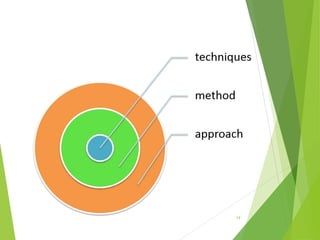
Different theories about the
nature of language and how
languages are learned (the
approach) imply different ways
of teaching language (the
method) and different methods
make use of different kinds of
classroom activities (the
techniques).
19
Examples of methods
Grammar Translation METHOD
 Traditional way of teaching Latin and
Greek. In the 19th century used to teach
French, German and English.
 Typical lesson consisted of a)
presentation of grammatical rule, b)
specially written text that demonstrated
the rule, c) list of new words, d)
translation exercises, e) grammar
exercises.
Grammar Translation METHOD
Emphasis on learning to read
and write.
Vocabulary is taught in the
form of lists of isolated
words.
Grammar Translation METHOD
 Long, elaborate explanations of
the intricacies of grammar are
given.
 Medium of instruction was the
mother tongue.
 No provision for the oral use of
language.
Grammar Translation METHOD
 Little attention is paid to the
content of texts, which are treated
as exercises in in grammatical
analysis.
 Often the only drills are exercises in
translating disconnected sentences
from the target language into the
mother tongue.
Direct Method: Early 1900’s
 Posited by Charles Berlitz.
 Second language learning is similar
to first language learning.
 Emphasis on:
oral interaction,
spontaneous use of language,
no translation,
little if any analysis of grammatical
rules and structures.
Direct Method: Early 1900’s
 Classroom instruction was conducted in
the target language.
 There was an inductive approach to
grammar.
 Only everyday vocabulary was taught.
 Concrete vocabulary was taught through
pictures and objects.
 Abstract vocabulary was taught by
association of ideas.
Direct Method: Early 1900’s
 New teaching points were introduced
orally.
 Communication skills were organized
around question-answer exchanges
between teachers and students.
 Speech and listening comprehension
were taught.
 Correct pronunciation and grammar
were emphasised.
The Audiolingual Method (1950’s)
 Outbreak of the World War II:
 Heightened the need to become orally
proficient.
 “The Army Method” (an oral-based
approach to language learning).
 Influenced by structuralism and
behaviourism:
 Identify the grammatical structures and
the basic sentence patterns.
 Practice these patterns by systematic
attention to pronunciation and intensive
oral drilling.
The Audiolingual Method (1950’s)
New material is presented
in dialogue form.
There is dependency on
mimicry, memorization of
set phrases, and
overlearning.
The Audiolingual Method (1950’s)
 By constant repetition the learner
develops habits. Language learning
is seen as acquiring a set of
appropriate mechanical habits;
errors are not accepted because
the lead to the development of
bad habits.
 The role of the teacher is to
develop good language habits.
The Audiolingual Method (1950’s)
 There is little or no grammatical
explanation. Grammar is taught
inductively.
 Great importance is attached to
pronunciation.
 Very little use of the mother tongue by
teachers is permitted.
 Successful responses are reinforced.
 There is great effort to get students to
produce error-free utterances.
Typical audiolingual activities
Dialog memorization.
Repetition drill: Students
repeat the teacher’s model
as accurately and as quickly
as possible to learn the
lines of the dialog.
Typical audiolingual activities
 Transformation drill: The teacher
gives students a certain kind of
sentence pattern. Students are
asked to transform a sentence into
a negative sentence.
 Question-and-answer drill: This
drill gives students practice with
answering questions.
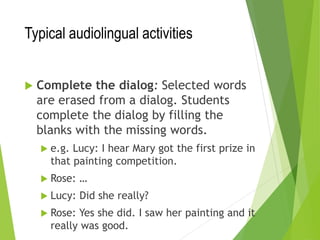
Typical audiolingual activities
 Complete the dialog: Selected words
are erased from a dialog. Students
complete the dialog by filling the
blanks with the missing words.
 e.g. Lucy: I hear Mary got the first prize in
that painting competition.
 Rose: …
 Lucy: Did she really?
 Rose: Yes she did. I saw her painting and it
really was good.
Designer Methods (Humanistic
Approaches) 1970’s 1980’s
 Influenced by principles of psychology
and psychotherapy.
 Developed in 70’s and 80’s mainly in US.
 The Silent way.
 Total physical response.
 Suggestopedia.
 Community language learning.
The silent way (Caleb Gattegno)
 Characterized by a problem-solving
approach.
 Develops independence and autonomy
and encourages students to cooperate
with each other.
 Learning is facilitated if the learner discovers
or creates rather than remembers and
repeats what is to be learned.
 Learning is facilitated by accompanying
(mediating) physical objects).
 Learning is facilitated by problem solving the
material to be learned.
The silent way (Caleb Gattegno)
 Sound-colour chart: Each colour symbolizes one
sound.
Typical techniques
 Sound-Colour Chart: The teacher refers
students to a color-coded wall chart
depicting individual sounds in the target
language - students use this to point out
and build words with correct pronunciation.
 Teacher's Silence: Teacher is generally
silent, only giving help when it is absolutely
necessary.
 Peer Correction: Students encouraged to
help each other in a cooperative and not
competitive spirit.
Typical techniques
 Self-correction Gestures: Teacher uses
hands to indicate that something is
incorrect or needs changing - e.g.. using
fingers as words then touching the
finger/word that is in need of correction.
 Word Chart: Words are depicted on
charts, the sounds in each word
corresponding in colour to the Sound-
Colour Chart described above - students
use this to build sentences.
Typical techniques
Fidel Chart: A chart that is
color-coded according to the
sound-colour chart but
includes the various English
spellings so that they can be
directly related to actual
sounds.
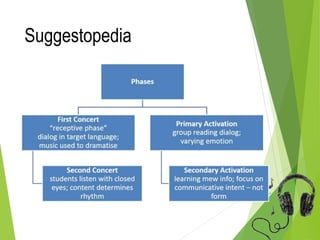
Suggestopedia
 One of the innovative methods
dating back to the 1970’s (Georgi
Lozanov).
 Lozanov suggests that the human
brain could process great quantities
of material if simply given the right
conditions for learning, among which
are a state of relaxation and giving
over the control of the teacher.
Music is central to this method.
Suggestopedia
Lozanov (1982) indicates that
this method transcends the
language classroom and can be
applied in other school subjects.
He claims that about 200 to 240
new words may be introduced
each lesson.
Suggestopedia
 Learning is facilitated in an environment
that is as comfortable as possible,
featuring soft cushioned seating and dim
lighting.
 "Peripheral" learning is encouraged
through the presence in the learning
environment of posters and decorations
featuring the target language and various
grammatical information.
 The teacher assumes a role of complete
authority and control in the classroom.
Suggestopedia
 Self-perceived and psychological
barriers to learners' potential to learn
are "desuggested".
 Students are encouraged to be child-
like, take "mental trips with the
teacher" and assume new roles and

names in the target language in order
to become more "suggestible".
 Baroque music is played softly in the
background to increase mental
relaxation and potential to take in and
retain new material during the lesson.
Suggestopedia
 Students work from lengthy dialogs
in the target language, with an
accompanying translation into the
students' native language.
 Errors are tolerated, the emphasis
being on content and not
structure. Grammar and
vocabulary are presented and given
treatment from the teacher, but
not dwelt on.
Suggestopedia
 Homework is limited to students re-
reading the dialog they are studying
- once before they go to sleep at
night and once in the morning
before they get up.
 Music, drama and "the Arts" are
integrated into the learning process
as often as possible.
Suggestopedia
Total Physical Response
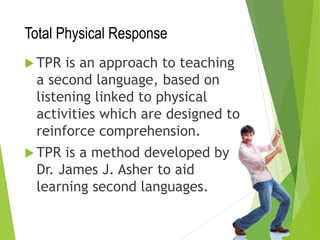
 TPR is an approach to teaching
a second language, based on
listening linked to physical
activities which are designed to
reinforce comprehension.
 TPR is a method developed by
Dr. James J. Asher to aid
learning second languages.
Total Physical Response
 The method relies on the
assumption that when learning a
second or additional language,
that language is internalized
through a process of code-
breaking similar to first language
development.
 Students respond to commands
that require physical movement.
Total Physical Response
Successful second language
learning should be a parallel
process to child first language
acquisition.
Appropriate activities can
produce stress-free learning.
Learners are encourage to
speak when they feel ready to
speak.
Total Physical Response
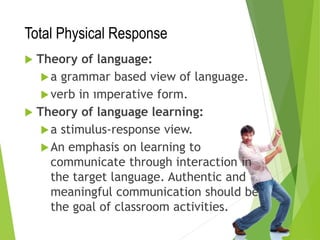
 Theory of language:
a grammar based view of language.
verb in ımperative form.
 Theory of language learning:
a stimulus-response view.
An emphasis on learning to
communicate through interaction in
the target language. Authentic and
meaningful communication should be
the goal of classroom activities.
Communicative language teaching
(1980s)
The introduction of authentic
texts into the learning situation.
The provision of opportunities
for learners to focus, not only on
the language but also on the
learning process itself.
Communicative language teaching
(1980s)
 An enhancement of the learner's
own personal experiences as
important contributing elements
to classroom learning.
 An attempt to link classroom
language learning with language
activation outside the classroom.
Communicative language teaching
(1980s)
 Fluency is an important dimension of
communication.
 Communication involves the integration
of different language skills.
 Learning is a process of creative
construction and involves trial and
error.
Task-based language learning
 Task-based language learning
(TBLL) is a method of
instruction which focuses on
the use of authentic language,
and students doing meaningful
tasks using the target
language; for example, visiting
the doctor, conducting an
interview, or calling customer
services for help.
Task-based language learning
 Assessment is primarily based
on task outcome (ie: the
appropriate completion of
tasks) rather than simply
accuracy of language forms.
This makes TBLL especially
popular for developing target
language fluency and student
confidence.
Task-based language learning
 In TBLL the role of the teacher
changes from that of an instructor
and prosecutor of errors to that of
a supporter and inventor of tasks
which her/his learners enjoy doing.
 It proved useful to divide the
learning process in TBLL in three
phases: The pre-task phase, the
doing of the task, and the post-task
phase. Taken together they form a
task cycle. The major role of the
teacher changes from phase to
phase.
Are there
drawbacks to the
use of methods?
58
Problems associated with methods
 No general agreement on what
method is: Any principled choice of
techniques can be termed “method”.
 Some methods not based on clear
language and language learning
theory.
 Methods are open to wide
interpretation by materials
developers and teachers.
Problems associated with methods
 Methods that present themselves
as “state of the art” have in
essence been around for thousands
of years. Total corpus of ideas
available to language teachers has
not basically changed in 2000
years. In essence methods
represent different configurations
of the same basic options.
Problems associated with methods
 The rise and fall of methods is mainly
due to the influence of profit seekers,
promoters and forces of the
intellectual marketplace. Methods
become influential when they gain
the seal of approval by university
departments.
 Language teaching is a massive
industry where much is done in the
name of profit and glory.
Problems associated with methods
 Most methods have been developed
in western developed countries (US
and UK). Fallacy that anything
imported by US and UK is by nature
effective and advanced.
 Methods developed in a specific
educational, social and cultural
context cannot be exported
wholesale and used in countries with
different philosophies, values and
beliefs.
Eclectic
Approach
63
Eclectic Approach in Teaching
English
 Larsen-Freeman (2000) and Mellow
(2000) both have used the term
principled eclecticism to describe a
desirable, coherent, pluralistic
approach to language teaching.
 Eclecticism involves the use of a
variety of language learning activities,
each of which may have very different
characteristics and may be motivated
by different underlying assumptions.
Eclectic Approach in Teaching
English
 The use eclecticism is due to the
fact that there are strengths as well
as weaknesses of single theory
based methods. Reliance upon a
single theory of teaching has been
criticized because the use of a
limited number of techniques can
become mechanic.
Eclectic Approach in Teaching
English
The teacher decides what
methodology or approach to use
depending on the aims of the
lesson and the learners in the
group. Almost all modern course
books have a mixture of
approaches and methodologies.
Advantages of an eclectic approach
 Safety: The use of a variety of
ideas and procedures from
different existing approaches and
methods will increase the chances
of learning taking place.
 Interest: Teachers need to use
different techniques to hold the
learners' attention.
Advantages of an eclectic approach
 Diversity: Different
learning/teaching contexts require
different methodologies.
 Flexibility: Awareness of a range of
available techniques will help
teachers exploit materials better
and manage unexpected situations.
Informed teaching is bound to be
eclectic.

Language teaching approaches and methods

  • 1.
    Applied Linguistics to ForeignLanguage Teaching and Learning
  • 2.
    Main issues ofthis unit  What is a method?  What are the components of a method?  What is an approach?  Overview of most well known methods in language teaching.  Do methods help teachers?  Problems with methods.  Is there a super method?
  • 3.
  • 4.
    All methods include prescriptionsfor the teacher and the learners. All methods are a pre- packaged set of specifications of how the teacher should teach and how the learner should learn derived from a particular theory of language and a theory of language learning.
  • 5.
     For theteacher, methods prescribe what materials and activities should be used, how they should be used and what the role of the teacher should be.  For learners, methods prescribe what approach to learning the learner should take and what roles the learner should adopt in the classroom.
  • 6.
  • 7.
     Underlying eachmethod is a theory on the nature of language and a theory on the nature of language learning both of which comprise the approach.  These theories are derived from the areas of linguistics, sociolinguistics, psycholinguistics and are the source of principles and practices of language teaching.
  • 8.
    What is anapproach influenced by? • Theory of language: How is language viewed? ‒ Structural View of Language. ‒ Functional View of Language.
  • 9.
    What is anapproach influenced by?  Theory of language learning: How do learners learn the language?  What are the psychological and cognitive processes involved (habit formation, induction, inferencing, generalization)?  What are the conditions that need to be met for these learning processes to be activated?
  • 10.
    FOCUS OF TEACHING Iflanguage is seen as a system of structurally related elements for the coding of meaning:  What dimension of language is prioritized?  Grammatical dimension.  What needs to be taught?  Phonological units.  Grammatical units and operations.  Lexical items.
  • 11.
    If language isviewed as a vehicle for the expression of functional meaning:  What dimension of language is prioritized?  semantic and communicative dimension of language.  What needs to be taught?  functions, notions of language. FOCUS OF TEACHING
  • 12.
  • 13.
    Syllabus  Syllabus isthe level at which theory is put into practice and at which choices are made about the content to be taught, the skills to be developed, the order of the content etc.  The theory of language adopted will affect the organisation and selection of language content.  Different methods have different types of syllabi associated with them i.e. different ways of selecting and organising content.
  • 14.
    Teaching/Learning Practices  Typesof learning tasks and activities to be used in the classroom.  Roles of learners in the classroom: the degree of control that learners have over their learning, roles that learners will assume in the classroom, learning groupings recommended.  Roles of teachers: functions that the teacher is to fulfil in the classroom, the degree to which the teacher influences the learning process and the kind of interaction between the teacher and the learners.
  • 15.
    Teaching/Learning Practices  Roleof materials: the function of materials in the learning process and the forms they take. In some methods, materials are designed to replace the teacher so that learning can take place independently. In others, materials are teacher proof so that even poorly trained teachers with imperfect control of the language can use them.
  • 16.
    Assessment How students’ language knowledgeis to be assessed. Error correction policy.
  • 17.
  • 18.
    Different theories aboutthe nature of language and how languages are learned (the approach) imply different ways of teaching language (the method) and different methods make use of different kinds of classroom activities (the techniques).
  • 19.
  • 20.
  • 21.
    Grammar Translation METHOD Traditional way of teaching Latin and Greek. In the 19th century used to teach French, German and English.  Typical lesson consisted of a) presentation of grammatical rule, b) specially written text that demonstrated the rule, c) list of new words, d) translation exercises, e) grammar exercises.
  • 22.
    Grammar Translation METHOD Emphasison learning to read and write. Vocabulary is taught in the form of lists of isolated words.
  • 23.
    Grammar Translation METHOD Long, elaborate explanations of the intricacies of grammar are given.  Medium of instruction was the mother tongue.  No provision for the oral use of language.
  • 24.
    Grammar Translation METHOD Little attention is paid to the content of texts, which are treated as exercises in in grammatical analysis.  Often the only drills are exercises in translating disconnected sentences from the target language into the mother tongue.
  • 25.
    Direct Method: Early1900’s  Posited by Charles Berlitz.  Second language learning is similar to first language learning.  Emphasis on: oral interaction, spontaneous use of language, no translation, little if any analysis of grammatical rules and structures.
  • 26.
    Direct Method: Early1900’s  Classroom instruction was conducted in the target language.  There was an inductive approach to grammar.  Only everyday vocabulary was taught.  Concrete vocabulary was taught through pictures and objects.  Abstract vocabulary was taught by association of ideas.
  • 27.
    Direct Method: Early1900’s  New teaching points were introduced orally.  Communication skills were organized around question-answer exchanges between teachers and students.  Speech and listening comprehension were taught.  Correct pronunciation and grammar were emphasised.
  • 28.
    The Audiolingual Method(1950’s)  Outbreak of the World War II:  Heightened the need to become orally proficient.  “The Army Method” (an oral-based approach to language learning).  Influenced by structuralism and behaviourism:  Identify the grammatical structures and the basic sentence patterns.  Practice these patterns by systematic attention to pronunciation and intensive oral drilling.
  • 29.
    The Audiolingual Method(1950’s) New material is presented in dialogue form. There is dependency on mimicry, memorization of set phrases, and overlearning.
  • 30.
    The Audiolingual Method(1950’s)  By constant repetition the learner develops habits. Language learning is seen as acquiring a set of appropriate mechanical habits; errors are not accepted because the lead to the development of bad habits.  The role of the teacher is to develop good language habits.
  • 31.
    The Audiolingual Method(1950’s)  There is little or no grammatical explanation. Grammar is taught inductively.  Great importance is attached to pronunciation.  Very little use of the mother tongue by teachers is permitted.  Successful responses are reinforced.  There is great effort to get students to produce error-free utterances.
  • 32.
    Typical audiolingual activities Dialogmemorization. Repetition drill: Students repeat the teacher’s model as accurately and as quickly as possible to learn the lines of the dialog.
  • 33.
    Typical audiolingual activities Transformation drill: The teacher gives students a certain kind of sentence pattern. Students are asked to transform a sentence into a negative sentence.  Question-and-answer drill: This drill gives students practice with answering questions.
  • 34.
    Typical audiolingual activities Complete the dialog: Selected words are erased from a dialog. Students complete the dialog by filling the blanks with the missing words.  e.g. Lucy: I hear Mary got the first prize in that painting competition.  Rose: …  Lucy: Did she really?  Rose: Yes she did. I saw her painting and it really was good.
  • 35.
    Designer Methods (Humanistic Approaches)1970’s 1980’s  Influenced by principles of psychology and psychotherapy.  Developed in 70’s and 80’s mainly in US.  The Silent way.  Total physical response.  Suggestopedia.  Community language learning.
  • 36.
    The silent way(Caleb Gattegno)  Characterized by a problem-solving approach.  Develops independence and autonomy and encourages students to cooperate with each other.  Learning is facilitated if the learner discovers or creates rather than remembers and repeats what is to be learned.  Learning is facilitated by accompanying (mediating) physical objects).  Learning is facilitated by problem solving the material to be learned.
  • 37.
    The silent way(Caleb Gattegno)  Sound-colour chart: Each colour symbolizes one sound.
  • 38.
    Typical techniques  Sound-ColourChart: The teacher refers students to a color-coded wall chart depicting individual sounds in the target language - students use this to point out and build words with correct pronunciation.  Teacher's Silence: Teacher is generally silent, only giving help when it is absolutely necessary.  Peer Correction: Students encouraged to help each other in a cooperative and not competitive spirit.
  • 39.
    Typical techniques  Self-correctionGestures: Teacher uses hands to indicate that something is incorrect or needs changing - e.g.. using fingers as words then touching the finger/word that is in need of correction.  Word Chart: Words are depicted on charts, the sounds in each word corresponding in colour to the Sound- Colour Chart described above - students use this to build sentences.
  • 40.
    Typical techniques Fidel Chart:A chart that is color-coded according to the sound-colour chart but includes the various English spellings so that they can be directly related to actual sounds.
  • 41.
    Suggestopedia  One ofthe innovative methods dating back to the 1970’s (Georgi Lozanov).  Lozanov suggests that the human brain could process great quantities of material if simply given the right conditions for learning, among which are a state of relaxation and giving over the control of the teacher. Music is central to this method.
  • 42.
    Suggestopedia Lozanov (1982) indicatesthat this method transcends the language classroom and can be applied in other school subjects. He claims that about 200 to 240 new words may be introduced each lesson.
  • 43.
    Suggestopedia  Learning isfacilitated in an environment that is as comfortable as possible, featuring soft cushioned seating and dim lighting.  "Peripheral" learning is encouraged through the presence in the learning environment of posters and decorations featuring the target language and various grammatical information.  The teacher assumes a role of complete authority and control in the classroom.
  • 44.
    Suggestopedia  Self-perceived andpsychological barriers to learners' potential to learn are "desuggested".  Students are encouraged to be child- like, take "mental trips with the teacher" and assume new roles and names in the target language in order to become more "suggestible".  Baroque music is played softly in the background to increase mental relaxation and potential to take in and retain new material during the lesson.
  • 45.
    Suggestopedia  Students workfrom lengthy dialogs in the target language, with an accompanying translation into the students' native language.  Errors are tolerated, the emphasis being on content and not structure. Grammar and vocabulary are presented and given treatment from the teacher, but not dwelt on.
  • 46.
    Suggestopedia  Homework islimited to students re- reading the dialog they are studying - once before they go to sleep at night and once in the morning before they get up.  Music, drama and "the Arts" are integrated into the learning process as often as possible.
  • 47.
  • 48.
    Total Physical Response TPR is an approach to teaching a second language, based on listening linked to physical activities which are designed to reinforce comprehension.  TPR is a method developed by Dr. James J. Asher to aid learning second languages.
  • 49.
    Total Physical Response The method relies on the assumption that when learning a second or additional language, that language is internalized through a process of code- breaking similar to first language development.  Students respond to commands that require physical movement.
  • 50.
    Total Physical Response Successfulsecond language learning should be a parallel process to child first language acquisition. Appropriate activities can produce stress-free learning. Learners are encourage to speak when they feel ready to speak.
  • 51.
    Total Physical Response Theory of language: a grammar based view of language. verb in ımperative form.  Theory of language learning: a stimulus-response view. An emphasis on learning to communicate through interaction in the target language. Authentic and meaningful communication should be the goal of classroom activities.
  • 52.
    Communicative language teaching (1980s) Theintroduction of authentic texts into the learning situation. The provision of opportunities for learners to focus, not only on the language but also on the learning process itself.
  • 53.
    Communicative language teaching (1980s) An enhancement of the learner's own personal experiences as important contributing elements to classroom learning.  An attempt to link classroom language learning with language activation outside the classroom.
  • 54.
    Communicative language teaching (1980s) Fluency is an important dimension of communication.  Communication involves the integration of different language skills.  Learning is a process of creative construction and involves trial and error.
  • 55.
    Task-based language learning Task-based language learning (TBLL) is a method of instruction which focuses on the use of authentic language, and students doing meaningful tasks using the target language; for example, visiting the doctor, conducting an interview, or calling customer services for help.
  • 56.
    Task-based language learning Assessment is primarily based on task outcome (ie: the appropriate completion of tasks) rather than simply accuracy of language forms. This makes TBLL especially popular for developing target language fluency and student confidence.
  • 57.
    Task-based language learning In TBLL the role of the teacher changes from that of an instructor and prosecutor of errors to that of a supporter and inventor of tasks which her/his learners enjoy doing.  It proved useful to divide the learning process in TBLL in three phases: The pre-task phase, the doing of the task, and the post-task phase. Taken together they form a task cycle. The major role of the teacher changes from phase to phase.
  • 58.
    Are there drawbacks tothe use of methods? 58
  • 59.
    Problems associated withmethods  No general agreement on what method is: Any principled choice of techniques can be termed “method”.  Some methods not based on clear language and language learning theory.  Methods are open to wide interpretation by materials developers and teachers.
  • 60.
    Problems associated withmethods  Methods that present themselves as “state of the art” have in essence been around for thousands of years. Total corpus of ideas available to language teachers has not basically changed in 2000 years. In essence methods represent different configurations of the same basic options.
  • 61.
    Problems associated withmethods  The rise and fall of methods is mainly due to the influence of profit seekers, promoters and forces of the intellectual marketplace. Methods become influential when they gain the seal of approval by university departments.  Language teaching is a massive industry where much is done in the name of profit and glory.
  • 62.
    Problems associated withmethods  Most methods have been developed in western developed countries (US and UK). Fallacy that anything imported by US and UK is by nature effective and advanced.  Methods developed in a specific educational, social and cultural context cannot be exported wholesale and used in countries with different philosophies, values and beliefs.
  • 63.
  • 64.
    Eclectic Approach inTeaching English  Larsen-Freeman (2000) and Mellow (2000) both have used the term principled eclecticism to describe a desirable, coherent, pluralistic approach to language teaching.  Eclecticism involves the use of a variety of language learning activities, each of which may have very different characteristics and may be motivated by different underlying assumptions.
  • 65.
    Eclectic Approach inTeaching English  The use eclecticism is due to the fact that there are strengths as well as weaknesses of single theory based methods. Reliance upon a single theory of teaching has been criticized because the use of a limited number of techniques can become mechanic.
  • 66.
    Eclectic Approach inTeaching English The teacher decides what methodology or approach to use depending on the aims of the lesson and the learners in the group. Almost all modern course books have a mixture of approaches and methodologies.
  • 67.
    Advantages of aneclectic approach  Safety: The use of a variety of ideas and procedures from different existing approaches and methods will increase the chances of learning taking place.  Interest: Teachers need to use different techniques to hold the learners' attention.
  • 68.
    Advantages of aneclectic approach  Diversity: Different learning/teaching contexts require different methodologies.  Flexibility: Awareness of a range of available techniques will help teachers exploit materials better and manage unexpected situations. Informed teaching is bound to be eclectic.