ENGLISH FOR YOUNG
LEARNERS
TEACHING SPEAKING
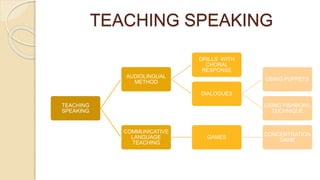
TEACHING SPEAKING
TEACHING
SPEAKING
AUDIOLINGUAL
METHOD
DRILLS WITH
CHORAL
RESPONSE
DIALOGUES
USING PUPPETS
USING FISHBOWL
TECHNIQUE
COMMUNICATIVE
LANGUAGE
TEACHING
GAMES
CONCENTRATION
GAME
BACKGROUND
 Children talk while they play.
 Play is vital and important aspect of a
child's development and language is a
part of that play. It is important to
consider the role of play in first language
acquisition because it is a subtle
reminder that play is also important in
children's second language
Classroom Techniques and
Activities
 When teaching speaking, it is especially
important to select activities which match
the objectives of your program.
 The specific techniques and task that you
choose should be based on the aims of the
program coupled with the learners' stages
of development
AUDIO LINGUAL METHOD
 It based on the notion that one can
learn language by developing habits
based on the patterns of language.
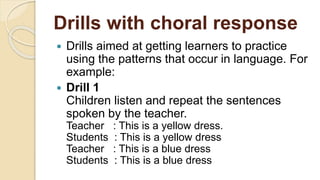
Drills with choral response
 Drills aimed at getting learners to practice
using the patterns that occur in language. For
example:
 Drill 1
Children listen and repeat the sentences
spoken by the teacher.
Teacher : This is a yellow dress.
Students : This is a yellow dress
Teacher : This is a blue dress
Students : This is a blue dress
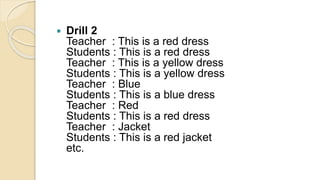
 Drill 2
Teacher : This is a red dress
Students : This is a red dress
Teacher : This is a yellow dress
Students : This is a yellow dress
Teacher : Blue
Students : This is a blue dress
Teacher : Red
Students : This is a red dress
Teacher : Jacket
Students : This is a red jacket
etc.
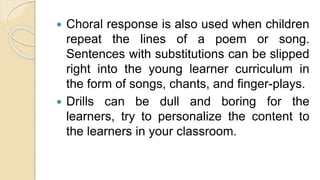
 Choral response is also used when children
repeat the lines of a poem or song.
Sentences with substitutions can be slipped
right into the young learner curriculum in
the form of songs, chants, and finger-plays.
 Drills can be dull and boring for the
learners, try to personalize the content to
the learners in your classroom.
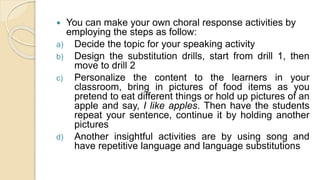
 You can make your own choral response activities by
employing the steps as follow:
a) Decide the topic for your speaking activity
b) Design the substitution drills, start from drill 1, then
move to drill 2
c) Personalize the content to the learners in your
classroom, bring in pictures of food items as you
pretend to eat different things or hold up pictures of an
apple and say, I like apples. Then have the students
repeat your sentence, continue it by holding another
pictures
d) Another insightful activities are by using song and
have repetitive language and language substitutions
DIALOGUES
 Dialogues provide learners with
grammatically controlled scripts that they
can use in real life. Dialogues can very
easily be scripted and turned into child-
friendly role-plays.
Using puppets to introduce dialogues
 Young learners are often aware that children feel
more comfortable talking with a puppet than with
an adult.
 The use of puppets is very appropriate in the
young learners’ classroom.
 A child who developmentally is too shy to speak to
an adult in front of his peers, may feel very
comfortable when the same adult is holding a
puppet and speaking to the child as the puppet.
 Puppets also make the language learning activity
 Puppets can be set as a role in a dialogue and played
by teacher and student or student-student. The real and
make-believe conversations for the young learners can
be as followed:
a) say thank you when somebody give a hand for them
b) say thank you when somebody give them something
c) say thank you when somebody give them a
compliment
d) introducing self in one occasion
e) apologize to someone else when they do the wrong
thing
f) request something to teacher or friend
Using fishbowl technique to
introduce dialogues
 The teacher can either invite a student to do
the activity with him or can model the activity
using 2 or more puppets.
 The teacher models the activity that the
children are expected to do while everyone
in the class watches as if the teacher and the
student were in a fishbowl.
 The activity can be as follow:
 T : Where is the math book?
S : It is on the table
T : Where is the pencil case
S : It is under the table
COMMUNICATIVE LANGUAGE
TEACHING
 CLT is an approach and a philosophical
orientation that connects classroom based
language learning with the language that
learners need in order to communicate
outside of the classroom.
 The activity can be authentic because it
represents the type of authentic play, outside
the classroom, that a young learner might
engage in depending upon her interests and
stage of development.
 It is necessary to consider the type of language that
children need in order to communicate in specific
situations.
 For instance, if children are going to role play finding a
pair of lost socks, they would need to know the
interrogative where. They might also need to know
prepositions such as in, on, under, etc.
 Another instance would be when children are playing
board games. They will need to be able say first, next,
last as in spaces on the game and whose turn it is to
play.
 If the children are talking about a birthday party they
had or went to, they will need to know the past tense.
 In CLT, the focus is on getting the message
across and helping children acquire fluency.
 In some cases, the language will need to be
adjusted to meet the language level of the
young learner.
 In other cases, the communicative task will
require language that the children have not
yet learned.
Games in CLT
 Play is a purposeful activity and
games are a part of playing
 Games offer the advantages of both
ALM and CLT
Concentration Game
 Provide some picture of things that students
familiar. Then, set the topic into Asking about your
preferences or opinion toward something.
 Gives the pictures to the students and ask them to
say whether they like the thing in the picture or not.
 For example:
S1 : (Turns over a picture of a chocolate candy
bar). I like chocolate.
(Turns over a picture of potatoes). I don't like
potatoes.
English for Young Learners - Teaching Speaking

English for Young Learners - Teaching Speaking

  • 1.
  • 2.
    TEACHING SPEAKING TEACHING SPEAKING AUDIOLINGUAL METHOD DRILLS WITH CHORAL RESPONSE DIALOGUES USINGPUPPETS USING FISHBOWL TECHNIQUE COMMUNICATIVE LANGUAGE TEACHING GAMES CONCENTRATION GAME
  • 3.
    BACKGROUND  Children talkwhile they play.  Play is vital and important aspect of a child's development and language is a part of that play. It is important to consider the role of play in first language acquisition because it is a subtle reminder that play is also important in children's second language
  • 4.
    Classroom Techniques and Activities When teaching speaking, it is especially important to select activities which match the objectives of your program.  The specific techniques and task that you choose should be based on the aims of the program coupled with the learners' stages of development
  • 5.
    AUDIO LINGUAL METHOD It based on the notion that one can learn language by developing habits based on the patterns of language.
  • 6.
    Drills with choralresponse  Drills aimed at getting learners to practice using the patterns that occur in language. For example:  Drill 1 Children listen and repeat the sentences spoken by the teacher. Teacher : This is a yellow dress. Students : This is a yellow dress Teacher : This is a blue dress Students : This is a blue dress
  • 7.
     Drill 2 Teacher: This is a red dress Students : This is a red dress Teacher : This is a yellow dress Students : This is a yellow dress Teacher : Blue Students : This is a blue dress Teacher : Red Students : This is a red dress Teacher : Jacket Students : This is a red jacket etc.
  • 8.
     Choral responseis also used when children repeat the lines of a poem or song. Sentences with substitutions can be slipped right into the young learner curriculum in the form of songs, chants, and finger-plays.  Drills can be dull and boring for the learners, try to personalize the content to the learners in your classroom.
  • 9.
     You canmake your own choral response activities by employing the steps as follow: a) Decide the topic for your speaking activity b) Design the substitution drills, start from drill 1, then move to drill 2 c) Personalize the content to the learners in your classroom, bring in pictures of food items as you pretend to eat different things or hold up pictures of an apple and say, I like apples. Then have the students repeat your sentence, continue it by holding another pictures d) Another insightful activities are by using song and have repetitive language and language substitutions
  • 10.
    DIALOGUES  Dialogues providelearners with grammatically controlled scripts that they can use in real life. Dialogues can very easily be scripted and turned into child- friendly role-plays.
  • 11.
    Using puppets tointroduce dialogues  Young learners are often aware that children feel more comfortable talking with a puppet than with an adult.  The use of puppets is very appropriate in the young learners’ classroom.  A child who developmentally is too shy to speak to an adult in front of his peers, may feel very comfortable when the same adult is holding a puppet and speaking to the child as the puppet.  Puppets also make the language learning activity
  • 12.
     Puppets canbe set as a role in a dialogue and played by teacher and student or student-student. The real and make-believe conversations for the young learners can be as followed: a) say thank you when somebody give a hand for them b) say thank you when somebody give them something c) say thank you when somebody give them a compliment d) introducing self in one occasion e) apologize to someone else when they do the wrong thing f) request something to teacher or friend
  • 13.
    Using fishbowl techniqueto introduce dialogues  The teacher can either invite a student to do the activity with him or can model the activity using 2 or more puppets.  The teacher models the activity that the children are expected to do while everyone in the class watches as if the teacher and the student were in a fishbowl.
  • 14.
     The activitycan be as follow:  T : Where is the math book? S : It is on the table T : Where is the pencil case S : It is under the table
  • 15.
    COMMUNICATIVE LANGUAGE TEACHING  CLTis an approach and a philosophical orientation that connects classroom based language learning with the language that learners need in order to communicate outside of the classroom.  The activity can be authentic because it represents the type of authentic play, outside the classroom, that a young learner might engage in depending upon her interests and stage of development.
  • 16.
     It isnecessary to consider the type of language that children need in order to communicate in specific situations.  For instance, if children are going to role play finding a pair of lost socks, they would need to know the interrogative where. They might also need to know prepositions such as in, on, under, etc.  Another instance would be when children are playing board games. They will need to be able say first, next, last as in spaces on the game and whose turn it is to play.  If the children are talking about a birthday party they had or went to, they will need to know the past tense.
  • 17.
     In CLT,the focus is on getting the message across and helping children acquire fluency.  In some cases, the language will need to be adjusted to meet the language level of the young learner.  In other cases, the communicative task will require language that the children have not yet learned.
  • 18.
    Games in CLT Play is a purposeful activity and games are a part of playing  Games offer the advantages of both ALM and CLT
  • 19.
    Concentration Game  Providesome picture of things that students familiar. Then, set the topic into Asking about your preferences or opinion toward something.  Gives the pictures to the students and ask them to say whether they like the thing in the picture or not.  For example: S1 : (Turns over a picture of a chocolate candy bar). I like chocolate. (Turns over a picture of potatoes). I don't like potatoes.