
Speaking Skills
Presented by the
teacher of English
Ra a Nataliaț
What is Speaking?
 Speaking is "the process of
building and sharing meaning
through the use of verbal and
non-verbal symbols, in a variety
of contexts."
(Chaney, 1998, p. 13)
To teach speaking is to
teach learners to:
 Produce the English speech sounds and sound
patterns
 Select appropriate words and sentences according
to the proper social setting, audience, situation and
subject matter
 Use language as a means of expressing values and
judgments.
 Use word and sentence stress, intonation patterns
and the rhythm of the second language.
 Organize their thoughts in a meaningful and logical
sequence.
 Use the language quickly and confidently with few
Class Activities For
Developing Speaking Skills
Types Of Class Activities
Language experts have
organized oral skills into
four distinctive types.
I. Drills or Linguistically
Structured Activities
II. Performance Activities
III. Participation Activities
IV. Observation Activities
Drills or Linguistically
Structured Activities
Teacher provides a particular
structure and the students
practice it by repeating it.
For Example,
Student 1 to Student 2:
I’m Nataly. What’s your
name?
Student 2 to Student 3:
I’m Ann. What’s your
name?
Performance Activities
A student prepares himself
beforehand and delivers a
message to a group or he can
also talk about whether he has
experienced anything worth
telling his friends about his daily
life before class.
e.g.
Student’s Speech
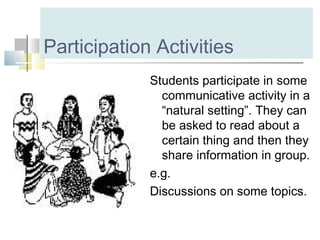
Participation Activities
Students participate in some
communicative activity in a
“natural setting”. They can
be asked to read about a
certain thing and then they
share information in group.
e.g.
Discussions on some topics.
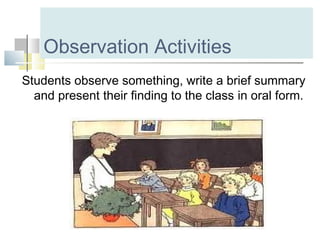
Observation Activities
Students observe something, write a brief summary
and present their finding to the class in oral form.
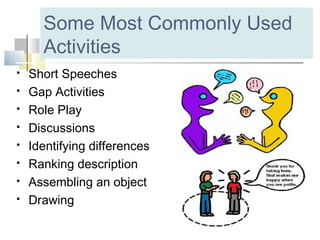
Some Most Commonly Used
Activities
 Short Speeches
 Gap Activities
 Role Play
 Discussions
 Identifying differences
 Ranking description
 Assembling an object
 Drawing
Short Speeches
• students may be given some easy topics
• Prepare them in verbal or written form
• Come to stage or deliver a lecture or speech
for given time frame before the class.
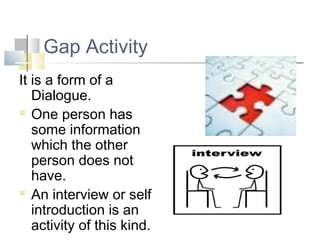
Gap Activity
It is a form of a
Dialogue.
 One person has
some information
which the other
person does not
have.
 An interview or self
introduction is an
activity of this kind.
Role Play
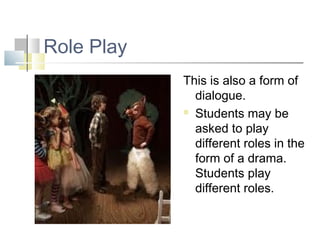
This is also a form of
dialogue.
 Students may be
asked to play
different roles in the
form of a drama.
Students play
different roles.
Role Play
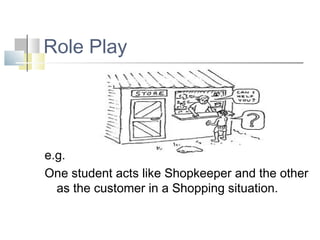
e.g.
One student acts like Shopkeeper and the other
as the customer in a Shopping situation.
Role Play
 This exercise will encourage the students to
speak in real life situation.
Simulations
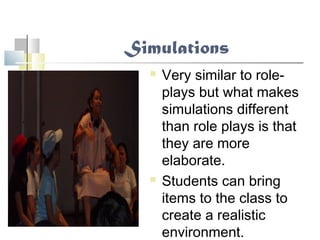
 Very similar to role-
plays but what makes
simulations different
than role plays is that
they are more
elaborate.
 Students can bring
items to the class to
create a realistic
environment.
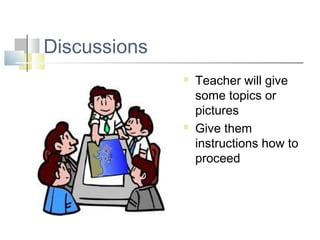
Discussions
 Teacher will give
some topics or
pictures
 Give them
instructions how to
proceed
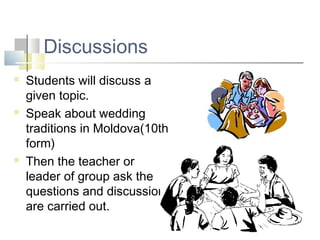
Discussions
 Students will discuss a
given topic.
 Speak about wedding
traditions in Moldova(10th
form)
 Then the teacher or
leader of group ask the
questions and discussions
are carried out.
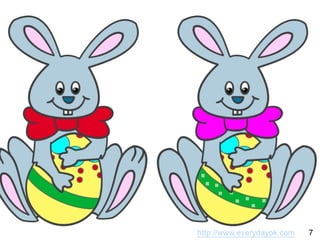
Identifying differences
Similar items differ in appearance. The features
of grammar and vocabulary that are practiced
are determined by the content of the pictures
and the items that are missing or different.
Differences in the activities depicted lead to
practice of different verbs. Differences in
number, size, and shape lead to adjective
practice. Differing locations would probably be
described with prepositional phrases.
Jigsaw Activities
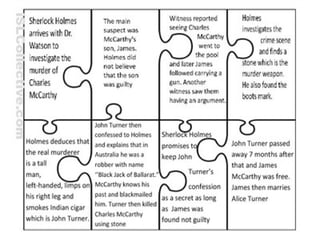
 Jigsaw activities are more
elaborate information gap
activities that can be done
with several partners. In a
jigsaw activity, each
partner has one or a few
pieces of the "puzzle,"
and the partners must
cooperate to fit all the
pieces into a whole
picture.
 The puzzle piece may
take one of several
forms. It may be one
panel from a comic strip
or one photo from a set
that tells a story. It may
be one sentence from a
written narrative.
Students ask questions in
order to find out whose
part is first and so on.
Picture
Sequencing/Narrating
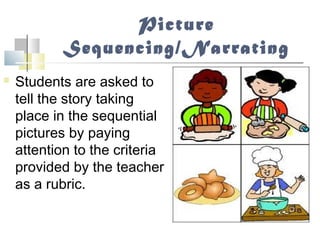
 Students are asked to
tell the story taking
place in the sequential
pictures by paying
attention to the criteria
provided by the teacher
as a rubric.
Picture describing
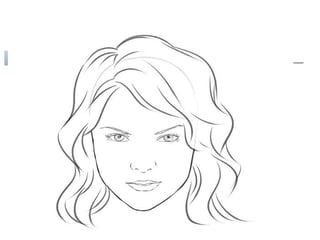
 A. Draw a face. Write 5 or 6 good sentences about
the face. Pay attention to adjective agreement.
 B. Work with a partner. Do not show your drawing to
your partner. Read your sentences to your partner.
Your partner is going to draw the face according to
your sentences. Compare your drawings to check
your descriptions.
 Eg. Here is Ann. She has little black eyes and
a straight nose. Her eyebrows are thin. She
has wavy and shoulder length hair. Her lips
are thick. She is pretty.
Assembling an Object
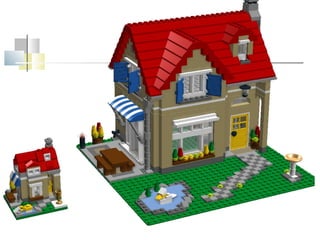
 Looking at a photograph of an object, a
student gives step-by-step directions to
another student who attempts to assemble
an object (e.g., a car made from Lego®
pieces, a collage made from multiple images,
etc.). The student assembling the object can
ask questions to clarify the directions
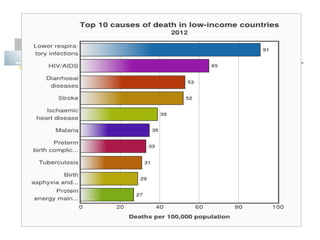
Ranking
 Small groups work together to construct a
ranking of members that all belong to the
same category (e.g., most deadly
diseases(10th form) or causes of death.
When the group reaches a consensus
about their rankings, they may compare
their results to actual data.
How to evaluate speaking
skills?
 You can use these online rubric makers
 http://rubistar.4teachers.org/index
.php?
screen=NewRubric&module=Rubi
star http://www.teach-
nology.com/web_tools/rubrics/oral
ex/
Suggestions for Teachers
in Teaching Speaking
 Provide maximum opportunity to
students to speak the target language
by providing a rich environment that
contains collaborative work, authentic
materials and tasks, and shared
knowledge.
 Try to involve each student in every
speaking activity; for this aim, practice
different ways of student participation.
Suggestions for Teachers
in Teaching Speaking
 Reduce teacher speaking time in class
while increasing student speaking time.
Step back and observe students.
 Indicate positive signs when
commenting on a student's response.
 Ask eliciting questions such as "What
do you mean? How did you reach that
conclusion?" in order to prompt
students to speak more.
Suggestions for Teachers
in Teaching Speaking
 Provide written feedback like "Your
presentation was really great. It was a
good job. I really appreciated your
efforts in preparing the materials and
efficient use of your voice…"
 Do not correct students' pronunciation
mistakes very often while they are
speaking. Correction should not distract
student from his or her speech.
Suggestions for Teachers in
Teaching Speaking
 Circulate around classroom to ensure
that students are on the right track and
see whether they need your help while
they work in groups or pairs.
 Provide the vocabulary beforehand that
students need in speaking activities.
 Diagnose problems faced by students
who have difficulty in expressing
themselves in the target language and
provide more opportunities to practice
the spoken language.
Prezentatre în cadrul seminarului teoretic

Prezentatre în cadrul seminarului teoretic

  • 1.
    Speaking Skills Presented bythe teacher of English Ra a Nataliaț
  • 2.
    What is Speaking? Speaking is "the process of building and sharing meaning through the use of verbal and non-verbal symbols, in a variety of contexts." (Chaney, 1998, p. 13)
  • 3.
    To teach speakingis to teach learners to:  Produce the English speech sounds and sound patterns  Select appropriate words and sentences according to the proper social setting, audience, situation and subject matter  Use language as a means of expressing values and judgments.  Use word and sentence stress, intonation patterns and the rhythm of the second language.  Organize their thoughts in a meaningful and logical sequence.  Use the language quickly and confidently with few
  • 4.
  • 5.
    Types Of ClassActivities Language experts have organized oral skills into four distinctive types. I. Drills or Linguistically Structured Activities II. Performance Activities III. Participation Activities IV. Observation Activities
  • 6.
    Drills or Linguistically StructuredActivities Teacher provides a particular structure and the students practice it by repeating it. For Example, Student 1 to Student 2: I’m Nataly. What’s your name? Student 2 to Student 3: I’m Ann. What’s your name?
  • 7.
    Performance Activities A studentprepares himself beforehand and delivers a message to a group or he can also talk about whether he has experienced anything worth telling his friends about his daily life before class. e.g. Student’s Speech
  • 8.
    Participation Activities Students participatein some communicative activity in a “natural setting”. They can be asked to read about a certain thing and then they share information in group. e.g. Discussions on some topics.
  • 9.
    Observation Activities Students observesomething, write a brief summary and present their finding to the class in oral form.
  • 10.
    Some Most CommonlyUsed Activities  Short Speeches  Gap Activities  Role Play  Discussions  Identifying differences  Ranking description  Assembling an object  Drawing
  • 11.
    Short Speeches • studentsmay be given some easy topics • Prepare them in verbal or written form • Come to stage or deliver a lecture or speech for given time frame before the class.
  • 12.
    Gap Activity It isa form of a Dialogue.  One person has some information which the other person does not have.  An interview or self introduction is an activity of this kind.
  • 13.
    Role Play This isalso a form of dialogue.  Students may be asked to play different roles in the form of a drama. Students play different roles.
  • 14.
    Role Play e.g. One studentacts like Shopkeeper and the other as the customer in a Shopping situation.
  • 15.
    Role Play  Thisexercise will encourage the students to speak in real life situation.
  • 16.
    Simulations  Very similarto role- plays but what makes simulations different than role plays is that they are more elaborate.  Students can bring items to the class to create a realistic environment.
  • 17.
    Discussions  Teacher willgive some topics or pictures  Give them instructions how to proceed
  • 18.
    Discussions  Students willdiscuss a given topic.  Speak about wedding traditions in Moldova(10th form)  Then the teacher or leader of group ask the questions and discussions are carried out.
  • 19.
    Identifying differences Similar itemsdiffer in appearance. The features of grammar and vocabulary that are practiced are determined by the content of the pictures and the items that are missing or different. Differences in the activities depicted lead to practice of different verbs. Differences in number, size, and shape lead to adjective practice. Differing locations would probably be described with prepositional phrases.
  • 21.
    Jigsaw Activities  Jigsawactivities are more elaborate information gap activities that can be done with several partners. In a jigsaw activity, each partner has one or a few pieces of the "puzzle," and the partners must cooperate to fit all the pieces into a whole picture.  The puzzle piece may take one of several forms. It may be one panel from a comic strip or one photo from a set that tells a story. It may be one sentence from a written narrative. Students ask questions in order to find out whose part is first and so on.
  • 23.
    Picture Sequencing/Narrating  Students areasked to tell the story taking place in the sequential pictures by paying attention to the criteria provided by the teacher as a rubric.
  • 24.
    Picture describing  A.Draw a face. Write 5 or 6 good sentences about the face. Pay attention to adjective agreement.  B. Work with a partner. Do not show your drawing to your partner. Read your sentences to your partner. Your partner is going to draw the face according to your sentences. Compare your drawings to check your descriptions.  Eg. Here is Ann. She has little black eyes and a straight nose. Her eyebrows are thin. She has wavy and shoulder length hair. Her lips are thick. She is pretty.
  • 26.
    Assembling an Object Looking at a photograph of an object, a student gives step-by-step directions to another student who attempts to assemble an object (e.g., a car made from Lego® pieces, a collage made from multiple images, etc.). The student assembling the object can ask questions to clarify the directions
  • 28.
    Ranking  Small groupswork together to construct a ranking of members that all belong to the same category (e.g., most deadly diseases(10th form) or causes of death. When the group reaches a consensus about their rankings, they may compare their results to actual data.
  • 30.
    How to evaluatespeaking skills?  You can use these online rubric makers  http://rubistar.4teachers.org/index .php? screen=NewRubric&module=Rubi star http://www.teach- nology.com/web_tools/rubrics/oral ex/
  • 31.
    Suggestions for Teachers inTeaching Speaking  Provide maximum opportunity to students to speak the target language by providing a rich environment that contains collaborative work, authentic materials and tasks, and shared knowledge.  Try to involve each student in every speaking activity; for this aim, practice different ways of student participation.
  • 32.
    Suggestions for Teachers inTeaching Speaking  Reduce teacher speaking time in class while increasing student speaking time. Step back and observe students.  Indicate positive signs when commenting on a student's response.  Ask eliciting questions such as "What do you mean? How did you reach that conclusion?" in order to prompt students to speak more.
  • 33.
    Suggestions for Teachers inTeaching Speaking  Provide written feedback like "Your presentation was really great. It was a good job. I really appreciated your efforts in preparing the materials and efficient use of your voice…"  Do not correct students' pronunciation mistakes very often while they are speaking. Correction should not distract student from his or her speech.
  • 34.
    Suggestions for Teachersin Teaching Speaking  Circulate around classroom to ensure that students are on the right track and see whether they need your help while they work in groups or pairs.  Provide the vocabulary beforehand that students need in speaking activities.  Diagnose problems faced by students who have difficulty in expressing themselves in the target language and provide more opportunities to practice the spoken language.