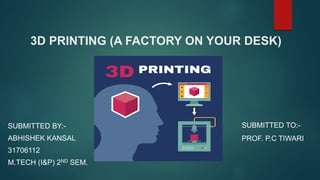
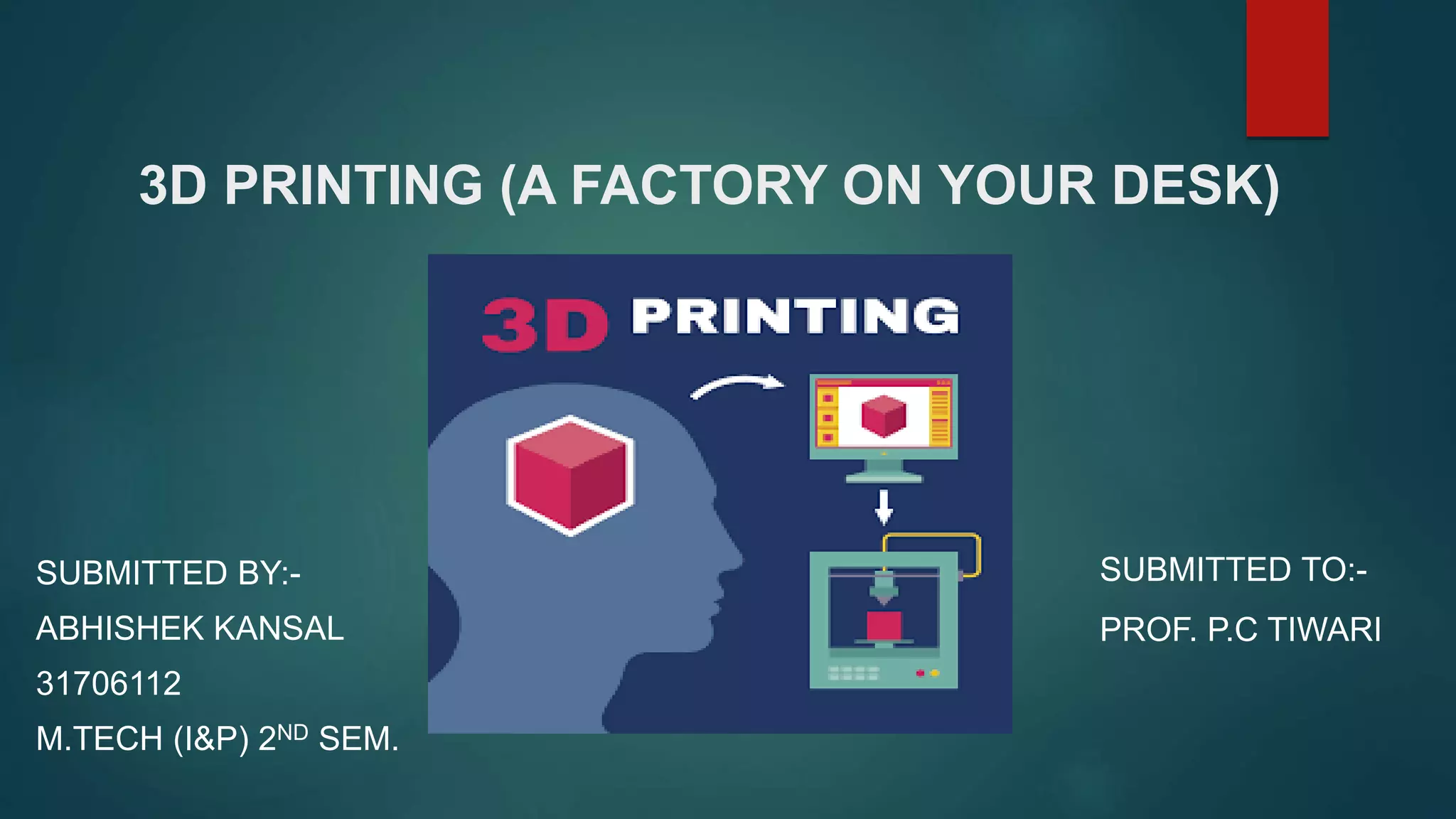
3D PRINTING (A FACTORY ON YOUR DESK)
SUBMITTED BY:-
ABHISHEK KANSAL
31706112
M.TECH (I&P) 2ND SEM.
SUBMITTED TO:-
PROF. P.C TIWARI
CONTENTS
 History
 What is 3D Printing
 Working
 3D Printing processes
 Advantages
 Limitations
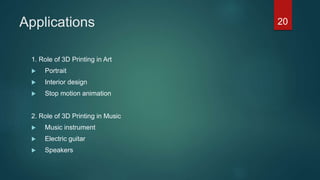
 Applications
 Conclusion
2
History
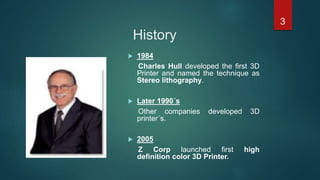
 1984
Charles Hull developed the first 3D
Printer and named the technique as
Stereo lithography.
 Later 1990´s
Other companies developed 3D
printer´s.
 2005
Z Corp launched first high
definition color 3D Printer.
3
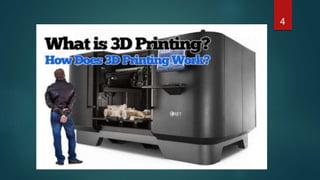
4
Introduction
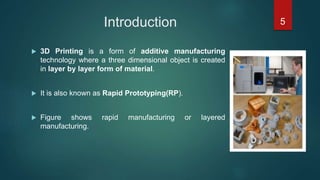
 3D Printing is a form of additive manufacturing
technology where a three dimensional object is created
in layer by layer form of material.
 It is also known as Rapid Prototyping(RP).
 Figure shows rapid manufacturing or layered
manufacturing.
5
Working
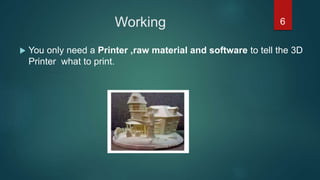
 You only need a Printer ,raw material and software to tell the 3D
Printer what to print.
6
Working steps…
Step1 :-
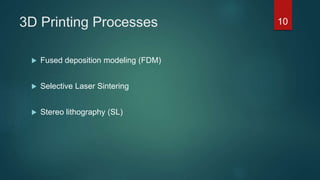
 Produce a 3D model using computer-aided design(CAD) software.(CAD
software Ex. Solid Works, Pro/Engineer, CATIA and many more )
Step 2 :-
 Convert the CAD drawing to the .STL format.(many other formats are
.WRL and .VRML )
Step 3 :-
 Now convert the .STL model in to thin no. of slice through slicer software
(Cura, Slic3r, KISSlicer).This slicer software convert .STL file in to G-code
file which is understandable by 3D Printer.
7
Working steps…
Step 4 :-
 This G-code file upload to 3D Printer.
Step 5 :-
 According to G-code instructions 3D Printer start printing layer by layer
form of material which after become diffused together form the final object
or product.
Step 6 :-
 After formation of product post processing will perform which help to get
finishing or accuracy in shape as well as in Dimensions.
8
9
3D Printing Processes
 Fused deposition modeling (FDM)
 Selective Laser Sintering
 Stereo lithography (SL)
10
Fused Deposition modelling(FDM)
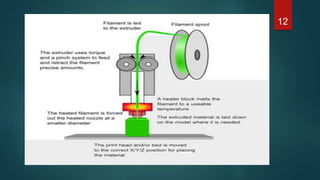
 Fused deposition modeling (FDM) was developed by S. Scott Crump in the
late 1980´s and was commercialized in 1990´s by Stratasys.
 FDM works on an "additive" principle by laying down material in layers; a
plastic filament wire is unwound from a coil and supplies material to
produce a part.
11
12
 Various polymers are used
o Polycarbonate (PC),
o Polylactic Acid (PLA)
o High Density Polyethylene (HDPE)
o Polyphenylsulfone (PPSU).
13
Selective laser sintering
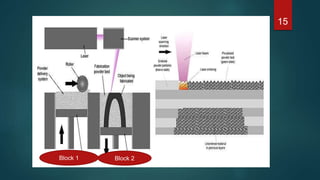
 Selective Laser Sintering (SLS) is an additive manufacturing (AM)
technique that uses a laser as the power source to sinter powdered
material , aiming the laser automatically at points in space defined
by a 3D model, binding the material together to create a solid
structure.
 An additive manufacturing layer technology, SLS involves the use of
a high power laser (for example, a carbon dioxide laser) to fuse
small particles of plastic, metal, ceramic, or glass powders into a
mass that has a desired three-dimensional shape.
14
15
Block 1 Block 2
Stereo lithography
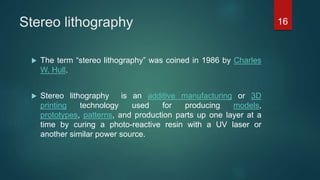
 The term “stereo lithography” was coined in 1986 by Charles
W. Hull.
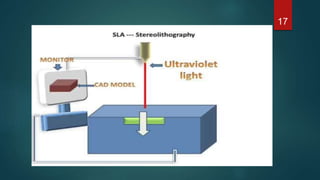
 Stereo lithography is an additive manufacturing or 3D
printing technology used for producing models,
prototypes, patterns, and production parts up one layer at a
time by curing a photo-reactive resin with a UV laser or
another similar power source.
16
17
Advantages
 3D printing allows ideas to develop faster than ever.
 Zero Scrap
 Verify a design before investing in an expensive molding tool .
 With a prototype you can test the market
 Get the feel of object
18
Limitations
 3D Printing material and equipment are costly
 Limited material
 Harmful emission
 3D Printer are slow
 Copyright infringements
 Size and scale limitation
19
Applications
1. Role of 3D Printing in Art
 Portrait
 Interior design
 Stop motion animation
2. Role of 3D Printing in Music
 Music instrument
 Electric guitar
 Speakers
20
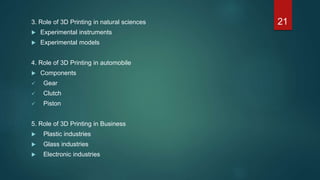
3. Role of 3D Printing in natural sciences
 Experimental instruments
 Experimental models
4. Role of 3D Printing in automobile
 Components
 Gear
 Clutch
 Piston
5. Role of 3D Printing in Business
 Plastic industries
 Glass industries
 Electronic industries
21
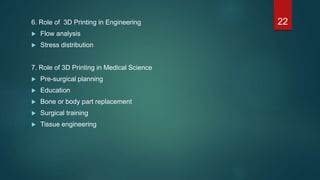
6. Role of 3D Printing in Engineering
 Flow analysis
 Stress distribution
7. Role of 3D Printing in Medical Science
 Pre-surgical planning
 Education
 Bone or body part replacement
 Surgical training
 Tissue engineering
22
Conclusion
Creating complete models in a single process using 3D
printing has great benefits. This innovative technology
has been proven to save companies time, manpower and
money.
23
References
 http://en.wikipedia.org/wiki/3D_printing
 http://www.zcorp.com
 http://www.howstuffworks.com
 mashable.com/category/3d-printing
 Rapid 3D printing of anatomically accurate and mechanically heterogeneous
aortic valve hydrogel scaffolds
 Vandendriessche, Pieter-Jan. "delta 3D printer accuracy“
 www.3dprinter.net
 www.livescience.com/34551-3d-printing.html
 www.3dprinter.net/reference/what-is-3d-printing
 www.stratasys.com/3d-printers
24
Thank
You
25

3d printing ppt

  • 1.
    3D PRINTING (AFACTORY ON YOUR DESK) SUBMITTED BY:- ABHISHEK KANSAL 31706112 M.TECH (I&P) 2ND SEM. SUBMITTED TO:- PROF. P.C TIWARI
  • 2.
    CONTENTS  History  Whatis 3D Printing  Working  3D Printing processes  Advantages  Limitations  Applications  Conclusion 2
  • 3.
    History  1984 Charles Hulldeveloped the first 3D Printer and named the technique as Stereo lithography.  Later 1990´s Other companies developed 3D printer´s.  2005 Z Corp launched first high definition color 3D Printer. 3
  • 4.
  • 5.
    Introduction  3D Printingis a form of additive manufacturing technology where a three dimensional object is created in layer by layer form of material.  It is also known as Rapid Prototyping(RP).  Figure shows rapid manufacturing or layered manufacturing. 5

  • 6.
    Working  You onlyneed a Printer ,raw material and software to tell the 3D Printer what to print. 6
  • 7.
    Working steps… Step1 :- Produce a 3D model using computer-aided design(CAD) software.(CAD software Ex. Solid Works, Pro/Engineer, CATIA and many more ) Step 2 :-  Convert the CAD drawing to the .STL format.(many other formats are .WRL and .VRML ) Step 3 :-  Now convert the .STL model in to thin no. of slice through slicer software (Cura, Slic3r, KISSlicer).This slicer software convert .STL file in to G-code file which is understandable by 3D Printer. 7
  • 8.
    Working steps… Step 4:-  This G-code file upload to 3D Printer. Step 5 :-  According to G-code instructions 3D Printer start printing layer by layer form of material which after become diffused together form the final object or product. Step 6 :-  After formation of product post processing will perform which help to get finishing or accuracy in shape as well as in Dimensions. 8
  • 9.
  • 10.
    3D Printing Processes Fused deposition modeling (FDM)  Selective Laser Sintering  Stereo lithography (SL) 10
  • 11.
    Fused Deposition modelling(FDM) Fused deposition modeling (FDM) was developed by S. Scott Crump in the late 1980´s and was commercialized in 1990´s by Stratasys.  FDM works on an "additive" principle by laying down material in layers; a plastic filament wire is unwound from a coil and supplies material to produce a part. 11
  • 12.
  • 13.
     Various polymersare used o Polycarbonate (PC), o Polylactic Acid (PLA) o High Density Polyethylene (HDPE) o Polyphenylsulfone (PPSU). 13
  • 14.
    Selective laser sintering Selective Laser Sintering (SLS) is an additive manufacturing (AM) technique that uses a laser as the power source to sinter powdered material , aiming the laser automatically at points in space defined by a 3D model, binding the material together to create a solid structure.  An additive manufacturing layer technology, SLS involves the use of a high power laser (for example, a carbon dioxide laser) to fuse small particles of plastic, metal, ceramic, or glass powders into a mass that has a desired three-dimensional shape. 14
  • 15.
  • 16.
    Stereo lithography  Theterm “stereo lithography” was coined in 1986 by Charles W. Hull.  Stereo lithography is an additive manufacturing or 3D printing technology used for producing models, prototypes, patterns, and production parts up one layer at a time by curing a photo-reactive resin with a UV laser or another similar power source. 16
  • 17.
  • 18.
    Advantages  3D printingallows ideas to develop faster than ever.  Zero Scrap  Verify a design before investing in an expensive molding tool .  With a prototype you can test the market  Get the feel of object 18
  • 19.
    Limitations  3D Printingmaterial and equipment are costly  Limited material  Harmful emission  3D Printer are slow  Copyright infringements  Size and scale limitation 19
  • 20.
    Applications 1. Role of3D Printing in Art  Portrait  Interior design  Stop motion animation 2. Role of 3D Printing in Music  Music instrument  Electric guitar  Speakers 20
  • 21.
    3. Role of3D Printing in natural sciences  Experimental instruments  Experimental models 4. Role of 3D Printing in automobile  Components  Gear  Clutch  Piston 5. Role of 3D Printing in Business  Plastic industries  Glass industries  Electronic industries 21
  • 22.
    6. Role of3D Printing in Engineering  Flow analysis  Stress distribution 7. Role of 3D Printing in Medical Science  Pre-surgical planning  Education  Bone or body part replacement  Surgical training  Tissue engineering 22
  • 23.
    Conclusion Creating complete modelsin a single process using 3D printing has great benefits. This innovative technology has been proven to save companies time, manpower and money. 23
  • 24.
    References  http://en.wikipedia.org/wiki/3D_printing  http://www.zcorp.com http://www.howstuffworks.com  mashable.com/category/3d-printing  Rapid 3D printing of anatomically accurate and mechanically heterogeneous aortic valve hydrogel scaffolds  Vandendriessche, Pieter-Jan. "delta 3D printer accuracy“  www.3dprinter.net  www.livescience.com/34551-3d-printing.html  www.3dprinter.net/reference/what-is-3d-printing  www.stratasys.com/3d-printers 24
  • 25.