JHELUM RAY CHAUDHURI
1ST YEAR 2ND SEMESTER
DEPARTMENT OF IEE
JADAVPUR UNIVERSITY
INTRODUCTION
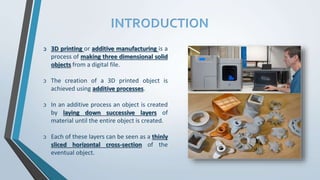
ↄ 3D printing or additive manufacturing is a
process of making three dimensional solid
objects from a digital file.
ↄ The creation of a 3D printed object is
achieved using additive processes.
ↄ In an additive process an object is created
by laying down successive layers of
material until the entire object is created.
ↄ Each of these layers can be seen as a thinly
sliced horizontal cross-section of the
eventual object.
HISTORY OF 3D PRINTERS
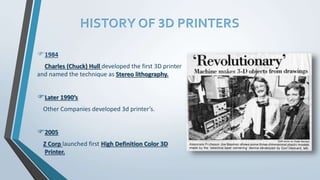
1984
Charles (Chuck) Hull developed the first 3D printer
and named the technique as Stereo lithography.
Later 1990’s
Other Companies developed 3d printer’s.
2005
Z Corp launched first High Definition Color 3D
Printer.
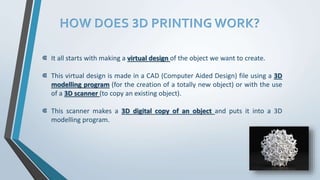
⋐ It all starts with making a virtual design of the object we want to create.
⋐ This virtual design is made in a CAD (Computer Aided Design) file using a 3D
modelling program (for the creation of a totally new object) or with the use
of a 3D scanner (to copy an existing object).
⋐ This scanner makes a 3D digital copy of an object and puts it into a 3D
modelling program.
HOW DOES 3D PRINTING WORK?
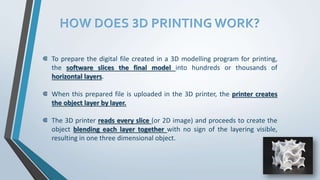
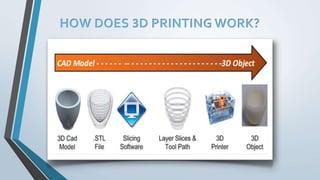
⋐ To prepare the digital file created in a 3D modelling program for printing,
the software slices the final model into hundreds or thousands of
horizontal layers.
⋐ When this prepared file is uploaded in the 3D printer, the printer creates
the object layer by layer.
⋐ The 3D printer reads every slice (or 2D image) and proceeds to create the
object blending each layer together with no sign of the layering visible,
resulting in one three dimensional object.
HOW DOES 3D PRINTING WORK?
METHODS AND TECHNOLOGIES
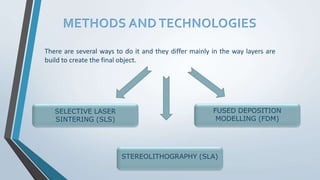
There are several ways to do it and they differ mainly in the way layers are
build to create the final object.
SELECTIVE LASER
SINTERING (SLS)
FUSED DEPOSITION
MODELLING (FDM)
STEREOLITHOGRAPHY (SLA)
SELECTIVE LASER SINTERING (SLS)
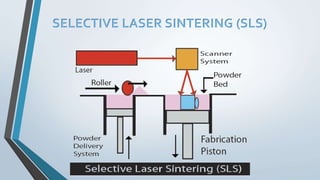
 This technology uses a high power laser to fuse small particles of plastic, metal,
ceramic or glass powders into a mass that has the desired three dimensional
shape.
 The laser selectively fuses the powdered material by scanning the cross-sections
(or layers) generated by the 3D modelling program on the surface of a powder bed.
 After each cross-section is scanned, the powder bed is lowered by one layer
thickness.
 Then a new layer of material is applied on top and the process is repeated until the
object is completed.
SELECTIVE LASER SINTERING (SLS)
FUSED DEPOSITION MODELING (FDM)
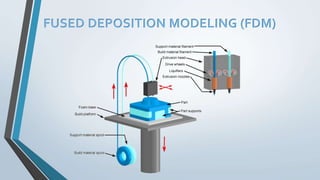
 The FDM technology works using a plastic filament or metal wire which is
unwound from a coil and supplies material to an extrusion nozzle which can turn
the flow on and off.
 The nozzle is heated to melt the material and can be moved in both horizontal
and vertical directions by a numerically controlled mechanism, directly
controlled by a computer-aided manufacturing (CAM) software package.
 The object is produced by extruding melted material to form layers as the
material hardens immediately after extrusion from the nozzle.
FUSED DEPOSITION MODELING (FDM)
STEREOLITHOGRAPHY (SLA)
The main technology in which photo polymerization is used to produce a solid
part from a liquid is SLA.
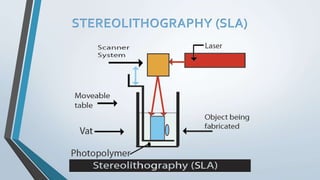
This technology employs a vat of liquid ultraviolet curable photopolymer resin
and an ultraviolet laser to build the object’s layers one at a time.
For each layer, the laser beam traces a cross-section of the part pattern on the
surface of the liquid resin.
Exposure to the ultraviolet laser light cures and solidifies the pattern traced on
the resin and joins it to the layer below.
STEREOLITHOGRAPHY (SLA)
After the pattern has been traced, the SLA’s elevator platform descends by a
distance equal to the thickness of a single layer, typically 0.05 mm to 0.15 mm
(0.002″ to 0.006″).
Then, a resin-filled blade sweeps across the cross section of the part, re-coating it
with fresh material.
On this new liquid surface, the subsequent layer pattern is traced, joining the
previous layer.
The complete three dimensional object is hence formed.
STEREOLITHOGRAPHY (SLA)
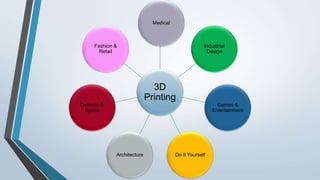
3D
Printing
Industrial
Design
Games &
Entertainment
Do It YourselfArchitecture
Defense &
Space
Fashion &
Retail
Medical
CONCLUSION
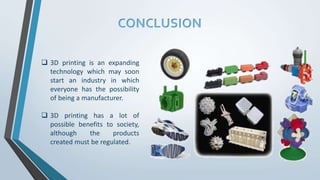
 3D printing is an expanding
technology which may soon
start an industry in which
everyone has the possibility
of being a manufacturer.
 3D printing has a lot of
possible benefits to society,
although the products
created must be regulated.

3D Printing

  • 1.
    JHELUM RAY CHAUDHURI 1STYEAR 2ND SEMESTER DEPARTMENT OF IEE JADAVPUR UNIVERSITY
  • 2.
    INTRODUCTION ↄ 3D printingor additive manufacturing is a process of making three dimensional solid objects from a digital file. ↄ The creation of a 3D printed object is achieved using additive processes. ↄ In an additive process an object is created by laying down successive layers of material until the entire object is created. ↄ Each of these layers can be seen as a thinly sliced horizontal cross-section of the eventual object.
  • 3.
    HISTORY OF 3DPRINTERS 1984 Charles (Chuck) Hull developed the first 3D printer and named the technique as Stereo lithography. Later 1990’s Other Companies developed 3d printer’s. 2005 Z Corp launched first High Definition Color 3D Printer.
  • 4.
    ⋐ It allstarts with making a virtual design of the object we want to create. ⋐ This virtual design is made in a CAD (Computer Aided Design) file using a 3D modelling program (for the creation of a totally new object) or with the use of a 3D scanner (to copy an existing object). ⋐ This scanner makes a 3D digital copy of an object and puts it into a 3D modelling program. HOW DOES 3D PRINTING WORK?
  • 5.
    HOW DOES 3DPRINTING WORK? ⋐ To prepare the digital file created in a 3D modelling program for printing, the software slices the final model into hundreds or thousands of horizontal layers. ⋐ When this prepared file is uploaded in the 3D printer, the printer creates the object layer by layer. ⋐ The 3D printer reads every slice (or 2D image) and proceeds to create the object blending each layer together with no sign of the layering visible, resulting in one three dimensional object.
  • 6.
    HOW DOES 3DPRINTING WORK?
  • 7.
    METHODS AND TECHNOLOGIES Thereare several ways to do it and they differ mainly in the way layers are build to create the final object. SELECTIVE LASER SINTERING (SLS) FUSED DEPOSITION MODELLING (FDM) STEREOLITHOGRAPHY (SLA)
  • 8.
    SELECTIVE LASER SINTERING(SLS)  This technology uses a high power laser to fuse small particles of plastic, metal, ceramic or glass powders into a mass that has the desired three dimensional shape.  The laser selectively fuses the powdered material by scanning the cross-sections (or layers) generated by the 3D modelling program on the surface of a powder bed.  After each cross-section is scanned, the powder bed is lowered by one layer thickness.  Then a new layer of material is applied on top and the process is repeated until the object is completed.
  • 9.
  • 10.
  • 11.
    FUSED DEPOSITION MODELING(FDM)  The FDM technology works using a plastic filament or metal wire which is unwound from a coil and supplies material to an extrusion nozzle which can turn the flow on and off.  The nozzle is heated to melt the material and can be moved in both horizontal and vertical directions by a numerically controlled mechanism, directly controlled by a computer-aided manufacturing (CAM) software package.  The object is produced by extruding melted material to form layers as the material hardens immediately after extrusion from the nozzle.
  • 12.
  • 13.
  • 14.
    STEREOLITHOGRAPHY (SLA) The maintechnology in which photo polymerization is used to produce a solid part from a liquid is SLA. This technology employs a vat of liquid ultraviolet curable photopolymer resin and an ultraviolet laser to build the object’s layers one at a time. For each layer, the laser beam traces a cross-section of the part pattern on the surface of the liquid resin. Exposure to the ultraviolet laser light cures and solidifies the pattern traced on the resin and joins it to the layer below.
  • 15.
    STEREOLITHOGRAPHY (SLA) After thepattern has been traced, the SLA’s elevator platform descends by a distance equal to the thickness of a single layer, typically 0.05 mm to 0.15 mm (0.002″ to 0.006″). Then, a resin-filled blade sweeps across the cross section of the part, re-coating it with fresh material. On this new liquid surface, the subsequent layer pattern is traced, joining the previous layer. The complete three dimensional object is hence formed.
  • 16.
  • 17.
  • 18.
    3D Printing Industrial Design Games & Entertainment Do ItYourselfArchitecture Defense & Space Fashion & Retail Medical
  • 20.
    CONCLUSION  3D printingis an expanding technology which may soon start an industry in which everyone has the possibility of being a manufacturer.  3D printing has a lot of possible benefits to society, although the products created must be regulated.