A
Seminar on
INTRODUCTION TO HOLOGRAPHYINTRODUCTION TO HOLOGRAPHY
Presented By
SWAPNIL G. THAWARE
20100764
MOB NO 7588057887
Dr. Babasaheb Ambedkar Technological University,
Department Of Information technology Engineering
LONERE-402 103
2011-2012
Hologram HistoryHologram History
 Hologram is from theHologram is from the
Greek word holosGreek word holos
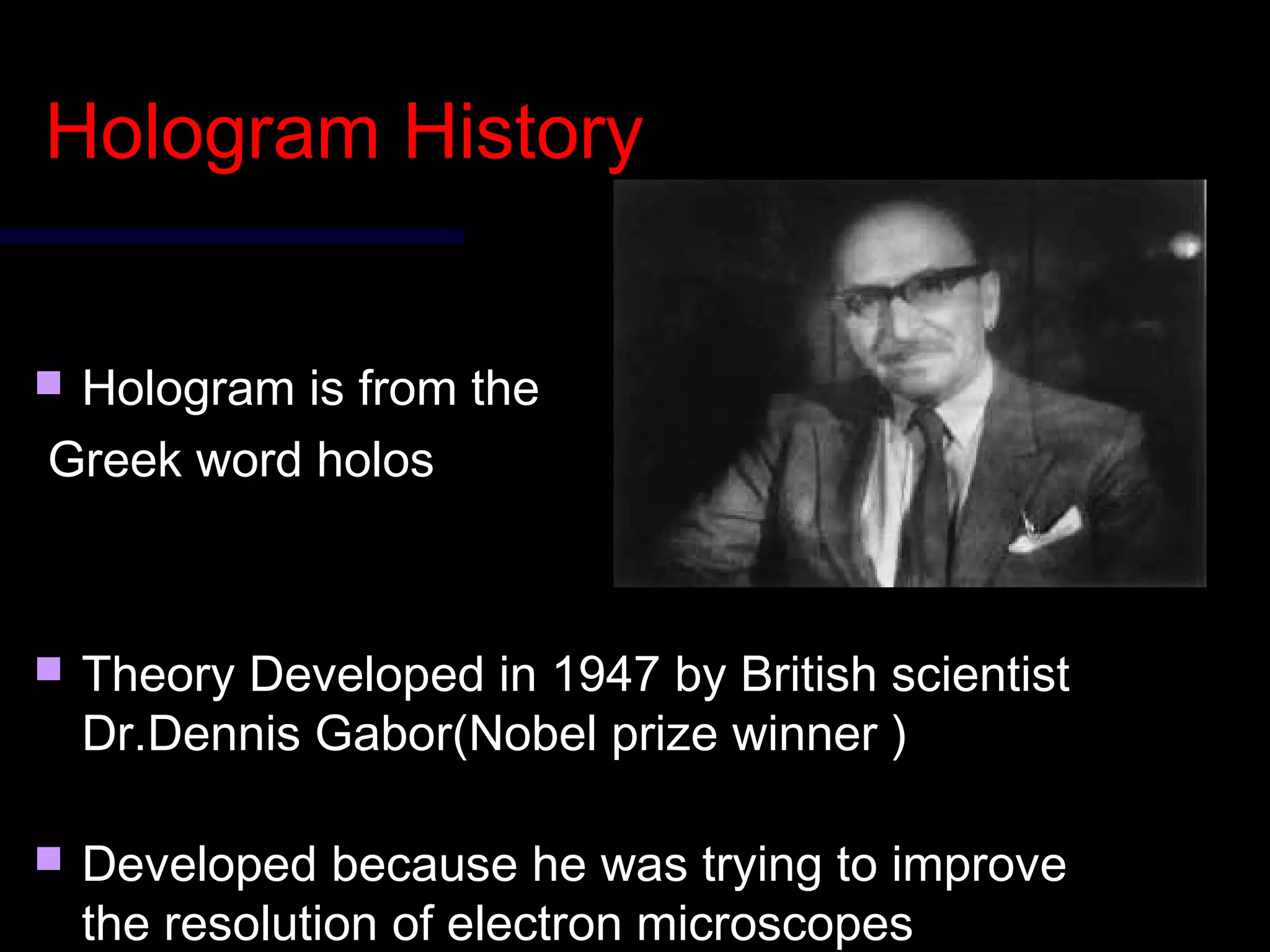
 Theory Developed in 1947 by British scientistTheory Developed in 1947 by British scientist
Dr.Dennis Gabor(Nobel prize winner )Dr.Dennis Gabor(Nobel prize winner )
 Developed because he was trying to improveDeveloped because he was trying to improve
the resolution of electron microscopesthe resolution of electron microscopes
HolographyHolography Holography is a methodHolography is a method
of recording patterns ofof recording patterns of lightlight to produceto produce
a three-dimensional object.a three-dimensional object.
HologramHologram :: The recorded patterns ofThe recorded patterns of
light are called a hologramlight are called a hologram
The process is accomplished by usingThe process is accomplished by using
two laser beams, instead of one, totwo laser beams, instead of one, to
Coherent LightCoherent Light
 Development in this field was stifledDevelopment in this field was stifled
during the 1950’s because light sourcesduring the 1950’s because light sources
were not coherent.were not coherent.
 Coherent light is light that isCoherent light is light that is
monochromatic and of a singlemonochromatic and of a single
wavelength.wavelength.
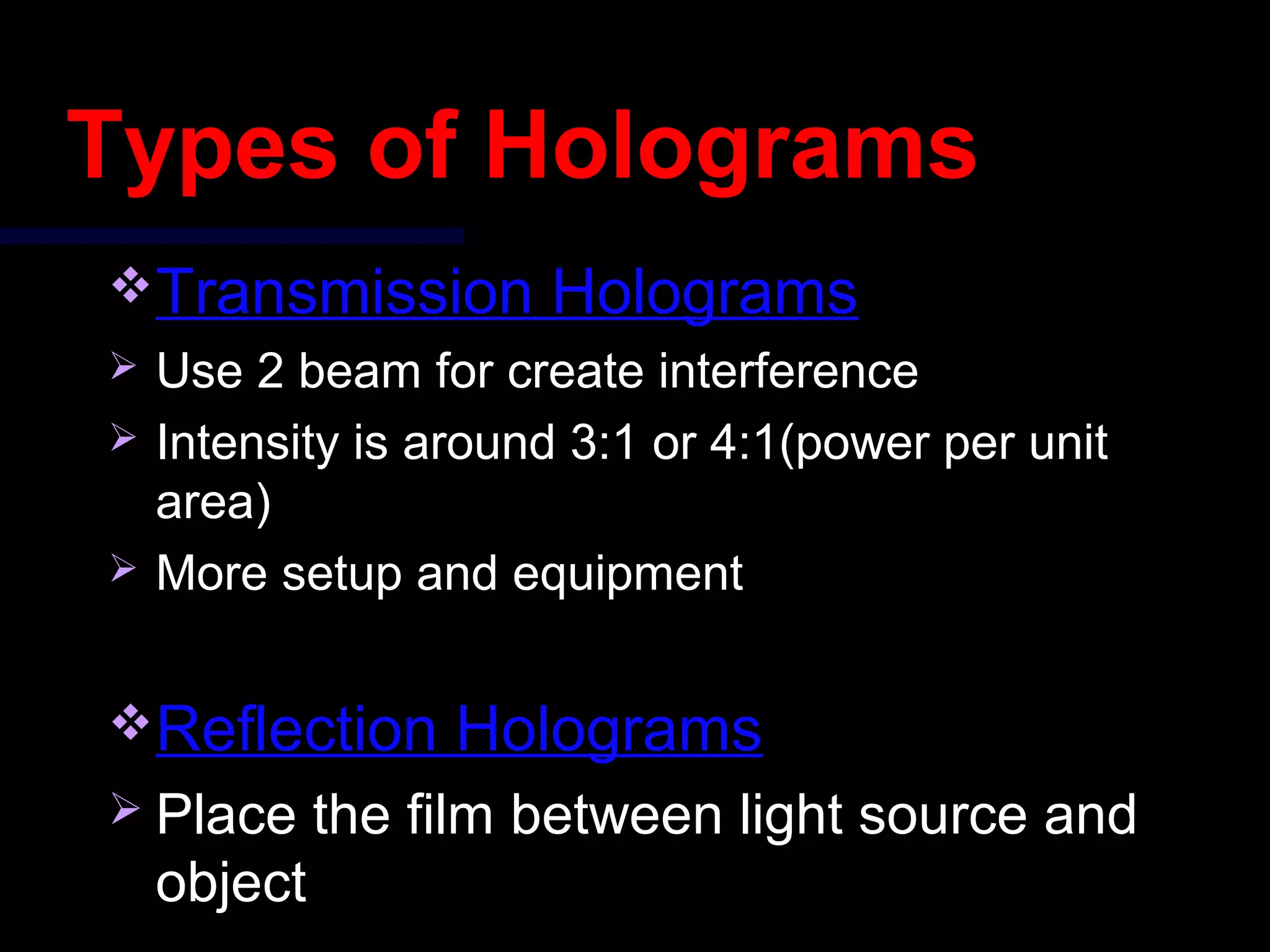
Types of Holograms
Transmission Holograms
 Use 2 beam for create interference
 Intensity is around 3:1 or 4:1(power per unit
area)
 More setup and equipment
Reflection Holograms
 Place the film between light source and
object
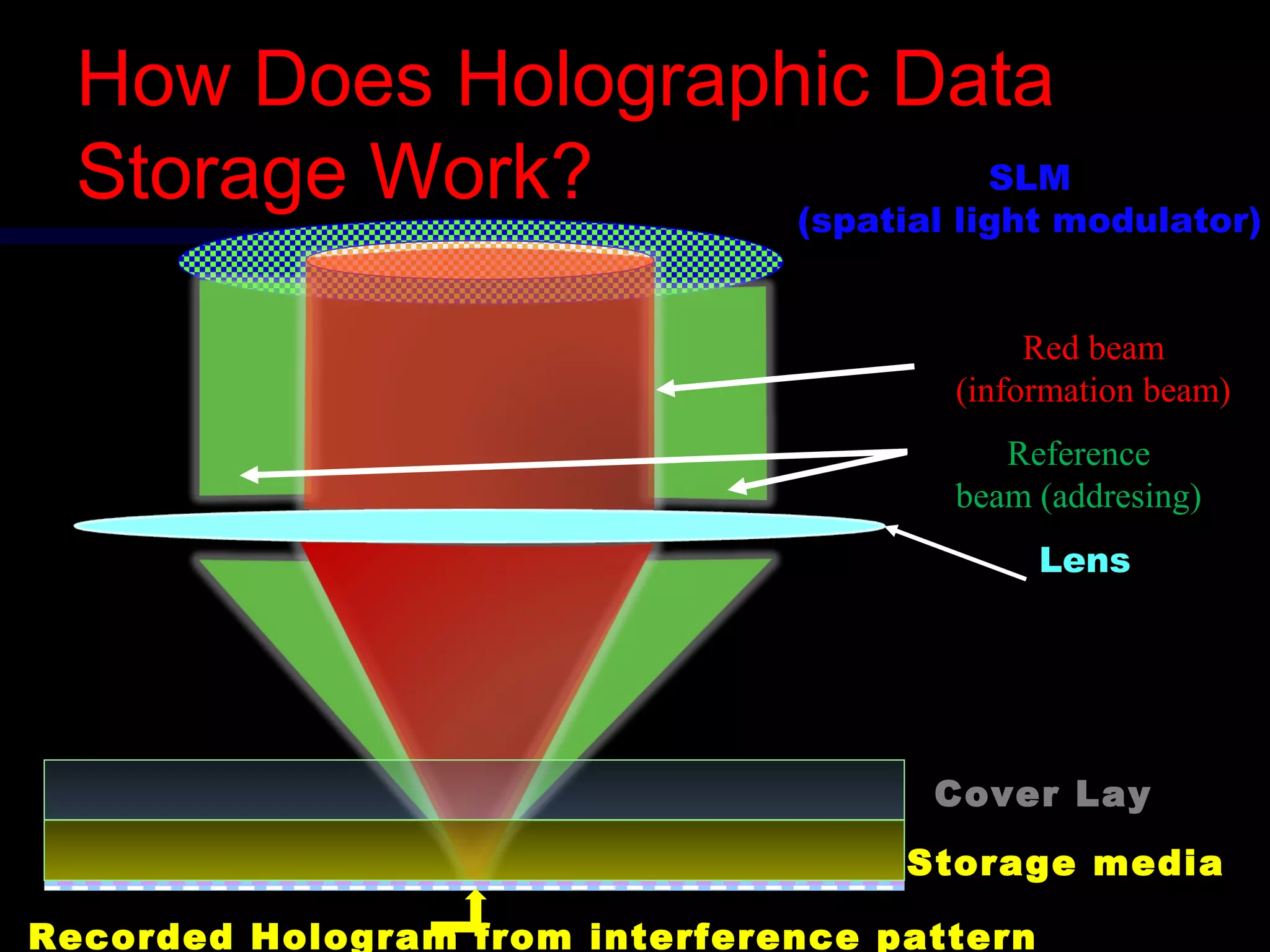
SLM
(spatial light modulator)
Lens
Cover Lay
Storage media
How Does Holographic DataHow Does Holographic Data
Storage Work?Storage Work?
Red beam
(information beam)
Reference
beam (addresing)
Recorded Hologram from interference pattern
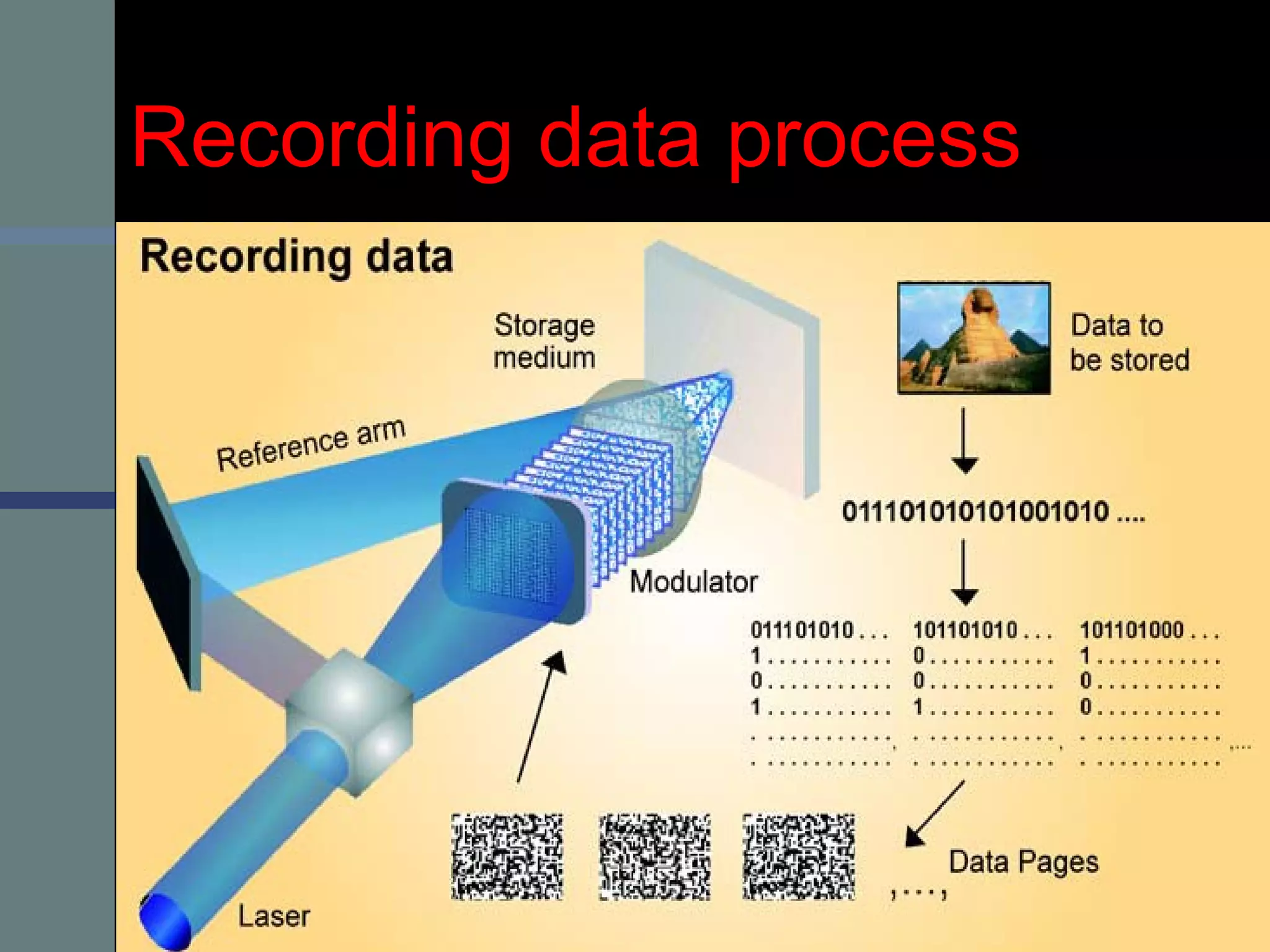
Recording data processRecording data process
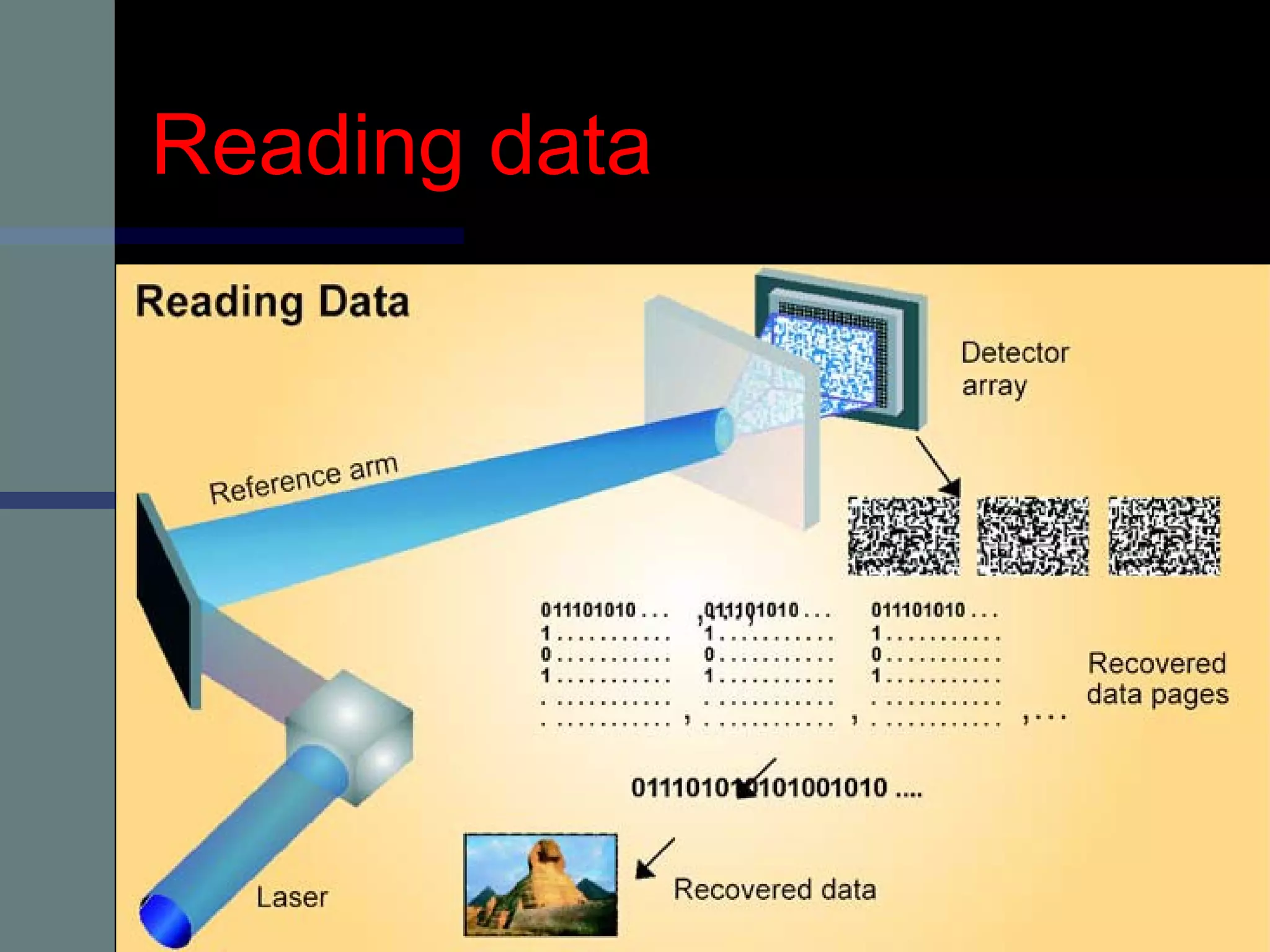
Reading dataReading data
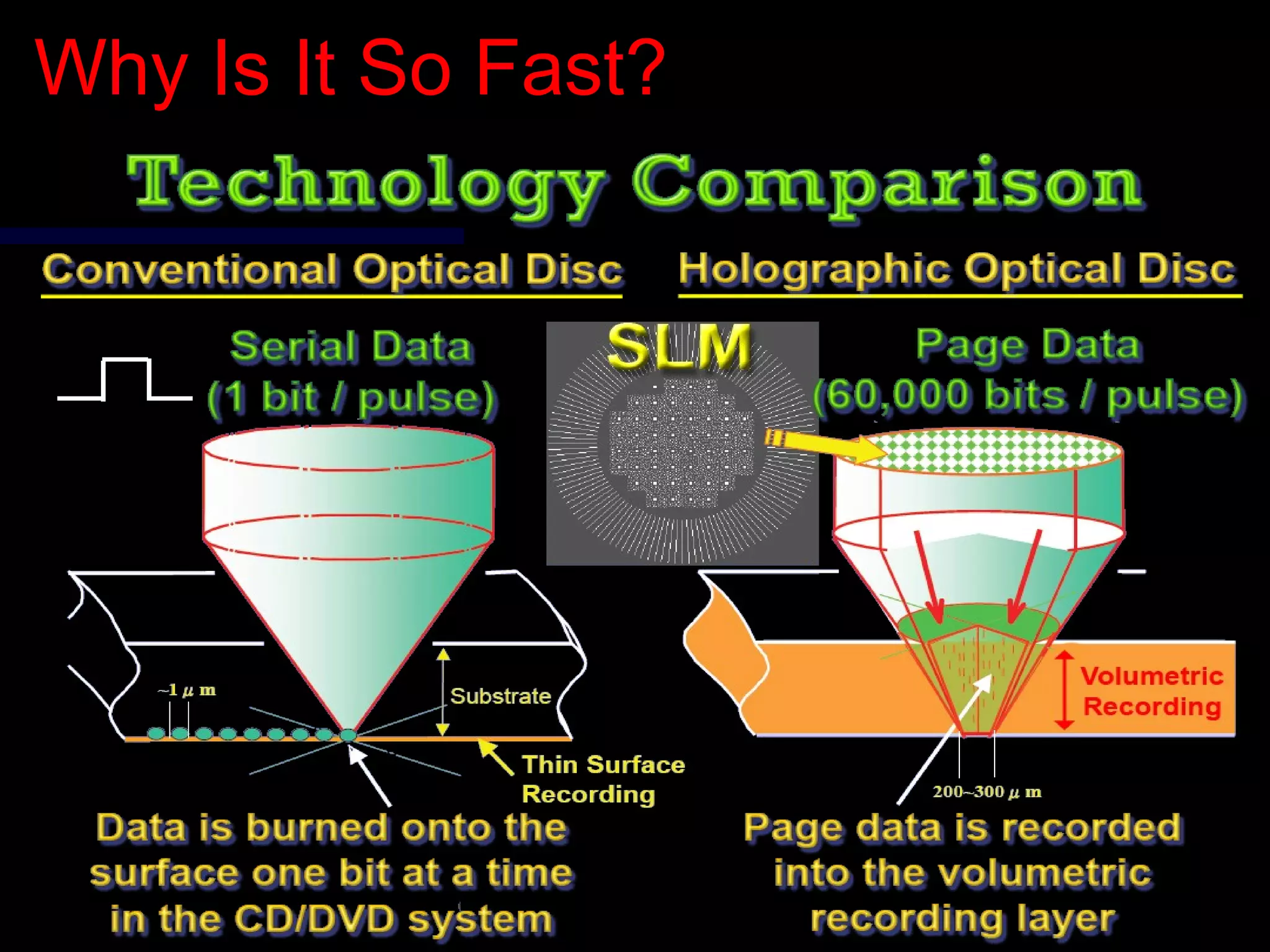
Why Is It So Fast?Why Is It So Fast?
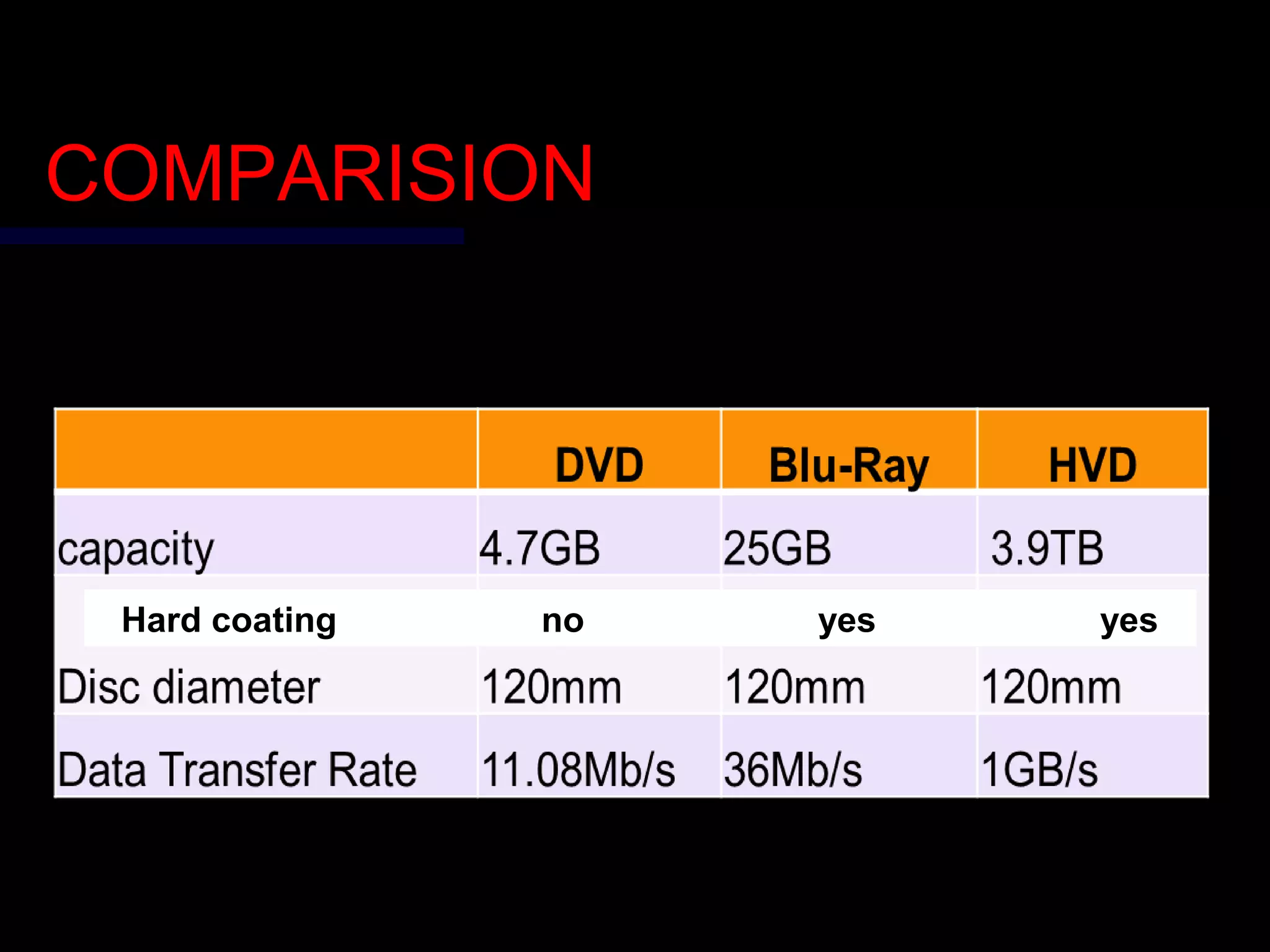
COMPARISIONCOMPARISION
Hard coating no yes yes
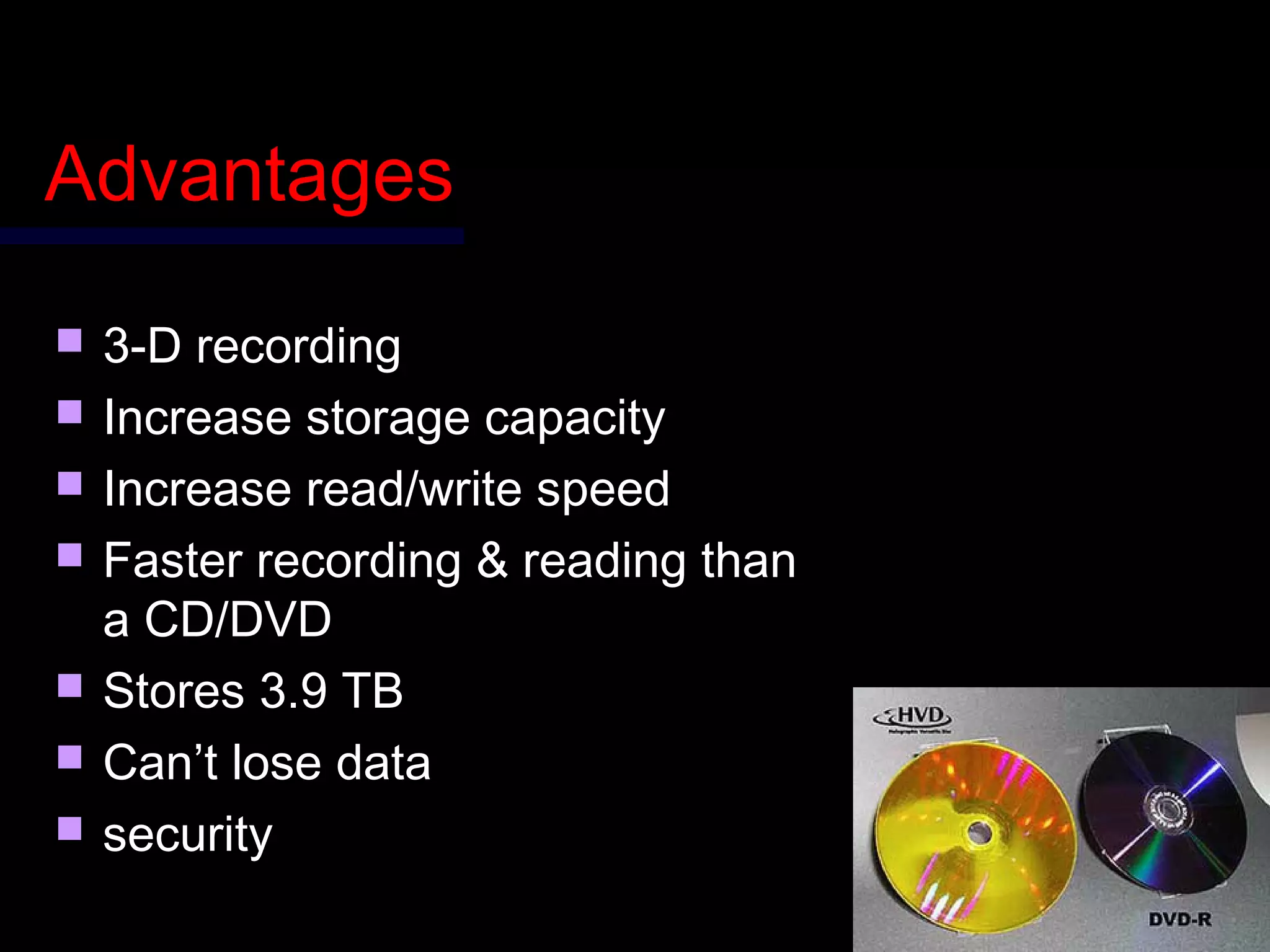
AdvantagesAdvantages
 3-D recording3-D recording
 Increase storage capacityIncrease storage capacity
 Increase read/write speedIncrease read/write speed
 Faster recording & reading thanFaster recording & reading than
a CD/DVDa CD/DVD
 Stores 3.9 TBStores 3.9 TB
 Can’t lose dataCan’t lose data
 securitysecurity
DisadvantagesDisadvantages
 Manufacture cost is highManufacture cost is high
 Hard to establish controlsHard to establish controls
 Won’t be able to locate problemWon’t be able to locate problem
 Lack of materials needed to produceLack of materials needed to produce
 Very powerfulVery powerful laserlaser needed forneeded for
projecting large hologramsprojecting large holograms
Applications of HolographyApplications of Holography
 Credit cards carryCredit cards carry
monetary valuemonetary value
 SupermarketSupermarket
scannersscanners
 Optical ComputersOptical Computers
 Used in aircraftUsed in aircraft
means improvemeans improve
design of aircraftdesign of aircraft
wings and turbinewings and turbine
bladesblades
 ArtArt
 Data miningData mining
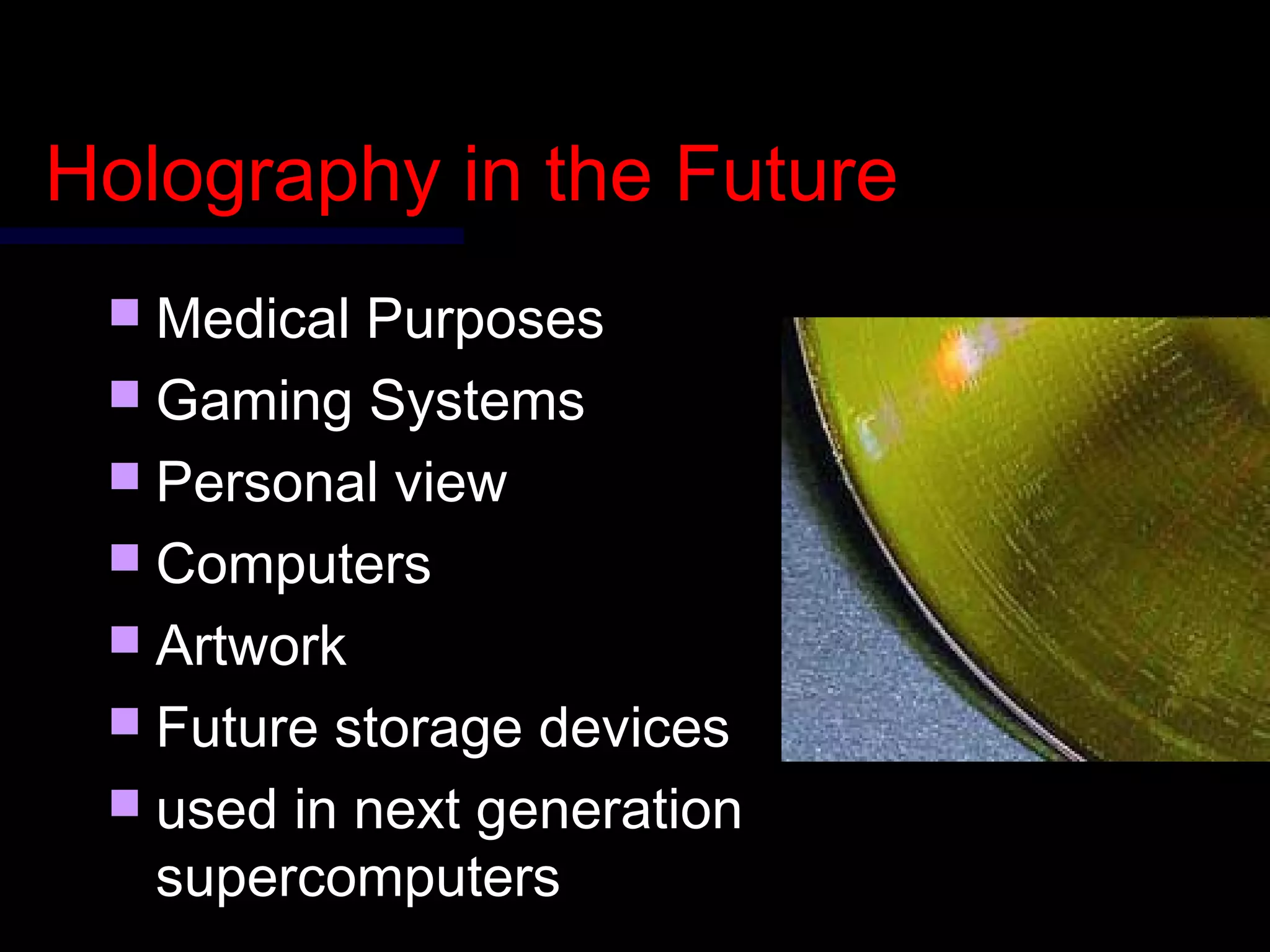
Holography in the FutureHolography in the Future
 Medical PurposesMedical Purposes
 Gaming SystemsGaming Systems
 Personal viewPersonal view
 ComputersComputers
 ArtworkArtwork
 Future storage devicesFuture storage devices
 used in next generationused in next generation
supercomputerssupercomputers
Interesting factsInteresting facts
 Many different shapes and sizesMany different shapes and sizes
 1 TB=one cube of sugar in future1 TB=one cube of sugar in future
 Longer storage lifeLonger storage life
Only because of LASEROnly because of LASER
ConclusionConclusion
 HVD will soon replace previousHVD will soon replace previous
DVDs.DVDs.
 In today’s world, digital media isIn today’s world, digital media is
becoming more and more commonbecoming more and more common
and is requiring more storageand is requiring more storage
 2200 DVD’s can fit on one 1 TB00 DVD’s can fit on one 1 TB
holographic disk wholographic disk with a fith a futureuture
capacity of 6 terabytescapacity of 6 terabytes..
ReferencesReferences
 Wikipedia – Holographic Data Storage,Wikipedia – Holographic Data Storage,
http://en.wikipedia.org/wiki/Holographic_data_sthttp://en.wikipedia.org/wiki/Holographic_data_st
The Economist, Holographic dataThe Economist, Holographic data
storage, Jul 31, 2003,storage, Jul 31, 2003,
http://www.economist.com/node/1956881http://www.economist.com/node/1956881

INTRODUCTION TO HOLOGRAPHY

  • 1.
    A Seminar on INTRODUCTION TOHOLOGRAPHYINTRODUCTION TO HOLOGRAPHY Presented By SWAPNIL G. THAWARE 20100764 MOB NO 7588057887 Dr. Babasaheb Ambedkar Technological University, Department Of Information technology Engineering LONERE-402 103 2011-2012
  • 2.
    Hologram HistoryHologram History Hologram is from theHologram is from the Greek word holosGreek word holos  Theory Developed in 1947 by British scientistTheory Developed in 1947 by British scientist Dr.Dennis Gabor(Nobel prize winner )Dr.Dennis Gabor(Nobel prize winner )  Developed because he was trying to improveDeveloped because he was trying to improve the resolution of electron microscopesthe resolution of electron microscopes
  • 3.
    HolographyHolography Holography isa methodHolography is a method of recording patterns ofof recording patterns of lightlight to produceto produce a three-dimensional object.a three-dimensional object. HologramHologram :: The recorded patterns ofThe recorded patterns of light are called a hologramlight are called a hologram The process is accomplished by usingThe process is accomplished by using two laser beams, instead of one, totwo laser beams, instead of one, to
  • 4.
    Coherent LightCoherent Light Development in this field was stifledDevelopment in this field was stifled during the 1950’s because light sourcesduring the 1950’s because light sources were not coherent.were not coherent.  Coherent light is light that isCoherent light is light that is monochromatic and of a singlemonochromatic and of a single wavelength.wavelength.
  • 5.
    Types of Holograms TransmissionHolograms  Use 2 beam for create interference  Intensity is around 3:1 or 4:1(power per unit area)  More setup and equipment Reflection Holograms  Place the film between light source and object
  • 6.
    SLM (spatial light modulator) Lens CoverLay Storage media How Does Holographic DataHow Does Holographic Data Storage Work?Storage Work? Red beam (information beam) Reference beam (addresing) Recorded Hologram from interference pattern
  • 7.
  • 8.
  • 9.
    Why Is ItSo Fast?Why Is It So Fast?
  • 10.
  • 11.
    AdvantagesAdvantages  3-D recording3-Drecording  Increase storage capacityIncrease storage capacity  Increase read/write speedIncrease read/write speed  Faster recording & reading thanFaster recording & reading than a CD/DVDa CD/DVD  Stores 3.9 TBStores 3.9 TB  Can’t lose dataCan’t lose data  securitysecurity
  • 12.
    DisadvantagesDisadvantages  Manufacture costis highManufacture cost is high  Hard to establish controlsHard to establish controls  Won’t be able to locate problemWon’t be able to locate problem  Lack of materials needed to produceLack of materials needed to produce  Very powerfulVery powerful laserlaser needed forneeded for projecting large hologramsprojecting large holograms
  • 13.
    Applications of HolographyApplicationsof Holography  Credit cards carryCredit cards carry monetary valuemonetary value  SupermarketSupermarket scannersscanners  Optical ComputersOptical Computers  Used in aircraftUsed in aircraft means improvemeans improve design of aircraftdesign of aircraft wings and turbinewings and turbine bladesblades  ArtArt  Data miningData mining
  • 14.
    Holography in theFutureHolography in the Future  Medical PurposesMedical Purposes  Gaming SystemsGaming Systems  Personal viewPersonal view  ComputersComputers  ArtworkArtwork  Future storage devicesFuture storage devices  used in next generationused in next generation supercomputerssupercomputers
  • 15.
    Interesting factsInteresting facts Many different shapes and sizesMany different shapes and sizes  1 TB=one cube of sugar in future1 TB=one cube of sugar in future  Longer storage lifeLonger storage life Only because of LASEROnly because of LASER
  • 16.
    ConclusionConclusion  HVD willsoon replace previousHVD will soon replace previous DVDs.DVDs.  In today’s world, digital media isIn today’s world, digital media is becoming more and more commonbecoming more and more common and is requiring more storageand is requiring more storage  2200 DVD’s can fit on one 1 TB00 DVD’s can fit on one 1 TB holographic disk wholographic disk with a fith a futureuture capacity of 6 terabytescapacity of 6 terabytes..
  • 17.
    ReferencesReferences  Wikipedia –Holographic Data Storage,Wikipedia – Holographic Data Storage, http://en.wikipedia.org/wiki/Holographic_data_sthttp://en.wikipedia.org/wiki/Holographic_data_st The Economist, Holographic dataThe Economist, Holographic data storage, Jul 31, 2003,storage, Jul 31, 2003, http://www.economist.com/node/1956881http://www.economist.com/node/1956881

Editor's Notes

  • #4 The first papers on holographic storage were published in 1963 Holographic storage is using the entire medium instead of a few layers. You use 2 laser beams instead of one with one carrying the data and the other being a reference beam.
  • #10 One bit at a time vs. entire page (60,000 bits) at a time. Flashes of light compared to actually burning the medium.