
3d printing: History, culture,
future
http://www.slideshare.net/
dbgerhard/3dprint-66700445
Tea.
Earl Grey.
Hot
What is 3d printing?
• Using a general-purpose machine to create a physical object, where
the design of the structure is provided to the machine at build-time.
• Usually, the object is created additively, in a layer-by-layer process.
• Compare to "CNC" (computerized numerical control) which usually
refers to a subtractive process like carving, routing, turning or
cutting.
Fab Lab
• Collection of machines to build anything
• 3d printing is one of them
• laser cutters arguably have higher utility and usability
• Circuit miller is arguably more important for making high tech things
• Price of these machines are prohibitive, but dropping
• as patents expire
Fab lab machines
• 3d printer
• 2d CNC router (shopbot)
• bench top 3d mill
• laser cutter
• vinyl cutter
• circuit etcher
• engraver
• CNC lathe
• paper printer
• water jet
Why do we care about 3d printing?
• Personalization and customization
• you can make a single copy of a thing, which is prohibitive with
traditional manufacturing
• Complexity
• you can make objects with complicated internal structures, which
is difficult with traditional manufacturing
Why do we care about 3d printing?
• Rapid prototyping
• Can make a physical instance of a design, and quickly tell if it's
the right size and shape for a job
• Can iteratively refine a design based on real-world performance
• Modelling for traditional manufacturing
• Build a complex shape, and use it as a mold for a more traditional
material process like metalwork
Why do we care about 3d printing?
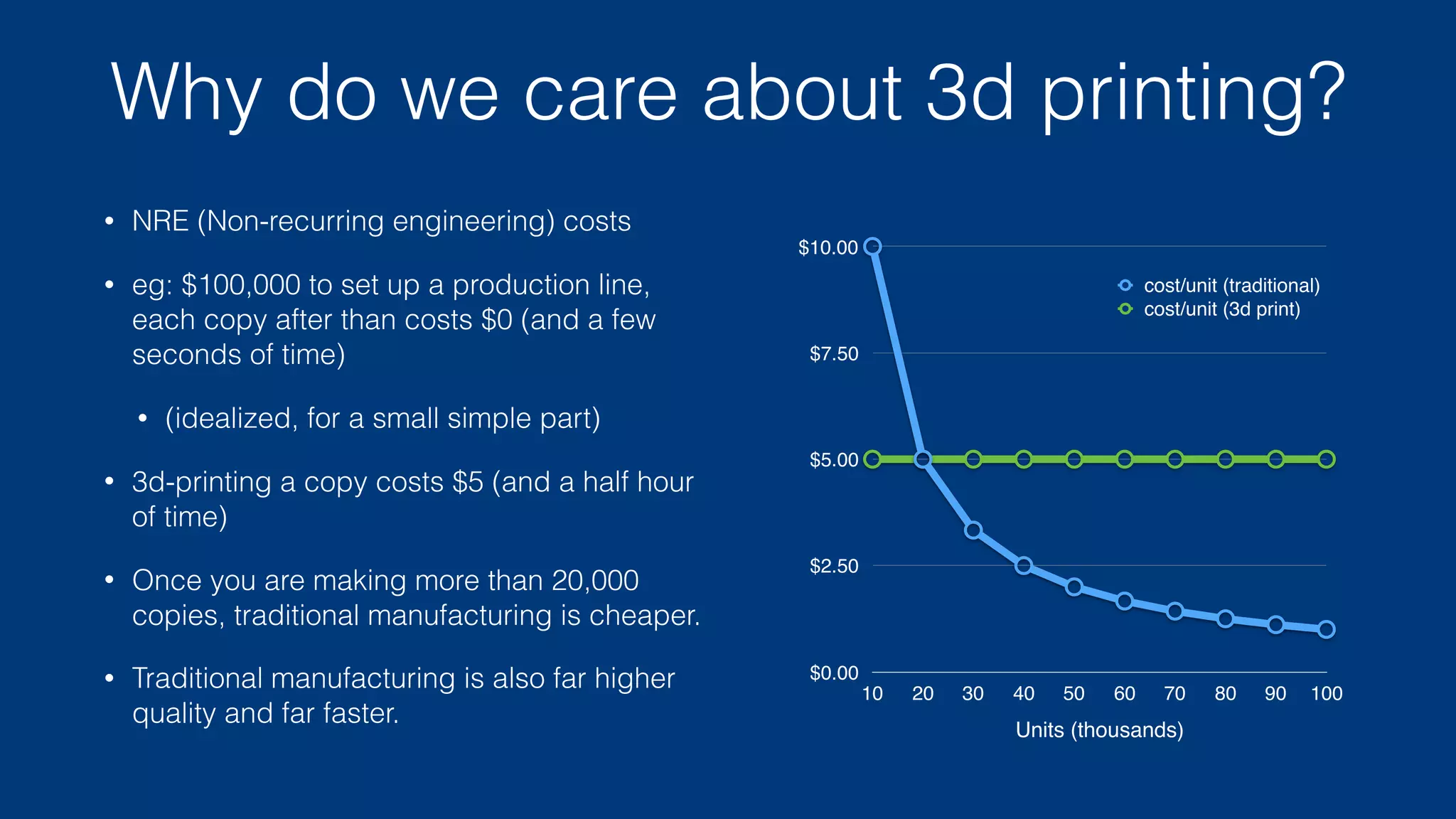
• NRE (Non-recurring engineering) costs
• eg: $100,000 to set up a production line,
each copy after than costs $0 (and a few
seconds of time)
• (idealized, for a small simple part)
• 3d-printing a copy costs $5 (and a half hour
of time)
• Once you are making more than 20,000
copies, traditional manufacturing is cheaper.
• Traditional manufacturing is also far higher
quality and far faster.
$0.00
$2.50
$5.00
$7.50
$10.00
Units (thousands)
10 20 30 40 50 60 70 80 90 100
cost/unit (traditional)
cost/unit (3d print)
BONUS ROUND: time to completion
0
12,500
25,000
37,500
50,000
Units (thousands)
10 20 30 40 50 60 70 80 90 100
hours to complete (traditional)
hours to complete (3d print)
• assume 100 hours to set up a
production line, and seconds to
make each device afterward
How did we make things before 3d printing?
• Carve the part out of wood or plaster
• Also, carve the internal structure of the part separately
• Cast a series of molds of stronger materials until you have a steel
form for the inside, and a separate steel form for the outside
• Pour molten plastic (metal, whatever), and let cool
• eject the part from the mold
• Alternatives: cornstarch molds for food gels like gummies
Injection molding and cornstarch molding
What are the limits of 3d printing
• a 3d printed part is not as good as a manufactured part.
• more fragile, lower resolution, more expensive and takes longer to produce
• 3d printing requires specialized equipment and materials
• a 3d printed part requires a 3d design file
• expert knowledge required to produce a design
• but, designs can be shared and modified
• Consumer 3d printing is limited to thermoplastics, and ~10cm3
build area
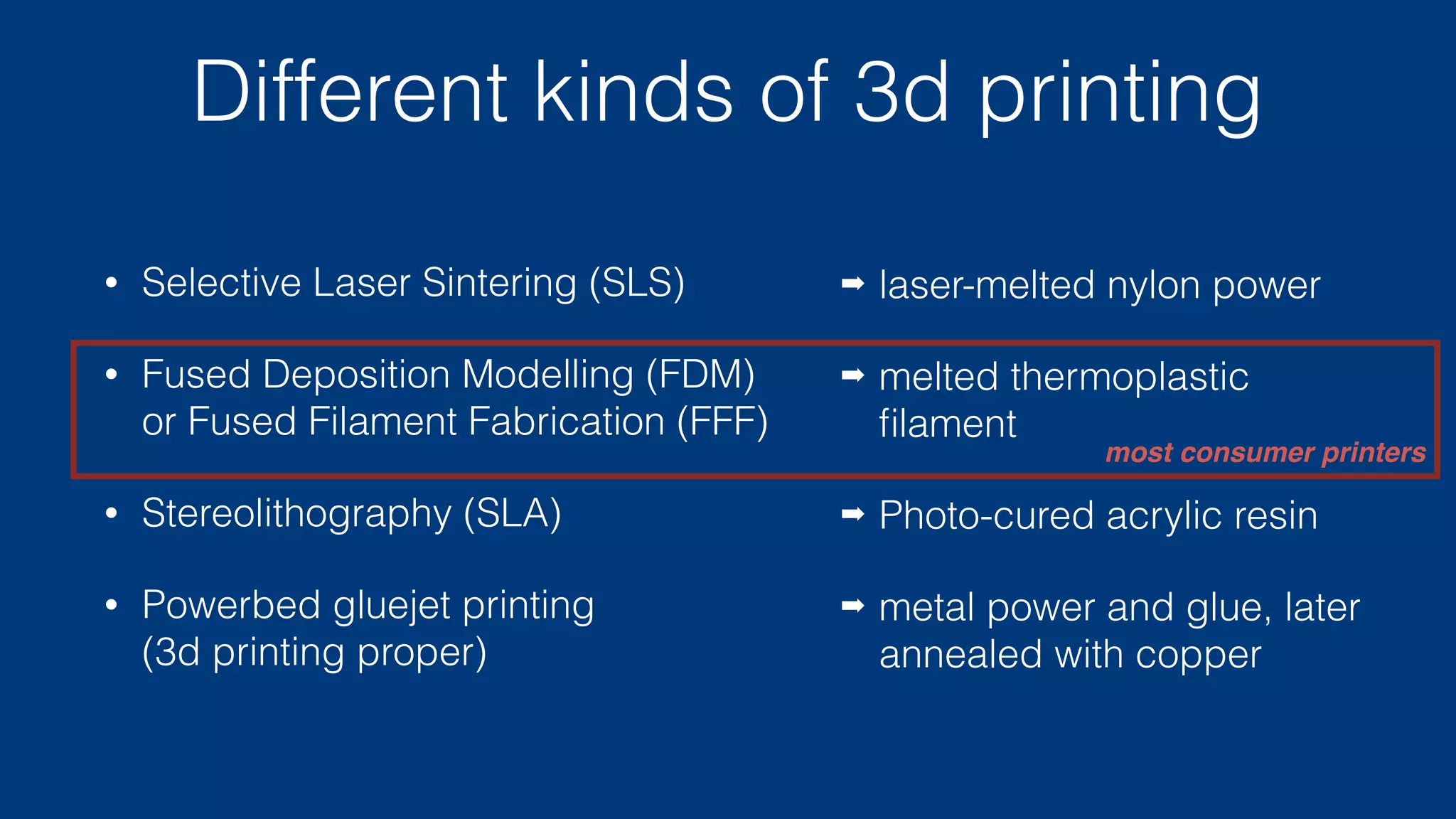
Different kinds of 3d printing
• Selective Laser Sintering (SLS)
• Fused Deposition Modelling (FDM)
or Fused Filament Fabrication (FFF)
• Stereolithography (SLA)
• Powerbed gluejet printing 

(3d printing proper)
➡ laser-melted nylon power
➡ melted thermoplastic
filament
➡ Photo-cured acrylic resin
➡ metal power and glue, later
annealed with copper
most consumer printers
Know your material
• FDM/FFF printing can use a few different thermoplastic materials
• Acrylonitrile butadiene styrene (ABS) : Strong, food-safe, lego plastic;
awesome.
• Polylactic acid (PLA): biodegradable; derived from corn, tapioca or other
plants. more brittle, higher melting temperature, harder to work with, not
as strong. more properly called a polyester.
• Specialized thermoplastic materials: ninjaflex, conductive plastic,
chocolate etc.
• All have specific properties that will influence your print
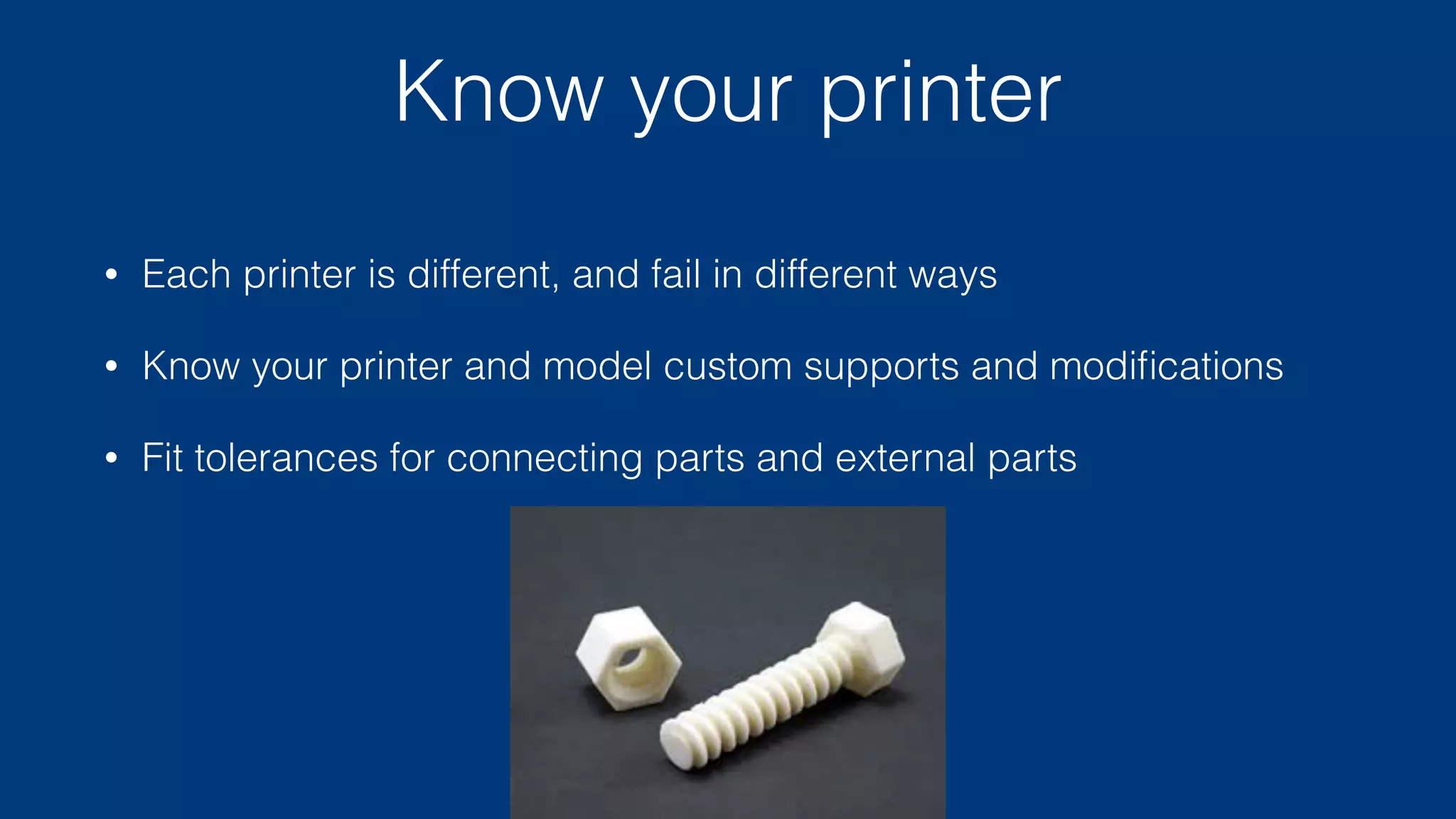
Know your printer
• Each printer is different, and fail in different ways
• Know your printer and model custom supports and modifications
• Fit tolerances for connecting parts and external parts
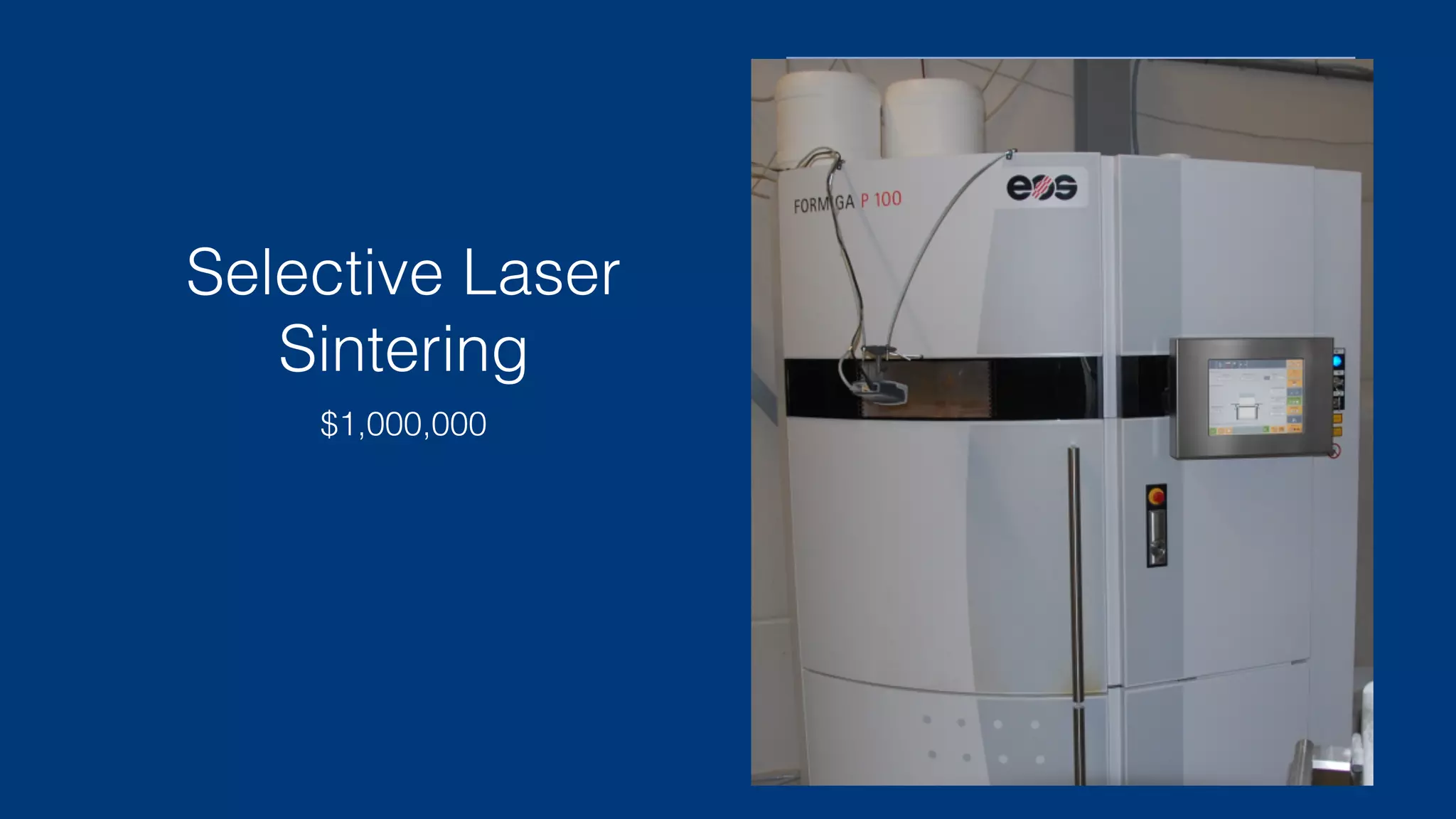
Selective Laser Sintering
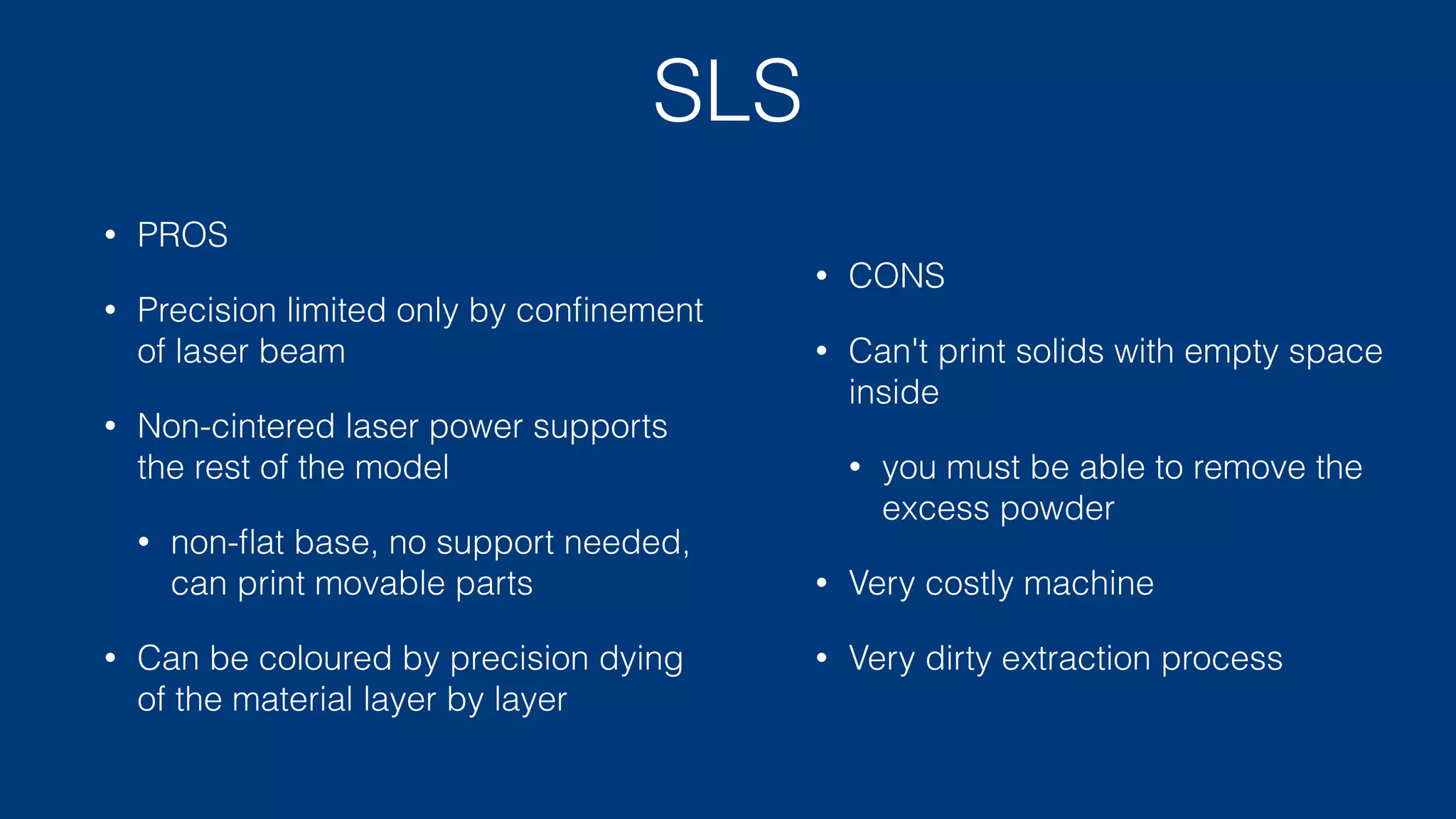
SLS
• PROS
• Precision limited only by confinement
of laser beam
• Non-cintered laser power supports
the rest of the model
• non-flat base, no support needed,
can print movable parts
• Can be coloured by precision dying
of the material layer by layer
• CONS
• Can't print solids with empty space
inside
• you must be able to remove the
excess powder
• Very costly machine
• Very dirty extraction process
Selective Laser
Sintering
$1,000,000
SLA
• PROS
• Precision limited only by confinement
of laser beam
• Acrylic is a very high quality food-
safe end-product
• Colouring is possible but difficult
• CONS
• Can't print solids with empty space
inside
• you must be able to remove the
excess liquid
• Expensive (but getting cheaper)
• Requires base to build the model to
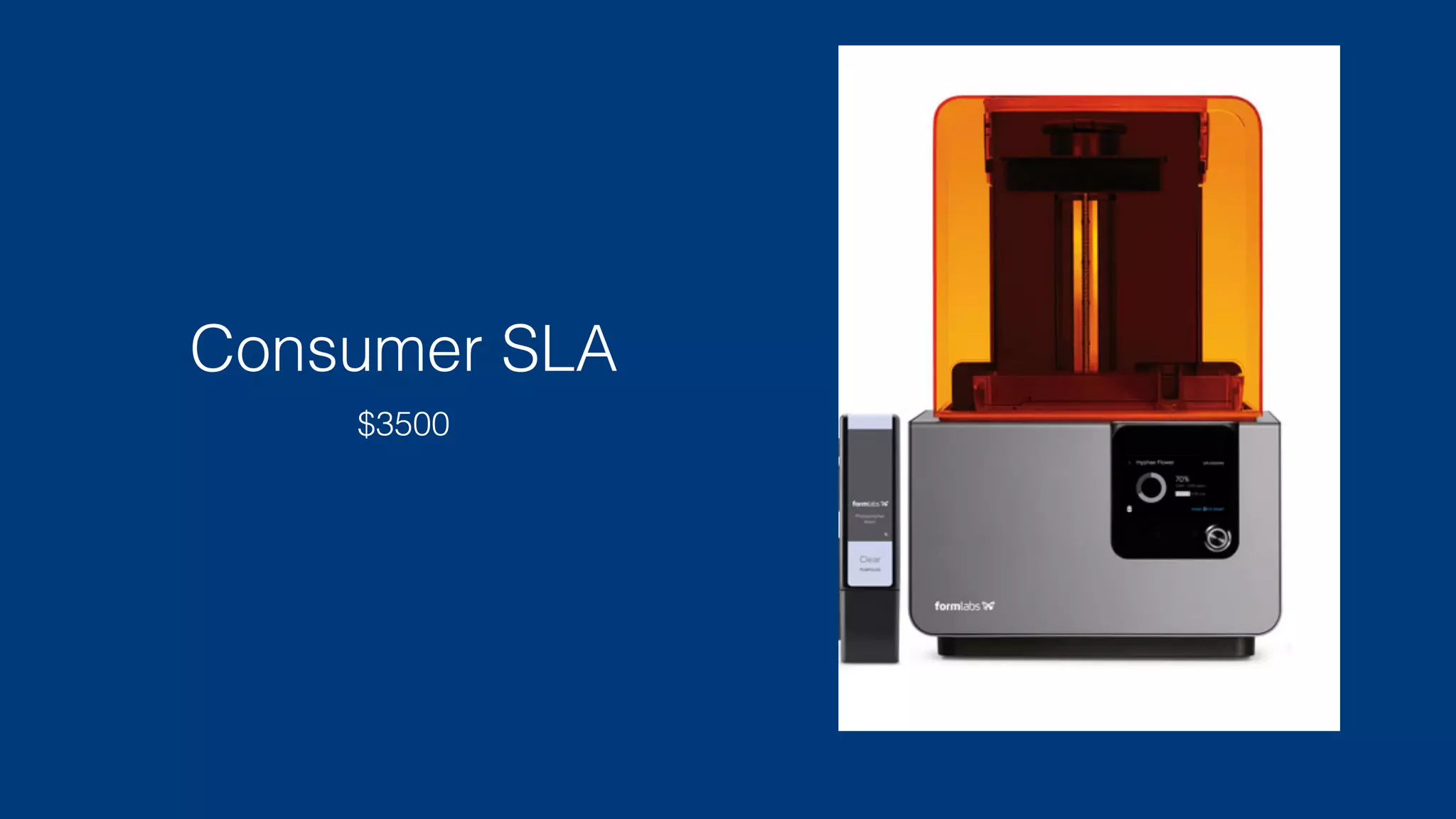
Consumer SLA
$3500
Really cheap consumer SLA
• Peachy printer: $100
• Very clever solution
• open source
• $600,000 on kickstarter
• Yorkton!
• ... WHERE ARE THEY NOW
FDM
• PROS
• Cheap
• ABS plastic is pretty good. PLA is not
great
• Can print complex internal structures
• Can print in colour, with multiple print
heads
• CONS
• Resolution limited to thickness of
material bead
• requires base to build model on
• Model should have a flat side
• requires support material
• unstable as models get large
• Print heads can clog causing build
failure
Consumer FDM
$500-$5000
Model Replication
• To replicate a physical model on a 3d printer, there are two ways
• 3d scanning
• Model Measurement
• (third way: find someone online who’s already made one)
3d scanning
• Many commercial products and
maker plans
• Microsoft kinect, makerbot
digitizer, etc
3d scanning
• 3d scanner is expensive
• (but getting cheaper)
• Many layers of postprocessing
required
• (but getting easier)
Model Measurement
• Use the right tools
• Calliper, protractor etc
• be precise
• Model as you Measure
• Aim for easy replication
• think construction process
• Find inspiration from existing models
Virtual Reality Sculpting
• https://www.youtube.com/watch?v=jnqFdSa5p7w
Rendering Data
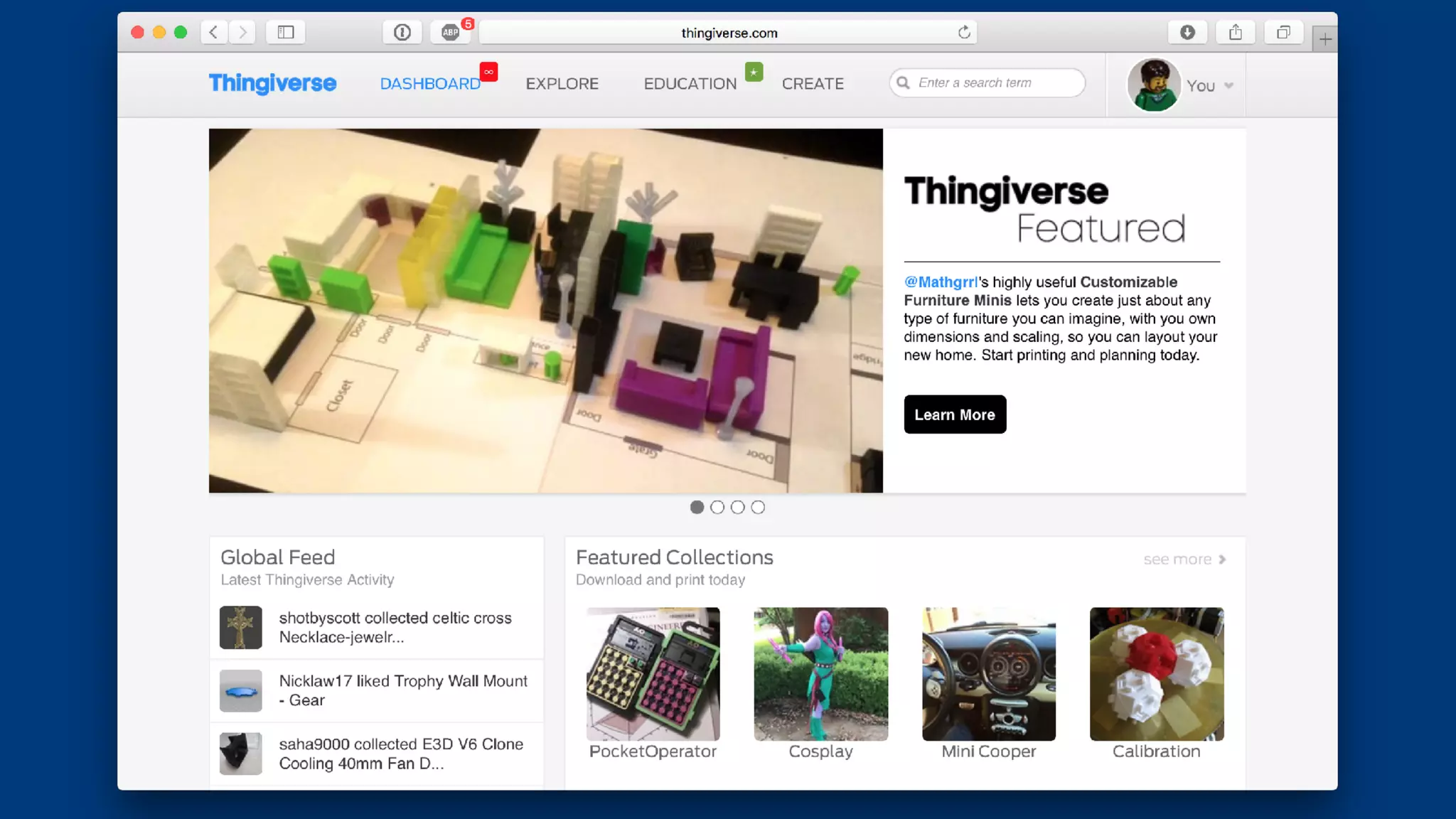
3d modelling software
• Tinkercad
• Blender
• Sketchup
• Zbrush
• Meshmixer, Meshlab, Netfabb
Scale
• Consider the smallest discernible element your printer can generate
• Simplify your model to match characteristics of the printer
• Don’t try to print (or even model) anything smaller than 2 mm
• Use the right tool for the job: metal pins and screws are better at
providing mechanical structure than 3d printed plastic
Support
• FDM printers layer melted plastic on
each previous layer
• Some things are impossible
• Aim for, at most, 45 degree
overhang, 2.5 cm bridge
• otherwise, add your own removable
support, or tell the software to
calculate support
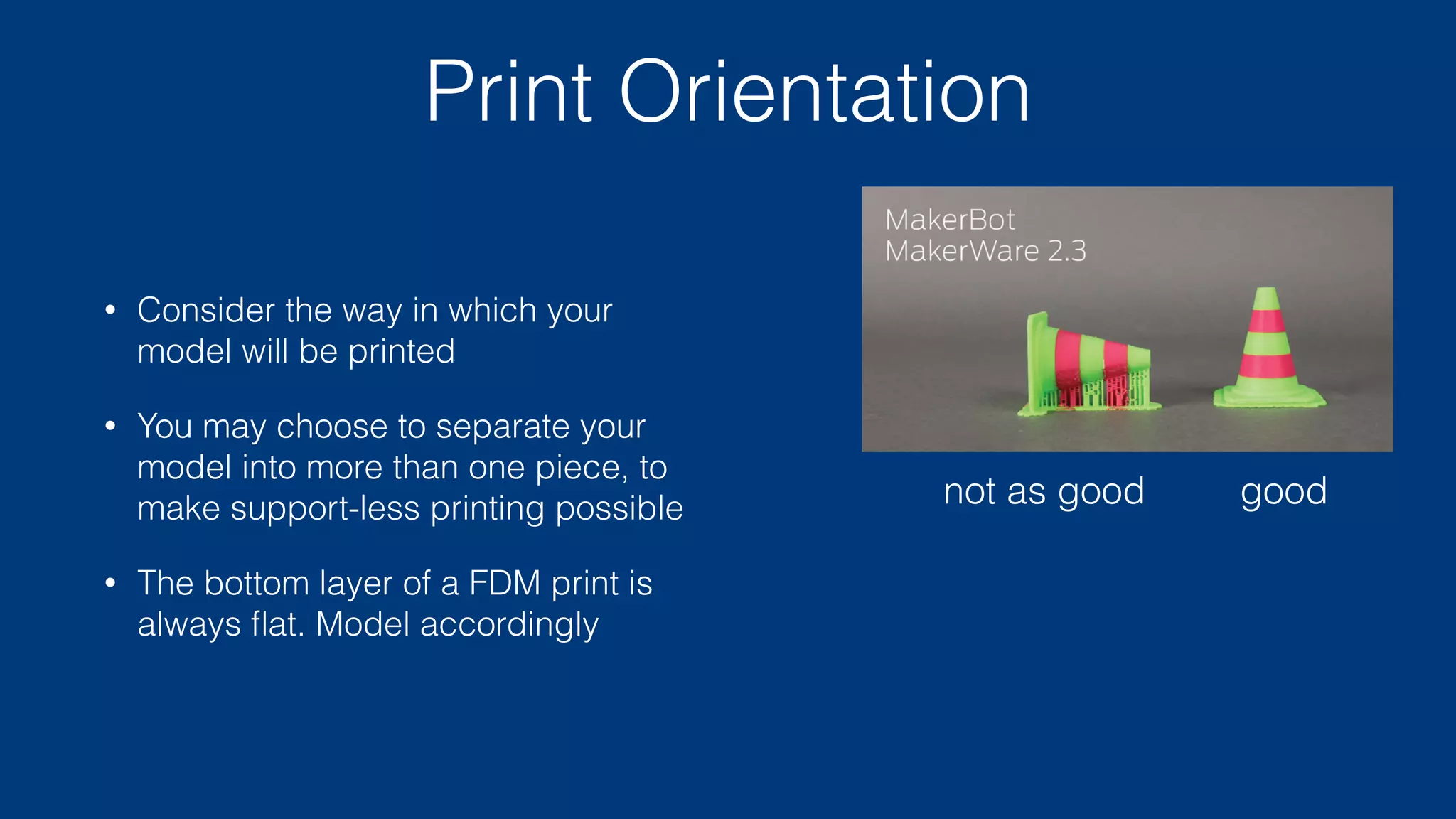
Print Orientation
• Consider the way in which your
model will be printed
• You may choose to separate your
model into more than one piece, to
make support-less printing possible
• The bottom layer of a FDM print is
always flat. Model accordingly
not as good good
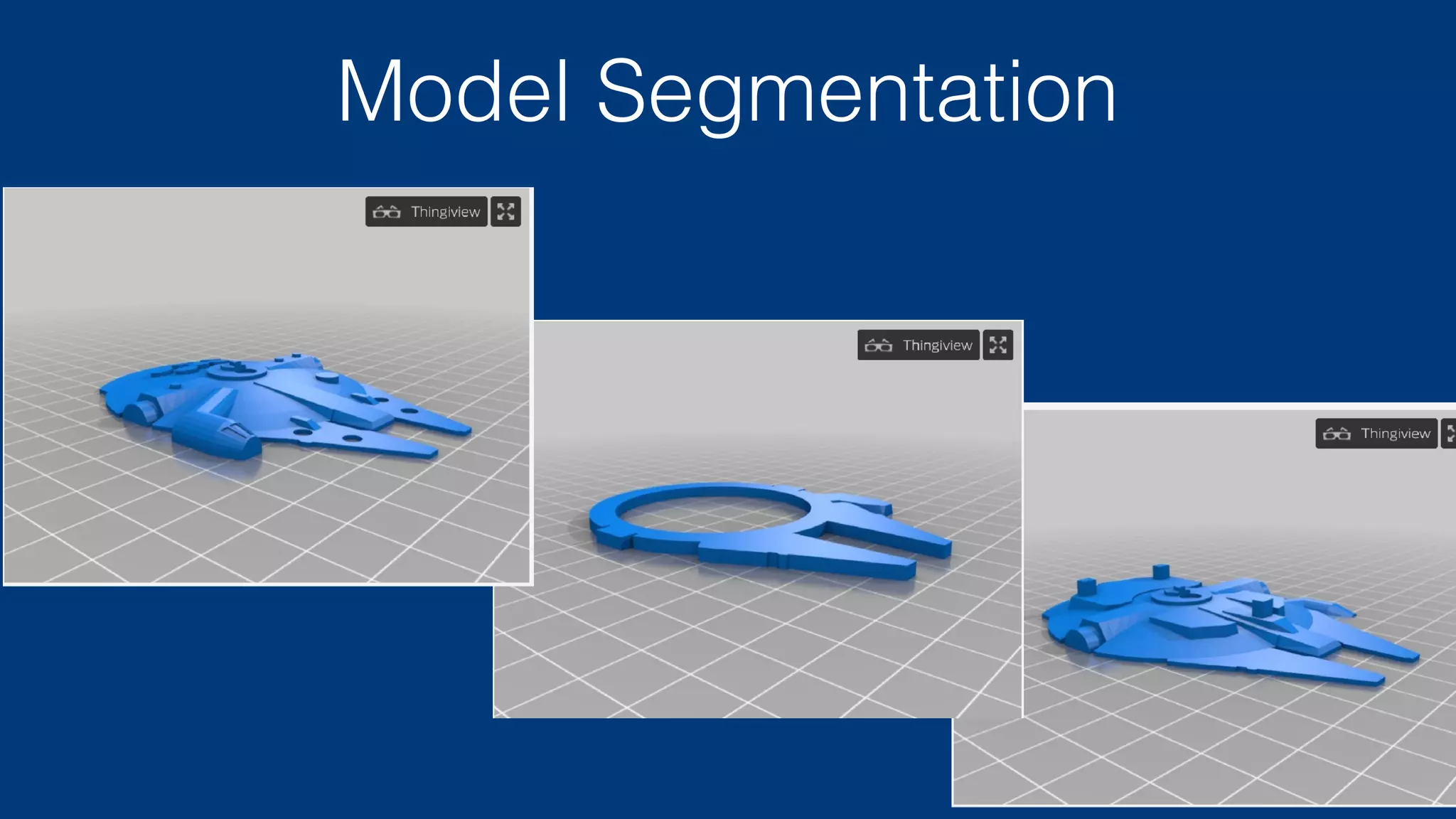
Model Segmentation
3D printing and social change
3d printing and social change
• traditional NRE means it’s only feasible to make a thing if you can
sell tens of thousands of them, or if you can charge a lot for them
• commodity versus luxury; walmart versus bespoke
• 3d printing means things can exist that are both inexpensive and
non-commodity
• 3d printing has limits, so how does this extend to other things?
3d printing controversies
• Guns or other restricted things
• 3d printer means anyone can make
anything whether or not the
government likes it
• as long as it’s made of plastic and
the size of a loaf of bread
• 3d printed guns are not very good
guns, and people make bombs out
of pots and pipes
3d printing controversies
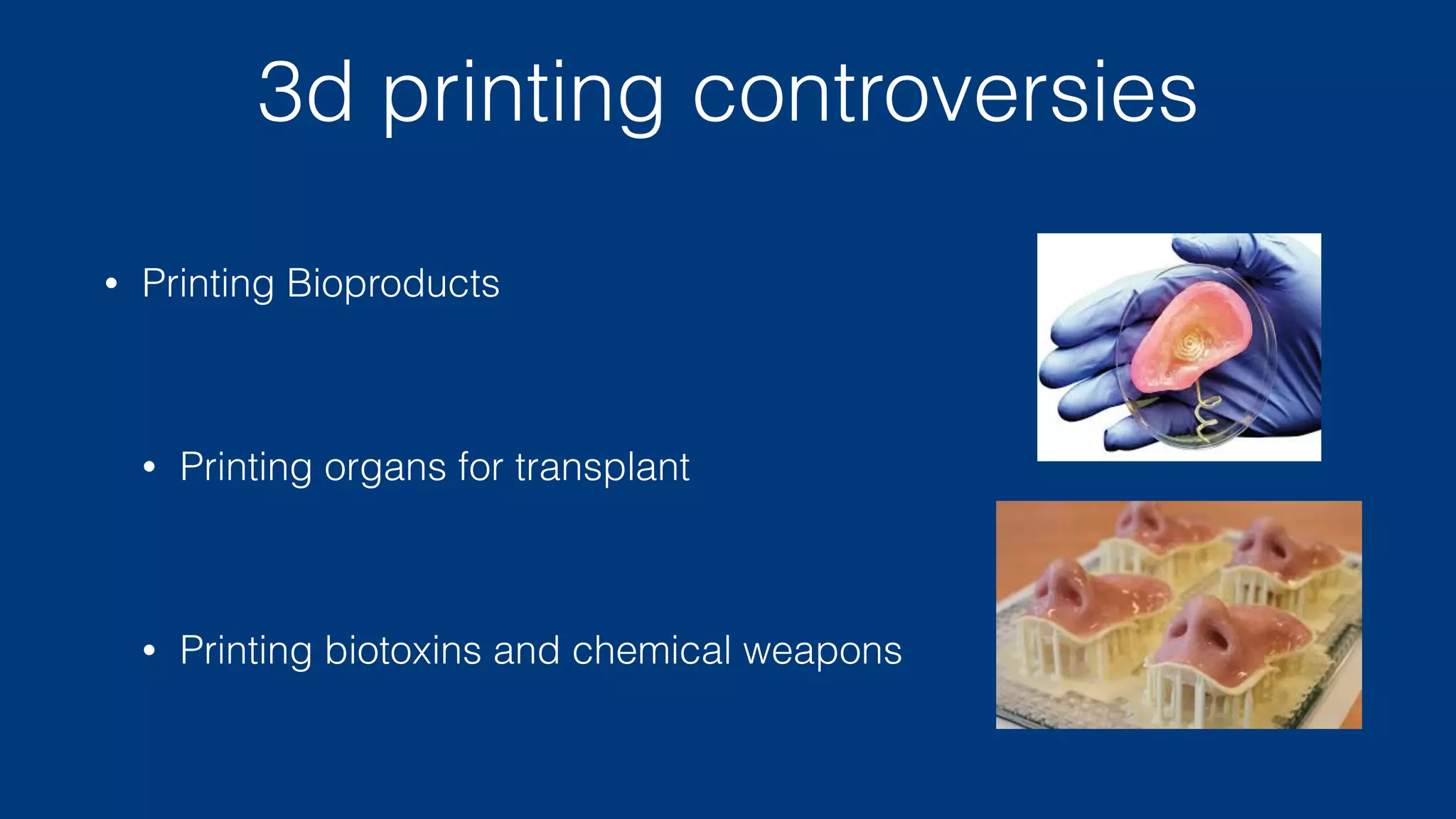
• Printing Bioproducts
• Printing organs for transplant
• Printing biotoxins and chemical weapons
3d printing controversies
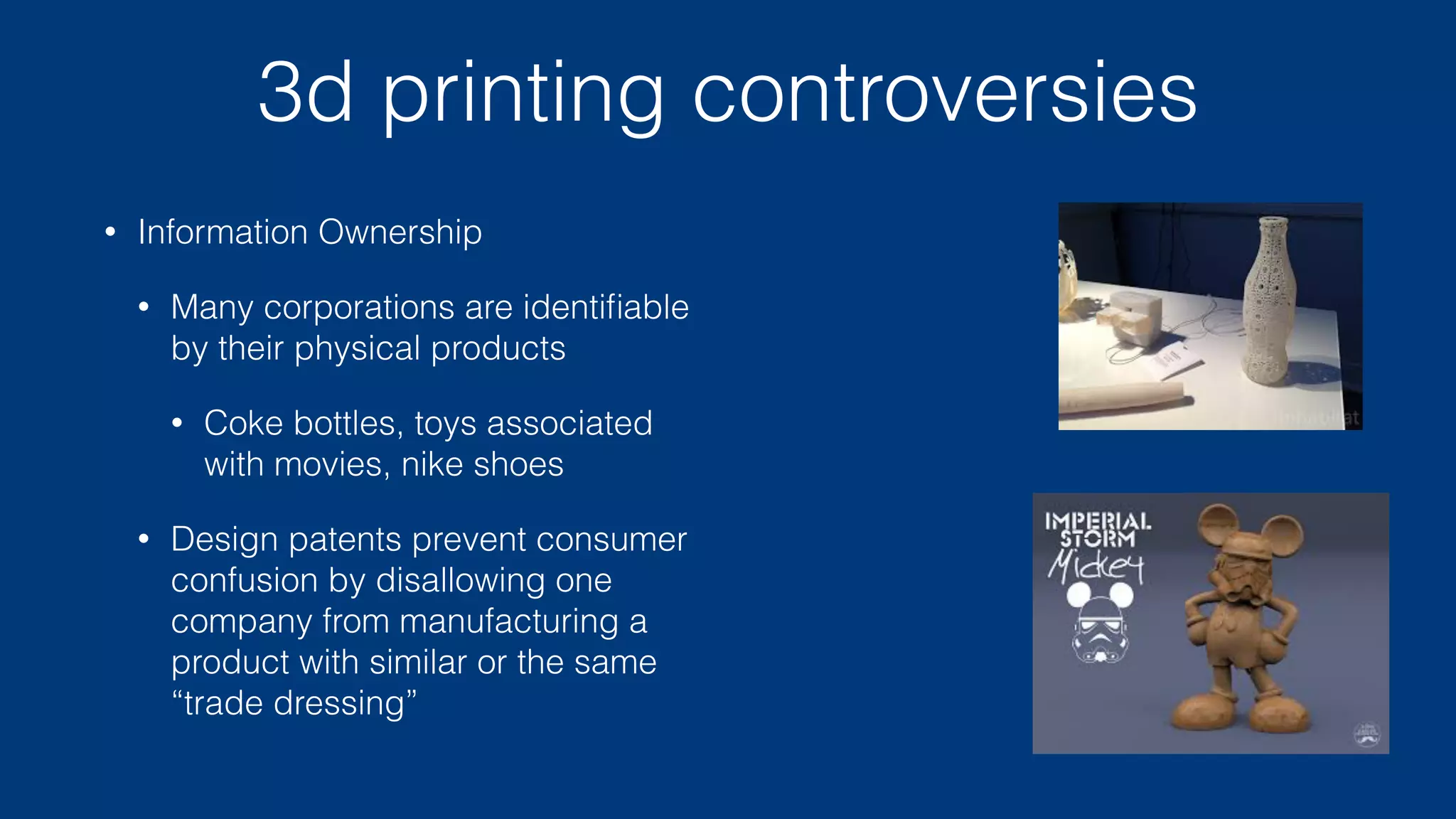
• Information Ownership
• Many corporations are identifiable
by their physical products
• Coke bottles, toys associated
with movies, nike shoes
• Design patents prevent consumer
confusion by disallowing one
company from manufacturing a
product with similar or the same
“trade dressing”
3d printing controversies
• Economics, industry
• What happens to the world
economy when people can print
whatever they need at home?
3D printing and the way forward
Space Pizza
• Space is a terrible place
• No Walmart to buy tools or supplies
or pizza
• Raw materials are easier to transport
than manufactured goods
• tools, parts, etc
• 3d printing food makes it more
interesting if you're 6 months to mars
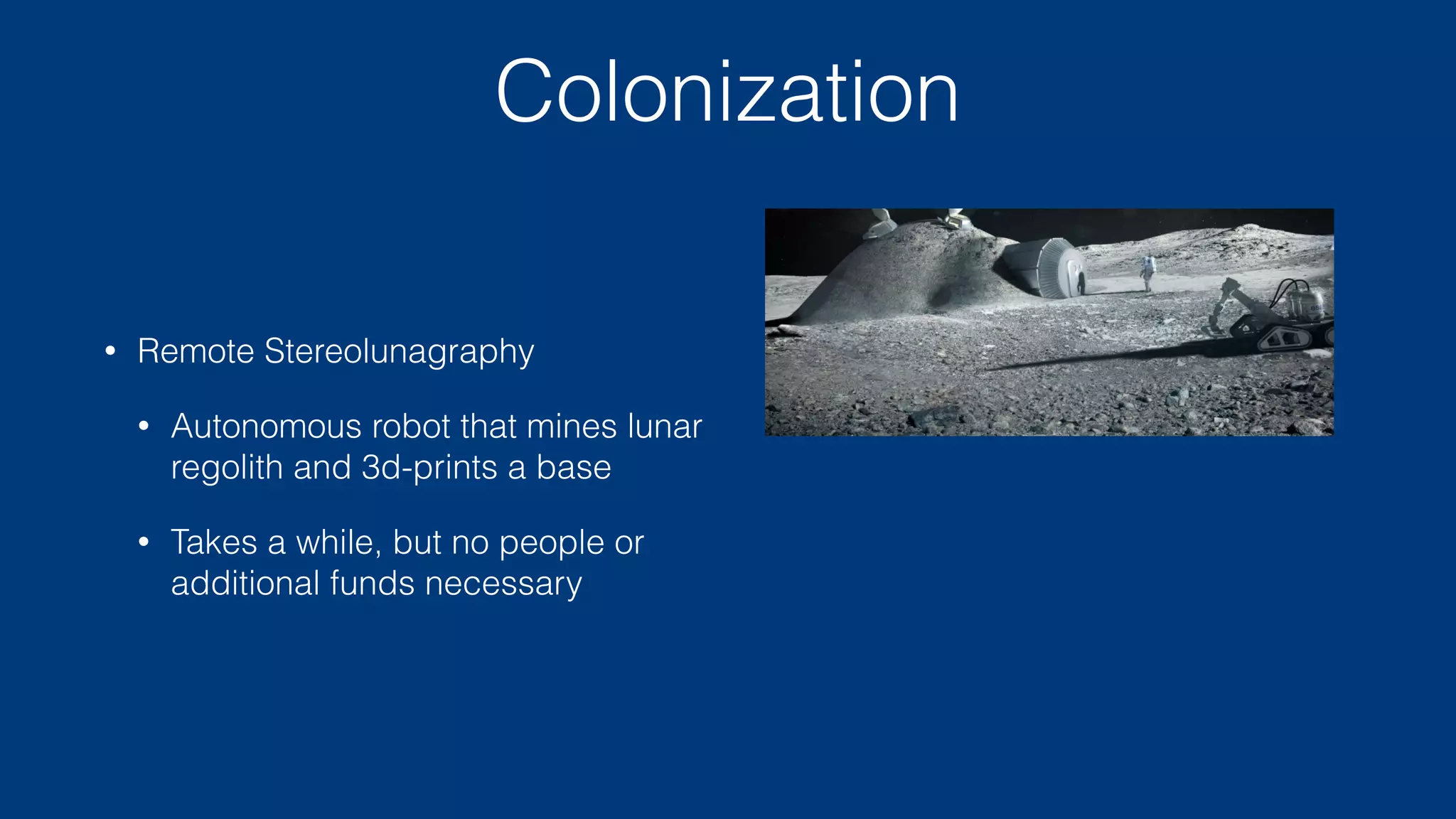
Colonization
• Remote Stereolunagraphy
• Autonomous robot that mines lunar
regolith and 3d-prints a base
• Takes a while, but no people or
additional funds necessary
printing housing
• 3d printing concrete is
slower and more
expensive than building a
house with traditional
framing, but can be fully
automated
Metamaterials
• Microstructure
means solid
materials can
have specific
and targeted
flexibility
Metamaterials
• Flexable materials with rigid structure
• Solid materials with flexible structure
• Materials that change shape after printing, re-folding into specific
patterns like proteins
• Micrometamaterials that can manipulate energy to bend light, be
different colours, be invisible
foldable 3d prints and CNC
• Special modelling techniques:
flexible and bendable joints, hinges
etc
• flexible materials: ninjaflex
• Thermoformable / hydroformable
materials (also called 4d printing: 3d
plus time)
Biomaterials
• Custom drug combinations
• 3d print exact dosages
• 2016 licensed by FDA
• Structural today, tomorrow
compositional
• 3d print bioweapons?
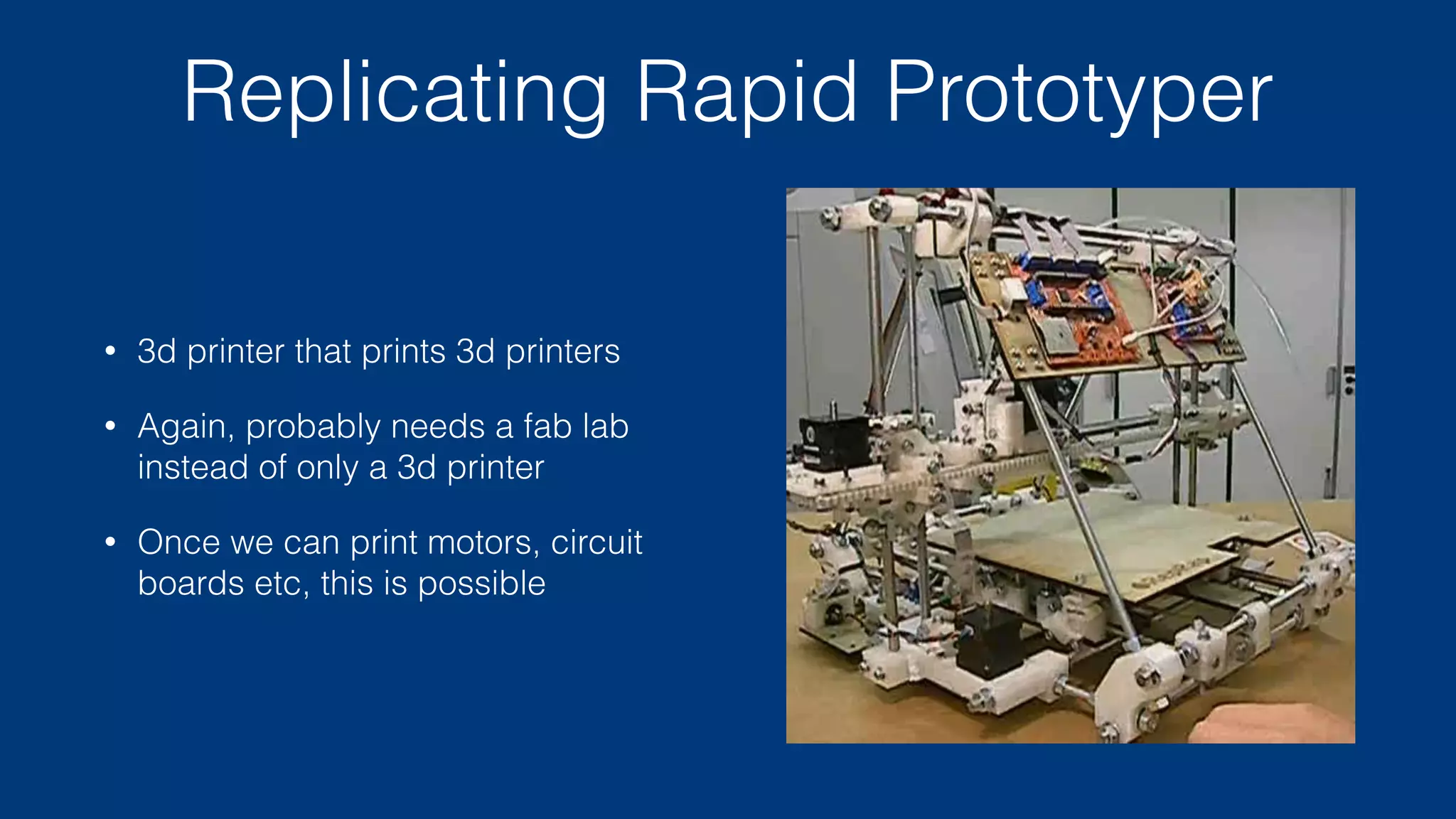
Replicating Rapid Prototyper
• 3d printer that prints 3d printers
• Again, probably needs a fab lab
instead of only a 3d printer
• Once we can print motors, circuit
boards etc, this is possible
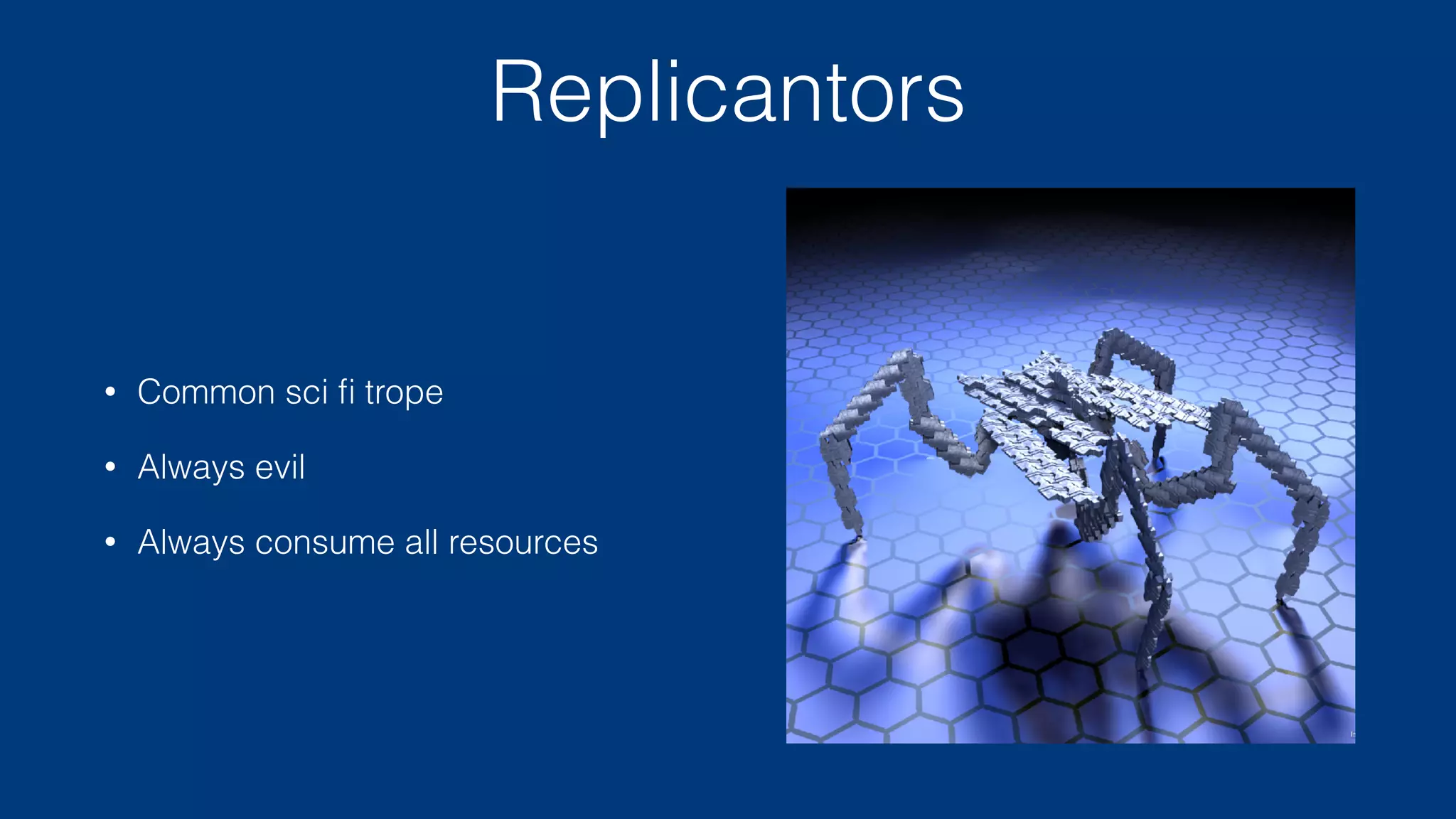
Replicantors
• Common sci fi trope
• Always evil
• Always consume all resources
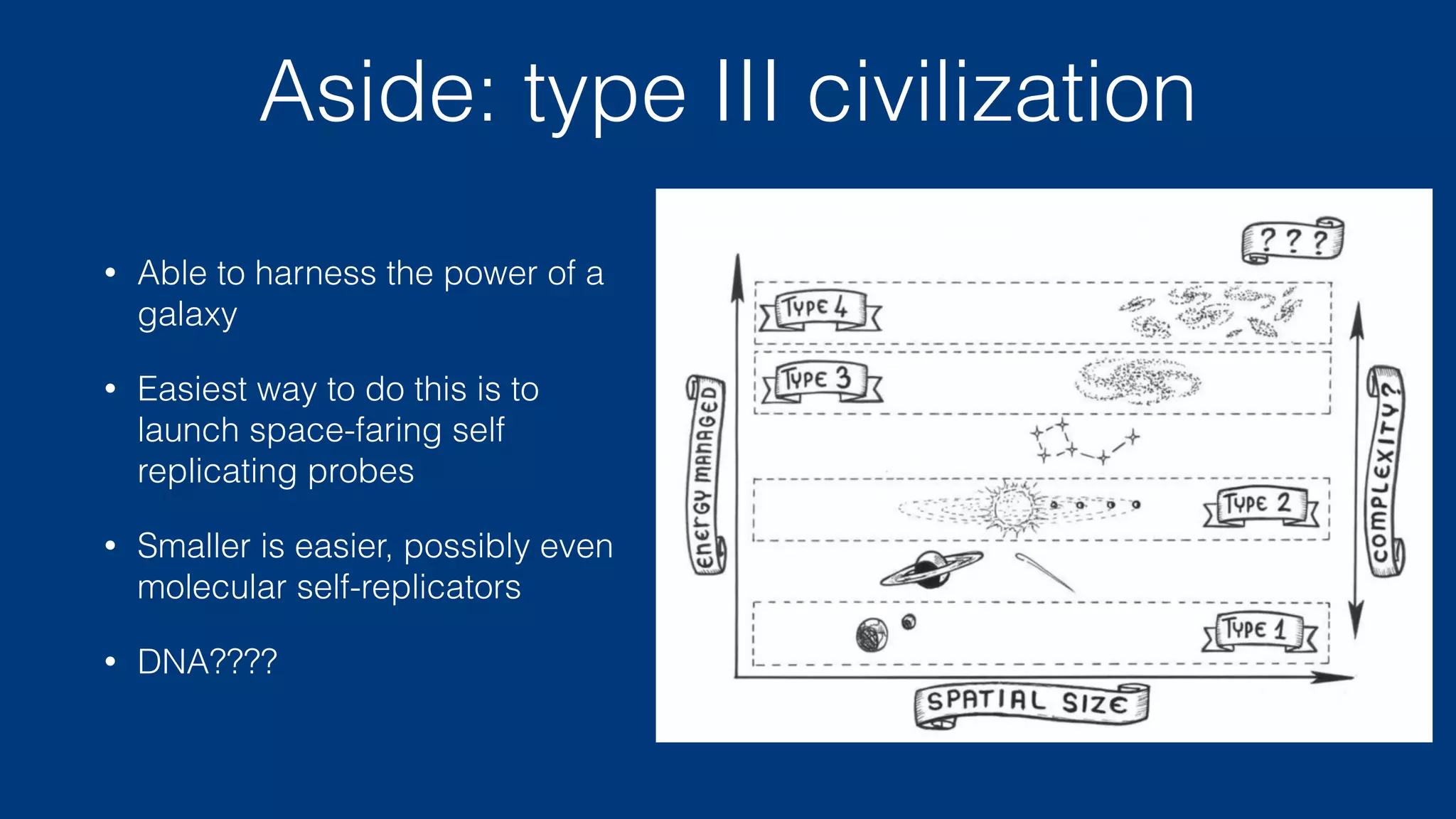
Aside: type III civilization
• Able to harness the power of a
galaxy
• Easiest way to do this is to
launch space-faring self
replicating probes
• Smaller is easier, possibly even
molecular self-replicators
• DNA????
Replicants + Biotech = Nanobots
• Self replicating cell-sized robots
• Cure Cancer?
• Destroy Humanity?
Luckily, our ineptitude will save us

3d printing: history, culture, future

  • 1.
    3d printing: History,culture, future
  • 2.
  • 3.
  • 4.
    What is 3dprinting? • Using a general-purpose machine to create a physical object, where the design of the structure is provided to the machine at build-time. • Usually, the object is created additively, in a layer-by-layer process. • Compare to "CNC" (computerized numerical control) which usually refers to a subtractive process like carving, routing, turning or cutting.
  • 5.
    Fab Lab • Collectionof machines to build anything • 3d printing is one of them • laser cutters arguably have higher utility and usability • Circuit miller is arguably more important for making high tech things • Price of these machines are prohibitive, but dropping • as patents expire
  • 6.
    Fab lab machines •3d printer • 2d CNC router (shopbot) • bench top 3d mill • laser cutter • vinyl cutter • circuit etcher • engraver • CNC lathe • paper printer • water jet
  • 7.
    Why do wecare about 3d printing? • Personalization and customization • you can make a single copy of a thing, which is prohibitive with traditional manufacturing • Complexity • you can make objects with complicated internal structures, which is difficult with traditional manufacturing
  • 8.
    Why do wecare about 3d printing? • Rapid prototyping • Can make a physical instance of a design, and quickly tell if it's the right size and shape for a job • Can iteratively refine a design based on real-world performance • Modelling for traditional manufacturing • Build a complex shape, and use it as a mold for a more traditional material process like metalwork
  • 9.
    Why do wecare about 3d printing? • NRE (Non-recurring engineering) costs • eg: $100,000 to set up a production line, each copy after than costs $0 (and a few seconds of time) • (idealized, for a small simple part) • 3d-printing a copy costs $5 (and a half hour of time) • Once you are making more than 20,000 copies, traditional manufacturing is cheaper. • Traditional manufacturing is also far higher quality and far faster. $0.00 $2.50 $5.00 $7.50 $10.00 Units (thousands) 10 20 30 40 50 60 70 80 90 100 cost/unit (traditional) cost/unit (3d print)
  • 10.
    BONUS ROUND: timeto completion 0 12,500 25,000 37,500 50,000 Units (thousands) 10 20 30 40 50 60 70 80 90 100 hours to complete (traditional) hours to complete (3d print) • assume 100 hours to set up a production line, and seconds to make each device afterward
  • 11.
    How did wemake things before 3d printing? • Carve the part out of wood or plaster • Also, carve the internal structure of the part separately • Cast a series of molds of stronger materials until you have a steel form for the inside, and a separate steel form for the outside • Pour molten plastic (metal, whatever), and let cool • eject the part from the mold • Alternatives: cornstarch molds for food gels like gummies
  • 12.
    Injection molding andcornstarch molding
  • 13.
    What are thelimits of 3d printing • a 3d printed part is not as good as a manufactured part. • more fragile, lower resolution, more expensive and takes longer to produce • 3d printing requires specialized equipment and materials • a 3d printed part requires a 3d design file • expert knowledge required to produce a design • but, designs can be shared and modified • Consumer 3d printing is limited to thermoplastics, and ~10cm3 build area
  • 14.
    Different kinds of3d printing • Selective Laser Sintering (SLS) • Fused Deposition Modelling (FDM) or Fused Filament Fabrication (FFF) • Stereolithography (SLA) • Powerbed gluejet printing 
 (3d printing proper) ➡ laser-melted nylon power ➡ melted thermoplastic filament ➡ Photo-cured acrylic resin ➡ metal power and glue, later annealed with copper most consumer printers
  • 15.
    Know your material •FDM/FFF printing can use a few different thermoplastic materials • Acrylonitrile butadiene styrene (ABS) : Strong, food-safe, lego plastic; awesome. • Polylactic acid (PLA): biodegradable; derived from corn, tapioca or other plants. more brittle, higher melting temperature, harder to work with, not as strong. more properly called a polyester. • Specialized thermoplastic materials: ninjaflex, conductive plastic, chocolate etc. • All have specific properties that will influence your print
  • 16.
    Know your printer •Each printer is different, and fail in different ways • Know your printer and model custom supports and modifications • Fit tolerances for connecting parts and external parts
  • 17.
  • 18.
    SLS • PROS • Precisionlimited only by confinement of laser beam • Non-cintered laser power supports the rest of the model • non-flat base, no support needed, can print movable parts • Can be coloured by precision dying of the material layer by layer • CONS • Can't print solids with empty space inside • you must be able to remove the excess powder • Very costly machine • Very dirty extraction process
  • 19.
  • 21.
    SLA • PROS • Precisionlimited only by confinement of laser beam • Acrylic is a very high quality food- safe end-product • Colouring is possible but difficult • CONS • Can't print solids with empty space inside • you must be able to remove the excess liquid • Expensive (but getting cheaper) • Requires base to build the model to
  • 22.
  • 23.
    Really cheap consumerSLA • Peachy printer: $100 • Very clever solution • open source • $600,000 on kickstarter • Yorkton! • ... WHERE ARE THEY NOW
  • 26.
    FDM • PROS • Cheap •ABS plastic is pretty good. PLA is not great • Can print complex internal structures • Can print in colour, with multiple print heads • CONS • Resolution limited to thickness of material bead • requires base to build model on • Model should have a flat side • requires support material • unstable as models get large • Print heads can clog causing build failure
  • 27.
  • 28.
    Model Replication • Toreplicate a physical model on a 3d printer, there are two ways • 3d scanning • Model Measurement • (third way: find someone online who’s already made one)
  • 29.
    3d scanning • Manycommercial products and maker plans • Microsoft kinect, makerbot digitizer, etc
  • 30.
    3d scanning • 3dscanner is expensive • (but getting cheaper) • Many layers of postprocessing required • (but getting easier)
  • 31.
    Model Measurement • Usethe right tools • Calliper, protractor etc • be precise • Model as you Measure • Aim for easy replication • think construction process • Find inspiration from existing models
  • 32.
    Virtual Reality Sculpting •https://www.youtube.com/watch?v=jnqFdSa5p7w
  • 33.
  • 35.
    3d modelling software •Tinkercad • Blender • Sketchup • Zbrush • Meshmixer, Meshlab, Netfabb
  • 36.
    Scale • Consider thesmallest discernible element your printer can generate • Simplify your model to match characteristics of the printer • Don’t try to print (or even model) anything smaller than 2 mm • Use the right tool for the job: metal pins and screws are better at providing mechanical structure than 3d printed plastic
  • 37.
    Support • FDM printerslayer melted plastic on each previous layer • Some things are impossible • Aim for, at most, 45 degree overhang, 2.5 cm bridge • otherwise, add your own removable support, or tell the software to calculate support
  • 38.
    Print Orientation • Considerthe way in which your model will be printed • You may choose to separate your model into more than one piece, to make support-less printing possible • The bottom layer of a FDM print is always flat. Model accordingly not as good good
  • 39.
  • 40.
    3D printing andsocial change
  • 41.
    3d printing andsocial change • traditional NRE means it’s only feasible to make a thing if you can sell tens of thousands of them, or if you can charge a lot for them • commodity versus luxury; walmart versus bespoke • 3d printing means things can exist that are both inexpensive and non-commodity • 3d printing has limits, so how does this extend to other things?
  • 42.
    3d printing controversies •Guns or other restricted things • 3d printer means anyone can make anything whether or not the government likes it • as long as it’s made of plastic and the size of a loaf of bread • 3d printed guns are not very good guns, and people make bombs out of pots and pipes
  • 43.
    3d printing controversies •Printing Bioproducts • Printing organs for transplant • Printing biotoxins and chemical weapons
  • 44.
    3d printing controversies •Information Ownership • Many corporations are identifiable by their physical products • Coke bottles, toys associated with movies, nike shoes • Design patents prevent consumer confusion by disallowing one company from manufacturing a product with similar or the same “trade dressing”
  • 45.
    3d printing controversies •Economics, industry • What happens to the world economy when people can print whatever they need at home?
  • 46.
    3D printing andthe way forward
  • 47.
    Space Pizza • Spaceis a terrible place • No Walmart to buy tools or supplies or pizza • Raw materials are easier to transport than manufactured goods • tools, parts, etc • 3d printing food makes it more interesting if you're 6 months to mars
  • 48.
    Colonization • Remote Stereolunagraphy •Autonomous robot that mines lunar regolith and 3d-prints a base • Takes a while, but no people or additional funds necessary
  • 49.
    printing housing • 3dprinting concrete is slower and more expensive than building a house with traditional framing, but can be fully automated
  • 50.
    Metamaterials • Microstructure means solid materialscan have specific and targeted flexibility
  • 51.
    Metamaterials • Flexable materialswith rigid structure • Solid materials with flexible structure • Materials that change shape after printing, re-folding into specific patterns like proteins • Micrometamaterials that can manipulate energy to bend light, be different colours, be invisible
  • 52.
    foldable 3d printsand CNC • Special modelling techniques: flexible and bendable joints, hinges etc • flexible materials: ninjaflex • Thermoformable / hydroformable materials (also called 4d printing: 3d plus time)
  • 53.
    Biomaterials • Custom drugcombinations • 3d print exact dosages • 2016 licensed by FDA • Structural today, tomorrow compositional • 3d print bioweapons?
  • 54.
    Replicating Rapid Prototyper •3d printer that prints 3d printers • Again, probably needs a fab lab instead of only a 3d printer • Once we can print motors, circuit boards etc, this is possible
  • 55.
    Replicantors • Common scifi trope • Always evil • Always consume all resources
  • 56.
    Aside: type IIIcivilization • Able to harness the power of a galaxy • Easiest way to do this is to launch space-faring self replicating probes • Smaller is easier, possibly even molecular self-replicators • DNA????
  • 57.
    Replicants + Biotech= Nanobots • Self replicating cell-sized robots • Cure Cancer? • Destroy Humanity?
  • 58.