Hologram Technology
Vishesh Banga
CSE/2-2
1411981272
Contents
 Introduction
 History
 Working
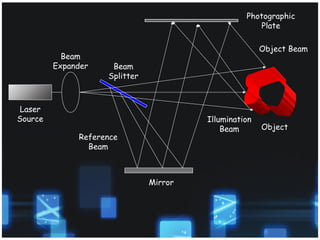
 Physics behind Holography
 Holography vs. Photography
 Hologram Classifications
 Applications
 Holography in Fiction
A hologram is a physical structure that diffracts light into
an image. The term ‘hologram’ can refer to both the
encoded material and the resulting image.
Holography
Science of producing holograms.
Enables 3-D images (holograms) to be made.
Involves the use of a laser, interference,
diffraction, light intensity recording &
suitable illumination of the recording.
The image changes as the position &
orientation of the viewing system changes in
exactly the same way as if the object were
still present, thus making the image
appear Three-dimensional.
History
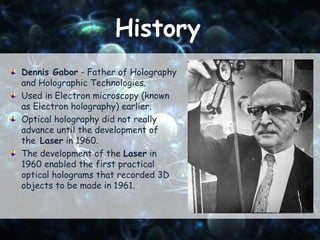
Dennis Gabor - Father of Holography
and Holographic Technologies.
Used in Electron microscopy (known
as Electron holography) earlier.
Optical holography did not really
advance until the development of
the Laser in 1960.
The development of the Laser in
1960 enabled the first practical
optical holograms that recorded 3D
objects to be made in 1961.
Working
Enables a light field, to be recorded & later reconstructed when the
original light field is no longer present, due to the absence of the
original objects.
Can be thought of as somewhat similar to sound recording,
whereby a sound field is encoded in such a way that it can be
reproduced later, without the presence of the original vibrating
matter.
Laser
Holograms are recorded using a flash of light that
illuminates a scene and then imprints on a recording
medium, much in the way a photograph is recorded.
However, part of the light (Reference beam) beam
must be shone directly onto the recording medium.
A hologram requires a Laser as the sole light source as
it can be precisely controlled and have a
fixed wavelength.
Usually taken in darkness, or in low level light of a
different color from the laser light used in making the
hologram to prevent external light from interfering.
Apparatus
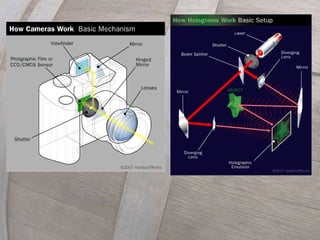
 Recording a hologram requires the laser beam to be
aimed through a series of elements that change it in
different ways. Beam splitter divides the beam into
two identical beams, each aimed in different
directions:
Illumination beam
Reference beam
To make a Hologram following items are required :
A suitable object or set of objects.
A suitable laser beam
Part of the laser beam to be directed so that it
illuminates the object (the object beam) and another
part so that it illuminates the recording medium
directly (the reference beam), enabling the reference
beam and the light which is scattered from the object
onto the recording medium to form an interference
pattern
A recording medium which converts this
interference pattern into an optical element which
modifies either the amplitude or the phase of an
incident light beam according to the intensity of
the interference pattern.
An environment which provides sufficient
mechanical and thermal stability that the
interference pattern is stable during the time in
which the interference pattern is recorded
Laser
Source
Mirror
Beam
Expander Beam
Splitter
Object
Photographic
Plate
Reference
Beam
Illumination
Beam
Object Beam
Process
It is this interference pattern that is imprinted on the
recording medium.
The interference pattern can be considered
an Encoded version of the scene.
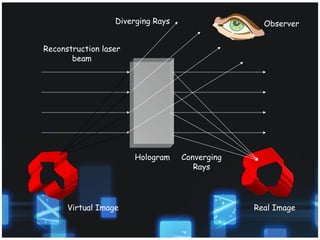
This missing key is provided later by shining a laser,
identical to the one used to record the hologram, onto
the developed film.
When this beam illuminates the hologram, it
is diffracted by the hologram's surface pattern. This
produces a light field identical to the one originally
produced by the scene and scattered onto the
hologram.
The image this effect produces in a person's retina is
known as a Virtual image.
Reconstruction laser
beam
Real ImageVirtual Image
Converging
Rays
Diverging Rays Observer
Hologram
Reconstructing and viewing the
holographic image
When the hologram plate is illuminated by the laser
beam, an exact reconstruction of the original object
wave front is obtained.
An imaging system (an eye or a camera) located in the
reconstructed beam 'sees' exactly the same scene as
it would have done when viewing the original.
When the lens is moved, the image changes in the same
way as it would have done when the object was in place.
If several objects were present when the hologram was
recorded, the reconstructed objects exhibit Parallax.
Hologram
Classifications
Reflection Holograms
 Volume hologram
Transmission Holograms
 Rainbow Holograms
Multi-image Holograms
Holographic Stereograms
Holographic movies
Transmission Holograms
Where the object and reference beams are incident on the
recording medium from the same side.
Several more mirrors may be used to direct the beams in the
required directions.
Normally, transmission holograms can only be reconstructed
using a laser, but a particular type of transmission hologram,
known as a rainbow hologram, can be viewed with white light.
Rainbow Holograms
The rainbow hologram separates out components wavelengths of
white light and sends them in different directions, so that the
viewer sees the image by light of only one wavelength, the actual
wavelength being determined by the viewpoint.
A plain diffraction grating disperses the light into a vertical
spectrum with red at the top and violet at the bottom.
This diffraction grating is produced in the transfer process, and
takes the place of the vertical parallax.
 So when we view a rainbow hologram at average height the image
appears yellow-green. If we stand a little higher, it changes to
orange or red, and if we dip, it becomes blue or violet.
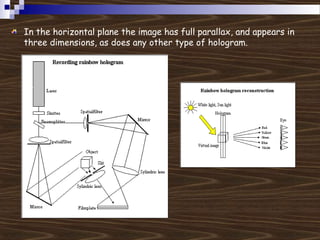
In the horizontal plane the image has full parallax, and appears in
three dimensions, as does any other type of hologram.
Reflection Holograms
The object and reference beams are incident on the plate from
opposite sides of the plate.
The reconstructed object is then viewed from the same side of the
plate as that at which the re-constructing beam is incident.
Only volume holograms can be used to make reflection holograms,
as only a very low intensity diffracted beam would be reflected by
a thin hologram.
Volume Holograms
A volume hologram can give a reconstructed beam using white
light, as the hologram structure effectively filters out colors
other than those equal to or very close to the color of the laser
used to make the hologram so that the reconstructed image will
appear to be approximately the same color as the laser light used
to create the holographic recording.
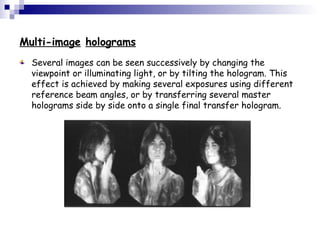
Multi-image holograms
Several images can be seen successively by changing the
viewpoint or illuminating light, or by tilting the hologram. This
effect is achieved by making several exposures using different
reference beam angles, or by transferring several master
holograms side by side onto a single final transfer hologram.
Holographic Stereograms
Hybrids of holography and photography.
Have some of the qualities of both media, but each add
something of their own.
Are a series of holograms, stripes of maybe hundreds, which are
multiplexed into a single hologram.
This can be done by taking several photographs of an object
from different angles. Each of these pictures are then to be
exposed onto a little area of the holographic film plate.
Holography has three things in common with photography:
• It uses light energy,
• It employs a light-sensitive surface, and
• the result is a visible image.
Differences from Ordinary Photography:
• A hologram represents a recording of information regarding the
light that came from the original scene as scattered in a range of
directions rather than from only one direction, as in a photograph.
This allows the scene to be viewed from a range of different
angles, as if it were still present.
• A photograph can be recorded using normal light sources (sunlight
or electric lighting) whereas a laser is required to record a
hologram.
Holography &
Photography
• Range of lighting conditions.
• When a hologram is cut in half, the whole scene can still be seen
in each piece. 
• Photograph lacks depth perception.
• whereas the reproduced viewing range of a hologram adds many
more depth perception cues that were present in the original
scene.
Applications
● Art
● Data Storage
● Dynamic Holography
● Hobbyist use
● Holographic interferometry
● Interferometric microscopy
● Sensors and Biosensors
● Security
Data Storage
Hobbyist Use
• In 1983, Fred Unterseher published the Holography Handbook, a
remarkably easy-to-read description of making holograms at
home.
• In 2000, Frank DeFreitas published the Shoebox Holography
Book and introduced the use of inexpensive laser pointers to
countless hobbyists.
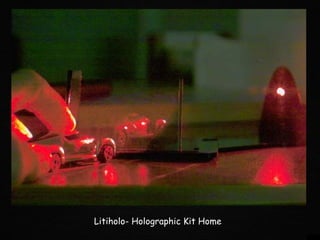
• By late 2000, holography kits with the inexpensive laser pointer
diodes entered the mainstream consumer market.
Litiholo- Holographic Kit Home
Holographic Sensors
• Comprises a hologram embedded in a smart material that
detects certain molecules or metabolites.
• Is usually a chemical interaction as a change in one of the
properties of the holographic reflection, either refractive index
or spacing between the holographic fringes. 
• The specificity of the sensor can be controlled by adding
molecules in the polymer film that selectively interacts with the
molecules of interest.
Holographic glucose detectors to help diabetes
patients
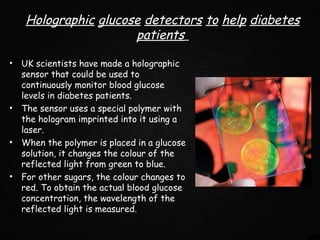
• UK scientists have made a holographic
sensor that could be used to
continuously monitor blood glucose
levels in diabetes patients.
• The sensor uses a special polymer with
the hologram imprinted into it using a
laser.
• When the polymer is placed in a glucose
solution, it changes the colour of the
reflected light from green to blue.
• For other sugars, the colour changes to
red. To obtain the actual blood glucose
concentration, the wavelength of the
reflected light is measured.
Security
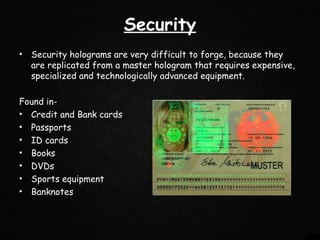
• Security holograms are very difficult to forge, because they
are replicated from a master hologram that requires expensive,
specialized and technologically advanced equipment.
Found in-
• Credit and Bank cards
• Passports
• ID cards
• Books
• DVDs
• Sports equipment
• Banknotes
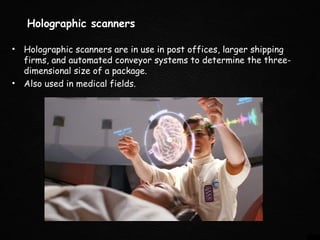
Holographic scanners
• Holographic scanners are in use in post offices, larger shipping
firms, and automated conveyor systems to determine the three-
dimensional size of a package.
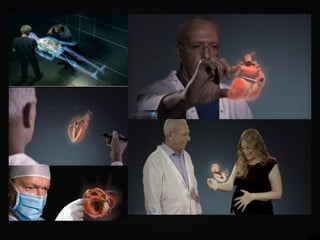
• Also used in medical fields.
Holography in Fiction
Often used as a plot device in Science fiction.
• In science fiction books
• Live-action films
• Live-action television series
• Cartoon films
• Cartoon television series
• Video games
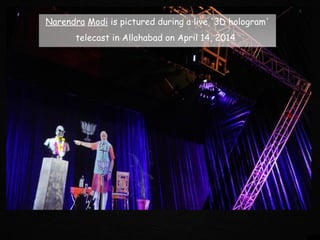
Narendra Modi is pictured during a live '3D hologram'
telecast in Allahabad on April 14, 2014
References
• http://www.fou.uib.no/fd/1996/h/404001/kap02.htm
• http://science.howstuffworks.com/hologram3.htm
• http://www.extremetech.com/extreme/156967-engineers-make-gigapixel-holograms-with
• Basics of Holography, Cambridge, P. Hariharan
• http://electronics.howstuffworks.com/gadgets/high-tech-gadgets/holographic-environme
• http://en.wikipedia.org/wiki/Holographic_sensor
• http://en.wikipedia.org/wiki/Holography
• Benton SA, (1969), Hologram reconstructions with extended incoherent sources, J.
Optical Society of America, 59: 1545-1546
• https://www.google.co.in/url?sa=t&rct=j&q=&esrc=s&source=web&cd=4&cad=rja&uact
=8&ved=0CEUQFjAD&url=http%3A%2F%2Fwww.math.ubc.ca%2F~cass%2Fcourses%2Fm3
• http://www.answers.com/topic/holography
• Introduction to holography, CRC Press, V. Toal

Holography

  • 1.
  • 2.
    Contents  Introduction  History Working  Physics behind Holography  Holography vs. Photography  Hologram Classifications  Applications  Holography in Fiction
  • 3.
    A hologram isa physical structure that diffracts light into an image. The term ‘hologram’ can refer to both the encoded material and the resulting image.
  • 4.
    Holography Science of producingholograms. Enables 3-D images (holograms) to be made. Involves the use of a laser, interference, diffraction, light intensity recording & suitable illumination of the recording. The image changes as the position & orientation of the viewing system changes in exactly the same way as if the object were still present, thus making the image appear Three-dimensional.
  • 5.
    History Dennis Gabor -Father of Holography and Holographic Technologies. Used in Electron microscopy (known as Electron holography) earlier. Optical holography did not really advance until the development of the Laser in 1960. The development of the Laser in 1960 enabled the first practical optical holograms that recorded 3D objects to be made in 1961.
  • 6.
    Working Enables a lightfield, to be recorded & later reconstructed when the original light field is no longer present, due to the absence of the original objects. Can be thought of as somewhat similar to sound recording, whereby a sound field is encoded in such a way that it can be reproduced later, without the presence of the original vibrating matter.
  • 7.
    Laser Holograms are recordedusing a flash of light that illuminates a scene and then imprints on a recording medium, much in the way a photograph is recorded. However, part of the light (Reference beam) beam must be shone directly onto the recording medium. A hologram requires a Laser as the sole light source as it can be precisely controlled and have a fixed wavelength. Usually taken in darkness, or in low level light of a different color from the laser light used in making the hologram to prevent external light from interfering.
  • 8.
    Apparatus  Recording ahologram requires the laser beam to be aimed through a series of elements that change it in different ways. Beam splitter divides the beam into two identical beams, each aimed in different directions: Illumination beam Reference beam
  • 9.
    To make aHologram following items are required : A suitable object or set of objects. A suitable laser beam Part of the laser beam to be directed so that it illuminates the object (the object beam) and another part so that it illuminates the recording medium directly (the reference beam), enabling the reference beam and the light which is scattered from the object onto the recording medium to form an interference pattern
  • 10.
    A recording mediumwhich converts this interference pattern into an optical element which modifies either the amplitude or the phase of an incident light beam according to the intensity of the interference pattern. An environment which provides sufficient mechanical and thermal stability that the interference pattern is stable during the time in which the interference pattern is recorded
  • 11.
  • 12.
    Process It is thisinterference pattern that is imprinted on the recording medium. The interference pattern can be considered an Encoded version of the scene. This missing key is provided later by shining a laser, identical to the one used to record the hologram, onto the developed film. When this beam illuminates the hologram, it is diffracted by the hologram's surface pattern. This produces a light field identical to the one originally produced by the scene and scattered onto the hologram. The image this effect produces in a person's retina is known as a Virtual image.
  • 13.
    Reconstruction laser beam Real ImageVirtualImage Converging Rays Diverging Rays Observer Hologram
  • 14.
    Reconstructing and viewingthe holographic image When the hologram plate is illuminated by the laser beam, an exact reconstruction of the original object wave front is obtained. An imaging system (an eye or a camera) located in the reconstructed beam 'sees' exactly the same scene as it would have done when viewing the original. When the lens is moved, the image changes in the same way as it would have done when the object was in place. If several objects were present when the hologram was recorded, the reconstructed objects exhibit Parallax.
  • 15.
    Hologram Classifications Reflection Holograms  Volumehologram Transmission Holograms  Rainbow Holograms Multi-image Holograms Holographic Stereograms Holographic movies
  • 16.
    Transmission Holograms Where theobject and reference beams are incident on the recording medium from the same side. Several more mirrors may be used to direct the beams in the required directions. Normally, transmission holograms can only be reconstructed using a laser, but a particular type of transmission hologram, known as a rainbow hologram, can be viewed with white light.
  • 17.
    Rainbow Holograms The rainbowhologram separates out components wavelengths of white light and sends them in different directions, so that the viewer sees the image by light of only one wavelength, the actual wavelength being determined by the viewpoint. A plain diffraction grating disperses the light into a vertical spectrum with red at the top and violet at the bottom. This diffraction grating is produced in the transfer process, and takes the place of the vertical parallax.  So when we view a rainbow hologram at average height the image appears yellow-green. If we stand a little higher, it changes to orange or red, and if we dip, it becomes blue or violet.
  • 18.
    In the horizontalplane the image has full parallax, and appears in three dimensions, as does any other type of hologram.
  • 19.
    Reflection Holograms The objectand reference beams are incident on the plate from opposite sides of the plate. The reconstructed object is then viewed from the same side of the plate as that at which the re-constructing beam is incident. Only volume holograms can be used to make reflection holograms, as only a very low intensity diffracted beam would be reflected by a thin hologram.
  • 20.
    Volume Holograms A volumehologram can give a reconstructed beam using white light, as the hologram structure effectively filters out colors other than those equal to or very close to the color of the laser used to make the hologram so that the reconstructed image will appear to be approximately the same color as the laser light used to create the holographic recording.
  • 21.
    Multi-image holograms Several imagescan be seen successively by changing the viewpoint or illuminating light, or by tilting the hologram. This effect is achieved by making several exposures using different reference beam angles, or by transferring several master holograms side by side onto a single final transfer hologram.
  • 22.
    Holographic Stereograms Hybrids ofholography and photography. Have some of the qualities of both media, but each add something of their own. Are a series of holograms, stripes of maybe hundreds, which are multiplexed into a single hologram. This can be done by taking several photographs of an object from different angles. Each of these pictures are then to be exposed onto a little area of the holographic film plate.
  • 23.
    Holography has threethings in common with photography: • It uses light energy, • It employs a light-sensitive surface, and • the result is a visible image. Differences from Ordinary Photography: • A hologram represents a recording of information regarding the light that came from the original scene as scattered in a range of directions rather than from only one direction, as in a photograph. This allows the scene to be viewed from a range of different angles, as if it were still present. • A photograph can be recorded using normal light sources (sunlight or electric lighting) whereas a laser is required to record a hologram. Holography & Photography
  • 24.
    • Range oflighting conditions. • When a hologram is cut in half, the whole scene can still be seen in each piece.  • Photograph lacks depth perception. • whereas the reproduced viewing range of a hologram adds many more depth perception cues that were present in the original scene.
  • 26.
    Applications ● Art ● DataStorage ● Dynamic Holography ● Hobbyist use ● Holographic interferometry ● Interferometric microscopy ● Sensors and Biosensors ● Security
  • 28.
  • 29.
    Hobbyist Use • In1983, Fred Unterseher published the Holography Handbook, a remarkably easy-to-read description of making holograms at home. • In 2000, Frank DeFreitas published the Shoebox Holography Book and introduced the use of inexpensive laser pointers to countless hobbyists. • By late 2000, holography kits with the inexpensive laser pointer diodes entered the mainstream consumer market.
  • 30.
  • 31.
    Holographic Sensors • Comprisesa hologram embedded in a smart material that detects certain molecules or metabolites. • Is usually a chemical interaction as a change in one of the properties of the holographic reflection, either refractive index or spacing between the holographic fringes.  • The specificity of the sensor can be controlled by adding molecules in the polymer film that selectively interacts with the molecules of interest.
  • 32.
    Holographic glucose detectorsto help diabetes patients • UK scientists have made a holographic sensor that could be used to continuously monitor blood glucose levels in diabetes patients. • The sensor uses a special polymer with the hologram imprinted into it using a laser. • When the polymer is placed in a glucose solution, it changes the colour of the reflected light from green to blue. • For other sugars, the colour changes to red. To obtain the actual blood glucose concentration, the wavelength of the reflected light is measured.
  • 33.
    Security • Security hologramsare very difficult to forge, because they are replicated from a master hologram that requires expensive, specialized and technologically advanced equipment. Found in- • Credit and Bank cards • Passports • ID cards • Books • DVDs • Sports equipment • Banknotes
  • 34.
    Holographic scanners • Holographicscanners are in use in post offices, larger shipping firms, and automated conveyor systems to determine the three- dimensional size of a package. • Also used in medical fields.
  • 36.
    Holography in Fiction Oftenused as a plot device in Science fiction. • In science fiction books • Live-action films • Live-action television series • Cartoon films • Cartoon television series • Video games
  • 37.
    Narendra Modi ispictured during a live '3D hologram' telecast in Allahabad on April 14, 2014
  • 38.
    References • http://www.fou.uib.no/fd/1996/h/404001/kap02.htm • http://science.howstuffworks.com/hologram3.htm •http://www.extremetech.com/extreme/156967-engineers-make-gigapixel-holograms-with • Basics of Holography, Cambridge, P. Hariharan • http://electronics.howstuffworks.com/gadgets/high-tech-gadgets/holographic-environme • http://en.wikipedia.org/wiki/Holographic_sensor • http://en.wikipedia.org/wiki/Holography • Benton SA, (1969), Hologram reconstructions with extended incoherent sources, J. Optical Society of America, 59: 1545-1546 • https://www.google.co.in/url?sa=t&rct=j&q=&esrc=s&source=web&cd=4&cad=rja&uact =8&ved=0CEUQFjAD&url=http%3A%2F%2Fwww.math.ubc.ca%2F~cass%2Fcourses%2Fm3 • http://www.answers.com/topic/holography • Introduction to holography, CRC Press, V. Toal