TechnologyPresented by
Lahiru diyamantha
The open university of Sri Lanka
Nawala
Nugegoda
What is 3D
Three D a movie with images having three dimensional from
or appearance
Our physical environment is three dimensional and we view
the world in a 3D way every day.Human have two eyes which
are about 2 inches apart so we are able to perceive the spatial
relationship between the things just by looking at them.
Introduction
 A 3D display is a screen that shows a three dimensional
picture.
 A 3D picture makes for a more interesting and real viewing
experience.
 In the past few years we have seen quick advances, and the
TV, movie and gaming industries are betting heavily on 3D
content.
The basic definition of 3D space
stays the same
 Everything about the X, Y, and Z-axis still holds true, but
there's one catch. While real world 3D
objects physically exist in three dimensions, in the digital
world of computer graphics 3D objects can only be
representedmathematically.
How 3D Image is Created?
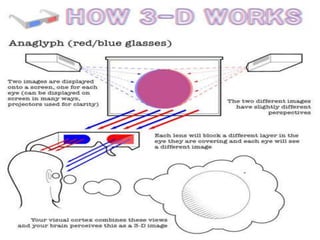
 Stereoscopy refers to a technique for creating or enhancing
the illusion of depth in an image by presenting two offset
images separately to the left and right eye of the viewer. Both
of these 2-D offset images are then combined in the brain to
give the perception of 3-D depth.
Stereoscopy
Active 3D and Passive 3D
 Active 3D
 Active 3D could also be called powered 3D, because it
requires that the glasses used be powered somehow.
 Early models used standard AA or AAA batteries, but the
newest ones use rechargeable cells that draw power from
special cradles, or even from a computer’s USB port when
plugged into it.
Active 3D and Passive 3D
 Passive 3D
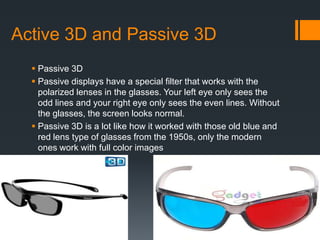
 Passive displays have a special filter that works with the
polarized lenses in the glasses. Your left eye only sees the
odd lines and your right eye only sees the even lines. Without
the glasses, the screen looks normal.
 Passive 3D is a lot like how it worked with those old blue and
red lens type of glasses from the 1950s, only the modern
ones work with full color images
Comparing Active and Passive 3D
Glasses
weight Heavy Low
weight
Image
quality
Very good
quality
Average
provides
Price High Low cost
Volumetric displays: Real 3D
Images
 The most straightforward way to create a 3D display, is to
actually creating it in 3D. These are called Volumetric
displays, and scientists are working on all sorts of way to
create them, which usually involves lasers and rotating or
vibrating mirrors
Auto-Stereoscopic Display
 Auto-Stereoscopic displays display different pixels to each
eye, using optics (lenses or barriers) to direct the correct
pixels to each eye. The nice part is that you don't need to
wear any glasses to experience the 3D image!
Auto-Stereoscopic Display
What’s on the Market?
 3D Movies
 3D Televisions
 3D Gaming
 3D Mobile Phones
3D Televisions
 During 2009, many companies have started to talk about 3D
TVs, and today most of the companies have already
announced future models. These companies include Sony,
Samsung, LG, Toshiba, Panasonic and LG. Most of these
TVs will be high-end models, usually LED-based LCDs.
Future of 3D TVs
 Sony 3D TV, 3D games expected to boost sales of such
televisions. This is the second year of 3-D TV availability for
consumers in the market. 3-D sets are currently owned by
about 1 million consumers
 It is estimated that within two years the prices of 3D TV sets
will decline and will become a common electronic device in
every home.
3D Mobiles
.
 3D is a new big thing now. Year 2010 was more towards
pushing 3D televisions into consumer's houses and now
2011 and 2012 is all about 3D smart phones.
 3D mobile phones are not available in the market but it is
soon going to change. Companies like Samsung, LG, Sharp
are on the verge of launching 3D mobiles phones in the
market
Future 3D Mobile Phones
 Proposed design for Sharp 3D phone that is to come around
next year. It also goes head to head with the other
companies like Samsung that will also provide 3D mobiles at
the same period.
Thank You

3 d technology

  • 1.
    TechnologyPresented by Lahiru diyamantha Theopen university of Sri Lanka Nawala Nugegoda
  • 2.
    What is 3D ThreeD a movie with images having three dimensional from or appearance Our physical environment is three dimensional and we view the world in a 3D way every day.Human have two eyes which are about 2 inches apart so we are able to perceive the spatial relationship between the things just by looking at them.
  • 3.
    Introduction  A 3Ddisplay is a screen that shows a three dimensional picture.  A 3D picture makes for a more interesting and real viewing experience.  In the past few years we have seen quick advances, and the TV, movie and gaming industries are betting heavily on 3D content.
  • 5.
    The basic definitionof 3D space stays the same  Everything about the X, Y, and Z-axis still holds true, but there's one catch. While real world 3D objects physically exist in three dimensions, in the digital world of computer graphics 3D objects can only be representedmathematically.
  • 6.
    How 3D Imageis Created?  Stereoscopy refers to a technique for creating or enhancing the illusion of depth in an image by presenting two offset images separately to the left and right eye of the viewer. Both of these 2-D offset images are then combined in the brain to give the perception of 3-D depth.
  • 7.
  • 8.
    Active 3D andPassive 3D  Active 3D  Active 3D could also be called powered 3D, because it requires that the glasses used be powered somehow.  Early models used standard AA or AAA batteries, but the newest ones use rechargeable cells that draw power from special cradles, or even from a computer’s USB port when plugged into it.
  • 9.
    Active 3D andPassive 3D  Passive 3D  Passive displays have a special filter that works with the polarized lenses in the glasses. Your left eye only sees the odd lines and your right eye only sees the even lines. Without the glasses, the screen looks normal.  Passive 3D is a lot like how it worked with those old blue and red lens type of glasses from the 1950s, only the modern ones work with full color images
  • 10.
    Comparing Active andPassive 3D Glasses weight Heavy Low weight Image quality Very good quality Average provides Price High Low cost
  • 11.
    Volumetric displays: Real3D Images  The most straightforward way to create a 3D display, is to actually creating it in 3D. These are called Volumetric displays, and scientists are working on all sorts of way to create them, which usually involves lasers and rotating or vibrating mirrors
  • 12.
    Auto-Stereoscopic Display  Auto-Stereoscopicdisplays display different pixels to each eye, using optics (lenses or barriers) to direct the correct pixels to each eye. The nice part is that you don't need to wear any glasses to experience the 3D image!
  • 13.
  • 14.
    What’s on theMarket?  3D Movies  3D Televisions  3D Gaming  3D Mobile Phones
  • 15.
    3D Televisions  During2009, many companies have started to talk about 3D TVs, and today most of the companies have already announced future models. These companies include Sony, Samsung, LG, Toshiba, Panasonic and LG. Most of these TVs will be high-end models, usually LED-based LCDs.
  • 16.
    Future of 3DTVs  Sony 3D TV, 3D games expected to boost sales of such televisions. This is the second year of 3-D TV availability for consumers in the market. 3-D sets are currently owned by about 1 million consumers  It is estimated that within two years the prices of 3D TV sets will decline and will become a common electronic device in every home.
  • 17.
    3D Mobiles .  3Dis a new big thing now. Year 2010 was more towards pushing 3D televisions into consumer's houses and now 2011 and 2012 is all about 3D smart phones.  3D mobile phones are not available in the market but it is soon going to change. Companies like Samsung, LG, Sharp are on the verge of launching 3D mobiles phones in the market
  • 18.
    Future 3D MobilePhones  Proposed design for Sharp 3D phone that is to come around next year. It also goes head to head with the other companies like Samsung that will also provide 3D mobiles at the same period.
  • 19.