BACTERIAL GENETIC
SYSTEM: TRANSFORMATION,
CONJUGATION,
TRANSDUCTION
From,
Salonee
M.Sc. Biotechnology(1st
sem)
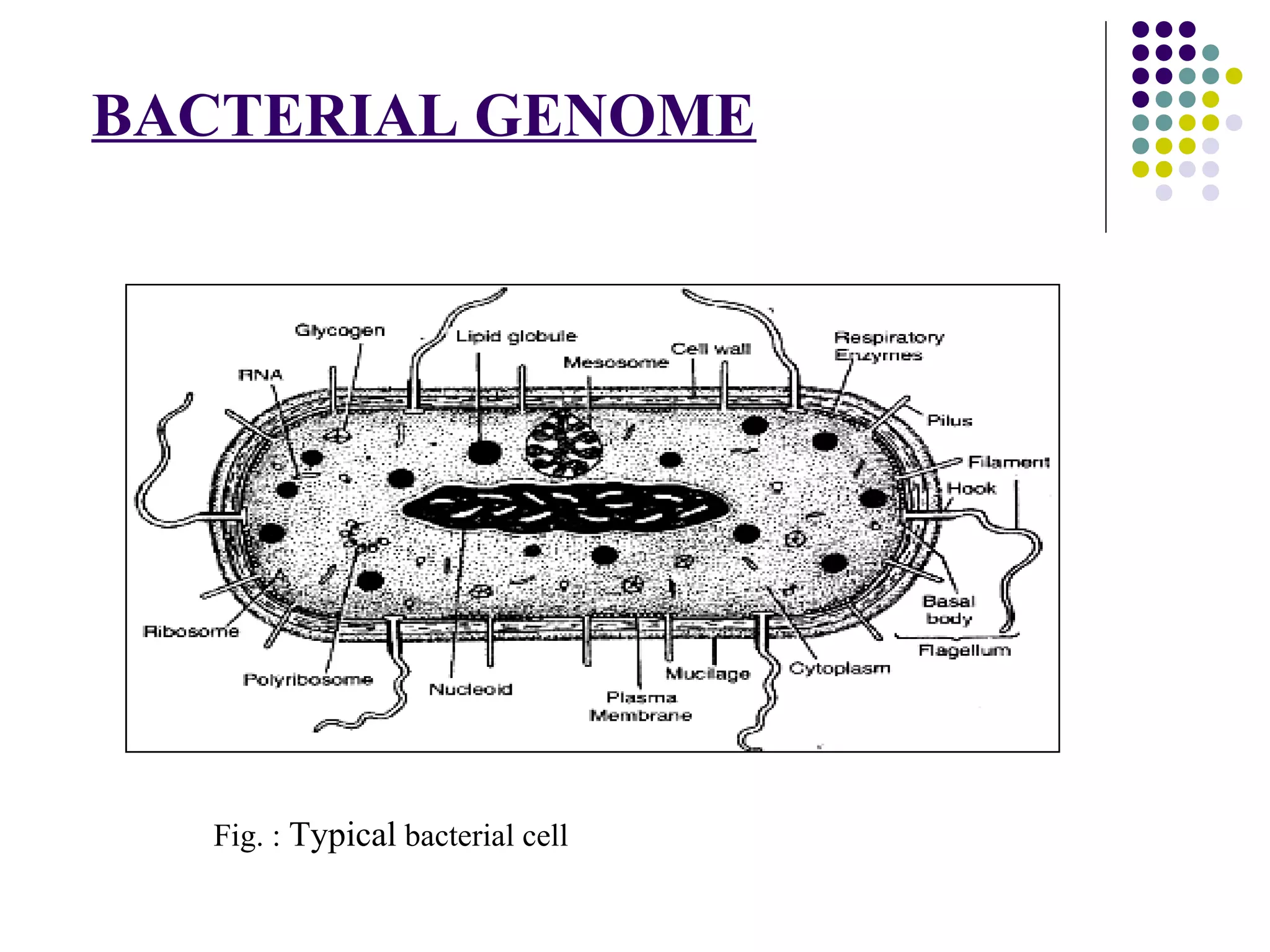
BACTERIAL GENOME
Fig. : Typical bacterial cell
 Circular, double stranded.
 The nucleoid is
 The region in a prokaryotic cell
that contains the genome.
 It lack a cell membrane and
contains dsDNA fibrils
 Basic histone proteins absent.
 low molecular weight polyamines
and magnesium ions present that
perform the function similar to the
histones.
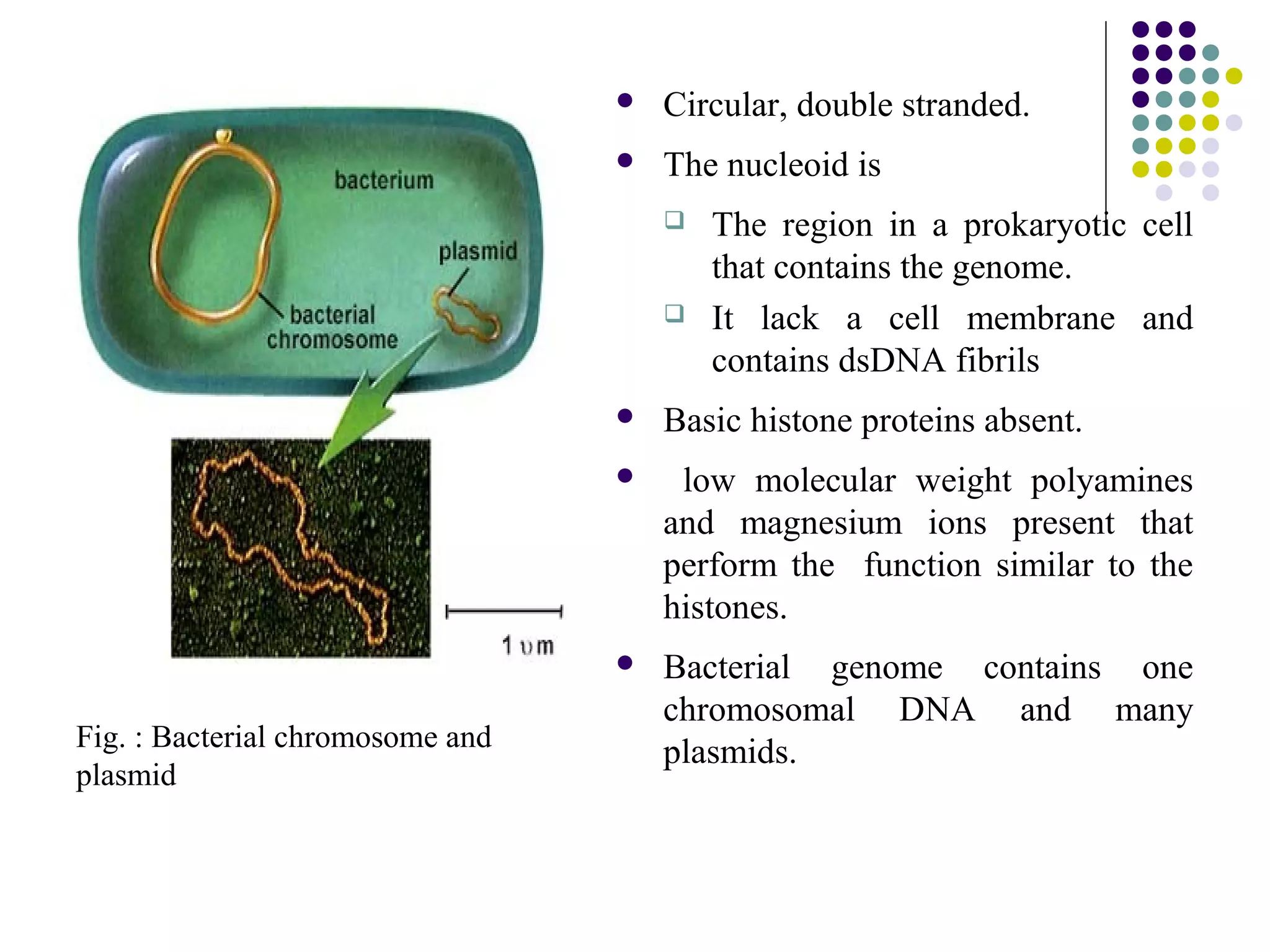
 Bacterial genome contains one
chromosomal DNA and many
plasmids.Fig. : Bacterial chromosome and
plasmid
BACTERIAL PLASMID:
The term plasmid was coined by J. Lederberg.
‘Plasmids are replicons that are extracellular genetic elements
in bacteria (also present in some yeast and fungi)’.
 These are
 self replicating
 contain small no of genes
 can incorporate themselves into the bacterial chromosome.
Classification of Plasmid:
a) Conjugative plasmids:
 Large plasmids whose replication is stringently controlled.
 Code for functions that promote transfer of the plasmid
from the donor to the recipient bacterium.
 Have genes for the synthesis of pili that help in the process
of conjugation. Eg- F factor of E.coli.
b) Non conjugative / cryptic plasmid:
Do not have any function.
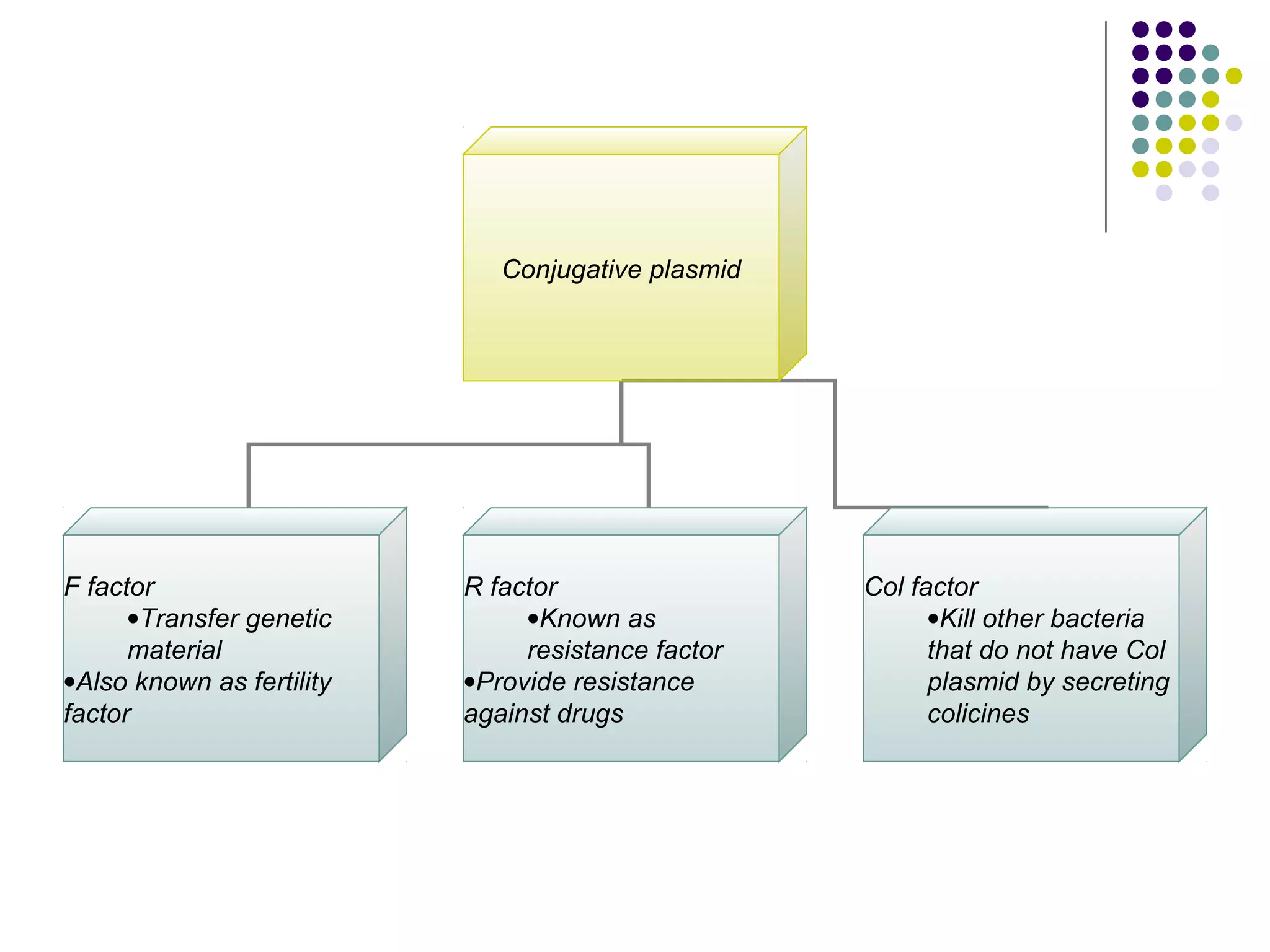
Conjugative plasmid
F factor
•Transfer genetic
material
•Also known as fertility
factor
R factor
•Known as
resistance factor
•Provide resistance
against drugs
Col factor
•Kill other bacteria
that do not have Col
plasmid by secreting
colicines
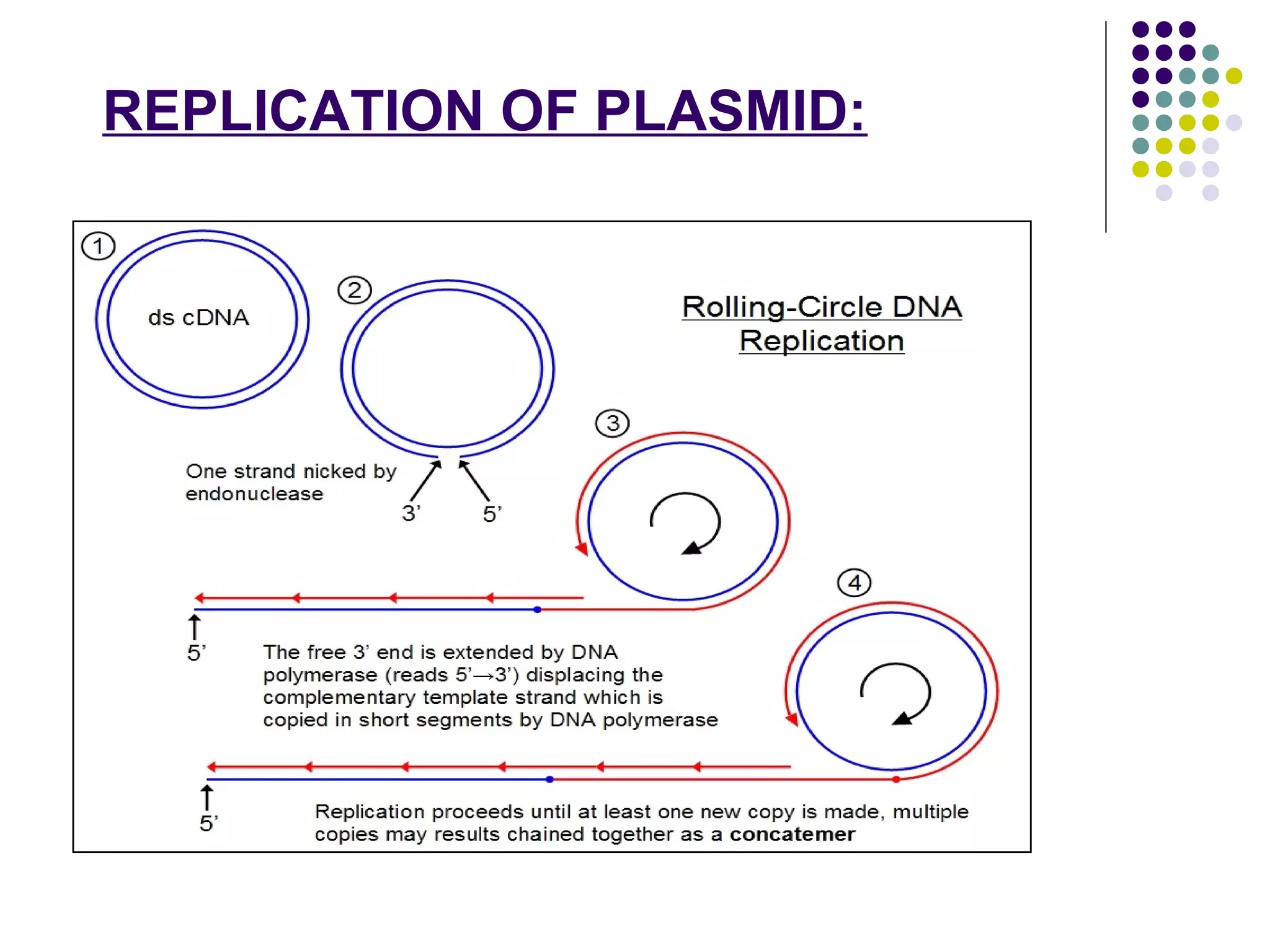
REPLICATION OF PLASMID:
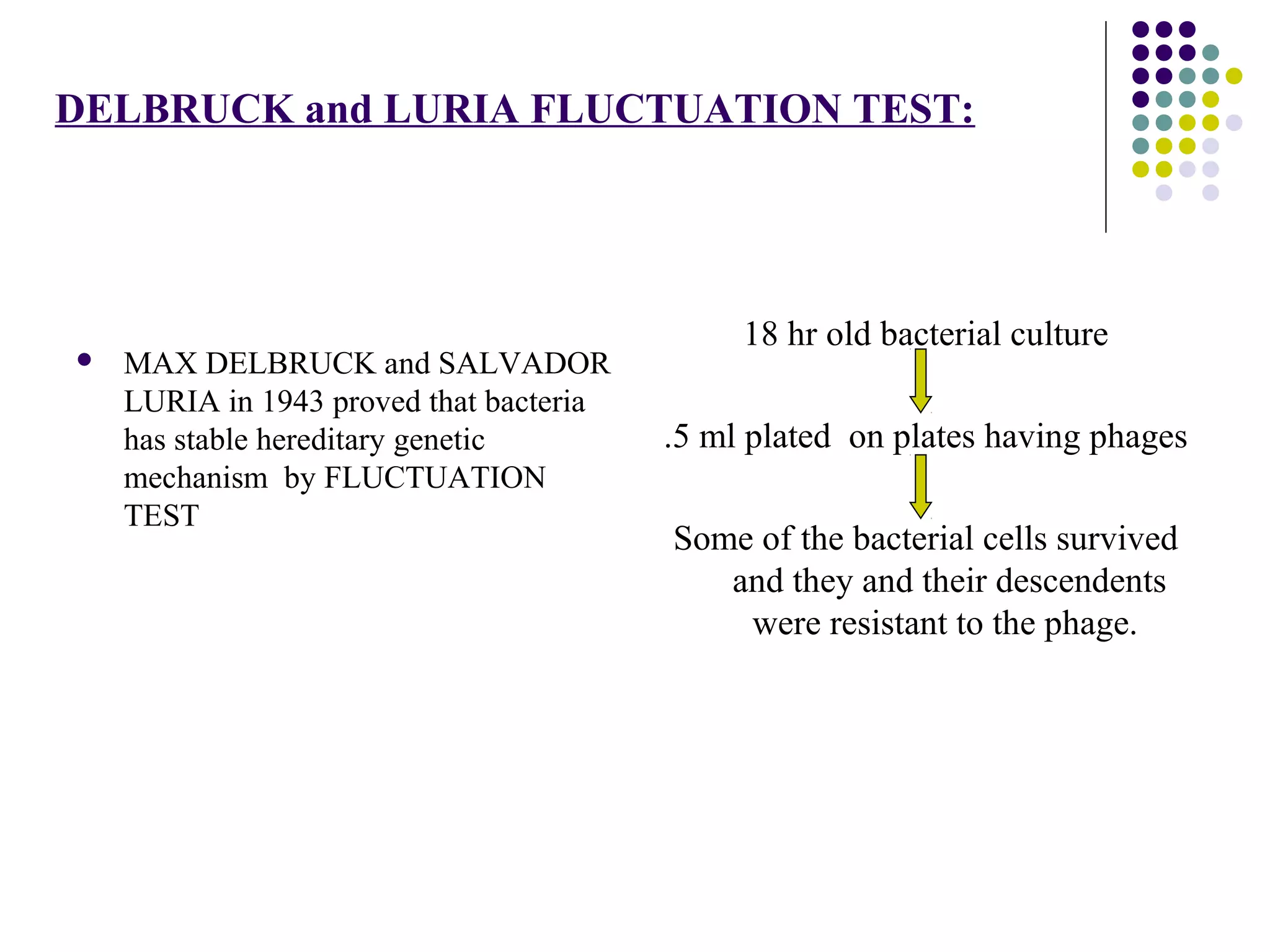
DELBRUCK and LURIA FLUCTUATION TEST:
 MAX DELBRUCK and SALVADOR
LURIA in 1943 proved that bacteria
has stable hereditary genetic
mechanism by FLUCTUATION
TEST
18 hr old bacterial culture
.5 ml plated on plates having phages
Some of the bacterial cells survived
and they and their descendents
were resistant to the phage.
OBSERVATION
 Great fluctuations found in the no. of phage resistant bacterial
cells
 Very less no. of cells were found to be survived in phages.
CONCLUSION:
 Mutation has occurred in the bacterial cell before its contact
with the phage and so its descendents were also found to be
resistant to the phage.
 It was not the result of contact with the phage since the
frequency was not very high.
 It was a result of mutation.
RECOMBINATION IN BACTERIA
 Genetic recombination refers to the exchange of the genes
between two DNA molecules to form new recombinations of
genes on a chromosome.
 Leads to genetic diversity.
 Much beneficial than mutation as
 Do not destroy genes function
 Bring together new combination of genes that lead to
valuable functions.
In bacteria recombination results from three types of
gene transfer-
a) Transformation
b) Conjugation
c) Transduction
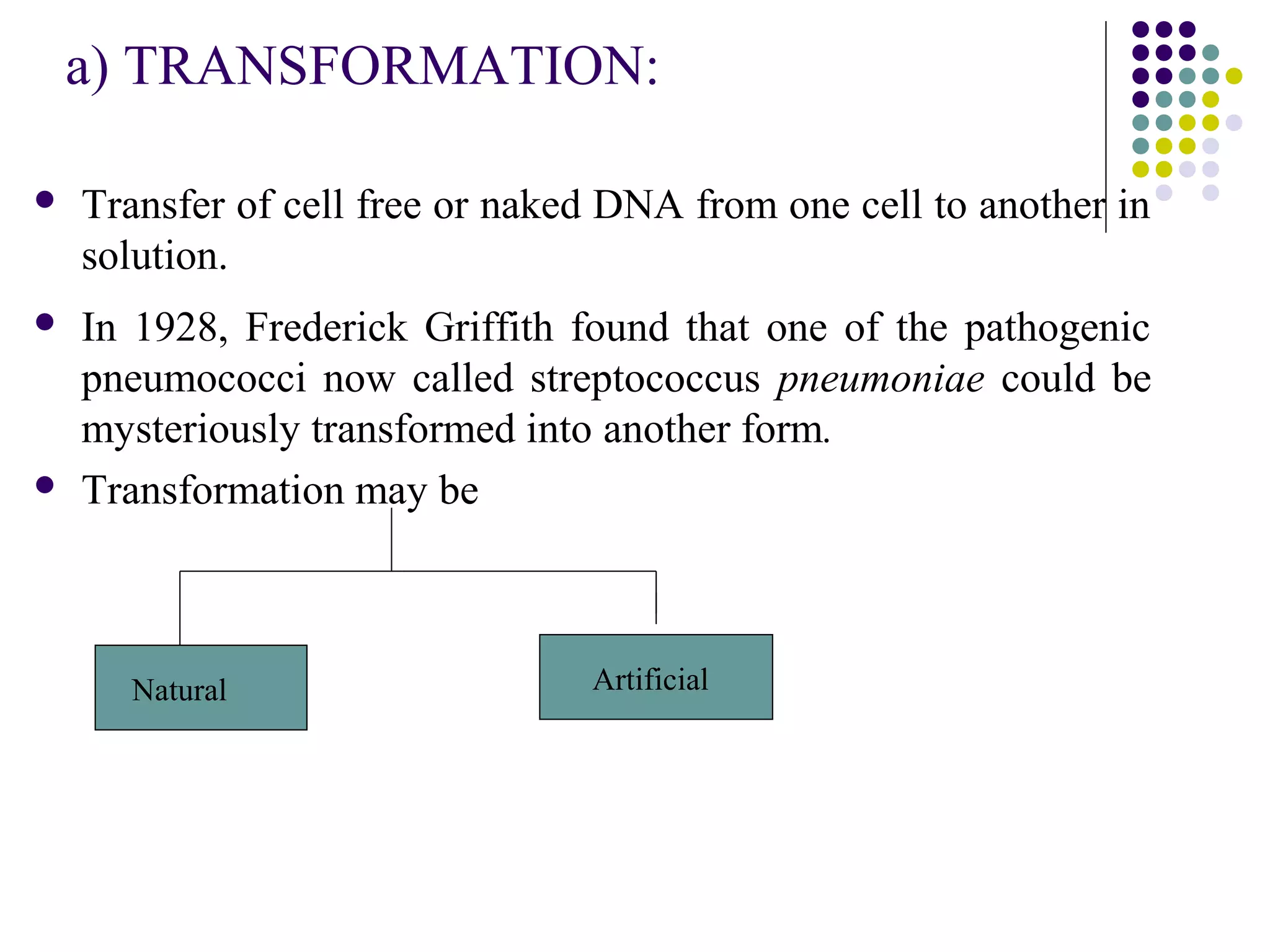
a) TRANSFORMATION:
 Transfer of cell free or naked DNA from one cell to another in
solution.
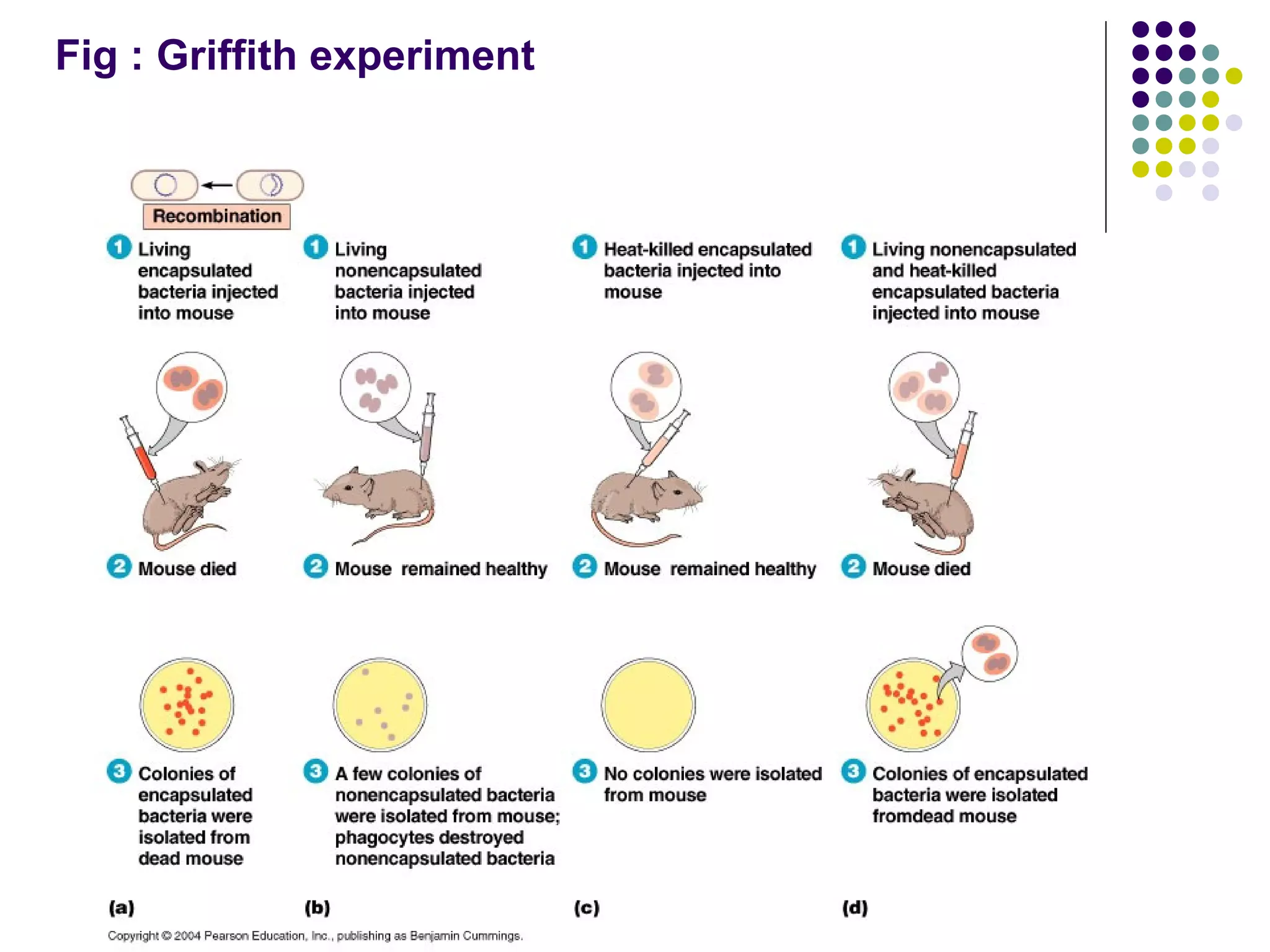
 In 1928, Frederick Griffith found that one of the pathogenic
pneumococci now called streptococcus pneumoniae could be
mysteriously transformed into another form.
 Transformation may be
Natural Artificial
Fig : Griffith experiment
Griffith’s experiment:
 Griffith called the genetic information which could be
passed from one bacterium to another the transforming
principle.
 After 16 yrs., i.e, in 1944 Oswald Avery, Collin
MacLeod and Maclyn revisited griffiths experiment and
proved that the transforming principle was DNA and not
protein or carbohydrate.
Natural transformation
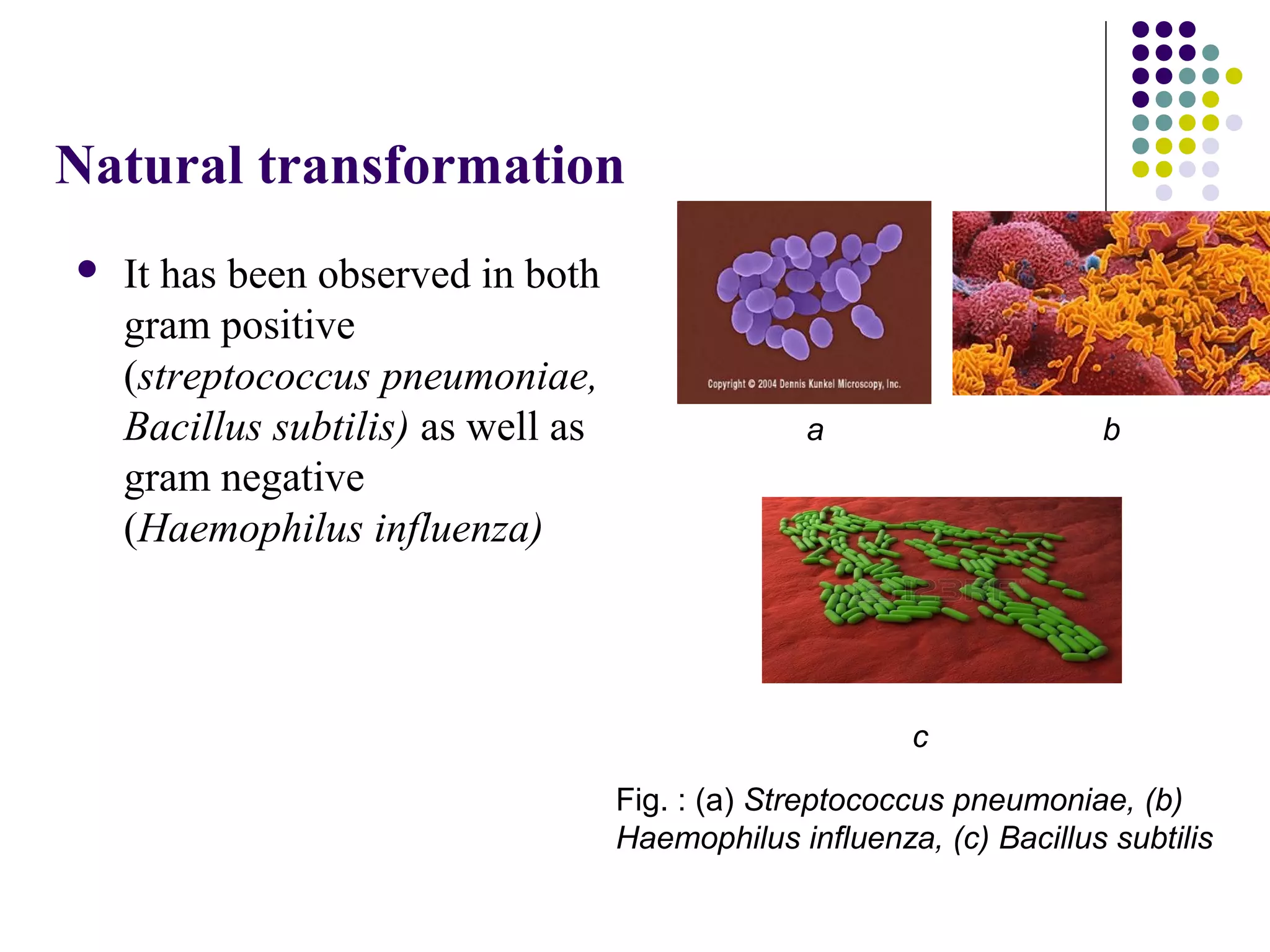
 It has been observed in both
gram positive
(streptococcus pneumoniae,
Bacillus subtilis) as well as
gram negative
(Haemophilus influenza)
a b
c
Fig. : (a) Streptococcus pneumoniae, (b)
Haemophilus influenza, (c) Bacillus subtilis
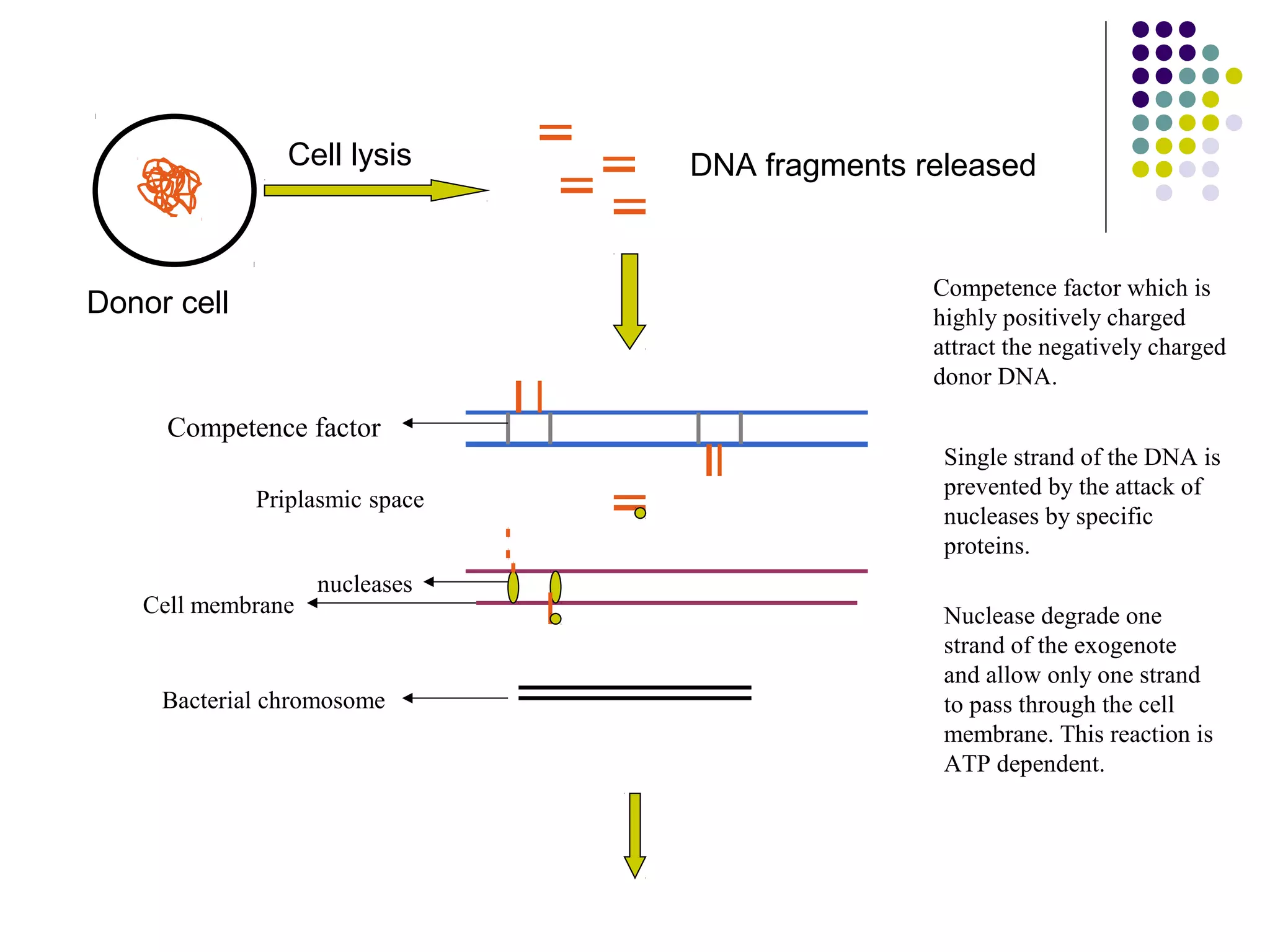
Mechanism of DNA transfer in bacteria by
transformation:
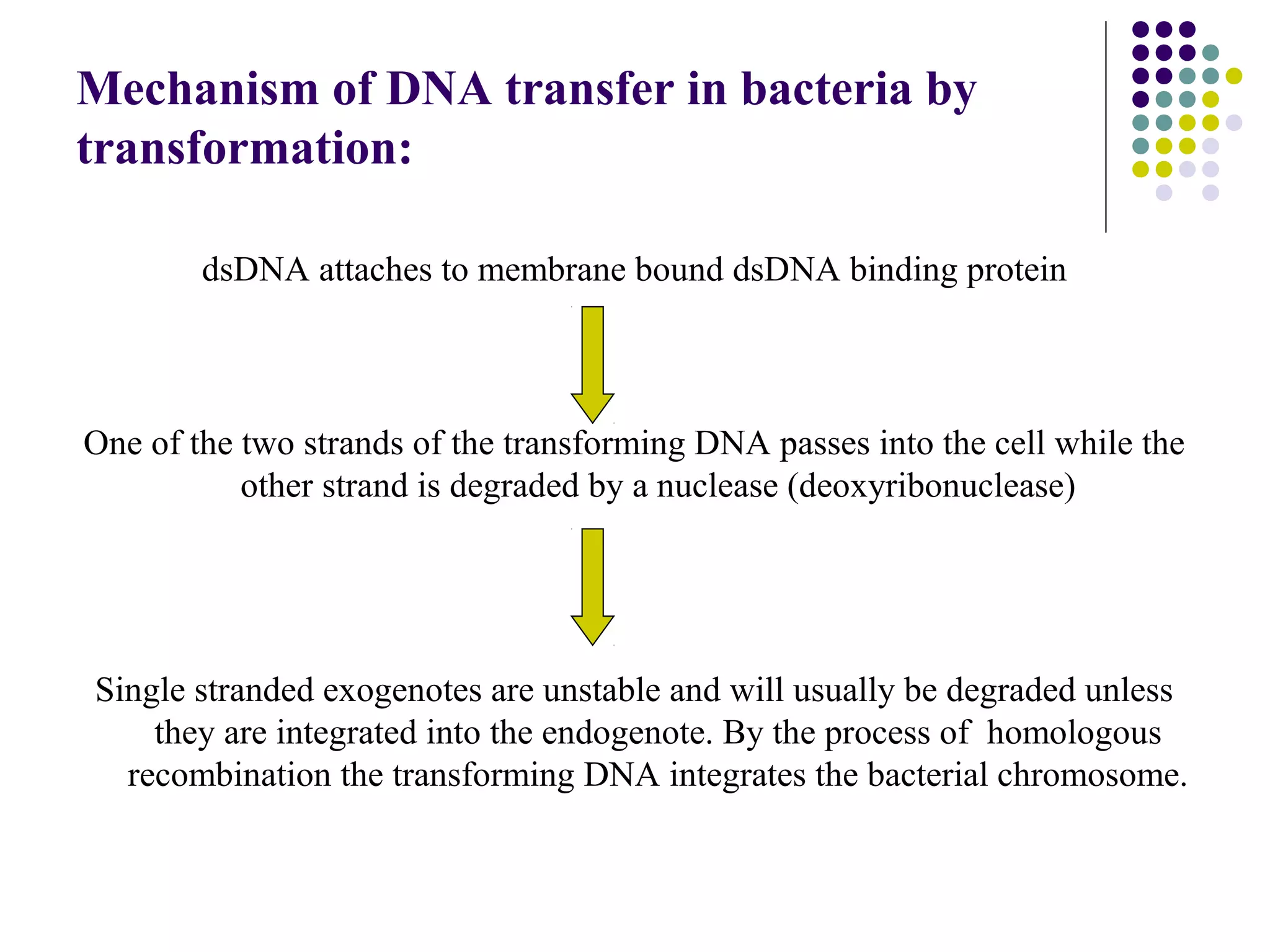
dsDNA attaches to membrane bound dsDNA binding protein
One of the two strands of the transforming DNA passes into the cell while the
other strand is degraded by a nuclease (deoxyribonuclease)
Single stranded exogenotes are unstable and will usually be degraded unless
they are integrated into the endogenote. By the process of homologous
recombination the transforming DNA integrates the bacterial chromosome.
Donor cell
Cell lysis DNA fragments released
Priplasmic space
Competence factor
nucleases
Cell membrane
Bacterial chromosome
Competence factor which is
highly positively charged
attract the negatively charged
donor DNA.
Single strand of the DNA is
prevented by the attack of
nucleases by specific
proteins.
Nuclease degrade one
strand of the exogenote
and allow only one strand
to pass through the cell
membrane. This reaction is
ATP dependent.
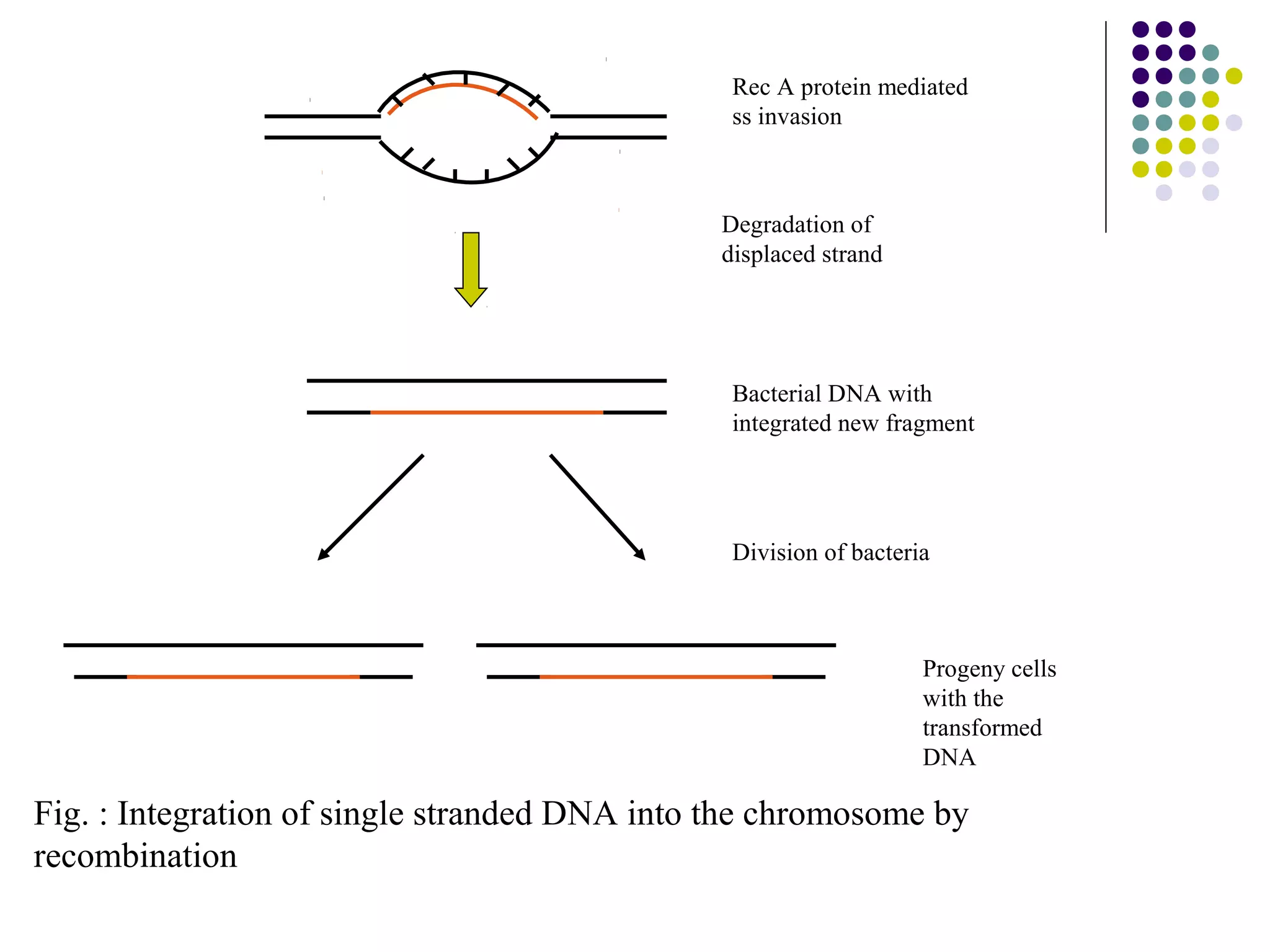
Rec A protein mediated
ss invasion
Degradation of
displaced strand
Bacterial DNA with
integrated new fragment
Division of bacteria
Progeny cells
with the
transformed
DNA
Fig. : Integration of single stranded DNA into the chromosome by
recombination
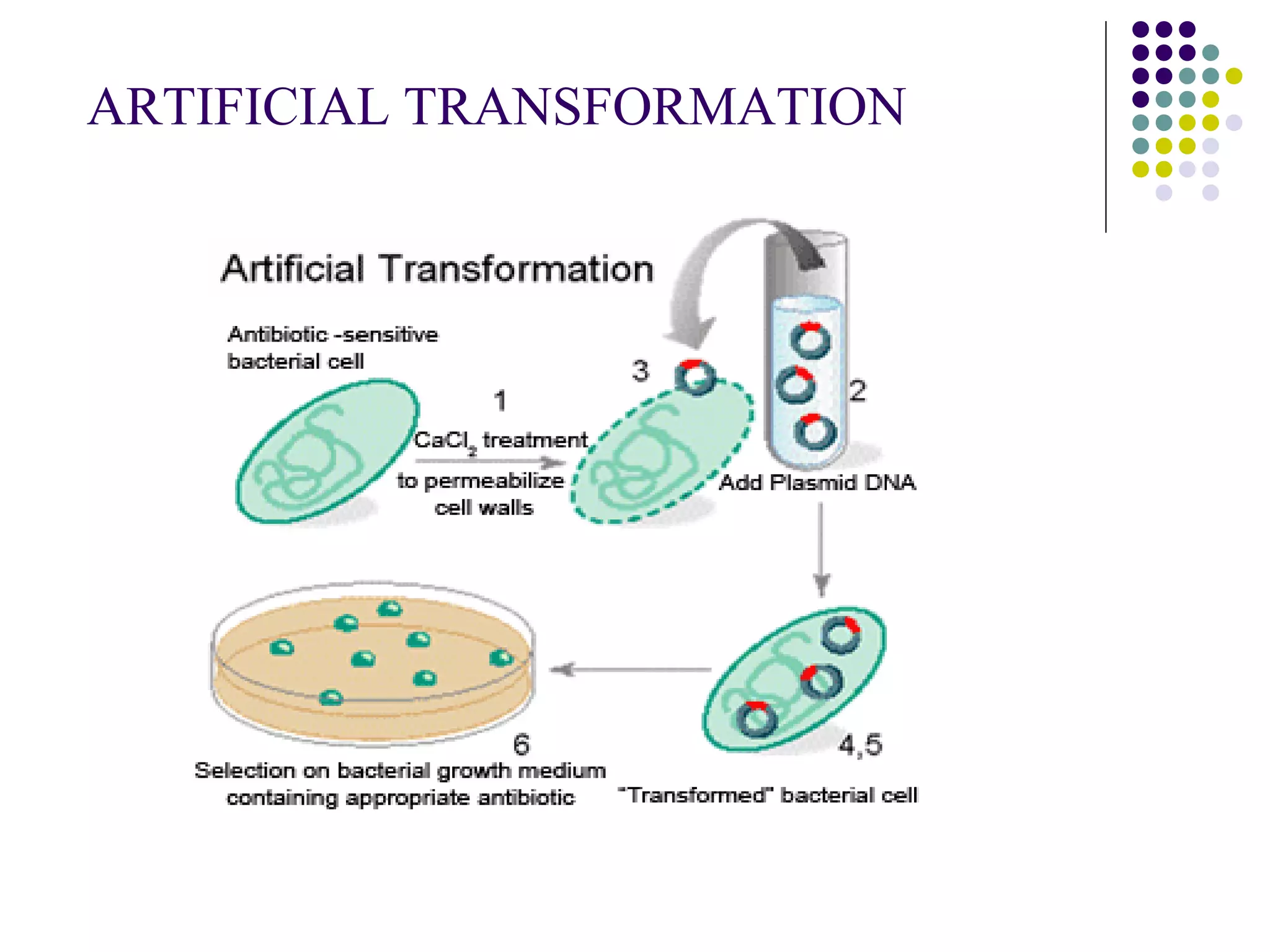
ARTIFICIAL TRANSFORMATION
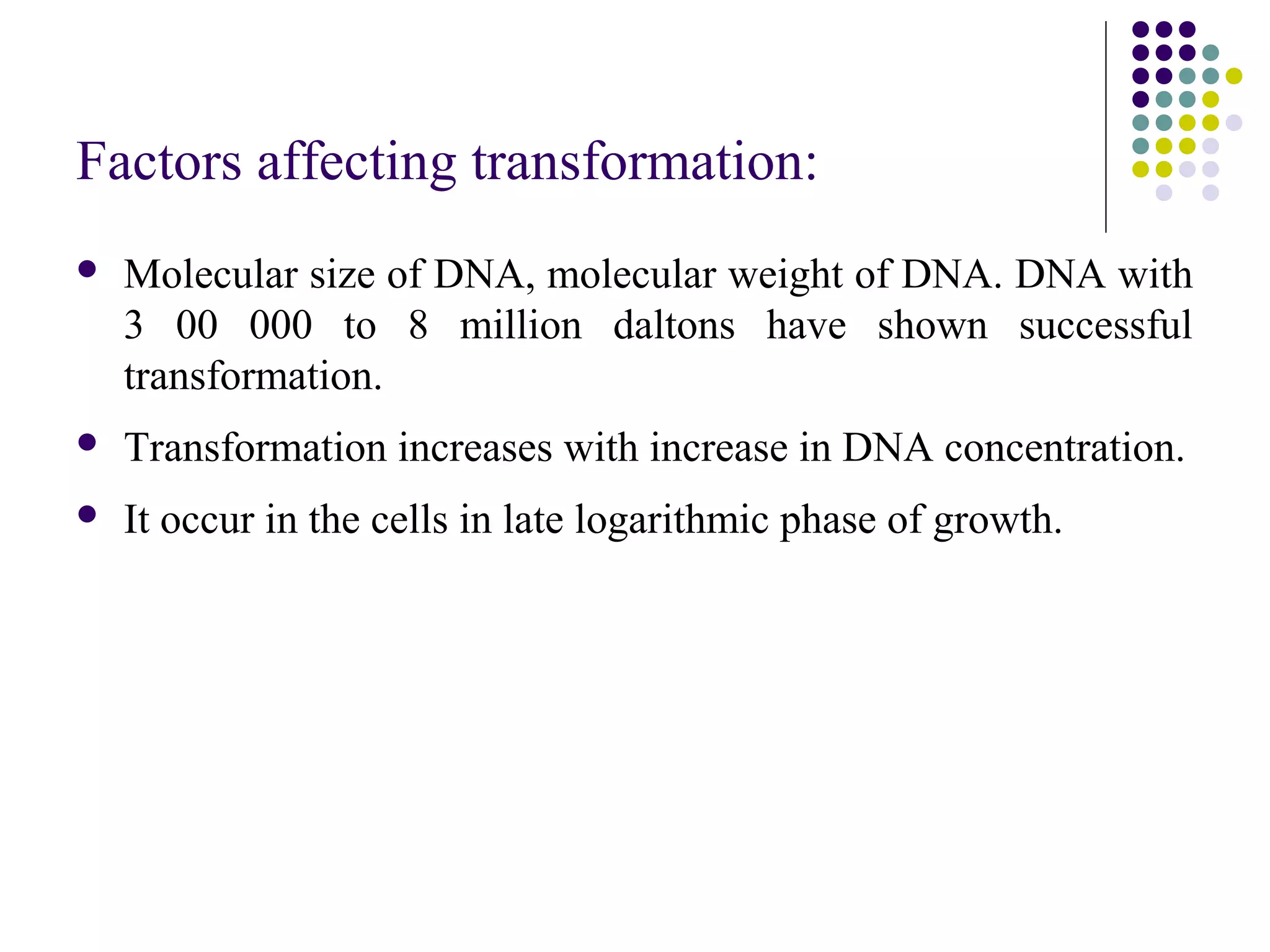
Factors affecting transformation:
 Molecular size of DNA, molecular weight of DNA. DNA with
3 00 000 to 8 million daltons have shown successful
transformation.
 Transformation increases with increase in DNA concentration.
 It occur in the cells in late logarithmic phase of growth.
Significance of transformation:
 By this process a non virulent bacteria can be transformed into
virulent form.
 Transformation is usually used in laboratories for mapping of
chromosome of the bacteria.
 The frequency of transformation of two genes at the same time
is an indication of the distance between these genes on the
chromosome.
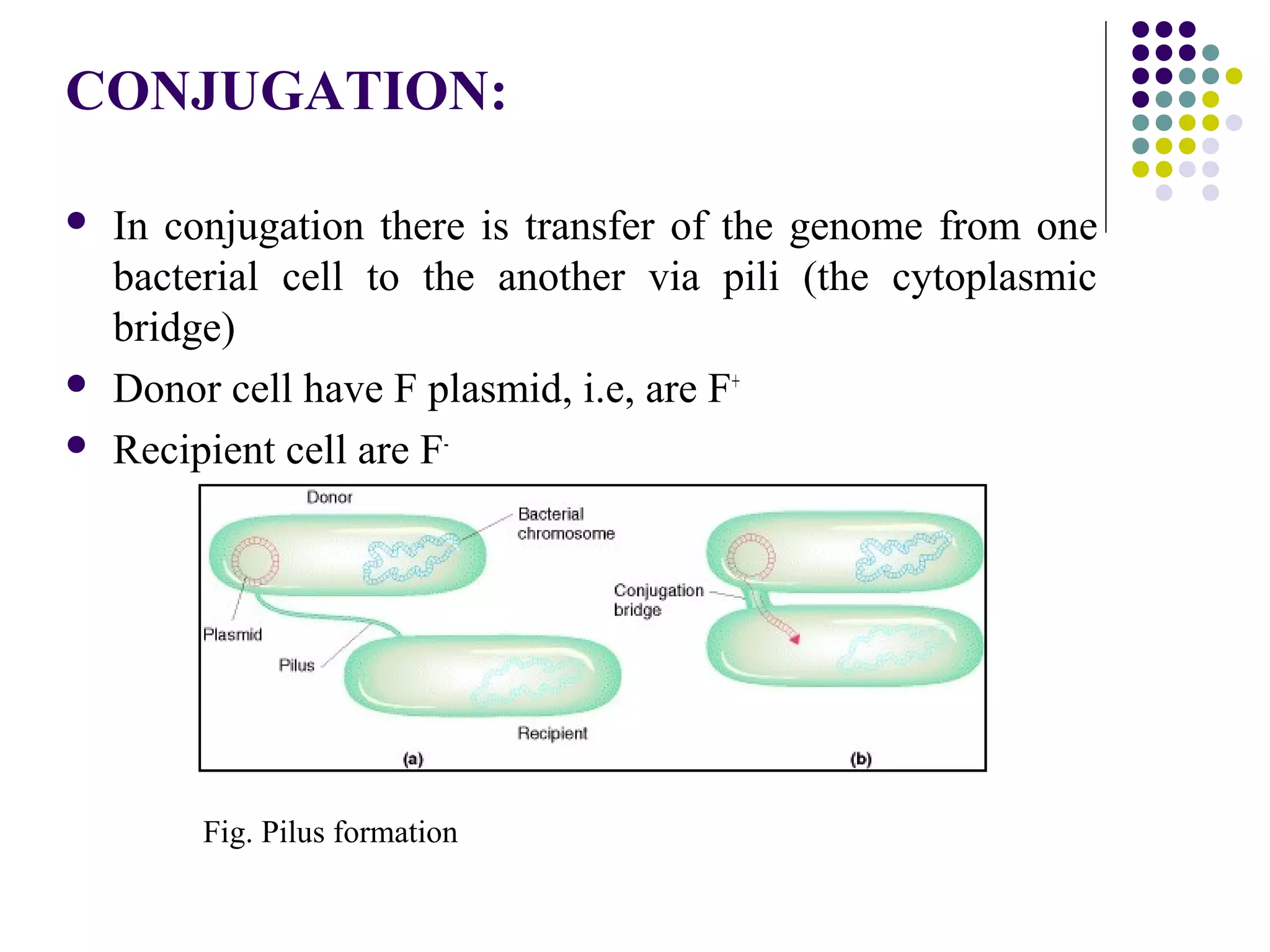
CONJUGATION:
 In conjugation there is transfer of the genome from one
bacterial cell to the another via pili (the cytoplasmic
bridge)
 Donor cell have F plasmid, i.e, are F+
 Recipient cell are F-
Fig. Pilus formation
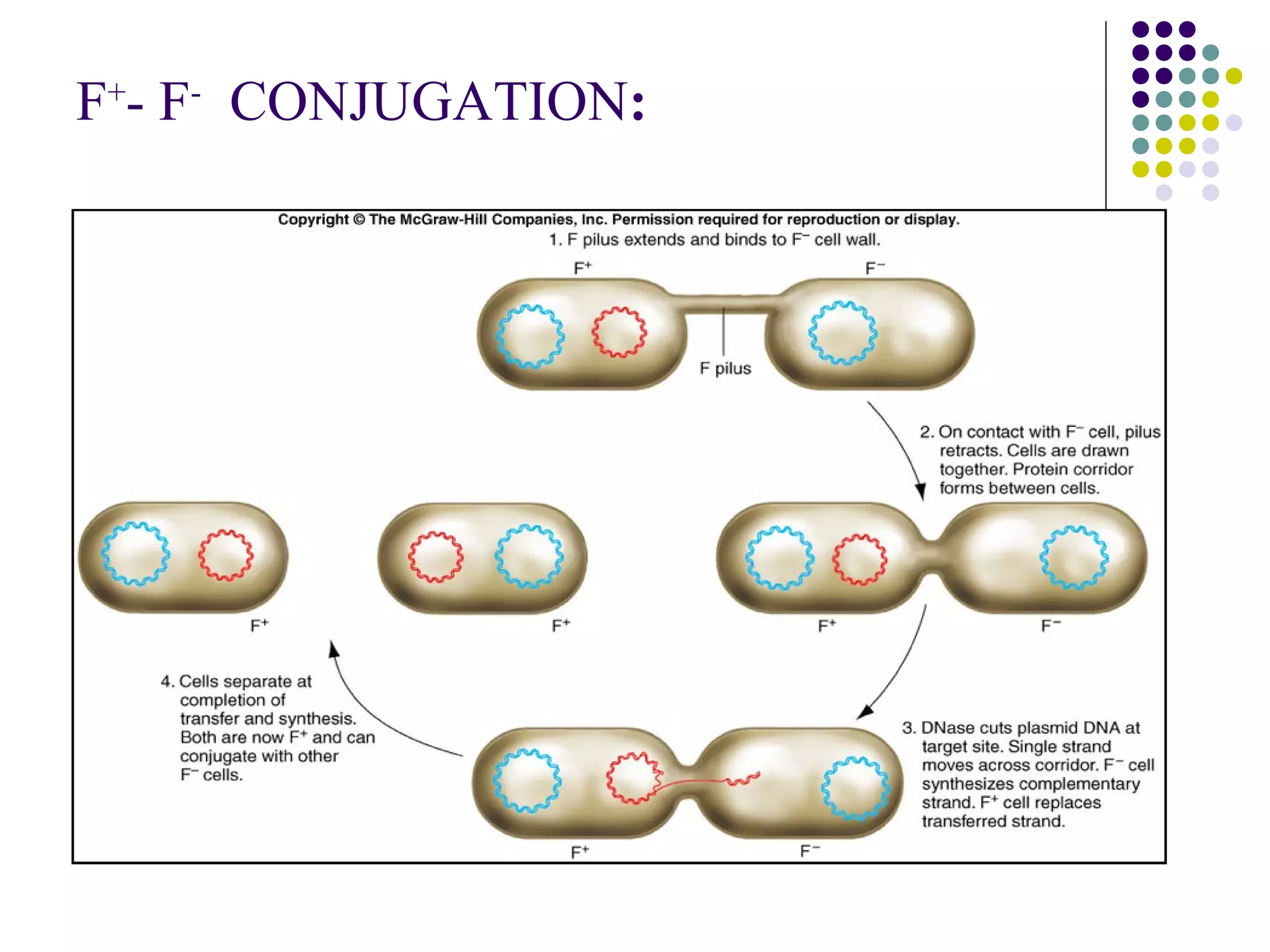
F+
- F-
CONJUGATION:
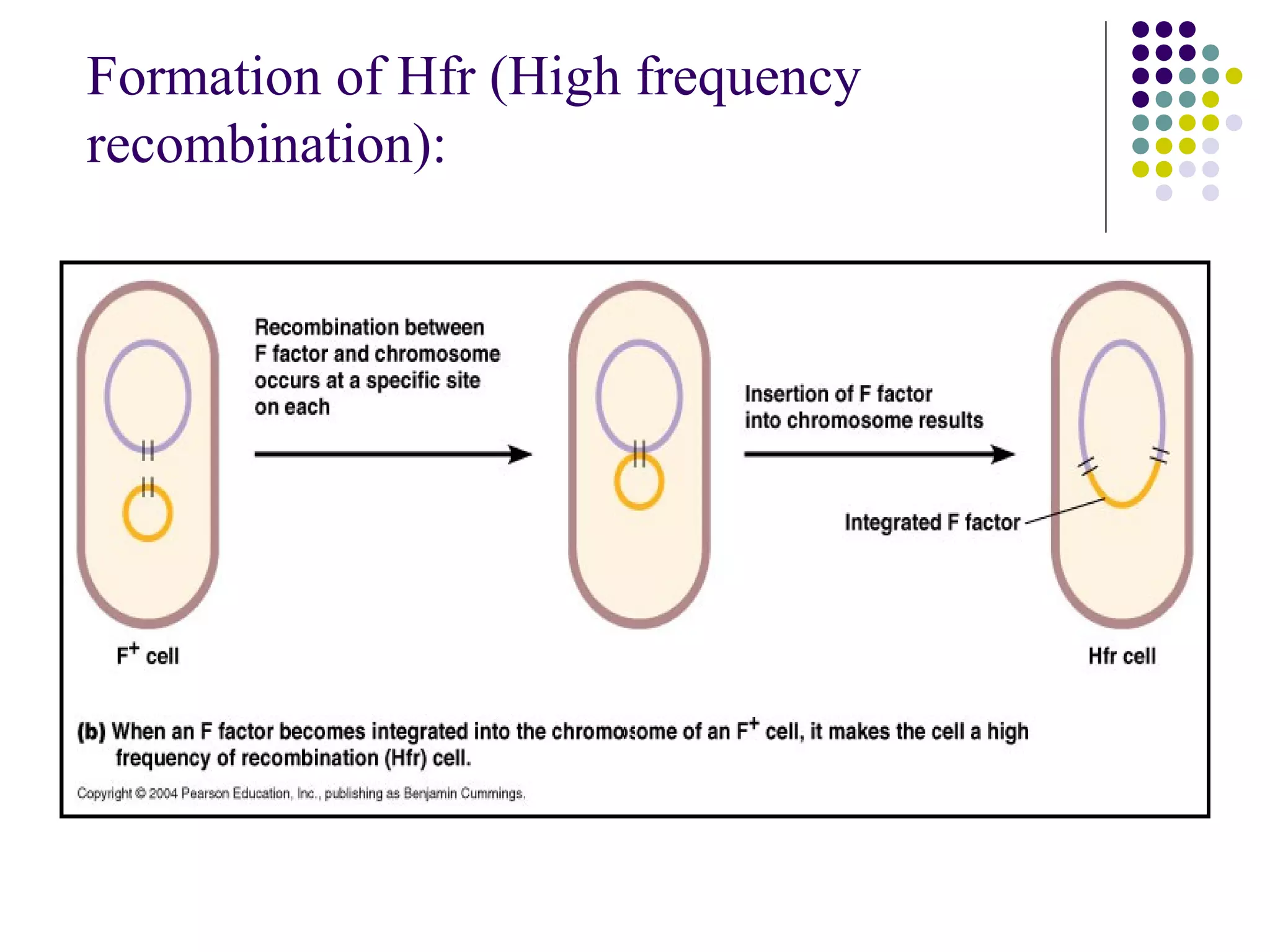
Formation of Hfr (High frequency
recombination):
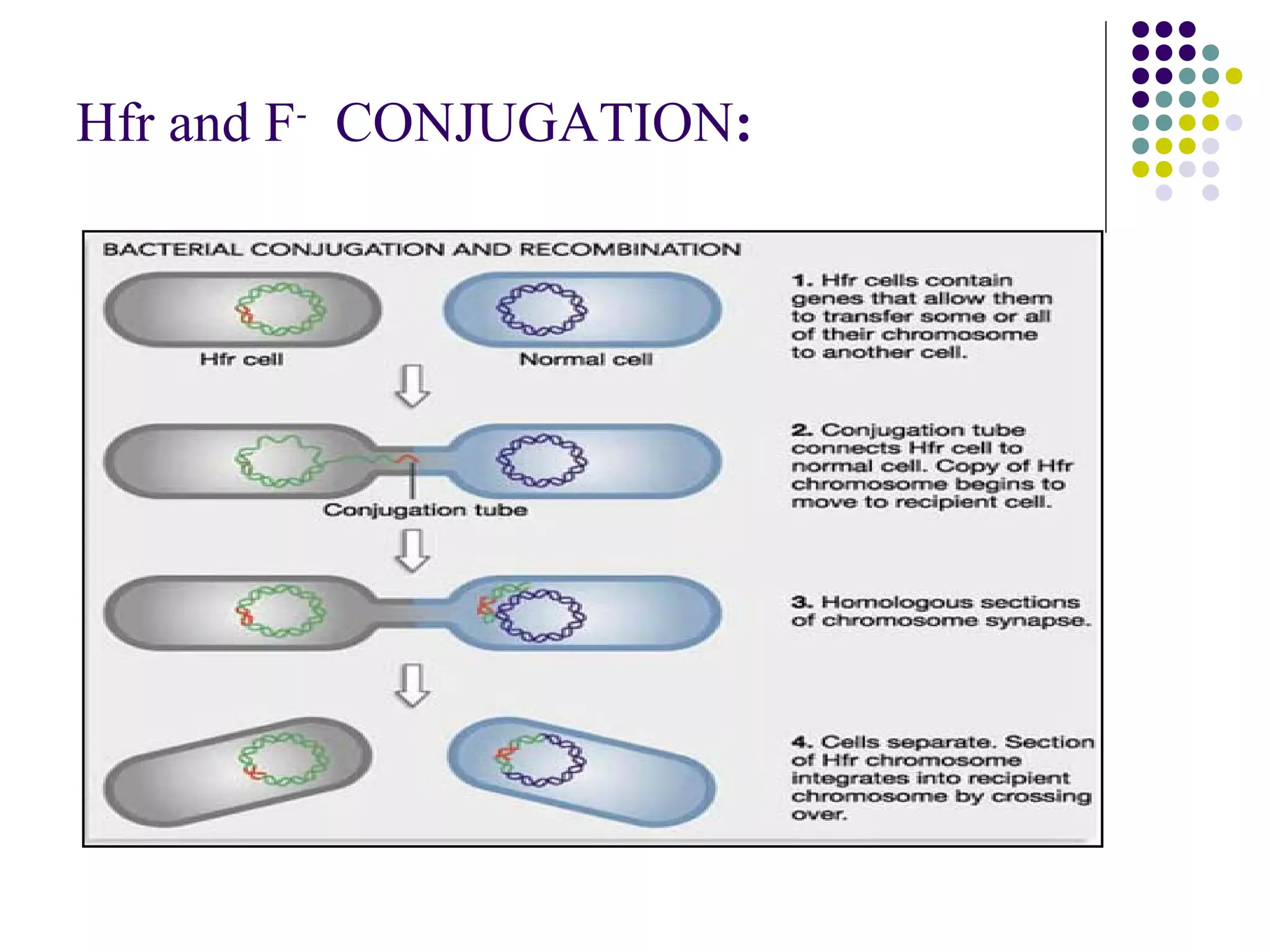
Hfr and F-
CONJUGATION:
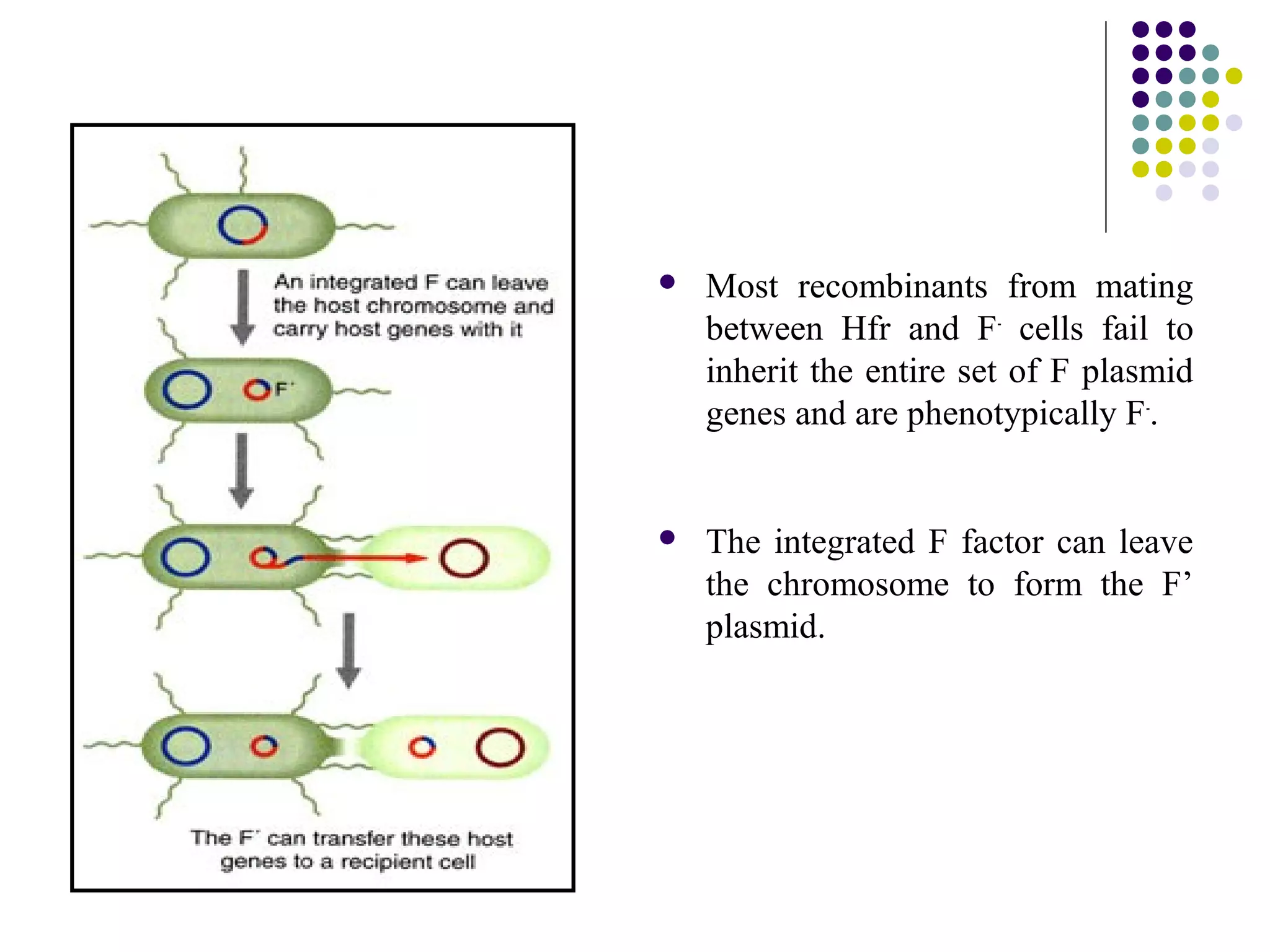
 Most recombinants from mating
between Hfr and F-
cells fail to
inherit the entire set of F plasmid
genes and are phenotypically F-
.
 The integrated F factor can leave
the chromosome to form the F’
plasmid.
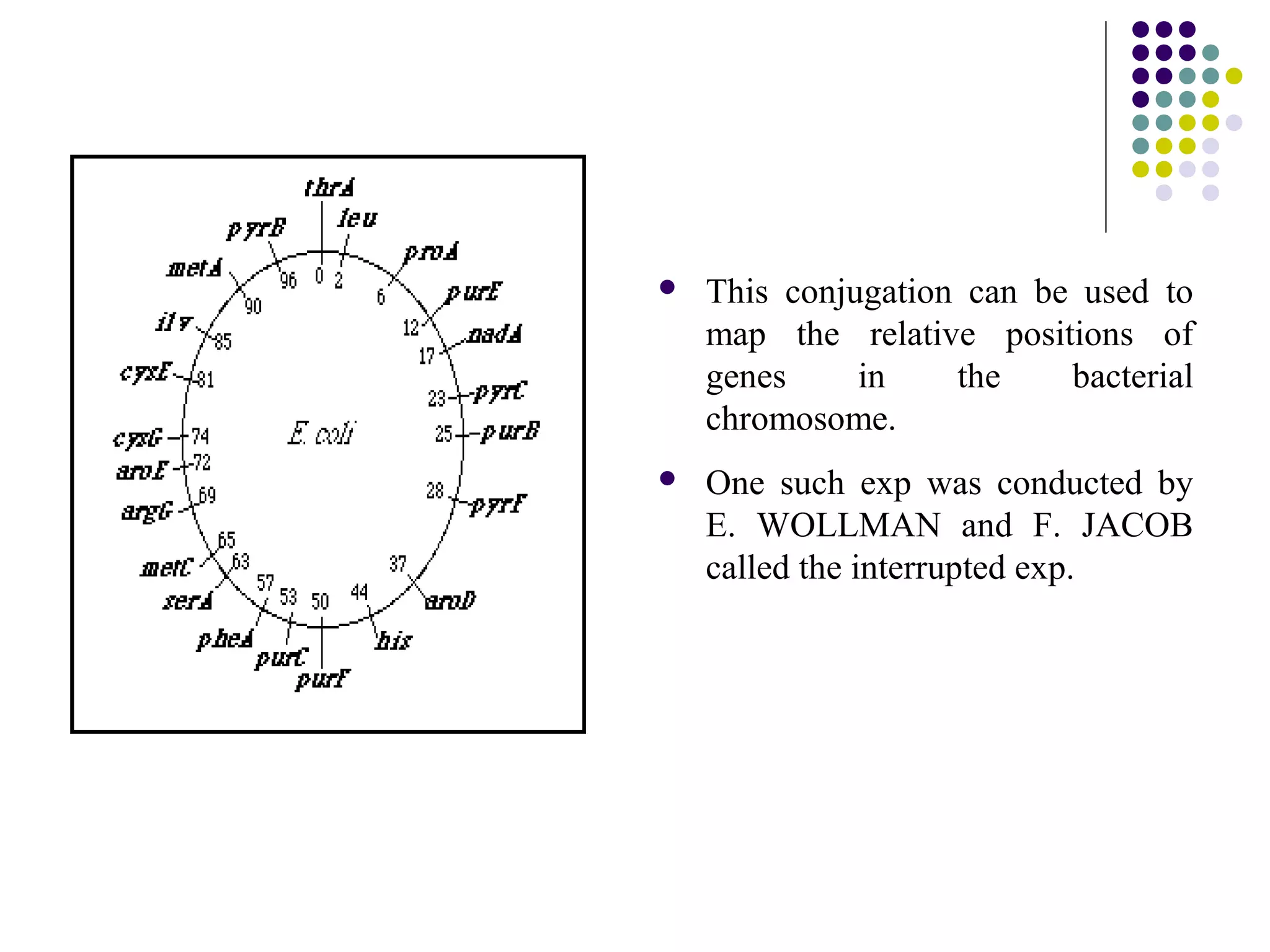
 This conjugation can be used to
map the relative positions of
genes in the bacterial
chromosome.
 One such exp was conducted by
E. WOLLMAN and F. JACOB
called the interrupted exp.
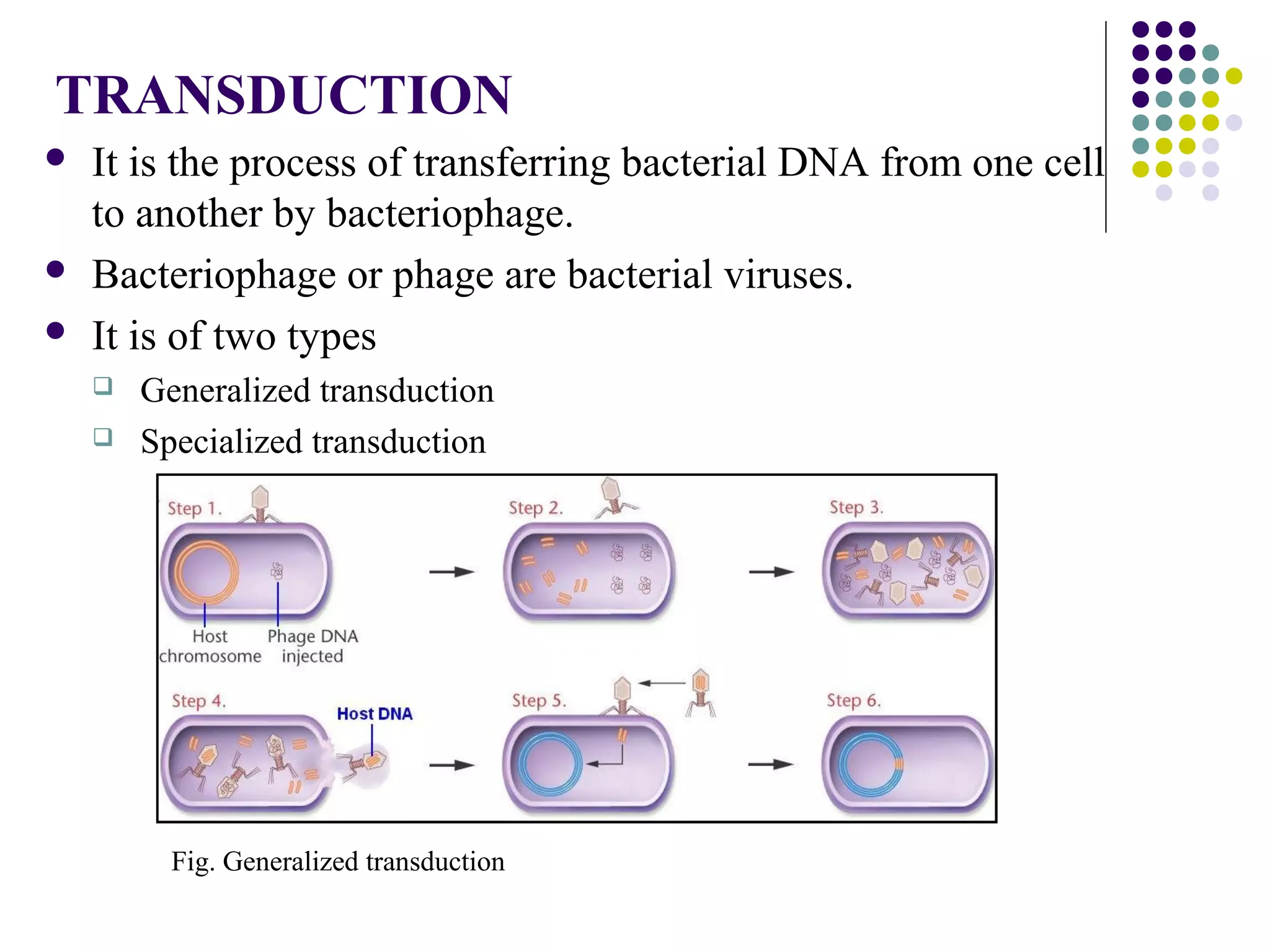
TRANSDUCTION
 It is the process of transferring bacterial DNA from one cell
to another by bacteriophage.
 Bacteriophage or phage are bacterial viruses.
 It is of two types
 Generalized transduction
 Specialized transduction
Fig. Generalized transduction
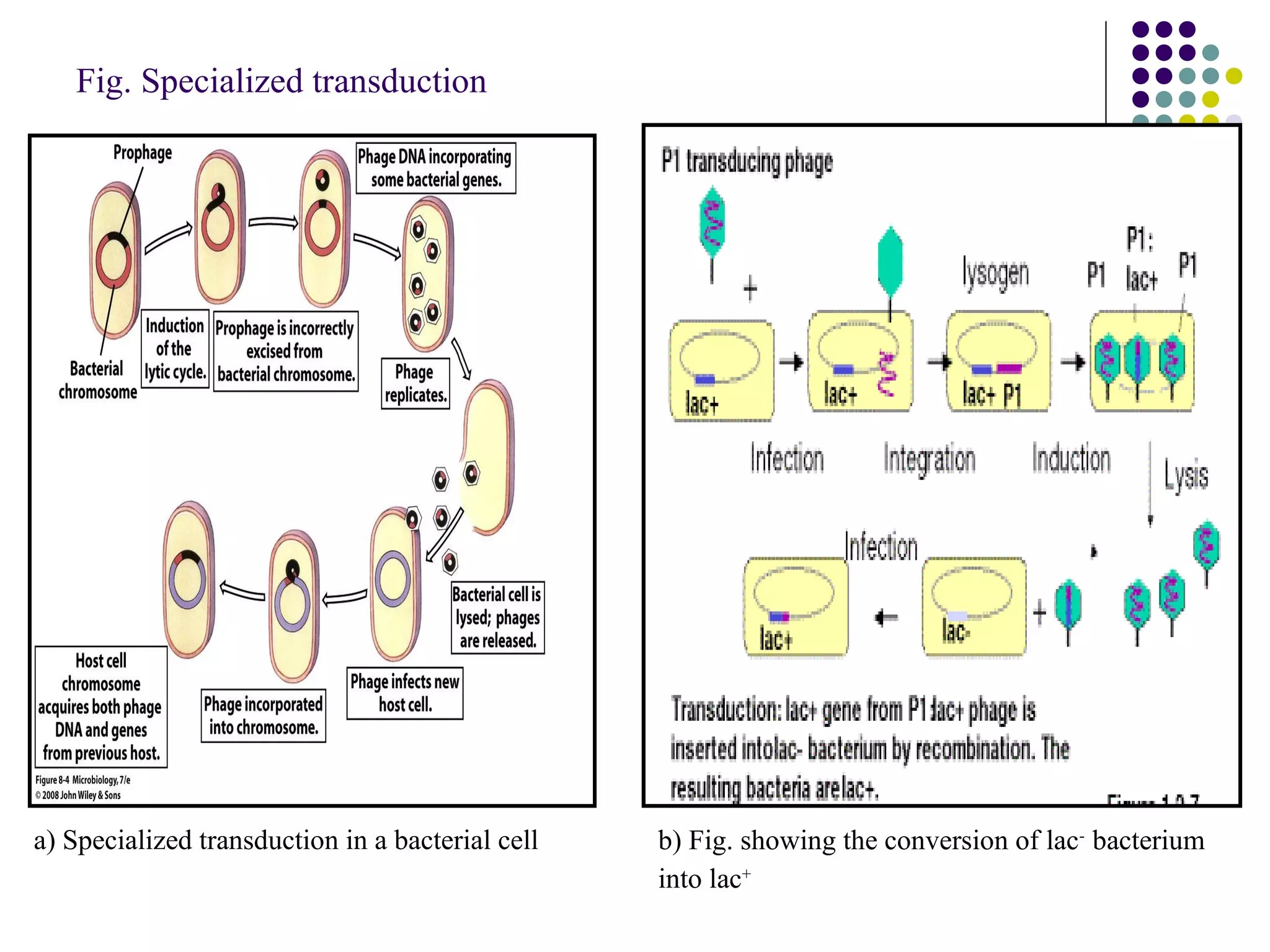
Fig. Specialized transduction
a) Specialized transduction in a bacterial cell b) Fig. showing the conversion of lac-
bacterium
into lac+
REFERENCES
 BOOK REFERENCES
 Life sciences: Fundamentals and practice by Pranav Kumar and Usha
Mina
 Genetics: By P. K Gupta
 A text of microbiology: By Pelzar
● WEB REFERENCES
 www.microbeonline.com
 www.studyblue.com
 www.biologicalexceptions.blogspot.com
ppt of Bacterial genetic system

ppt of Bacterial genetic system

  • 1.
  • 2.
    BACTERIAL GENOME Fig. :Typical bacterial cell
  • 3.
     Circular, doublestranded.  The nucleoid is  The region in a prokaryotic cell that contains the genome.  It lack a cell membrane and contains dsDNA fibrils  Basic histone proteins absent.  low molecular weight polyamines and magnesium ions present that perform the function similar to the histones.  Bacterial genome contains one chromosomal DNA and many plasmids.Fig. : Bacterial chromosome and plasmid
  • 4.
    BACTERIAL PLASMID: The termplasmid was coined by J. Lederberg. ‘Plasmids are replicons that are extracellular genetic elements in bacteria (also present in some yeast and fungi)’.  These are  self replicating  contain small no of genes  can incorporate themselves into the bacterial chromosome.
  • 5.
    Classification of Plasmid: a)Conjugative plasmids:  Large plasmids whose replication is stringently controlled.  Code for functions that promote transfer of the plasmid from the donor to the recipient bacterium.  Have genes for the synthesis of pili that help in the process of conjugation. Eg- F factor of E.coli. b) Non conjugative / cryptic plasmid: Do not have any function.
  • 6.
    Conjugative plasmid F factor •Transfergenetic material •Also known as fertility factor R factor •Known as resistance factor •Provide resistance against drugs Col factor •Kill other bacteria that do not have Col plasmid by secreting colicines
  • 7.
  • 8.
    DELBRUCK and LURIAFLUCTUATION TEST:  MAX DELBRUCK and SALVADOR LURIA in 1943 proved that bacteria has stable hereditary genetic mechanism by FLUCTUATION TEST 18 hr old bacterial culture .5 ml plated on plates having phages Some of the bacterial cells survived and they and their descendents were resistant to the phage.
  • 9.
    OBSERVATION  Great fluctuationsfound in the no. of phage resistant bacterial cells  Very less no. of cells were found to be survived in phages. CONCLUSION:  Mutation has occurred in the bacterial cell before its contact with the phage and so its descendents were also found to be resistant to the phage.  It was not the result of contact with the phage since the frequency was not very high.  It was a result of mutation.
  • 10.
    RECOMBINATION IN BACTERIA Genetic recombination refers to the exchange of the genes between two DNA molecules to form new recombinations of genes on a chromosome.  Leads to genetic diversity.  Much beneficial than mutation as  Do not destroy genes function  Bring together new combination of genes that lead to valuable functions.
  • 11.
    In bacteria recombinationresults from three types of gene transfer- a) Transformation b) Conjugation c) Transduction
  • 12.
    a) TRANSFORMATION:  Transferof cell free or naked DNA from one cell to another in solution.  In 1928, Frederick Griffith found that one of the pathogenic pneumococci now called streptococcus pneumoniae could be mysteriously transformed into another form.  Transformation may be Natural Artificial
  • 13.
    Fig : Griffithexperiment
  • 14.
    Griffith’s experiment:  Griffithcalled the genetic information which could be passed from one bacterium to another the transforming principle.  After 16 yrs., i.e, in 1944 Oswald Avery, Collin MacLeod and Maclyn revisited griffiths experiment and proved that the transforming principle was DNA and not protein or carbohydrate.
  • 15.
    Natural transformation  Ithas been observed in both gram positive (streptococcus pneumoniae, Bacillus subtilis) as well as gram negative (Haemophilus influenza) a b c Fig. : (a) Streptococcus pneumoniae, (b) Haemophilus influenza, (c) Bacillus subtilis
  • 16.
    Mechanism of DNAtransfer in bacteria by transformation: dsDNA attaches to membrane bound dsDNA binding protein One of the two strands of the transforming DNA passes into the cell while the other strand is degraded by a nuclease (deoxyribonuclease) Single stranded exogenotes are unstable and will usually be degraded unless they are integrated into the endogenote. By the process of homologous recombination the transforming DNA integrates the bacterial chromosome.
  • 17.
    Donor cell Cell lysisDNA fragments released Priplasmic space Competence factor nucleases Cell membrane Bacterial chromosome Competence factor which is highly positively charged attract the negatively charged donor DNA. Single strand of the DNA is prevented by the attack of nucleases by specific proteins. Nuclease degrade one strand of the exogenote and allow only one strand to pass through the cell membrane. This reaction is ATP dependent.
  • 18.
    Rec A proteinmediated ss invasion Degradation of displaced strand Bacterial DNA with integrated new fragment Division of bacteria Progeny cells with the transformed DNA Fig. : Integration of single stranded DNA into the chromosome by recombination
  • 19.
  • 20.
    Factors affecting transformation: Molecular size of DNA, molecular weight of DNA. DNA with 3 00 000 to 8 million daltons have shown successful transformation.  Transformation increases with increase in DNA concentration.  It occur in the cells in late logarithmic phase of growth.
  • 21.
    Significance of transformation: By this process a non virulent bacteria can be transformed into virulent form.  Transformation is usually used in laboratories for mapping of chromosome of the bacteria.  The frequency of transformation of two genes at the same time is an indication of the distance between these genes on the chromosome.
  • 22.
    CONJUGATION:  In conjugationthere is transfer of the genome from one bacterial cell to the another via pili (the cytoplasmic bridge)  Donor cell have F plasmid, i.e, are F+  Recipient cell are F- Fig. Pilus formation
  • 23.
  • 24.
    Formation of Hfr(High frequency recombination):
  • 25.
  • 26.
     Most recombinantsfrom mating between Hfr and F- cells fail to inherit the entire set of F plasmid genes and are phenotypically F- .  The integrated F factor can leave the chromosome to form the F’ plasmid.
  • 27.
     This conjugationcan be used to map the relative positions of genes in the bacterial chromosome.  One such exp was conducted by E. WOLLMAN and F. JACOB called the interrupted exp.
  • 28.
    TRANSDUCTION  It isthe process of transferring bacterial DNA from one cell to another by bacteriophage.  Bacteriophage or phage are bacterial viruses.  It is of two types  Generalized transduction  Specialized transduction Fig. Generalized transduction
  • 29.
    Fig. Specialized transduction a)Specialized transduction in a bacterial cell b) Fig. showing the conversion of lac- bacterium into lac+
  • 30.
    REFERENCES  BOOK REFERENCES Life sciences: Fundamentals and practice by Pranav Kumar and Usha Mina  Genetics: By P. K Gupta  A text of microbiology: By Pelzar ● WEB REFERENCES  www.microbeonline.com  www.studyblue.com  www.biologicalexceptions.blogspot.com