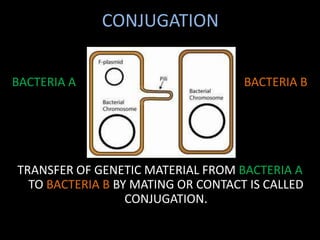
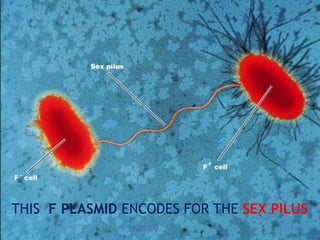
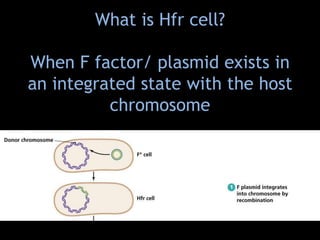
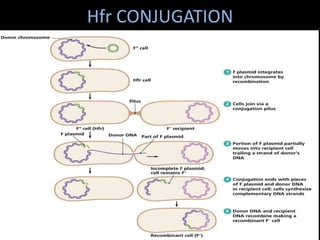
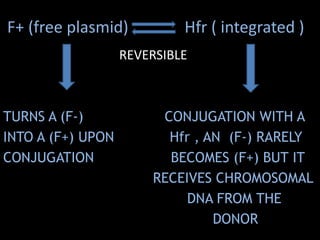
Bacterial conjugation involves the transfer of genetic material between bacteria through direct contact. It was first discovered in 1946 by Lederberg and Tatum in E. coli K12 strains. The process involves a donor bacterium containing an F plasmid transferring it to a recipient bacterium. The F plasmid encodes for sex pili that allow the transfer of genetic material. During conjugation, the recipient bacterium receives part of the donor's DNA and may gain traits like antibiotic resistance.









![genetic-recombination-1 [Compatibility Mode].pdf](https://cdn.slidesharecdn.com/ss_thumbnails/genetic-recombination-1compatibilitymode-220816192824-82739c20-thumbnail.jpg?width=640&height=640&fit=bounds)


