BACTERIAL GENE TRANSFER
Presented by
Athi
Msc biotechnology
Horizontal gene transfer
Horizontal gene transfer, also known as lateral gene transfer, is a process in
which an organism transfers genetic material to another organism that is not
its offspring. In bacteria it can be achieved through conjugation,
transformation, and viral transduction.
1 Transformation:
Transformation is a form of genetic recombination in which a DNA fragment
from a dead, degraded bacterium enters a competent recipient bacterium and
is exchanged for a piece of DNA of the recipient.
Transformation usually involves only homologous recombination, a
recombination of homologous DNA regions having nearly the same nucleotide
sequences.
Typically this involves similar bacterial strains or strains of the same bacterial
species.
There are four steps in transformation:
●
Development of competence,
●
Binding of DNA to the cell surface,
●
Processing and uptake of free DNA (usually in a 3’ to 5’ direction), and
●
Integration of the DNA into the chromosome by recombination.
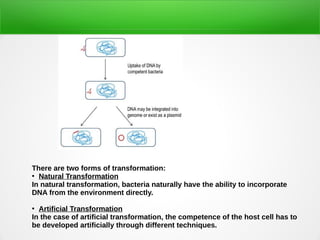
There are two forms of transformation:
●
Natural Transformation
In natural transformation, bacteria naturally have the ability to incorporate
DNA from the environment directly.
●
Artificial Transformation
In the case of artificial transformation, the competence of the host cell has to
be developed artificially through different techniques.
2 Conjugation:
Conjugation is the process by which one bacterium transfers genetic
material to another through direct contact.
During conjugation, one bacterium serves as the donor of the genetic
material, and the other serves as the recipient. The donor bacterium carries
a DNA sequence called the fertility factor, or F-factor. The F-factor allows
the donor to produce a thin, tubelike structure called a pilus, which the
donor uses to contact the recipient. The pilus then draws the two bacteria
together, at which time the donor bacterium transfers genetic material to
the recipient bacterium.
Steps in conjugation:
●
Donor cell produces pilus.
●
Pilus attaches to recipient cell and brings the two cells together.
●
The mobile plasmid is nicked and a single strand of DNA is then
transferred to the recipient cell.
●
Both cells synthesize a complementary strand to produce a double
stranded circular plasmid and also reproduce pili; both cells are now
viable donor for the F-factor.
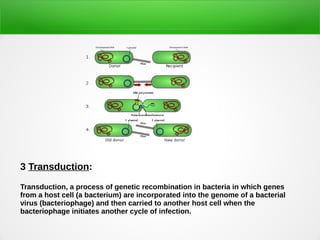
3 Transduction:
Transduction, a process of genetic recombination in bacteria in which genes
from a host cell (a bacterium) are incorporated into the genome of a bacterial
virus (bacteriophage) and then carried to another host cell when the
bacteriophage initiates another cycle of infection.
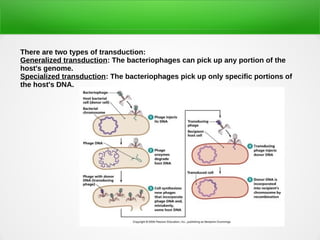
There are two types of transduction:
Generalized transduction: The bacteriophages can pick up any portion of the
host's genome.
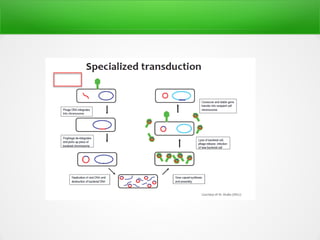
Specialized transduction: The bacteriophages pick up only specific portions of
the host's DNA.
THANK YOU
THANK YOU

Bacterial gene transfer

  • 1.
    BACTERIAL GENE TRANSFER Presentedby Athi Msc biotechnology
  • 2.
    Horizontal gene transfer Horizontalgene transfer, also known as lateral gene transfer, is a process in which an organism transfers genetic material to another organism that is not its offspring. In bacteria it can be achieved through conjugation, transformation, and viral transduction. 1 Transformation: Transformation is a form of genetic recombination in which a DNA fragment from a dead, degraded bacterium enters a competent recipient bacterium and is exchanged for a piece of DNA of the recipient. Transformation usually involves only homologous recombination, a recombination of homologous DNA regions having nearly the same nucleotide sequences. Typically this involves similar bacterial strains or strains of the same bacterial species. There are four steps in transformation: ● Development of competence, ● Binding of DNA to the cell surface, ● Processing and uptake of free DNA (usually in a 3’ to 5’ direction), and ● Integration of the DNA into the chromosome by recombination.
  • 3.
    There are twoforms of transformation: ● Natural Transformation In natural transformation, bacteria naturally have the ability to incorporate DNA from the environment directly. ● Artificial Transformation In the case of artificial transformation, the competence of the host cell has to be developed artificially through different techniques.
  • 4.
    2 Conjugation: Conjugation isthe process by which one bacterium transfers genetic material to another through direct contact. During conjugation, one bacterium serves as the donor of the genetic material, and the other serves as the recipient. The donor bacterium carries a DNA sequence called the fertility factor, or F-factor. The F-factor allows the donor to produce a thin, tubelike structure called a pilus, which the donor uses to contact the recipient. The pilus then draws the two bacteria together, at which time the donor bacterium transfers genetic material to the recipient bacterium. Steps in conjugation: ● Donor cell produces pilus. ● Pilus attaches to recipient cell and brings the two cells together. ● The mobile plasmid is nicked and a single strand of DNA is then transferred to the recipient cell. ● Both cells synthesize a complementary strand to produce a double stranded circular plasmid and also reproduce pili; both cells are now viable donor for the F-factor.
  • 5.
    3 Transduction: Transduction, aprocess of genetic recombination in bacteria in which genes from a host cell (a bacterium) are incorporated into the genome of a bacterial virus (bacteriophage) and then carried to another host cell when the bacteriophage initiates another cycle of infection.
  • 6.
    There are twotypes of transduction: Generalized transduction: The bacteriophages can pick up any portion of the host's genome. Specialized transduction: The bacteriophages pick up only specific portions of the host's DNA.
  • 8.