Pituitary Gland
Subject faculty: Mr. Khurram
Presenter: Maryam Noor
7/23/2018 1Maryam Noor
Objectives:
 Define pituitary gland.
 Discuss the anatomy of the pituitary gland.
 Discuss the role of hypothalamic hormones in the
regulation of pituitary gland secretion.
 Discuss the function of hormones secreted from the
anterior and posterior pituitary gland.
7/23/2018 2Maryam Noor
Pituitary Gland
“The Master gland of the body”
Pituitary gland is the small structure in the head and
main endocrine gland.
The normal adult pituitary gland is a reddish-grey bean
shaped gland.
It is also called the Master gland because it produces the
hormones that control other glands and many body
functions including growth.
7/23/2018 3Maryam Noor
Anatomy of Pituitary Gland:
 The pituitary gland is a pea sized, weighs 500 mg located
at the base of brain.
 It is 1cm in diameter.
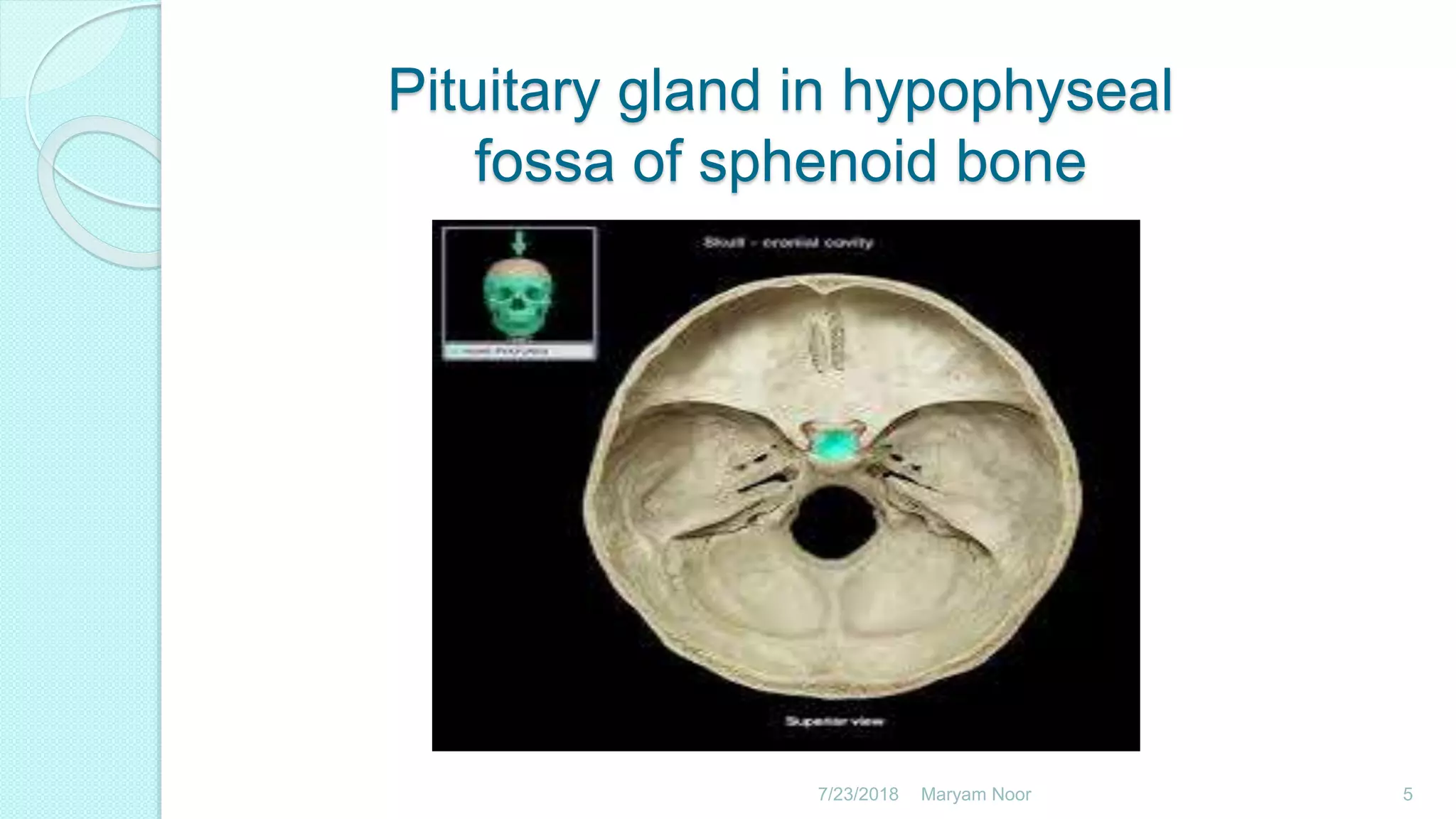
 The pituitary gland lies in the Hypophyseal fossa (Sella
turcica) of the Sphenoid bone below the hypothalamus.
 A fold of durameter covers the pituitary gland and has an
opening for the passage of infundibulum (stalk)
connecting the gland to the hypothalamus.
7/23/2018 4Maryam Noor
Pituitary gland in hypophyseal
fossa of sphenoid bone
7/23/2018 5Maryam Noor
Para ventricular nucleus Supra-optic nucleus
Pituitary portal system
Hypothalamo-
hypophyseal
tract
Posterior lobe
Pituitary stalk
Anterior lobe
Intermediate lobeFigure 9.3
The pituitary gland.
The lobes of the pituitary gland and their relationship with the hypothalamus.
Third ventricle
7/23/2018 6Maryam Noor
Division of pituitary gland
 It consists of two main parts that originate from
different type of cells.
Anterior pituitary gland (Adeno hypophysis):
◦ It is an up growth of glandular epithelium from the
pharynx.
◦ It secrete peptide hormones.
Posterior pituitary gland (neurohypophysis):
◦ It is formed from the nervous tissue and nerve cells,
surrounding by supporting glial cells (pituicytes).
◦ It stores hormones secreted by the hypothalamus.
7/23/2018 7Maryam Noor
Relation of Hypothalamus and Pituitary gland
 The connection between the hypothalamus and the
pituitary gland results from hormones released from the
hypothalamic neurons. The hypothalamus has two
different connections with the pituitary gland.
 The connection to the adenohypophysis (the anterior
lobe) is via a special portal blood system.
 Whereas the connection to the neurohypophysis (the
posterior lobe) is directly through neurons.
7/23/2018 8Maryam Noor
Blood supply to pituitary gland
Arterial blood supply:
 Superior and inferior hypophyseal arteries, branches of
internal carotid.
Anterior lobe is supplied indirectly by blood (from
hypothalamus).
Posterior lobe is supplied directly.
Venous drainage:
Containing hormones from both lobes, venous blood leaves
the gland and enter the venous sinuses between the layers
of durameter. 7/23/2018 9Maryam Noor
Para ventricular nucleus Supra-optic nucleus
Pituitary portal system
Hypothalamo-
hypophyseal
tract
Posterior lobe
Pituitary stalk
Anterior lobe
Intermediate lobeFigure 9.3
The pituitary gland.
The lobes of the pituitary gland and their relationship with the hypothalamus.
Third ventricle
7/23/2018 10Maryam Noor
Hormones of the pituitary gland
The hormones of the pituitary gland send signals to other
endocrine glands to stimulate or inhibit their own
hormone production. For example, the anterior pituitary
lobe will release adrenocorticotropic hormone (ACTH) to
stimulate cortical production in the adrenal glands when
you’re stressed.
The anterior lobe releases hormones upon receiving
releasing or inhibiting hormones from the hypothalamus.
These hypothalamic hormones tell the anterior lobe
whether to release more of a specific hormone or stop
production of the hormone. 7/23/2018 11Maryam Noor
Hormones produced by anterior pituitary
gland
 Growth hormone (GH)
 Thyroid-stimulating hormone (TSH)
 Adrenocorticotrophic hormone (ACTH)
 Prolactin (PRL)
 Gonadotrophins
I. Luteinizing hormone (LH)
II. Follicle-stimulating hormone (FSH)
7/23/2018 12Maryam Noor
Growth hormone:
 Its release is stimulated by GHRH (growth hormone
releasing hormone) suppressed by GHRIH (growth
hormone release inhibiting hormone) secreted by
hypothalamus.
 Secretion is also stimulated by hypoglycemia, exercise
and anxiety.
 Secretion is greater during night sleep than day.
 GHRIH also suppress the secretion of TSH and
gastrointestinal secretion, e.g. gastric juice, gastrin and
cholecystokinin.
7/23/2018 13Maryam Noor
7/23/2018 14Maryam Noor
Thyroid Stimulating Hormone(TSH)
 The release of this hormone is stimulated by the
Thyrotrophin Releasing Hormone(TRH) from the
hypothalamus.
 It stimulates the growth and activity of thyroid gland.
 Thyroid gland secretes the thyroxine (T4) and Tri-
Iodothyronine (T3).
 Its level is highest during the night.
 When blood level of thyroid hormone is high, secretion
of TSH is reduced.
7/23/2018 15Maryam Noor
Thyroid system
7/23/2018 16Maryam Noor
Adrenocorticotrophic hormone(ACTH)
 ACTH secretion is stimulated by the release of
Corticotrophin releasing hormone(CRH) from
hypothalamus.
 ACTH level is highest at midday and lowest at midnight.
 It stimulates the synthesis and secretion of adrenal cortical
hormone.
 It is stimulated by the hypoglycemia, stress, exercise and
other emotional states.
 Its secretion is suppressed when blood level of ACTH
rises.
7/23/2018 17Maryam Noor
Prolactin
 This hormone is secreted during pregnancy for lactation.
 It is stimulated by prolactin releasing hormone (PRH)
from hypothalamus.
 After birth suckling stimulate the Prolactin secretion and
lactation.
7/23/2018 18Maryam Noor
Gonadotrophins (FSH and LH)
 Just before puberty two Gonadotrophins are secreted in
gradually increasing amounts by the anterior pituitary
gland.
 Its secretion is stimulated by Gonadotrophin releasing
hormone (GnRH) or luteinizing releasing
hormone(LRH) from hypothalamus.
 Rising level of this hormone during puberty enhances the
maturation of reproductive organs.
7/23/2018 19Maryam Noor
Cont..
Gonadotrophin is combination of:
 Follicle stimulating hormone(FSH)
 Luteinizing hormone(LH)
Follicle stimulating hormone:
 In both male and female it stimulates the production of
gametes (ova and sperms from ovaries and testis
respectively).
7/23/2018 20Maryam Noor
Luteinizing hormone(LH)
IN FEMALES:
 LH and FSH stimulate the secretion of Oestrogen and
Progesterone from corpus luteum during the menstrual
cycle.
 As the level of oestrogen and progesterone rises in blood,
secretion of LH and FSH is suppressed.
IN MALES:
 LH also called interstitial cell stimulated releasing
hormone (ICSH).
 It stimulates the interstitial cells to secrete testosterone.
7/23/2018 21Maryam Noor
7/23/2018 22Maryam Noor
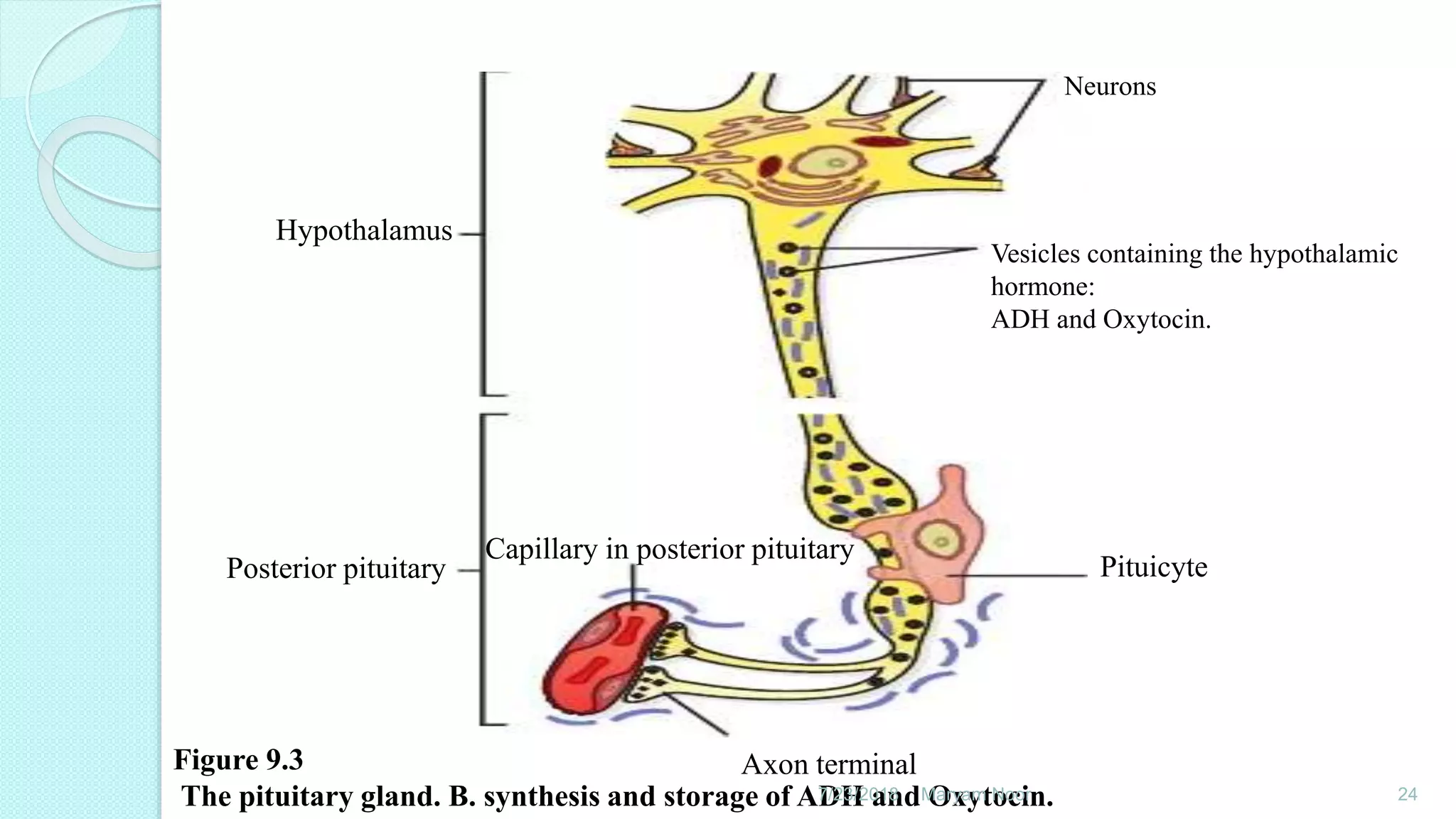
Posterior Pituitary Gland:
 Posterior pituitary hormones are synthesized in the nerve cells
bodies, transported along the axons and stored in vesicles
within the axon terminals in the posterior pituitary gland.
 Nerve impulses from hypothalamus trigger the exocytosis of
vesicles (of pituitary gland) releasing their hormone into blood
stream.
 Axon terminal release these two hormone within the posterior
pituitary gland.
1. Oxytoxin
2. Antidiuritic hormone (ADH, Vasopressin)
7/23/2018 23Maryam Noor
Neurons
Vesicles containing the hypothalamic
hormone:
ADH and Oxytocin.
Pituicyte
Axon terminal
Hypothalamus
Posterior pituitary
Capillary in posterior pituitary
Figure 9.3
The pituitary gland. B. synthesis and storage of ADH and Oxytocin.7/23/2018 24Maryam Noor
Oxytocin
 It is also called anti stress hormone.
Oxytocin is produced in both males and females, but its
main physiological roles seem to take place in the female.
In the female, oxytocin is involved in a number of
important physiological actions:
1. Stimulates the contraction of the uterus (myometrium)
2. Stimulates the contraction of the myoepithelial cells that
eject milk from the breast.
7/23/2018 25Maryam Noor
Uterine muscle contraction
 Sensory stretch receptors in the uterine cervix (due to
baby’s head) stimulate the release of oxytocin.
 Oxytocin stimulates the more forceful contraction of
cervix, as the baby’s head is forced further downwards.
 It is also used clinically for the induction of labor.
7/23/2018 26Maryam Noor
Milk Ejection
 Suckling generates sensory impulses that are transmitted
from breast to the hypothalamus.
 This impulses triggers the release of oxytocin from
posterior pituitary gland.
 Oxytocin stimulates the contraction of the milk ducts and
myoepithelial cells for ejection of milk.
 Suckling also inhibits the release of Prolactin inhibiting
hormone (PIH) prolonging Prolactin secretion and
lactation.
7/23/2018 27Maryam Noor
Antidiuritic hormone (ADH,
Vasopressin).
 The main effect of the antidiuretic hormone is to reduce
urine output (diuresis is the production of a large amount
of urine) therefore it is called Antidiuritic.
 Its secretion is determined by osmotic pressure by
circulating osmoreceptors in blood.
 Increase water intake > decrease in ADH > increase in
urine output.
 Decrease in water intake > Increase in ADH > Decrease
in urine output.
7/23/2018 28Maryam Noor
ADH
 It acts on the distal convoluted tubules and collecting
ducts of the nephrons of kidneys.
Q. Why is it called vasopressin?
Higher water concentration increases the volume and
pressure of your blood. Vasopressin raises blood
pressure by constricting (narrowing) blood vessels.
7/23/2018 29Maryam Noor
7/23/2018 30Maryam Noor
Growth hormone (GH)
Thyroid stimulating hormone
(TSH)
Adrenocorticotrophic
hormone(ACTH)
Prolactin (PRL)
Follicle stimulating hormone
(FSH
Luteinizing hormone (LH)
Regulates metabolism, promotes tissue growth esp
ecially of bones and muscles.
Stimulates growth and activity of thyroid gland and
secretion of T3 and T4.
Stimulates the adrenal cortex to secrete
glucocorticoids.Stimulates growth of breast tissue and milk producti
on.
Stimulates production of sperm in the testes,
stimulates secretion of oestrogen by the ovaries,
maturation of ovarian follicles, ovulation.
Stimulates secretion of testosterone by the testes,
stimulates secretion of progesterone by the
corpus luteum.
Hormone Function
Table 9.2 Summary of the hormones secreted by the anterior pituitary
gland and their functions
31Maryam Noor
References:
 Ross and Wilson,2014 Anatomy and Physiology in health
and illness (ed.14th ). London. Churchill Livingstone
Elsevier. Anne Waugh.
 https;//www.pituitary.org.uk/information/hormones/
 https://www.healthline.com/human-body-maps/pituitary-
gland
7/23/2018 32Maryam Noor
7/23/2018 33Maryam Noor

Pituitary gland (1)

  • 1.
    Pituitary Gland Subject faculty:Mr. Khurram Presenter: Maryam Noor 7/23/2018 1Maryam Noor
  • 2.
    Objectives:  Define pituitarygland.  Discuss the anatomy of the pituitary gland.  Discuss the role of hypothalamic hormones in the regulation of pituitary gland secretion.  Discuss the function of hormones secreted from the anterior and posterior pituitary gland. 7/23/2018 2Maryam Noor
  • 3.
    Pituitary Gland “The Mastergland of the body” Pituitary gland is the small structure in the head and main endocrine gland. The normal adult pituitary gland is a reddish-grey bean shaped gland. It is also called the Master gland because it produces the hormones that control other glands and many body functions including growth. 7/23/2018 3Maryam Noor
  • 4.
    Anatomy of PituitaryGland:  The pituitary gland is a pea sized, weighs 500 mg located at the base of brain.  It is 1cm in diameter.  The pituitary gland lies in the Hypophyseal fossa (Sella turcica) of the Sphenoid bone below the hypothalamus.  A fold of durameter covers the pituitary gland and has an opening for the passage of infundibulum (stalk) connecting the gland to the hypothalamus. 7/23/2018 4Maryam Noor
  • 5.
    Pituitary gland inhypophyseal fossa of sphenoid bone 7/23/2018 5Maryam Noor
  • 6.
    Para ventricular nucleusSupra-optic nucleus Pituitary portal system Hypothalamo- hypophyseal tract Posterior lobe Pituitary stalk Anterior lobe Intermediate lobeFigure 9.3 The pituitary gland. The lobes of the pituitary gland and their relationship with the hypothalamus. Third ventricle 7/23/2018 6Maryam Noor
  • 7.
    Division of pituitarygland  It consists of two main parts that originate from different type of cells. Anterior pituitary gland (Adeno hypophysis): ◦ It is an up growth of glandular epithelium from the pharynx. ◦ It secrete peptide hormones. Posterior pituitary gland (neurohypophysis): ◦ It is formed from the nervous tissue and nerve cells, surrounding by supporting glial cells (pituicytes). ◦ It stores hormones secreted by the hypothalamus. 7/23/2018 7Maryam Noor
  • 8.
    Relation of Hypothalamusand Pituitary gland  The connection between the hypothalamus and the pituitary gland results from hormones released from the hypothalamic neurons. The hypothalamus has two different connections with the pituitary gland.  The connection to the adenohypophysis (the anterior lobe) is via a special portal blood system.  Whereas the connection to the neurohypophysis (the posterior lobe) is directly through neurons. 7/23/2018 8Maryam Noor
  • 9.
    Blood supply topituitary gland Arterial blood supply:  Superior and inferior hypophyseal arteries, branches of internal carotid. Anterior lobe is supplied indirectly by blood (from hypothalamus). Posterior lobe is supplied directly. Venous drainage: Containing hormones from both lobes, venous blood leaves the gland and enter the venous sinuses between the layers of durameter. 7/23/2018 9Maryam Noor
  • 10.
    Para ventricular nucleusSupra-optic nucleus Pituitary portal system Hypothalamo- hypophyseal tract Posterior lobe Pituitary stalk Anterior lobe Intermediate lobeFigure 9.3 The pituitary gland. The lobes of the pituitary gland and their relationship with the hypothalamus. Third ventricle 7/23/2018 10Maryam Noor
  • 11.
    Hormones of thepituitary gland The hormones of the pituitary gland send signals to other endocrine glands to stimulate or inhibit their own hormone production. For example, the anterior pituitary lobe will release adrenocorticotropic hormone (ACTH) to stimulate cortical production in the adrenal glands when you’re stressed. The anterior lobe releases hormones upon receiving releasing or inhibiting hormones from the hypothalamus. These hypothalamic hormones tell the anterior lobe whether to release more of a specific hormone or stop production of the hormone. 7/23/2018 11Maryam Noor
  • 12.
    Hormones produced byanterior pituitary gland  Growth hormone (GH)  Thyroid-stimulating hormone (TSH)  Adrenocorticotrophic hormone (ACTH)  Prolactin (PRL)  Gonadotrophins I. Luteinizing hormone (LH) II. Follicle-stimulating hormone (FSH) 7/23/2018 12Maryam Noor
  • 13.
    Growth hormone:  Itsrelease is stimulated by GHRH (growth hormone releasing hormone) suppressed by GHRIH (growth hormone release inhibiting hormone) secreted by hypothalamus.  Secretion is also stimulated by hypoglycemia, exercise and anxiety.  Secretion is greater during night sleep than day.  GHRIH also suppress the secretion of TSH and gastrointestinal secretion, e.g. gastric juice, gastrin and cholecystokinin. 7/23/2018 13Maryam Noor
  • 14.
  • 15.
    Thyroid Stimulating Hormone(TSH) The release of this hormone is stimulated by the Thyrotrophin Releasing Hormone(TRH) from the hypothalamus.  It stimulates the growth and activity of thyroid gland.  Thyroid gland secretes the thyroxine (T4) and Tri- Iodothyronine (T3).  Its level is highest during the night.  When blood level of thyroid hormone is high, secretion of TSH is reduced. 7/23/2018 15Maryam Noor
  • 16.
  • 17.
    Adrenocorticotrophic hormone(ACTH)  ACTHsecretion is stimulated by the release of Corticotrophin releasing hormone(CRH) from hypothalamus.  ACTH level is highest at midday and lowest at midnight.  It stimulates the synthesis and secretion of adrenal cortical hormone.  It is stimulated by the hypoglycemia, stress, exercise and other emotional states.  Its secretion is suppressed when blood level of ACTH rises. 7/23/2018 17Maryam Noor
  • 18.
    Prolactin  This hormoneis secreted during pregnancy for lactation.  It is stimulated by prolactin releasing hormone (PRH) from hypothalamus.  After birth suckling stimulate the Prolactin secretion and lactation. 7/23/2018 18Maryam Noor
  • 19.
    Gonadotrophins (FSH andLH)  Just before puberty two Gonadotrophins are secreted in gradually increasing amounts by the anterior pituitary gland.  Its secretion is stimulated by Gonadotrophin releasing hormone (GnRH) or luteinizing releasing hormone(LRH) from hypothalamus.  Rising level of this hormone during puberty enhances the maturation of reproductive organs. 7/23/2018 19Maryam Noor
  • 20.
    Cont.. Gonadotrophin is combinationof:  Follicle stimulating hormone(FSH)  Luteinizing hormone(LH) Follicle stimulating hormone:  In both male and female it stimulates the production of gametes (ova and sperms from ovaries and testis respectively). 7/23/2018 20Maryam Noor
  • 21.
    Luteinizing hormone(LH) IN FEMALES: LH and FSH stimulate the secretion of Oestrogen and Progesterone from corpus luteum during the menstrual cycle.  As the level of oestrogen and progesterone rises in blood, secretion of LH and FSH is suppressed. IN MALES:  LH also called interstitial cell stimulated releasing hormone (ICSH).  It stimulates the interstitial cells to secrete testosterone. 7/23/2018 21Maryam Noor
  • 22.
  • 23.
    Posterior Pituitary Gland: Posterior pituitary hormones are synthesized in the nerve cells bodies, transported along the axons and stored in vesicles within the axon terminals in the posterior pituitary gland.  Nerve impulses from hypothalamus trigger the exocytosis of vesicles (of pituitary gland) releasing their hormone into blood stream.  Axon terminal release these two hormone within the posterior pituitary gland. 1. Oxytoxin 2. Antidiuritic hormone (ADH, Vasopressin) 7/23/2018 23Maryam Noor
  • 24.
    Neurons Vesicles containing thehypothalamic hormone: ADH and Oxytocin. Pituicyte Axon terminal Hypothalamus Posterior pituitary Capillary in posterior pituitary Figure 9.3 The pituitary gland. B. synthesis and storage of ADH and Oxytocin.7/23/2018 24Maryam Noor
  • 25.
    Oxytocin  It isalso called anti stress hormone. Oxytocin is produced in both males and females, but its main physiological roles seem to take place in the female. In the female, oxytocin is involved in a number of important physiological actions: 1. Stimulates the contraction of the uterus (myometrium) 2. Stimulates the contraction of the myoepithelial cells that eject milk from the breast. 7/23/2018 25Maryam Noor
  • 26.
    Uterine muscle contraction Sensory stretch receptors in the uterine cervix (due to baby’s head) stimulate the release of oxytocin.  Oxytocin stimulates the more forceful contraction of cervix, as the baby’s head is forced further downwards.  It is also used clinically for the induction of labor. 7/23/2018 26Maryam Noor
  • 27.
    Milk Ejection  Sucklinggenerates sensory impulses that are transmitted from breast to the hypothalamus.  This impulses triggers the release of oxytocin from posterior pituitary gland.  Oxytocin stimulates the contraction of the milk ducts and myoepithelial cells for ejection of milk.  Suckling also inhibits the release of Prolactin inhibiting hormone (PIH) prolonging Prolactin secretion and lactation. 7/23/2018 27Maryam Noor
  • 28.
    Antidiuritic hormone (ADH, Vasopressin). The main effect of the antidiuretic hormone is to reduce urine output (diuresis is the production of a large amount of urine) therefore it is called Antidiuritic.  Its secretion is determined by osmotic pressure by circulating osmoreceptors in blood.  Increase water intake > decrease in ADH > increase in urine output.  Decrease in water intake > Increase in ADH > Decrease in urine output. 7/23/2018 28Maryam Noor
  • 29.
    ADH  It actson the distal convoluted tubules and collecting ducts of the nephrons of kidneys. Q. Why is it called vasopressin? Higher water concentration increases the volume and pressure of your blood. Vasopressin raises blood pressure by constricting (narrowing) blood vessels. 7/23/2018 29Maryam Noor
  • 30.
  • 31.
    Growth hormone (GH) Thyroidstimulating hormone (TSH) Adrenocorticotrophic hormone(ACTH) Prolactin (PRL) Follicle stimulating hormone (FSH Luteinizing hormone (LH) Regulates metabolism, promotes tissue growth esp ecially of bones and muscles. Stimulates growth and activity of thyroid gland and secretion of T3 and T4. Stimulates the adrenal cortex to secrete glucocorticoids.Stimulates growth of breast tissue and milk producti on. Stimulates production of sperm in the testes, stimulates secretion of oestrogen by the ovaries, maturation of ovarian follicles, ovulation. Stimulates secretion of testosterone by the testes, stimulates secretion of progesterone by the corpus luteum. Hormone Function Table 9.2 Summary of the hormones secreted by the anterior pituitary gland and their functions 31Maryam Noor
  • 32.
    References:  Ross andWilson,2014 Anatomy and Physiology in health and illness (ed.14th ). London. Churchill Livingstone Elsevier. Anne Waugh.  https;//www.pituitary.org.uk/information/hormones/  https://www.healthline.com/human-body-maps/pituitary- gland 7/23/2018 32Maryam Noor
  • 33.