sterile environment
•parenteral---body cannot get the chance to
‘evaluate’ the drug and screen out contaminates.
•aseptic technique ---keeping sterility to protect
drug from contamination
•greatest source of contamination is….you!
person working on the product.
•syringe---length, inches of needle.
•gauge----bigger number=smaller needle
sterile environment
sterile environment
• rubber stopper on bottle---insert need 45deg to
avoid coring.
• laminar flow hood---blows filtered air across
work area.
• HEPA filter---High Effiency Particulate Air
filter.catches particles and organisms to .3
microns. removes 99.997% of contaminants.
• old flow hoods were horizontal, wind blows at
operator. vertical flow blows air downward.
sterile environment
• In 2012---200 pt get fungal meningitis from poor
practices
• USP sets standards for production of
medications
• USP 797----chapter 797 covers equipment,
technique, and quality control for sterile
products.
• USP 795--chapter 795 covers nonsterile
compounder responsibility
sterile environment-USP ch 795
USP <795> outlines the responsibilities of the compounder,
which can be summarized as being responsible for compounding
preparations of acceptable strength, quality, and purity with appropriate packagin
and labeling in compliance with requirements established by applicable laws and
agencies (eg, state boards of pharmacy). Specifically, the responsibilities of the
compounder include the following general principles:
Personnel are capable and qualified to perform their assigned duties.
Compounding ingredients of the appropriate identity, quality, and purity
are purchased from reliable sources.
All equipment used in compounding is clean, properly maintained, an
used appropriately.
Only authorized personnel are allowed in the immediate vicinity of the
drug compounding operations.
There is assurance that processes are always carried out as intended or
specified and are reproducible.
The compounding environment is suitable for its intended purpose and to
prevent errors.
Adequate procedures and records exist for investigating and correcting
failures or problems in compounding, in testing, or in the
preparation itself.
sterile environment-usp 797
“THE INTENT OF <797> IS TO PREVENT HARM
AND FATALITY TO PATIENTS THAT COULD
RESULT FROM MICROBIAL CONTAMINATION
(NONSTERILITY), EXCESSIVE BACTERIAL
ENDOTOXINS, LARGE CONTENT ERRORS IN
THE STRENGTH OF CORRECT INGREDIENTS,
AND INCORRECT INGREDIENTS IN
COMPOUNDED STERILE PRODUCTS (CSPs).”
or..is your workplace clean enough? furniture, ceiling,shoe covers
gowns, washing, gloves, hair cover..PPE
sterile environment
• CSP---compounded sterile products
• Clean room—has flow hood, HEPA, approved
personnel only. Positive pressure room
• Anteroom---has supplies, sink
ISO standards-----International Organization for
Standards
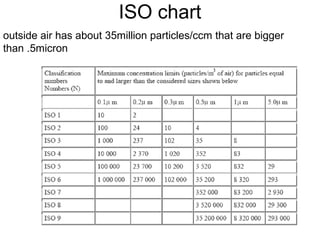
• ISO number is particles in cubic meter of air.
• USP 797 wants ISO class 5 in the laminar hood
• class 7 in clean room
• class 8 in anteroom
ISO chart
outside air has about 35million particles/ccm that are bigger
than .5micron

Sterile enviroment

  • 1.
    sterile environment •parenteral---body cannotget the chance to ‘evaluate’ the drug and screen out contaminates. •aseptic technique ---keeping sterility to protect drug from contamination •greatest source of contamination is….you! person working on the product. •syringe---length, inches of needle. •gauge----bigger number=smaller needle
  • 2.
  • 3.
    sterile environment • rubberstopper on bottle---insert need 45deg to avoid coring. • laminar flow hood---blows filtered air across work area. • HEPA filter---High Effiency Particulate Air filter.catches particles and organisms to .3 microns. removes 99.997% of contaminants. • old flow hoods were horizontal, wind blows at operator. vertical flow blows air downward.
  • 4.
    sterile environment • In2012---200 pt get fungal meningitis from poor practices • USP sets standards for production of medications • USP 797----chapter 797 covers equipment, technique, and quality control for sterile products. • USP 795--chapter 795 covers nonsterile compounder responsibility
  • 5.
    sterile environment-USP ch795 USP <795> outlines the responsibilities of the compounder, which can be summarized as being responsible for compounding preparations of acceptable strength, quality, and purity with appropriate packagin and labeling in compliance with requirements established by applicable laws and agencies (eg, state boards of pharmacy). Specifically, the responsibilities of the compounder include the following general principles: Personnel are capable and qualified to perform their assigned duties. Compounding ingredients of the appropriate identity, quality, and purity are purchased from reliable sources. All equipment used in compounding is clean, properly maintained, an used appropriately. Only authorized personnel are allowed in the immediate vicinity of the drug compounding operations. There is assurance that processes are always carried out as intended or specified and are reproducible. The compounding environment is suitable for its intended purpose and to prevent errors. Adequate procedures and records exist for investigating and correcting failures or problems in compounding, in testing, or in the preparation itself.
  • 6.
    sterile environment-usp 797 “THEINTENT OF <797> IS TO PREVENT HARM AND FATALITY TO PATIENTS THAT COULD RESULT FROM MICROBIAL CONTAMINATION (NONSTERILITY), EXCESSIVE BACTERIAL ENDOTOXINS, LARGE CONTENT ERRORS IN THE STRENGTH OF CORRECT INGREDIENTS, AND INCORRECT INGREDIENTS IN COMPOUNDED STERILE PRODUCTS (CSPs).” or..is your workplace clean enough? furniture, ceiling,shoe covers gowns, washing, gloves, hair cover..PPE
  • 7.
    sterile environment • CSP---compoundedsterile products • Clean room—has flow hood, HEPA, approved personnel only. Positive pressure room • Anteroom---has supplies, sink ISO standards-----International Organization for Standards • ISO number is particles in cubic meter of air. • USP 797 wants ISO class 5 in the laminar hood • class 7 in clean room • class 8 in anteroom
  • 8.
    ISO chart outside airhas about 35million particles/ccm that are bigger than .5micron