1
HMP SHUNT [Hexose Monophosphate Pathway] /HMP SHUNT [Hexose Monophosphate Pathway] /
PPP [Pentose Phosphate Pathway]PPP [Pentose Phosphate Pathway]
• Principle pathway for oxidation of Glucose-Glycolysis & TCA
• HMP-alternative pathway for oxidation of Glucose-not for Energy
• Occours in cytosol
• Provides: NADPH [reductive synthesis] & Pentoses [for NA synth]
• Most common at the site of synthesis:
Liver [phospholipid, FA synth, Cholesterol], adipose tissue [FA synth],
lactating mammary gland [FA synth], adrenal cortex [Cholesterol, steroid
hormone synth], testes & other endocrine glands concerned with steroid
synthesis and RBC
• NADPH produced: required for – Reductive biosynthesis of FA, TG,
cholesterol, steroids
[NADH – reduction in Catabolic pathways (NADH enters ETC→ ATP);
NADPH – reduction in Synthetic pathways]
2
HMPHMP
Anabolic
pathway
that utilizes
the 6
carbons of
glucose to
generate 5
carbon
sugars and
reducing
equivalents
3
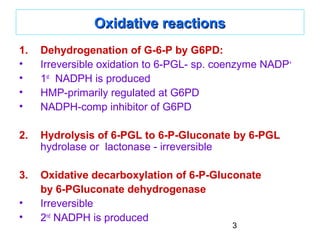
Oxidative reactionsOxidative reactions
1. Dehydrogenation of G-6-P by G6PD:
• Irreversible oxidation to 6-PGL- sp. coenzyme NADP+
• 1st
NADPH is produced
• HMP-primarily regulated at G6PD
• NADPH-comp inhibitor of G6PD
2. Hydrolysis of 6-PGL to 6-P-Gluconate by 6-PGL
hydrolase or lactonase - irreversible
3. Oxidative decarboxylation of 6-P-Gluconate
by 6-PGluconate dehydrogenase
• Irreversible
• 2nd
NADPH is produced
4
Non-oxidative reactionsNon-oxidative reactions
• Interconversion of 3-, 4-, 5- and 7-Carbon Sugars
• Ribulose 5-P to be converted to ribose 5-P [for Nucleic
acid synthesis]
• Or to intermediates of Glycolysis : F-6-P and
Glycerladehyde-3-P
• Non-oxidative part - controlled by availability of
intermediates
• Only coenzyme required: TPP for Transketolase reaction
5
Products of HMP ShuntProducts of HMP Shunt
G6P
NADPH Ribose 5-P
Biosynthesis (fatty
acids, steroid
hormones)
Nucleic acid
synthesis
(DNA, RNA)
6G-6-P→ 5G-6-P regenerated, 6 CO2 eliminated,12 NADPH
generated, 1 Glucose is completely oxidized
6
Uses of NADPHUses of NADPH
1.1. Reductive biosynthesis:Reductive biosynthesis:
NADPH is a high energy molecule and electron donor. It is
required as a source of electrons for biosynthesis of FA,
cholesterol, sterols, hormones, and bile salts.
2.2. Reduction of HReduction of H22OO22:: ROS- damage DNA, proteins, unsaturated
lipids– reperfusion injuries, cancer, inflammatory diseases,
aging.
Several protective mechanisms:
a. Enzymes that catalyze Antioxidant reactions:
Glutathione peroxidase or GOD [ using reduced Glutathione or
GSH which is active as antioxidant, present in most cells which
can detoxify HH22OO22 ]
Glutathione reductase or GR [regenerates GSH from oxidized
glutathione formed in above reaction] using NADPHNADPH as a source
of electrons
b. Antioxidant chemicals:
Vit E, A, C, uric acid, bilirubin, ceruloplasmin etc
7
3.3. CYP 450 or Cyt P-450: major pathway for hydroxylation ofCYP 450 or Cyt P-450: major pathway for hydroxylation of
xenobioticsxenobiotics
Supply of NADPHNADPH is critical for liver microsomal cyt P-450
4.4. Phagocytosis of microorganisms esp bacteria, foreignPhagocytosis of microorganisms esp bacteria, foreign
particles etc by Neutrophils & Macrophages:particles etc by Neutrophils & Macrophages:
imp defense mechanism
a. Oxygen dependent system- MPO [myeloperoxidase system]-
most potent, NADPH OXIDASE [needs NADPH] in WBC cell
memb, converts OO22 into Superoxide FRinto Superoxide FR [Respiratory
burst]→Superoxide is converted by SOD [superoxid dismutase]
into HH22OO22 →lysosomal MPO converts it to hypochlorous acid
HOCl·→ kills bacteria
NADPH OXIDASE deficiency- Chronic granulomatosis
b. Oxygen independent system- pH changes in phagolysosomes
and lysosomal enzymes- destroy pathogens
8
G6PD and NADPH in the RBCG6PD and NADPH in the RBC
H M P
2 A D P
2 A T P
2 L a c ta te
G 6 P
G lu c o s e
G lu c o s e
G 6 P N A D P
N A D P H6 -P h o s p h o -
g lu c o n a te
G lu c o s e 6 -p h o s p h a te
d e h y d ro g e n a s e
G S -S G
2 G S H
2 H O
H O
G lu ta th io n e
re d u c ta s e
2 2
2
G ly c o ly tic
p a th w a y
G lu ta th io n e
p e ro x id a s e
G 6 P D d e fic ie n c y p re v e n ts
th e p ro d u c tio n o f N A D P H
in th e e ry th ro c y te . L a c k o f
N A D P H re s u lts in h e m o ly s is .
+ H +
C e rta in D ru g s
In fe c tio n s
F a v a B e a n s
O x id a n t S tre s s
E ry th ro c y te
9
G-6-PD deficiency
• Inherited disease-most common disease producing enzyme
abnormality in humans- X-linked
• Hemolytic anemia due to inability to detoxify oxidizing agent
• 400 different types of mutations [point mutations]
• Shortened life span due to complications
• Increased resistance to falciparum malaria in female carriers of
mutation
• ↓activity of G6-PD→↓NADPH [HMP] →↓detoxification of FR &
peroxides
• RBC- most vulnerable as HMP is only means for NADPH
production. (other tissues NADP-dependent malate dehydrogenase
also]
• Precipitating factors- Oxidant drugs[ A-antibioticsA-antibiotics
(sulfamethoxazole), A-antimalarial (primaquin),A-antipyritics(sulfamethoxazole), A-antimalarial (primaquin),A-antipyritics
(acetanilid)(acetanilid), ingest Fava beans [favism], severe infection-free
radical generation in macrophages diffuse to RBC-hemolysis
10
Regulatory Mechanisms
Enzymes G6PD and 6PGD catalyze irreversible
steps of the HMP shunt.
↑ [NADPH] inhibits these enzymes via feedback
inhibition
↑ [ATP]: a putative inhibitor of these steps
↑ [G-6P] increases flux through the HMP shunt (G-6P is a
substrate)
11
TPP is coenzyme for Transketolase
Transketolase reaction is measured in RBC as index of
Thiamine status.
Wernicke-Korsakoff syndrome: seen in alcoholics
and persons with Thiamine deficiency is due to genetic
defect in the enzyme Transketolase
12
Uronic acid Pathway of GlucoseUronic acid Pathway of Glucose
Importance in humans:
• Provides UDP-glucuronic acid for conjugation [conjugation of
bilirubin, steroids etc] and synthesis of glycosaminoglycans.
• In lower animals (not in primates- deficiency of enzyme L-
gulonolactone oxidase), this pathway leads to synthesis of Vit C.
• Essential Pentosuria: one of Garrod’s tetrad [alkaptonuria,
albinism, pentosuria, cystinuria- inborn error of metabolism]:
*1 in 2500 births due to deficiency of xylitol dehydrogenase →
L-xylulose excreted in urine gives + benedict’s test-not harmful.
*Diffentiated from DM by + Bials test [orcinol in HCL-Bial’s reagent]
by pentose sugars.
13
URONIC ACID PATHWAYURONIC ACID PATHWAY
G-6-PG-6-P
PhosphoglucomutasePhosphoglucomutase
G-1-PG-1-P
+ UTP [UDPG Phosphorylase]UTP [UDPG Phosphorylase]
UDP- GlucoseUDP- Glucose
enters Uronic acid pathway
14
Aldose reductaseAldose reductase- Glucose to Sorbitol [glucitol]:
Lens, retina, Schwann cell of peripheral nerves, kidney, placenta,
RBC, cells of ovaries and seminal vesicles.
Sorbitol dehydrogenaseSorbitol dehydrogenase- Sorbitol to Fructose
Glucoe to Sorbitol to Fructose: in seminal vesicles for sperm cell [fructose is
preferred carbohydrate energy source]
Hyperglycemia: Uncontrolled DM-large amt Glucose entersHyperglycemia: Uncontrolled DM-large amt Glucose enters
Lens, Retina,Nerve, Kidney – with action of aldose reductaseLens, Retina,Nerve, Kidney – with action of aldose reductase
→↑→↑Sorbitol, cannot pass through cell memb, so trapped insideSorbitol, cannot pass through cell memb, so trapped inside
cell.cell.
Sorbitol dehydrogenase is absent in Lens, retina, kidney andSorbitol dehydrogenase is absent in Lens, retina, kidney and
nerve cell →↑sorbitol accumulates →Osmotic effects →cellnerve cell →↑sorbitol accumulates →Osmotic effects →cell
swelling and water retention:swelling and water retention:
cause of cataract formation, peripheral neuropathy, vascularcause of cataract formation, peripheral neuropathy, vascular
problems leading to nephropathy and retinopathyproblems leading to nephropathy and retinopathy

Hmp shunt

  • 1.
    1 HMP SHUNT [HexoseMonophosphate Pathway] /HMP SHUNT [Hexose Monophosphate Pathway] / PPP [Pentose Phosphate Pathway]PPP [Pentose Phosphate Pathway] • Principle pathway for oxidation of Glucose-Glycolysis & TCA • HMP-alternative pathway for oxidation of Glucose-not for Energy • Occours in cytosol • Provides: NADPH [reductive synthesis] & Pentoses [for NA synth] • Most common at the site of synthesis: Liver [phospholipid, FA synth, Cholesterol], adipose tissue [FA synth], lactating mammary gland [FA synth], adrenal cortex [Cholesterol, steroid hormone synth], testes & other endocrine glands concerned with steroid synthesis and RBC • NADPH produced: required for – Reductive biosynthesis of FA, TG, cholesterol, steroids [NADH – reduction in Catabolic pathways (NADH enters ETC→ ATP); NADPH – reduction in Synthetic pathways]
  • 2.
    2 HMPHMP Anabolic pathway that utilizes the 6 carbonsof glucose to generate 5 carbon sugars and reducing equivalents
  • 3.
    3 Oxidative reactionsOxidative reactions 1.Dehydrogenation of G-6-P by G6PD: • Irreversible oxidation to 6-PGL- sp. coenzyme NADP+ • 1st NADPH is produced • HMP-primarily regulated at G6PD • NADPH-comp inhibitor of G6PD 2. Hydrolysis of 6-PGL to 6-P-Gluconate by 6-PGL hydrolase or lactonase - irreversible 3. Oxidative decarboxylation of 6-P-Gluconate by 6-PGluconate dehydrogenase • Irreversible • 2nd NADPH is produced
  • 4.
    4 Non-oxidative reactionsNon-oxidative reactions •Interconversion of 3-, 4-, 5- and 7-Carbon Sugars • Ribulose 5-P to be converted to ribose 5-P [for Nucleic acid synthesis] • Or to intermediates of Glycolysis : F-6-P and Glycerladehyde-3-P • Non-oxidative part - controlled by availability of intermediates • Only coenzyme required: TPP for Transketolase reaction
  • 5.
    5 Products of HMPShuntProducts of HMP Shunt G6P NADPH Ribose 5-P Biosynthesis (fatty acids, steroid hormones) Nucleic acid synthesis (DNA, RNA) 6G-6-P→ 5G-6-P regenerated, 6 CO2 eliminated,12 NADPH generated, 1 Glucose is completely oxidized
  • 6.
    6 Uses of NADPHUsesof NADPH 1.1. Reductive biosynthesis:Reductive biosynthesis: NADPH is a high energy molecule and electron donor. It is required as a source of electrons for biosynthesis of FA, cholesterol, sterols, hormones, and bile salts. 2.2. Reduction of HReduction of H22OO22:: ROS- damage DNA, proteins, unsaturated lipids– reperfusion injuries, cancer, inflammatory diseases, aging. Several protective mechanisms: a. Enzymes that catalyze Antioxidant reactions: Glutathione peroxidase or GOD [ using reduced Glutathione or GSH which is active as antioxidant, present in most cells which can detoxify HH22OO22 ] Glutathione reductase or GR [regenerates GSH from oxidized glutathione formed in above reaction] using NADPHNADPH as a source of electrons b. Antioxidant chemicals: Vit E, A, C, uric acid, bilirubin, ceruloplasmin etc
  • 7.
    7 3.3. CYP 450or Cyt P-450: major pathway for hydroxylation ofCYP 450 or Cyt P-450: major pathway for hydroxylation of xenobioticsxenobiotics Supply of NADPHNADPH is critical for liver microsomal cyt P-450 4.4. Phagocytosis of microorganisms esp bacteria, foreignPhagocytosis of microorganisms esp bacteria, foreign particles etc by Neutrophils & Macrophages:particles etc by Neutrophils & Macrophages: imp defense mechanism a. Oxygen dependent system- MPO [myeloperoxidase system]- most potent, NADPH OXIDASE [needs NADPH] in WBC cell memb, converts OO22 into Superoxide FRinto Superoxide FR [Respiratory burst]→Superoxide is converted by SOD [superoxid dismutase] into HH22OO22 →lysosomal MPO converts it to hypochlorous acid HOCl·→ kills bacteria NADPH OXIDASE deficiency- Chronic granulomatosis b. Oxygen independent system- pH changes in phagolysosomes and lysosomal enzymes- destroy pathogens
  • 8.
    8 G6PD and NADPHin the RBCG6PD and NADPH in the RBC H M P 2 A D P 2 A T P 2 L a c ta te G 6 P G lu c o s e G lu c o s e G 6 P N A D P N A D P H6 -P h o s p h o - g lu c o n a te G lu c o s e 6 -p h o s p h a te d e h y d ro g e n a s e G S -S G 2 G S H 2 H O H O G lu ta th io n e re d u c ta s e 2 2 2 G ly c o ly tic p a th w a y G lu ta th io n e p e ro x id a s e G 6 P D d e fic ie n c y p re v e n ts th e p ro d u c tio n o f N A D P H in th e e ry th ro c y te . L a c k o f N A D P H re s u lts in h e m o ly s is . + H + C e rta in D ru g s In fe c tio n s F a v a B e a n s O x id a n t S tre s s E ry th ro c y te
  • 9.
    9 G-6-PD deficiency • Inheriteddisease-most common disease producing enzyme abnormality in humans- X-linked • Hemolytic anemia due to inability to detoxify oxidizing agent • 400 different types of mutations [point mutations] • Shortened life span due to complications • Increased resistance to falciparum malaria in female carriers of mutation • ↓activity of G6-PD→↓NADPH [HMP] →↓detoxification of FR & peroxides • RBC- most vulnerable as HMP is only means for NADPH production. (other tissues NADP-dependent malate dehydrogenase also] • Precipitating factors- Oxidant drugs[ A-antibioticsA-antibiotics (sulfamethoxazole), A-antimalarial (primaquin),A-antipyritics(sulfamethoxazole), A-antimalarial (primaquin),A-antipyritics (acetanilid)(acetanilid), ingest Fava beans [favism], severe infection-free radical generation in macrophages diffuse to RBC-hemolysis
  • 10.
    10 Regulatory Mechanisms Enzymes G6PDand 6PGD catalyze irreversible steps of the HMP shunt. ↑ [NADPH] inhibits these enzymes via feedback inhibition ↑ [ATP]: a putative inhibitor of these steps ↑ [G-6P] increases flux through the HMP shunt (G-6P is a substrate)
  • 11.
    11 TPP is coenzymefor Transketolase Transketolase reaction is measured in RBC as index of Thiamine status. Wernicke-Korsakoff syndrome: seen in alcoholics and persons with Thiamine deficiency is due to genetic defect in the enzyme Transketolase
  • 12.
    12 Uronic acid Pathwayof GlucoseUronic acid Pathway of Glucose Importance in humans: • Provides UDP-glucuronic acid for conjugation [conjugation of bilirubin, steroids etc] and synthesis of glycosaminoglycans. • In lower animals (not in primates- deficiency of enzyme L- gulonolactone oxidase), this pathway leads to synthesis of Vit C. • Essential Pentosuria: one of Garrod’s tetrad [alkaptonuria, albinism, pentosuria, cystinuria- inborn error of metabolism]: *1 in 2500 births due to deficiency of xylitol dehydrogenase → L-xylulose excreted in urine gives + benedict’s test-not harmful. *Diffentiated from DM by + Bials test [orcinol in HCL-Bial’s reagent] by pentose sugars.
  • 13.
    13 URONIC ACID PATHWAYURONICACID PATHWAY G-6-PG-6-P PhosphoglucomutasePhosphoglucomutase G-1-PG-1-P + UTP [UDPG Phosphorylase]UTP [UDPG Phosphorylase] UDP- GlucoseUDP- Glucose enters Uronic acid pathway
  • 14.
    14 Aldose reductaseAldose reductase-Glucose to Sorbitol [glucitol]: Lens, retina, Schwann cell of peripheral nerves, kidney, placenta, RBC, cells of ovaries and seminal vesicles. Sorbitol dehydrogenaseSorbitol dehydrogenase- Sorbitol to Fructose Glucoe to Sorbitol to Fructose: in seminal vesicles for sperm cell [fructose is preferred carbohydrate energy source] Hyperglycemia: Uncontrolled DM-large amt Glucose entersHyperglycemia: Uncontrolled DM-large amt Glucose enters Lens, Retina,Nerve, Kidney – with action of aldose reductaseLens, Retina,Nerve, Kidney – with action of aldose reductase →↑→↑Sorbitol, cannot pass through cell memb, so trapped insideSorbitol, cannot pass through cell memb, so trapped inside cell.cell. Sorbitol dehydrogenase is absent in Lens, retina, kidney andSorbitol dehydrogenase is absent in Lens, retina, kidney and nerve cell →↑sorbitol accumulates →Osmotic effects →cellnerve cell →↑sorbitol accumulates →Osmotic effects →cell swelling and water retention:swelling and water retention: cause of cataract formation, peripheral neuropathy, vascularcause of cataract formation, peripheral neuropathy, vascular problems leading to nephropathy and retinopathyproblems leading to nephropathy and retinopathy