Pentose Phosphate Pathway
Also known as:
• Pentose shunt
• Hexose monophosphate shunt
• Phosphogluconate pathway
• It occurs in the cytosol.
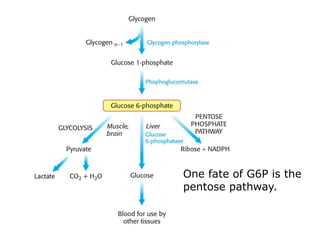
One fate of G6P is the
pentose pathway.
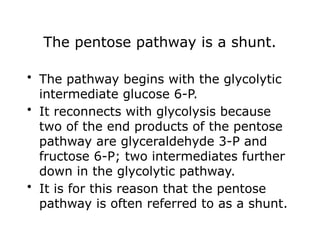
The pentose pathway is a shunt.
• The pathway begins with the glycolytic
intermediate glucose 6-P.
• It reconnects with glycolysis because
two of the end products of the pentose
pathway are glyceraldehyde 3-P and
fructose 6-P; two intermediates further
down in the glycolytic pathway.
• It is for this reason that the pentose
pathway is often referred to as a shunt.
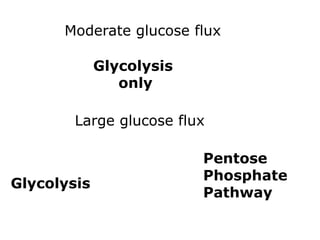
Moderate glucose flux
Glycolysis
only
Large glucose flux
Glycolysis
Pentose
Phosphate
Pathway
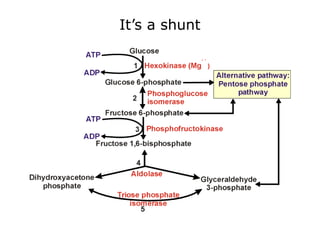
It’s a shunt
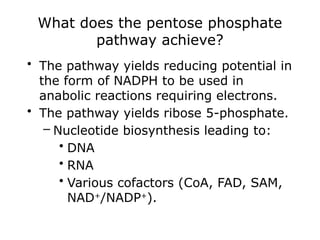
What does the pentose phosphate
pathway achieve?
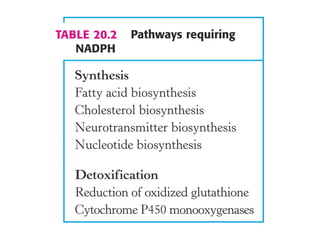
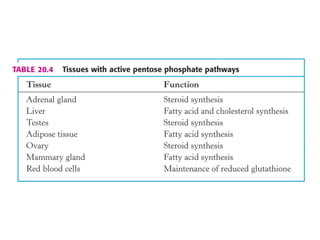
• The pathway yields reducing potential in
the form of NADPH to be used in
anabolic reactions requiring electrons.
• The pathway yields ribose 5-phosphate.
– Nucleotide biosynthesis leading to:
• DNA
• RNA
• Various cofactors (CoA, FAD, SAM,
NAD+
/NADP+
).
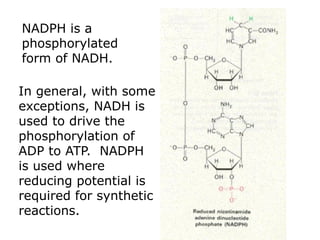
NADPH is a
phosphorylated
form of NADH.
In general, with some
exceptions, NADH is
used to drive the
phosphorylation of
ADP to ATP. NADPH
is used where
reducing potential is
required for synthetic
reactions.
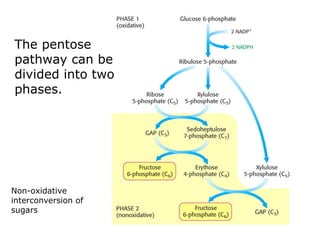
The pentose
pathway can be
divided into two
phases.
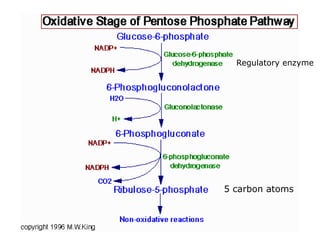
Non-oxidative
interconversion of
sugars
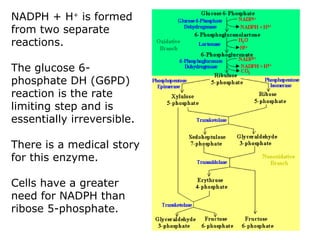
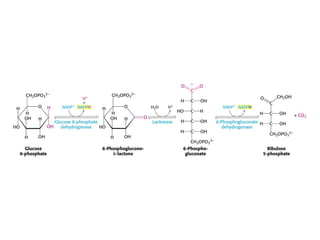
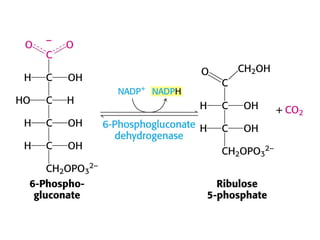
NADPH + H+
is formed
from two separate
reactions.
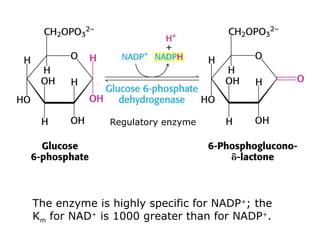
The glucose 6-
phosphate DH (G6PD)
reaction is the rate
limiting step and is
essentially irreversible.
There is a medical story
for this enzyme.
Cells have a greater
need for NADPH than
ribose 5-phosphate.
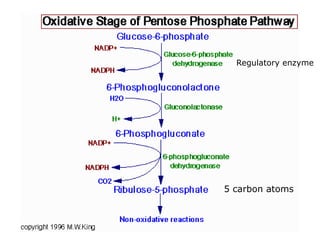
5 carbon atoms
Regulatory enzyme
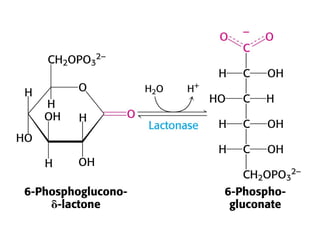
Regulatory enzyme
The enzyme is highly specific for NADP+
; the
Km for NAD+
is 1000 greater than for NADP+
.
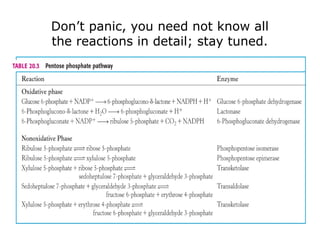
Don’t panic, you need not know all
the reactions in detail; stay tuned.
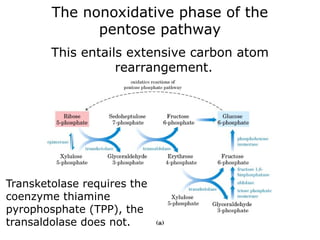
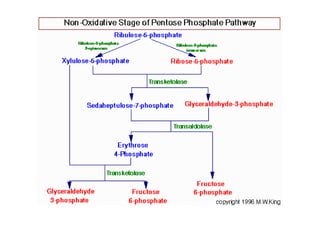
The nonoxidative phase of the
pentose pathway
This entails extensive carbon atom
rearrangement.
Transketolase requires the
coenzyme thiamine
pyrophosphate (TPP), the
transaldolase does not.
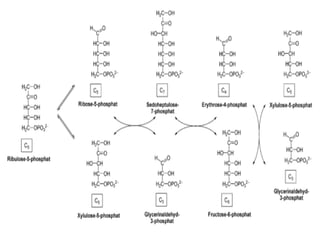
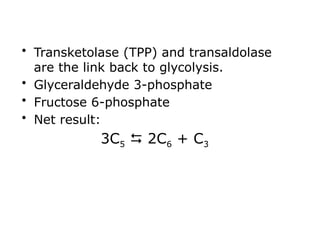
• Transketolase (TPP) and transaldolase
are the link back to glycolysis.
• Glyceraldehyde 3-phosphate
• Fructose 6-phosphate
• Net result:
3C5  2C6 + C3
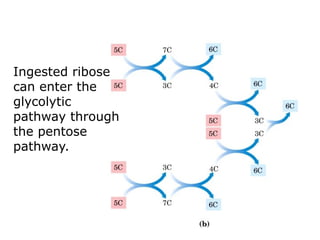
Ingested ribose
can enter the
glycolytic
pathway through
the pentose
pathway.
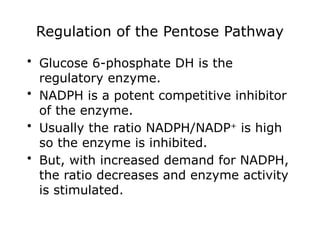
Regulation of the Pentose Pathway
• Glucose 6-phosphate DH is the
regulatory enzyme.
• NADPH is a potent competitive inhibitor
of the enzyme.
• Usually the ratio NADPH/NADP+
is high
so the enzyme is inhibited.
• But, with increased demand for NADPH,
the ratio decreases and enzyme activity
is stimulated.
5 carbon atoms
Regulatory enzyme
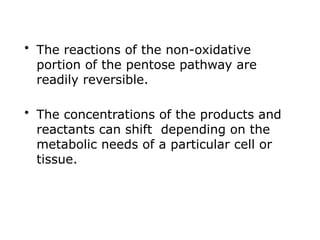
• The reactions of the non-oxidative
portion of the pentose pathway are
readily reversible.
• The concentrations of the products and
reactants can shift depending on the
metabolic needs of a particular cell or
tissue.
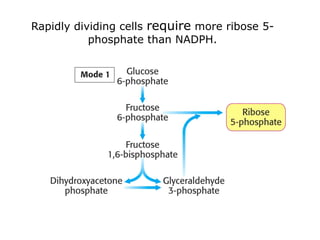
Rapidly dividing cells require more ribose 5-
phosphate than NADPH.
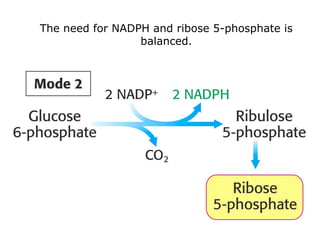
The need for NADPH and ribose 5-phosphate is
balanced.
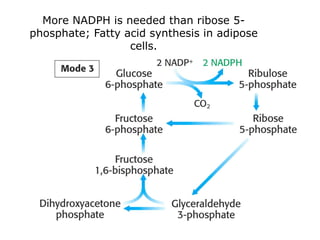
More NADPH is needed than ribose 5-
phosphate; Fatty acid synthesis in adipose
cells.
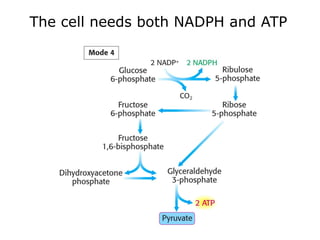
The cell needs both NADPH and ATP
Glutathione and NADPH
• What is glutathione?
• Why is it important?
• How is it related to NADPH?
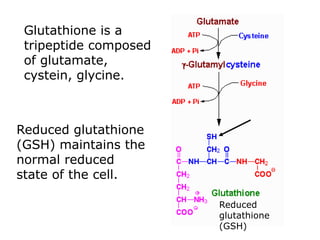
Reduced
glutathione
(GSH)
Glutathione is a
tripeptide composed
of glutamate,
cystein, glycine.
Reduced glutathione
(GSH) maintains the
normal reduced
state of the cell.
Glutathione Functions -1
• It serves as a reductant.
• Conjugates to drugs making them
water soluble.
• Involved in amino acid transport
across cell membranes.
• Cofactor in some enzymatic
reactions.
– rearrangement of protein disulfide
bonds.
Glutathione Functions -2
• The sulfhydryl of GSH is used to reduce
peroxides (ROS) formed during oxygen
transport.
– Reactive oxygen species (ROS)
damage macromolecules (DNA, RNA,
and protein) and ultimately lead to
cell death.
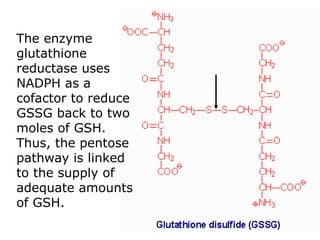
• The resulting oxidized form of GSH is
two molecules linked by a disulfide
bridge (GSSG).
The enzyme
glutathione
reductase uses
NADPH as a
cofactor to reduce
GSSG back to two
moles of GSH.
Thus, the pentose
pathway is linked
to the supply of
adequate amounts
of GSH.
So, what happens if glucose 6-
phosphate DH is defective?
Insufficient production of NADPH.
Which translates into insufficient
glutathione.
Is this a medical problem?
YES
Glutathione and Erythrocytes -1
• GSH is extremely important particularly
in the highly oxidizing environment of
the red blood cell.
• Mature RBCs have no mitochondria and
are totally dependent on NADPH from
the pentose phosphate pathway to
regenerate GSH from GSSG via
glutathione reductase.
• In fact, as much as 10% of glucose
consumption, by erythrocytes, is
mediated by the pentose pathway.
Glutathione and Erythrocytes -2
• The reduced form of glutathione serves
as a sulfhydryl buffer.
• It maintains cysteine residues in
hemoglobin and other proteins in a
reduced state.
• GSH is essential for normal RBC
structure and keeping hemoglobin in
Fe++
state.
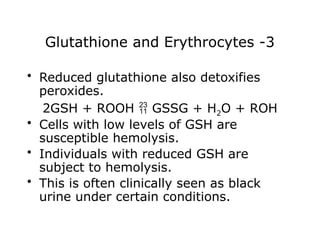
Glutathione and Erythrocytes -3
• Reduced glutathione also detoxifies
peroxides.
2GSH + ROOH  GSSG + H2O + ROH
• Cells with low levels of GSH are
susceptible hemolysis.
• Individuals with reduced GSH are
subject to hemolysis.
• This is often clinically seen as black
urine under certain conditions.
Conditions for hemolytic anemia
related G6PD deficiency.
• The ingestion of oxidative agents that
generate peroxides or reactive oxygen
species (ROS).
– Antimalarials - pamaquine
– purine glycoside from fava beans.
• Individules with G6PD deficiency can
not produce sufficient GSH to cope with
the ROS.
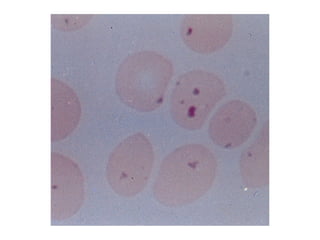
• Proteins become cross linked leading to
Heinz body formation and cell lysis.
Glucose 6-phosphate DH deficiency
and nonspherocytic hemolytic
anemia.
• Over 300 genetic variants of the G6PD
protein are known.
• Thus, there is a remarkable variation in
the clinical spectrum.
• G6PD deficiency is an inheritable X-
linked recessive disorder.
• Approximately 10-14% of the male
African American population is affected.
• It is also seen in Caucasians from the
Mediterranean Basin.
• People with the disorder are not normally
anemic and display no evidence of the disease
until the red cells are exposed to an oxidant or
stress.
Drugs that can precipitate this reaction:
• antimalarial agents
• sulfonamides (antibiotic)
• aspirin
• nonsteroidal antiinflammatory drugs (NSAIDs)
• nitrofurantoin
• quinidine
• quinine
• exposure to certain chemicals - mothballs
FAVISM
• Individuals with G6PD deficiency must
not eat Fava beans.
• Pythagoras
• Vicia faba. The Mediterranean
plant Vicia faba is a source of fava
beans that contain the purine glycoside
vicine
• Erythrocytes lyse=dark or black urine.
• Interesting
– The growth Plasmodium falciparum
(malaria parasite) fails in G6PD
deficient individuals.

Pentosephosphate pathway (PPP) 31 OCT 23.pptx

  • 1.
    Pentose Phosphate Pathway Alsoknown as: • Pentose shunt • Hexose monophosphate shunt • Phosphogluconate pathway • It occurs in the cytosol.
  • 2.
    One fate ofG6P is the pentose pathway.
  • 3.
    The pentose pathwayis a shunt. • The pathway begins with the glycolytic intermediate glucose 6-P. • It reconnects with glycolysis because two of the end products of the pentose pathway are glyceraldehyde 3-P and fructose 6-P; two intermediates further down in the glycolytic pathway. • It is for this reason that the pentose pathway is often referred to as a shunt.
  • 4.
    Moderate glucose flux Glycolysis only Largeglucose flux Glycolysis Pentose Phosphate Pathway
  • 5.
  • 6.
    What does thepentose phosphate pathway achieve? • The pathway yields reducing potential in the form of NADPH to be used in anabolic reactions requiring electrons. • The pathway yields ribose 5-phosphate. – Nucleotide biosynthesis leading to: • DNA • RNA • Various cofactors (CoA, FAD, SAM, NAD+ /NADP+ ).
  • 9.
    NADPH is a phosphorylated formof NADH. In general, with some exceptions, NADH is used to drive the phosphorylation of ADP to ATP. NADPH is used where reducing potential is required for synthetic reactions.
  • 10.
    The pentose pathway canbe divided into two phases. Non-oxidative interconversion of sugars
  • 11.
    NADPH + H+ isformed from two separate reactions. The glucose 6- phosphate DH (G6PD) reaction is the rate limiting step and is essentially irreversible. There is a medical story for this enzyme. Cells have a greater need for NADPH than ribose 5-phosphate.
  • 12.
  • 14.
    Regulatory enzyme The enzymeis highly specific for NADP+ ; the Km for NAD+ is 1000 greater than for NADP+ .
  • 17.
    Don’t panic, youneed not know all the reactions in detail; stay tuned.
  • 18.
    The nonoxidative phaseof the pentose pathway This entails extensive carbon atom rearrangement. Transketolase requires the coenzyme thiamine pyrophosphate (TPP), the transaldolase does not.
  • 20.
    • Transketolase (TPP)and transaldolase are the link back to glycolysis. • Glyceraldehyde 3-phosphate • Fructose 6-phosphate • Net result: 3C5  2C6 + C3
  • 21.
    Ingested ribose can enterthe glycolytic pathway through the pentose pathway.
  • 23.
    Regulation of thePentose Pathway • Glucose 6-phosphate DH is the regulatory enzyme. • NADPH is a potent competitive inhibitor of the enzyme. • Usually the ratio NADPH/NADP+ is high so the enzyme is inhibited. • But, with increased demand for NADPH, the ratio decreases and enzyme activity is stimulated.
  • 24.
  • 25.
    • The reactionsof the non-oxidative portion of the pentose pathway are readily reversible. • The concentrations of the products and reactants can shift depending on the metabolic needs of a particular cell or tissue.
  • 26.
    Rapidly dividing cellsrequire more ribose 5- phosphate than NADPH.
  • 27.
    The need forNADPH and ribose 5-phosphate is balanced.
  • 28.
    More NADPH isneeded than ribose 5- phosphate; Fatty acid synthesis in adipose cells.
  • 29.
    The cell needsboth NADPH and ATP
  • 30.
    Glutathione and NADPH •What is glutathione? • Why is it important? • How is it related to NADPH?
  • 31.
    Reduced glutathione (GSH) Glutathione is a tripeptidecomposed of glutamate, cystein, glycine. Reduced glutathione (GSH) maintains the normal reduced state of the cell.
  • 32.
    Glutathione Functions -1 •It serves as a reductant. • Conjugates to drugs making them water soluble. • Involved in amino acid transport across cell membranes. • Cofactor in some enzymatic reactions. – rearrangement of protein disulfide bonds.
  • 33.
    Glutathione Functions -2 •The sulfhydryl of GSH is used to reduce peroxides (ROS) formed during oxygen transport. – Reactive oxygen species (ROS) damage macromolecules (DNA, RNA, and protein) and ultimately lead to cell death. • The resulting oxidized form of GSH is two molecules linked by a disulfide bridge (GSSG).
  • 34.
    The enzyme glutathione reductase uses NADPHas a cofactor to reduce GSSG back to two moles of GSH. Thus, the pentose pathway is linked to the supply of adequate amounts of GSH.
  • 35.
    So, what happensif glucose 6- phosphate DH is defective? Insufficient production of NADPH. Which translates into insufficient glutathione. Is this a medical problem? YES
  • 36.
    Glutathione and Erythrocytes-1 • GSH is extremely important particularly in the highly oxidizing environment of the red blood cell. • Mature RBCs have no mitochondria and are totally dependent on NADPH from the pentose phosphate pathway to regenerate GSH from GSSG via glutathione reductase. • In fact, as much as 10% of glucose consumption, by erythrocytes, is mediated by the pentose pathway.
  • 37.
    Glutathione and Erythrocytes-2 • The reduced form of glutathione serves as a sulfhydryl buffer. • It maintains cysteine residues in hemoglobin and other proteins in a reduced state. • GSH is essential for normal RBC structure and keeping hemoglobin in Fe++ state.
  • 38.
    Glutathione and Erythrocytes-3 • Reduced glutathione also detoxifies peroxides. 2GSH + ROOH  GSSG + H2O + ROH • Cells with low levels of GSH are susceptible hemolysis. • Individuals with reduced GSH are subject to hemolysis. • This is often clinically seen as black urine under certain conditions.
  • 39.
    Conditions for hemolyticanemia related G6PD deficiency. • The ingestion of oxidative agents that generate peroxides or reactive oxygen species (ROS). – Antimalarials - pamaquine – purine glycoside from fava beans. • Individules with G6PD deficiency can not produce sufficient GSH to cope with the ROS. • Proteins become cross linked leading to Heinz body formation and cell lysis.
  • 41.
    Glucose 6-phosphate DHdeficiency and nonspherocytic hemolytic anemia. • Over 300 genetic variants of the G6PD protein are known. • Thus, there is a remarkable variation in the clinical spectrum. • G6PD deficiency is an inheritable X- linked recessive disorder. • Approximately 10-14% of the male African American population is affected. • It is also seen in Caucasians from the Mediterranean Basin.
  • 42.
    • People withthe disorder are not normally anemic and display no evidence of the disease until the red cells are exposed to an oxidant or stress. Drugs that can precipitate this reaction: • antimalarial agents • sulfonamides (antibiotic) • aspirin • nonsteroidal antiinflammatory drugs (NSAIDs) • nitrofurantoin • quinidine • quinine • exposure to certain chemicals - mothballs
  • 43.
    FAVISM • Individuals withG6PD deficiency must not eat Fava beans. • Pythagoras • Vicia faba. The Mediterranean plant Vicia faba is a source of fava beans that contain the purine glycoside vicine • Erythrocytes lyse=dark or black urine. • Interesting – The growth Plasmodium falciparum (malaria parasite) fails in G6PD deficient individuals.