Lecture 2
1
Generation of Microprocessors
 We divide the years of development of
microprocessors as 5 generations
 From 1970 to date
2
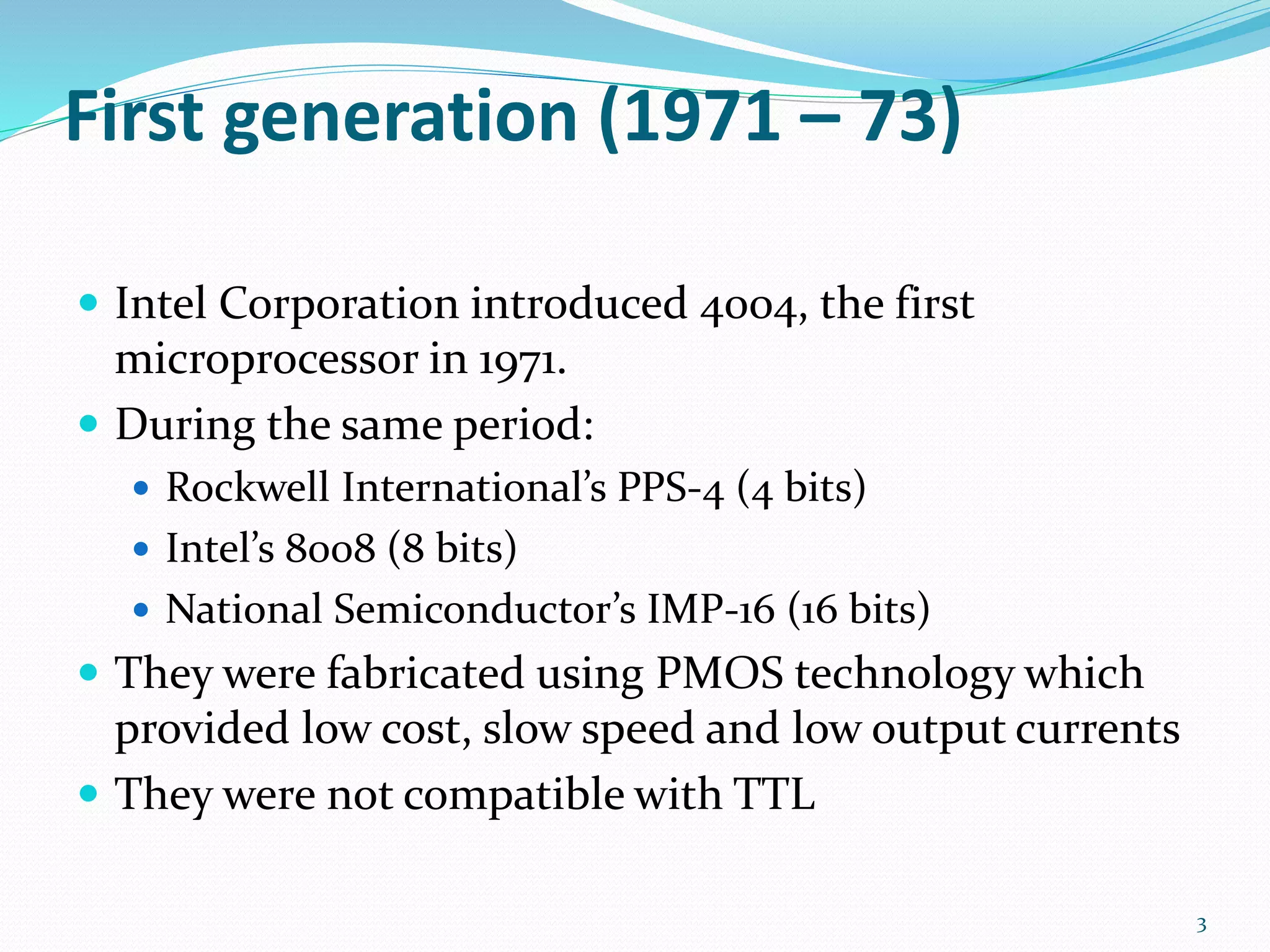
First generation (1971 – 73)
 Intel Corporation introduced 4004, the first
microprocessor in 1971.
 During the same period:
 Rockwell International’s PPS-4 (4 bits)
 Intel’s 8008 (8 bits)
 National Semiconductor’s IMP-16 (16 bits)
 They were fabricated using PMOS technology which
provided low cost, slow speed and low output currents
 They were not compatible with TTL
3
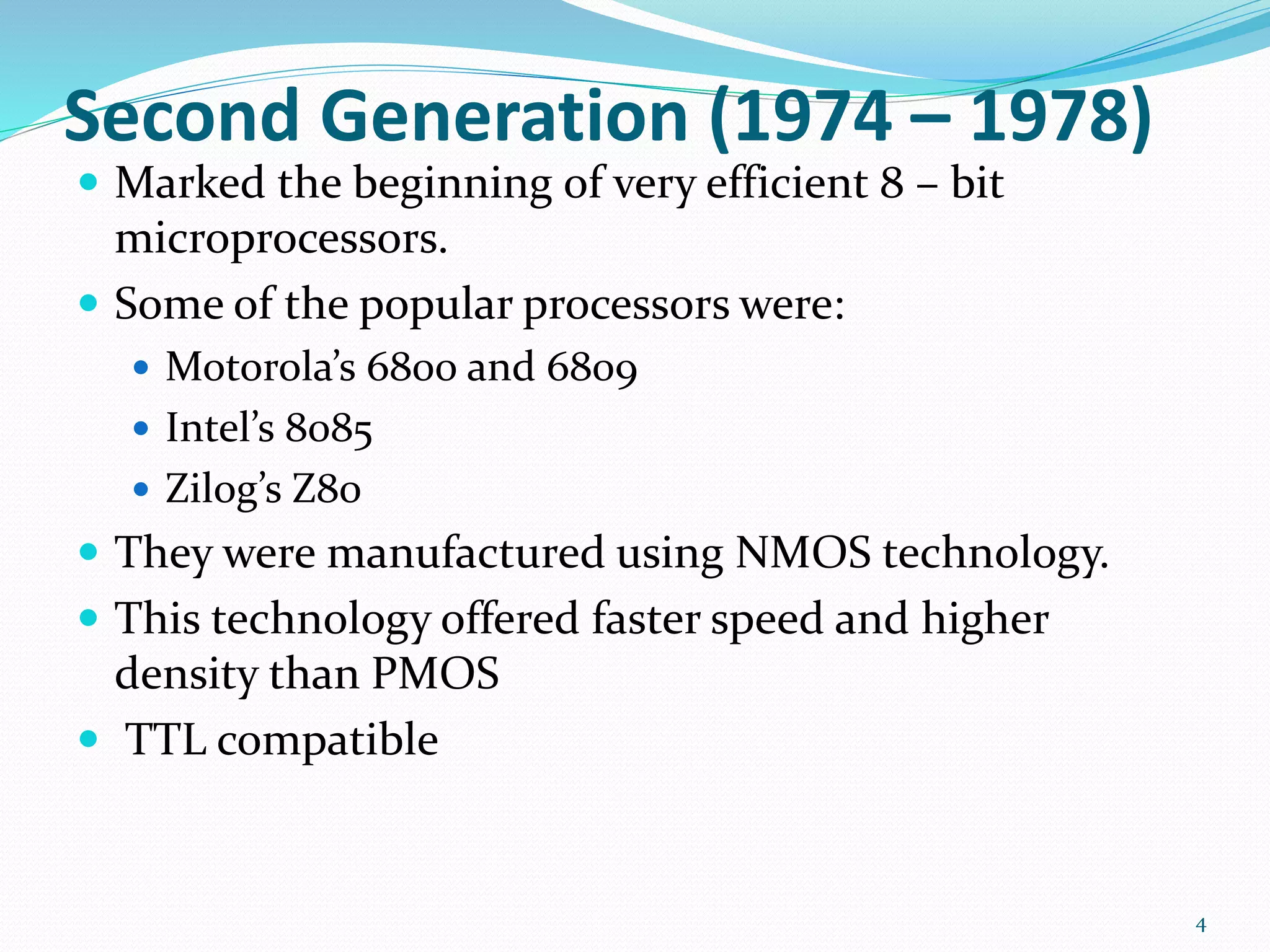
Second Generation (1974 – 1978)
 Marked the beginning of very efficient 8 – bit
microprocessors.
 Some of the popular processors were:
 Motorola’s 6800 and 6809
 Intel’s 8085
 Zilog’s Z80
 They were manufactured using NMOS technology.
 This technology offered faster speed and higher
density than PMOS
 TTL compatible
4
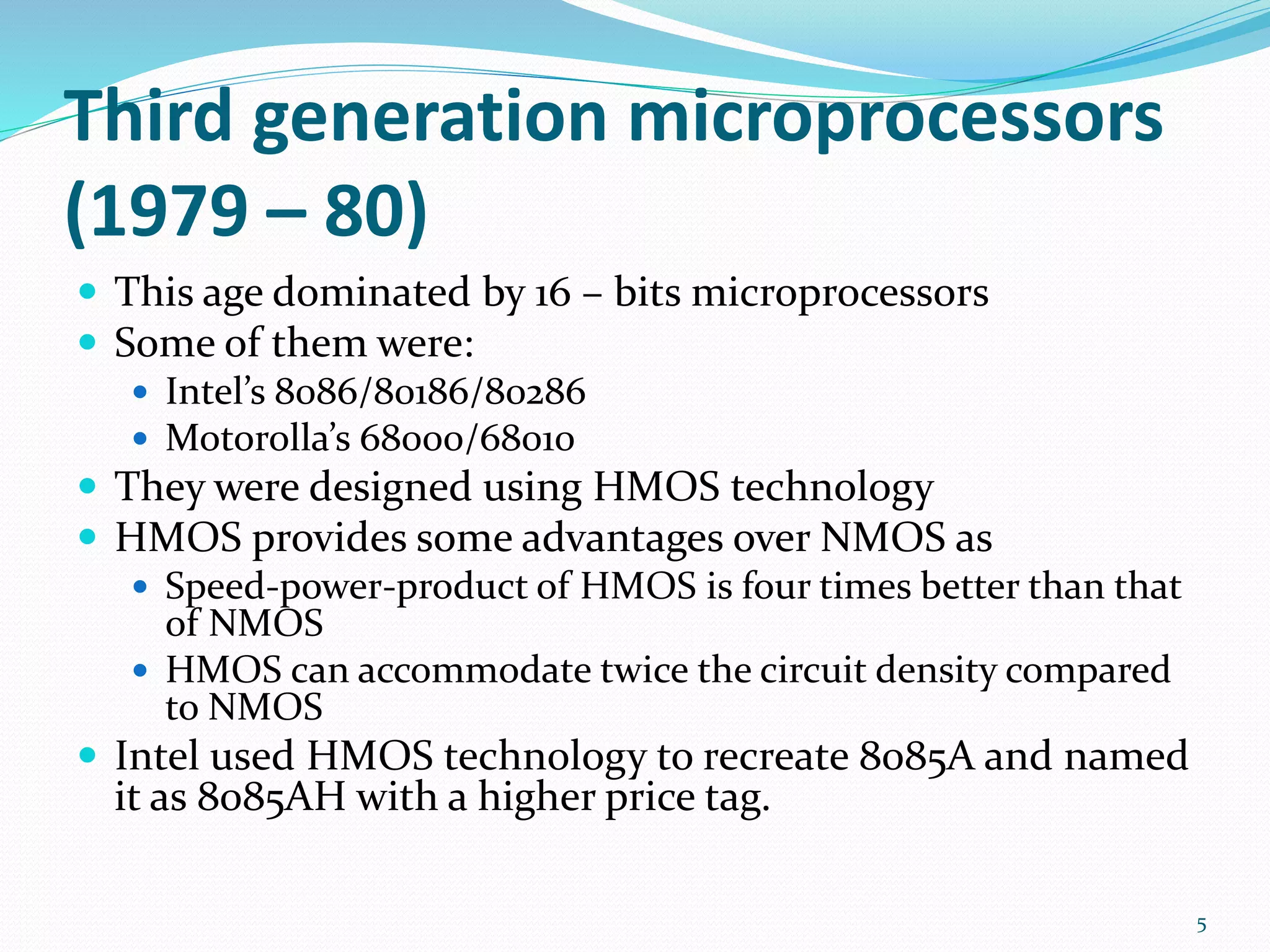
Third generation microprocessors
(1979 – 80)
 This age dominated by 16 – bits microprocessors
 Some of them were:
 Intel’s 8086/80186/80286
 Motorolla’s 68000/68010
 They were designed using HMOS technology
 HMOS provides some advantages over NMOS as
 Speed-power-product of HMOS is four times better than that
of NMOS
 HMOS can accommodate twice the circuit density compared
to NMOS
 Intel used HMOS technology to recreate 8085A and named
it as 8085AH with a higher price tag.
5
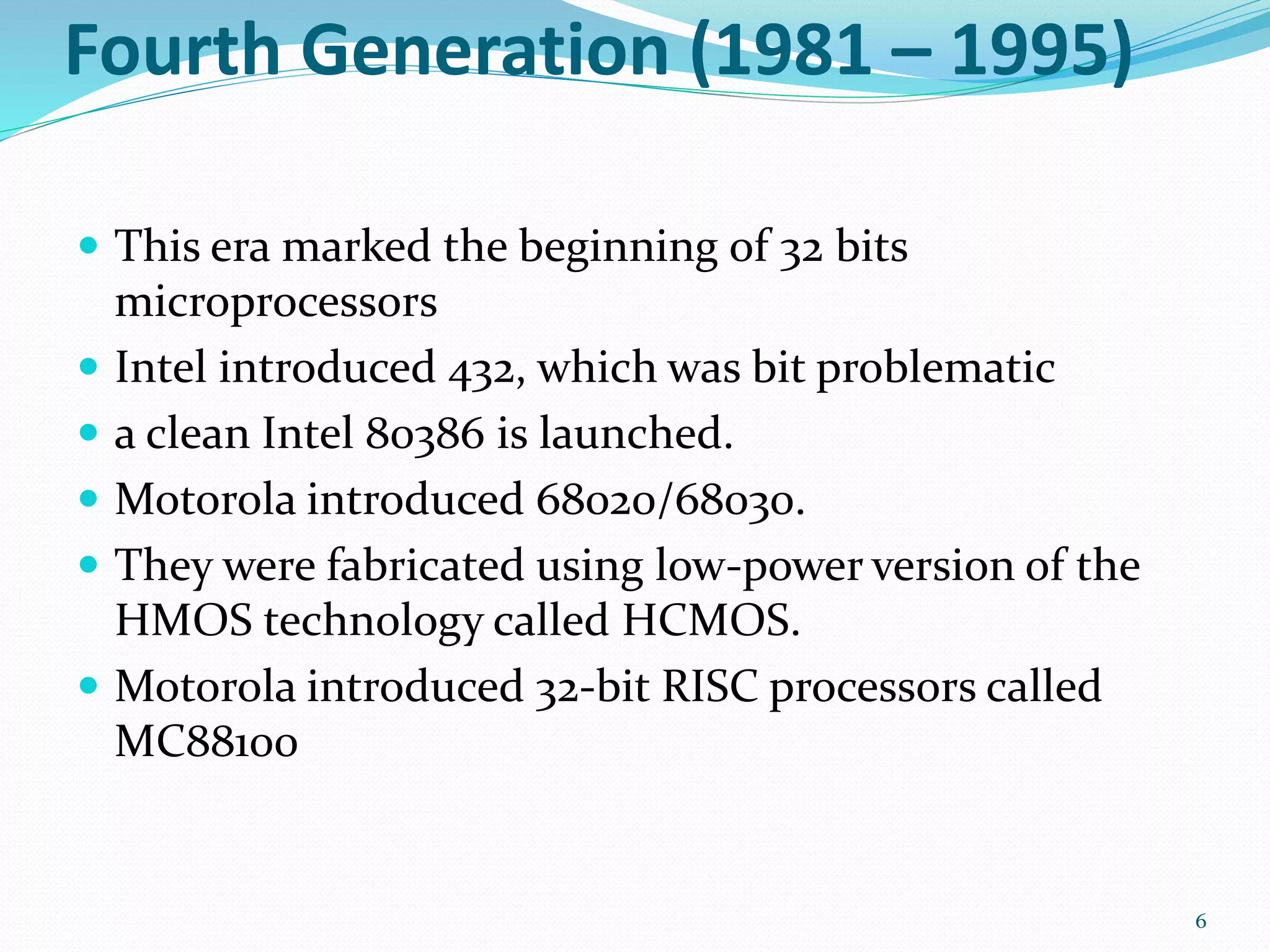
Fourth Generation (1981 – 1995)
 This era marked the beginning of 32 bits
microprocessors
 Intel introduced 432, which was bit problematic
 a clean Intel 80386 is launched.
 Motorola introduced 68020/68030.
 They were fabricated using low-power version of the
HMOS technology called HCMOS.
 Motorola introduced 32-bit RISC processors called
MC88100
6
Fifth Generation (1995 – till date)
 This age the emphasis is on introducing chips that
carry on-chip functionalities and improvements in the
speed of memory and I/O devices along with
introduction of 64-bit microprocessors.
 Intel leads the show here with Pentium, Celeron and
very recently dual and quad core processors working
with up to 3.5GHz speed.
7
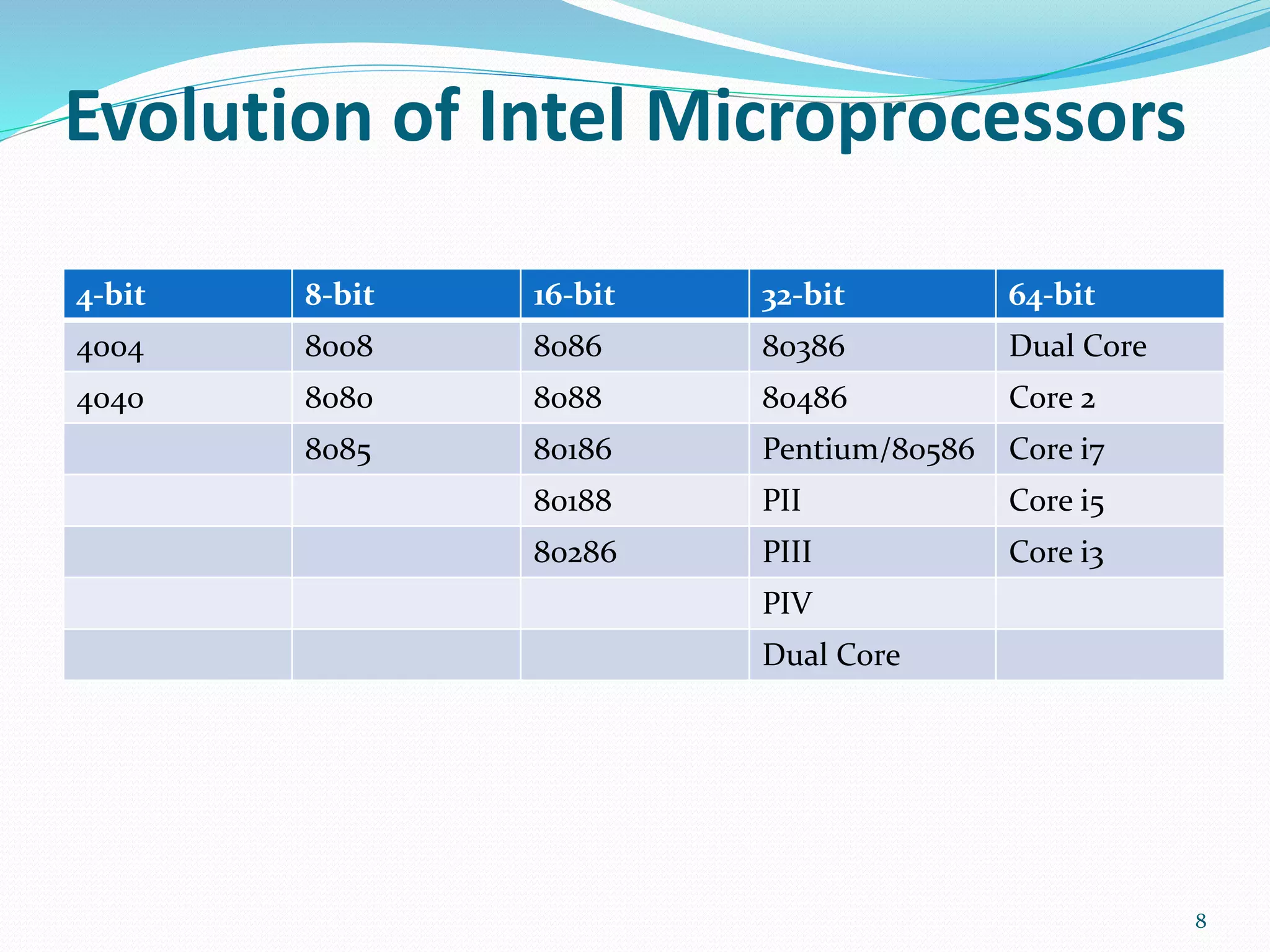
Evolution of Intel Microprocessors
4-bit 8-bit 16-bit 32-bit 64-bit
4004 8008 8086 80386 Dual Core
4040 8080 8088 80486 Core 2
8085 80186 Pentium/80586 Core i7
80188 PII Core i5
80286 PIII Core i3
PIV
Dual Core
8
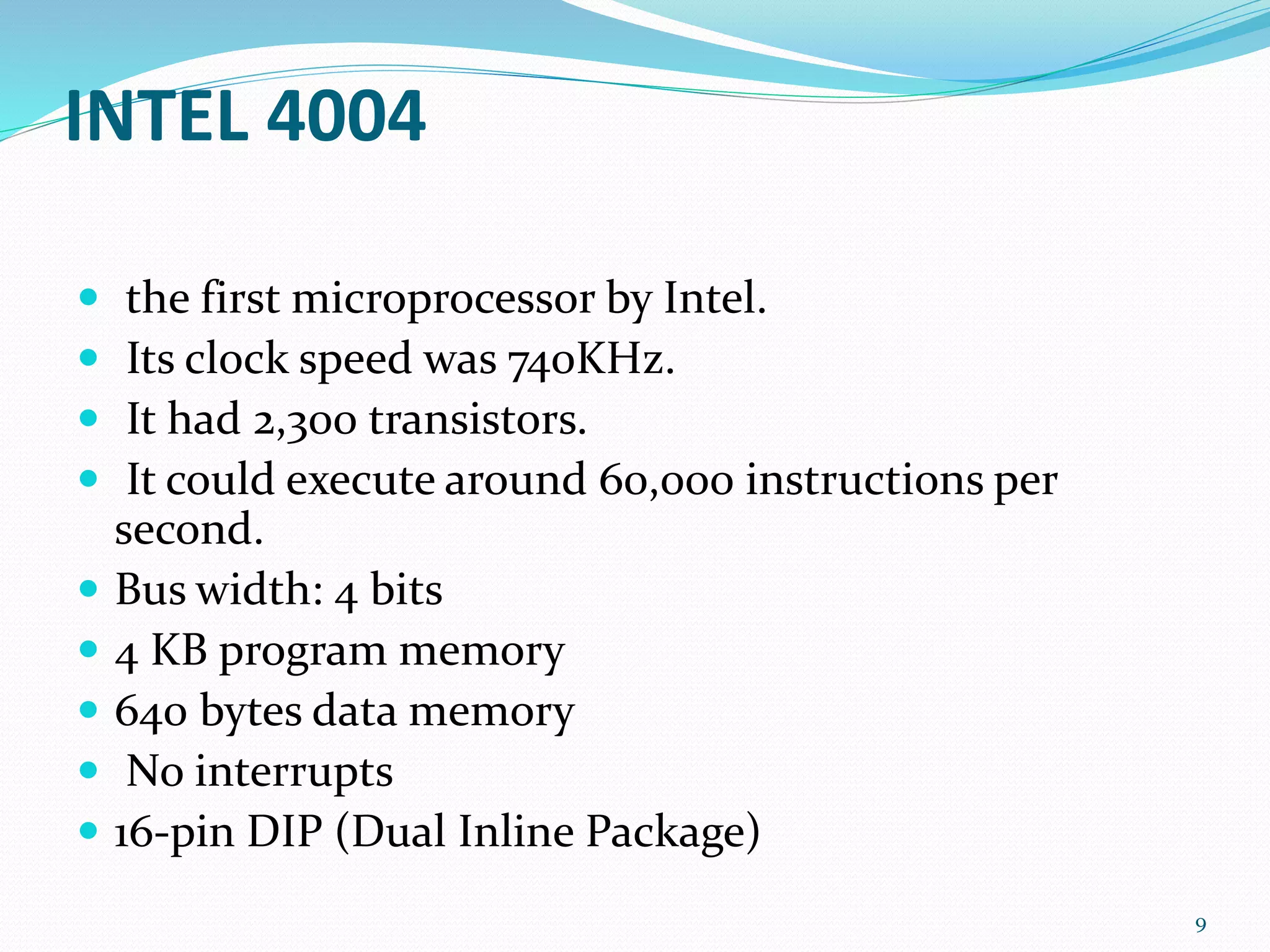
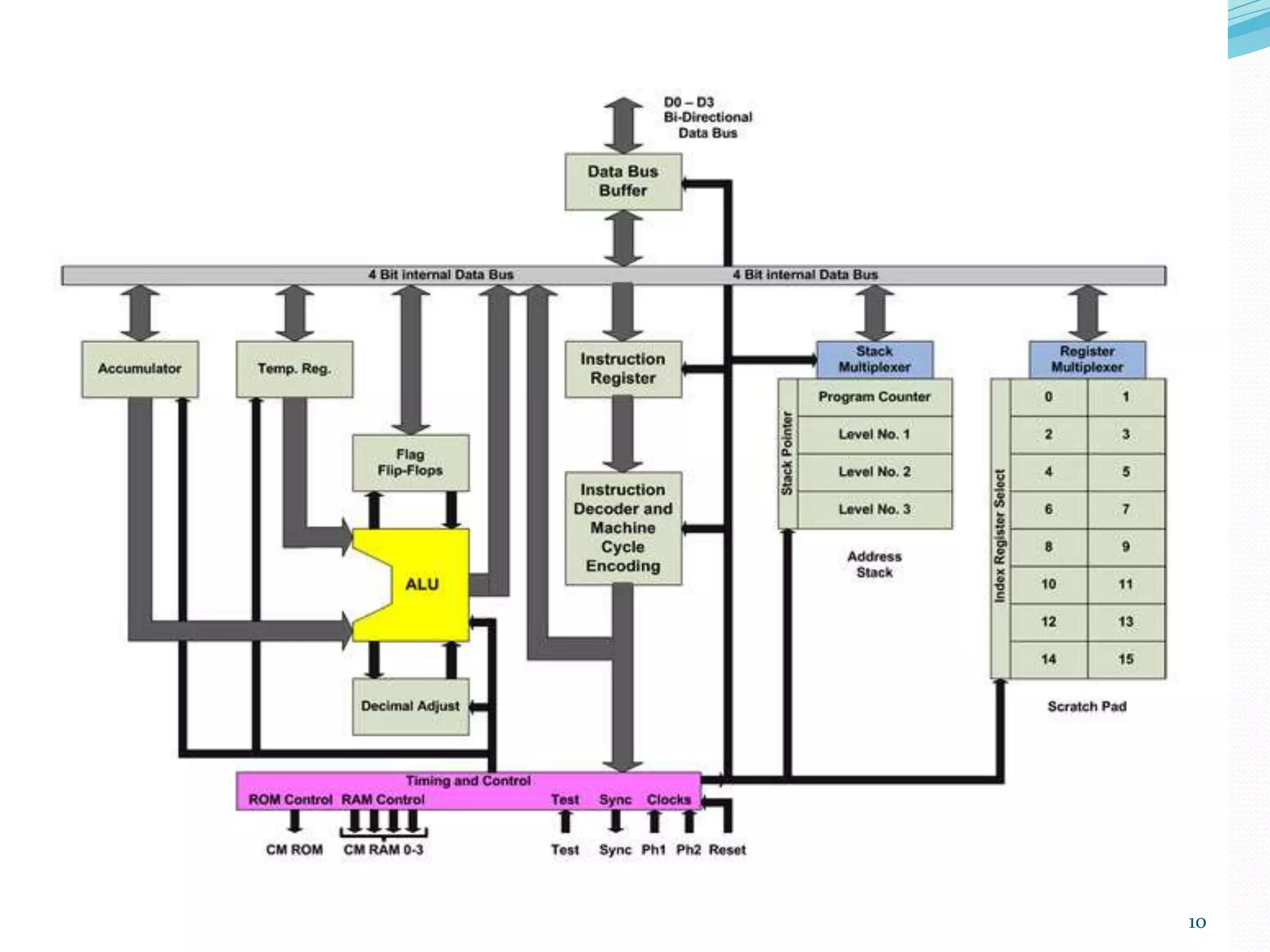
INTEL 4004
 the first microprocessor by Intel.
 Its clock speed was 740KHz.
 It had 2,300 transistors.
 It could execute around 60,000 instructions per
second.
 Bus width: 4 bits
 4 KB program memory
 640 bytes data memory
 No interrupts
 16-pin DIP (Dual Inline Package)
9
10
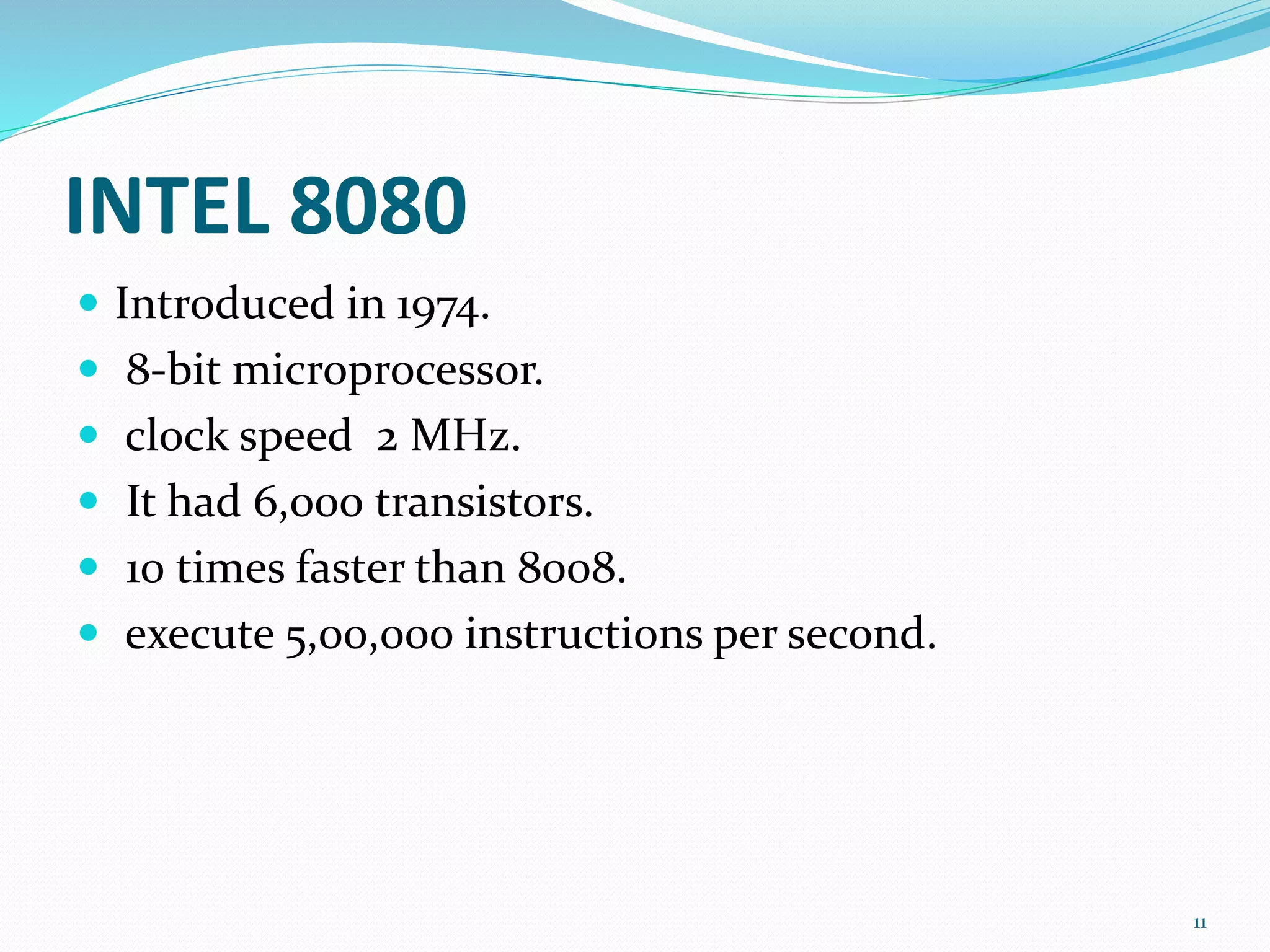
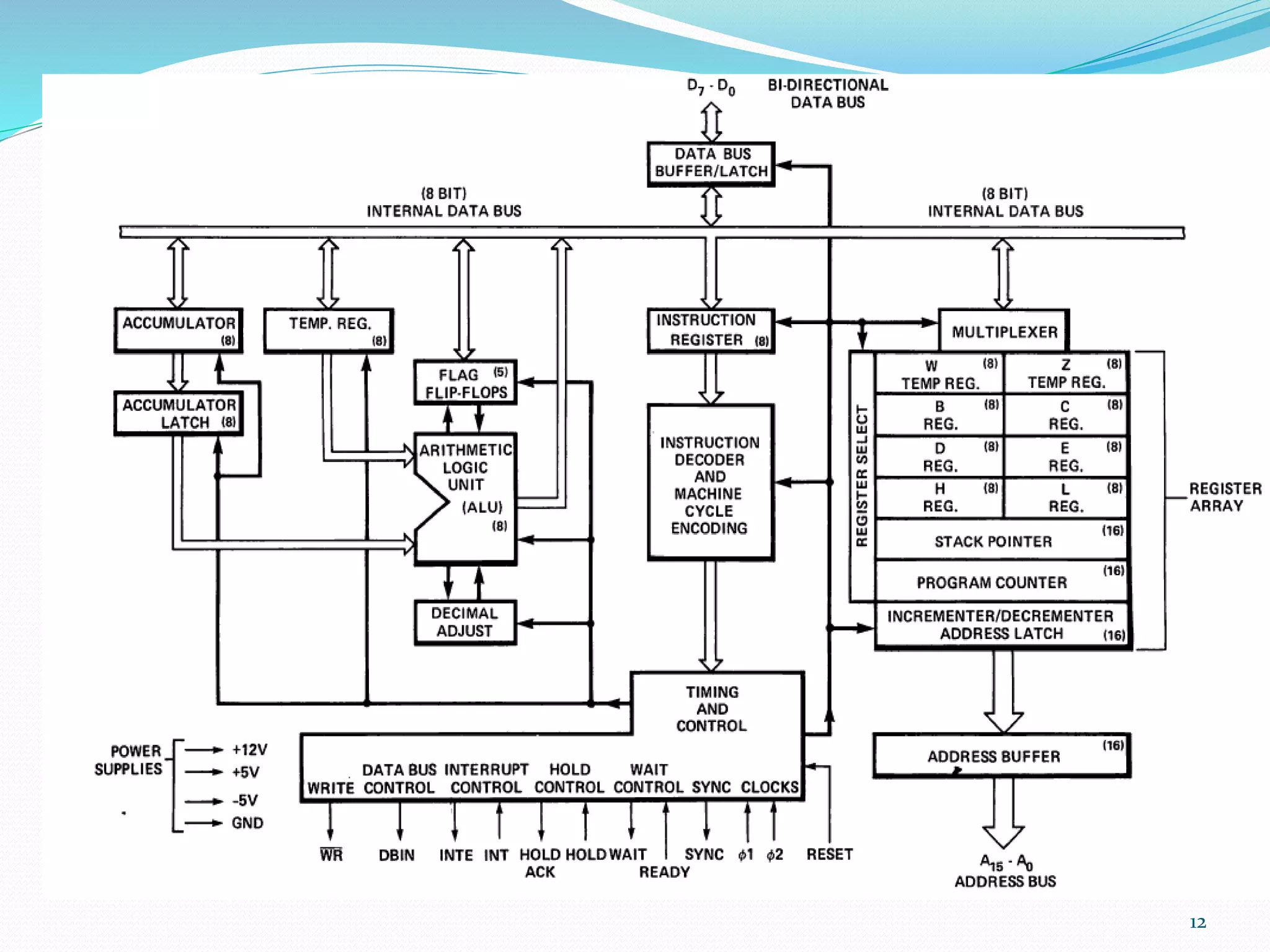
INTEL 8080
 Introduced in 1974.
 8-bit microprocessor.
 clock speed 2 MHz.
 It had 6,000 transistors.
 10 times faster than 8008.
 execute 5,00,000 instructions per second.
11
12
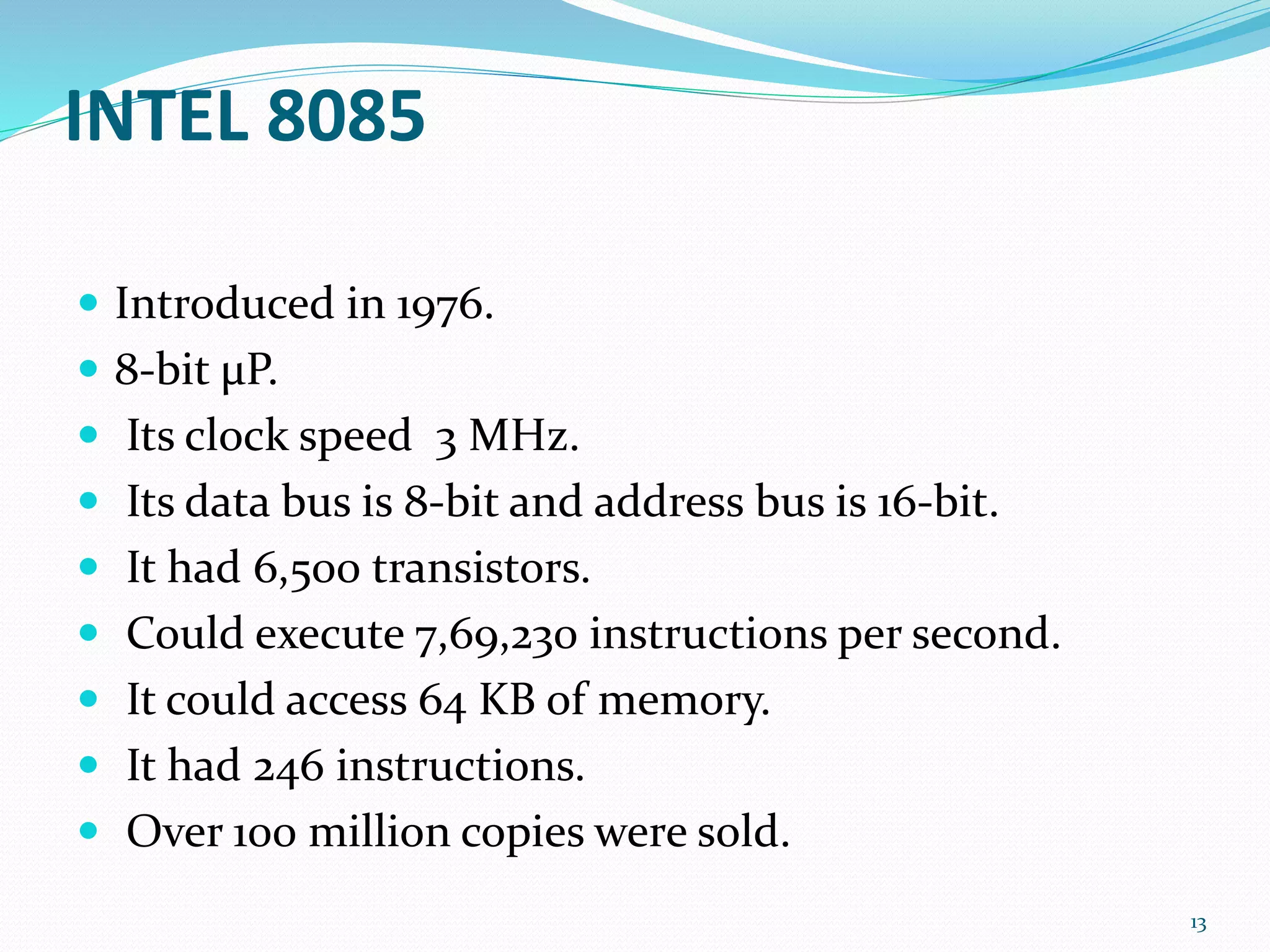
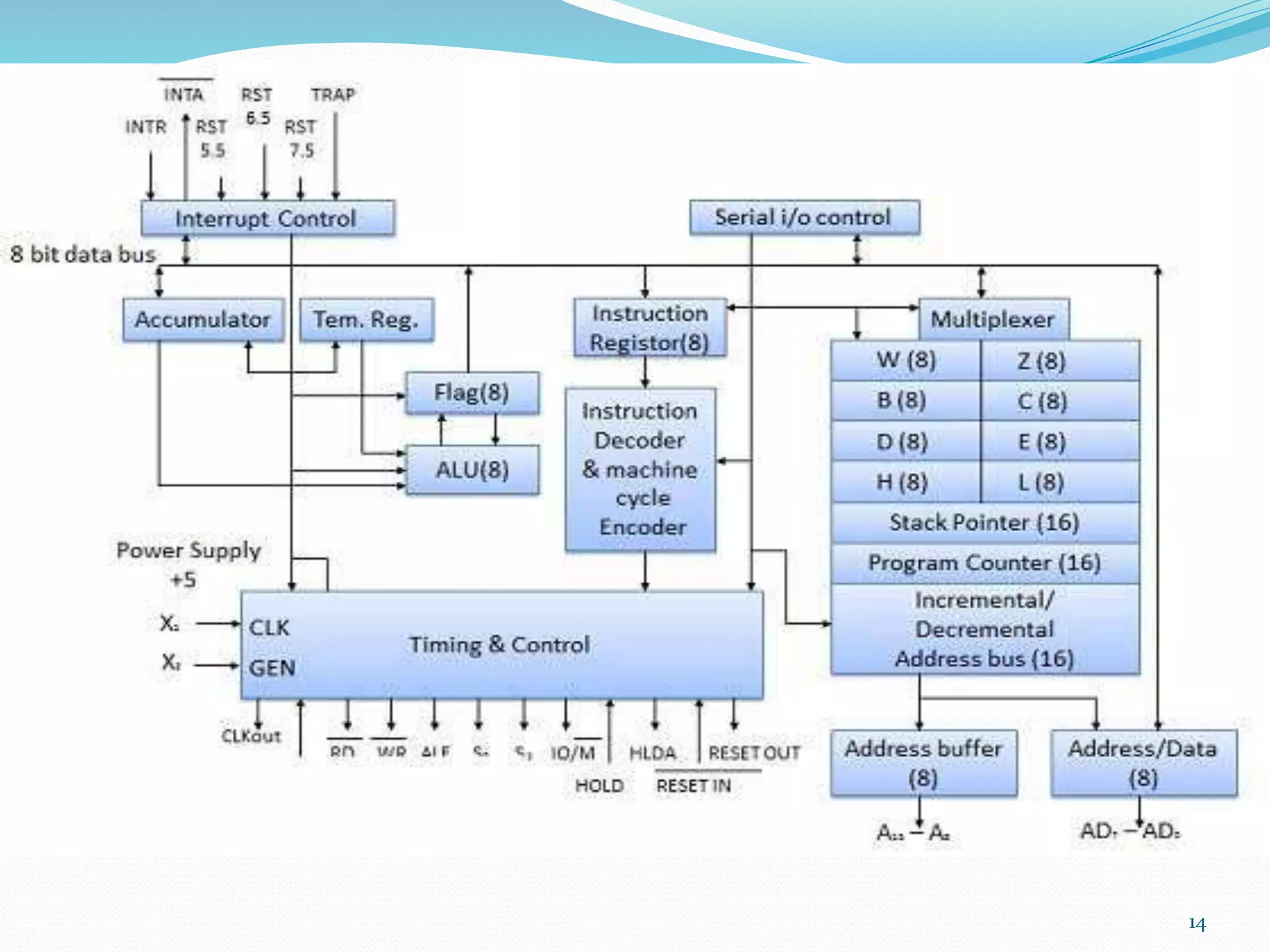
INTEL 8085
 Introduced in 1976.
 8-bit μP.
 Its clock speed 3 MHz.
 Its data bus is 8-bit and address bus is 16-bit.
 It had 6,500 transistors.
 Could execute 7,69,230 instructions per second.
 It could access 64 KB of memory.
 It had 246 instructions.
 Over 100 million copies were sold.
13
14
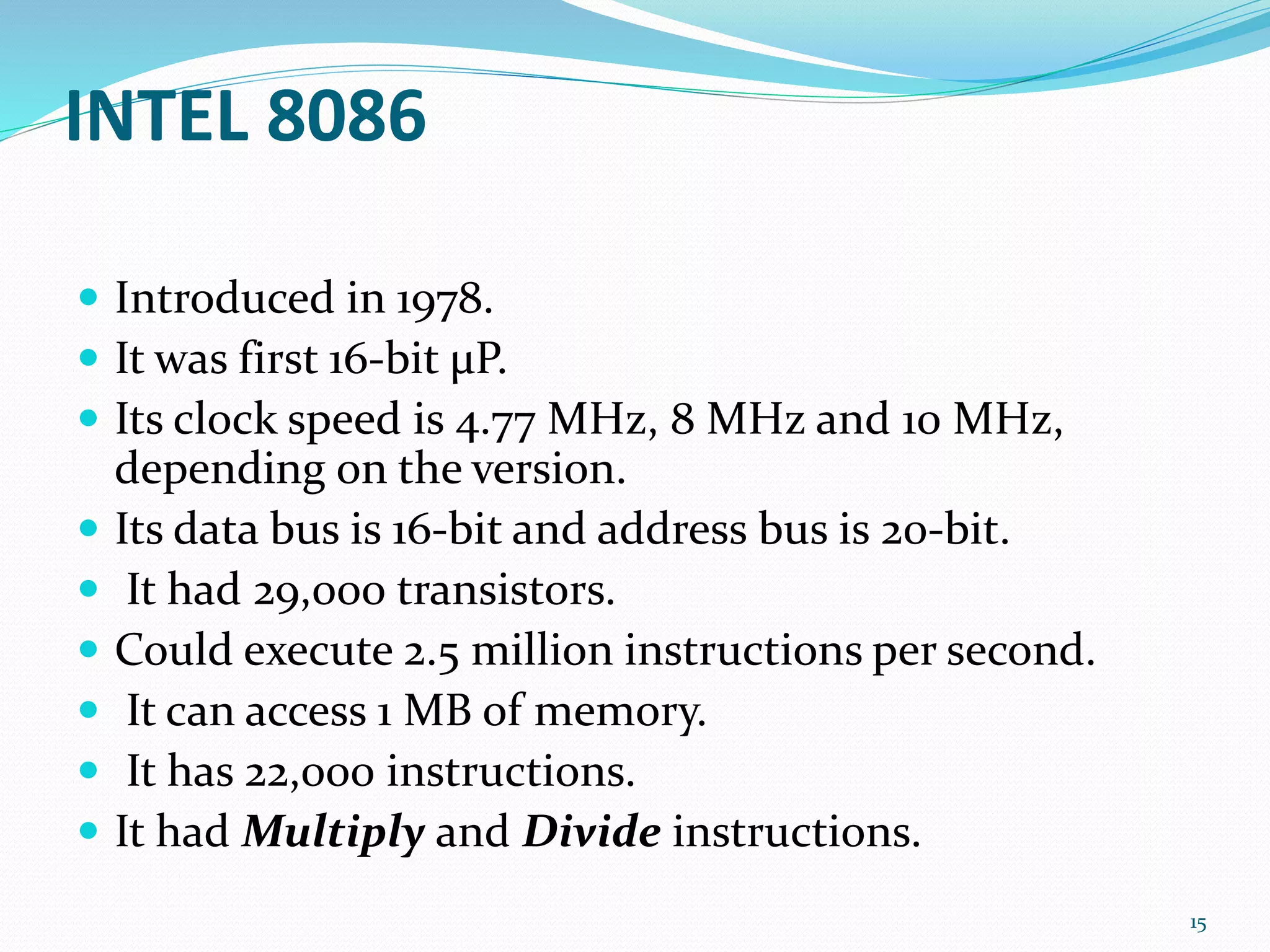
INTEL 8086
 Introduced in 1978.
 It was first 16-bit μP.
 Its clock speed is 4.77 MHz, 8 MHz and 10 MHz,
depending on the version.
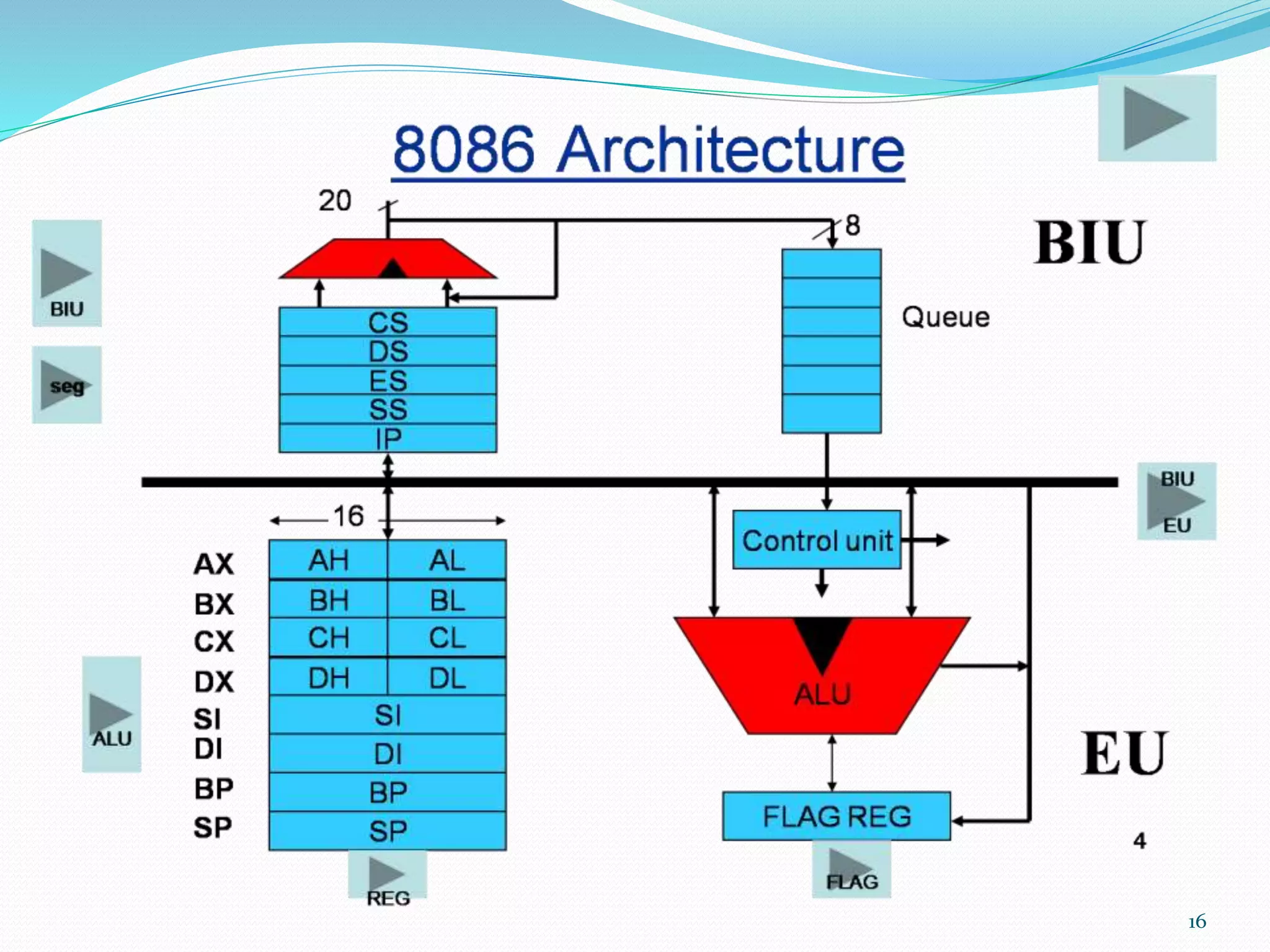
 Its data bus is 16-bit and address bus is 20-bit.
 It had 29,000 transistors.
 Could execute 2.5 million instructions per second.
 It can access 1 MB of memory.
 It has 22,000 instructions.
 It had Multiply and Divide instructions.
15
16
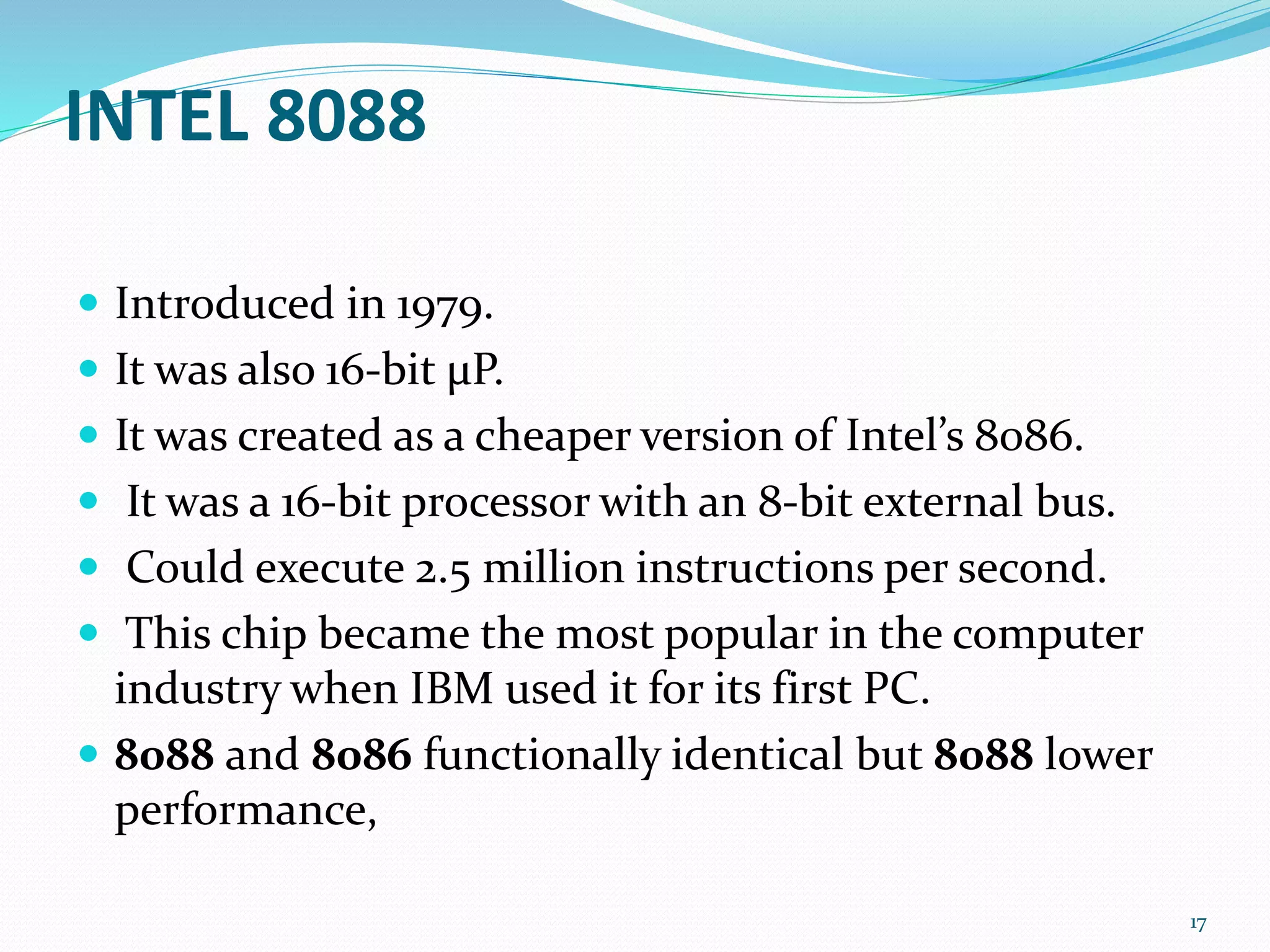
INTEL 8088
 Introduced in 1979.
 It was also 16-bit μP.
 It was created as a cheaper version of Intel’s 8086.
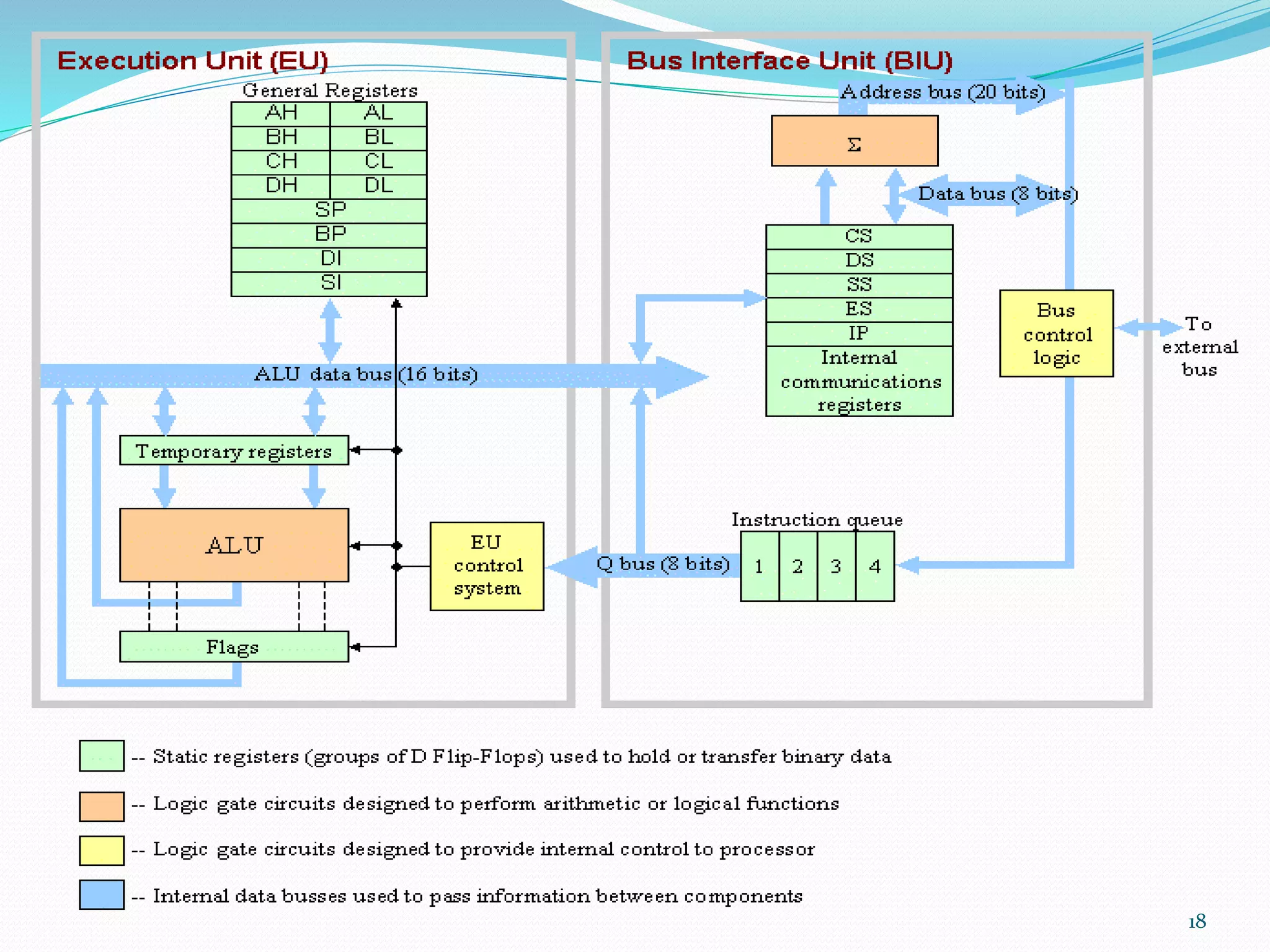
 It was a 16-bit processor with an 8-bit external bus.
 Could execute 2.5 million instructions per second.
 This chip became the most popular in the computer
industry when IBM used it for its first PC.
 8088 and 8086 functionally identical but 8088 lower
performance,
17
18
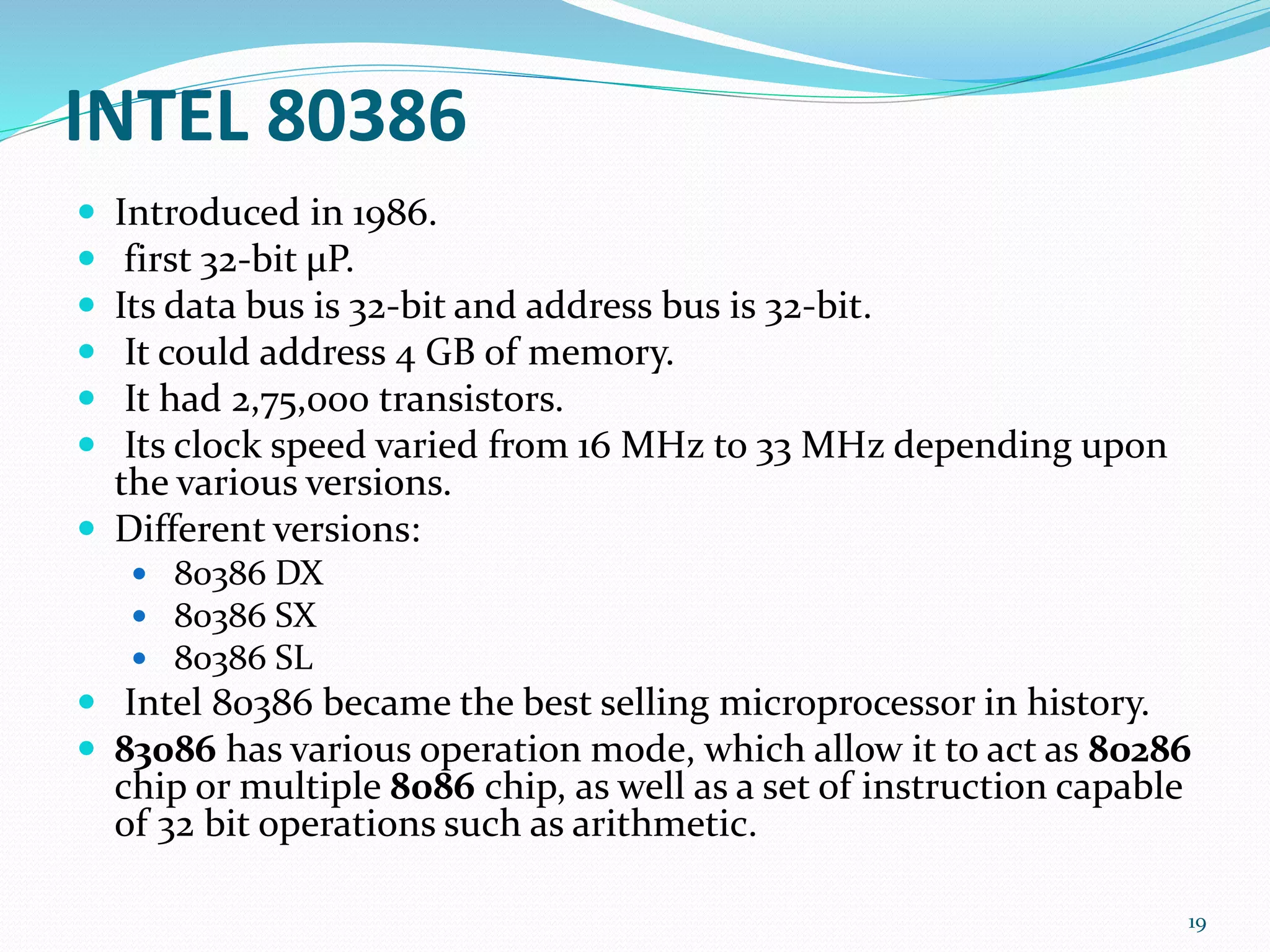
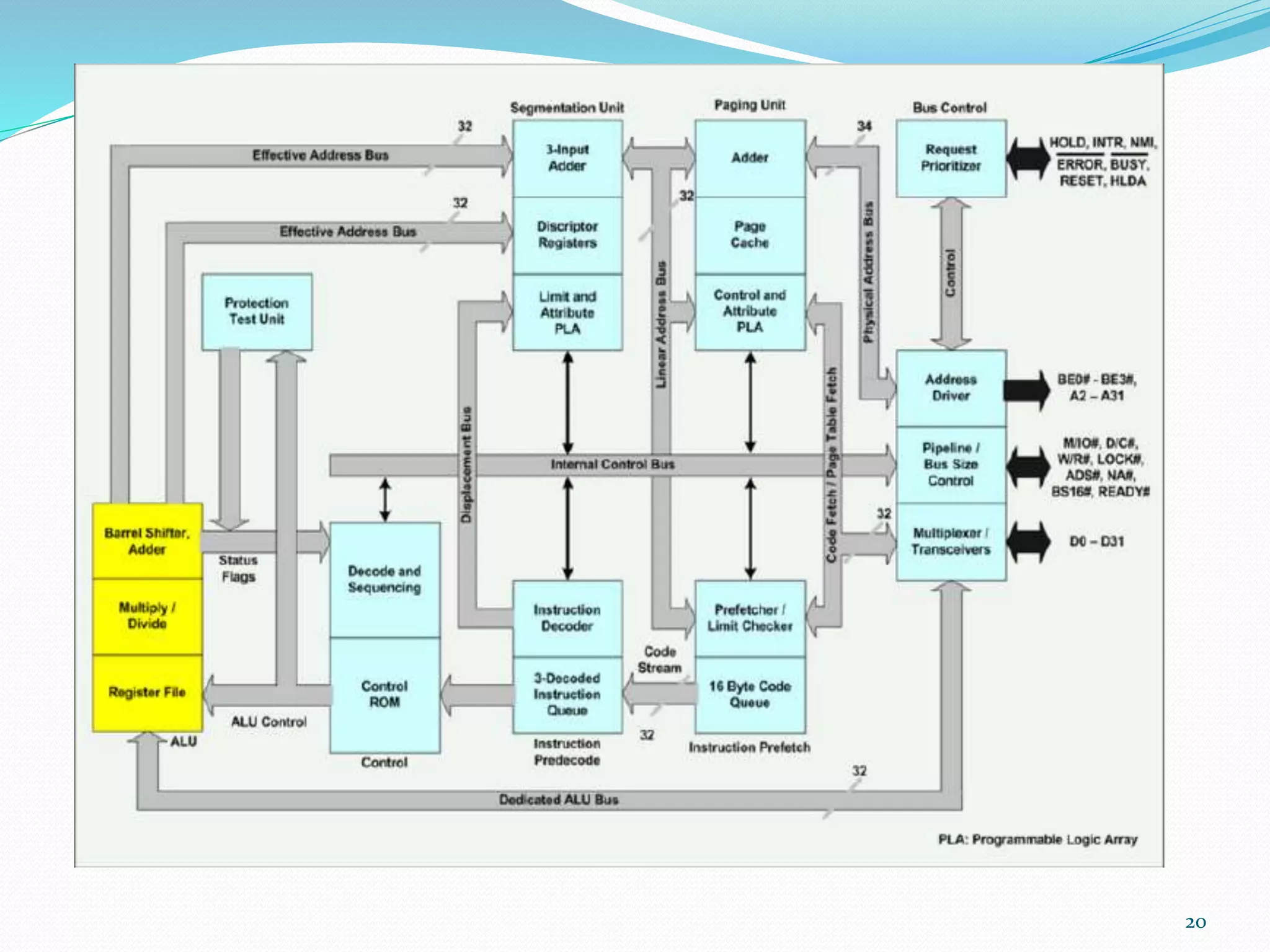
INTEL 80386
 Introduced in 1986.
 first 32-bit μP.
 Its data bus is 32-bit and address bus is 32-bit.
 It could address 4 GB of memory.
 It had 2,75,000 transistors.
 Its clock speed varied from 16 MHz to 33 MHz depending upon
the various versions.
 Different versions:
 80386 DX
 80386 SX
 80386 SL
 Intel 80386 became the best selling microprocessor in history.
 83086 has various operation mode, which allow it to act as 80286
chip or multiple 8086 chip, as well as a set of instruction capable
of 32 bit operations such as arithmetic.
19
20
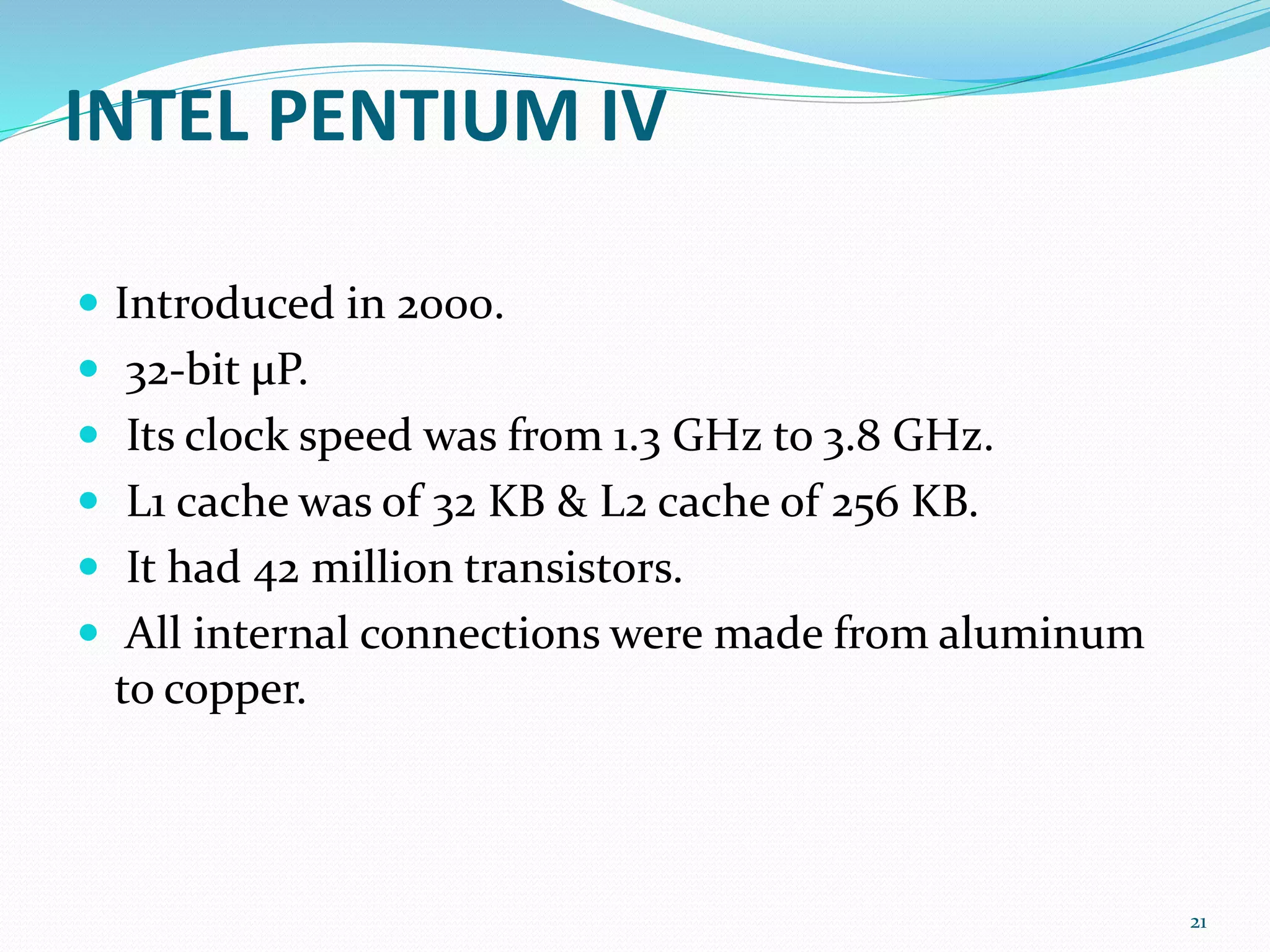
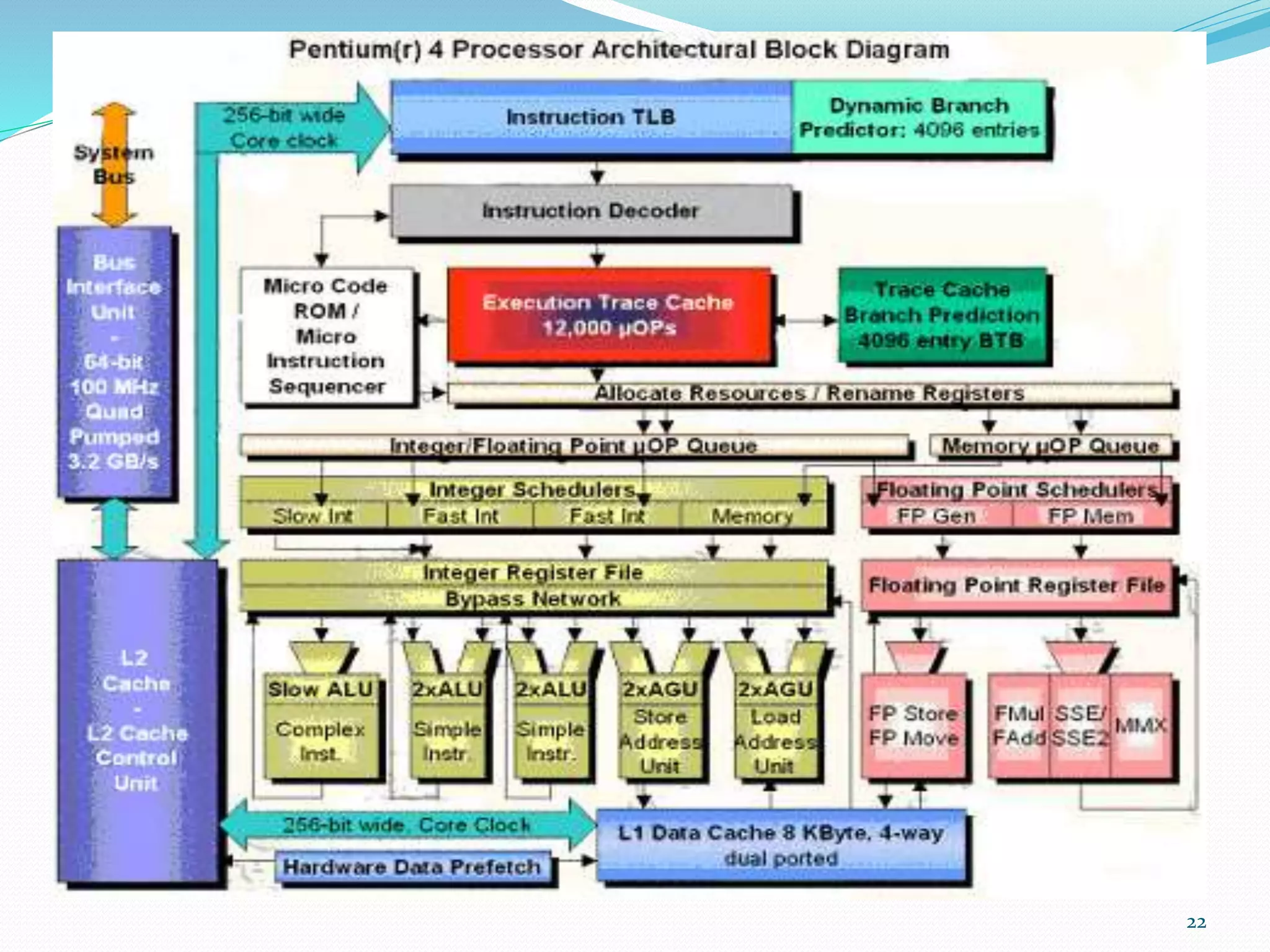
INTEL PENTIUM IV
 Introduced in 2000.
 32-bit μP.
 Its clock speed was from 1.3 GHz to 3.8 GHz.
 L1 cache was of 32 KB & L2 cache of 256 KB.
 It had 42 million transistors.
 All internal connections were made from aluminum
to copper.
21
22
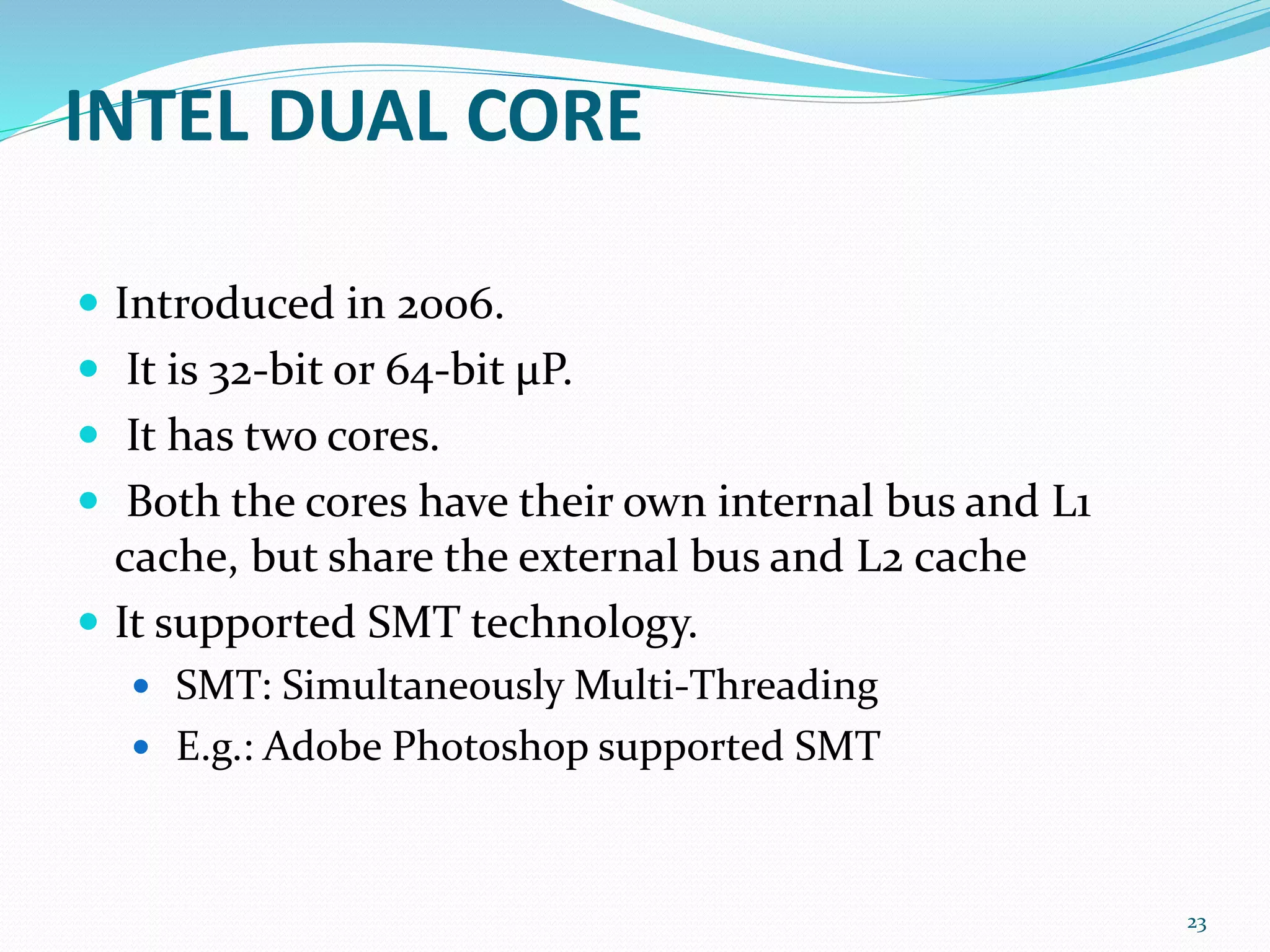
INTEL DUAL CORE
 Introduced in 2006.
 It is 32-bit or 64-bit μP.
 It has two cores.
 Both the cores have their own internal bus and L1
cache, but share the external bus and L2 cache
 It supported SMT technology.
 SMT: Simultaneously Multi-Threading
 E.g.: Adobe Photoshop supported SMT
23
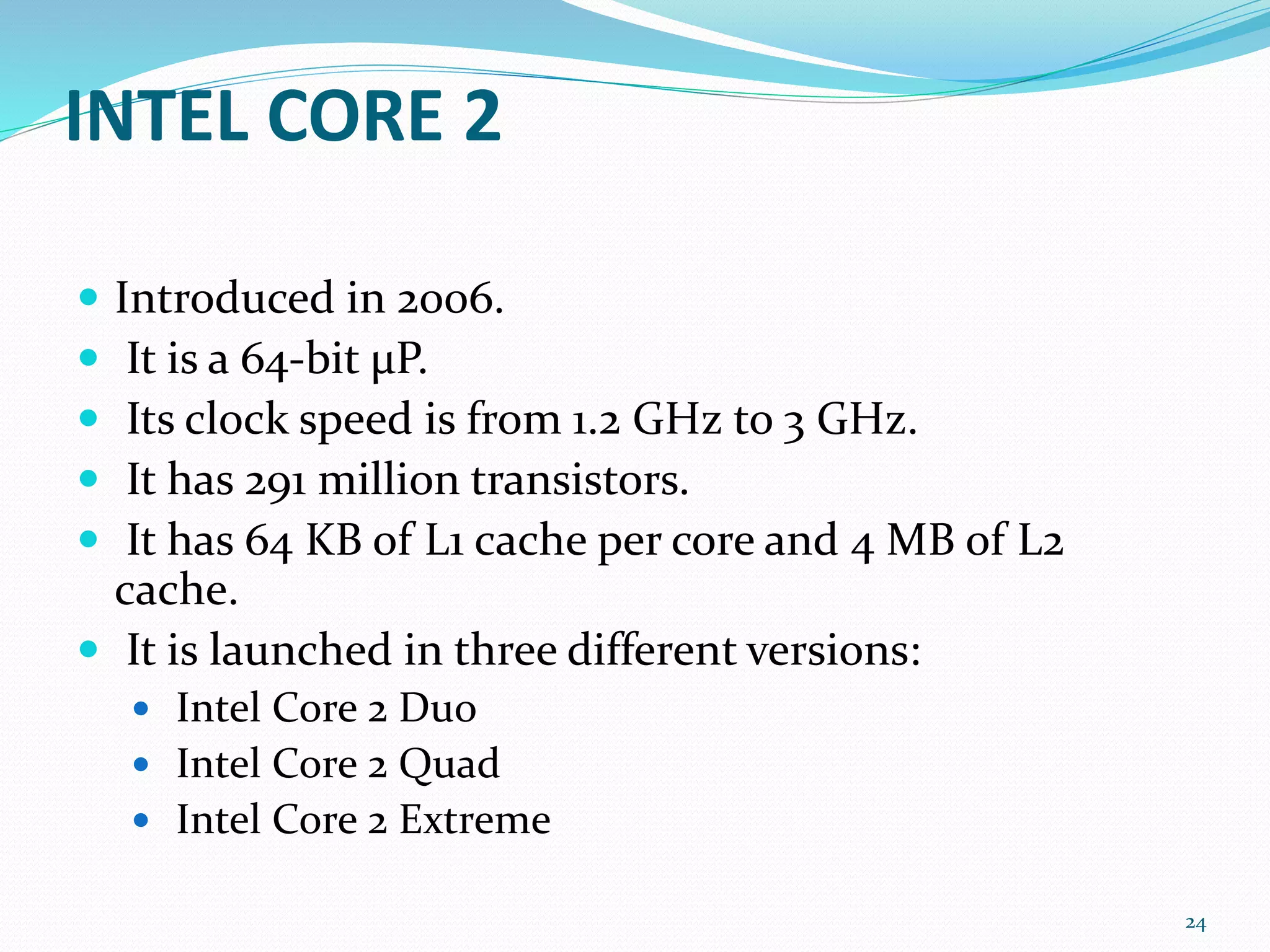
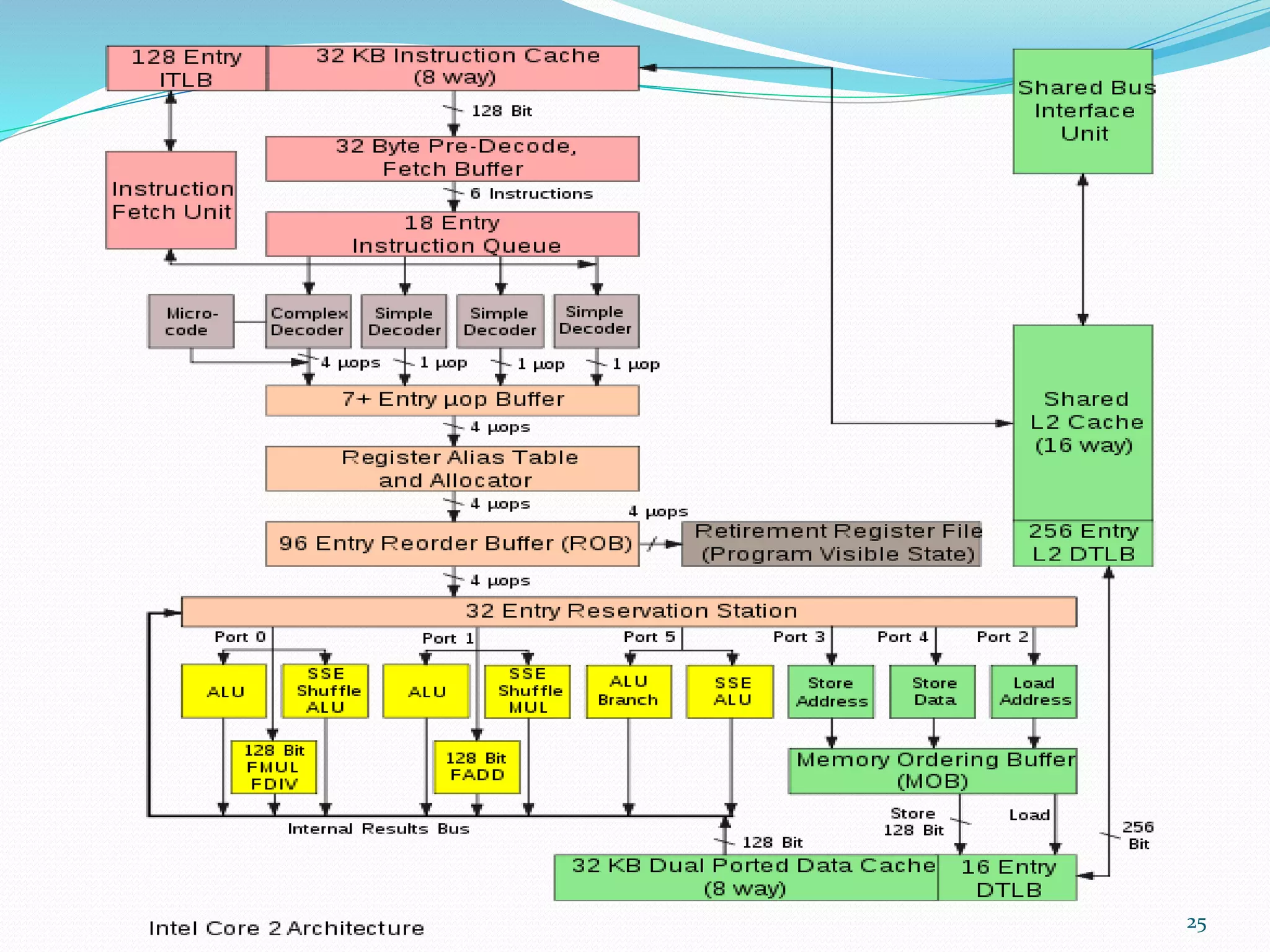
INTEL CORE 2
 Introduced in 2006.
 It is a 64-bit μP.
 Its clock speed is from 1.2 GHz to 3 GHz.
 It has 291 million transistors.
 It has 64 KB of L1 cache per core and 4 MB of L2
cache.
 It is launched in three different versions:
 Intel Core 2 Duo
 Intel Core 2 Quad
 Intel Core 2 Extreme
24
25
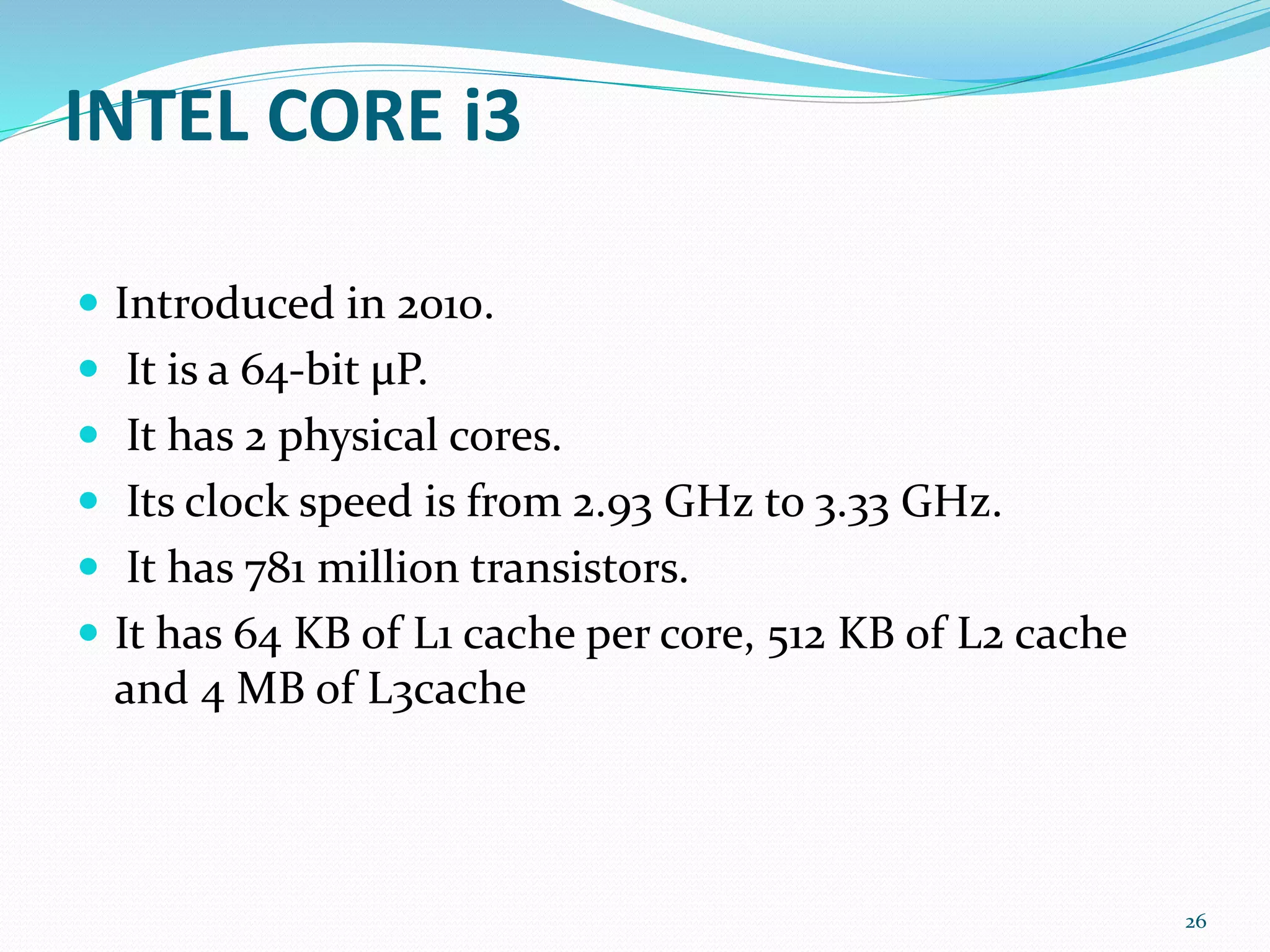
INTEL CORE i3
 Introduced in 2010.
 It is a 64-bit μP.
 It has 2 physical cores.
 Its clock speed is from 2.93 GHz to 3.33 GHz.
 It has 781 million transistors.
 It has 64 KB of L1 cache per core, 512 KB of L2 cache
and 4 MB of L3cache
26
Other processors
 Mobile Pentium processors
 Atom processors
27

History of microprocessors copy

  • 1.
  • 2.
    Generation of Microprocessors We divide the years of development of microprocessors as 5 generations  From 1970 to date 2
  • 3.
    First generation (1971– 73)  Intel Corporation introduced 4004, the first microprocessor in 1971.  During the same period:  Rockwell International’s PPS-4 (4 bits)  Intel’s 8008 (8 bits)  National Semiconductor’s IMP-16 (16 bits)  They were fabricated using PMOS technology which provided low cost, slow speed and low output currents  They were not compatible with TTL 3
  • 4.
    Second Generation (1974– 1978)  Marked the beginning of very efficient 8 – bit microprocessors.  Some of the popular processors were:  Motorola’s 6800 and 6809  Intel’s 8085  Zilog’s Z80  They were manufactured using NMOS technology.  This technology offered faster speed and higher density than PMOS  TTL compatible 4
  • 5.
    Third generation microprocessors (1979– 80)  This age dominated by 16 – bits microprocessors  Some of them were:  Intel’s 8086/80186/80286  Motorolla’s 68000/68010  They were designed using HMOS technology  HMOS provides some advantages over NMOS as  Speed-power-product of HMOS is four times better than that of NMOS  HMOS can accommodate twice the circuit density compared to NMOS  Intel used HMOS technology to recreate 8085A and named it as 8085AH with a higher price tag. 5
  • 6.
    Fourth Generation (1981– 1995)  This era marked the beginning of 32 bits microprocessors  Intel introduced 432, which was bit problematic  a clean Intel 80386 is launched.  Motorola introduced 68020/68030.  They were fabricated using low-power version of the HMOS technology called HCMOS.  Motorola introduced 32-bit RISC processors called MC88100 6
  • 7.
    Fifth Generation (1995– till date)  This age the emphasis is on introducing chips that carry on-chip functionalities and improvements in the speed of memory and I/O devices along with introduction of 64-bit microprocessors.  Intel leads the show here with Pentium, Celeron and very recently dual and quad core processors working with up to 3.5GHz speed. 7
  • 8.
    Evolution of IntelMicroprocessors 4-bit 8-bit 16-bit 32-bit 64-bit 4004 8008 8086 80386 Dual Core 4040 8080 8088 80486 Core 2 8085 80186 Pentium/80586 Core i7 80188 PII Core i5 80286 PIII Core i3 PIV Dual Core 8
  • 9.
    INTEL 4004  thefirst microprocessor by Intel.  Its clock speed was 740KHz.  It had 2,300 transistors.  It could execute around 60,000 instructions per second.  Bus width: 4 bits  4 KB program memory  640 bytes data memory  No interrupts  16-pin DIP (Dual Inline Package) 9
  • 10.
  • 11.
    INTEL 8080  Introducedin 1974.  8-bit microprocessor.  clock speed 2 MHz.  It had 6,000 transistors.  10 times faster than 8008.  execute 5,00,000 instructions per second. 11
  • 12.
  • 13.
    INTEL 8085  Introducedin 1976.  8-bit μP.  Its clock speed 3 MHz.  Its data bus is 8-bit and address bus is 16-bit.  It had 6,500 transistors.  Could execute 7,69,230 instructions per second.  It could access 64 KB of memory.  It had 246 instructions.  Over 100 million copies were sold. 13
  • 14.
  • 15.
    INTEL 8086  Introducedin 1978.  It was first 16-bit μP.  Its clock speed is 4.77 MHz, 8 MHz and 10 MHz, depending on the version.  Its data bus is 16-bit and address bus is 20-bit.  It had 29,000 transistors.  Could execute 2.5 million instructions per second.  It can access 1 MB of memory.  It has 22,000 instructions.  It had Multiply and Divide instructions. 15
  • 16.
  • 17.
    INTEL 8088  Introducedin 1979.  It was also 16-bit μP.  It was created as a cheaper version of Intel’s 8086.  It was a 16-bit processor with an 8-bit external bus.  Could execute 2.5 million instructions per second.  This chip became the most popular in the computer industry when IBM used it for its first PC.  8088 and 8086 functionally identical but 8088 lower performance, 17
  • 18.
  • 19.
    INTEL 80386  Introducedin 1986.  first 32-bit μP.  Its data bus is 32-bit and address bus is 32-bit.  It could address 4 GB of memory.  It had 2,75,000 transistors.  Its clock speed varied from 16 MHz to 33 MHz depending upon the various versions.  Different versions:  80386 DX  80386 SX  80386 SL  Intel 80386 became the best selling microprocessor in history.  83086 has various operation mode, which allow it to act as 80286 chip or multiple 8086 chip, as well as a set of instruction capable of 32 bit operations such as arithmetic. 19
  • 20.
  • 21.
    INTEL PENTIUM IV Introduced in 2000.  32-bit μP.  Its clock speed was from 1.3 GHz to 3.8 GHz.  L1 cache was of 32 KB & L2 cache of 256 KB.  It had 42 million transistors.  All internal connections were made from aluminum to copper. 21
  • 22.
  • 23.
    INTEL DUAL CORE Introduced in 2006.  It is 32-bit or 64-bit μP.  It has two cores.  Both the cores have their own internal bus and L1 cache, but share the external bus and L2 cache  It supported SMT technology.  SMT: Simultaneously Multi-Threading  E.g.: Adobe Photoshop supported SMT 23
  • 24.
    INTEL CORE 2 Introduced in 2006.  It is a 64-bit μP.  Its clock speed is from 1.2 GHz to 3 GHz.  It has 291 million transistors.  It has 64 KB of L1 cache per core and 4 MB of L2 cache.  It is launched in three different versions:  Intel Core 2 Duo  Intel Core 2 Quad  Intel Core 2 Extreme 24
  • 25.
  • 26.
    INTEL CORE i3 Introduced in 2010.  It is a 64-bit μP.  It has 2 physical cores.  Its clock speed is from 2.93 GHz to 3.33 GHz.  It has 781 million transistors.  It has 64 KB of L1 cache per core, 512 KB of L2 cache and 4 MB of L3cache 26
  • 27.
    Other processors  MobilePentium processors  Atom processors 27