EVOLUTION OF
MICROPROCESSOR
S
Dr. D. C. Diana
Associate Professor
Easwari Engineering College
1
The First µP
• Very large scale integration (VLSI)—the
acronym is the “name technology” has allowed
us to put a complete CPU on a single chip.
• The first microprocessor, the Intel 4004 in 1971,
was designed for an embedded application
“calculator”.
What is µP
The microprocessor is a programmable
device that takes in numbers, performs on them
arithmetic or logical operations according to the
program stored in memory and then produces
other numbers as a result.
It is a multi programmable clock driven
register based semiconductor device that is used
to fetch , process & execute a data within fraction
of seconds.
3
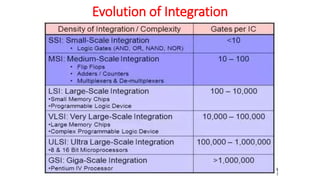
Evolution of Integration
10/1/2021 4
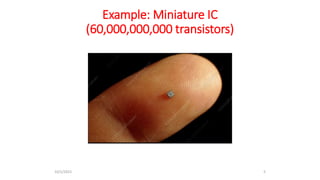
Example: Miniature IC
(60,000,000,000 transistors)
10/1/2021 5
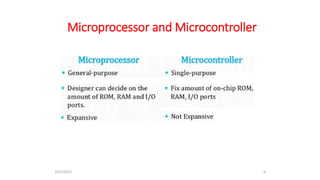
Microprocessor and Microcontroller
10/1/2021 6
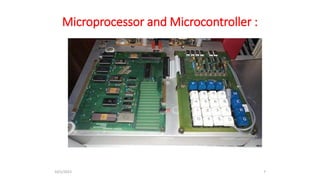
Microprocessor and Microcontroller :
10/1/2021 7
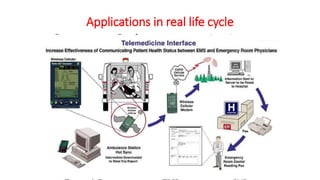
Applications in real life cycle
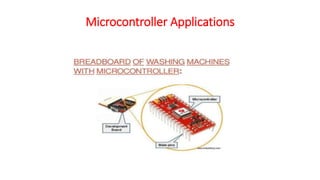
Microcontroller Applications
Applications
• Light sensing & controlling devices.
• Temperature sensing and controlling devices.
• Fire detection & safety devices.
• Industrial instrumentation devices.
• Process control devices.
• Calculators
• Accounting system
• Games machine
• Instrumentation
• Traffic light Control
• Multi user, multi-function environments
• Military applications
• Communication systems
10
MICROPROCESSOR Generations…..
11
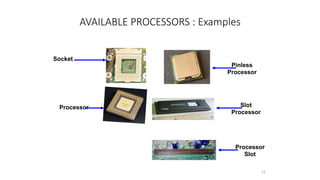
AVAILABLE PROCESSORS : Examples
Socket
Processor
Pinless
Processor
Slot
Processor
Processor
Slot
12
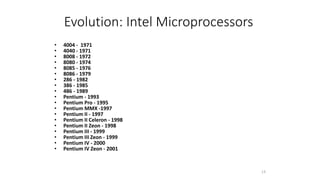
Evolution: Intel Microprocessors
• 4004 - 1971
• 4040 - 1971
• 8008 - 1972
• 8080 - 1974
• 8085 - 1976
• 8086 - 1979
• 286 - 1982
• 386 - 1985
• 486 - 1989
• Pentium - 1993
• Pentium Pro - 1995
• Pentium MMX -1997
• Pentium II - 1997
• Pentium II Celeron - 1998
• Pentium II Zeon - 1998
• Pentium III - 1999
• Pentium III Zeon - 1999
• Pentium IV - 2000
• Pentium IV Zeon - 2001
13
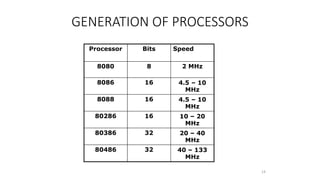
GENERATION OF PROCESSORS
Processor Bits Speed
8080 8 2 MHz
8086 16 4.5 – 10
MHz
8088 16 4.5 – 10
MHz
80286 16 10 – 20
MHz
80386 32 20 – 40
MHz
80486 32 40 – 133
MHz
14
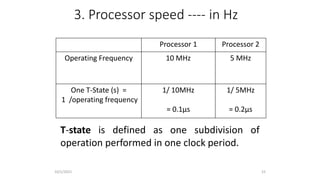
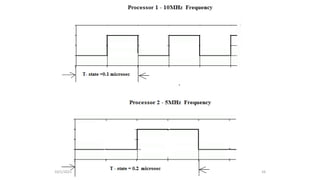
Processor 1 Processor 2
Operating Frequency 10 MHz 5 MHz
One T-State (s) =
1 /operating frequency
1/ 10MHz
= 0.1μs
1/ 5MHz
= 0.2μs
3. Processor speed ---- in Hz
T-state is defined as one subdivision of
operation performed in one clock period.
10/1/2021 15
10/1/2021 16
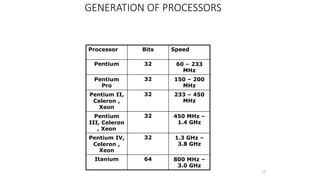
GENERATION OF PROCESSORS
Processor Bits Speed
Pentium 32 60 – 233
MHz
Pentium
Pro
32 150 – 200
MHz
Pentium II,
Celeron ,
Xeon
32 233 – 450
MHz
Pentium
III, Celeron
, Xeon
32 450 MHz –
1.4 GHz
Pentium IV,
Celeron ,
Xeon
32 1.3 GHz –
3.8 GHz
Itanium 64 800 MHz –
3.0 GHz
17
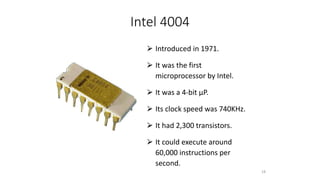
Intel 4004
⮚ Introduced in 1971.
⮚ It was the first
microprocessor by Intel.
⮚ It was a 4-bit µP.
⮚ Its clock speed was 740KHz.
⮚ It had 2,300 transistors.
⮚ It could execute around
60,000 instructions per
second.
18
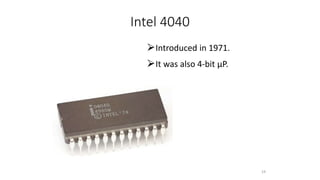
Intel 4040
⮚Introduced in 1971.
⮚It was also 4-bit µP.
19
8-bit Microprocessors
20
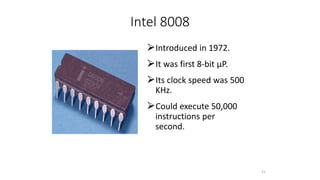
Intel 8008
⮚Introduced in 1972.
⮚It was first 8-bit µP.
⮚Its clock speed was 500
KHz.
⮚Could execute 50,000
instructions per
second.
21
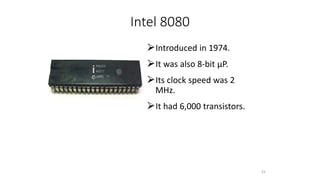
Intel 8080
⮚Introduced in 1974.
⮚It was also 8-bit µP.
⮚Its clock speed was 2
MHz.
⮚It had 6,000 transistors.
22
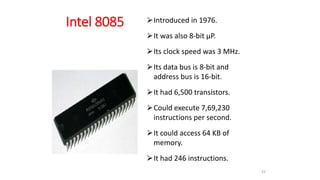
Intel 8085 ⮚Introduced in 1976.
⮚It was also 8-bit µP.
⮚Its clock speed was 3 MHz.
⮚Its data bus is 8-bit and
address bus is 16-bit.
⮚It had 6,500 transistors.
⮚Could execute 7,69,230
instructions per second.
⮚It could access 64 KB of
memory.
⮚It had 246 instructions.
23
16-bit Microprocessors
24
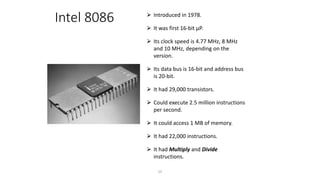
Intel 8086 ⮚ Introduced in 1978.
⮚ It was first 16-bit µP.
⮚ Its clock speed is 4.77 MHz, 8 MHz
and 10 MHz, depending on the
version.
⮚ Its data bus is 16-bit and address bus
is 20-bit.
⮚ It had 29,000 transistors.
⮚ Could execute 2.5 million instructions
per second.
⮚ It could access 1 MB of memory.
⮚ It had 22,000 instructions.
⮚ It had Multiply and Divide
instructions.
25
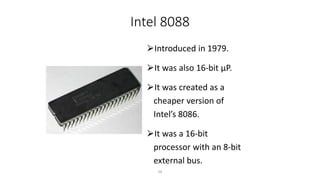
Intel 8088
⮚Introduced in 1979.
⮚It was also 16-bit µP.
⮚It was created as a
cheaper version of
Intel’s 8086.
⮚It was a 16-bit
processor with an 8-bit
external bus.
26
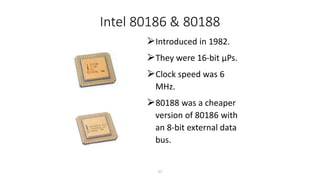
Intel 80186 & 80188
⮚Introduced in 1982.
⮚They were 16-bit µPs.
⮚Clock speed was 6
MHz.
⮚80188 was a cheaper
version of 80186 with
an 8-bit external data
bus.
27
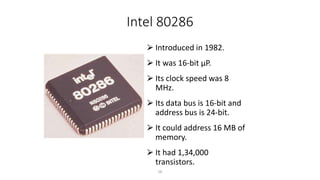
Intel 80286
⮚ Introduced in 1982.
⮚ It was 16-bit µP.
⮚ Its clock speed was 8
MHz.
⮚ Its data bus is 16-bit and
address bus is 24-bit.
⮚ It could address 16 MB of
memory.
⮚ It had 1,34,000
transistors.
28
32-bit Microprocessors
29
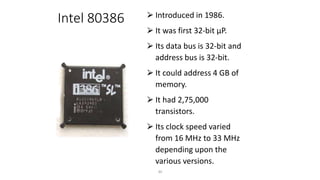
Intel 80386 ⮚ Introduced in 1986.
⮚ It was first 32-bit µP.
⮚ Its data bus is 32-bit and
address bus is 32-bit.
⮚ It could address 4 GB of
memory.
⮚ It had 2,75,000
transistors.
⮚ Its clock speed varied
from 16 MHz to 33 MHz
depending upon the
various versions.
30
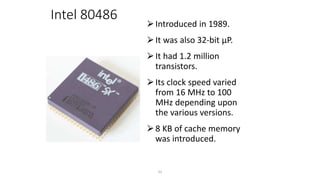
Intel 80486
⮚Introduced in 1989.
⮚It was also 32-bit µP.
⮚It had 1.2 million
transistors.
⮚Its clock speed varied
from 16 MHz to 100
MHz depending upon
the various versions.
⮚8 KB of cache memory
was introduced.
31
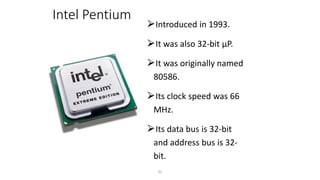
Intel Pentium
⮚Introduced in 1993.
⮚It was also 32-bit µP.
⮚It was originally named
80586.
⮚Its clock speed was 66
MHz.
⮚Its data bus is 32-bit
and address bus is 32-
bit.
32
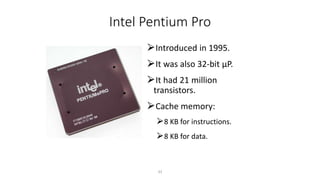
Intel Pentium Pro
⮚Introduced in 1995.
⮚It was also 32-bit µP.
⮚It had 21 million
transistors.
⮚Cache memory:
⮚8 KB for instructions.
⮚8 KB for data.
33
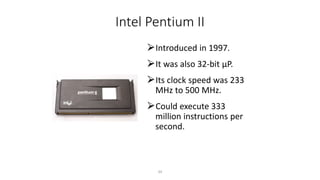
Intel Pentium II
⮚Introduced in 1997.
⮚It was also 32-bit µP.
⮚Its clock speed was 233
MHz to 500 MHz.
⮚Could execute 333
million instructions per
second.
34
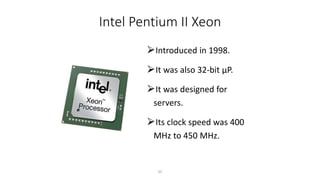
Intel Pentium II Xeon
⮚Introduced in 1998.
⮚It was also 32-bit µP.
⮚It was designed for
servers.
⮚Its clock speed was 400
MHz to 450 MHz.
35
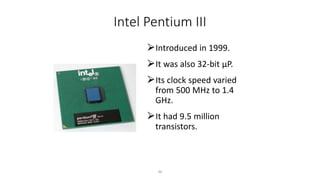
Intel Pentium III
⮚Introduced in 1999.
⮚It was also 32-bit µP.
⮚Its clock speed varied
from 500 MHz to 1.4
GHz.
⮚It had 9.5 million
transistors.
36
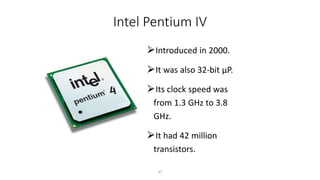
Intel Pentium IV
⮚Introduced in 2000.
⮚It was also 32-bit µP.
⮚Its clock speed was
from 1.3 GHz to 3.8
GHz.
⮚It had 42 million
transistors.
37
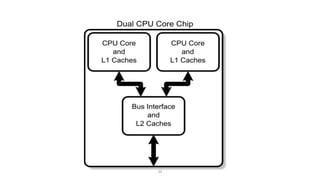
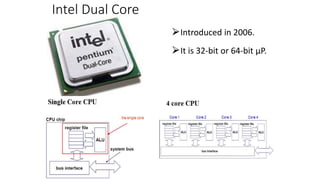
Intel Dual Core
⮚Introduced in 2006.
⮚It is 32-bit or 64-bit µP.
38
39
64-bit Microprocessors
40
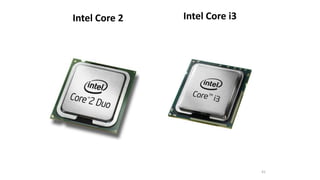
Intel Core 2 Intel Core i3
41
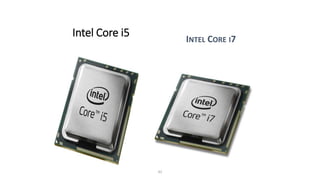
Intel Core i5 INTEL CORE I7
42

Microprocessor GENERARIONS.pptx

  • 1.
    EVOLUTION OF MICROPROCESSOR S Dr. D.C. Diana Associate Professor Easwari Engineering College 1
  • 2.
    The First µP •Very large scale integration (VLSI)—the acronym is the “name technology” has allowed us to put a complete CPU on a single chip. • The first microprocessor, the Intel 4004 in 1971, was designed for an embedded application “calculator”.
  • 3.
    What is µP Themicroprocessor is a programmable device that takes in numbers, performs on them arithmetic or logical operations according to the program stored in memory and then produces other numbers as a result. It is a multi programmable clock driven register based semiconductor device that is used to fetch , process & execute a data within fraction of seconds. 3
  • 4.
  • 5.
    Example: Miniature IC (60,000,000,000transistors) 10/1/2021 5
  • 6.
  • 7.
  • 8.
  • 9.
  • 10.
    Applications • Light sensing& controlling devices. • Temperature sensing and controlling devices. • Fire detection & safety devices. • Industrial instrumentation devices. • Process control devices. • Calculators • Accounting system • Games machine • Instrumentation • Traffic light Control • Multi user, multi-function environments • Military applications • Communication systems 10
  • 11.
  • 12.
    AVAILABLE PROCESSORS :Examples Socket Processor Pinless Processor Slot Processor Processor Slot 12
  • 13.
    Evolution: Intel Microprocessors •4004 - 1971 • 4040 - 1971 • 8008 - 1972 • 8080 - 1974 • 8085 - 1976 • 8086 - 1979 • 286 - 1982 • 386 - 1985 • 486 - 1989 • Pentium - 1993 • Pentium Pro - 1995 • Pentium MMX -1997 • Pentium II - 1997 • Pentium II Celeron - 1998 • Pentium II Zeon - 1998 • Pentium III - 1999 • Pentium III Zeon - 1999 • Pentium IV - 2000 • Pentium IV Zeon - 2001 13
  • 14.
    GENERATION OF PROCESSORS ProcessorBits Speed 8080 8 2 MHz 8086 16 4.5 – 10 MHz 8088 16 4.5 – 10 MHz 80286 16 10 – 20 MHz 80386 32 20 – 40 MHz 80486 32 40 – 133 MHz 14
  • 15.
    Processor 1 Processor2 Operating Frequency 10 MHz 5 MHz One T-State (s) = 1 /operating frequency 1/ 10MHz = 0.1μs 1/ 5MHz = 0.2μs 3. Processor speed ---- in Hz T-state is defined as one subdivision of operation performed in one clock period. 10/1/2021 15
  • 16.
  • 17.
    GENERATION OF PROCESSORS ProcessorBits Speed Pentium 32 60 – 233 MHz Pentium Pro 32 150 – 200 MHz Pentium II, Celeron , Xeon 32 233 – 450 MHz Pentium III, Celeron , Xeon 32 450 MHz – 1.4 GHz Pentium IV, Celeron , Xeon 32 1.3 GHz – 3.8 GHz Itanium 64 800 MHz – 3.0 GHz 17
  • 18.
    Intel 4004 ⮚ Introducedin 1971. ⮚ It was the first microprocessor by Intel. ⮚ It was a 4-bit µP. ⮚ Its clock speed was 740KHz. ⮚ It had 2,300 transistors. ⮚ It could execute around 60,000 instructions per second. 18
  • 19.
    Intel 4040 ⮚Introduced in1971. ⮚It was also 4-bit µP. 19
  • 20.
  • 21.
    Intel 8008 ⮚Introduced in1972. ⮚It was first 8-bit µP. ⮚Its clock speed was 500 KHz. ⮚Could execute 50,000 instructions per second. 21
  • 22.
    Intel 8080 ⮚Introduced in1974. ⮚It was also 8-bit µP. ⮚Its clock speed was 2 MHz. ⮚It had 6,000 transistors. 22
  • 23.
    Intel 8085 ⮚Introducedin 1976. ⮚It was also 8-bit µP. ⮚Its clock speed was 3 MHz. ⮚Its data bus is 8-bit and address bus is 16-bit. ⮚It had 6,500 transistors. ⮚Could execute 7,69,230 instructions per second. ⮚It could access 64 KB of memory. ⮚It had 246 instructions. 23
  • 24.
  • 25.
    Intel 8086 ⮚Introduced in 1978. ⮚ It was first 16-bit µP. ⮚ Its clock speed is 4.77 MHz, 8 MHz and 10 MHz, depending on the version. ⮚ Its data bus is 16-bit and address bus is 20-bit. ⮚ It had 29,000 transistors. ⮚ Could execute 2.5 million instructions per second. ⮚ It could access 1 MB of memory. ⮚ It had 22,000 instructions. ⮚ It had Multiply and Divide instructions. 25
  • 26.
    Intel 8088 ⮚Introduced in1979. ⮚It was also 16-bit µP. ⮚It was created as a cheaper version of Intel’s 8086. ⮚It was a 16-bit processor with an 8-bit external bus. 26
  • 27.
    Intel 80186 &80188 ⮚Introduced in 1982. ⮚They were 16-bit µPs. ⮚Clock speed was 6 MHz. ⮚80188 was a cheaper version of 80186 with an 8-bit external data bus. 27
  • 28.
    Intel 80286 ⮚ Introducedin 1982. ⮚ It was 16-bit µP. ⮚ Its clock speed was 8 MHz. ⮚ Its data bus is 16-bit and address bus is 24-bit. ⮚ It could address 16 MB of memory. ⮚ It had 1,34,000 transistors. 28
  • 29.
  • 30.
    Intel 80386 ⮚Introduced in 1986. ⮚ It was first 32-bit µP. ⮚ Its data bus is 32-bit and address bus is 32-bit. ⮚ It could address 4 GB of memory. ⮚ It had 2,75,000 transistors. ⮚ Its clock speed varied from 16 MHz to 33 MHz depending upon the various versions. 30
  • 31.
    Intel 80486 ⮚Introduced in1989. ⮚It was also 32-bit µP. ⮚It had 1.2 million transistors. ⮚Its clock speed varied from 16 MHz to 100 MHz depending upon the various versions. ⮚8 KB of cache memory was introduced. 31
  • 32.
    Intel Pentium ⮚Introduced in1993. ⮚It was also 32-bit µP. ⮚It was originally named 80586. ⮚Its clock speed was 66 MHz. ⮚Its data bus is 32-bit and address bus is 32- bit. 32
  • 33.
    Intel Pentium Pro ⮚Introducedin 1995. ⮚It was also 32-bit µP. ⮚It had 21 million transistors. ⮚Cache memory: ⮚8 KB for instructions. ⮚8 KB for data. 33
  • 34.
    Intel Pentium II ⮚Introducedin 1997. ⮚It was also 32-bit µP. ⮚Its clock speed was 233 MHz to 500 MHz. ⮚Could execute 333 million instructions per second. 34
  • 35.
    Intel Pentium IIXeon ⮚Introduced in 1998. ⮚It was also 32-bit µP. ⮚It was designed for servers. ⮚Its clock speed was 400 MHz to 450 MHz. 35
  • 36.
    Intel Pentium III ⮚Introducedin 1999. ⮚It was also 32-bit µP. ⮚Its clock speed varied from 500 MHz to 1.4 GHz. ⮚It had 9.5 million transistors. 36
  • 37.
    Intel Pentium IV ⮚Introducedin 2000. ⮚It was also 32-bit µP. ⮚Its clock speed was from 1.3 GHz to 3.8 GHz. ⮚It had 42 million transistors. 37
  • 38.
    Intel Dual Core ⮚Introducedin 2006. ⮚It is 32-bit or 64-bit µP. 38
  • 39.
  • 40.
  • 41.
    Intel Core 2Intel Core i3 41
  • 42.
    Intel Core i5INTEL CORE I7 42