BY :-
   GANESH RAM
NITTTR, KOLKATA
**** A MICROCONTROLLER IS A SINGLE CHIP
    MICROPROCESSOR SYSTEM WHICH CONSISTS OF
    CPU, DATA AND PROGRAM MEMORY, SERIAL
    AND PARALLEL I/O PORTS, TIMERS AND
    EXTERNAL AS WELL AS INTERNAL INTERRUPTS.
** IT CAN ALSO BE CALLED AS A ENTIRE
    COMPUTER MANUFACTURED ON A SINGLE
    CHIP.
   Microcontroller 8051 was first developed by
    INTEL, for use in embedded systems.
    it consisted of standard on chip peripherals i.e.
    timers, counters, 4k bytes of on chip program
    memory and 128 bytes of data memory.
   It has separate spaces for program memory and
    data memory.
   It has 128 byte of data memory that are
    accessible directly by its instructions.
   8051 CENTRAL PROCESSING UNITS
   4k *8 ROM
   128*8 RAM
   Three 16 bit counters/timers.
   Full duplex serial channels
   Boolean processor full static operation


   MEMORY ADDRESSING CAPABILITY
   64k ROM and 64k RAM
   POWER CONTROL MODES:-
     - idle mode
     - power-down mode

   CMOS and TTL compatible
   Frequency range of 0 to 33 MHz
   4 level priority interrupts
   6 interrupt services
   Four 8 bit i/o ports.
   ACCUMULATOR(ACC):- it is used for data
    transfer and arithmetic operations. After any
    operation result is stored in ACC and can be
    accessed through its SFR address of 0E0H.

   B REGISTER:- it is used to store the upper 8 bit
    result of multiplication and divisions. It is used
    as temporary register and can be accessed
    through its SFR address of 0F0H.
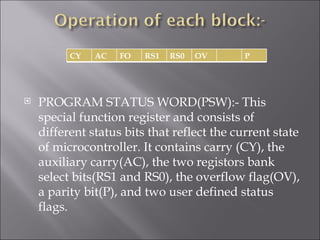
CY   AC   FO   RS1   RS0   OV      P


   PROGRAM STATUS WORD(PSW):- This
    special function register and consists of
    different status bits that reflect the current state
    of microcontroller. It contains carry (CY), the
    auxiliary carry(AC), the two registors bank
    select bits(RS1 and RS0), the overflow flag(OV),
    a parity bit(P), and two user defined status
    flags.
   STACK POINTER(SP):- This is an 8 bit register. SP
    is incremented before the data is stored onto the
    stack using PUSH/CALL instructions execution.
    During PUSH, first SP is incremented and then
    copy the data. In the POP operation, initially copy
    the data and then decrement the SP.

   DATA POINTER(DTPR):- DTPR is a 16 bit
    register. It consists of higher byte (DPH) and a
    lower byte (DPL). DPTR is very useful for string
    operations and look up table operations. With a 16
    bit DPTR, a maximum of 64K of off chip data
    memory and 64k of off chip memory can be
    addressed.
PORT0, PORT1, PORT2, PORT3 LATCHES AND
  DRIVERS:- Each latch and corresponding
  drivers of port 0-3 is allotted to the
  corresponding on chip I/O port.

Architecture of 8051 microcontroller))

  • 1.
    BY :- GANESH RAM NITTTR, KOLKATA
  • 2.
    **** A MICROCONTROLLERIS A SINGLE CHIP MICROPROCESSOR SYSTEM WHICH CONSISTS OF CPU, DATA AND PROGRAM MEMORY, SERIAL AND PARALLEL I/O PORTS, TIMERS AND EXTERNAL AS WELL AS INTERNAL INTERRUPTS. ** IT CAN ALSO BE CALLED AS A ENTIRE COMPUTER MANUFACTURED ON A SINGLE CHIP.
  • 3.
    Microcontroller 8051 was first developed by INTEL, for use in embedded systems.  it consisted of standard on chip peripherals i.e. timers, counters, 4k bytes of on chip program memory and 128 bytes of data memory.  It has separate spaces for program memory and data memory.  It has 128 byte of data memory that are accessible directly by its instructions.
  • 4.
    8051 CENTRAL PROCESSING UNITS  4k *8 ROM  128*8 RAM  Three 16 bit counters/timers.  Full duplex serial channels  Boolean processor full static operation  MEMORY ADDRESSING CAPABILITY  64k ROM and 64k RAM
  • 5.
    POWER CONTROL MODES:-  - idle mode  - power-down mode  CMOS and TTL compatible  Frequency range of 0 to 33 MHz  4 level priority interrupts  6 interrupt services  Four 8 bit i/o ports.
  • 7.
    ACCUMULATOR(ACC):- it is used for data transfer and arithmetic operations. After any operation result is stored in ACC and can be accessed through its SFR address of 0E0H.  B REGISTER:- it is used to store the upper 8 bit result of multiplication and divisions. It is used as temporary register and can be accessed through its SFR address of 0F0H.
  • 8.
    CY AC FO RS1 RS0 OV P  PROGRAM STATUS WORD(PSW):- This special function register and consists of different status bits that reflect the current state of microcontroller. It contains carry (CY), the auxiliary carry(AC), the two registors bank select bits(RS1 and RS0), the overflow flag(OV), a parity bit(P), and two user defined status flags.
  • 9.
    STACK POINTER(SP):- This is an 8 bit register. SP is incremented before the data is stored onto the stack using PUSH/CALL instructions execution. During PUSH, first SP is incremented and then copy the data. In the POP operation, initially copy the data and then decrement the SP.  DATA POINTER(DTPR):- DTPR is a 16 bit register. It consists of higher byte (DPH) and a lower byte (DPL). DPTR is very useful for string operations and look up table operations. With a 16 bit DPTR, a maximum of 64K of off chip data memory and 64k of off chip memory can be addressed.
  • 10.
    PORT0, PORT1, PORT2,PORT3 LATCHES AND DRIVERS:- Each latch and corresponding drivers of port 0-3 is allotted to the corresponding on chip I/O port.