Evolution of
Intel Processors
Presented by:
SAYED SHAD AHMAD ZAIDI
VI Semester 2013BCA139 GG0772
Presentation on
2
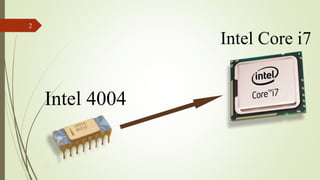
Intel 4004
Intel Core i7
Contents
Introduction
4-bit processors
8-bit processors
16-bit processors
32-bit processors
64-bit processors
Modern Trends
Conclusion
3
Introduction4
Founded on July 18, 1968
Founders:
Robert Noyce
Gorden Moore
Andrew
Headquartered in Santa Clara, California
Grew as start up in 1968 to industrial grant by 1981
Above1 lakhs employees, $55 billion revenue
Intel Corporation
Contents
Introduction
4-bit processors
8-bit processors
16-bit processors
32-bit processors
64-bit processors
Modern Trends
Conclusion
5
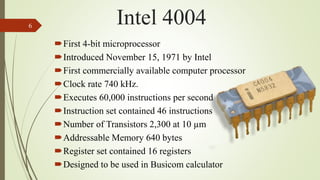
First 4-bit microprocessor
Introduced November 15, 1971 by Intel
First commercially available computer processor
Clock rate 740 kHz.
Executes 60,000 instructions per second
Instruction set contained 46 instructions
Number of Transistors 2,300 at 10 µm
Addressable Memory 640 bytes
Register set contained 16 registers
Designed to be used in Busicom calculator
6
Intel 4004
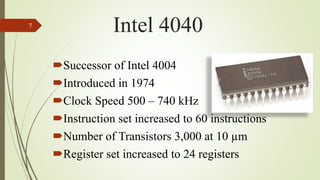
Successor of Intel 4004
Introduced in 1974
Clock Speed 500 – 740 kHz
Instruction set increased to 60 instructions
Number of Transistors 3,000 at 10 µm
Register set increased to 24 registers
7
Intel 4040
Contents
Introduction
4-bit processors
8-bit processors
16-bit processors
32-bit processors
64-bit processors
Modern Trends
Conclusion
8
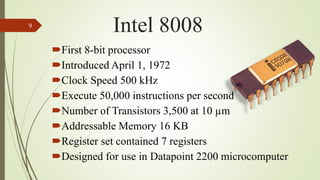
First 8-bit processor
Introduced April 1, 1972
Clock Speed 500 kHz
Execute 50,000 instructions per second
Number of Transistors 3,500 at 10 µm
Addressable Memory 16 KB
Register set contained 7 registers
Designed for use in Datapoint 2200 microcomputer
9
Intel 8008
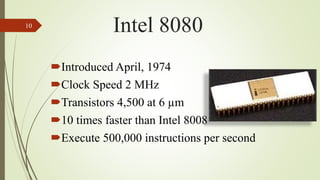
Introduced April, 1974
Clock Speed 2 MHz
Transistors 4,500 at 6 µm
10 times faster than Intel 8008
Execute 500,000 instructions per second
10
Intel 8080
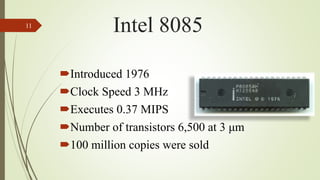
Introduced 1976
Clock Speed 3 MHz
Executes 0.37 MIPS
Number of transistors 6,500 at 3 μm
100 million copies were sold
11
Intel 8085
Contents
Introduction
4-bit processors
8-bit processors
16-bit processors
32-bit processors
64-bit processors
Modern Trends
Conclusion
12
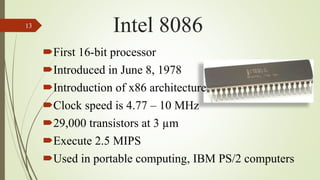
First 16-bit processor
Introduced in June 8, 1978
Introduction of x86 architecture
Clock speed is 4.77 – 10 MHz
29,000 transistors at 3 µm
Execute 2.5 MIPS
Used in portable computing, IBM PS/2 computers
13
Intel 8086
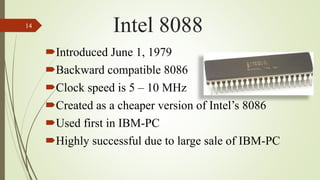
Introduced June 1, 1979
Backward compatible 8086
Clock speed is 5 – 10 MHz
Created as a cheaper version of Intel’s 8086
Used first in IBM-PC
Highly successful due to large sale of IBM-PC
14
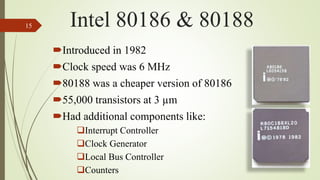
Intel 8088
Introduced in 1982
Clock speed was 6 MHz
80188 was a cheaper version of 80186
55,000 transistors at 3 µm
Had additional components like:
Interrupt Controller
Clock Generator
Local Bus Controller
Counters
15 Intel 80186 & 80188
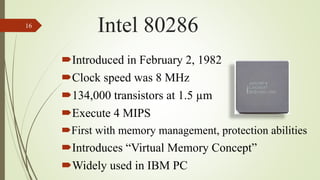
Introduced in February 2, 1982
Clock speed was 8 MHz
134,000 transistors at 1.5 µm
Execute 4 MIPS
First with memory management, protection abilities
Introduces “Virtual Memory Concept”
Widely used in IBM PC
16
Intel 80286
Contents
Introduction
4-bit processors
8-bit processors
16-bit processors
32-bit processors
64-bit processors
Modern Trends
Conclusion
17
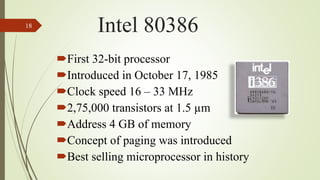
First 32-bit processor
Introduced in October 17, 1985
Clock speed 16 – 33 MHz
2,75,000 transistors at 1.5 µm
Address 4 GB of memory
Concept of paging was introduced
Best selling microprocessor in history
18
Intel 80386
Introduced in 1989
1.2 million transistors at 1 µm
Clock speed 16 – 100 MHz
1 TB Virtual Memory
Cache Memory of 8 KB was introduced
Used in Desktop computing and Servers
19
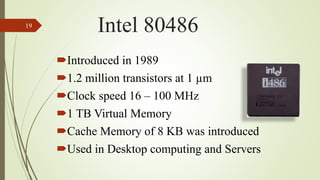
Intel 80486
Introduced in March 22, 1993
Originally named 80586
Clock speed 60 – 66 MHz
Executes 110 MIPS
3.1 million transistors at 0.8 µm
Virtual Memory 64 TB
16 KB L1 cache memory
20
Intel Pentium
Introduced in November 1, 1995
Clock speed 150 – 200 MHz
5.5 million transistors at 0.5 µm
16 KB L1 cache memory
256 KB L2 cache memory
Access up to 64GB of memory
Primarily designed for servers
Used in ASCI Red supercomputer
21
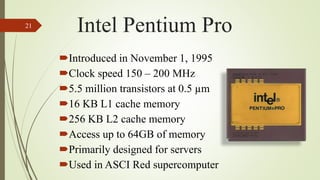
Intel Pentium Pro
Introduced on May 7, 1997
Clock speed 233 - 450 MHz
7.5 million transistors at 0.35 µm
Execute 333 MIPS
L2 cache & processor were on one circuit
22
Intel Pentium II
Introduced on Feb 26, 1999
Clock speed 0.45 – 1.4 GHz
9.5 million transistors at 0.25 µm
L2 cache increased to 512 KB
Used faster core than its predecessor
23
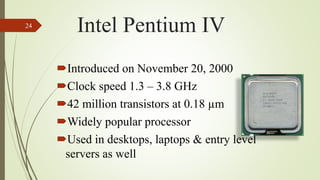
Intel Pentium III
Introduced on November 20, 2000
Clock speed 1.3 – 3.8 GHz
42 million transistors at 0.18 µm
Widely popular processor
Used in desktops, laptops & entry level
servers as well
24
Intel Pentium IV
Introduced on 2008
32 or 64 bit processor
Single, Dual Core processor
Clock speed 0.6 – 2.13 GHz
47 million transistors at 45 nm
Also know as Centrino Atom
Low power, small size processor
Widely used in Portable Netbooks
25 Intel Atom
32 bit or 64 bit processor
Introduced on April, 1998
Single, Dual Core processor
Clock speed 0.26 – 3.6 GHz
2MB L3 cache
Used in budget range PC’s
26
Intel Celeron
32 bit or 64 bit processor
In use from 1998
Clock speed 0.4 – 4.4 GHz
Up to 16 cores
Up to 24MB L3 cache
Very high end processor
Used for non-consumer workstation, server
27
Intel Xeon
32 bit or 64 bit processor
Introduced on 2006
Dual Core processor
Clock speed 1.3 – 2.6 GHz
228 million transistors at 90 nm
Support for Simultaneous Multi-Threading
28
Intel Pentium Dual Core
Contents
Introduction
4-bit processors
8-bit processors
16-bit processors
32-bit processors
64-bit processors
Modern Trends
Conclusion
29
Pure 64 bit processor
Introduced on July 27, 2006
Multi core on a single chip
Dual, Quad Core processor
Clock speed 1.06 – 3.33 GHz
291 million transistors at 45 nm
64 KB of L1 cache per core
4 MB of L2 cache
 Core 2 Duo widely used in desktops, laptops
Core 2 Quad used for business purposes
30 Intel Core 2 Series
Introduced in January 7, 2010
Clock Speed 1.2 – 3.7 GHz
4 MB L3 cache
Dual Core processor
2 – 4 logical processors
Supports Hyper threading
Entry level processor in today’s era
Supports in-built security features
31 Intel Core i3
Introduced September 8, 2009
Clock Speed 1.06 – 3.6 GHz
Support for Hyper Threading
Support for Turbo Boost
Dual Core mobile processor
Dual, Quad Core desktop processor
4 logical processors
4 – 8 MB L3 cache
Mid to High end processor series
Desktop versions comes with support for Overclocking
32 Intel Core i5
Introduced November 17, 2008
Clock Speed 1.6 – 4.4 GHz
Dual, Quad Core processor
4 – 8 logical processors
6 – 15 MB L3 cache
High end processor Series
Comes with support for Overclocking
Widely used in Gaming Laptops
33 Intel Core i7
Contents
Introduction
4-bit processors
8-bit processors
16-bit processors
32-bit processors
64-bit processors
Modern Trends
Conclusion
34
35 Modern Trends of Processor
Intel was the first microprocessor producer
Intel owns more than 83% microprocessor market share
Intel supplies processors to Apple, Samsung, HP, Dell & others
Intel Core i3, i5 Dual Core are most sold in India
Gaming Geeks use i7 processors, along with a high power
GPU for enhanced performance
Processors with suffix “K” can be Overclocked for getting
ultimate performance
Servers, Workstations are deployed on Intel Xeon chips
Contents
Introduction
4-bit processors
8-bit processors
16-bit processors
32-bit processors
64-bit processors
Modern Trends
Conclusion
36
37
Conclusion
Growth is tremendous
Speed of microprocessor is increasing day-by-day
Architecture has been reduced to very small, 22 nm
Microprocessor are also used in various devices like
mobiles, watches, ATM, cameras
Price reduced in recent years
Much more in the upcoming years
38
References
http://www.cpu-world.com/
https://en.wikipedia.org/wiki/List_of_Intel_microprocessors
http://www.intel.com/museum/visit.htm
http://ark.intel.com/
http://www.intel.com/pressroom
http://en.wikipedia.org/wiki/Microprocessor
http://www.scm.tees.ac.uk/users/a.clements/History
http://www.buzzle.com/articles
"An Introduction to the Intel Family of Microprocessors,"
by J. L. Antonakos, Third Edition, Prentice Hall, 1999
39
40

Evolution of Intel Processors

  • 1.
    Evolution of Intel Processors Presentedby: SAYED SHAD AHMAD ZAIDI VI Semester 2013BCA139 GG0772 Presentation on
  • 2.
  • 3.
    Contents Introduction 4-bit processors 8-bit processors 16-bitprocessors 32-bit processors 64-bit processors Modern Trends Conclusion 3
  • 4.
    Introduction4 Founded on July18, 1968 Founders: Robert Noyce Gorden Moore Andrew Headquartered in Santa Clara, California Grew as start up in 1968 to industrial grant by 1981 Above1 lakhs employees, $55 billion revenue Intel Corporation
  • 5.
    Contents Introduction 4-bit processors 8-bit processors 16-bitprocessors 32-bit processors 64-bit processors Modern Trends Conclusion 5
  • 6.
    First 4-bit microprocessor IntroducedNovember 15, 1971 by Intel First commercially available computer processor Clock rate 740 kHz. Executes 60,000 instructions per second Instruction set contained 46 instructions Number of Transistors 2,300 at 10 µm Addressable Memory 640 bytes Register set contained 16 registers Designed to be used in Busicom calculator 6 Intel 4004
  • 7.
    Successor of Intel4004 Introduced in 1974 Clock Speed 500 – 740 kHz Instruction set increased to 60 instructions Number of Transistors 3,000 at 10 µm Register set increased to 24 registers 7 Intel 4040
  • 8.
    Contents Introduction 4-bit processors 8-bit processors 16-bitprocessors 32-bit processors 64-bit processors Modern Trends Conclusion 8
  • 9.
    First 8-bit processor IntroducedApril 1, 1972 Clock Speed 500 kHz Execute 50,000 instructions per second Number of Transistors 3,500 at 10 µm Addressable Memory 16 KB Register set contained 7 registers Designed for use in Datapoint 2200 microcomputer 9 Intel 8008
  • 10.
    Introduced April, 1974 ClockSpeed 2 MHz Transistors 4,500 at 6 µm 10 times faster than Intel 8008 Execute 500,000 instructions per second 10 Intel 8080
  • 11.
    Introduced 1976 Clock Speed3 MHz Executes 0.37 MIPS Number of transistors 6,500 at 3 μm 100 million copies were sold 11 Intel 8085
  • 12.
    Contents Introduction 4-bit processors 8-bit processors 16-bitprocessors 32-bit processors 64-bit processors Modern Trends Conclusion 12
  • 13.
    First 16-bit processor Introducedin June 8, 1978 Introduction of x86 architecture Clock speed is 4.77 – 10 MHz 29,000 transistors at 3 µm Execute 2.5 MIPS Used in portable computing, IBM PS/2 computers 13 Intel 8086
  • 14.
    Introduced June 1,1979 Backward compatible 8086 Clock speed is 5 – 10 MHz Created as a cheaper version of Intel’s 8086 Used first in IBM-PC Highly successful due to large sale of IBM-PC 14 Intel 8088
  • 15.
    Introduced in 1982 Clockspeed was 6 MHz 80188 was a cheaper version of 80186 55,000 transistors at 3 µm Had additional components like: Interrupt Controller Clock Generator Local Bus Controller Counters 15 Intel 80186 & 80188
  • 16.
    Introduced in February2, 1982 Clock speed was 8 MHz 134,000 transistors at 1.5 µm Execute 4 MIPS First with memory management, protection abilities Introduces “Virtual Memory Concept” Widely used in IBM PC 16 Intel 80286
  • 17.
    Contents Introduction 4-bit processors 8-bit processors 16-bitprocessors 32-bit processors 64-bit processors Modern Trends Conclusion 17
  • 18.
    First 32-bit processor Introducedin October 17, 1985 Clock speed 16 – 33 MHz 2,75,000 transistors at 1.5 µm Address 4 GB of memory Concept of paging was introduced Best selling microprocessor in history 18 Intel 80386
  • 19.
    Introduced in 1989 1.2million transistors at 1 µm Clock speed 16 – 100 MHz 1 TB Virtual Memory Cache Memory of 8 KB was introduced Used in Desktop computing and Servers 19 Intel 80486
  • 20.
    Introduced in March22, 1993 Originally named 80586 Clock speed 60 – 66 MHz Executes 110 MIPS 3.1 million transistors at 0.8 µm Virtual Memory 64 TB 16 KB L1 cache memory 20 Intel Pentium
  • 21.
    Introduced in November1, 1995 Clock speed 150 – 200 MHz 5.5 million transistors at 0.5 µm 16 KB L1 cache memory 256 KB L2 cache memory Access up to 64GB of memory Primarily designed for servers Used in ASCI Red supercomputer 21 Intel Pentium Pro
  • 22.
    Introduced on May7, 1997 Clock speed 233 - 450 MHz 7.5 million transistors at 0.35 µm Execute 333 MIPS L2 cache & processor were on one circuit 22 Intel Pentium II
  • 23.
    Introduced on Feb26, 1999 Clock speed 0.45 – 1.4 GHz 9.5 million transistors at 0.25 µm L2 cache increased to 512 KB Used faster core than its predecessor 23 Intel Pentium III
  • 24.
    Introduced on November20, 2000 Clock speed 1.3 – 3.8 GHz 42 million transistors at 0.18 µm Widely popular processor Used in desktops, laptops & entry level servers as well 24 Intel Pentium IV
  • 25.
    Introduced on 2008 32or 64 bit processor Single, Dual Core processor Clock speed 0.6 – 2.13 GHz 47 million transistors at 45 nm Also know as Centrino Atom Low power, small size processor Widely used in Portable Netbooks 25 Intel Atom
  • 26.
    32 bit or64 bit processor Introduced on April, 1998 Single, Dual Core processor Clock speed 0.26 – 3.6 GHz 2MB L3 cache Used in budget range PC’s 26 Intel Celeron
  • 27.
    32 bit or64 bit processor In use from 1998 Clock speed 0.4 – 4.4 GHz Up to 16 cores Up to 24MB L3 cache Very high end processor Used for non-consumer workstation, server 27 Intel Xeon
  • 28.
    32 bit or64 bit processor Introduced on 2006 Dual Core processor Clock speed 1.3 – 2.6 GHz 228 million transistors at 90 nm Support for Simultaneous Multi-Threading 28 Intel Pentium Dual Core
  • 29.
    Contents Introduction 4-bit processors 8-bit processors 16-bitprocessors 32-bit processors 64-bit processors Modern Trends Conclusion 29
  • 30.
    Pure 64 bitprocessor Introduced on July 27, 2006 Multi core on a single chip Dual, Quad Core processor Clock speed 1.06 – 3.33 GHz 291 million transistors at 45 nm 64 KB of L1 cache per core 4 MB of L2 cache  Core 2 Duo widely used in desktops, laptops Core 2 Quad used for business purposes 30 Intel Core 2 Series
  • 31.
    Introduced in January7, 2010 Clock Speed 1.2 – 3.7 GHz 4 MB L3 cache Dual Core processor 2 – 4 logical processors Supports Hyper threading Entry level processor in today’s era Supports in-built security features 31 Intel Core i3
  • 32.
    Introduced September 8,2009 Clock Speed 1.06 – 3.6 GHz Support for Hyper Threading Support for Turbo Boost Dual Core mobile processor Dual, Quad Core desktop processor 4 logical processors 4 – 8 MB L3 cache Mid to High end processor series Desktop versions comes with support for Overclocking 32 Intel Core i5
  • 33.
    Introduced November 17,2008 Clock Speed 1.6 – 4.4 GHz Dual, Quad Core processor 4 – 8 logical processors 6 – 15 MB L3 cache High end processor Series Comes with support for Overclocking Widely used in Gaming Laptops 33 Intel Core i7

  • 34.
    Contents Introduction 4-bit processors 8-bit processors 16-bitprocessors 32-bit processors 64-bit processors Modern Trends Conclusion 34
  • 35.
    35 Modern Trendsof Processor Intel was the first microprocessor producer Intel owns more than 83% microprocessor market share Intel supplies processors to Apple, Samsung, HP, Dell & others Intel Core i3, i5 Dual Core are most sold in India Gaming Geeks use i7 processors, along with a high power GPU for enhanced performance Processors with suffix “K” can be Overclocked for getting ultimate performance Servers, Workstations are deployed on Intel Xeon chips
  • 36.
    Contents Introduction 4-bit processors 8-bit processors 16-bitprocessors 32-bit processors 64-bit processors Modern Trends Conclusion 36
  • 37.
    37 Conclusion Growth is tremendous Speedof microprocessor is increasing day-by-day Architecture has been reduced to very small, 22 nm Microprocessor are also used in various devices like mobiles, watches, ATM, cameras Price reduced in recent years Much more in the upcoming years
  • 38.
  • 39.
  • 40.

Editor's Notes

  • #7 MIPS: Million Instructions per Second, The speed of a given CPU depends on no of instructions being executed kHz: Kilohertz=1000 Hertz, cycles per second µm=Micrometre= 10^(-6) m
  • #21 Cache is used by the CPU to reduce the average time to access data from RAM
  • #26 Nm=nanometre=10^(-9)m
  • #31 L2 cache is twice of Dual Core Second batch of Dual Core Processors by Intel Costs twice as Pentium Dual Core. That’s just difference