Evolution of Microprocessors
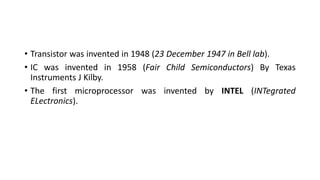
• Transistor was invented in 1948 (23 December 1947 in Bell lab).
• IC was invented in 1958 (Fair Child Semiconductors) By Texas
Instruments J Kilby.
• The first microprocessor was invented by INTEL (INTegrated
ELectronics).
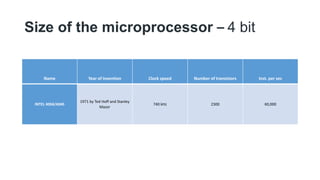
Size of the microprocessor – 4 bit
Name Year of Invention Clock speed Number of transistors Inst. per sec
INTEL 4004/4040
1971 by Ted Hoff and Stanley
Mazor
740 kHz 2300 60,000
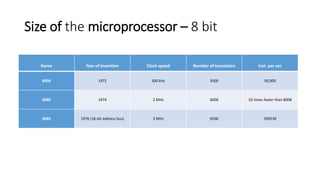
Size of the microprocessor – 8 bit
Name Year of Invention Clock speed Number of transistors Inst. per sec
8008 1972 500 kHz 3500 50,000
8080 1974 2 MHz 6000 10 times faster than 8008
8085 1976 (16-bit address bus) 3 MHz 6500 769230
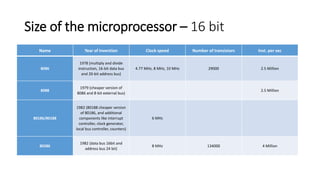
Size of the microprocessor – 16 bit
Name Year of Invention Clock speed Number of transistors Inst. per sec
8086
1978 (multiply and divide
instruction, 16-bit data bus
and 20-bit address bus)
4.77 MHz, 8 MHz, 10 MHz 29000 2.5 Million
8088
1979 (cheaper version of
8086 and 8-bit external bus)
2.5 Million
80186/80188
1982 (80188 cheaper version
of 80186, and additional
components like interrupt
controller, clock generator,
local bus controller, counters)
6 MHz
80286
1982 (data bus 16bit and
address bus 24 bit)
8 MHz 134000 4 Million
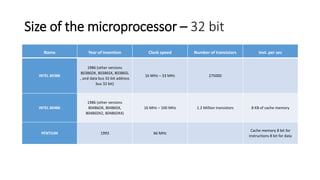
Size of the microprocessor – 32 bit
Name Year of Invention Clock speed Number of transistors Inst. per sec
INTEL 80386
1986 (other versions
80386DX, 80386SX, 80386SL
, and data bus 32-bit address
bus 32 bit)
16 MHz – 33 MHz 275000
INTEL 80486
1986 (other versions
80486DX, 80486SX,
80486DX2, 80486DX4)
16 MHz – 100 MHz 1.2 Million transistors 8 KB of cache memory
PENTIUM 1993 66 MHz
Cache memory 8 bit for
instructions 8 bit for data
Size of the microprocessor – 64 bit
Name Year of Invention Clock speed Number of transistors Inst. per sec
INTEL core 2
2006 (other versions core2
duo, core2 quad, core2
extreme)
1.2 GHz to 3 GHz 291 Million transistors
64 KB of L1 cache per core 4
MB of L2 cache
i3, i5, i7 2007, 2009, 2010
2.2GHz – 3.3GHz, 2.4GHz –
3.6GHz, 2.93GHz – 3.33GHz
Generations of microprocessors:
• First-generation –
From 1971 to 1972 the era of the first generation came which
brought microprocessors like INTEL 4004 Rockwell international PPS-4
INTEL 8008 etc.
• Second generation –
The second generation marked the development of 8-bit
microprocessors from 1973 to 1978. Processors like INTEL 8085
Motorola 6800 and 6801 etc came into existence.
• Third generation –
The third generation brought forward the 16-bit processors like INTEL
8086/80186/80286 Motorola 68000 68010 etc. From 1979 to 1980 this
generation used the HMOS technology.
• Fourth generation –
The fourth-generation came into existence from 1981 to 1995. The 32-bit
processors using HMOS fabrication came into existence. INTEL 80386 and
Motorola 68020 are some of the popular processors of this generation.
• Fifth-generation –
From 1995 till now we are in the fifth generation. 64-bit processors like
PENTIUM, Celeron, dual, quad, and octa-core processors came into
existence.

Evolution of Microprocessors.pptx

  • 1.
  • 2.
    • Transistor wasinvented in 1948 (23 December 1947 in Bell lab). • IC was invented in 1958 (Fair Child Semiconductors) By Texas Instruments J Kilby. • The first microprocessor was invented by INTEL (INTegrated ELectronics).
  • 3.
    Size of themicroprocessor – 4 bit Name Year of Invention Clock speed Number of transistors Inst. per sec INTEL 4004/4040 1971 by Ted Hoff and Stanley Mazor 740 kHz 2300 60,000
  • 4.
    Size of themicroprocessor – 8 bit Name Year of Invention Clock speed Number of transistors Inst. per sec 8008 1972 500 kHz 3500 50,000 8080 1974 2 MHz 6000 10 times faster than 8008 8085 1976 (16-bit address bus) 3 MHz 6500 769230
  • 5.
    Size of themicroprocessor – 16 bit Name Year of Invention Clock speed Number of transistors Inst. per sec 8086 1978 (multiply and divide instruction, 16-bit data bus and 20-bit address bus) 4.77 MHz, 8 MHz, 10 MHz 29000 2.5 Million 8088 1979 (cheaper version of 8086 and 8-bit external bus) 2.5 Million 80186/80188 1982 (80188 cheaper version of 80186, and additional components like interrupt controller, clock generator, local bus controller, counters) 6 MHz 80286 1982 (data bus 16bit and address bus 24 bit) 8 MHz 134000 4 Million
  • 6.
    Size of themicroprocessor – 32 bit Name Year of Invention Clock speed Number of transistors Inst. per sec INTEL 80386 1986 (other versions 80386DX, 80386SX, 80386SL , and data bus 32-bit address bus 32 bit) 16 MHz – 33 MHz 275000 INTEL 80486 1986 (other versions 80486DX, 80486SX, 80486DX2, 80486DX4) 16 MHz – 100 MHz 1.2 Million transistors 8 KB of cache memory PENTIUM 1993 66 MHz Cache memory 8 bit for instructions 8 bit for data
  • 7.
    Size of themicroprocessor – 64 bit Name Year of Invention Clock speed Number of transistors Inst. per sec INTEL core 2 2006 (other versions core2 duo, core2 quad, core2 extreme) 1.2 GHz to 3 GHz 291 Million transistors 64 KB of L1 cache per core 4 MB of L2 cache i3, i5, i7 2007, 2009, 2010 2.2GHz – 3.3GHz, 2.4GHz – 3.6GHz, 2.93GHz – 3.33GHz
  • 8.
    Generations of microprocessors: •First-generation – From 1971 to 1972 the era of the first generation came which brought microprocessors like INTEL 4004 Rockwell international PPS-4 INTEL 8008 etc. • Second generation – The second generation marked the development of 8-bit microprocessors from 1973 to 1978. Processors like INTEL 8085 Motorola 6800 and 6801 etc came into existence.
  • 9.
    • Third generation– The third generation brought forward the 16-bit processors like INTEL 8086/80186/80286 Motorola 68000 68010 etc. From 1979 to 1980 this generation used the HMOS technology. • Fourth generation – The fourth-generation came into existence from 1981 to 1995. The 32-bit processors using HMOS fabrication came into existence. INTEL 80386 and Motorola 68020 are some of the popular processors of this generation. • Fifth-generation – From 1995 till now we are in the fifth generation. 64-bit processors like PENTIUM, Celeron, dual, quad, and octa-core processors came into existence.