Introduction to
Microprocessors
www.eazynotes.com
Introduction to
Microprocessors
The microprocessor is one of the most important components of
a digital computer.
It acts as the brain of the computer system.
As technology has progressed, microprocessors have become
faster, smaller and capable of doing more work per clock cycle.
Sometimes, microprocessor is written as µP.
( µ is pronounced as Mu )
www.eazynotes.com
Introduction to
Microprocessors
Definition:
Microprocessor is the controlling unit or CPU of a micro-computer,
fabricated on a very small chip capable of performing ALU
operations and communicating with the external devices connected
to it.
www.eazynotes.com
A Computer
A computer:
Accepts the data from the user.
Stores the data and the set of instructions supplied by the user in
memory.
Processes the data according to the instructions in the processing
unit.
Communicates the result to the user or stores it for further
reference.
www.eazynotes.com
A Computer
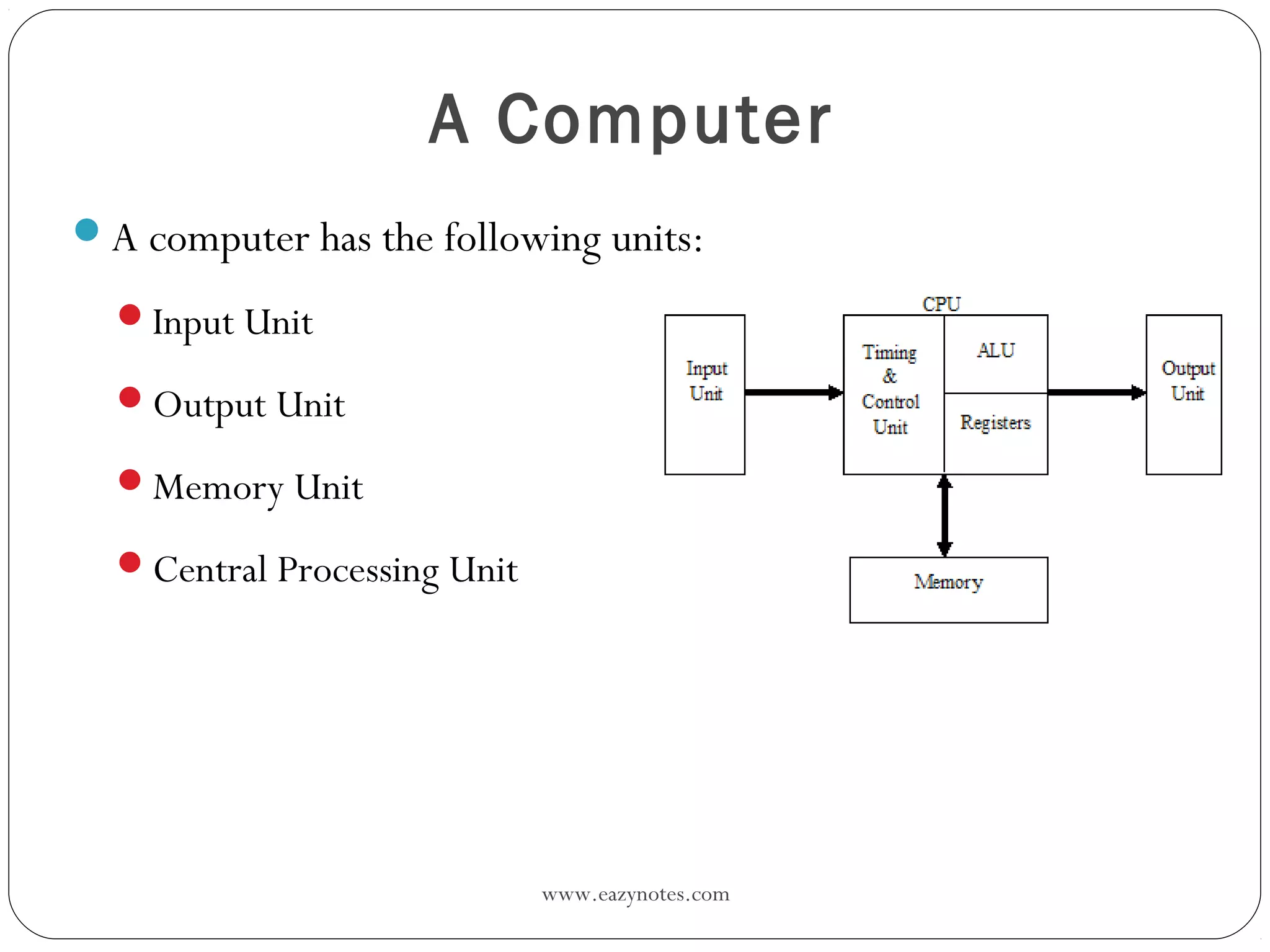
A computer has the following units:
Input Unit
Output Unit
Memory Unit
Central Processing Unit
www.eazynotes.com
A Computer
INPUT UNIT
The input unit consists of the devices which accept the data and
instructions from the user and communicates it to the CPU.
The various input devices are: keyboard, mouse, joystick, trackball etc.
OUTPUT UNIT
It provides the result of the various operations performed by the CPU to
the user.
The various output devices are: printers, monitors, loudspeakers etc.
www.eazynotes.com
A Computer
CENTRAL PROCESSING UNIT (CPU)
The CPU is the heart and nerve centre of the computer.
It fetches the instruction and data from the peripheral devices and
performs all the arithmetic operations, takes logical decision and
control the operation of all other units.
Various sub-blocks of the central processing unit are:
Arithmetic and Logic Unit (ALU)
Timing & Control Unit
Registers
www.eazynotes.com
A Computer
 ARITHMETIC AND LOGIC UNIT (ALU)
This unit perform all the logical and arithmetic operations.
Various arithmetic operations are: addition, subtraction, increment and decrement
etc.
Various logical operations are: AND, OR, NOT, XOR, etc.
 TIMING AND CONTROL UNIT
This unit controls the entire operations being performed by the system.
It controls the operations of ALU, input/output devices and memory unit.
This unit interprets the instructions and generates various timing and control signals.
 REGISTERS
A register is a very small amount of very fast memory that is built into the CPU in
order to store the current data and instructions which are being executed by the CPU.
www.eazynotes.com
A Computer
MEMORY UNIT
It stores the program statement and the data i.e. the information
supplied from the input unit.
It also stores the final output.
This is connected to the CPU by means of a bidirectional bus.
The CPU processes the information as taken from the memory and
performs the operations in the ALU section.
The results are either transferred to the output unit or stored in the
memory for later use by the CPU.
www.eazynotes.com
A Micro-Computer
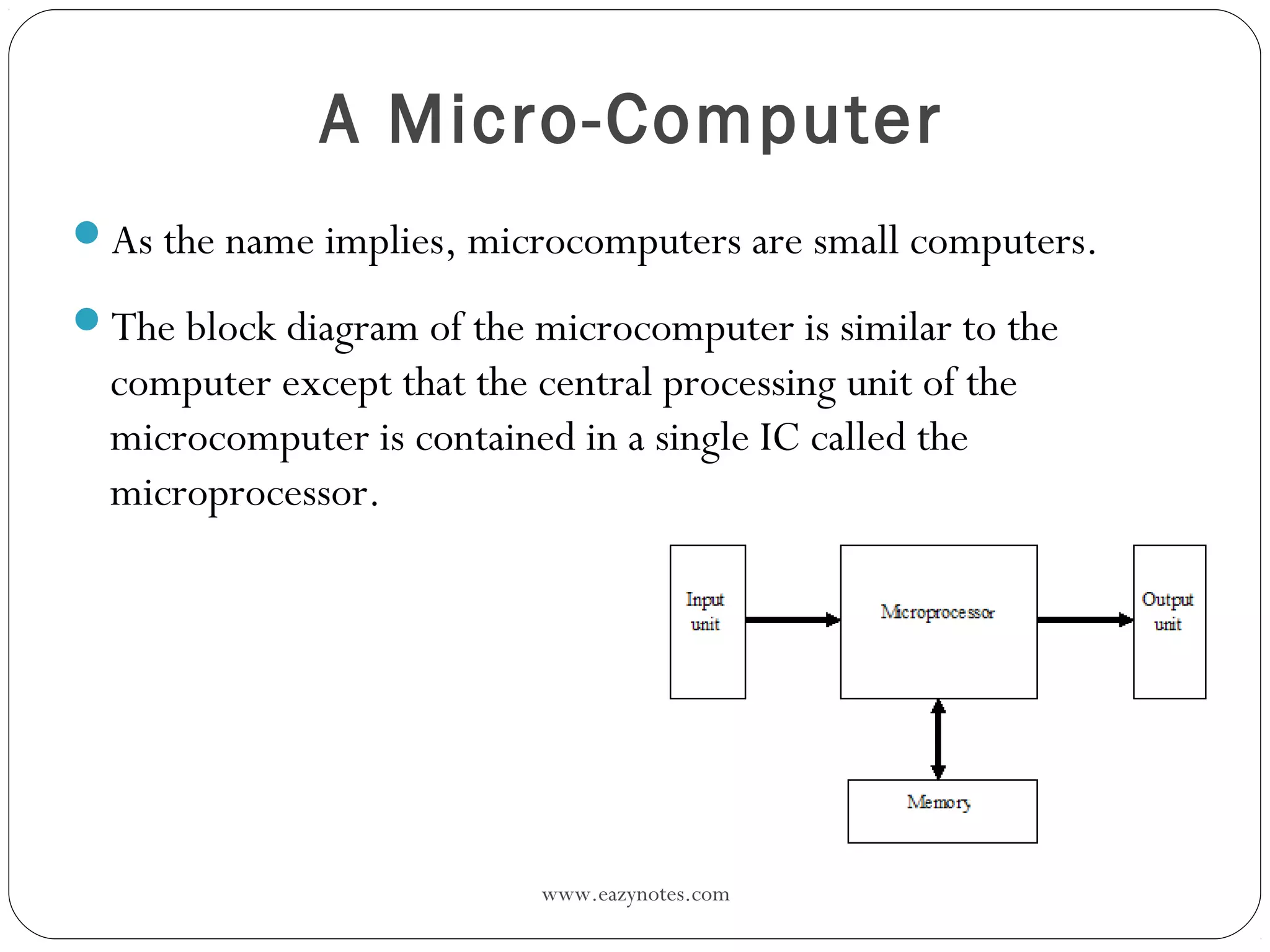
As the name implies, microcomputers are small computers.
The block diagram of the microcomputer is similar to the
computer except that the central processing unit of the
microcomputer is contained in a single IC called the
microprocessor.
www.eazynotes.com
A Micro-Computer
A microprocessor is a LSI (Large Scale Integration) IC that does almost
all the functions of the CPU.
It is also defined as a CPU contained in a single chip.
The basic function of the microprocessor is:
to fetch the instructions stored in the main memory
identify the operations and the devices involved in it
and accordingly generate control signals to determine when a given action
is to take place.
We can say that a computer with a microprocessor as its CPU, is
known as Microcomputer.
www.eazynotes.com
Some Definitions
Microprocessor:
The central processing unit built on a single IC is called
Microprocessor.
A microprocessor (sometimes abbreviated as µP) is a digital
electronic component with miniaturized transistors on a single
semiconductor integrated circuit (IC).
One or more microprocessors typically serve as a central processing
unit (CPU) in a computer system or handheld device.
www.eazynotes.com
Some Definitions
Microcomputer:
A digital computer, in which one microprocessor has been provided
to act as a CPU, is called Microcomputer.
A desktop computer, laptop, notebook, palmtop, etc. contain one
microprocessor to act as a CPU and hence they come under the
category of microcomputer.
The term microcomputer is generally synonymous with personal
computer.
www.eazynotes.com
Some Definitions
Multiprocessor System:
The CPU of a large powerful digital computer contains more than
one microprocessor.
High-end powerful servers, mainframe computers,
supercomputers, etc. contain more than one microprocessor to act
as CPU.
A computer whose CPU contains more than one microprocessor is
called Multiprocessor System.
www.eazynotes.com
Some Definitions
Microcontroller:
A highly integrated chip that contains all the components such as
CPU, RAM, some form of ROM, I/O ports, and timers is called
Microcontroller.
Unlike a general-purpose computer, which also includes all of these
components, a microcontroller is designed for a very specific task to
control a particular system.
www.eazynotes.com
Microprocessor Characteristics
Instruction Set:
The set of instructions that a microprocessor can understand.
Bandwidth:
The number of bits processed in a single instruction.
Capability:
It depends upon the number of instructions and capability of each
instruction.
www.eazynotes.com
Microprocessor Characteristics
Clock Speed:
The clock speed determines how many operations per second the processor can
perform.
It is also called Clock Rate.
Every computer contains an internal clock that regulates the rate at which
instructions are executed and synchronizes the various computer components.
The faster the clock, the more instructions the CPU can execute per second.
Clock speeds are expressed in megahertz (MHz) or gigahertz (GHz).
The microprocessors of personal computers have clock speeds of anywhere from
300 MHz to over 3.8 GHz.
www.eazynotes.com
Microprocessor Characteristics
Word Length:
It depends upon the width of internal data bus, registers, ALU etc.
An 8-bit microprocessor can process 8 bit data at a time.
A processor with longer word length is more powerful and can
process data at a faster speed as compared to processor with shorter
word length.
The word length ranges from 4 bits for small microprocessor, to 64
bits for high-end microcomputers.
www.eazynotes.com
Microprocessor Characteristics
 Width of Data Bus:
This is the size of the data bus. It defines the number of bits that can be transferred
through data bus.
 Width of Address Bus:
This parameter decides the memory addressing capability of the microprocessor. The
maximum size of the memory unit is decided by this parameter.
 Input/Output Addressing Capability:
The maximum number of the input/output ports accessed by the microprocessor
depends upon the width of the input/output address provided in the input/output
instruction.
www.eazynotes.com
Microprocessor Characteristics
Data Types:
The microprocessor handles various types of data formats like
binary, BCD, ASCII, signed and unsigned numbers.
Interrupt Capability:
Interrupts are used to handle unpredictable and random events in
the microcomputer.
It is used to interrupt the microprocessor.
Interrupt driven input/output improves the throughput of a
system.
www.eazynotes.com
Features of Microprocessor
Cost:
The most important feature of a microcomputer is its low cost.
Because of the widespread use of microprocessors, the volume of production is
very high.
That is why, microprocessor chips are available at fairly low prices.
Size:
The second important feature of a microprocessor is its small size.
As a result of improvement in fabrication technology, VLSI, electronic circuitry
has become so dense that a minute silicon chip can contain hundred and thousands
of transistors.
www.eazynotes.com
Features of Microprocessor
 Power Consumption:
Another important feature is its low power consumption.
Microprocessors are normally manufactured by Metal-Oxide semiconductor
technology, which has the feature of low power consumption.
 Versatility:
The microprocessors are versatile.
Keeping the same basic hardware, a microprocessor-based system can be configured
for a number of applications by simply altering the software program.
 Reliability:
Another important property of microprocessors is its extreme reliability.
It has been established that the failure rate of an IC is fairly uniform at the package
level, regardless of its complexity.
www.eazynotes.com
Micron
A unit of length equal to one millionth of a meter.
It is denoted by µ (Mu).
For Example:
If we pluck a hair from the head, it is very thin.
But a hair is more than 2000 times wider than a transistor on a microprocessor.
Wires between transistors are even thinner.
They're more than 4000 times thinner than a hair.
A hair is about 100 microns in diameter.
That means, a transistor is just 0.045 microns wide.
www.eazynotes.com

introduction to microprocessors

  • 1.
  • 2.
    www.eazynotes.com Introduction to Microprocessors The microprocessoris one of the most important components of a digital computer. It acts as the brain of the computer system. As technology has progressed, microprocessors have become faster, smaller and capable of doing more work per clock cycle. Sometimes, microprocessor is written as µP. ( µ is pronounced as Mu )
  • 3.
    www.eazynotes.com Introduction to Microprocessors Definition: Microprocessor isthe controlling unit or CPU of a micro-computer, fabricated on a very small chip capable of performing ALU operations and communicating with the external devices connected to it.
  • 4.
    www.eazynotes.com A Computer A computer: Acceptsthe data from the user. Stores the data and the set of instructions supplied by the user in memory. Processes the data according to the instructions in the processing unit. Communicates the result to the user or stores it for further reference.
  • 5.
    www.eazynotes.com A Computer A computerhas the following units: Input Unit Output Unit Memory Unit Central Processing Unit
  • 6.
    www.eazynotes.com A Computer INPUT UNIT Theinput unit consists of the devices which accept the data and instructions from the user and communicates it to the CPU. The various input devices are: keyboard, mouse, joystick, trackball etc. OUTPUT UNIT It provides the result of the various operations performed by the CPU to the user. The various output devices are: printers, monitors, loudspeakers etc.
  • 7.
    www.eazynotes.com A Computer CENTRAL PROCESSINGUNIT (CPU) The CPU is the heart and nerve centre of the computer. It fetches the instruction and data from the peripheral devices and performs all the arithmetic operations, takes logical decision and control the operation of all other units. Various sub-blocks of the central processing unit are: Arithmetic and Logic Unit (ALU) Timing & Control Unit Registers
  • 8.
    www.eazynotes.com A Computer  ARITHMETICAND LOGIC UNIT (ALU) This unit perform all the logical and arithmetic operations. Various arithmetic operations are: addition, subtraction, increment and decrement etc. Various logical operations are: AND, OR, NOT, XOR, etc.  TIMING AND CONTROL UNIT This unit controls the entire operations being performed by the system. It controls the operations of ALU, input/output devices and memory unit. This unit interprets the instructions and generates various timing and control signals.  REGISTERS A register is a very small amount of very fast memory that is built into the CPU in order to store the current data and instructions which are being executed by the CPU.
  • 9.
    www.eazynotes.com A Computer MEMORY UNIT Itstores the program statement and the data i.e. the information supplied from the input unit. It also stores the final output. This is connected to the CPU by means of a bidirectional bus. The CPU processes the information as taken from the memory and performs the operations in the ALU section. The results are either transferred to the output unit or stored in the memory for later use by the CPU.
  • 10.
    www.eazynotes.com A Micro-Computer As thename implies, microcomputers are small computers. The block diagram of the microcomputer is similar to the computer except that the central processing unit of the microcomputer is contained in a single IC called the microprocessor.
  • 11.
    www.eazynotes.com A Micro-Computer A microprocessoris a LSI (Large Scale Integration) IC that does almost all the functions of the CPU. It is also defined as a CPU contained in a single chip. The basic function of the microprocessor is: to fetch the instructions stored in the main memory identify the operations and the devices involved in it and accordingly generate control signals to determine when a given action is to take place. We can say that a computer with a microprocessor as its CPU, is known as Microcomputer.
  • 12.
    www.eazynotes.com Some Definitions Microprocessor: The centralprocessing unit built on a single IC is called Microprocessor. A microprocessor (sometimes abbreviated as µP) is a digital electronic component with miniaturized transistors on a single semiconductor integrated circuit (IC). One or more microprocessors typically serve as a central processing unit (CPU) in a computer system or handheld device.
  • 13.
    www.eazynotes.com Some Definitions Microcomputer: A digitalcomputer, in which one microprocessor has been provided to act as a CPU, is called Microcomputer. A desktop computer, laptop, notebook, palmtop, etc. contain one microprocessor to act as a CPU and hence they come under the category of microcomputer. The term microcomputer is generally synonymous with personal computer.
  • 14.
    www.eazynotes.com Some Definitions Multiprocessor System: TheCPU of a large powerful digital computer contains more than one microprocessor. High-end powerful servers, mainframe computers, supercomputers, etc. contain more than one microprocessor to act as CPU. A computer whose CPU contains more than one microprocessor is called Multiprocessor System.
  • 15.
    www.eazynotes.com Some Definitions Microcontroller: A highlyintegrated chip that contains all the components such as CPU, RAM, some form of ROM, I/O ports, and timers is called Microcontroller. Unlike a general-purpose computer, which also includes all of these components, a microcontroller is designed for a very specific task to control a particular system.
  • 16.
    www.eazynotes.com Microprocessor Characteristics Instruction Set: Theset of instructions that a microprocessor can understand. Bandwidth: The number of bits processed in a single instruction. Capability: It depends upon the number of instructions and capability of each instruction.
  • 17.
    www.eazynotes.com Microprocessor Characteristics Clock Speed: Theclock speed determines how many operations per second the processor can perform. It is also called Clock Rate. Every computer contains an internal clock that regulates the rate at which instructions are executed and synchronizes the various computer components. The faster the clock, the more instructions the CPU can execute per second. Clock speeds are expressed in megahertz (MHz) or gigahertz (GHz). The microprocessors of personal computers have clock speeds of anywhere from 300 MHz to over 3.8 GHz.
  • 18.
    www.eazynotes.com Microprocessor Characteristics Word Length: Itdepends upon the width of internal data bus, registers, ALU etc. An 8-bit microprocessor can process 8 bit data at a time. A processor with longer word length is more powerful and can process data at a faster speed as compared to processor with shorter word length. The word length ranges from 4 bits for small microprocessor, to 64 bits for high-end microcomputers.
  • 19.
    www.eazynotes.com Microprocessor Characteristics  Widthof Data Bus: This is the size of the data bus. It defines the number of bits that can be transferred through data bus.  Width of Address Bus: This parameter decides the memory addressing capability of the microprocessor. The maximum size of the memory unit is decided by this parameter.  Input/Output Addressing Capability: The maximum number of the input/output ports accessed by the microprocessor depends upon the width of the input/output address provided in the input/output instruction.
  • 20.
    www.eazynotes.com Microprocessor Characteristics Data Types: Themicroprocessor handles various types of data formats like binary, BCD, ASCII, signed and unsigned numbers. Interrupt Capability: Interrupts are used to handle unpredictable and random events in the microcomputer. It is used to interrupt the microprocessor. Interrupt driven input/output improves the throughput of a system.
  • 21.
    www.eazynotes.com Features of Microprocessor Cost: Themost important feature of a microcomputer is its low cost. Because of the widespread use of microprocessors, the volume of production is very high. That is why, microprocessor chips are available at fairly low prices. Size: The second important feature of a microprocessor is its small size. As a result of improvement in fabrication technology, VLSI, electronic circuitry has become so dense that a minute silicon chip can contain hundred and thousands of transistors.
  • 22.
    www.eazynotes.com Features of Microprocessor Power Consumption: Another important feature is its low power consumption. Microprocessors are normally manufactured by Metal-Oxide semiconductor technology, which has the feature of low power consumption.  Versatility: The microprocessors are versatile. Keeping the same basic hardware, a microprocessor-based system can be configured for a number of applications by simply altering the software program.  Reliability: Another important property of microprocessors is its extreme reliability. It has been established that the failure rate of an IC is fairly uniform at the package level, regardless of its complexity.
  • 23.
    www.eazynotes.com Micron A unit oflength equal to one millionth of a meter. It is denoted by µ (Mu). For Example: If we pluck a hair from the head, it is very thin. But a hair is more than 2000 times wider than a transistor on a microprocessor. Wires between transistors are even thinner. They're more than 4000 times thinner than a hair. A hair is about 100 microns in diameter. That means, a transistor is just 0.045 microns wide.
  • 24.