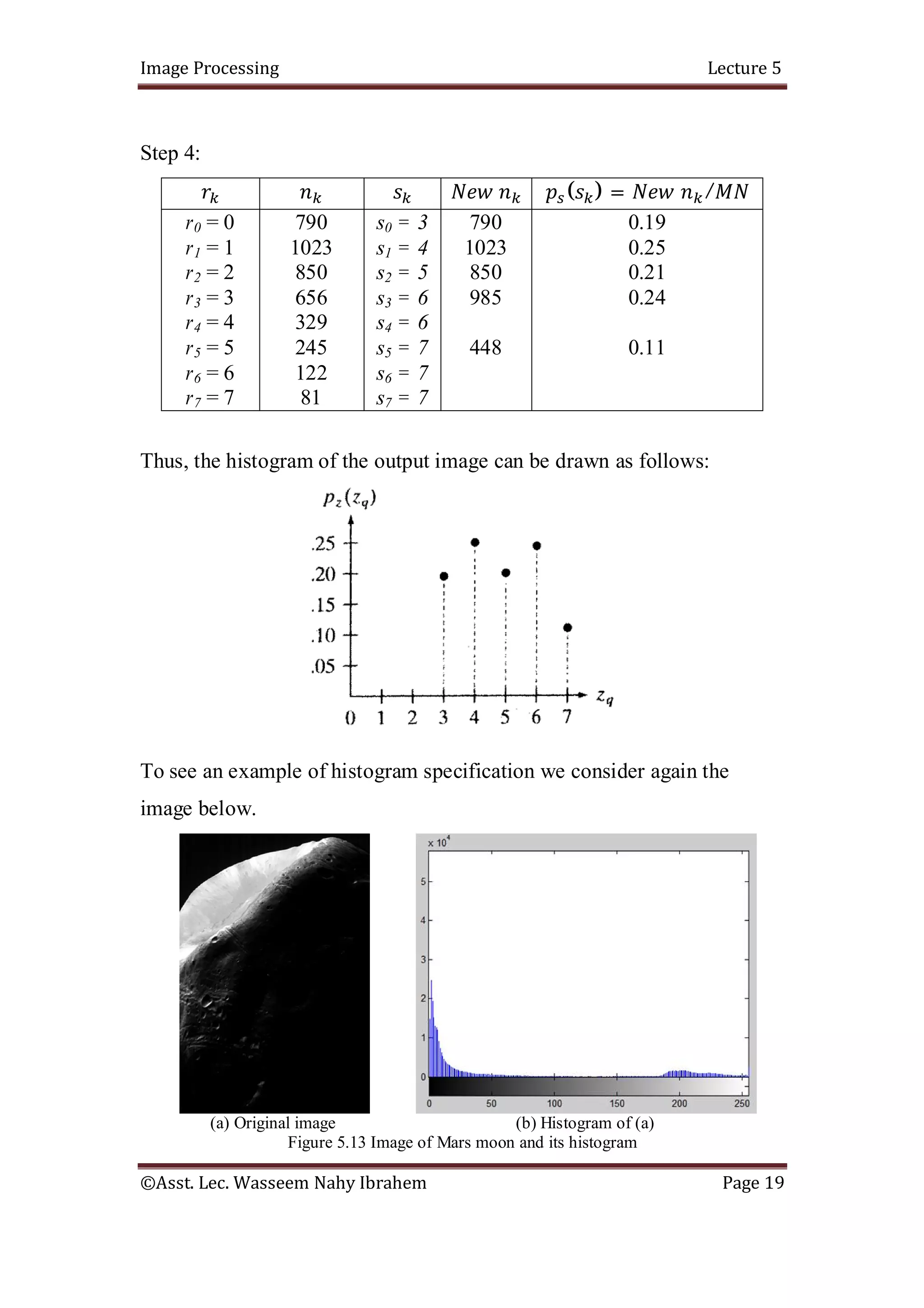
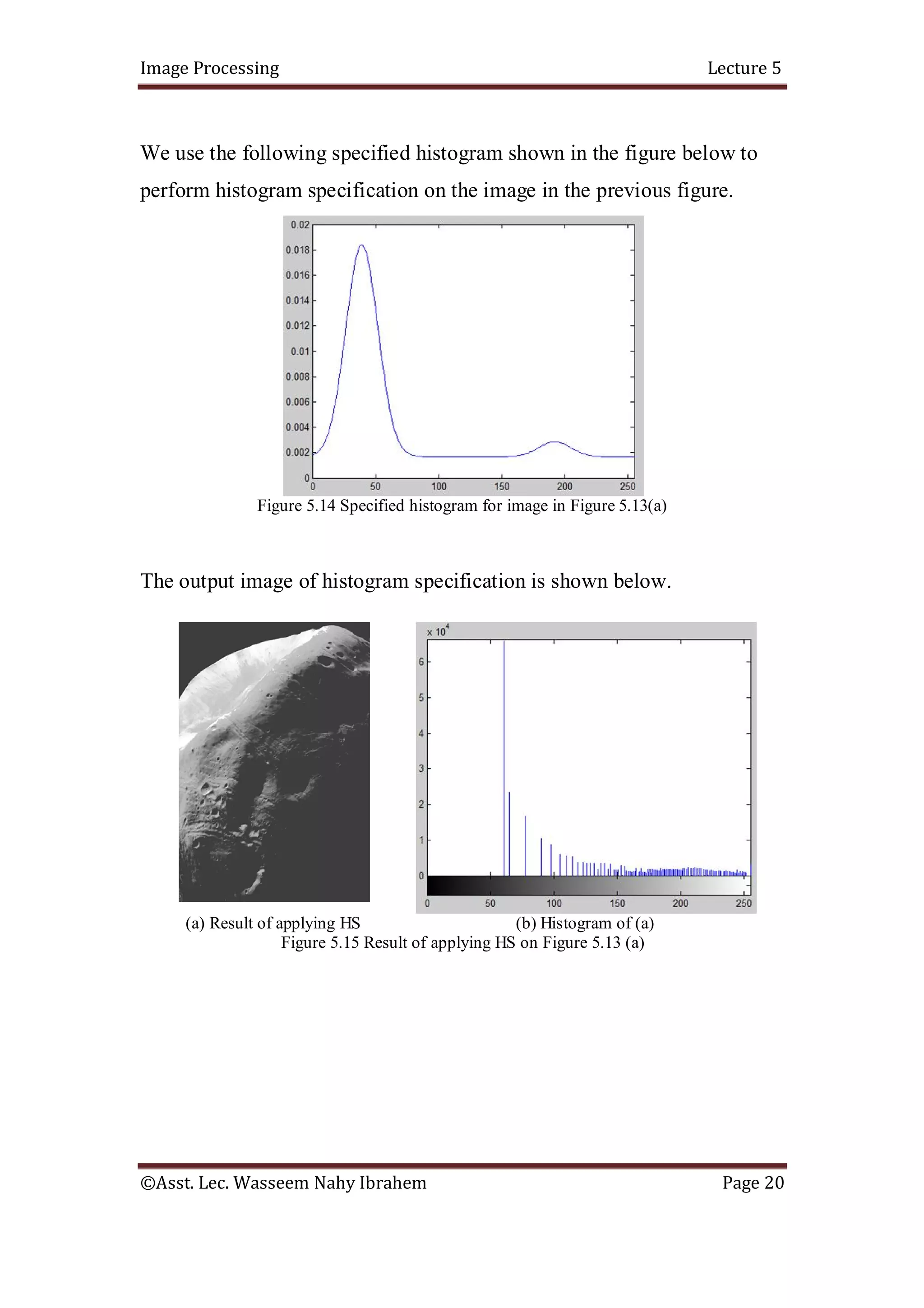
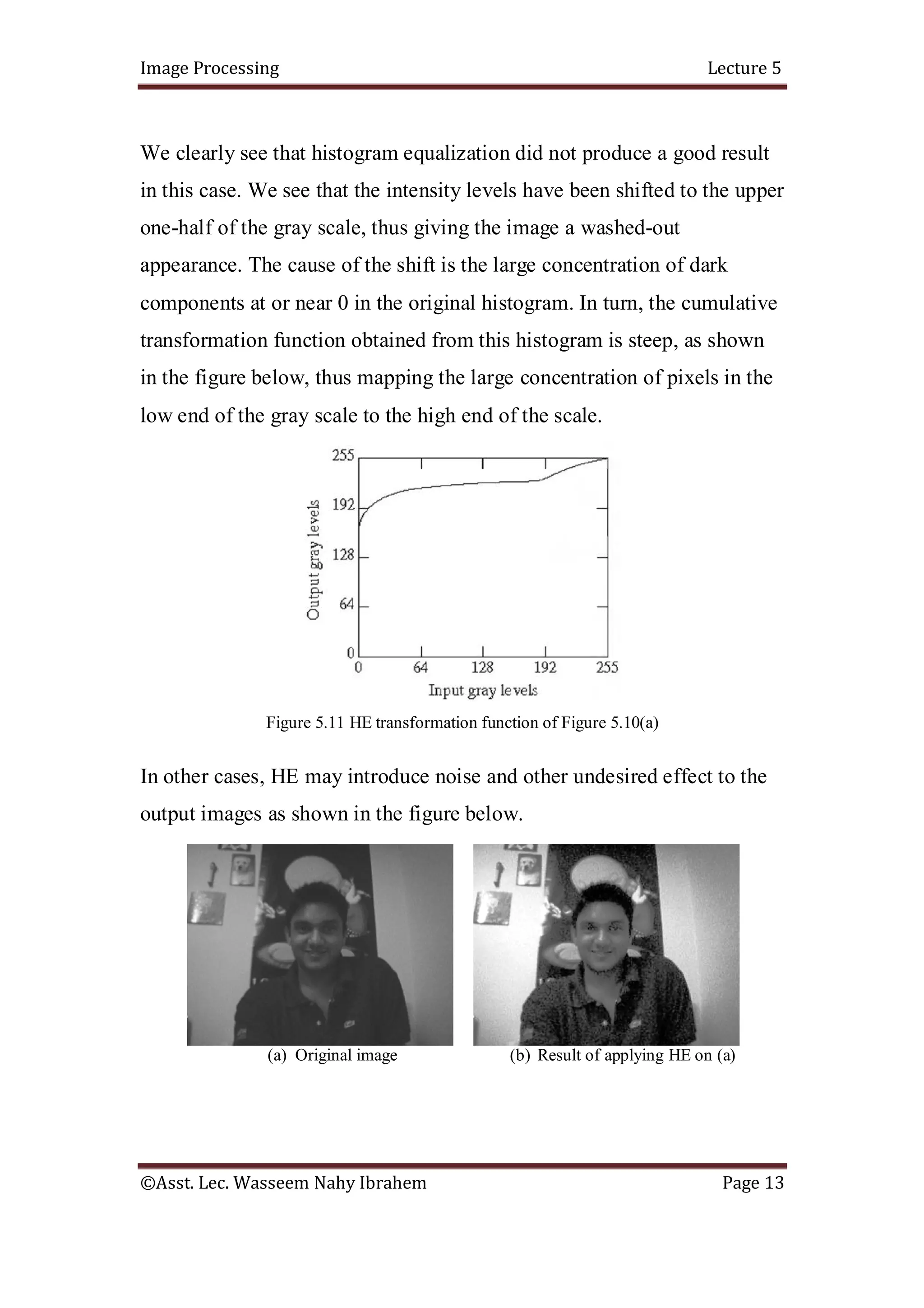
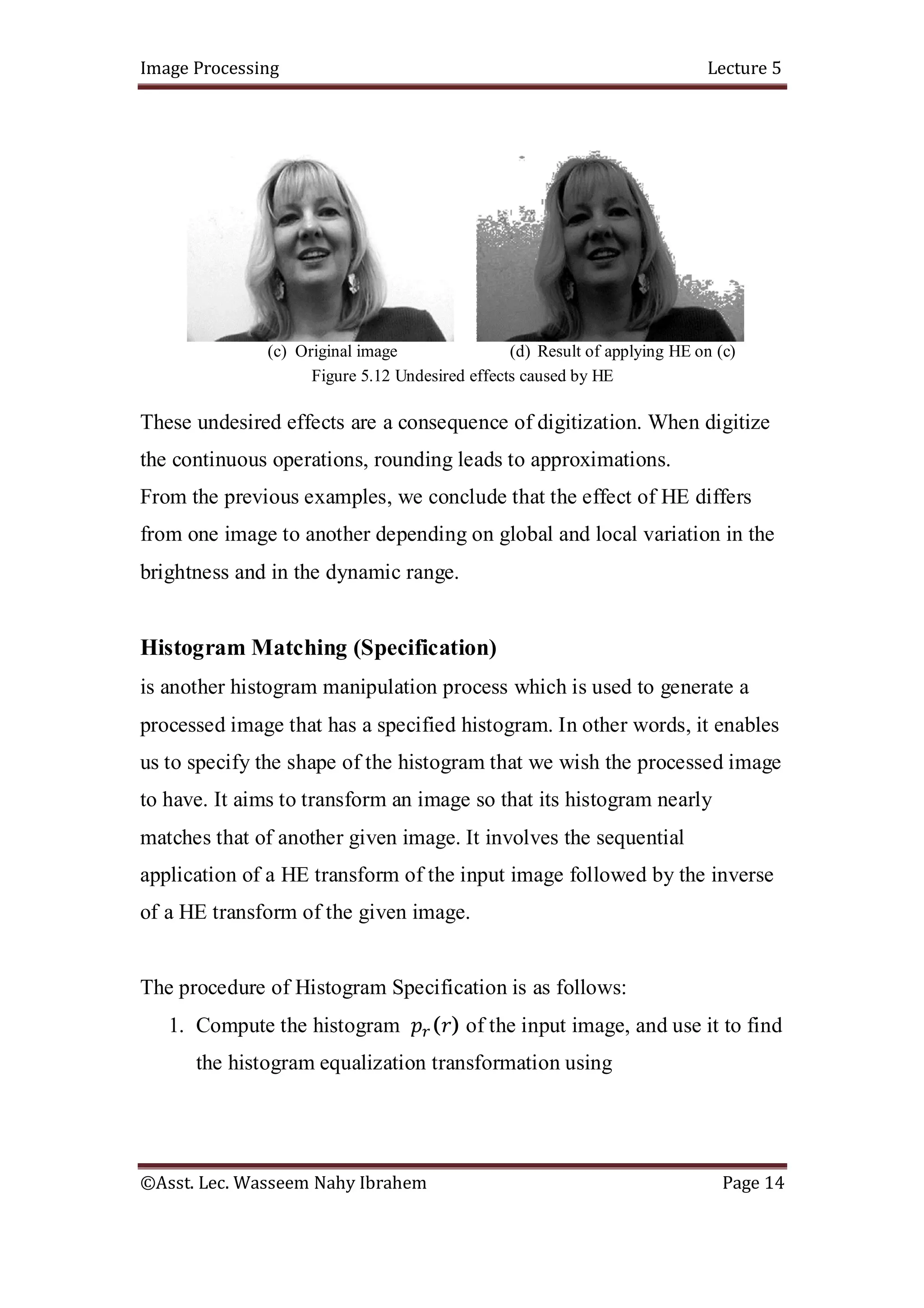
Contrast stretching aims to increase the dynamic range of an image by transforming gray levels using a piecewise linear function. The locations of points (r1, s1) and (r2, s2) control the shape of this function. Histogram equalization produces an output image with a near-uniformly distributed histogram by mapping input gray levels to output levels based on the cumulative distribution function. It enhances contrast but may introduce noise or wash out images with most pixels at one end of the gray scale. Histogram matching transforms an image to match the histogram of a specified image by applying histogram equalization followed by the inverse transformation.
Contrast stretching enhances image contrast by adjusting gray levels using piecewise linear functions. Examples demonstrate transformations and their impact on original and processed images.
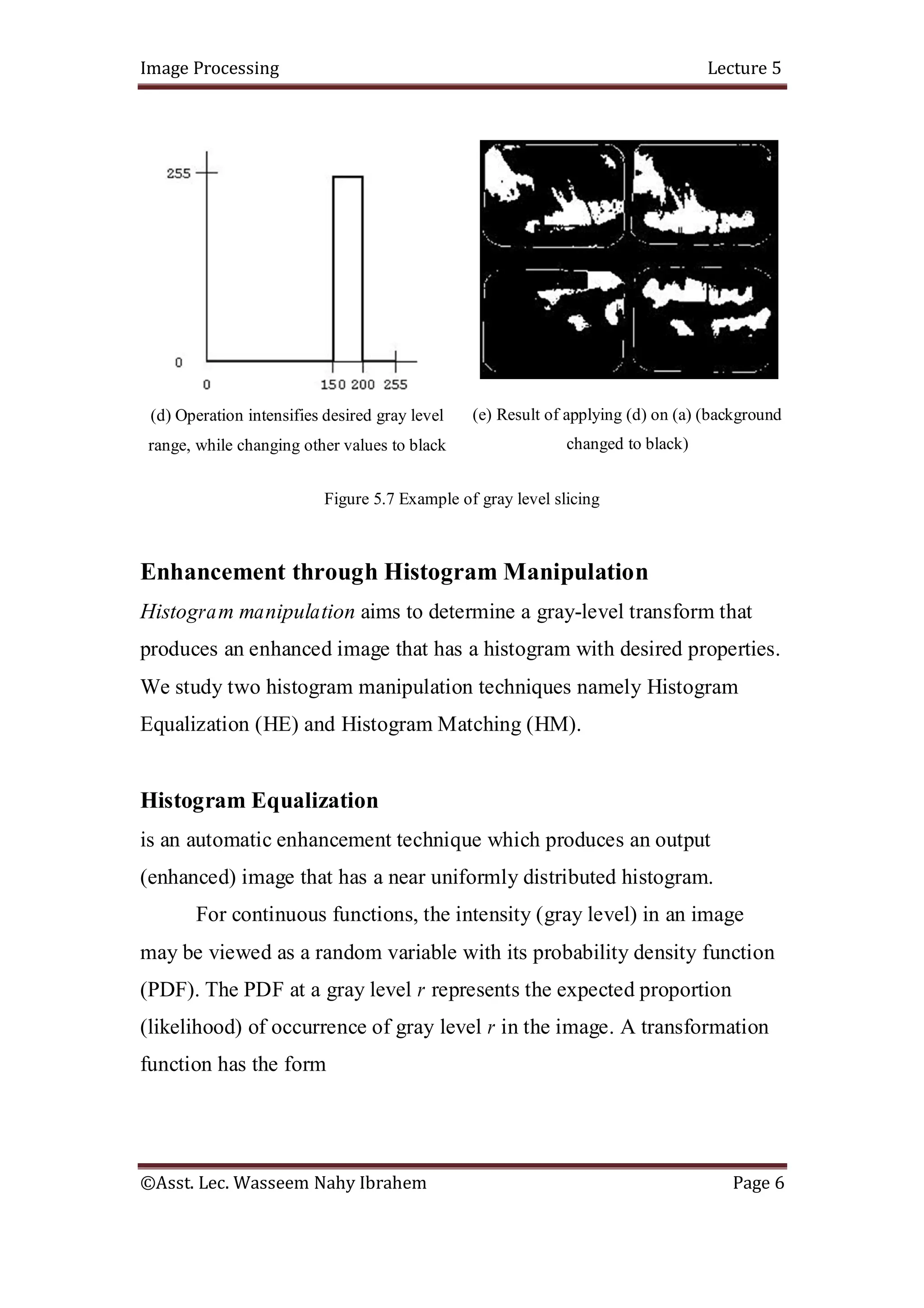
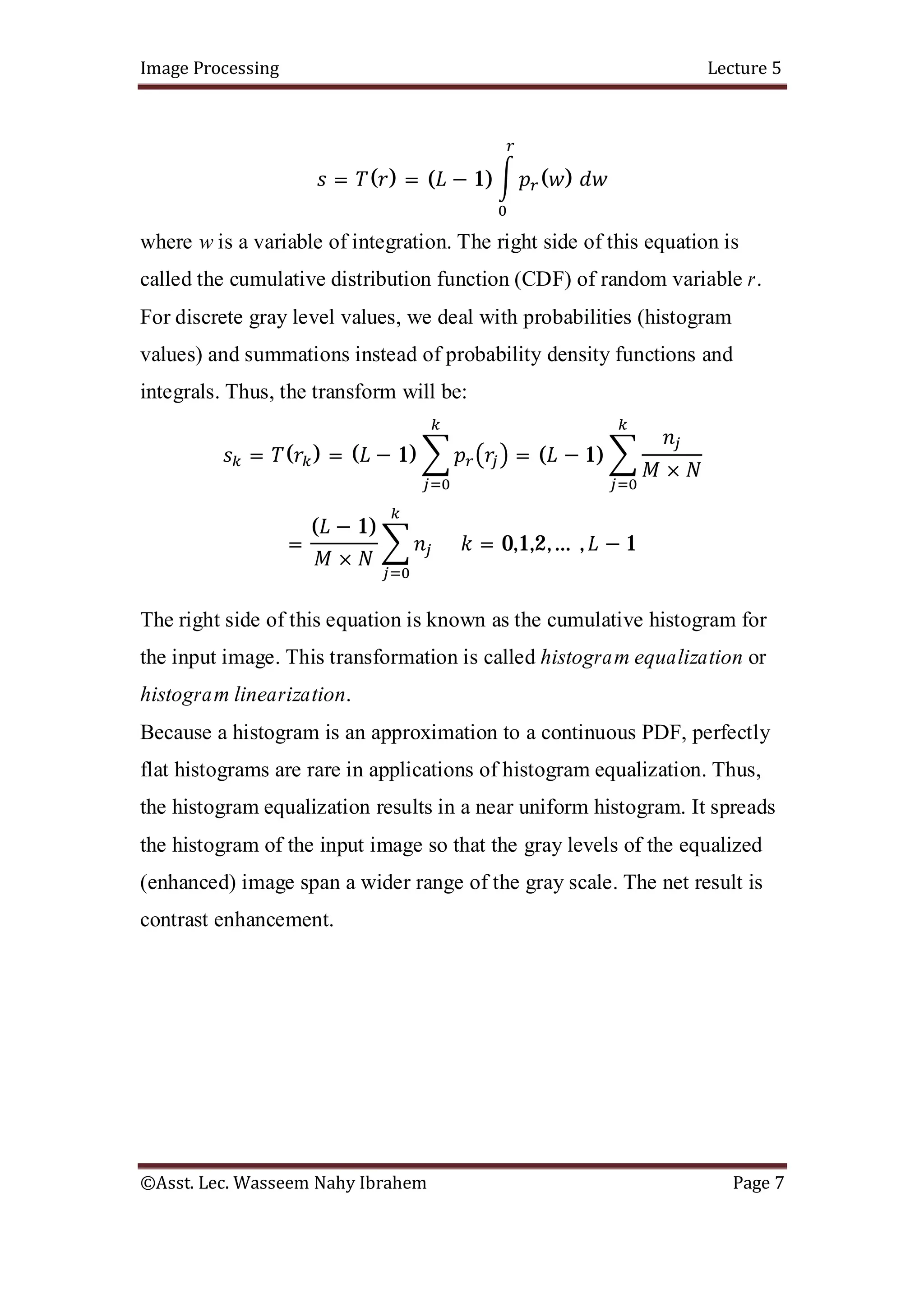
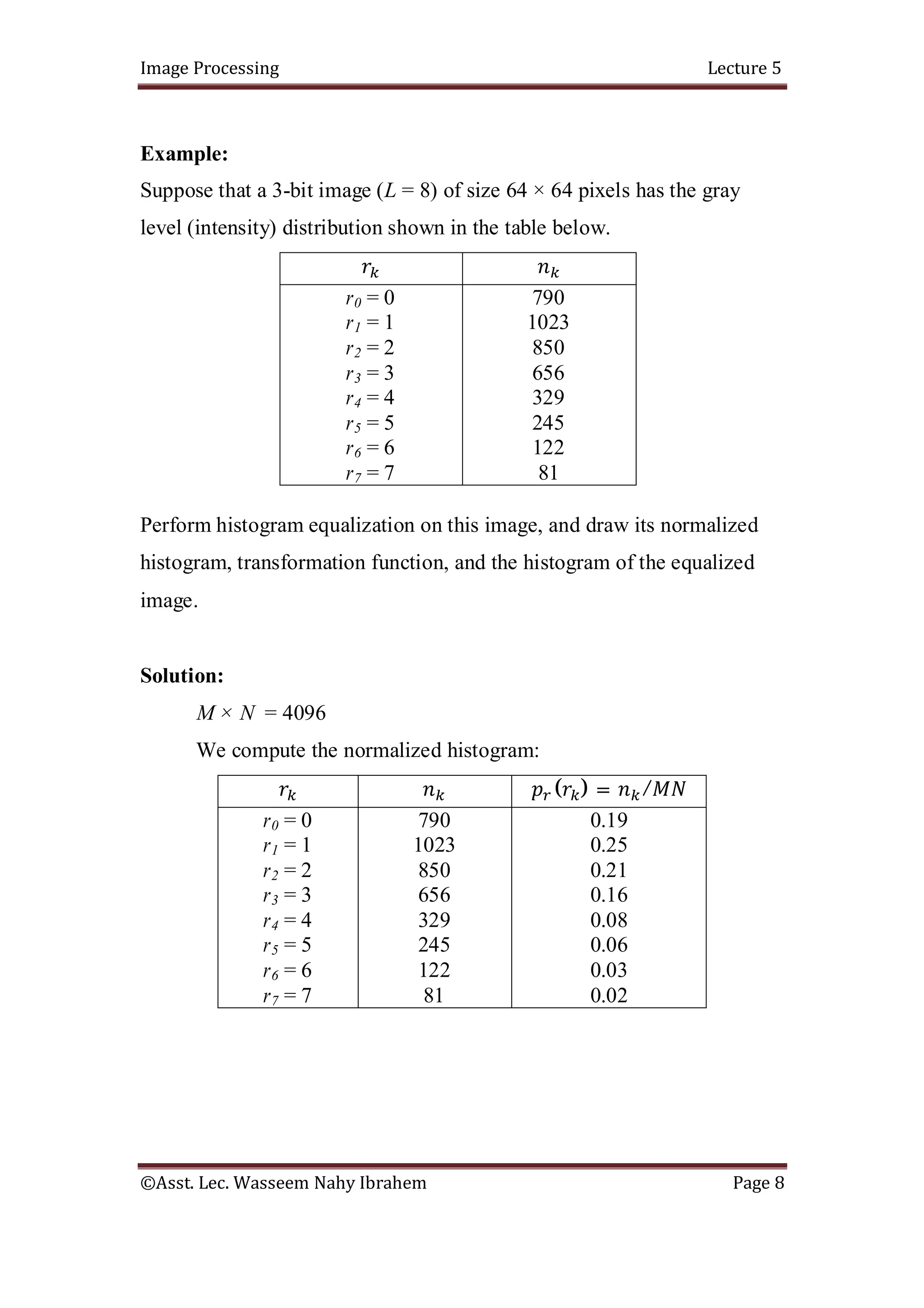
Gray-level slicing emphasizes specific gray level ranges in images while altering or preserving others. It's effective for feature extraction in applications like satellite imagery.
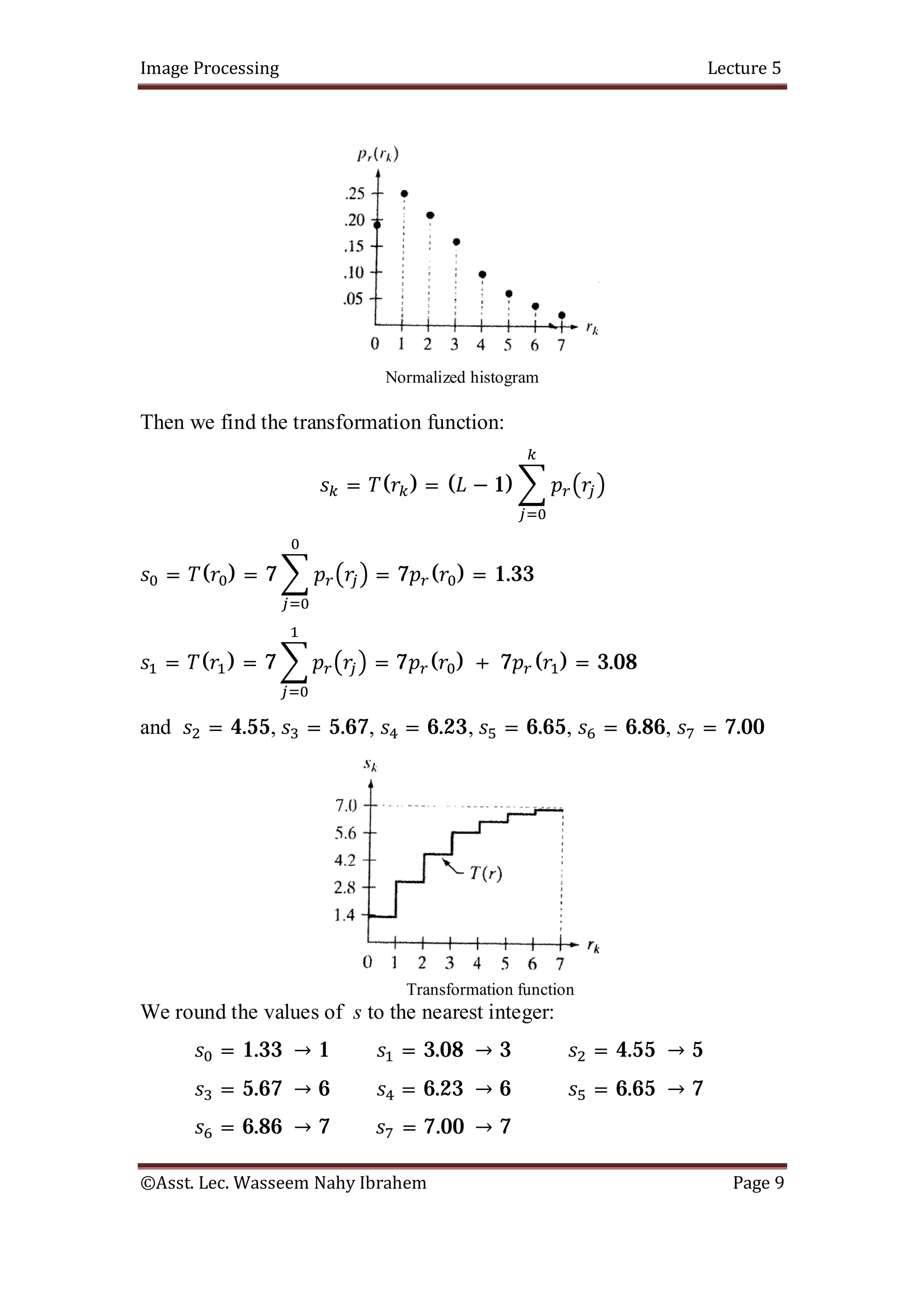
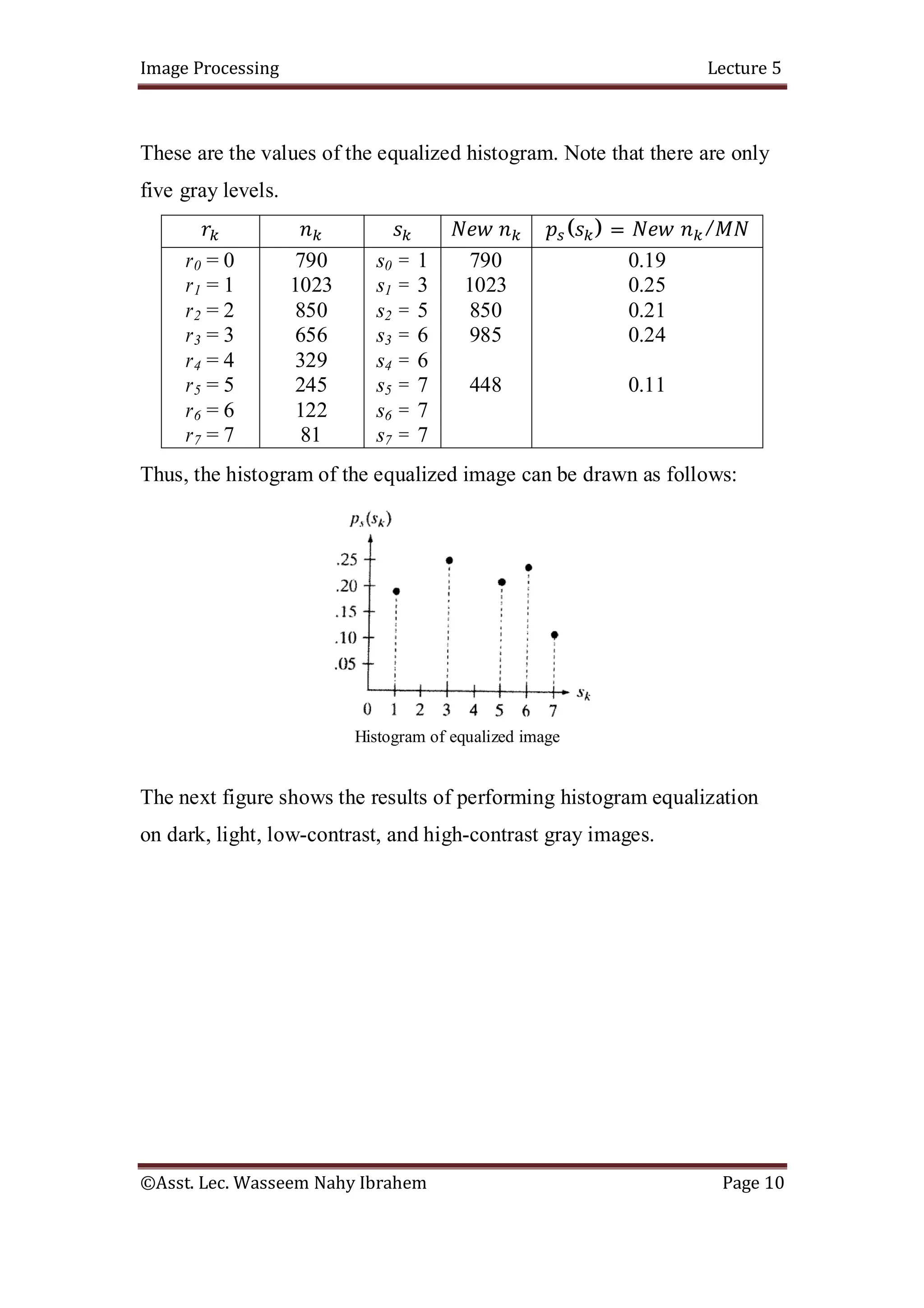
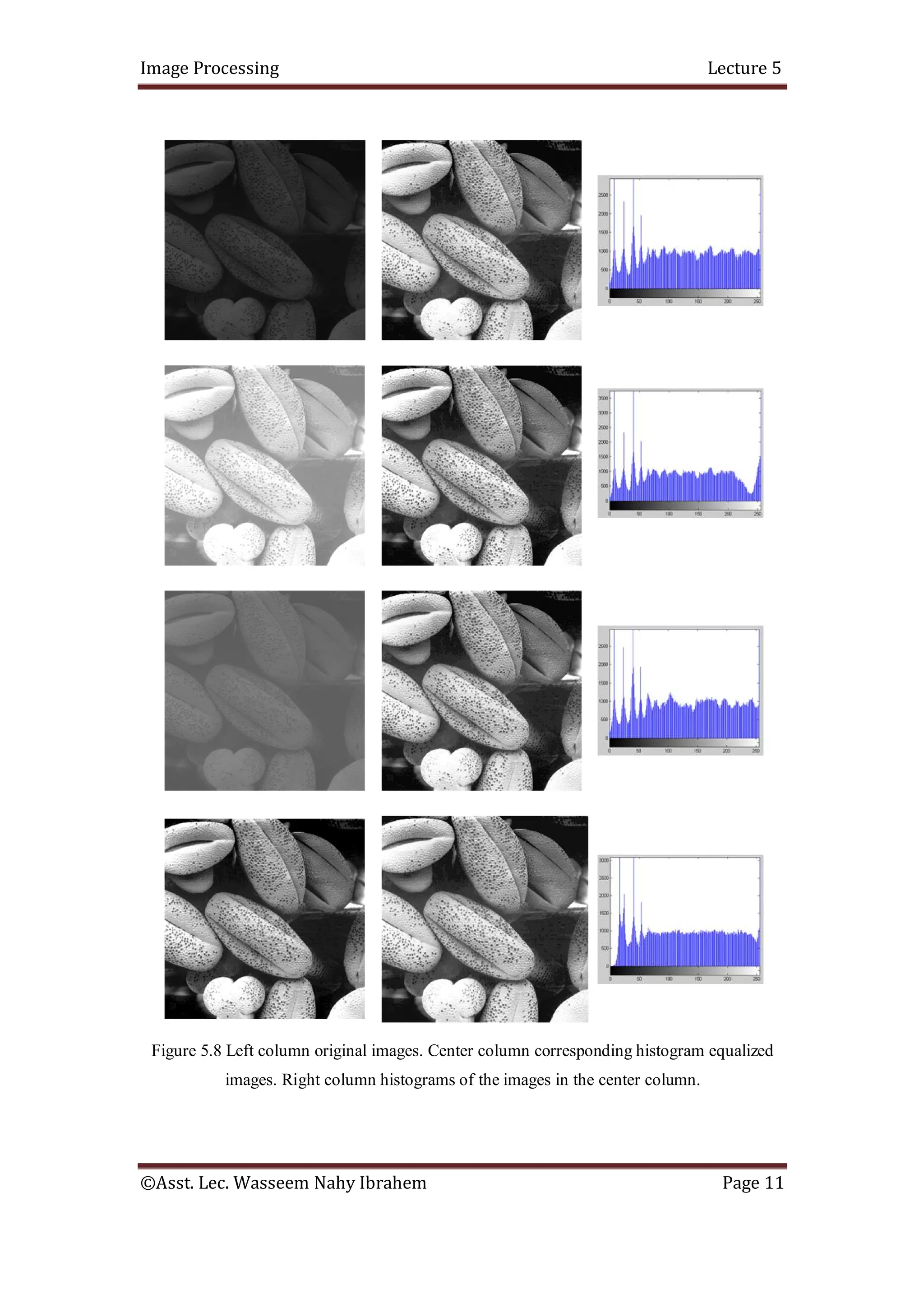
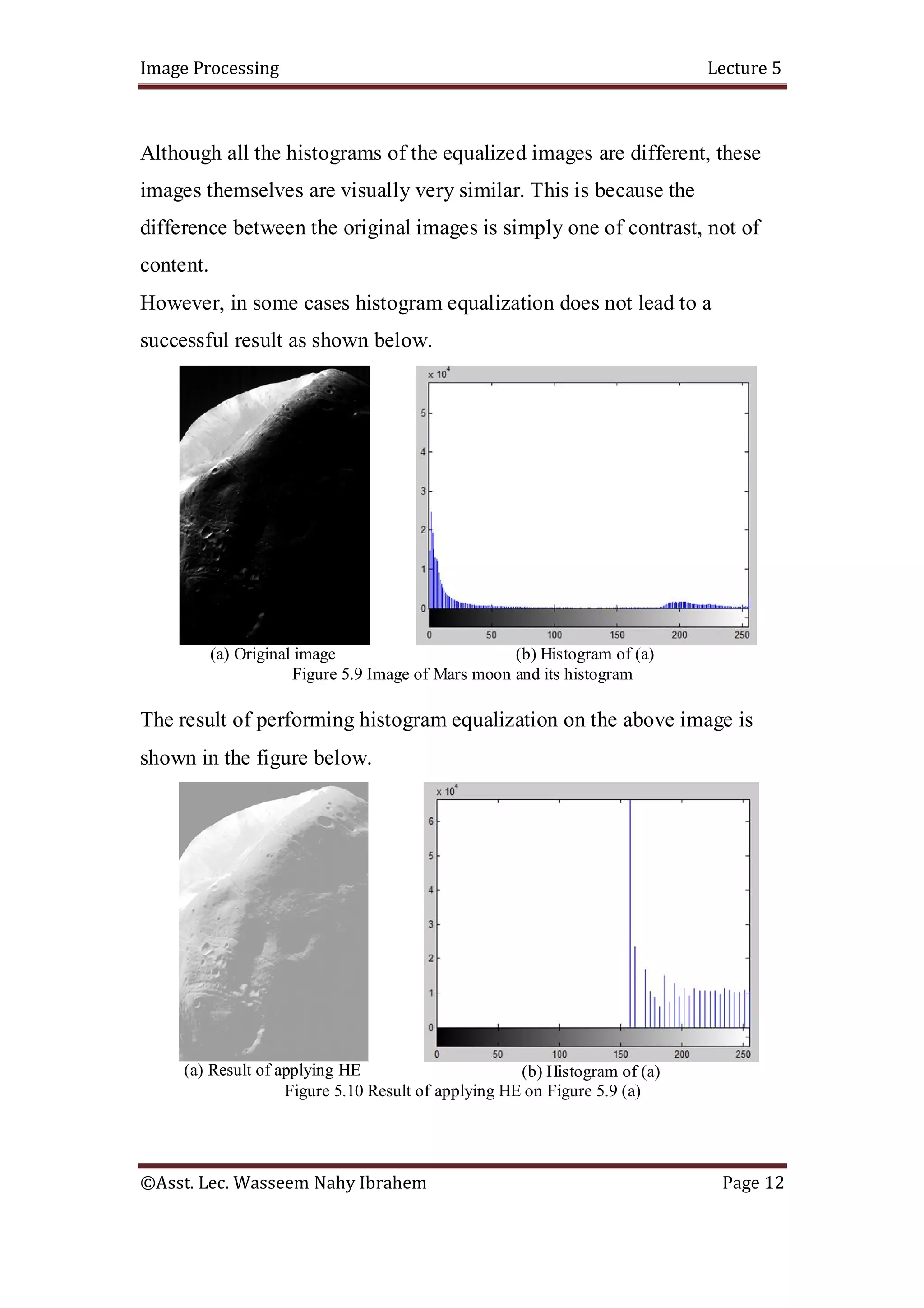
Histogram manipulation techniques like Equalization and Matching aim to improve image contrast and distribution. Methods are demonstrated with examples showing both effectiveness and limitations.
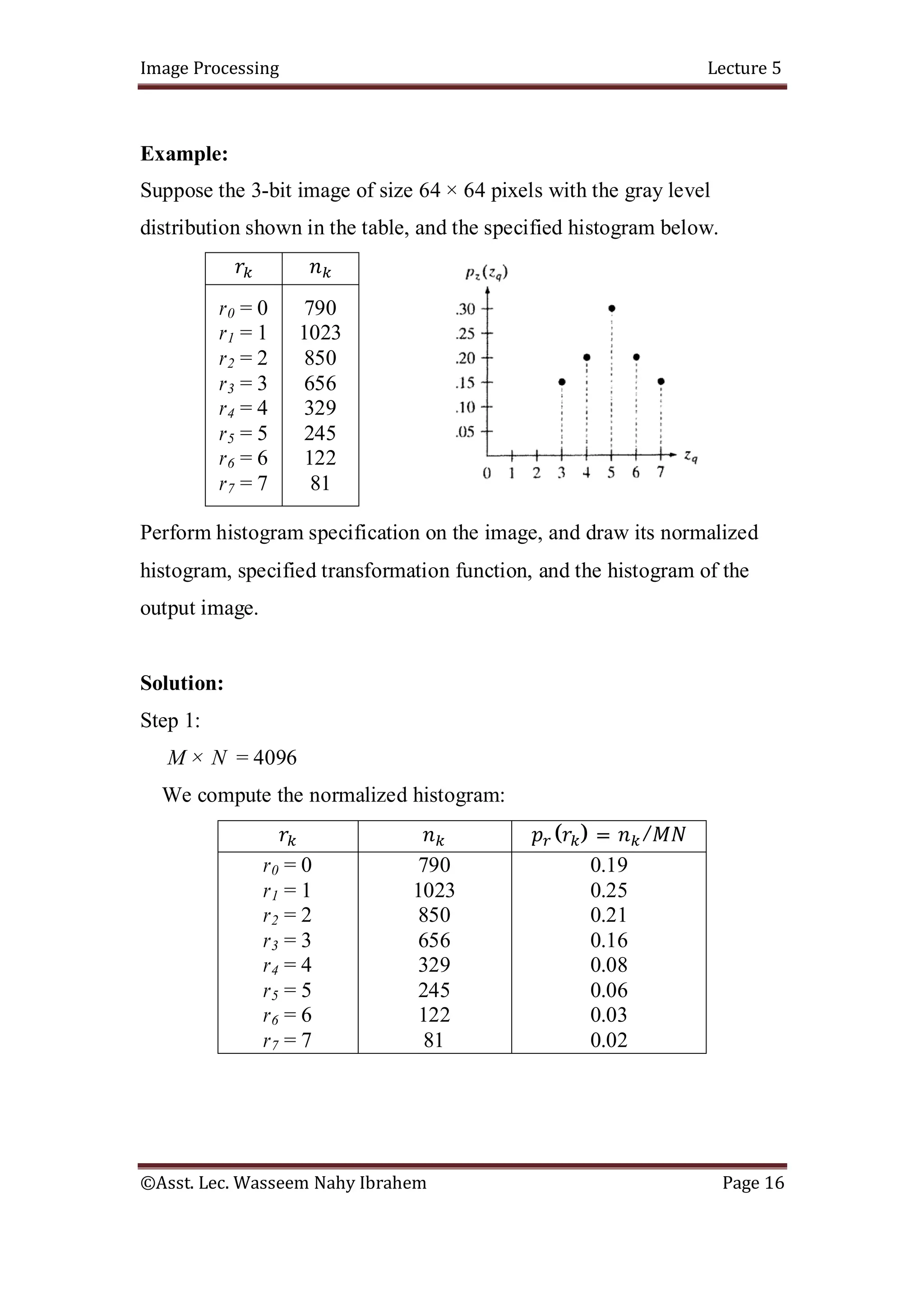
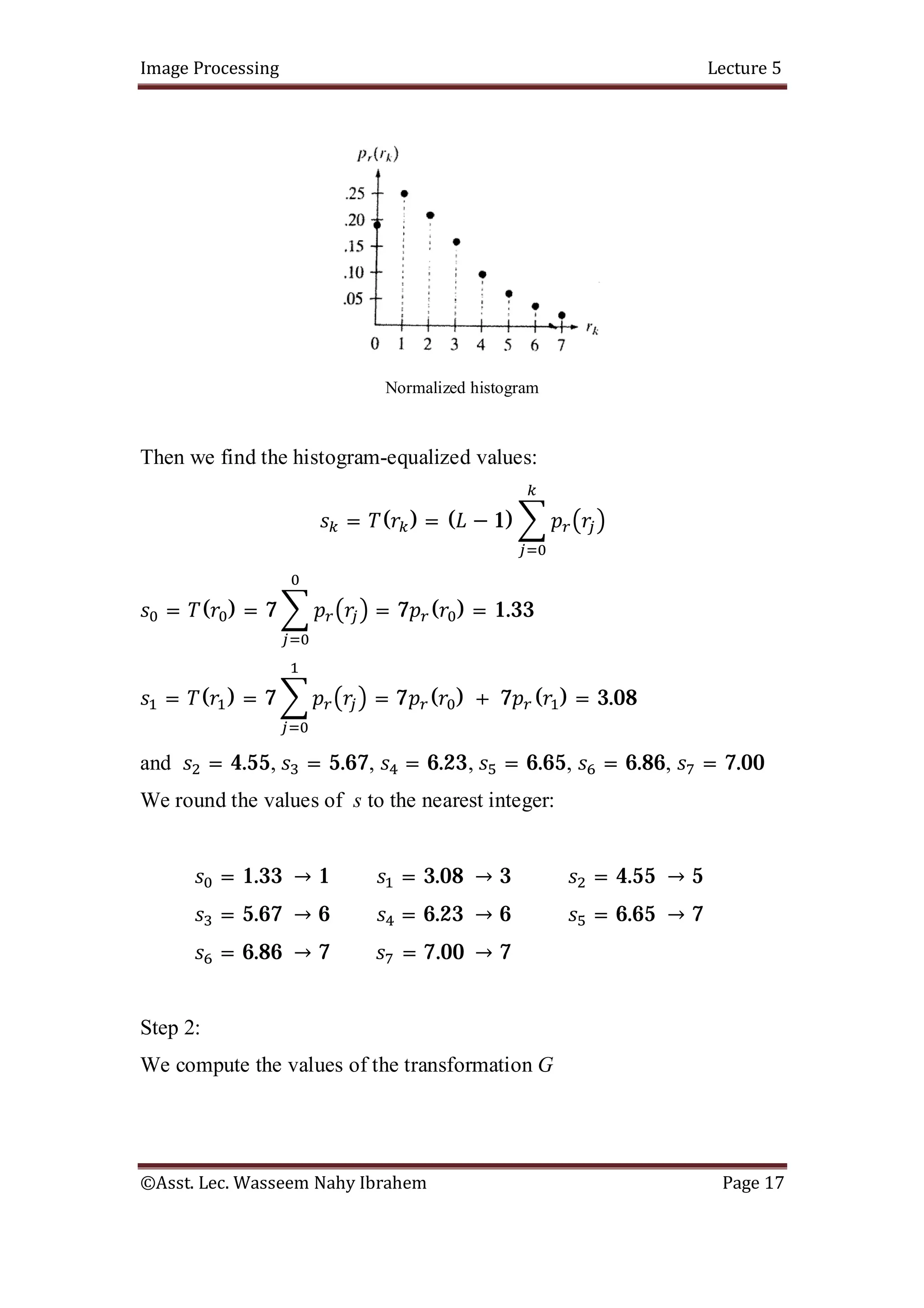
Histogram specification transforms images to match a desired histogram shape, following a series of steps to compute mappings and produce adjusted output images.
![Image Processing Lecture 5
©Asst. Lec. Wasseem Nahy Ibrahem Page 3
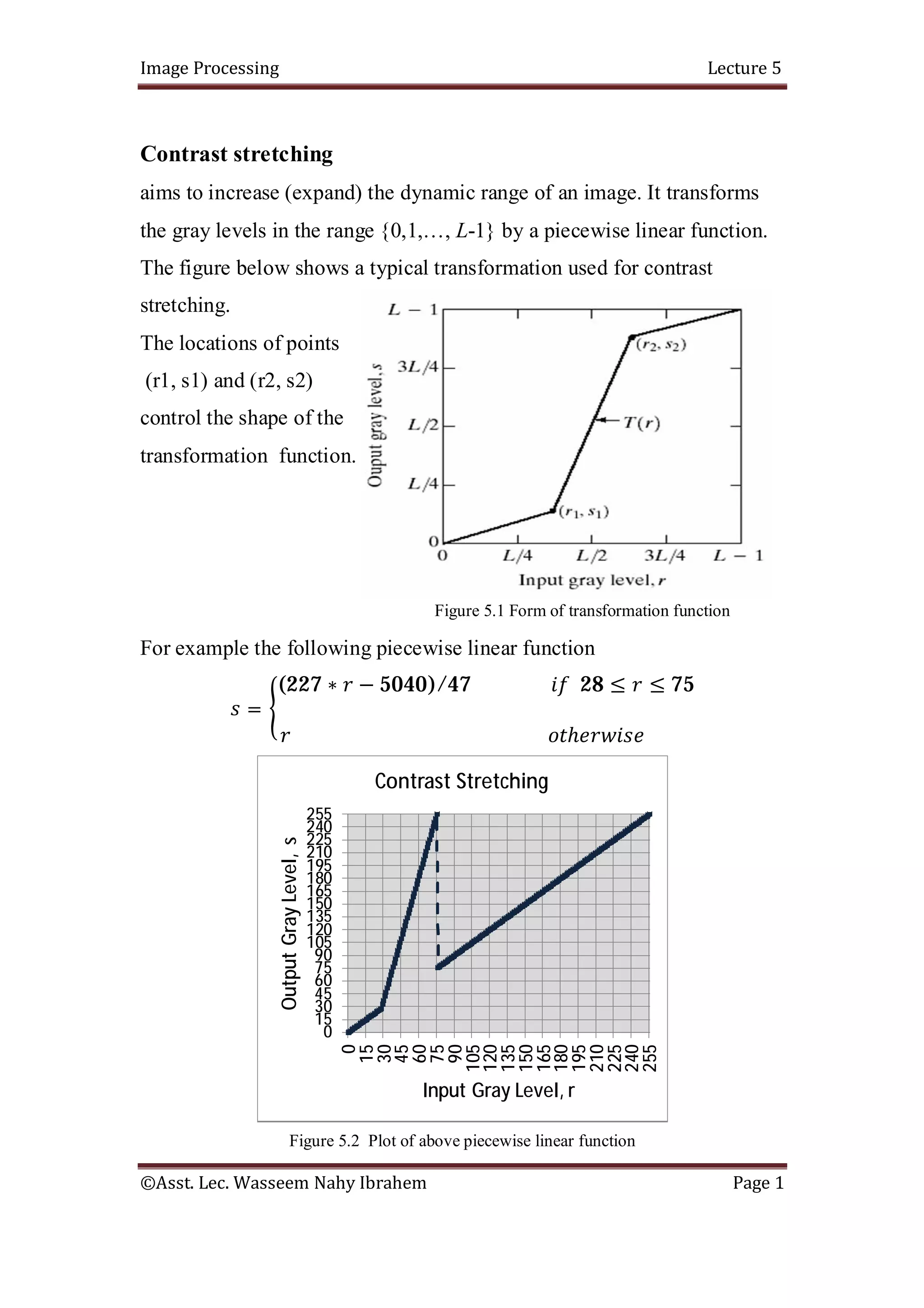
For example the plot in Figure 5.2, for the input gray values in the
interval [28 to 75] we get:
− 28 =
255 − 28
75 − 28
( − 28)
= (227 ∗ − 5040)/47 28 ≤ ≤ 75
Similarly, we compute the equations of the other lines.
Another form of contrast stretching is called automatic (full) contrast
stretching as shown in the example below:
=
0 < 90
(255 ∗ − 22950)/48 90 ≤ ≤ 138
255 > 138
Figure 5.4 Full contrast-stretching
This transform produces a high-contrast image from the low-contrast
image as shown in the next figure.
0
51
102
153
204
255
0
15
30
45
60
75
90
105
120
135
150
165
180
195
210
225
240
255
Output
Gray
Level,
s
Input Gray Level, r](https://image.slidesharecdn.com/diplecture5-221118195353-a629361e/75/DIP_Lecture5-pdf-3-2048.jpg)
![Image Processing Lecture 5
©Asst. Lec. Wasseem Nahy Ibrahem Page 4
(a) (b)
(c) (d)
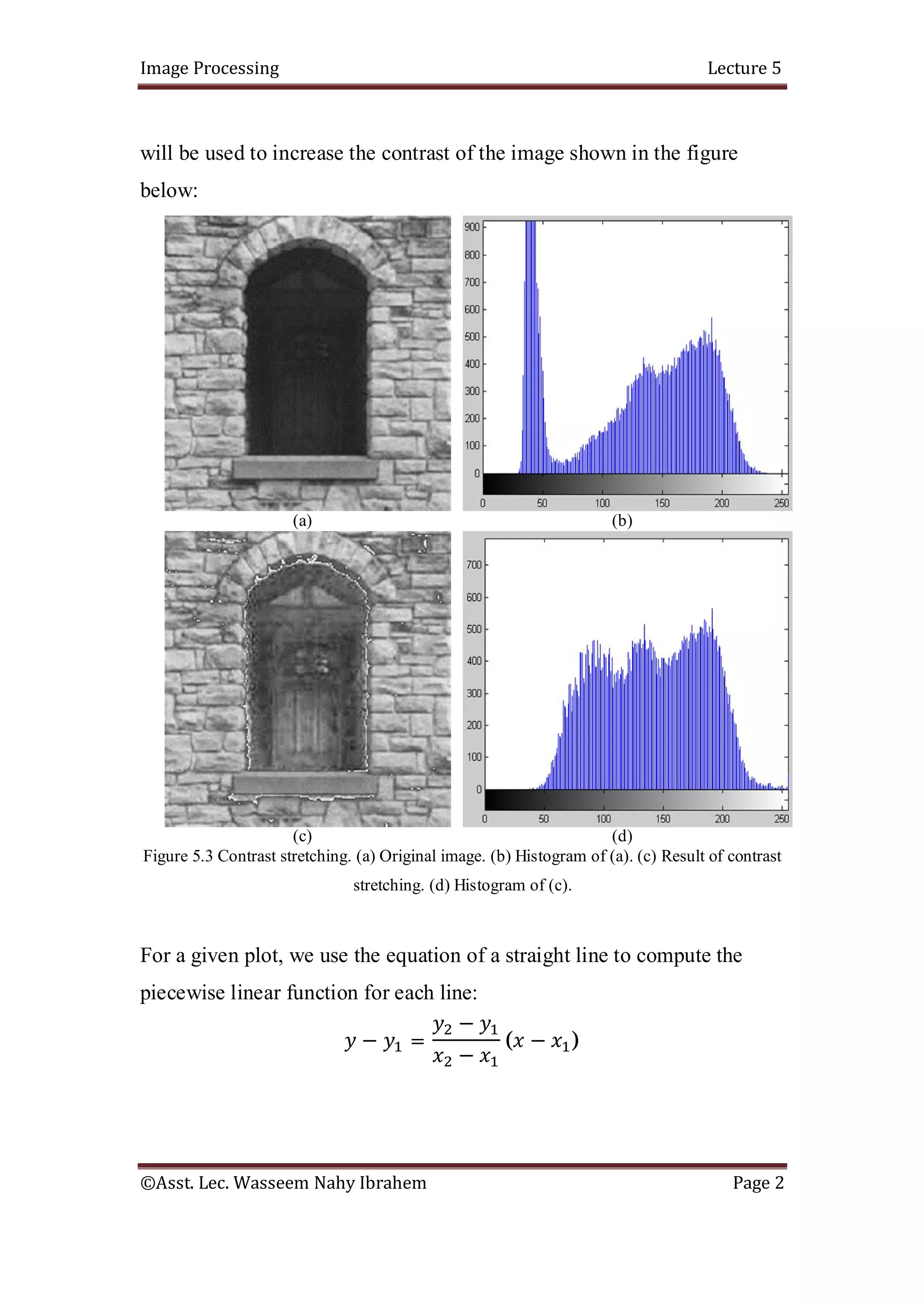
Figure 5.5 (a) Low-contrast image. (b) Histogram of (a). (c) High-contrast image resulted
from applying full contrast-stretching in Figure 5.4 on (a). (d) Histogram of (c)
Gray-level slicing
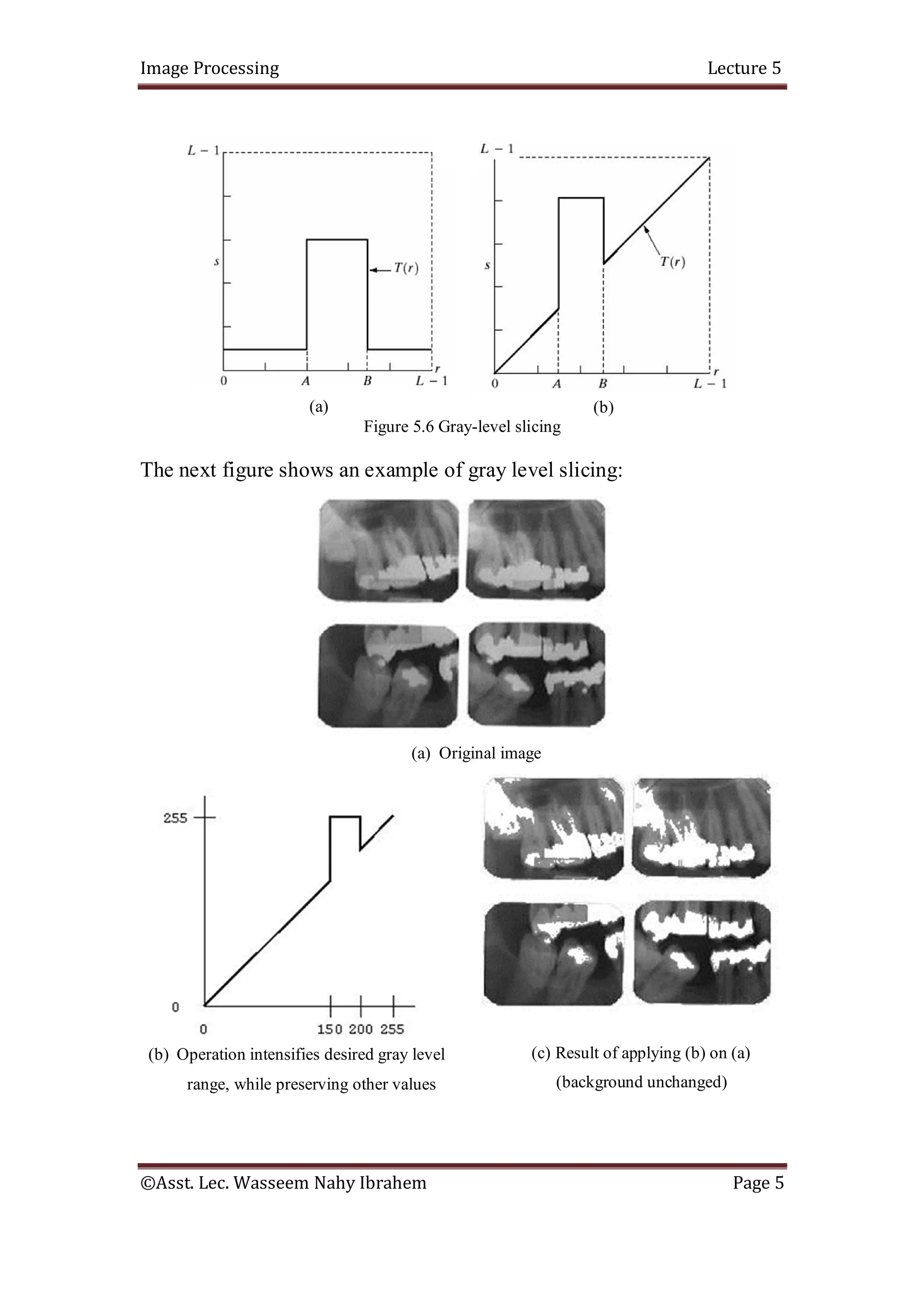
Gray-level slicing aims to highlight a specific range [A…B] of gray
levels. It simply maps all gray levels in the chosen range to a high value.
Other gray levels are either mapped to a low value (Figure 5.6(a)) or left
unchanged (Figure 5.6(b)). Gray-level slicing is used for enhancing
features such as masses of water in satellite imagery. Thus it is useful for
feature extraction.](https://image.slidesharecdn.com/diplecture5-221118195353-a629361e/75/DIP_Lecture5-pdf-4-2048.jpg)
![Image Processing Lecture 5
©Asst. Lec. Wasseem Nahy Ibrahem Page 15
= ( ) = ( − 1) = ( − 1)
×
=
( − 1)
×
= 0,1,2, … , − 1
Then round the resulting values, , to the integer range [0, L-1].
2. Compute the specified histogram ( ) of the given image, and use
it find the transformation function G using
( ) = ( − 1) ( ) = 0,1,2, … , − 1
Then round the values of G to integers in the range [0, L-1]. Store
the values of G in a table.
3. Perform inverse mapping. For every value of , use the stored
values of G from step 2 to find the corresponding value of so
that ( ) is closest to and store these mappings from to .
When more than one value of satisfies the given (i.e. the
mapping is not unique), choose the smallest value.
4. Form the output image by first histogram-equalizing the input
image and then mapping every equalized pixel value, , of this
image to the corresponding value in the histogram-specified
image using the inverse mappings in step 3.](https://image.slidesharecdn.com/diplecture5-221118195353-a629361e/75/DIP_Lecture5-pdf-15-2048.jpg)
![Image Processing Lecture 5
©Asst. Lec. Wasseem Nahy Ibrahem Page 18
( ) = 7 ( ) = 0
( ) = 7 ( ) = 7[ ( ) + ( )] = 0
and ( ) = 0 , ( ) = 1.05 , ( ) = 2.45
( ) = 4.55 , ( ) = 5.95 , ( ) = 7.00
We round the values of G to the nearest integer:
( )
z0 = 0
z1 = 1
z2 = 2
z3 = 3
z4 = 4
z5 = 5
z6 = 6
z7 = 7
0
0
0
1
2
5
6
7
Transformation function obtained
from the specified histogram
Step 3:
We find the corresponding value of so that the value ( ) is the
closest to .
1
3
5
6
7
3
4
5
6
7](https://image.slidesharecdn.com/diplecture5-221118195353-a629361e/75/DIP_Lecture5-pdf-18-2048.jpg)