




Log Transformation
Presented by:
Group no: 08
Roll: 160129, 160134
Session: 2016-17
Department of Computer Science and Engineering
Jashore University of Science and Technology
Objectives
• What is log transformation?
• Properties of log transformation;
• Log transformation graph;
• Coding technique;
• Input and output;
• Log transformation applications;
• References.
What is Log Transformation?
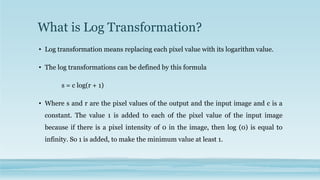
• Log transformation means replacing each pixel value with its logarithm value.
• The log transformations can be defined by this formula
s = c log(r + 1)
• Where s and r are the pixel values of the output and the input image and c is a
constant. The value 1 is added to each of the pixel value of the input image
because if there is a pixel intensity of 0 in the image, then log (0) is equal to
infinity. So 1 is added, to make the minimum value at least 1.
Properties of log transformations
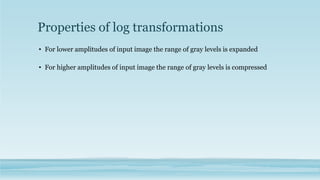
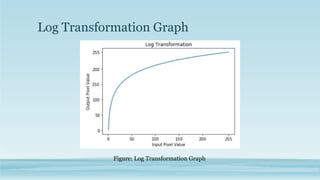
• For lower amplitudes of input image the range of gray levels is expanded
• For higher amplitudes of input image the range of gray levels is compressed
Log Transformation Graph
Figure: Log Transformation Graph
Coding Technique
a1 = imread('image.jpg');
a = double(a1)/255;
c = 2;
f = c*log(1 + (a));
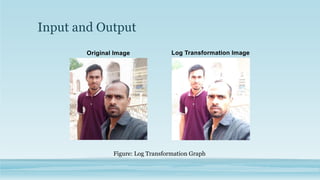
subplot(1,2,1),imshow(a1),title('Original Image');
subplot(1,2,2),imshow((f)),title('Log Transformation Image');
Input and Output
Figure: Log Transformation Graph
Log Transformation Applications
• Expands the dark pixels in the image while compressing the brighter pixels.
• Compresses the dynamic display.
References
• https://www.tutorialspoint.com/dip/gray_level_transformations.htm#
• https://theailearner.com/2019/01/01/log-transformation/
THANK
YOU

Log Transformation in Image Processing with Example