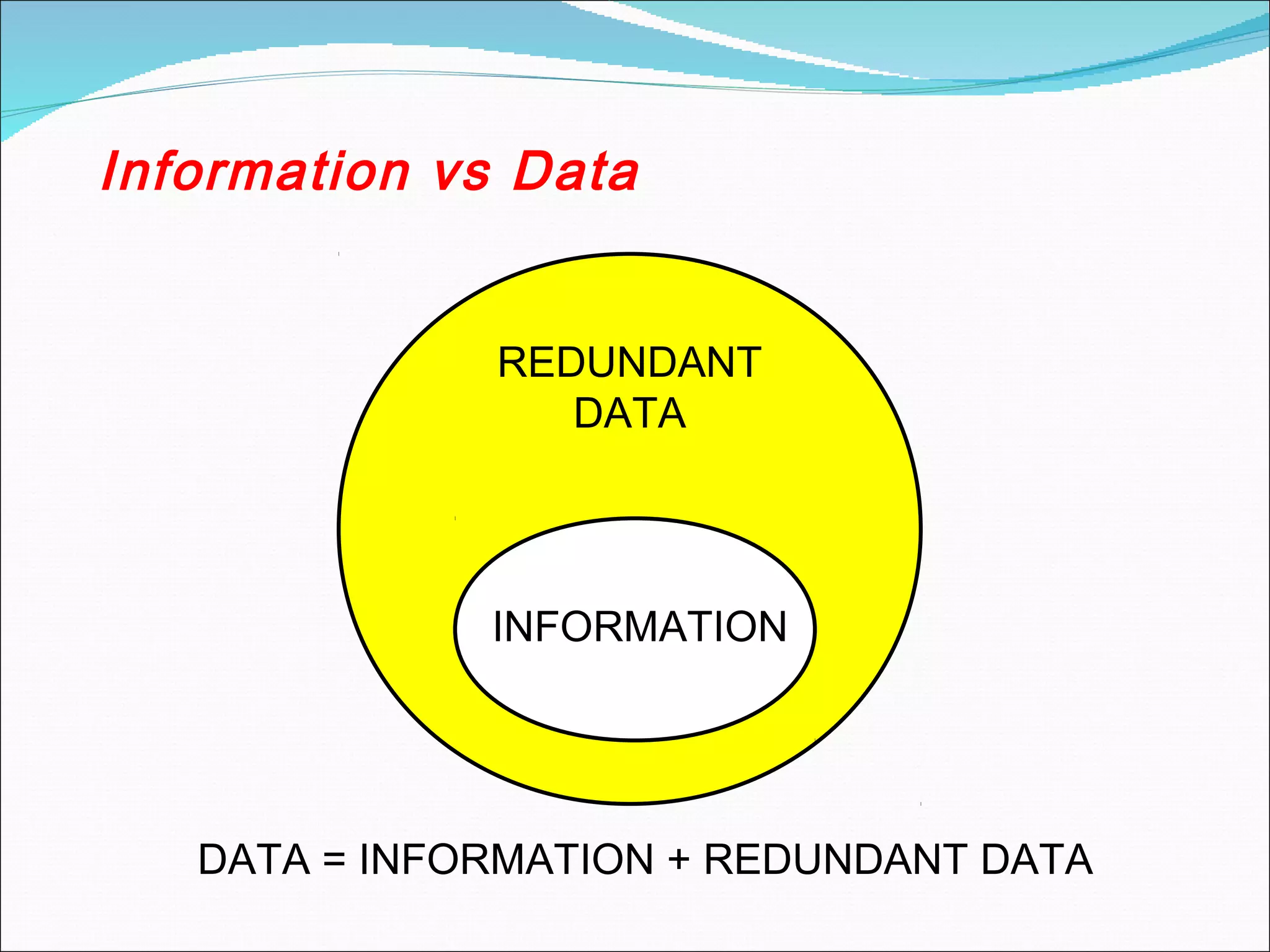
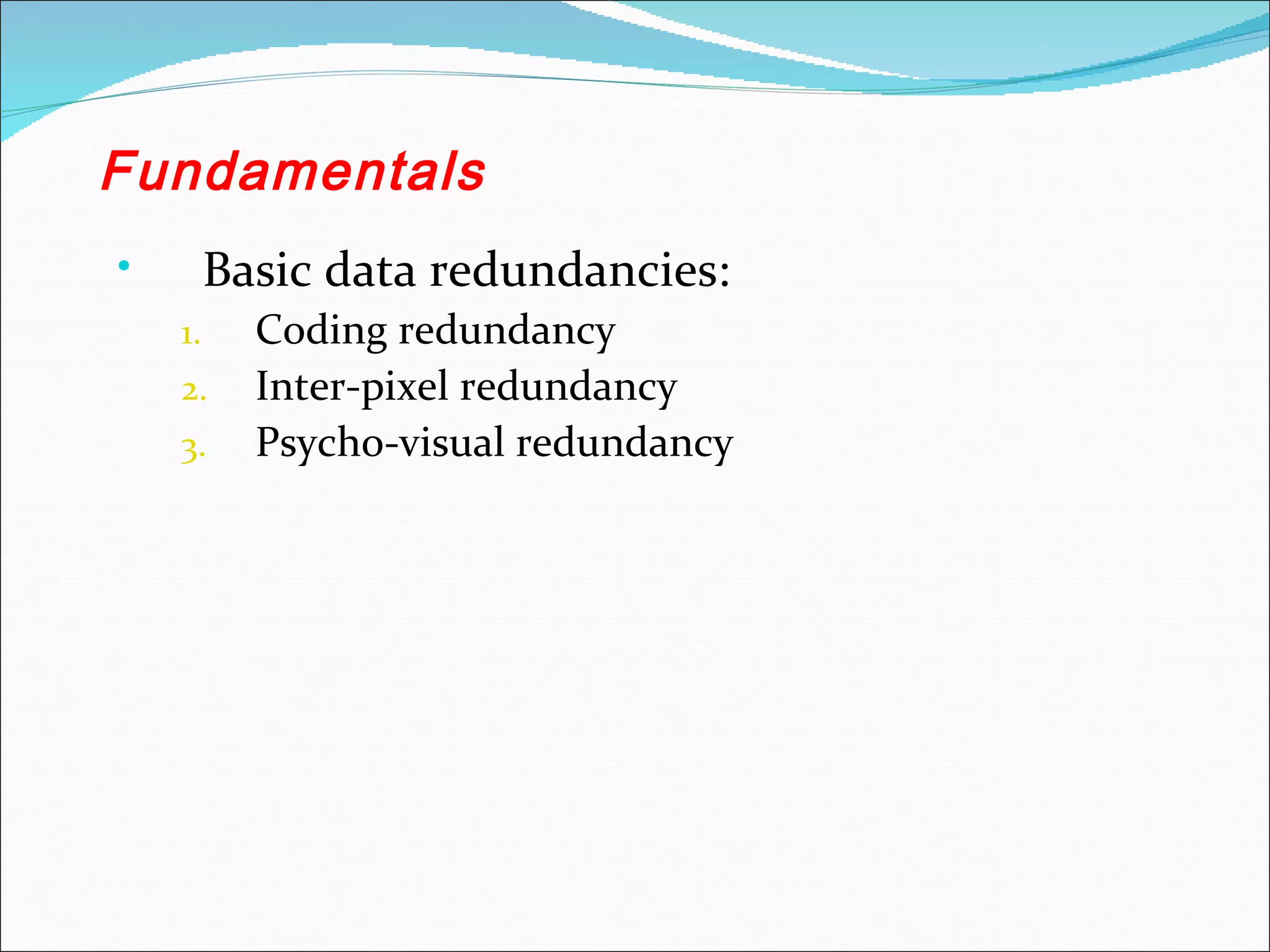
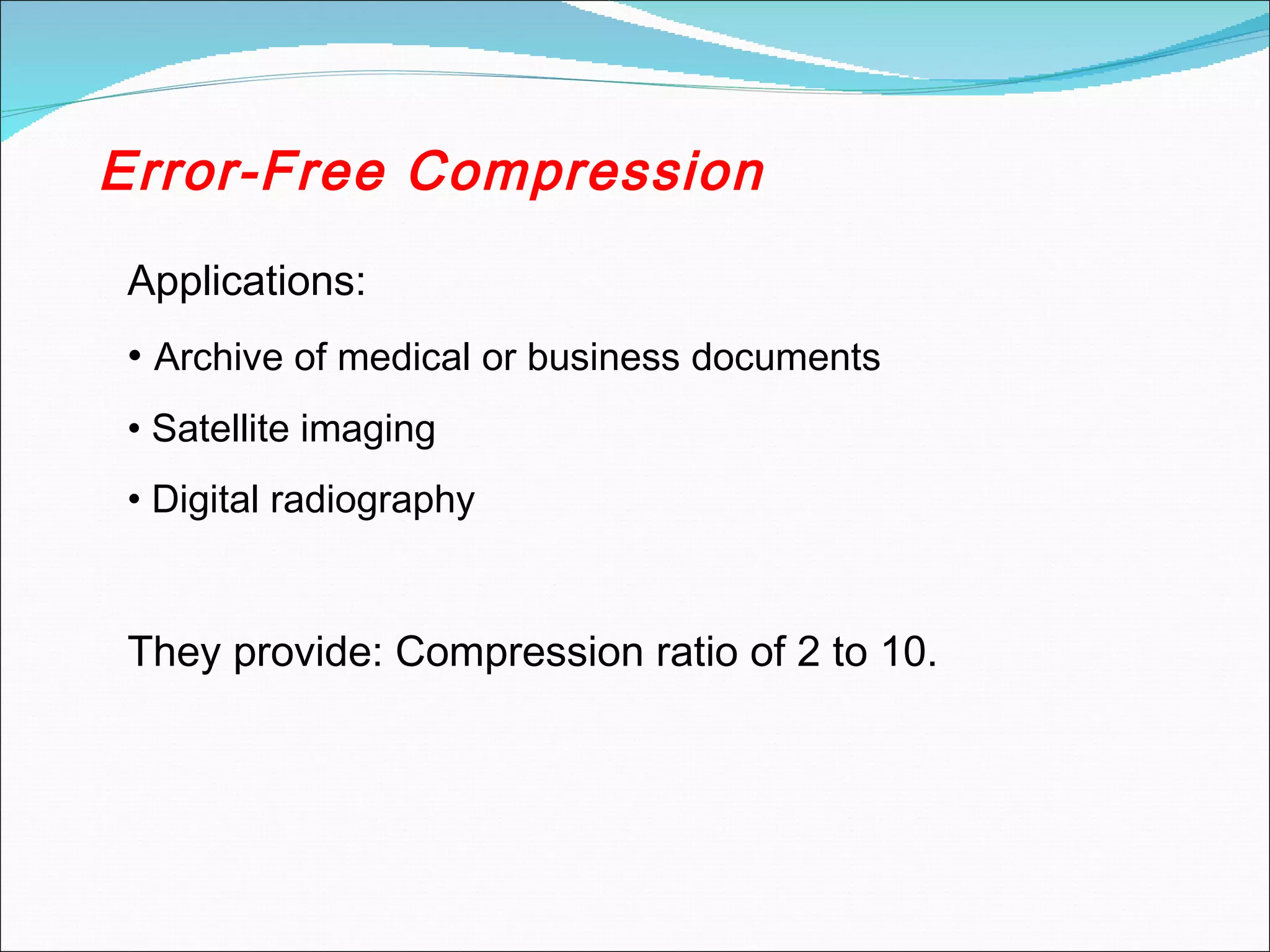
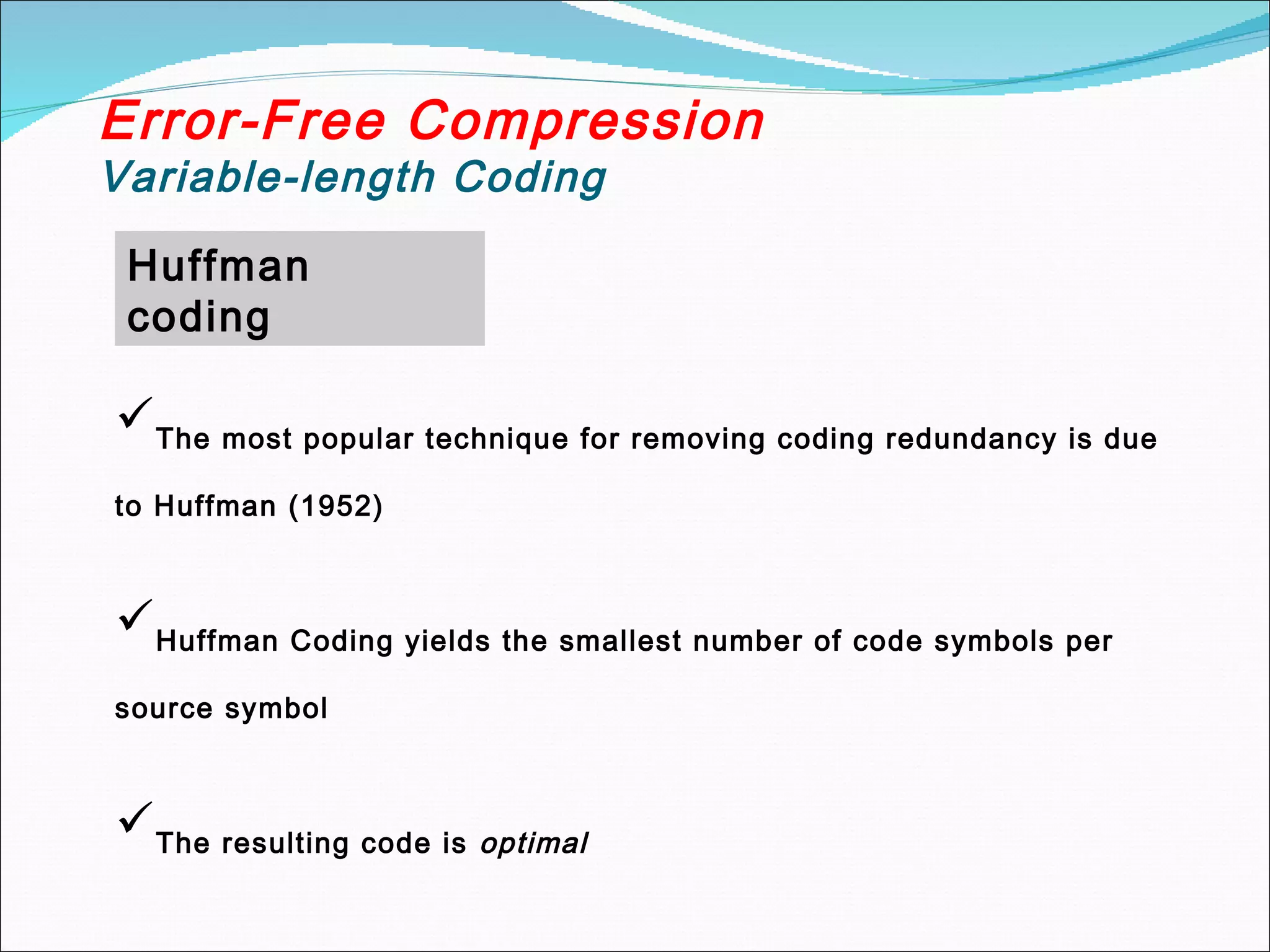
This document discusses image compression techniques. It begins by defining image compression as reducing the data required to represent a digital image. It then discusses why image compression is needed for storage, transmission and other applications. The document outlines different types of redundancies that can be exploited in compression, including spatial, temporal and psychovisual redundancies. It categorizes compression techniques as lossless or lossy and describes several algorithms for each type, including Huffman coding, LZW coding, DPCM, DCT and others. Key aspects like prediction, quantization, fidelity criteria and compression models are also summarized.


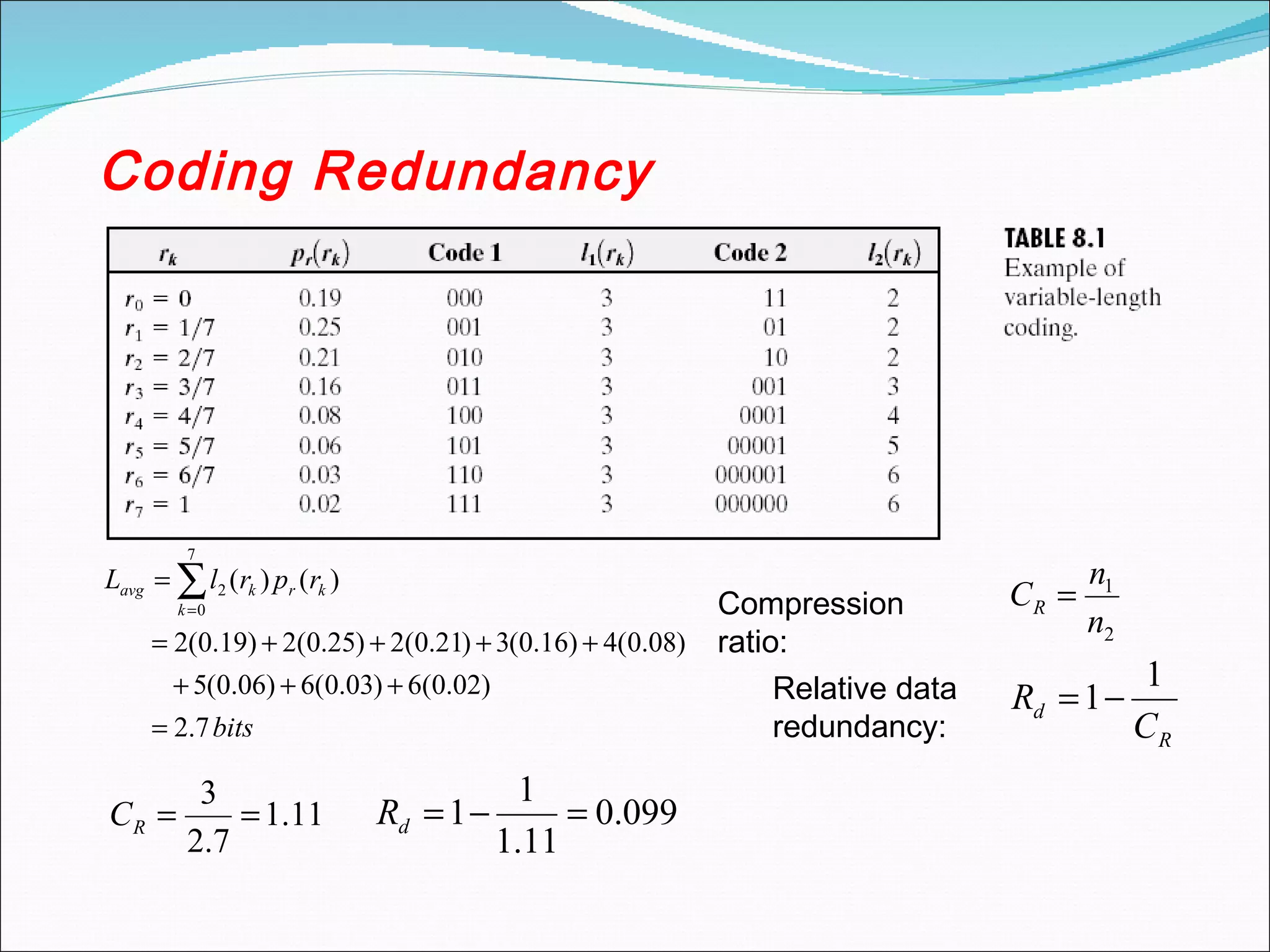
![Let us assume, that a discrete random variable rk in the interval [0,1]
represent the gray level of an image:
If the number of bits used to represent each value of rk is l(rk), then
the average number of bits required to represent each pixel:
The total number bits required to code an MxN image:
1,,2,1,0)( −== Lk
n
n
rp k
kr
avgLNM ..
Coding Redundancy
∑
−
=
=
1
0
)()(
L
k
krkavg rprlL](https://image.slidesharecdn.com/ppt-150316041228-conversion-gate01/75/image-compression-ppt-7-2048.jpg)
![Fidelity Criteria
Objective fidelity:
Level of information loss can be expressed as a function
of the original and the compressed and subsequently
decompressed image.
2/1
2
1
0
1
0
]),(),(ˆ[
1
−= ∑∑
−
=
−
=
M
x
N
y
rms yxfyxf
MN
e
∑∑
∑∑
−
=
−
=
−
=
−
=
−
= 1
0
1
0
2
1
0
1
0
2
)],(),(ˆ[
),(ˆ
M
x
N
y
M
x
N
y
ms
yxfyxf
yxf
SNR
Root-mean-square
error
Mean-square
signal-to-noise ratio](https://image.slidesharecdn.com/ppt-150316041228-conversion-gate01/75/image-compression-ppt-13-2048.jpg)


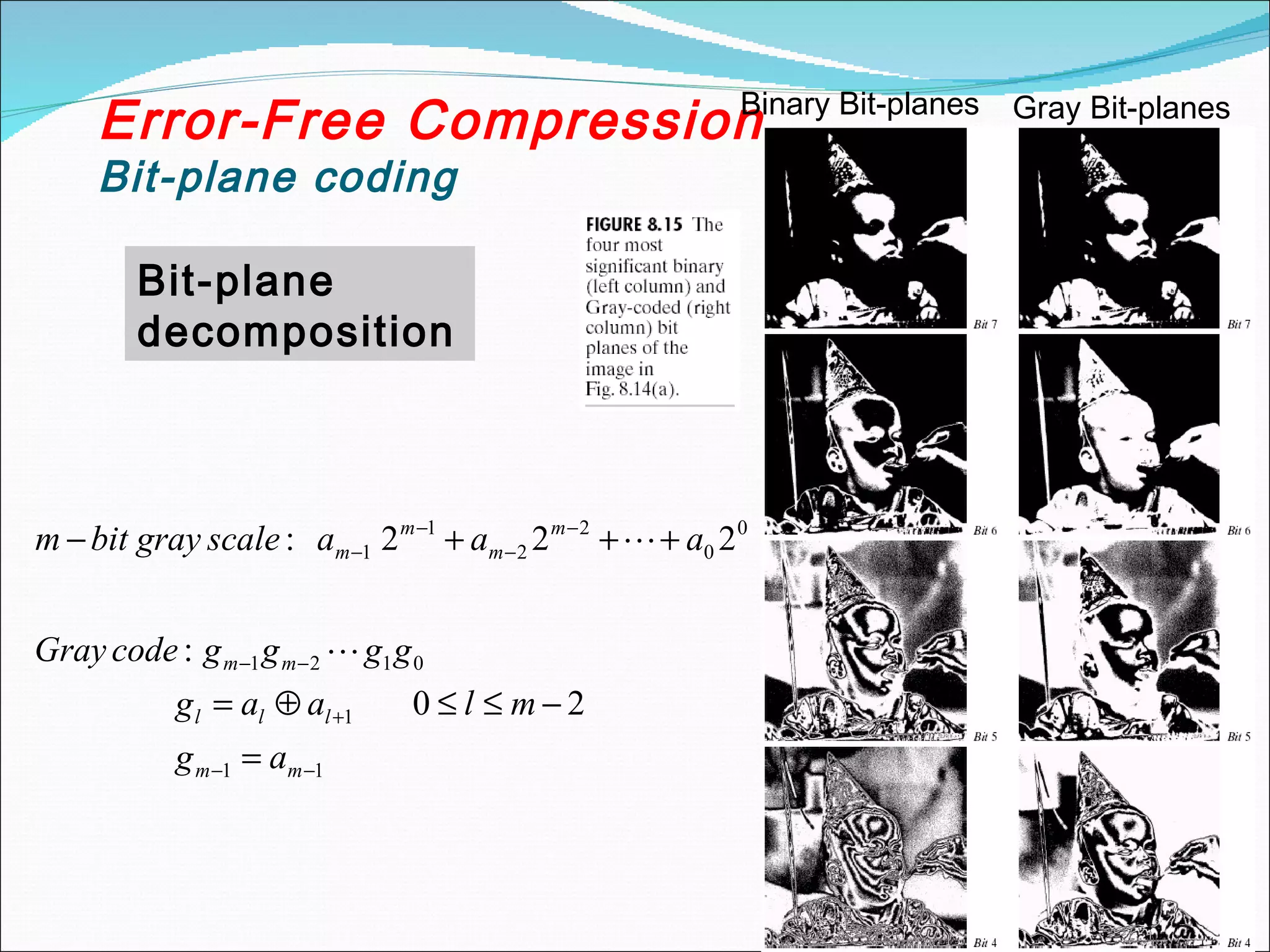
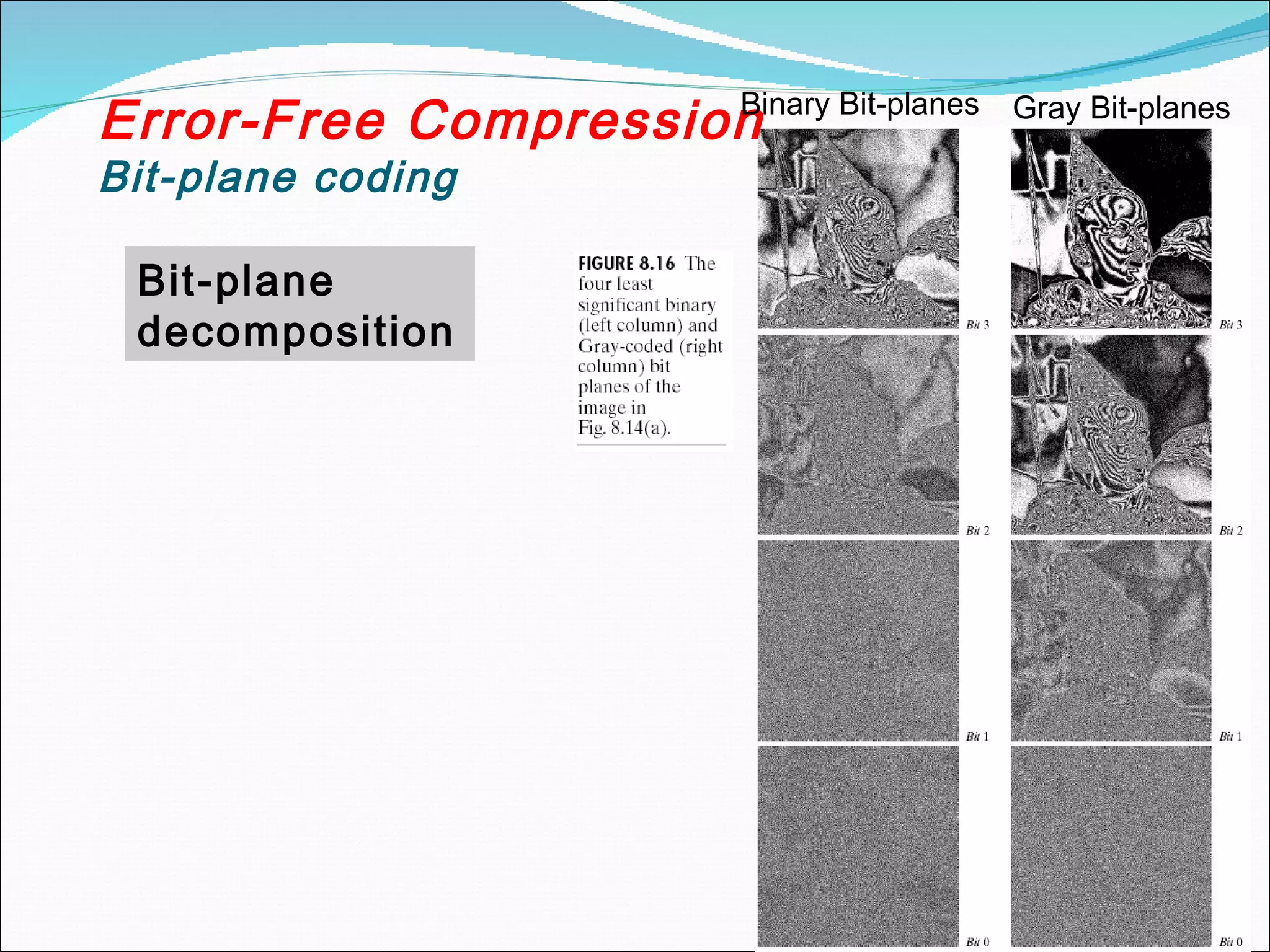

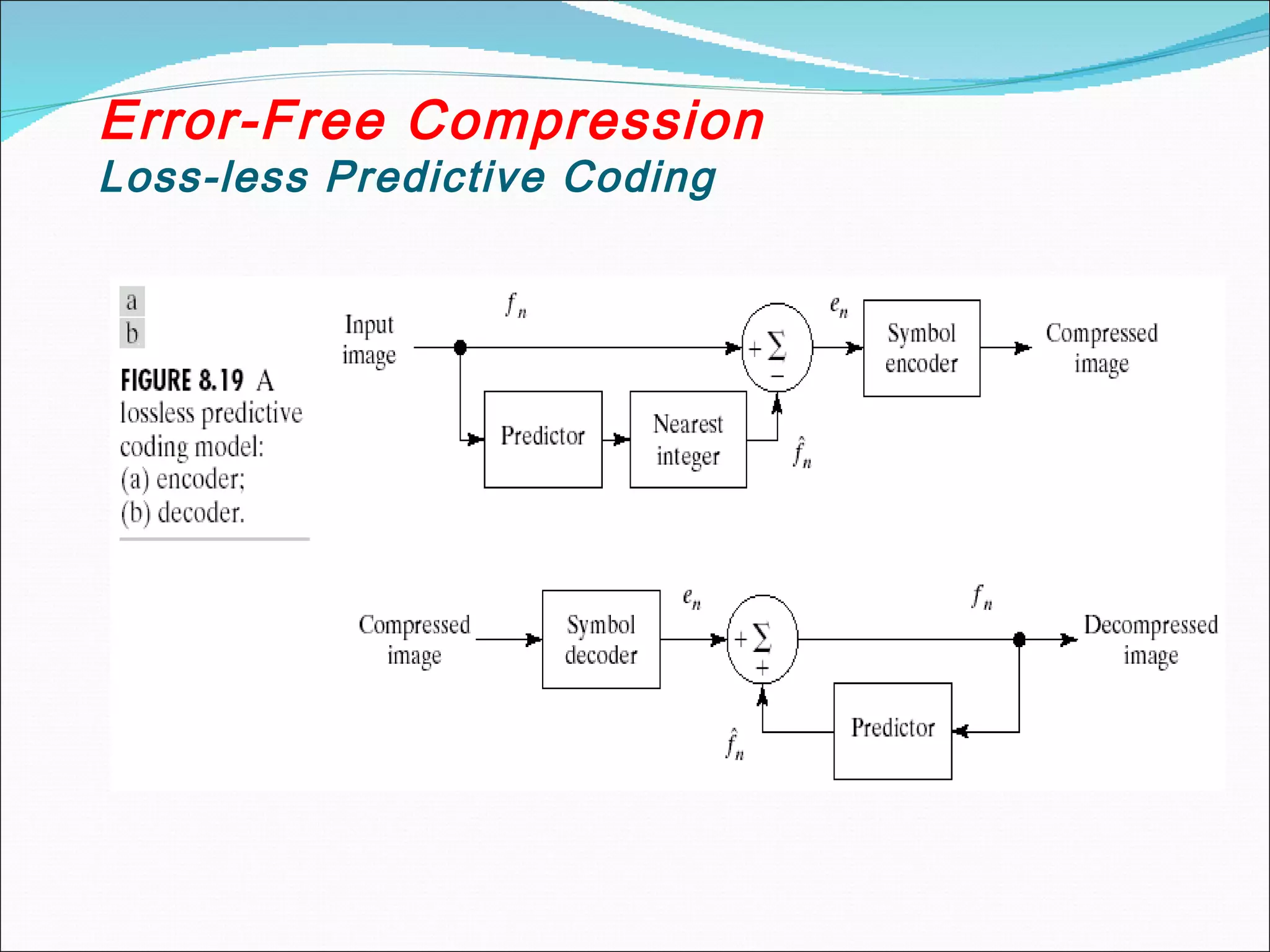
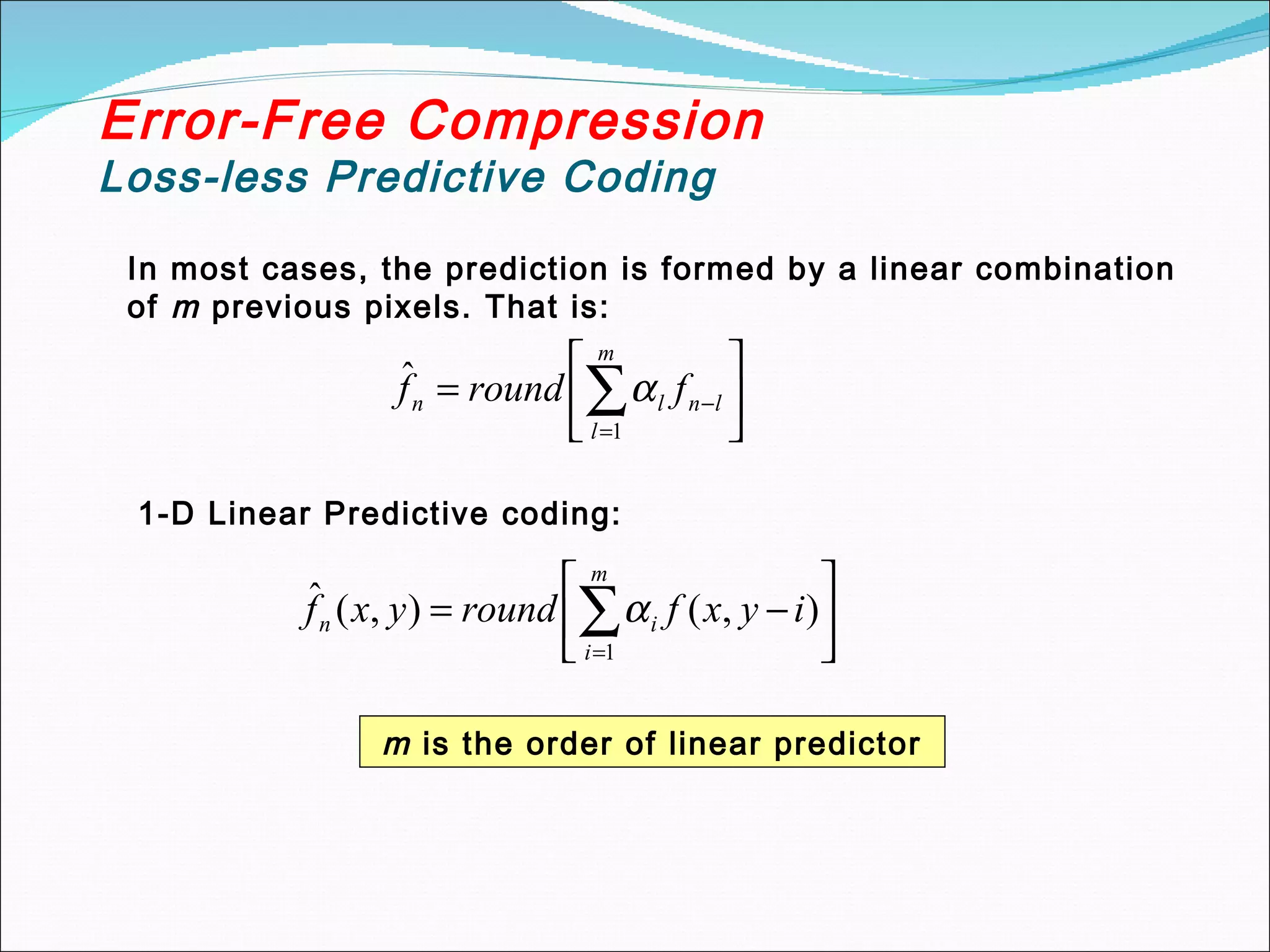
![H.R. Pourreza
Error-Free Compression
Loss-less Predictive Coding
[ ])1,(),(ˆ −= yxfroundyxf α First-order linear predictor](https://image.slidesharecdn.com/ppt-150316041228-conversion-gate01/75/image-compression-ppt-32-2048.jpg)
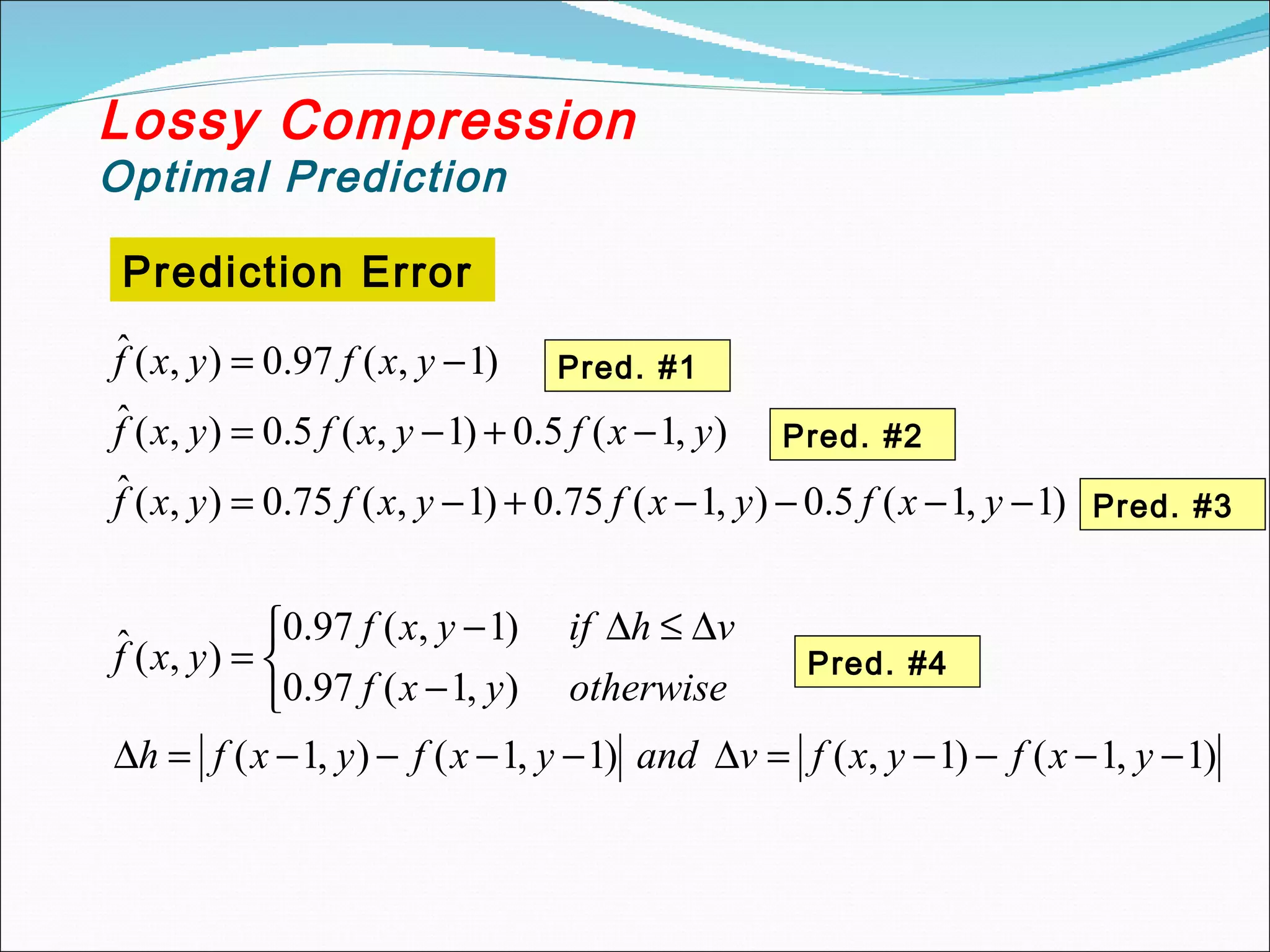
![Lossy Compression
Optimal Prediction
∑
∑
∑
=
=
−
=
−
≤
−=
=
=+≈+=
−=
m
i
i
m
i
ininn
m
i
inin
nnnnnn
nnn
ffEeE
ff
ffefef
ffEeE
1
2
1
2
1
22
1
}{
ˆ
ˆˆ
}]ˆ{[}{
α
α
α
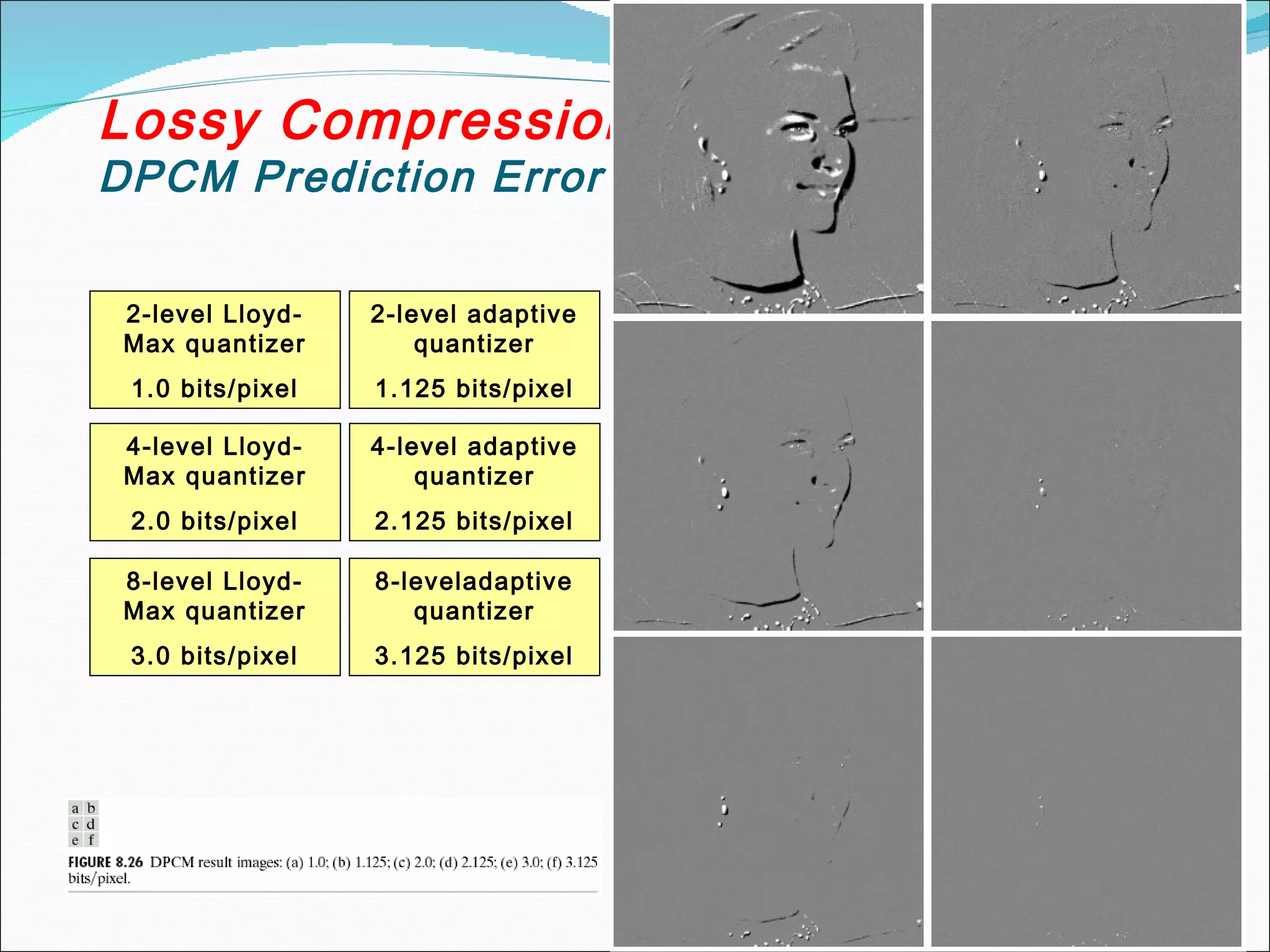
Differential Pulse Code
Modulation (DPCM)](https://image.slidesharecdn.com/ppt-150316041228-conversion-gate01/75/image-compression-ppt-37-2048.jpg)
![Discrete Fourier Transform (DFT):
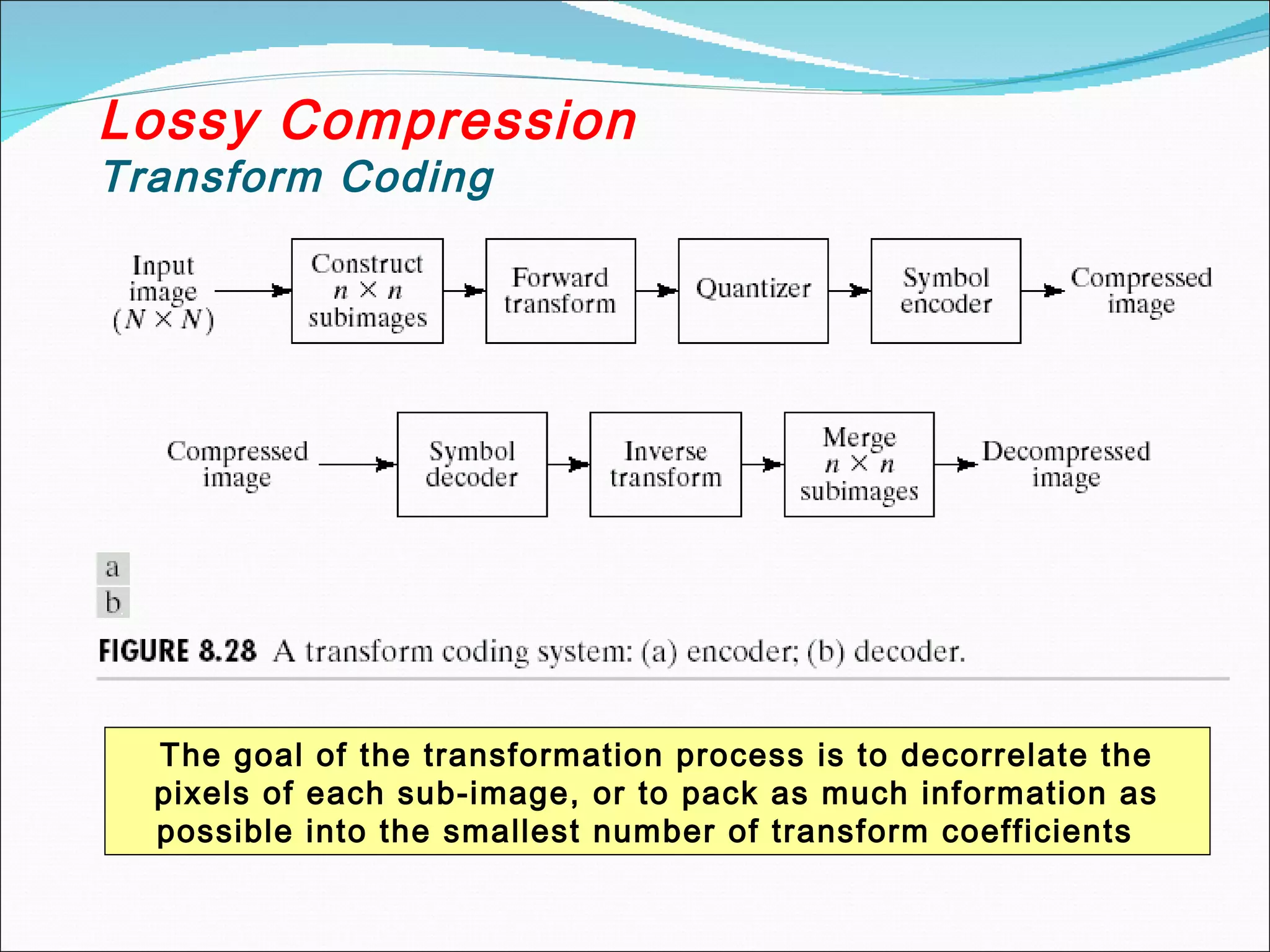
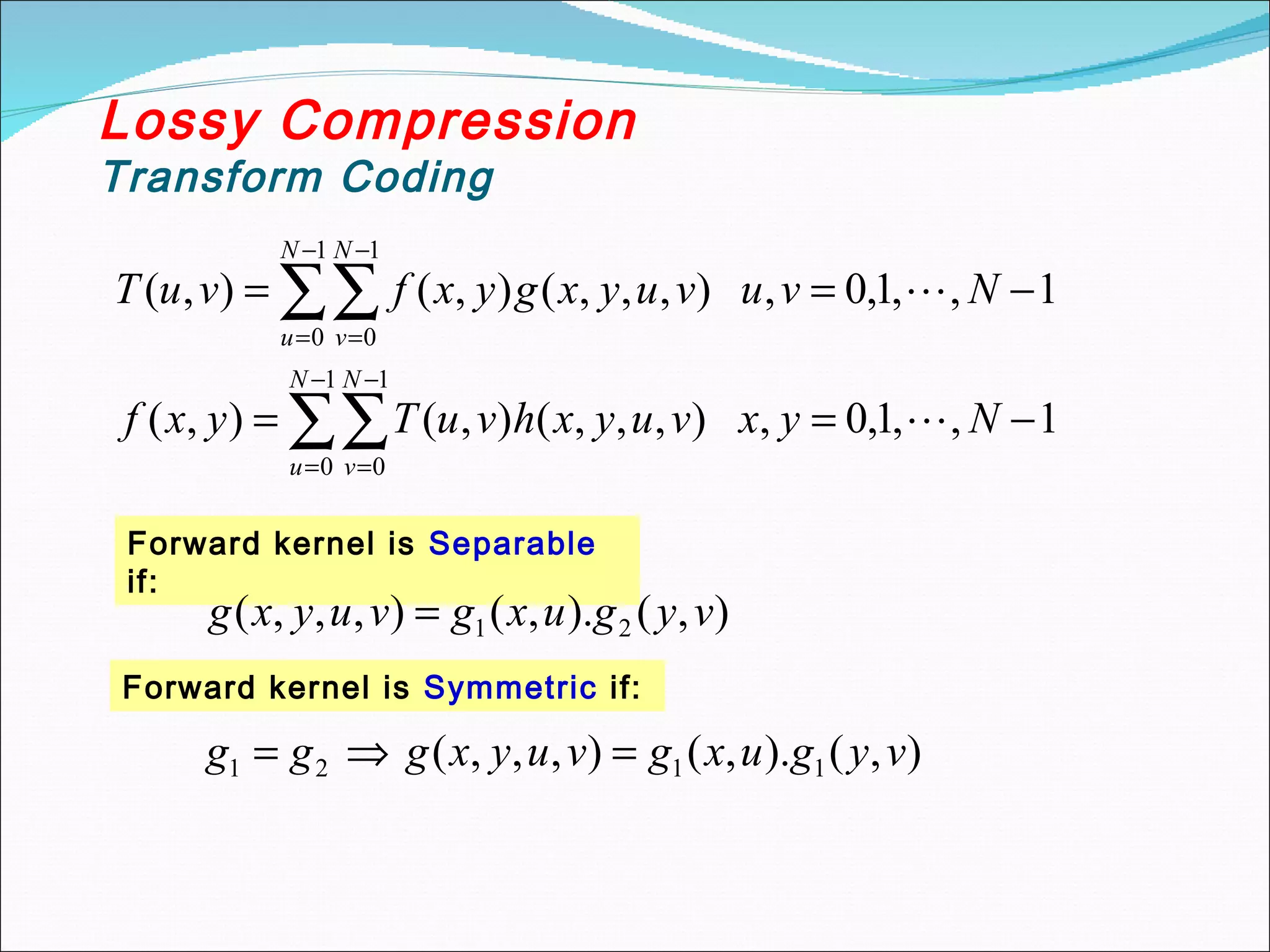
Lossy Compression
Transform Coding
Nvyuxj
Nvyuxj
evuyxh
e
N
vuyxg
/)(2
/)(2
),,,(
1
),,,(
+
+−
=
=
π
π
Walsh-Hadamard Transform (WHT):
)2()1(
1
),,,(),,,(
1
0
)]()()()([
m
vpybupxb
N
N
vuyxhvuyxg
m
i
iiii
=
∑
−==
−
=
+
bk(z) is the kth bit (from right to left) in the binary
representation of z.](https://image.slidesharecdn.com/ppt-150316041228-conversion-gate01/75/image-compression-ppt-49-2048.jpg)


