AntihistAmines
Prepared by:
Mr. Dharmendrasinh A Baria
Assistant professor
Department of Pharmaceutical Chemistry
Smt. S. M. Shah Pharmacy college, Amsaran
What is an antihistamine?
• A drug that reduces or eliminates the effects mediated by the chemical
histamine.
• Histamine is released by your body during an allergic reaction and acts on
a specific histamine receptor.
• True antihistamines are only the agents that produce a therapeutic effect
that is mediated by negative modulation of histamine receptors (other
agents may have anti-histaminergic action but are not true antihistamines)
• The term antihistamine only refers to H1 receptor antagonists (actually
inverse agonists)
• Antihistamines compete with histamine for binding sites at the receptors.
Antihistamine cannot remove the histamine if it is already bound.
What are allergies?
• Allergies are caused by a hypersensitivity reaction of the antibody class
IgE (which are located on mast cells in the tissues and basophils in the
blood)
• When an allergen is encountered, it binds to IgE, which excessively
activates the mast cells or basophils, leading them to release massive
amounts of histamines.
• These histamines lead to inflammatory responses ranging from runny
nose to anaphylactic shock
• If both parents have allergies, you have a 70% of having them, if only
one parent does, you have a 48% chance (American Academy of
Asthma, Allergies and Immunology, Spring 2003).
Allergies
Structure of Histamine
Mast Cells
•When it is released, histamine causes
inflammation by increasing
vasodilation, capillary permeability,
causing smooth muscle contraction,
mucus secretion, and parasympathetic
nerve stimulation
•Histamine is distributed in Mast Cells
in all peripheral tissues of the body and
basophils, which circulate in the blood
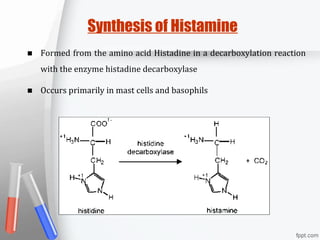
Synthesis of Histamine
■ Formed from the amino acid Histadine in a decarboxylation reaction
with the enzyme histadine decarboxylase
■ Occurs primarily in mast cells and basophils
Histamine Receptors
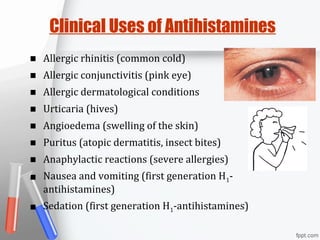
Clinical Uses of Antihistamines
■ Allergic rhinitis (common cold)
■ Allergic conjunctivitis (pink eye)
■ Allergic dermatological conditions
■ Urticaria (hives)
■ Angioedema (swelling of the skin)
■ Puritus (atopic dermatitis, insect bites)
■ Anaphylactic reactions (severe allergies)
■ Nausea and vomiting (first generation H1-
antihistamines)
■ Sedation (first generation H1-antihistamines)
Adverse effects
■ Associated with the first generation H1-antihistamines and due to their lack
of selectivity for the H1 receptor and anti-cholinergic activity. Side effects are
due to CNS depression:
■ Sedation
■ Dizziness
■ Tinnitus (ringing in the ear)
■ Blurred vision
■ Euphoria
■ Uncoordination
■ Anxiety
■ Insomnia
■ Tremor
■ Nausea/vomitting
■ Dry mouth/dry cough
■ Newer second generation H1-antihistamines are more selective for the
peripheral histamine receptors and have far less side effects (drowsiness,
fatigue, headache, nausea and dry mouth)
Structural Considerations
Mole Percentage
of Species at
pH 7.4
3.3
96.2
0.4
~0
N NH
NH2
HN N
NH2
HN N
NH3
N NH
NH3
pKa3 = 14
pKa1 = 9.75
pKa2 = 5.94 Dication
Monocation
Unionized
Anion
NπNτ
+HN
NH3
NH
–N
NH2
N
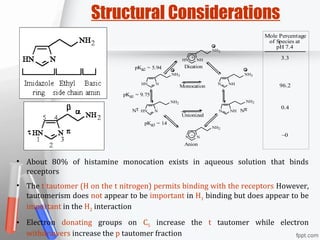
• About 80% of histamine monocation exists in aqueous solution that binds
receptors
• The t tautomer (H on the t nitrogen) permits binding with the receptors However,
tautomerism does not appear to be important in H1 binding but does appear to be
important in the H2 interaction
• Electron donating groups on C5 increase the t tautomer while electron
withdrawers increase the p tautomer fraction
Sawhorse and Newman Projections
trans
gauche
A B
NH3
H H
N
H
N
HH
NH3
H
H
NH
N
H H
N
H
N
HH
H H
NH3
NH
N
H
H
H H
NH3
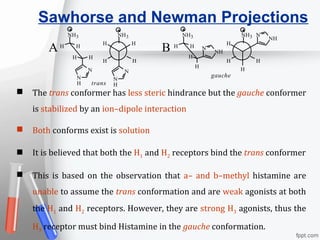
 The trans conformer has less steric hindrance but the gauche conformer
is stabilized by an ion–dipole interaction
 Both conforms exist is solution
 It is believed that both the H1 and H2 receptors bind the trans conformer
 This is based on the observation that a– and b–methyl histamine are
unable to assume the trans conformation and are weak agonists at both
the H1 and H2 receptors. However, they are strong H3 agonists, thus the
H3 receptor must bind Histamine in the gauche conformation.
H1-Antagonists- Classification
1st
Generation Antihistamines (Classical
antihistamines)
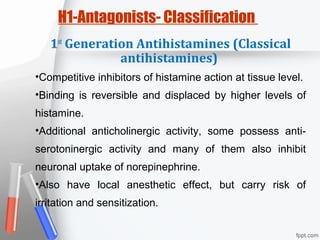
•Competitive inhibitors of histamine action at tissue level.
•Binding is reversible and displaced by higher levels of
histamine.
•Additional anticholinergic activity, some possess anti-
serotoninergic activity and many of them also inhibit
neuronal uptake of norepinephrine.
•Also have local anesthetic effect, but carry risk of
irritation and sensitization.
1st
Generation Antihistamines (Classical
antihistamines)
1.Ethylene diamines
2.Ethanolamines (Aminoalkylethers)
3.Alkylamines (Propylamines)
4.Piperazines (Cyclizines)
5.Tricyclics (Piperidines)
6.Phenothiazine
Common Structural Features of classical first
generation antihistamines
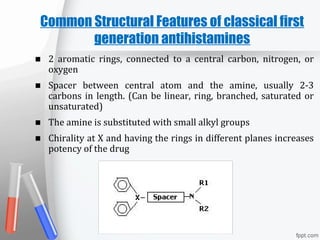
■ 2 aromatic rings, connected to a central carbon, nitrogen, or
oxygen
■ Spacer between central atom and the amine, usually 2-3
carbons in length. (Can be linear, ring, branched, saturated or
unsaturated)
■ The amine is substituted with small alkyl groups
■ Chirality at X and having the rings in different planes increases
potency of the drug
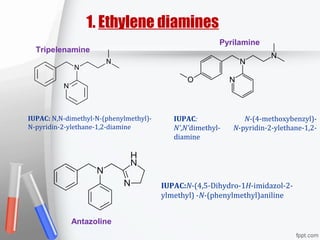
1. Ethylene diamines
Tripelenamine
Pyrilamine
Antazoline
IUPAC: N,N-dimethyl-N-(phenylmethyl)-
N-pyridin-2-ylethane-1,2-diamine
IUPAC: N-(4-methoxybenzyl)-
N',N'dimethyl- N-pyridin-2-ylethane-1,2-
diamine
IUPAC:N-(4,5-Dihydro-1H-imidazol-2-
ylmethyl) -N-(phenylmethyl)aniline
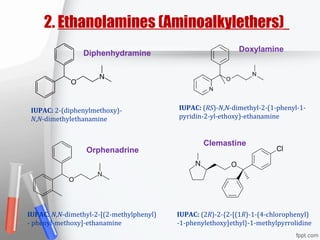
2. Ethanolamines (Aminoalkylethers)
Diphenhydramine
Doxylamine
Clemastine
Orphenadrine
IUPAC: 2-(diphenylmethoxy)-
N,N-dimethylethanamine
IUPAC: (RS)-N,N-dimethyl-2-(1-phenyl-1-
pyridin-2-yl-ethoxy)-ethanamine
IUPAC: N,N-dimethyl-2-[(2-methylphenyl)
- phenyl-methoxy]-ethanamine
IUPAC: (2R)-2-{2-[(1R)-1-(4-chlorophenyl)
-1-phenylethoxy]ethyl}-1-methylpyrrolidine
3. Alkylamines (Propylamines)
Pheniramine Chlorpheniramine
Phenindamine
Triprolidine
IUPAC: N,N-dimethyl-3-phenyl-3-
pyridin-2-yl-propan-1-amine
IUPAC: 3-(4-chlorophenyl)-N,N-dimethyl-
3-pyridin-2-yl-propan-1-amine
IUPAC: 2-methyl-9-phenyl-2,3,4,9-
tetrahydro-1H-indeno[2,1-c]pyridine
IUPAC: 2-[(E)-1-(4-methylphenyl)-3-
pyrrolidin-1-yl-prop-1-enyl]pyridine
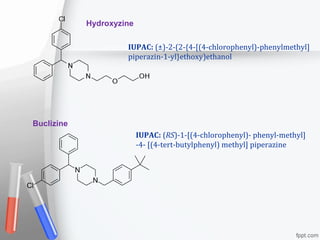
4. Piperazines (Cyclizines)
Cyclizine
Chlorcyclizine
Meclizine
IUPAC: 1-benzhydryl-4-methyl-piperazine IUPAC:1-[(4-Chlorophenyl)(phenyl)
methyl]-4-methylpiperazine
IUPAC: (RS)-1-[(4-chlorophenyl)(phenyl)methyl]-
4-(3-methylbenzyl)piperazine
Buclizine
Hydroxyzine
IUPAC: (RS)-1-[(4-chlorophenyl)- phenyl-methyl]
-4- [(4-tert-butylphenyl) methyl] piperazine
IUPAC: (±)-2-(2-{4-[(4-chlorophenyl)-phenylmethyl]
piperazin-1-yl}ethoxy)ethanol
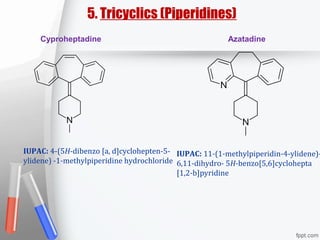
5. Tricyclics (Piperidines)
Cyproheptadine Azatadine
IUPAC: 4-(5H-dibenzo [a, d]cyclohepten-5-
ylidene) -1-methylpiperidine hydrochloride
IUPAC: 11-(1-methylpiperidin-4-ylidene)-
6,11-dihydro- 5H-benzo[5,6]cyclohepta
[1,2-b]pyridine
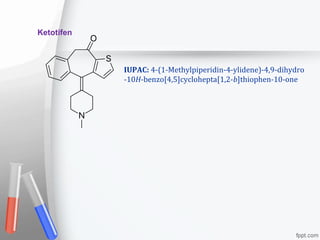
Ketotifen
IUPAC: 4-(1-Methylpiperidin-4-ylidene)-4,9-dihydro
-10H-benzo[4,5]cyclohepta[1,2-b]thiophen-10-one
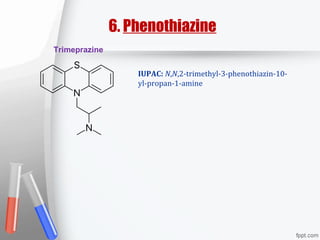
6. Phenothiazine
Trimeprazine
IUPAC: N,N,2-trimethyl-3-phenothiazin-10-
yl-propan-1-amine
2nd Generation Antihistamines
 Antagonists at H1 receptors
 Competitive antagonists though some are
noncompetitive at higher doses
 High therapeutic index
 Poorly lipophilic - do not readily traverse blood brain
barrier
 Highly selective with little or no anticholinergic activity
 Additional anti-allergic mechanisms of some, like
inhibition of late phase allergic reaction by acting on
leukotrienes or anti platelet factor activating effect
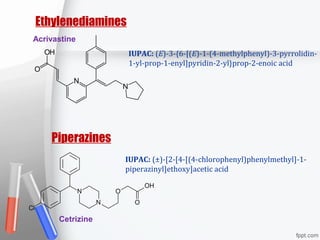
Ethylenediamines
Acrivastine
Cetrizine
Piperazines
IUPAC: (E)-3-{6-[(E)-1-(4-methylphenyl)-3-pyrrolidin-
1-yl-prop-1-enyl]pyridin-2-yl}prop-2-enoic acid
IUPAC: (±)-[2-[4-[(4-chlorophenyl)phenylmethyl]-1-
piperazinyl]ethoxy]acetic acid
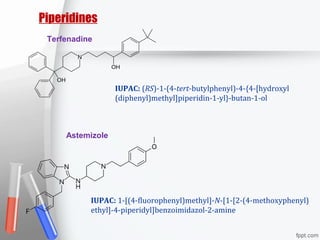
Piperidines
Terfenadine
Astemizole
IUPAC: (RS)-1-(4-tert-butylphenyl)-4-{4-[hydroxyl
(diphenyl)methyl]piperidin-1-yl}-butan-1-ol
IUPAC: 1-[(4-fluorophenyl)methyl]-N-[1-[2-(4-methoxyphenyl)
ethyl]-4-piperidyl]benzoimidazol-2-amine
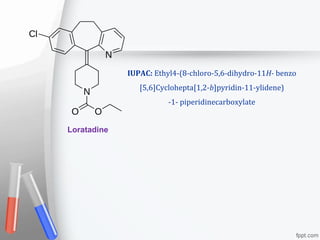
Loratadine
IUPAC: Ethyl4-(8-chloro-5,6-dihydro-11H- benzo
[5,6]Cyclohepta[1,2-b]pyridin-11-ylidene)
-1- piperidinecarboxylate
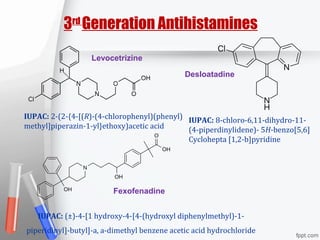
3rd
Generation Antihistamines
Levocetrizine
Desloatadine
Fexofenadine
IUPAC: (±)-4-[1 hydroxy-4-[4-(hydroxyl diphenylmethyl)-1-
piperidinyl]-butyl]-a, a-dimethyl benzene acetic acid hydrochloride
IUPAC: 2-(2-{4-[(R)-(4-chlorophenyl)(phenyl)
methyl]piperazin-1-yl}ethoxy)acetic acid
IUPAC: 8-chloro-6,11-dihydro-11-
(4-piperdinylidene)- 5H-benzo[5,6]
Cyclohepta [1,2-b]pyridine
C C N
R1
R2
X
Ar1
Ar2
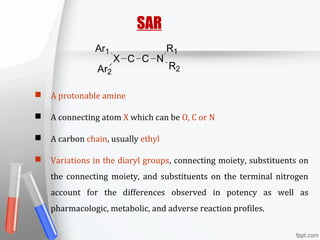
 A protonable amine
 A connecting atom X which can be O, C or N
 A carbon chain, usually ethyl
 Variations in the diaryl groups, connecting moiety, substituents on
the connecting moiety, and substituents on the terminal nitrogen
account for the differences observed in potency as well as
pharmacologic, metabolic, and adverse reaction profiles.
SAR
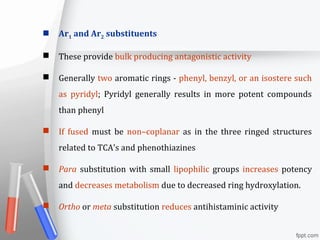
 Ar1 and Ar2 substituents
 These provide bulk producing antagonistic activity
 Generally two aromatic rings - phenyl, benzyl, or an isostere such
as pyridyl; Pyridyl generally results in more potent compounds
than phenyl
 If fused must be non–coplanar as in the three ringed structures
related to TCA’s and phenothiazines
 Para substitution with small lipophilic groups increases potency
and decreases metabolism due to decreased ring hydroxylation.
 Ortho or meta substitution reduces antihistaminic activity
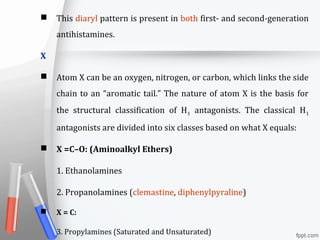
 This diaryl pattern is present in both first- and second-generation
antihistamines.
X
 Atom X can be an oxygen, nitrogen, or carbon, which links the side
chain to an “aromatic tail.” The nature of atom X is the basis for
the structural classification of H1 antagonists. The classical H1
antagonists are divided into six classes based on what X equals:
 X =C–O: (Aminoalkyl Ethers)
1. Ethanolamines
2. Propanolamines (clemastine, diphenylpyraline)
 X = C:
3. Propylamines (Saturated and Unsaturated)
 X = N:
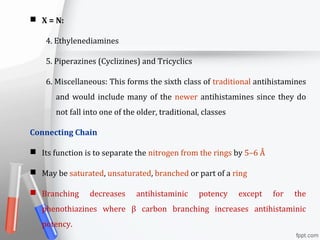
4. Ethylenediamines
5. Piperazines (Cyclizines) and Tricyclics
6. Miscellaneous: This forms the sixth class of traditional antihistamines
and would include many of the newer antihistamines since they do
not fall into one of the older, traditional, classes
Connecting Chain
 Its function is to separate the nitrogen from the rings by 5–6 Å
 May be saturated, unsaturated, branched or part of a ring
 Branching decreases antihistaminic potency except for the
phenothiazines where β carbon branching increases antihistaminic
potency.
Basic aliphatic amine
 Must be able to accept a proton (basic) at physiological pH
 R1 and R2 : Potency order is 3° > 2° > 1°
 Quaternization does not increase antihistaminic but does
increase anti-cholinergic activity
 May be incorporated into a heterocycle which is although larger,
the heterocycle constrains
 Dimethyl is the optimum configuration
 Larger substituents decrease antihistaminic potency due to steric
hindrance unless they are part of a heterocycle structure when
the ring constrains the two ethyls so they are still active
 The H1 antagonists do not occupy the same area or space as the natural
receptor substrate
 Only the protonated nitrogen binds the same anionic site as Histamine
 The aromatic tail binds adjacent to the Histamine binding site thus
produces the nonspecific conformational perturbation of the receptor.
This changes the shape of the receptor decreasing the affinity for
Histamine
 It seems that sites outside may be chiral because steroselectivity is
observed with some H1 antagonists
 As previously discussed the optical isomers of α-Methyl histamine are
equipotent as agonists
Receptor Interaction
Histamine H2-Antagonists
Guanylhistamine
N C
NH
NH2CH2CH2
NHN
H
N C
S
NH2CH2CH2CH2
NHN
H
N C
S
NH2CH2CH2CH2CH2
NHN
H
N C
S
NHCH3CH2CH2CH2CH2
NHN
H
N C
S
NHCH3CH2–S–CH2CH2
NHN
H
H3C
Metiamide
N C
NH
NHCH3CH2–S–CH2CH2
NHN
H
H3C
N C
N
NHCH3CH2–S–CH2CH2
NHN
H
H3C
CN
SK&F 91581
SK&F 91863
Burimamide
Cimetidine ™
I
a
b
c
d
e
f
g
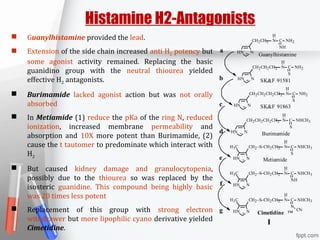
 Guanylhistamine provided the lead.
 Extension of the side chain increased anti H2 potency but
some agonist activity remained. Replacing the basic
guanidino group with the neutral thiourea yielded
effective H2 antagonists.
 Burimamide lacked agonist action but was not orally
absorbed
 In Metiamide (1) reduce the pKa of the ring N, reduced
ionization, increased membrane permeability and
absorption and 10X more potent than Burimamide, (2)
cause the t tautomer to predominate which interact with
H2
 But caused kidney damage and granulocytopenia,
possibly due to the thiourea so was replaced by the
isosteric guanidine. This compound being highly basic
was 20 times less potent
 Replacement of this group with strong electron
withdrawer but more lipophilic cyano derivative yielded
Cimetidine.
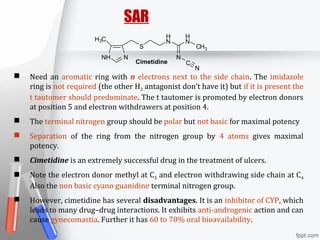
 Need an aromatic ring with n electrons next to the side chain. The imidazole
ring is not required (the other H2 antagonist don’t have it) but if it is present the
t tautomer should predominate. The t tautomer is promoted by electron donors
at position 5 and electron withdrawers at position 4.
 The terminal nitrogen group should be polar but not basic for maximal potency
 Separation of the ring from the nitrogen group by 4 atoms gives maximal
potency.
 Cimetidine is an extremely successful drug in the treatment of ulcers.
 Note the electron donor methyl at C5 and electron withdrawing side chain at C4
Also the non basic cyano guanidine terminal nitrogen group.
 However, cimetidine has several disadvantages. It is an inhibitor of CYP, which
leads to many drug–drug interactions. It exhibits anti-androgenic action and can
cause gynecomastia. Further it has 60 to 70% oral bioavailability.
SAR
C
H3C
NH N
S
H
N
H
N
CH3
N
N
Cimetidine
CH3
CH3
N
NO2
O
S
H
N
H
N
CH3
HC
Ranitidine
NS
N
NH2
NH2
N
H
N
H
S
SO2NH2
Famotidine
CH3
CH3
N
NO2
S N
S
H
N
H
N
CH3
HC
Nizatidine
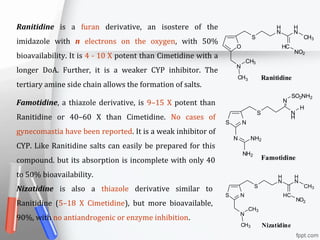
Nizatidine is also a thiazole derivative similar to
Ranitidine (5–18 X Cimetidine), but more bioavailable,
90%, with no antiandrogenic or enzyme inhibition.
Ranitidine is a furan derivative, an isostere of the
imidazole with n electrons on the oxygen, with 50%
bioavailability. It is 4 - 10 X potent than Cimetidine with a
longer DoA. Further, it is a weaker CYP inhibitor. The
tertiary amine side chain allows the formation of salts.
Famotidine, a thiazole derivative, is 9–15 X potent than
Ranitidine or 40–60 X than Cimetidine. No cases of
gynecomastia have been reported. It is a weak inhibitor of
CYP. Like Ranitidine salts can easily be prepared for this
compound. but its absorption is incomplete with only 40
to 50% bioavailability.
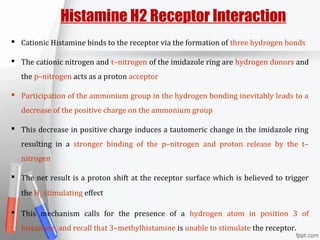
 Cationic Histamine binds to the receptor via the formation of three hydrogen bonds
 The cationic nitrogen and t–nitrogen of the imidazole ring are hydrogen donors and
the p–nitrogen acts as a proton acceptor
 Participation of the ammonium group in the hydrogen bonding inevitably leads to a
decrease of the positive charge on the ammonium group
 This decrease in positive charge induces a tautomeric change in the imidazole ring
resulting in a stronger binding of the p–nitrogen and proton release by the t–
nitrogen
 The net result is a proton shift at the receptor surface which is believed to trigger
the H2 stimulating effect
 This mechanism calls for the presence of a hydrogen atom in position 3 of
histamine, and recall that 3–methylhistamine is unable to stimulate the receptor.
Histamine H2 Receptor Interaction
H3-Receptor Antagonists
HN N
Thioperamide
N NH
S
HN N
N
N
O
Cl
GR-175737
HN N
N
O
GT-2016
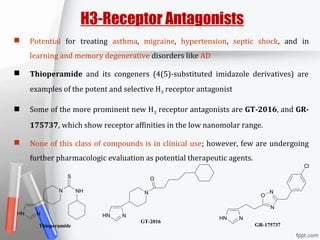
 Potential for treating asthma, migraine, hypertension, septic shock, and in
learning and memory degenerative disorders like AD
 Thioperamide and its congeners (4(5)-substituted imidazole derivatives) are
examples of the potent and selective H3 receptor antagonist
 Some of the more prominent new H3 receptor antagonists are GT-2016, and GR-
175737, which show receptor affinities in the low nanomolar range.
 None of this class of compounds is in clinical use; however, few are undergoing
further pharmacologic evaluation as potential therapeutic agents.