High Tibial Osteotomy
Osteotomy of the proximal tibia has been used for
more than a century to correct angular deformity
in the setting of rickets, poliomyelitis, and
posttraumatic conditions.
Jackson is credited being the first in the English-
language literature to report performing a
proximal (high) tibial osteotomy (HTO) to treat
osteoarthritis of the knee.
Jackson’s concept was subsequently adopted by
Coventry et al and Insall et al,who refined and
popularized the lateral closing wedge HTO
In the United States, initial experience indicated
that HTO was effective in relieving the pain of
unicompartmental osteoarthritis
HTO has been temporized by two factors:
recognition of the procedure’s limitations
evolution and clinical success of total knee
arthroplasty (TKA)
drawbacks:
it is not an ideal treatment option for patients
with significant bicompartmental or
tricompartmental disease
results of the procedure progressively
deteriorate
use HTO
(1) medial compartment osteoarthritis in physiologically
young, active patients, for whom TKA is imperfect for
long-term solution.
(2) HTO imposes no permanent activity restrictions
(3) Superior results are more likely with contemporary
fixation and postoperative management techniques after
HTO
(4) Evolving chondral resurfacing techniques are
contraindicated in the presence of tibiofemoral malalign
mandate concomitant correction of significant coexistent
angular deformity.
(5) Combining HTOwith chondral resurfacing procedures may
provide better results than would HTOalone.
Indications for High Tibial
Osteotomy
• Oseoarthritis Patients WithVarus Limb Alignment
• Oseoarthritis Patients WithValgus Limb Alignment
• Adult Osteochondritis Dissecan
• Osteonecrosis
• Posterolateral Instability
• Chondral Resurfacing
• the ability of the patient to use crutches after the
operation and the possession of sufficient muscle strength
and motivation to carry out a rehabilitation program
• good vascular status without serious arterial insufficiency
or large varicosities
Vargus Limb Alignment
The most common indication for HTOis isolated medial
compartment degenerative joint disease with
associated varus tibiofemoral malalignment
The rationale behind performing a valgus-producing HTO
in the context of unicompartmental degenerative joint
disease is to unload the arthritic medial compartment.
The ideal patient for this procedure is physiologically
young and active
Elderly patients (chronologically older than 60 years) with
low functional demand typically are more appropriate
candidates for TKA
Valgus Limb Alignment
Isolated lateral compartment osteoarthritis is much
less common than isolated medial compartment
osteoarthritis.
Most authorities have a preference for performing
a varus-producing distal femoral osteotomy
rather than a varus producing HTO
Correcting the valgus angulation on the tibial side
of the knee has been criticized because a valgus-
producingHTO produces obliquity of the
tibiofemoral joint line
Adult Osteochondritis Dissecans
HTOshould be considered in physiologically
young, active adults with osteochondritis
dissecans of the medial femoral condyle
author reported that HTO reliably decreases
pain and improves function in patients with
osteochondritis dissecans.
Osteonecrosis
osteonecrosis typically affects individuals older than 60 years,
TKA and unicompartmental knee arthroplasty (UKA) are the
most commonly considered salvage operations.
HTO is a valid alternative to arthroplasty for physiologically
young patients with osteonecrosis of the medial femoral
condyle
According to author HTO not only decreases discomfort and
postpones the need for TKA, but it also leads to regression
of the underlying disease
Koshino also observed that the efficacy of HTO was enhanced
by concomitant drilling and/or bone grafting of the
osteonecrotic lesion.
Posterolateral Instability
Isolated soft-tissue reconstruction procedures
for posterolateral insufficiency are likely to fail
in the setting of varus alignment because the
reconstruction is subjected to excessive
tension
Hence, performing a valgus-producing HTO
before or in conjunction with the ligamentous
reconstruction should be considered when
there is varus malalignment.
Chondral Resurfacing
Techniques for repairing focal chondral defects
include marrow stimulation (ie, subchondral
drilling, abrasion arthroplasty, microfracture),
autologous chondrocyte implantation,
osteochondral autograft transplantation , and
autogenous periosteal grafting.
Because most isolated articular cartilage lesions
within the knee affect the medial femoral
condyle, the realignment procedure typically
indicated during knee cartilage repair is a valgus-
producing HTO
Contraindications to High
Tibial Osteotomy valgus-producing
severe lateral compartment degenerative joint disease
loss of a significant portion of the lateral meniscus
symptomatic patellofemoral degenerative joint disease
nonconcordant pain (ie, patellofemoral pain with medial
compartment osteoarthritis)
patient unwillingness to accept the anticipated cosmetic
appearance of the desired amount of angular correction
Inflammatory arthritis.
more than 20 degrees of correction needed
knee flexion of less than 90 degrees
flexion contracture of more than 15 degrees
lateral tibial subluxation of more than 1 cm,
Arthroplasty Versus High
Tibial Osteotomy
Isolated medial compartment disease in a physiologically
young, high-demand individual is the ideal scenario for
HTO
Multicompartmental disease in a physiologically old, low-
demand individual is the ideal scenario for TKA.
Isolated medial compartmental disease in a
physiologically old, low demand individual is an
appropriate situation for eitherTKAor UKA.
UKA should not be considered a substitute for HTO in the
physiologically young, high demand individual with
isolated medial compartment disease.
Osteotomy Techniques
• three principle techniques
lateral closing wedge osteotomy,
medial opening wedge osteotomy,
dome osteotomy
Techniques for valgus-producing high tibial osteotomy. A, Lateral closing wedge. B,
Medial opening wedge. C, Dome osteotomy.
Lateral closing wedge osteotomy
used by Coventry et al and Insall et al
advantage of producing apposition of two broad
metaphyseal surfaces, thus optimizing inherent stability and
healing potential
it is made near the deformity
it permits exploration of the knee through the same incision
traditionally performed with freehand cuts and stabilized with
either bone staples or cylinder casts
Potential problems associated with these methods include
patella baja and an inability to precisely achieve the desired
amount of correction.
More recently, calibrated cutting guides, rigid
internal fixation devices, and early
mobilization have produced improved results
and low complication rates after lateral closing
wedge osteotomy
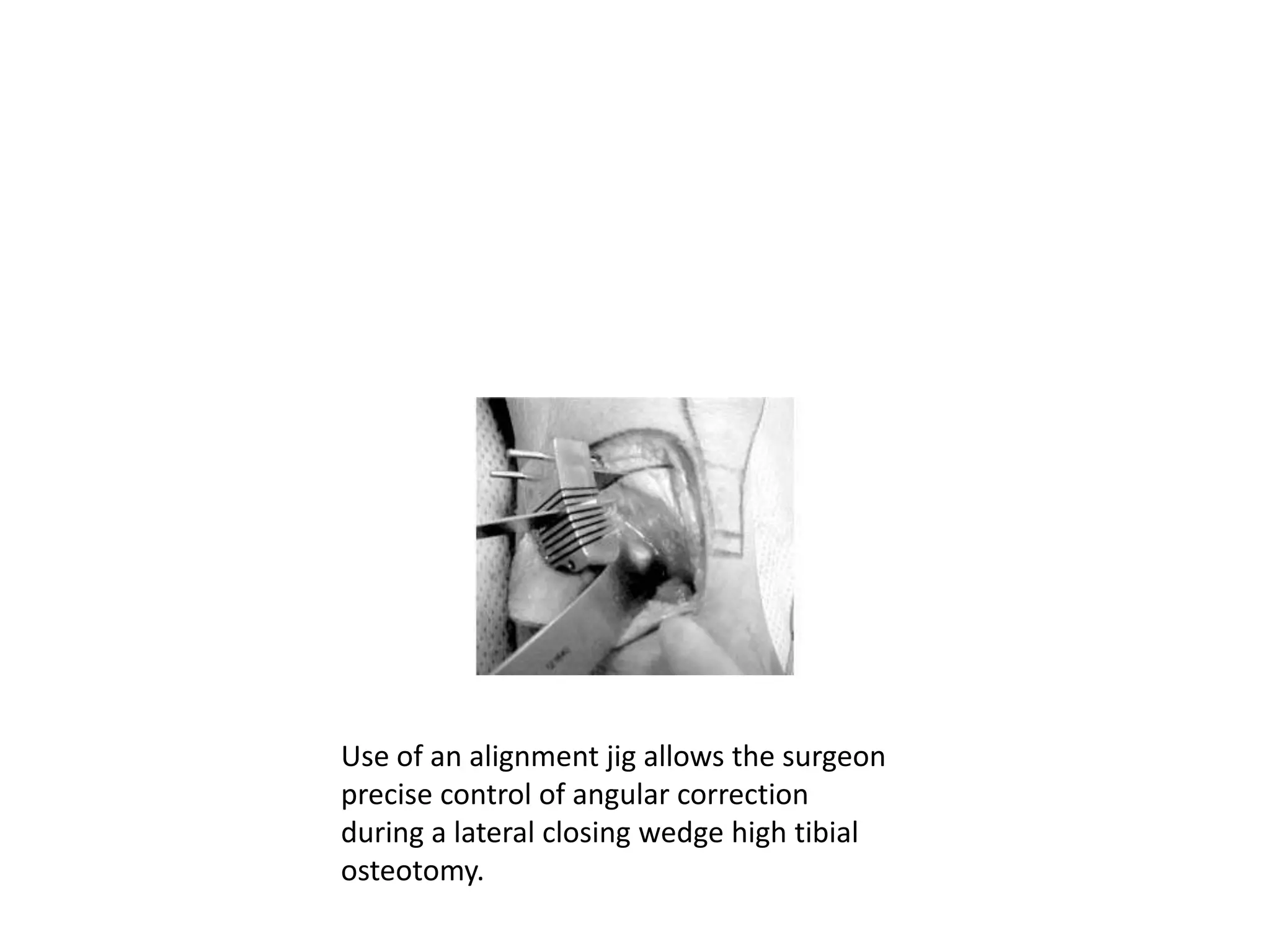
Use of an alignment jig allows the surgeon
precise control of angular correction
during a lateral closing wedge high tibial
osteotomy.
medial opening wedge
used to treat medial compartment
osteoarthritis since 1951 in france
fixation is achieved by either a medial
distraction plate or an external fixator.
it is technically easier for the surgeon to achieve
the precise desired amount of angular
correction than with lateral closing wedgeHTO
Merit and demerit
include less extensive surgical dissection and lack
of proximity to the peroneal nerve.
no need to mobilize the proximal fibula.
Medial closing wedge constructs are relatively
unstable; hence, loss of fixation, nonunion, and
delayed union are likely to be more frequent than
after lateral closing wedge osteotomy.
immediate weight bearing is not appropriate after a
medial opening wedge procedure and typically is
delayed for 6 to 8 weeks.
When medial opening wedge osteotomy fixation
is achieved with a distraction plate, autograft
and/allograft bone is required, and associated
graft morbidity issues
If external fixation is used, the potential for pin
tract morbidity arises it could jeopardize
subsequent salvage with TKA
Dome osteotomy
less commonly used
to be a more technically demanding operation
because of the challenges of creating a curved
osteotomy and avoiding iatrogenic trauma to
the patellar tendon
advantage of intraoperative flexibility, which
allows the surgeon to achieve the precise
amount of desired angular correction
if combined with external fixation, the amount
of angular correction may be adjusted
postoperatively as well.
In contradiction to lateral closing wedge and
medial opening wedge techniques, dome
osteotomy permits concomitant anterior
translation of the tibial tubercle, which may
alleviate associated patellofemoral disease
Cartilage Regeneration After High
Tibial Osteotomy
Bruce et al documented decreased medial compartment
scintigraphic uptake following valgus-producingHTO.
Odenbring et al detected fibrocartilage proliferation and
increased cellularity of hyaline cartilage afterHTO,
MacIntosh and Welsh reported superior clinical outcomes
with combined open débridement and HTO compared
with HTO alone
Schultz and Gobel documented improved cartilage
regeneration when HTO was combined with abrasion
arthroplasty
Complications of High
Tibial Osteotomy
• Patella Baja
• Fracture
• Nonunion
• Peroneal Nerve Palsy
• Compartment Syndrome
• Infection
• Thromboembolism
Total Knee Arthroplasty
After High Tibial
Osteotomy
TKA following HTO is considered to be more
technically demanding than TKA in the
absence of prior HTO.
In some clinical study the results of TKA have
been inferior following HTO Contracture of the
patellar tendon with resultant patella baja
increases the technical difficulty of TKA after
HTO
`
L-shaped scars from previous lateral closing
wedge HTOs pose challenges for the surgeon
performing a subsequent TKA because of the
potential for skin necrosis
The surgeon must aware of the proximal tibial
deformation caused by the HTO when
planning and executing proximal tibial
resection at the time of TKA
thank you
High tibial osteotomy

High tibial osteotomy

  • 1.
  • 2.
    Osteotomy of theproximal tibia has been used for more than a century to correct angular deformity in the setting of rickets, poliomyelitis, and posttraumatic conditions. Jackson is credited being the first in the English- language literature to report performing a proximal (high) tibial osteotomy (HTO) to treat osteoarthritis of the knee. Jackson’s concept was subsequently adopted by Coventry et al and Insall et al,who refined and popularized the lateral closing wedge HTO
  • 3.
    In the UnitedStates, initial experience indicated that HTO was effective in relieving the pain of unicompartmental osteoarthritis HTO has been temporized by two factors: recognition of the procedure’s limitations evolution and clinical success of total knee arthroplasty (TKA)
  • 4.
    drawbacks: it is notan ideal treatment option for patients with significant bicompartmental or tricompartmental disease results of the procedure progressively deteriorate
  • 5.
    use HTO (1) medialcompartment osteoarthritis in physiologically young, active patients, for whom TKA is imperfect for long-term solution. (2) HTO imposes no permanent activity restrictions (3) Superior results are more likely with contemporary fixation and postoperative management techniques after HTO (4) Evolving chondral resurfacing techniques are contraindicated in the presence of tibiofemoral malalign mandate concomitant correction of significant coexistent angular deformity. (5) Combining HTOwith chondral resurfacing procedures may provide better results than would HTOalone.
  • 6.
    Indications for HighTibial Osteotomy • Oseoarthritis Patients WithVarus Limb Alignment • Oseoarthritis Patients WithValgus Limb Alignment • Adult Osteochondritis Dissecan • Osteonecrosis • Posterolateral Instability • Chondral Resurfacing • the ability of the patient to use crutches after the operation and the possession of sufficient muscle strength and motivation to carry out a rehabilitation program • good vascular status without serious arterial insufficiency or large varicosities
  • 7.
    Vargus Limb Alignment Themost common indication for HTOis isolated medial compartment degenerative joint disease with associated varus tibiofemoral malalignment The rationale behind performing a valgus-producing HTO in the context of unicompartmental degenerative joint disease is to unload the arthritic medial compartment. The ideal patient for this procedure is physiologically young and active Elderly patients (chronologically older than 60 years) with low functional demand typically are more appropriate candidates for TKA
  • 8.
    Valgus Limb Alignment Isolatedlateral compartment osteoarthritis is much less common than isolated medial compartment osteoarthritis. Most authorities have a preference for performing a varus-producing distal femoral osteotomy rather than a varus producing HTO Correcting the valgus angulation on the tibial side of the knee has been criticized because a valgus- producingHTO produces obliquity of the tibiofemoral joint line
  • 9.
    Adult Osteochondritis Dissecans HTOshouldbe considered in physiologically young, active adults with osteochondritis dissecans of the medial femoral condyle author reported that HTO reliably decreases pain and improves function in patients with osteochondritis dissecans.
  • 10.
    Osteonecrosis osteonecrosis typically affectsindividuals older than 60 years, TKA and unicompartmental knee arthroplasty (UKA) are the most commonly considered salvage operations. HTO is a valid alternative to arthroplasty for physiologically young patients with osteonecrosis of the medial femoral condyle According to author HTO not only decreases discomfort and postpones the need for TKA, but it also leads to regression of the underlying disease Koshino also observed that the efficacy of HTO was enhanced by concomitant drilling and/or bone grafting of the osteonecrotic lesion.
  • 11.
    Posterolateral Instability Isolated soft-tissuereconstruction procedures for posterolateral insufficiency are likely to fail in the setting of varus alignment because the reconstruction is subjected to excessive tension Hence, performing a valgus-producing HTO before or in conjunction with the ligamentous reconstruction should be considered when there is varus malalignment.
  • 12.
    Chondral Resurfacing Techniques forrepairing focal chondral defects include marrow stimulation (ie, subchondral drilling, abrasion arthroplasty, microfracture), autologous chondrocyte implantation, osteochondral autograft transplantation , and autogenous periosteal grafting. Because most isolated articular cartilage lesions within the knee affect the medial femoral condyle, the realignment procedure typically indicated during knee cartilage repair is a valgus- producing HTO
  • 13.
    Contraindications to High TibialOsteotomy valgus-producing severe lateral compartment degenerative joint disease loss of a significant portion of the lateral meniscus symptomatic patellofemoral degenerative joint disease nonconcordant pain (ie, patellofemoral pain with medial compartment osteoarthritis) patient unwillingness to accept the anticipated cosmetic appearance of the desired amount of angular correction Inflammatory arthritis. more than 20 degrees of correction needed knee flexion of less than 90 degrees flexion contracture of more than 15 degrees lateral tibial subluxation of more than 1 cm,
  • 14.
    Arthroplasty Versus High TibialOsteotomy Isolated medial compartment disease in a physiologically young, high-demand individual is the ideal scenario for HTO Multicompartmental disease in a physiologically old, low- demand individual is the ideal scenario for TKA. Isolated medial compartmental disease in a physiologically old, low demand individual is an appropriate situation for eitherTKAor UKA. UKA should not be considered a substitute for HTO in the physiologically young, high demand individual with isolated medial compartment disease.
  • 15.
    Osteotomy Techniques • threeprinciple techniques lateral closing wedge osteotomy, medial opening wedge osteotomy, dome osteotomy
  • 16.
    Techniques for valgus-producinghigh tibial osteotomy. A, Lateral closing wedge. B, Medial opening wedge. C, Dome osteotomy.
  • 17.
    Lateral closing wedgeosteotomy used by Coventry et al and Insall et al advantage of producing apposition of two broad metaphyseal surfaces, thus optimizing inherent stability and healing potential it is made near the deformity it permits exploration of the knee through the same incision traditionally performed with freehand cuts and stabilized with either bone staples or cylinder casts Potential problems associated with these methods include patella baja and an inability to precisely achieve the desired amount of correction.
  • 18.
    More recently, calibratedcutting guides, rigid internal fixation devices, and early mobilization have produced improved results and low complication rates after lateral closing wedge osteotomy
  • 20.
    Use of analignment jig allows the surgeon precise control of angular correction during a lateral closing wedge high tibial osteotomy.
  • 21.
    medial opening wedge usedto treat medial compartment osteoarthritis since 1951 in france fixation is achieved by either a medial distraction plate or an external fixator. it is technically easier for the surgeon to achieve the precise desired amount of angular correction than with lateral closing wedgeHTO
  • 22.
    Merit and demerit includeless extensive surgical dissection and lack of proximity to the peroneal nerve. no need to mobilize the proximal fibula. Medial closing wedge constructs are relatively unstable; hence, loss of fixation, nonunion, and delayed union are likely to be more frequent than after lateral closing wedge osteotomy. immediate weight bearing is not appropriate after a medial opening wedge procedure and typically is delayed for 6 to 8 weeks.
  • 23.
    When medial openingwedge osteotomy fixation is achieved with a distraction plate, autograft and/allograft bone is required, and associated graft morbidity issues If external fixation is used, the potential for pin tract morbidity arises it could jeopardize subsequent salvage with TKA
  • 24.
    Dome osteotomy less commonlyused to be a more technically demanding operation because of the challenges of creating a curved osteotomy and avoiding iatrogenic trauma to the patellar tendon advantage of intraoperative flexibility, which allows the surgeon to achieve the precise amount of desired angular correction
  • 25.
    if combined withexternal fixation, the amount of angular correction may be adjusted postoperatively as well. In contradiction to lateral closing wedge and medial opening wedge techniques, dome osteotomy permits concomitant anterior translation of the tibial tubercle, which may alleviate associated patellofemoral disease
  • 26.
    Cartilage Regeneration AfterHigh Tibial Osteotomy Bruce et al documented decreased medial compartment scintigraphic uptake following valgus-producingHTO. Odenbring et al detected fibrocartilage proliferation and increased cellularity of hyaline cartilage afterHTO, MacIntosh and Welsh reported superior clinical outcomes with combined open débridement and HTO compared with HTO alone Schultz and Gobel documented improved cartilage regeneration when HTO was combined with abrasion arthroplasty
  • 27.
    Complications of High TibialOsteotomy • Patella Baja • Fracture • Nonunion • Peroneal Nerve Palsy • Compartment Syndrome • Infection • Thromboembolism
  • 28.
    Total Knee Arthroplasty AfterHigh Tibial Osteotomy TKA following HTO is considered to be more technically demanding than TKA in the absence of prior HTO. In some clinical study the results of TKA have been inferior following HTO Contracture of the patellar tendon with resultant patella baja increases the technical difficulty of TKA after HTO
  • 29.
    ` L-shaped scars fromprevious lateral closing wedge HTOs pose challenges for the surgeon performing a subsequent TKA because of the potential for skin necrosis The surgeon must aware of the proximal tibial deformation caused by the HTO when planning and executing proximal tibial resection at the time of TKA
  • 30.