TB SPINE with Neurology-
“ What is expected from you”
.
How do I present a case of TB Spine
with neurological deficit
 How to examine a spine case
 How to diagnose TB spine
 What are the other possible diagnosis
 How to differentiate from them clinically
 How they are investigated in your hospital
 Possible options in management
 How is it managed in your hospital
 Common problems involving spine
 Common problems causing similar deficit
How to examine a spine case
 The sequence to present the case…like a
CNS case protocol or ortho way-
 Easy steps to find the motor and sensory
level-
 Specific findings and tests to be done in a
spine with neurology case
 What to say of bladder and bowel
 Should we do all the tests for sensations
like vibration, fine touch etc
The sequence to present the case…like a
CNS case protocol or ortho way
 You should present the case as you will
proceed to do spine exam
History should take into consideration
Pathology part – TB and its D/D
Area of involvement – Spine
Complications – neuro deficit
History
 TB – general symptoms and local symptoms
specific to area of involvement
 Leading questions specific to TB of spine
 Negative history of DDs
Ankylosing spondylitis
Disc deg
Tumors
Septic
Trauma
History
 Common problem
 Perfect diagnosis
 Not able to justify that
Clinical exam of spine

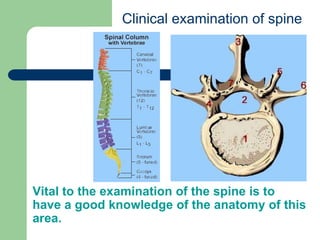
Vital to the examination of the spine is to
have a good knowledge of the anatomy of this
area.
Clinical examination of spine
 Gait
 Inspection
 Palpation
 Movement and measurement
 Neurology of the limbs
 Special tests
 SI joints
 CNS exam
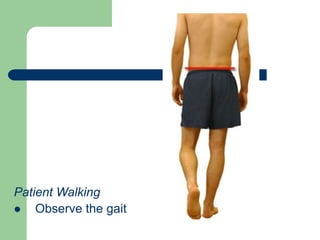
Patient Walking
 Observe the gait
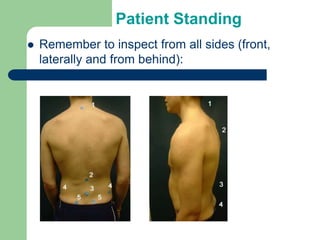
Patient Standing
 Remember to inspect from all sides (front,
laterally and from behind):
Inspection
1. Attitude and deformity
2. Position of head, shoulder, scapula
3. swellings, sinus, skin
4. Gait
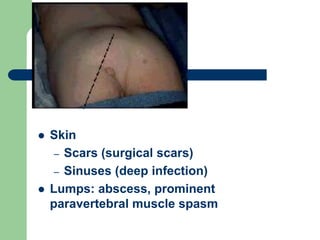
 Skin
– Scars (surgical scars)
– Sinuses (deep infection)
 Lumps: abscess, prominent
paravertebral muscle spasm
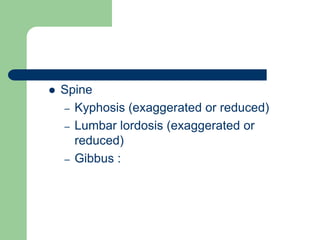
 Spine
– Kyphosis (exaggerated or reduced)
– Lumbar lordosis (exaggerated or
reduced)
– Gibbus :
 Expose the back and legs.
 Look for the following:
– sinuses; scars and nodes
– deformity and asymmetries - postural or
permanent; direction / plane i.e. kyphosis or
tilt
– muscle spasm, fasciculation, wasting -
specifically calf and buttock
– legs / arms - wasting, movement, muscle
imbalance, size
palpation
 You have to know your anatomy to know what
you are feeling!
 With the patient standing and then perhaps
later, lying supine, palpate the back for the:
– skin temperature
– deformity of the spine - steps or a steady contour?
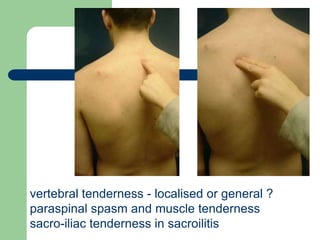
vertebral tenderness - localised or general ?
paraspinal spasm and muscle tenderness
sacro-iliac tenderness in sacroilitis
 Elsewhere:
– feel for peripheral pulses
– palpate groin and abdomen for abscesses
– Chest, abdominal, rectal examination
Movts and measurements
 Measurement of mobility of the spine
 Movements
 Chest expansion
 costovertebral movements are gauged by
asking the patient to breathe in and out: the
distance between maximal inspiration and
expiration is normally 5cm.
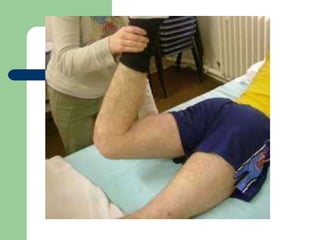
Special tests
 Straight Leg Raising Test (SLR)
 Bowstring Sign
 Crossed SLR
 Reverse sciatic tension test
 Schober's test
 Femoral stretch
 the patient is then asked to lie supine and the
straight leg raise test is performed.
 carry out neurological testing of power;
 sensation -
 reflexes -
 do a rectal examination - check tone, power,
sensation
Neurological examination
 Easy steps to find the motor and sensory
level
 What to say of bladder and bowel-
 Should we do all the tests for sensations
like vibration, fine touch etc
 What the examiner is looking in a spine
neurology case
Neurological assessment
 Neurological assessment is an essential part of
the examination of the spine.
 The examination should involve a full
assessment of muscle wasting, fasiculation,
tone, power, coordination / proprioception,
sensation and reflexes.
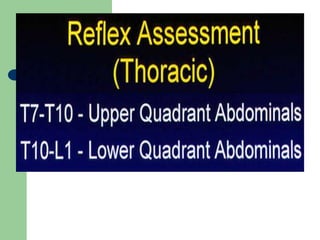
 perianal reflexes and sphincter tone should be
tested.
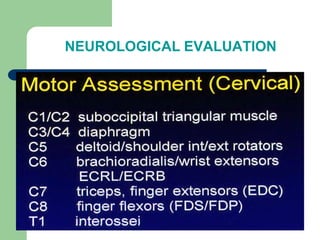
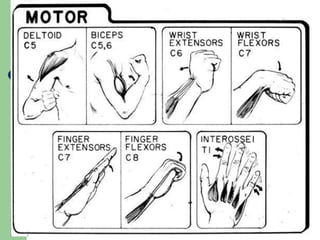
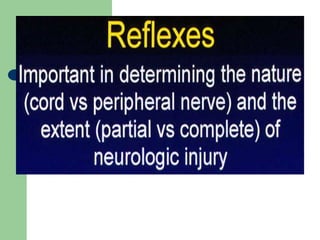
NEUROLOGICAL EVALUATION
SEGMENTAL NEUROLOGY
 When examining the cervical spine it is essential to
examine the segmental neurology.
 Root lesions may be indicated by weakness in the
upper limbs in a segmental distribution, with loss of
dermatomal sensation and altered reflexes.
 If cervical cord compression is suspected the lower
limbs should also be examined specifically looking for
upgoing planters and hyperreflexia.
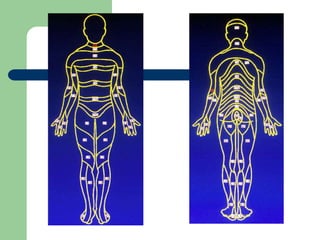
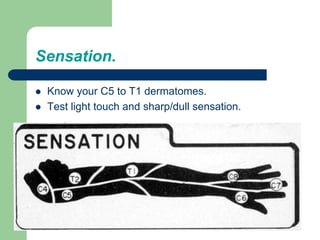
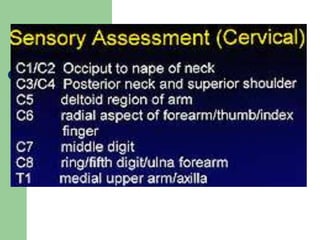
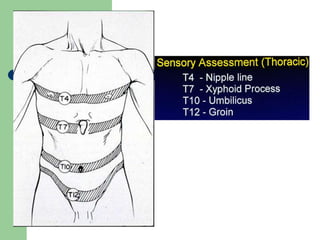
Sensation.
 Know your C5 to T1 dermatomes.
 Test light touch and sharp/dull sensation.
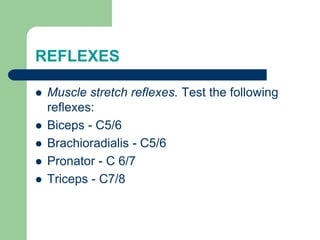
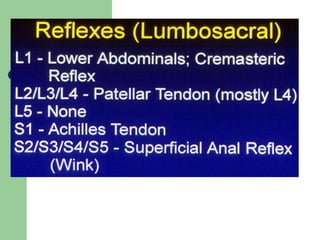
REFLEXES
 Muscle stretch reflexes. Test the following
reflexes:
 Biceps - C5/6
 Brachioradialis - C5/6
 Pronator - C 6/7
 Triceps - C7/8
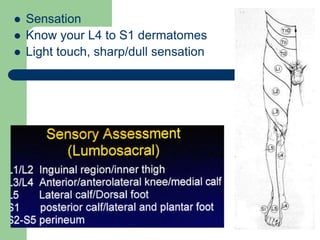
 Sensation
 Know your L4 to S1 dermatomes
 Light touch, sharp/dull sensation
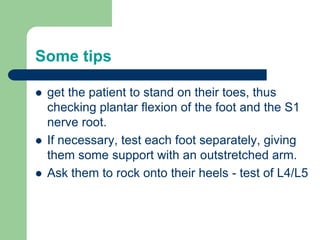
Some tips
 get the patient to stand on their toes, thus
checking plantar flexion of the foot and the S1
nerve root.
 If necessary, test each foot separately, giving
them some support with an outstretched arm.
 Ask them to rock onto their heels - test of L4/L5
 Should we do all the tests for sensations
like vibration, fine touch etc
 What the examiner is looking in a spine
neurology case
 The examination should include the following:
– Careful assessment of spine
– Examination for abscesses
– Abdominal evaluation for psoas / iliac mass
 Meticulous neurologic examination
TB SPINE - HISTORY AND
CLINICAL EXAMINATION
TB Spine – History
 The presentation of Pott disease depends
on the following:
– Stage of disease
– Affected site
– Presence of complications such as
neurologic deficits, abscesses, or sinus
tracts
TB Spine – History
 The reported average duration of symptoms at
diagnosis is 4 months but can be considerably
longer, even in most recent series.
 This is due to the nonspecific presentation of
chronic back pain.
TB Spine – History
 Back pain is the earliest and most common
symptom.
– Patients with Pott’s disease usually
experience back pain for weeks before
seeking treatment.
– The pain caused by Pott’s disease can be
spinal or radicular.
TB Spine – History
 Insidious onset of localised pain in the spine.
 This is usually accompanied by fever, malaise,
anorexia and weight loss.
 Clumsiness in walking and weakness in lower
limbs may be present.
 There may be evidences of associated
extraskeletal tuberculosis
 Presence of hoarseness, dysphagia, respiratory
stridor or torticollis indicate cervical involvement.
TB Spine – History
 The onset of is usually insidious and of slow
evolution.
 Potential constitutional symptoms of Pott’s
disease include fever and weight loss.
 Patient might have constitutional symptoms
like low-grade fever, anorexia and weight loss.
TB Spine – History
 They usually precede local symptoms and
signs such as pain, tenderness and swelling of
the affected part.
 However absence of constitutional symptoms
does not rule out the possibility of the disease
as it is common for patients to present without
any constitutional symptoms.
TB Spine – History
 Neurologic abnormalities occur in 50% of
cases and can include spinal cord compression
with paraplegia, paresis, impaired sensation,
nerve root pain, and/or cauda equina
syndrome.
On examination - TB Spine - spasm
 Muscle spasm makes the back rigid.
 Motion of the spine is limited in all direction.
 When picking an object up from the floor, the
patient flexes his hips and knees, keeping the
spine in extension.
In TB Spine - spasm
 Spasm of the paravertebral muscles in the
lumbar region is also elicited by passive
hyperextension of the hips with the patient in
prone position-this also puts stretch on the
iliopsoas muscle, which is in spasm and
contracture owing to psoas abscess
In TB Spine - deformity
 Almost all patients with Pott disease have
some degree of spine deformity
 A kyphus in the thoracic region may be the first
noticeable sign.
 As the kyphosis increases, the ribs will crowd
together and a barrel chest deformity will
develop.
 When the lesion is situated in the cervical or
lumbar spine, a flattening of the normal
lordosis is the initial finding.
In TB Spine - cervical
 Cervical spine tuberculosis is a less common
presentation but is potentially more serious
because severe neurologic complications are
more likely.
In TB Spine - cervical
– This condition is characterized by pain and
stiffness.
– Patients with lower cervical spine disease
can present with dysphagia or stridor.
– Symptoms can also include torticollis,
hoarseness, and neurologic deficits.
In TB Spine - cervical
 Pott disease that involves the upper cervical
spine can cause rapidly progressive
symptoms.
– Retropharyngeal abscesses occur in almost
all cases.
– Neurologic manifestations occur early and
range from a single nerve palsy to
hemiparesis or quadriplegia.
In TB Spine - HIV
 The clinical presentation of spinal tuberculosis
in patients infected with the human
immunodeficiency virus (HIV) is similar to that
of patients who are HIV negative; however,
spinal tuberculosis seems to be more common
in persons infected with HIV.
In TB Spine - Thoracic
 Although both the thoracic and lumbar spinal
segments are nearly equally affected in
persons with Pott disease, the thoracic spine
is frequently reported as the most common
site of involvement.
 Together, they comprise 80-90% of spinal
tuberculosis sites.
 The remaining cases correspond to the
cervical spine.
Cold abscess
 The abscesses may be palpated as fluctuant
swellings in the groin, iliac fossa, retropharynx,
or on the side of the neck, depending upon the
level of the lesion.
Cold abscess
 Large cold abscesses of paraspinal tissues or
psoas muscle may protrude under the inguinal
ligament and may erode into the perineum or
gluteal area.
 Tuberculous necrotic material from the cervical
spine may collect in the form of a cold abscess
in the retropharyngeal region; at the posterior
border of sternomastoid; in the back of neck
along spinal nerves and in the axilla along
axillary sheath
Cold abscess
 Pott disease that involves the upper cervical
spine can cause rapidly progressive
symptoms.
– Retropharyngeal abscesses occur in almost
all cases.
– Neurologic manifestations occur early and
range from a single nerve palsy to
hemiparesis or quadriplegia.
Cold abscess
 Involvement of the dorsolumbar spine may lead to cold
abscess in the rectus sheath and lower abdominal wall
along the intercostal, ilioinguinal and iliohypogastric
nerves;
 in the thigh along the psoas sheath;
 in the back along the posterior spinal nerves;
 in the buttock along superior gluteal nerve;
 in the Petit's triangle along the flat muscles of
abdominal wall or,
 in the ischiorectal fossa along the internal pudendal
nerve.
Gait
 The gait of the person with Pott’s disease is
peculiar, reflecting the protective rigidity of the
spine.
 His steps are short, as he is trying to avoid any
jarring of his back.
 In tuberculosis of the cervical spine, he holds
his neck is extension and supports his head
with one hand under the chin and the other
over the occiput.
Neurology
 Neurologic deficits may occur early in the
course of Pott disease.
 Signs of such deficits depend on the level of
spinal cord or nerve root compression.
Neurology
 If paraplegia develops, there will be spasticity
of the lower limbs with hyperactive deep
tendon reflexes, a spastic gait, a varying
degree of motor weakness, and disturbances
of bladder and anorectal function.
Extraspinal tuberculosis
 Many persons with Pott disease (62-90%) of
patients in reported series have no evidence of
extraspinal tuberculosis, further complicating a
timely diagnosis..
Rare presentation
 The presence of a sinus in the back with a thin
watery discharge is a strong evidence of
tuberculous involvement of the posterior arch
of vertebral bodies.
 Rarely, tuberculous spondylitis may present as
synovitis of posterior vertebral articulations,
atlanto-occipital or atlanto-axial joints or as
spinal tumour syndrome
How to say the final diagnosis
 Anatomoical
 Pathological
 Level
 Neuro – Cord compression
 Level – Motor, Sensory and Reflex
 Cord level, Vertebral level
What to say of bladder and bowel
 History
 Subject may be already catheterised
Provisional diagnosis
 Only one Diagnosis if there are no reasons (
points) against that diagnosis
 Otherwise give DD
Investigations
1. ESR
2. Mantoux / Elisa -
3. Xrays including chest
4. CT
5. MRI
6. CT-guided procedures.
7. Microbiology studies are used to confirm
diagnosis.
What are the common surgical treatments
given
 Treatment – ATT –regime, duration.
 Surgical
 Indications ???
 Middle path regime ???
 Instrumentation ???
Indications for surgical treatment
 Neurologic deficit (acute neurologic
deterioration, paraparesis, paraplegia)
 Spinal deformity with instability or pain
 No response to medical therapy (continuing
progression of kyphosis or instability)
 Large paraspinal abscess
 Nondiagnostic percutaneous needle biopsy
sample
Surgical options
 Costo-transversectomy
 ALD
 Anterior decompression and fusion
 Anterior decompression and fusion and
instrumentation ( posterior or anterior)
 Thoracoscopic surgery
 Posterior approach with transpedicular
decompression and fusion with
instrumentation.
 Resources and experience are key factors in
the decision to use a surgical approach.
 The lesion site, extent of vertebral destruction,
and presence of cord compression or spinal
deformity determine the specific operative
approach (kyphosis, paraplegia, tuberculous
abscess).
 Vertebral damage is considered significant if
more than 50% of the vertebral body is
collapsed or destroyed or a spinal deformity of
more than 5° exists.
 The most conventional approaches include
anterior radical focal debridement and posterior
stabilization with instrumentation.
 In Pott disease that involves the cervical spine,
the following factors justify early surgical
intervention:
 High frequency and severity of neurologic
deficits
 Severe abscess compression that may induce
dysphagia or asphyxia
 Instability of the cervical spine
Contraindications:
 Vertebral collapse of a lesser magnitude
is not considered an indication for
surgery because, with appropriate
treatment and therapy compliance, it is
less likely to progress to a severe
deformity.
ICS 2010
a combined meeting of
SPINE SOCIETY OF EUROPE &
ASSOCIATION OF SPINE SURGEONS OF INDIA
3,4,5 September 2010
International & National Faculty
Venue:
Golden Landmark Resort, Mysore.
Theme: Iatrogenic complications in Spine
Residential and Non-Residential Packages

Tuberculosis Spine

  • 1.
    TB SPINE withNeurology- “ What is expected from you” .
  • 2.
    How do Ipresent a case of TB Spine with neurological deficit  How to examine a spine case  How to diagnose TB spine  What are the other possible diagnosis  How to differentiate from them clinically  How they are investigated in your hospital  Possible options in management  How is it managed in your hospital  Common problems involving spine  Common problems causing similar deficit
  • 3.
    How to examinea spine case  The sequence to present the case…like a CNS case protocol or ortho way-  Easy steps to find the motor and sensory level-  Specific findings and tests to be done in a spine with neurology case  What to say of bladder and bowel  Should we do all the tests for sensations like vibration, fine touch etc
  • 4.
    The sequence topresent the case…like a CNS case protocol or ortho way  You should present the case as you will proceed to do spine exam
  • 5.
    History should takeinto consideration Pathology part – TB and its D/D Area of involvement – Spine Complications – neuro deficit
  • 6.
    History  TB –general symptoms and local symptoms specific to area of involvement  Leading questions specific to TB of spine  Negative history of DDs Ankylosing spondylitis Disc deg Tumors Septic Trauma
  • 7.
    History  Common problem Perfect diagnosis  Not able to justify that
  • 8.
  • 9.
    Vital to theexamination of the spine is to have a good knowledge of the anatomy of this area. Clinical examination of spine
  • 10.
    Clinical examination ofspine  Gait  Inspection  Palpation  Movement and measurement  Neurology of the limbs  Special tests  SI joints  CNS exam
  • 11.
  • 12.
    Patient Standing  Rememberto inspect from all sides (front, laterally and from behind):
  • 13.
    Inspection 1. Attitude anddeformity 2. Position of head, shoulder, scapula 3. swellings, sinus, skin 4. Gait
  • 14.
     Skin – Scars(surgical scars) – Sinuses (deep infection)  Lumps: abscess, prominent paravertebral muscle spasm
  • 15.
     Spine – Kyphosis(exaggerated or reduced) – Lumbar lordosis (exaggerated or reduced) – Gibbus :
  • 16.
     Expose theback and legs.  Look for the following: – sinuses; scars and nodes – deformity and asymmetries - postural or permanent; direction / plane i.e. kyphosis or tilt – muscle spasm, fasciculation, wasting - specifically calf and buttock – legs / arms - wasting, movement, muscle imbalance, size
  • 17.
    palpation  You haveto know your anatomy to know what you are feeling!  With the patient standing and then perhaps later, lying supine, palpate the back for the: – skin temperature – deformity of the spine - steps or a steady contour?
  • 18.
    vertebral tenderness -localised or general ? paraspinal spasm and muscle tenderness sacro-iliac tenderness in sacroilitis
  • 19.
     Elsewhere: – feelfor peripheral pulses – palpate groin and abdomen for abscesses – Chest, abdominal, rectal examination
  • 20.
    Movts and measurements Measurement of mobility of the spine  Movements  Chest expansion  costovertebral movements are gauged by asking the patient to breathe in and out: the distance between maximal inspiration and expiration is normally 5cm.
  • 21.
    Special tests  StraightLeg Raising Test (SLR)  Bowstring Sign  Crossed SLR  Reverse sciatic tension test  Schober's test  Femoral stretch
  • 23.
     the patientis then asked to lie supine and the straight leg raise test is performed.  carry out neurological testing of power;  sensation -  reflexes -  do a rectal examination - check tone, power, sensation Neurological examination
  • 24.
     Easy stepsto find the motor and sensory level  What to say of bladder and bowel-  Should we do all the tests for sensations like vibration, fine touch etc  What the examiner is looking in a spine neurology case
  • 25.
    Neurological assessment  Neurologicalassessment is an essential part of the examination of the spine.  The examination should involve a full assessment of muscle wasting, fasiculation, tone, power, coordination / proprioception, sensation and reflexes.  perianal reflexes and sphincter tone should be tested.
  • 26.
  • 28.
    SEGMENTAL NEUROLOGY  Whenexamining the cervical spine it is essential to examine the segmental neurology.  Root lesions may be indicated by weakness in the upper limbs in a segmental distribution, with loss of dermatomal sensation and altered reflexes.  If cervical cord compression is suspected the lower limbs should also be examined specifically looking for upgoing planters and hyperreflexia.
  • 30.
    Sensation.  Know yourC5 to T1 dermatomes.  Test light touch and sharp/dull sensation.
  • 32.
    REFLEXES  Muscle stretchreflexes. Test the following reflexes:  Biceps - C5/6  Brachioradialis - C5/6  Pronator - C 6/7  Triceps - C7/8
  • 34.
     Sensation  Knowyour L4 to S1 dermatomes  Light touch, sharp/dull sensation
  • 38.
    Some tips  getthe patient to stand on their toes, thus checking plantar flexion of the foot and the S1 nerve root.  If necessary, test each foot separately, giving them some support with an outstretched arm.  Ask them to rock onto their heels - test of L4/L5
  • 39.
     Should wedo all the tests for sensations like vibration, fine touch etc  What the examiner is looking in a spine neurology case
  • 40.
     The examinationshould include the following: – Careful assessment of spine – Examination for abscesses – Abdominal evaluation for psoas / iliac mass  Meticulous neurologic examination
  • 41.
    TB SPINE -HISTORY AND CLINICAL EXAMINATION
  • 42.
    TB Spine –History  The presentation of Pott disease depends on the following: – Stage of disease – Affected site – Presence of complications such as neurologic deficits, abscesses, or sinus tracts
  • 43.
    TB Spine –History  The reported average duration of symptoms at diagnosis is 4 months but can be considerably longer, even in most recent series.  This is due to the nonspecific presentation of chronic back pain.
  • 44.
    TB Spine –History  Back pain is the earliest and most common symptom. – Patients with Pott’s disease usually experience back pain for weeks before seeking treatment. – The pain caused by Pott’s disease can be spinal or radicular.
  • 45.
    TB Spine –History  Insidious onset of localised pain in the spine.  This is usually accompanied by fever, malaise, anorexia and weight loss.  Clumsiness in walking and weakness in lower limbs may be present.  There may be evidences of associated extraskeletal tuberculosis  Presence of hoarseness, dysphagia, respiratory stridor or torticollis indicate cervical involvement.
  • 46.
    TB Spine –History  The onset of is usually insidious and of slow evolution.  Potential constitutional symptoms of Pott’s disease include fever and weight loss.  Patient might have constitutional symptoms like low-grade fever, anorexia and weight loss.
  • 47.
    TB Spine –History  They usually precede local symptoms and signs such as pain, tenderness and swelling of the affected part.  However absence of constitutional symptoms does not rule out the possibility of the disease as it is common for patients to present without any constitutional symptoms.
  • 48.
    TB Spine –History  Neurologic abnormalities occur in 50% of cases and can include spinal cord compression with paraplegia, paresis, impaired sensation, nerve root pain, and/or cauda equina syndrome.
  • 49.
    On examination -TB Spine - spasm  Muscle spasm makes the back rigid.  Motion of the spine is limited in all direction.  When picking an object up from the floor, the patient flexes his hips and knees, keeping the spine in extension.
  • 50.
    In TB Spine- spasm  Spasm of the paravertebral muscles in the lumbar region is also elicited by passive hyperextension of the hips with the patient in prone position-this also puts stretch on the iliopsoas muscle, which is in spasm and contracture owing to psoas abscess
  • 51.
    In TB Spine- deformity  Almost all patients with Pott disease have some degree of spine deformity  A kyphus in the thoracic region may be the first noticeable sign.  As the kyphosis increases, the ribs will crowd together and a barrel chest deformity will develop.  When the lesion is situated in the cervical or lumbar spine, a flattening of the normal lordosis is the initial finding.
  • 52.
    In TB Spine- cervical  Cervical spine tuberculosis is a less common presentation but is potentially more serious because severe neurologic complications are more likely.
  • 53.
    In TB Spine- cervical – This condition is characterized by pain and stiffness. – Patients with lower cervical spine disease can present with dysphagia or stridor. – Symptoms can also include torticollis, hoarseness, and neurologic deficits.
  • 54.
    In TB Spine- cervical  Pott disease that involves the upper cervical spine can cause rapidly progressive symptoms. – Retropharyngeal abscesses occur in almost all cases. – Neurologic manifestations occur early and range from a single nerve palsy to hemiparesis or quadriplegia.
  • 55.
    In TB Spine- HIV  The clinical presentation of spinal tuberculosis in patients infected with the human immunodeficiency virus (HIV) is similar to that of patients who are HIV negative; however, spinal tuberculosis seems to be more common in persons infected with HIV.
  • 56.
    In TB Spine- Thoracic  Although both the thoracic and lumbar spinal segments are nearly equally affected in persons with Pott disease, the thoracic spine is frequently reported as the most common site of involvement.  Together, they comprise 80-90% of spinal tuberculosis sites.  The remaining cases correspond to the cervical spine.
  • 57.
    Cold abscess  Theabscesses may be palpated as fluctuant swellings in the groin, iliac fossa, retropharynx, or on the side of the neck, depending upon the level of the lesion.
  • 58.
    Cold abscess  Largecold abscesses of paraspinal tissues or psoas muscle may protrude under the inguinal ligament and may erode into the perineum or gluteal area.  Tuberculous necrotic material from the cervical spine may collect in the form of a cold abscess in the retropharyngeal region; at the posterior border of sternomastoid; in the back of neck along spinal nerves and in the axilla along axillary sheath
  • 59.
    Cold abscess  Pottdisease that involves the upper cervical spine can cause rapidly progressive symptoms. – Retropharyngeal abscesses occur in almost all cases. – Neurologic manifestations occur early and range from a single nerve palsy to hemiparesis or quadriplegia.
  • 60.
    Cold abscess  Involvementof the dorsolumbar spine may lead to cold abscess in the rectus sheath and lower abdominal wall along the intercostal, ilioinguinal and iliohypogastric nerves;  in the thigh along the psoas sheath;  in the back along the posterior spinal nerves;  in the buttock along superior gluteal nerve;  in the Petit's triangle along the flat muscles of abdominal wall or,  in the ischiorectal fossa along the internal pudendal nerve.
  • 61.
    Gait  The gaitof the person with Pott’s disease is peculiar, reflecting the protective rigidity of the spine.  His steps are short, as he is trying to avoid any jarring of his back.  In tuberculosis of the cervical spine, he holds his neck is extension and supports his head with one hand under the chin and the other over the occiput.
  • 62.
    Neurology  Neurologic deficitsmay occur early in the course of Pott disease.  Signs of such deficits depend on the level of spinal cord or nerve root compression.
  • 63.
    Neurology  If paraplegiadevelops, there will be spasticity of the lower limbs with hyperactive deep tendon reflexes, a spastic gait, a varying degree of motor weakness, and disturbances of bladder and anorectal function.
  • 64.
    Extraspinal tuberculosis  Manypersons with Pott disease (62-90%) of patients in reported series have no evidence of extraspinal tuberculosis, further complicating a timely diagnosis..
  • 65.
    Rare presentation  Thepresence of a sinus in the back with a thin watery discharge is a strong evidence of tuberculous involvement of the posterior arch of vertebral bodies.  Rarely, tuberculous spondylitis may present as synovitis of posterior vertebral articulations, atlanto-occipital or atlanto-axial joints or as spinal tumour syndrome
  • 66.
    How to saythe final diagnosis  Anatomoical  Pathological  Level  Neuro – Cord compression  Level – Motor, Sensory and Reflex  Cord level, Vertebral level
  • 67.
    What to sayof bladder and bowel  History  Subject may be already catheterised
  • 68.
    Provisional diagnosis  Onlyone Diagnosis if there are no reasons ( points) against that diagnosis  Otherwise give DD
  • 69.
    Investigations 1. ESR 2. Mantoux/ Elisa - 3. Xrays including chest 4. CT 5. MRI 6. CT-guided procedures. 7. Microbiology studies are used to confirm diagnosis.
  • 70.
    What are thecommon surgical treatments given  Treatment – ATT –regime, duration.  Surgical
  • 71.
     Indications ??? Middle path regime ???  Instrumentation ???
  • 72.
    Indications for surgicaltreatment  Neurologic deficit (acute neurologic deterioration, paraparesis, paraplegia)  Spinal deformity with instability or pain  No response to medical therapy (continuing progression of kyphosis or instability)  Large paraspinal abscess  Nondiagnostic percutaneous needle biopsy sample
  • 73.
    Surgical options  Costo-transversectomy ALD  Anterior decompression and fusion  Anterior decompression and fusion and instrumentation ( posterior or anterior)  Thoracoscopic surgery  Posterior approach with transpedicular decompression and fusion with instrumentation.
  • 74.
     Resources andexperience are key factors in the decision to use a surgical approach.  The lesion site, extent of vertebral destruction, and presence of cord compression or spinal deformity determine the specific operative approach (kyphosis, paraplegia, tuberculous abscess).  Vertebral damage is considered significant if more than 50% of the vertebral body is collapsed or destroyed or a spinal deformity of more than 5° exists.
  • 75.
     The mostconventional approaches include anterior radical focal debridement and posterior stabilization with instrumentation.  In Pott disease that involves the cervical spine, the following factors justify early surgical intervention:  High frequency and severity of neurologic deficits  Severe abscess compression that may induce dysphagia or asphyxia  Instability of the cervical spine
  • 76.
    Contraindications:  Vertebral collapseof a lesser magnitude is not considered an indication for surgery because, with appropriate treatment and therapy compliance, it is less likely to progress to a severe deformity.
  • 77.
    ICS 2010 a combinedmeeting of SPINE SOCIETY OF EUROPE & ASSOCIATION OF SPINE SURGEONS OF INDIA 3,4,5 September 2010 International & National Faculty Venue: Golden Landmark Resort, Mysore. Theme: Iatrogenic complications in Spine Residential and Non-Residential Packages