OSTEOTOMY AROUND
KNEE
PREPARED BY Dr. SHANKAR 3rd year pg trainee
SUPERVISED BY DR. PRASHANT MODI
SMS MEDICAL COLLEGE JAIPUR
 The knee joint is largest and most complex joint in
the human body and has the longest lever arms.
 The joint transmits muscle force in to motion of
human body. the large lever arm of knee joint
produce substantial loading moments.
 Malalignment of limb result in excessive loading
and stress in a part of joint and consequently
increased damage to articular cartilage in that
area.
INTRODUCTION
 As articular surface is destroyed, the
deformity progressively increases so
deviation of lower extremity axes are
regarded as prearthritic deformity.
 Osteotomy and repositioning of bone
fragements, by correcting the deformity,
will improve the load bearing mechanics of
joint.
Cont…..
Corrective lower limb osteotomies are innovative
and efficient therapeutic procedure for restoring
axial alignment
in managing of unicompartmental osteoarthritis
knee, complex posttraumatic and congenital lower
limb deformities.
As the basic science and technology of cartilage
restoration and meniscal transplantation have
envolved,new indication of osteotomy around
knee also emerges.
....
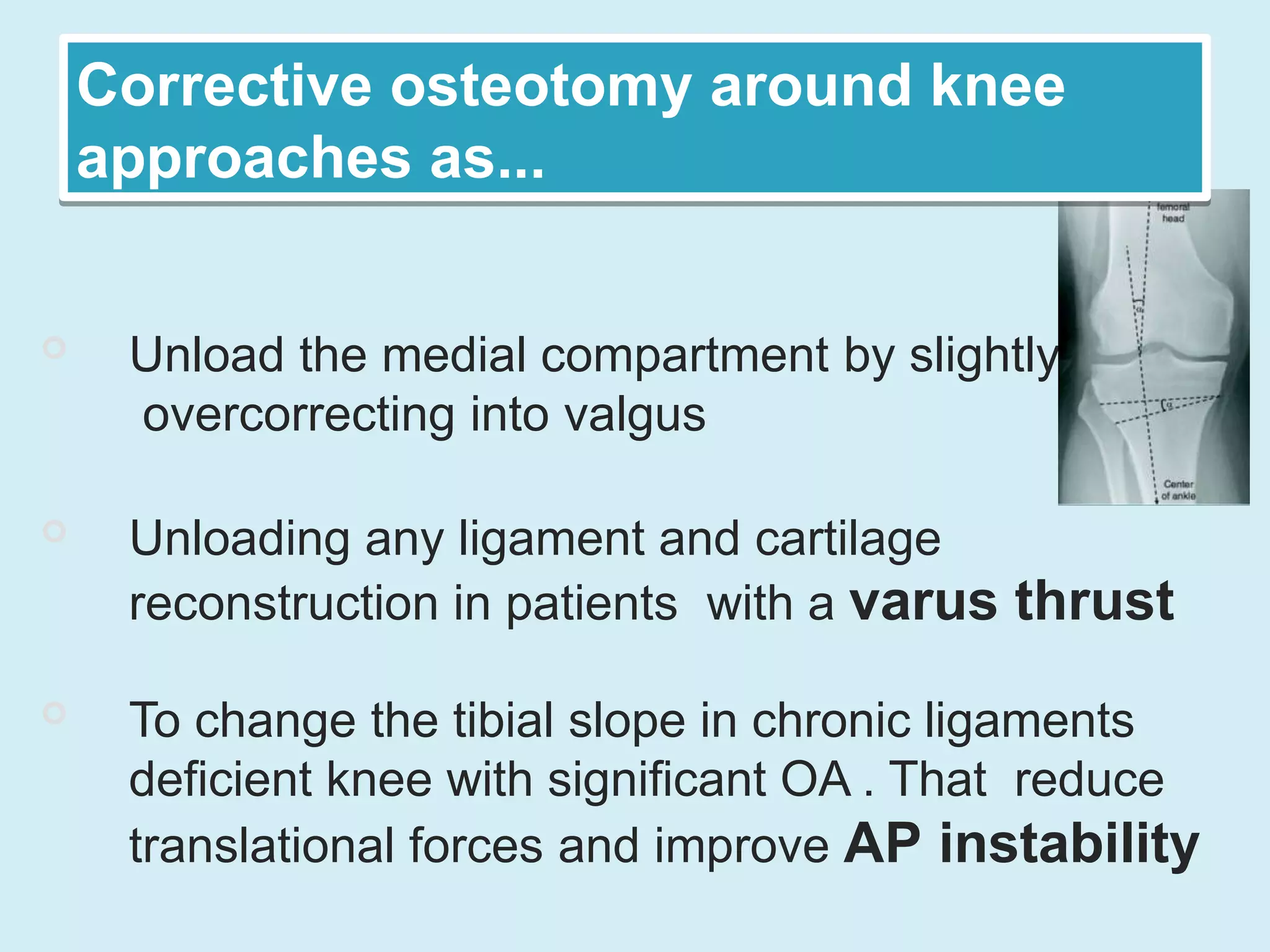
 Unload the medial compartment by slightly
overcorrecting into valgus
 Unloading any ligament and cartilage
reconstruction in patients with a varus thrust
 To change the tibial slope in chronic ligaments
deficient knee with significant OA . That reduce
translational forces and improve AP instability
Corrective osteotomy around knee
approaches as...
Corrective osteotomy around knee
approaches as...
 DEFORMITY OF KNEE-severe varus/valgus or in
hyperextention deformity of knee.
 Localized articular surface destruction.
 Help in articular reconstruction of meniscus,
articular cartilage and ligament reconstruction.
INDICATION OF OSTEOTOMY in
adult….
• Post acquired epiphysiodesis [septic/traumatic]
• Congenital deformity[PFFD,NF]
• Flexion contracture in arthrogryposis,polio..
• Acquired deformity [rickets,blount disease]
• Focal chondrodysplasia.
• Post traumatic deformity..
Indication in children and
adolescent...
 Physiological examination-in sagittal , frontal and
axial plane..
 Definition of deformity and aim of correction
 Radiological analysis..
 Patient selection guideline..
 Planning of correction
 Implant selection
 Description of surgical technique..
Surgical plan for deformity correction
of lower limb..
Anatomical axis
Mechanical axis
Mechanical axis deviation
Reference Joint angle
Location of deformity[cora]
Physiological axes and joint angle of
leg
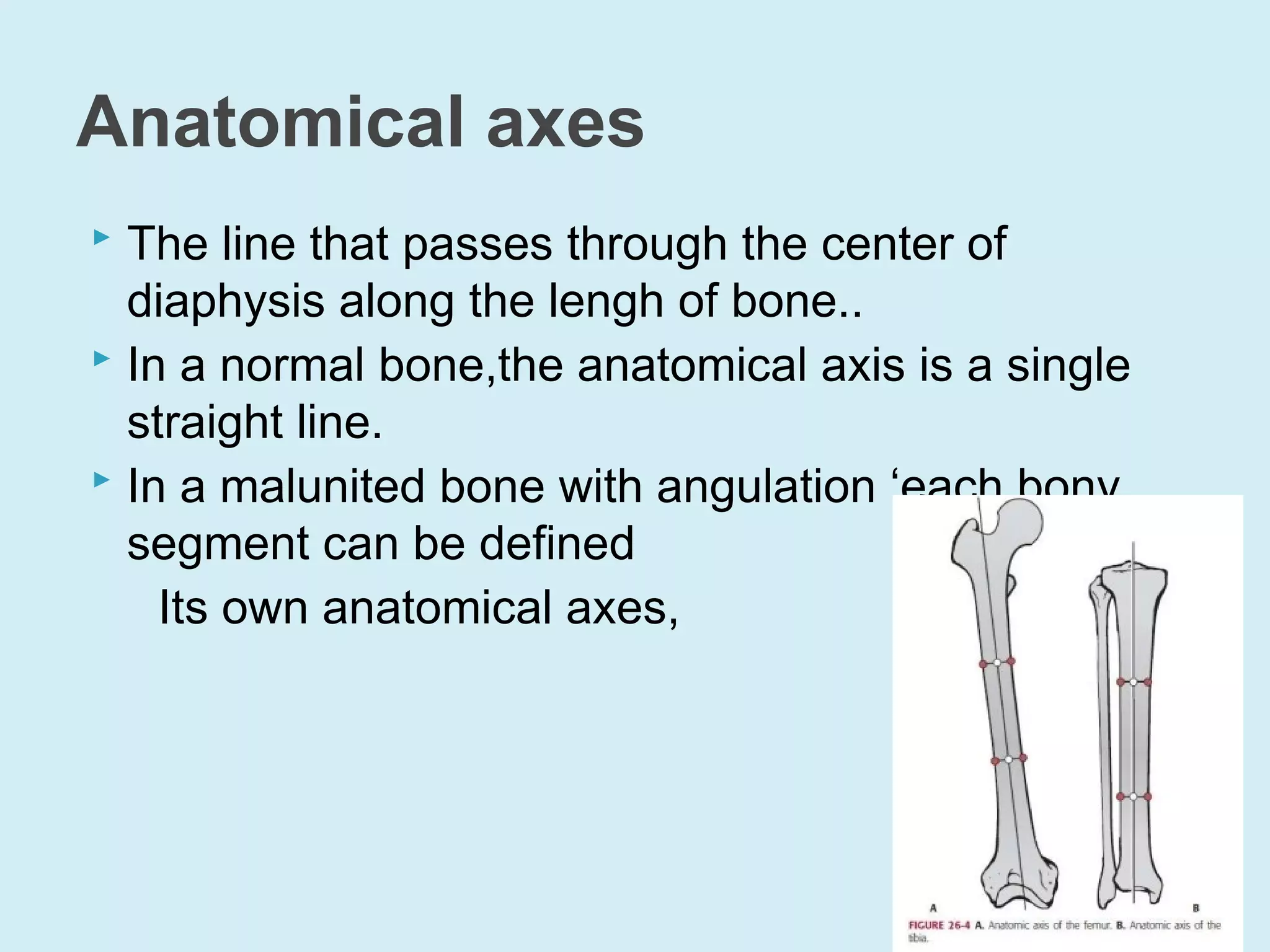
 The line that passes through the center of
diaphysis along the lengh of bone..
 In a normal bone,the anatomical axis is a single
straight line.
 In a malunited bone with angulation ‘each bony
segment can be defined
Its own anatomical axes,
Anatomical axes
Mechanical axes
 •mechanical axis of a limb is defined by an
imaginary line connecting the center of the most
proximal major joint to the center of the most
distal joint.
In the lower limb from the center of hip joint to the
center of ankle joint.
• If a deformity is present the line may be displaced
away from the its usual position.

MAD is measured as the distance from the
knee joint center, to the mechanical axes.
 • Normally, 1 mm to 15 mm medial to the
knee joint center.
 • MAD >15 mm medial to the knee
midpoint- varus malalignment.
• MAD lateral to knee joint mid point- valgus
malalignment.
Mechanical axes deviation
References angle..
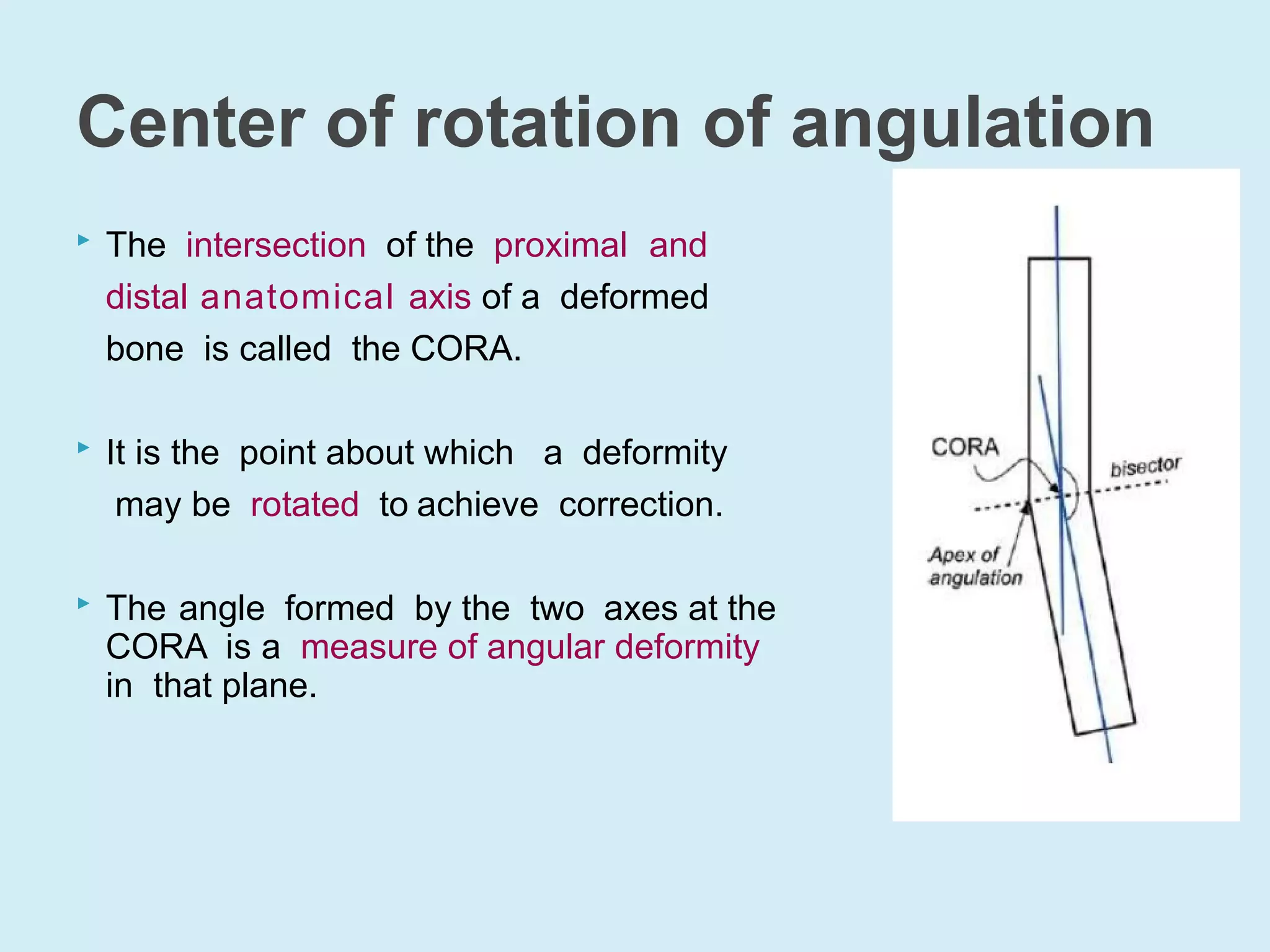
 The intersection of the proximal and
distal anatomical axis of a deformed
bone is called the CORA.
 It is the point about which a deformity
may be rotated to achieve correction.
 The angle formed by the two axes at the
CORA is a measure of angular deformity
in that plane.
Center of rotation of angulation
 If CORA lies at the point of obvious deformity
in the bone and the joint orientations are
normal, the deformity is uniapical (in the
respective plane).[only angular deformity]
 If CORA lies outside the point of obvious
deformity or either joint orientation is abnormal,
either a second CORA exists in that plane , the
deformityis multi-apical or translational deformity
exists in that plane.
 When the CORA lies outside the boundaries of
the involved bone, a multi-apical deformity is
likely to be present.
Importance of CORA
 A. The CORA, the correction axis, and the
osteotomy all lie at the same location; the
bone realigns through angulation alone,
without translation. [indicate only angular
deformity]
 B. The CORA and thecorrection axis lie in the
same location but the osteotomy is proximal
or distal to that location; the bone realigns
through both angulation and translation.
 C. The CORA lies at one location and the
correction axis and the osteotomy lie in a
different location; correction of angulation
results in an iatrogenic translational deformity.
Rule of osteotomy based on cora
 Deformities of lower limb are defined as deviation
of the physiological axes.
 The joint angle and axes may be pathological
altered in the frontal ,sagittal and transeverse
plane.
 The most frequent pathologies and therefore
those of greatest clinical relevence are varus and
valgus deformity in frontal plane.
 Malalignment is menifestation of deviation of
mechanical axes.
Deformity analysis
 Malalignment refers to the loss of collinearity of
the hip, knee, and ankle in the frontal plane.
Therefore, if the MAD exceeds the normal range,
there is malalignment.
 Frontal plane MAD may arise from four anatomic
sources:
femoral frontal plane deformity
tibial frontal plane deformity
frontal plane knee joint laxity
femoral or tibial condylar deficiency.
Malalignment..
Malalignment test
 The line from the center of rotation
of the hip to the center of rotation of
the ankle is the mechanical axis of
the lower limb in the sagittal plane.
 With the knee in full extension, it
passes anterior to the center of
rotation of the knee joint., while it
become collinear at approximately
5°_10° of knee flexion
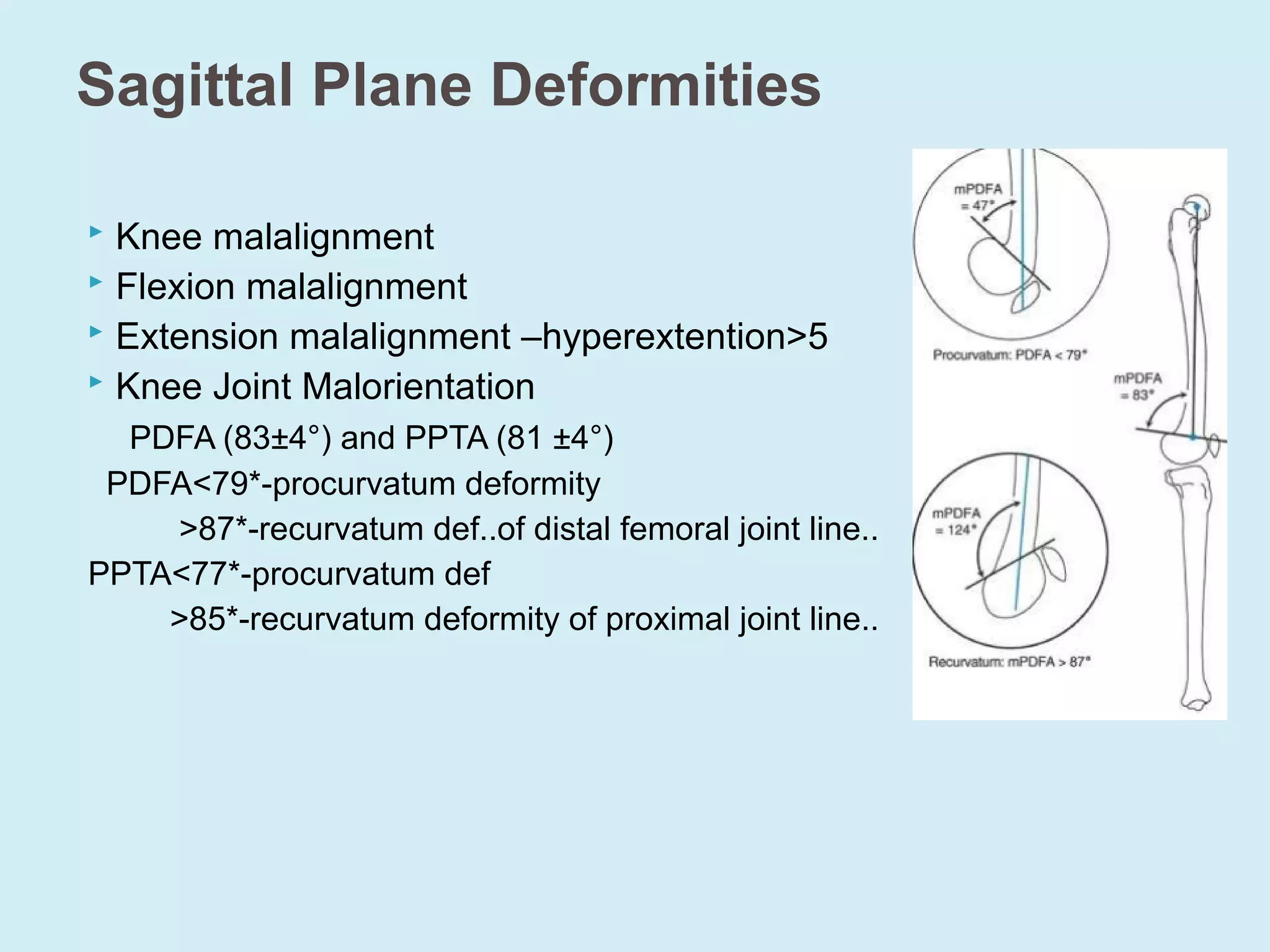
Sagittal Plane Deformities..
 Knee malalignment
 Flexion malalignment
 Extension malalignment –hyperextention>5
 Knee Joint Malorientation
PDFA (83±4°) and PPTA (81 ±4°)
PDFA<79*-procurvatum deformity
>87*-recurvatum def..of distal femoral joint line..
PPTA<77*-procurvatum def
>85*-recurvatum deformity of proximal joint line..
Sagittal Plane Deformities
 Xray- AP, LAT, Patella tangential view
weight bearing xray of entire limb..
Rosenberg view..
Varus / Valgus stress view...
 MRI...
 CT SCAN..specially for torsional malalignment
deformity...
Radiographical evaluation
 Patient history...previous trauma/sx/sports
injury/smoking/over weight/age>60
history of rheumatoid arthritis...
 Clinical examination..
range of motion/alignment of extremity..
Clinical evaluation...
 Three different group..with different approach..
unicompartmental OA Knee..
patient with malalignment leg with ligament instability of knee..
patient with complex deformity...
 Stage of osteoarthritis..
 Patellofemoral joint involvement..
open wedge osteotomy[modified biplaner Tq]
 Ligamentous instability..
persistant deformity+meniscectomy+along medial OA WITH varus..
posteriolateral instability+varus deformity...
Acl Pcl deficiency with intact lateral compartment...
Patient selection guidlines...
 Type of deformity..
metaphyseal varus deformity with uni OA..
complex deformity...
 Obesity..no clear demarcation..
 Age..
 Range of motion..
full extention is prerequested..
flexion contracture..only open wedge HTO
 Lateral osteoarthtis knee..
only due to osseous deformity..SCO
only wear of lateral comparment...UKA
Cont..
 Good quality weight bearing xray
 Evaluate the type and localization of deformity
 Knowledge of any associated ligamentous
instability...
 Level of osteotomy..at apex of deformity/
metaphysis of bone..high tibial/SCFO
 Type of osteotomy..open wedge/close wedge
 Amount of correction..
Planning of correction...
 In patient with varus deformity correction axes should
be 10-35% laterally on fujisawa scale. It depend on
residual cartilage thickness in the involved
compartment...if residual cartilage thickness
>2/3—planned axes 10 to 15 %
>1/3—20 to 25 %
if none then 30 to 35% laterally on FS...
 Patient with valgus deformity along with lateral
compartment osteoarthritis the correction axes can be
planned at 0 to 20% medially on the fujisawa scale..
Amount of correction...in coronal
plane..
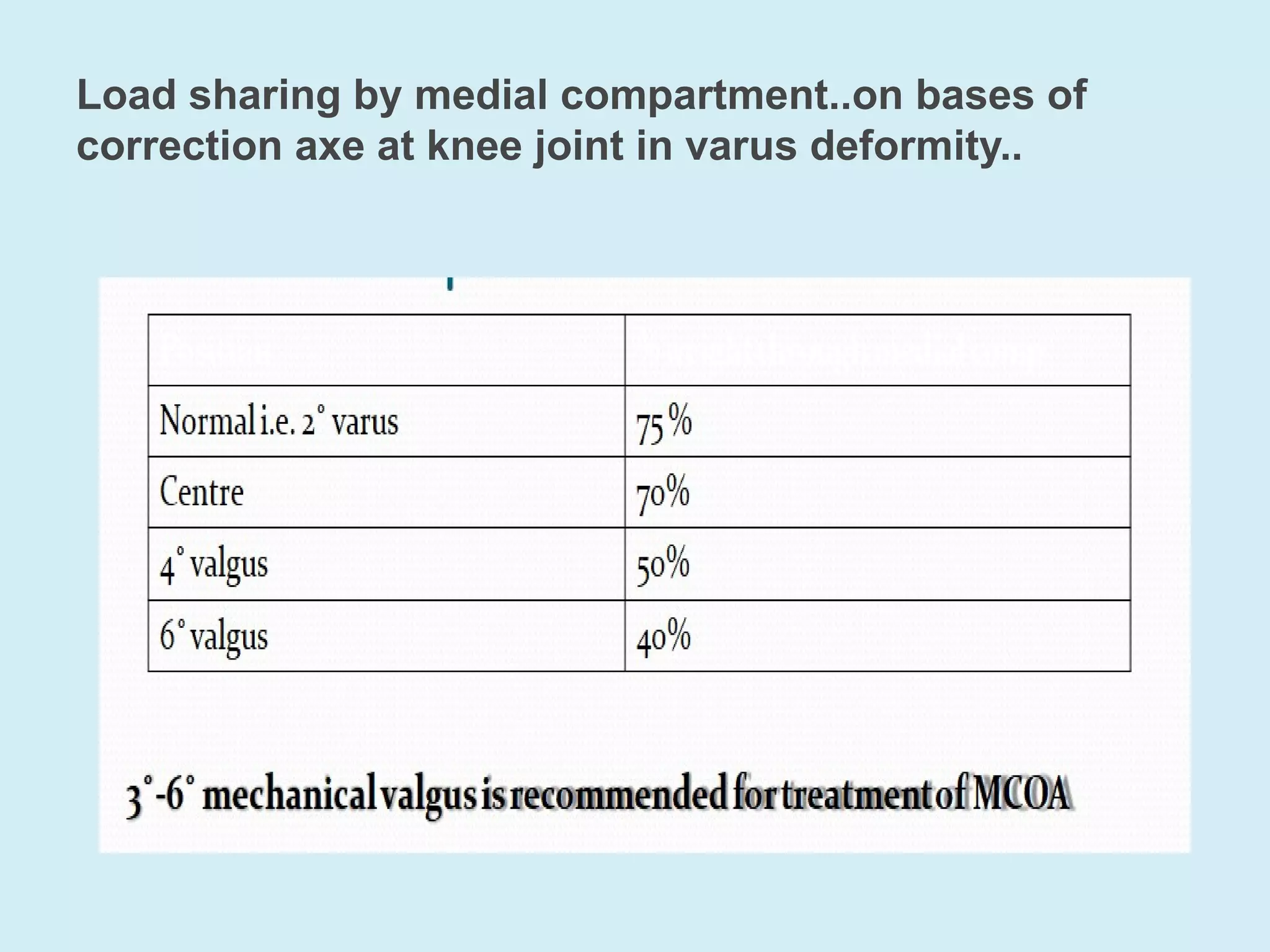
Load sharing by medial compartment..on bases of
correction axe at knee joint in varus deformity..
 Line 1-planned WBL
for postop correction
 Line2-hinge point to center of
ankle
 Line 3-connect HP to the
intersection of line 1
 Hinge point-
in close wedge at medial proximal
metaphysis
in open wedge at lateral proximal
tibial metaphysis,,
 Correction angle-angle formed by
line2 and line 3...
Correction according to miniaci
Recommended correction angle
 Anterior knee unstability-tibial slop..decrease
it create posterior vector force..
it prevent anterior subluxation of tibia..
 Posterior knee unstability-tibial slop..increase
 CORRECTION OF TRANSEVERSE PLANE..
it describe as rotational deformity..
important to analyze patellofemoral alignment.
correct by rotational osteotomy of femur and tibia..
Correction in sagittal plane associated with
ligamentous unstability..
High tibial osteotomy..Lateral closing wedgeosteotomy (Coventry)Medial open wedgeosteotomy with bone graftOpening wedgehemicallotasis (Turi)Barrel vault /domeosteotomy (Maquet)Supracondyler femoralosteotomyTibial tuberosityosteotomyDouble osteotomyRotational osteotomy,,
Various type of osteotomy around
knee
High Tibial Osteotomy
 High tibial osteotomy (HTO) corrects alignment
of the knee, relieving pressure from the arthritic
portion of the joint, and transferring it to an area
of more normal cartilage.
This frequently leads to pain relief and
subsequently, improved function.
Well established procedure for
unicompartmental arthritis with 80 % satisfactory
results. Biomechanical basis  unloading of the
affected compartment
Credited to Jackson and Waugh (1961)
 Valgus osteotomy of proximal tibia remain the
treatment of choice for young active patient with a
progessive symtomatic varus knee and mild to
moderate osteoarthritis..
 Classical valgus osteotomy perform proximal to
tibial tuberosity propagaged by coventry et al in
1965.
Cont..
Lateral closing wedge osteotomy (Coventry)
Medial open wedge osteotomy with bone
graft
Opening wedge hemicallotasis (Turi)
Barrel vault /dome osteotomy (Maquet)
High tibial osteotomy type
Lateral closing wedge osteotomy
used by Coventry et al and Insall et al
advantage of producing apposition of two broad
metaphyseal surfaces, thus optimizing inherent stability and
healing potential
it is made near the deformity
it permits exploration of the knee through the same incision
traditionally performed with freehand cuts and stabilized with
either bone staples or cylinder casts
Potential problems associated with these methods include
longer duration surgery and an inability to precisely achieve
the desired amount of correction.
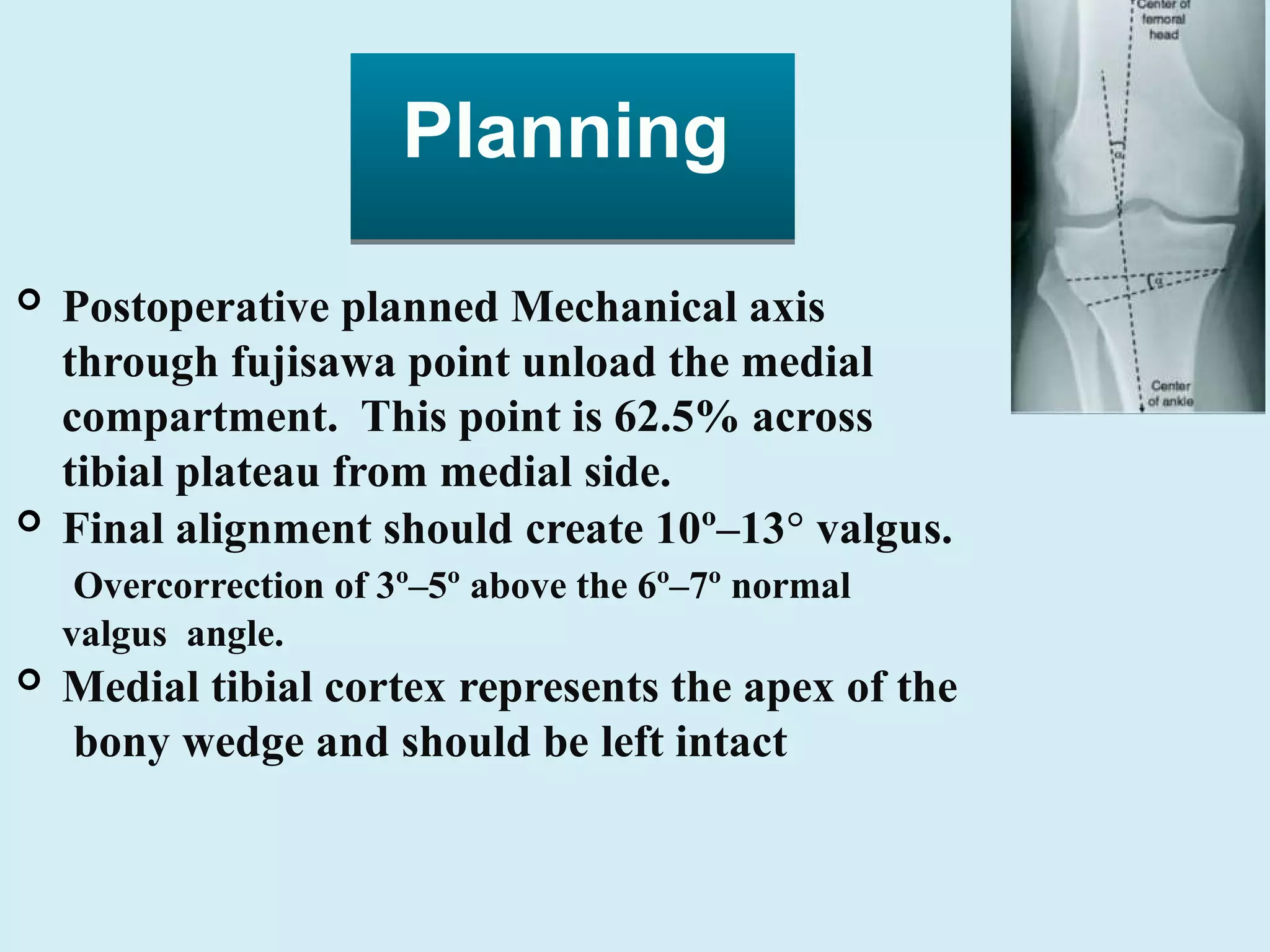
Planning
 Postoperative planned Mechanical axis
through fujisawa point unload the medial
compartment. This point is 62.5% across
tibial plateau from medial side.
 Final alignment should create 10º–13 valgus.
Overcorrection of 3º–5º above the 6º–7º normal
valgus angle.
 Medial tibial cortex represents the apex of the
bony wedge and should be left intact
Amount of wedge resected..
if tibia is 57 mm wide, length of wedge=degrees of correction
Length = Diameter of tibia X 0.02 X Angle
o Curved incision from the head of the fibula to 2 cm below
the tibial tubercle. Peroneal nerve protected.
Excise the bare area of the fibula head Or proximal
tibiofibula joint.
A calibrated osteotomy guide must be used for the bone
cut.
Leave 15–20 mm of tibial plateau to avoid fracture.
Fix with a plate or staples.
Rigid fixation+ early mobilisation .
Procedure..
 Parcial removal of femoral
head .
 Resection of proximal
tibio-fibular syndesmosis
(Insall)
 Resection of fibular head
with advancement of LCL
insertion(Coventry)
Management of Fibula
 Most stable
 Early consolidation
 Early mobilisation
 Exploration of knee joint through same approach..
Advantage of close wedge osteotomy
 Limb shortening
 Nerve injury
 LCL laxity
 Patella baja
Disadvantage of close osteotomy
medial opening wedge osteotomy
used to treat medial compartment osteoarthritis since 1951.
Single transverse cut is used and wedge is opened on concave
surface with bone graft.
Base of wedge is on concave surface and apex on convex
surface.
it is technically easier for the surgeon to achieve the
precise desired amount of angular correction than with
lateral closing wedge HTO
Opening Wedge
Procedure..Procedure..
 The MCL mobilize.
 Two 2.5-mm Kirschner wires mark the oblique osteotomy
 Starting proximal to the pes anserinus
 The wires guided to the tip of the fibula
 The osteotomy of the posterior two-thirds of the tibia
 Leave a 10-mm lateral bone bridge intact.
 Hinge on the lateral - not posterolateral - side of the tibia
 The second osteotomy begins in the anterior one-third of the
tibia at an angle of 135° while leaving the tibial tuberosity intac
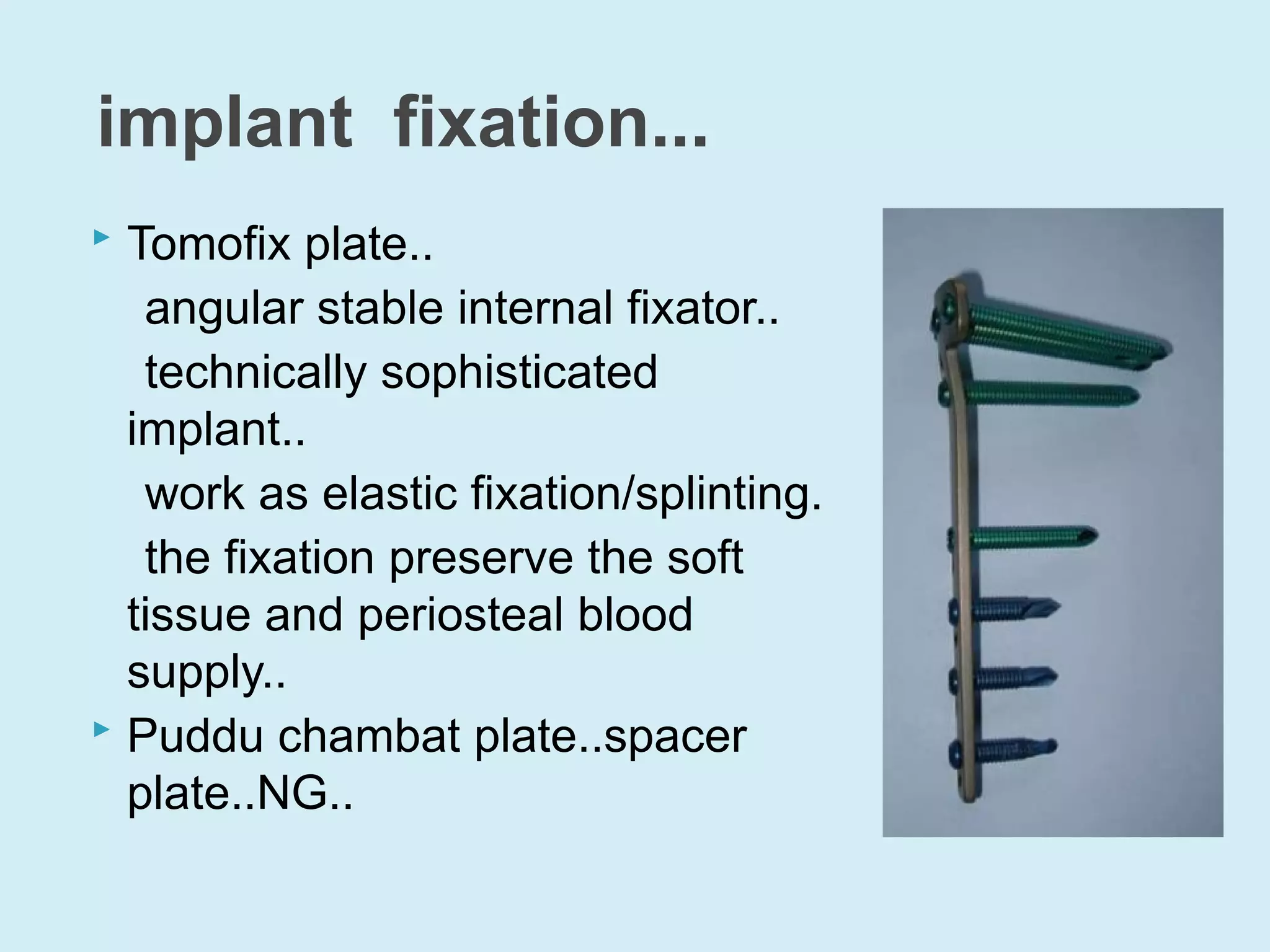
 Tomofix plate..
angular stable internal fixator..
technically sophisticated
implant..
work as elastic fixation/splinting.
the fixation preserve the soft
tissue and periosteal blood
supply..
 Puddu chambat plate..spacer
plate..NG..
implant fixation...
 Usual deformity is proximal tibia vara, which is addressed
directly.
 Preservation of bone at proximal tibia.
 No disruption of proximal tibio fibular joint or anterior
compartment.
 Less chance of nerve injury.
 Correction can be modified intra-operatively.
 Makes tightening of the MCL easier
 Preserve the lateral side for LCL or posterolateral
reconstruction if insufficient
Advantages of open wedge oseotomy
 Non-union
 Longer time for consolidation.
 Longer duration of immobilisation
 Donor site morbidity.
 Limb lengthning
 Shift tibial tubercle laterally – patellofemoral
symptoms..
 Loss of fixation and recurrence of varus deformity
 Worsens patella Baja
Disadvantage of opening wedge
osteotomy
 Close wedge osteotomy has lost importance during last
few years whereas open wedge is performed more
frequently.
this newer technique is easier/faster/more precise and
avoid the risk of peroneal nerve lesion.
 Despite this, certain indication also for close wedge
osteotomy...
if lateral arthrotomy is planned then it might be wise to
use lateral approach through LCWO.
in acl deficient knee, patella baja..
Discussion about close and open
wedge oseotomy...in brief
 Schwartsman  After OWHTO  Ilizarov
Advantages :
More reliable healing,Less chances of patella
baja
Less bone loss, Ability to translate distal
fragment to correct mechanical axis
Disadvantages : Cumbersome, reduced
complaince
Pin loosening, Pin site infection
Turi et al  dynamic uniplanar external fixator
Opening Wedge hemicallotasis
 Maquet described barrel vault osteotomy.
 In which he believed more accuracy and adjustability
of correction.
 It may be considered if a correction angle >20*
 Because this osteotomy is inherently stable, so internal
fixation not required.
 Maquet use special jig to orient dome osteotomy
properly.
 In this procedure Distal tibia can be translated if
needed to change patellar tracking for patellofemoral
degenrative changes.
Barrel vault /dome osteotomy
Barrel vault/maquet dome osteotomy
Indications for High Tibial
Osteotomy
• Oseoarthritis Patients WithVarus Limb Alignment
• Oseoarthritis Patients WithValgus Limb Alignment
• Adult Osteochondritis Dissecan
• Osteonecrosis
• Posterolateral ,anteroposterior Instability
• Chondral Resurfacing
Idial condidate for HTO
age<60 year..nonsmoker..has a certain pain tolerance..
congenial metapphyseal varus deformity..normal range of
motion...intact lateral compartment..ligamentous deficient..
Posterolateral Instability
Isolated soft-tissue reconstruction procedures
for posterolateral insufficiency are likely to fail
in the setting of varus alignment because the
reconstruction is subjected to excessive
tension
Hence, performing a valgus-producing HTO
before or in conjunction with the ligamentous
reconstruction should be considered when
there is varus malalignment.
 Changes in tibial slope affect antero-posterior knee
stability.
 Increasing tibial slope causes increase stress to ACL,
while decrease tibial slop causes increase stress to PCL.
 Hence tibial slope is crucial in concomitent acl and pcl
reconstruction.
 Reduction in posterior tibial slope surgically reduces
stress on reconstructed ACL.
 Patients with chronic PCL injuries and varus
malalignment should be treated with an osteotomy to
correct malalignment prior to PCL reconstruction.
Antero -posterior instability
Compensating for Abnormal AP Laxity
ACL Rupture
 Correction needed >20*
 Flexion contracture>15*
 Knee flexion <90*
 Tibial subluxation >1cm
 Medial compartment tibial bone loss>3mm
 Patella baja
 Inflammatory arthritis[RA]
 Morbid obesity and smokers
 Relative contraindication-age>60 yr..
Contraindication of high tibial
osteotomy
Cont…
severe lateral compartment degenerative joint disease
with loss of a significant portion of the lateral meniscus.
- symptomatic patellofemoral degenerative joint disease.
With severe pain (ie, patellofemoral pain with medial
compartment osteoarthritis)
• patient unwillingness to accept the anticipated cosmetic
appearance of the desired amount of angular correction
Complications of High
Tibial Osteotomy
• Patella Baja,under/over correction
• Fracture ,hematoma,damage to bone surface
• incorrect position of implant
• Peroneal Nerve Palsy,injury to popliteal vessel
• Compartment Syndrome
• Thromboembolism/pulmonary embolism
• infection,nonunion
 In HTO good result are obtained during first year
follow-up, with worse over time.
 Insall showed in his study
2year follow up-97% good result..
after 5 year-up to 85%..after 9 year-63%..
 Unsatisfactory result are due to inadequate patient
selection,planning defect,loss of correction with
less stable implant..
 Insall reported that because of progression of OA
23% patient of HTO converted to TKA.
Discussion about HTO in brief..
 Supracondylar femoral osteotomy is one of the
most commonly performed procedure to correct
the valgus deformity of knee due to various
etiology.
Valgus deformity of 12º or more needs
distal femoral varus producing osteotomy to
address a lateral femoral condyle deficiency
and to prevent joint line obliquity and
gradual lateral tibial subluxation.
SUPRACONDYLAR FEMORAL
OSTEOTOMY
Distal Femur Osteotomy for
Valgus Malalignment
Close wedge distal femoral ostetomy...
.. ..
 Correction of frontal plane valgus deformity with
lateral unicompartmental OA knee. [conta-RA]
 Correction of load imbalance in ligamentous instability
due to medial collateral ligament insufficiency.
 Correction of lateral patellofemoral maltracking due to
valgus leg alignment.
 Genu recurvatum secondry to paralytic poliomylitis.
 Genu valgum may be congenital,idiopathic, or
secondry to trauma, or might be due to rickets or
osteomalacia.
Indication of scfo
 medial closing wedge osteotomy and lateral
opening wedge osteotomy –for genu valgus
deformity
For fixation an angle blade plate, a dynamic
condylar screw and side plate, staples are used.
 Anterior wedge ostetomy –for flexion contracture
of knee joint.
 posterior wedge osteotomy –genu recurvatum
 Mixed wedge ostetomy – for mixed or rotation
deformity of knee joint,
TECHNIQUES of scfo..
 TTO is well described treatment option for a broad
range of patellofemoral joint disorders, including
patellofemoral instability,patellar and trochlear
focal chondral lesions and patellofemoral arthritis.
 A laterally tracking patella is commonly seen in
patient with chronic recurrent lateral patellar
dislocation. A fulkerson osteotomy procedure
corrects the maltracking of patella by medially
transferring the tibial tubercle.
TIBIAL TUBEROSITY OSTEOTOMY
Tibial tuberosity osteotomy
 Allow correction for complex deformity..
for varus deformity-lateral CW femoral with
medial OW tibial osteotomy
For valgus deformity-medial CW femoral with medial
close wedge tibial osteotomy..
AIM-
unload affected joint compartment..
normalized the knee joint angle..
orientation of mid joint line..
Double osteotomy around knee
 Progression of osteoarthritic process is most
common cause of failure of osteotomy around knee.
 Other cause..over/under correction,nonunion
 Insall et al-23% conversion
Everage time -6 year
Several reports state that the result of post osteotomy
TKA are comparable to the result of primary TKA.
Recent study of haslam et al-slightly poor result
compare to primary TKA.
TKA after osteotomy around knee
Osteotomy around knee dr shankar jangid (1)

Osteotomy around knee dr shankar jangid (1)

  • 1.
    OSTEOTOMY AROUND KNEE PREPARED BYDr. SHANKAR 3rd year pg trainee SUPERVISED BY DR. PRASHANT MODI SMS MEDICAL COLLEGE JAIPUR
  • 2.
     The kneejoint is largest and most complex joint in the human body and has the longest lever arms.  The joint transmits muscle force in to motion of human body. the large lever arm of knee joint produce substantial loading moments.  Malalignment of limb result in excessive loading and stress in a part of joint and consequently increased damage to articular cartilage in that area. INTRODUCTION
  • 3.
     As articularsurface is destroyed, the deformity progressively increases so deviation of lower extremity axes are regarded as prearthritic deformity.  Osteotomy and repositioning of bone fragements, by correcting the deformity, will improve the load bearing mechanics of joint. Cont…..
  • 4.
    Corrective lower limbosteotomies are innovative and efficient therapeutic procedure for restoring axial alignment in managing of unicompartmental osteoarthritis knee, complex posttraumatic and congenital lower limb deformities. As the basic science and technology of cartilage restoration and meniscal transplantation have envolved,new indication of osteotomy around knee also emerges. ....
  • 5.
     Unload themedial compartment by slightly overcorrecting into valgus  Unloading any ligament and cartilage reconstruction in patients with a varus thrust  To change the tibial slope in chronic ligaments deficient knee with significant OA . That reduce translational forces and improve AP instability Corrective osteotomy around knee approaches as... Corrective osteotomy around knee approaches as...
  • 6.
     DEFORMITY OFKNEE-severe varus/valgus or in hyperextention deformity of knee.  Localized articular surface destruction.  Help in articular reconstruction of meniscus, articular cartilage and ligament reconstruction. INDICATION OF OSTEOTOMY in adult….
  • 7.
    • Post acquiredepiphysiodesis [septic/traumatic] • Congenital deformity[PFFD,NF] • Flexion contracture in arthrogryposis,polio.. • Acquired deformity [rickets,blount disease] • Focal chondrodysplasia. • Post traumatic deformity.. Indication in children and adolescent...
  • 8.
     Physiological examination-insagittal , frontal and axial plane..  Definition of deformity and aim of correction  Radiological analysis..  Patient selection guideline..  Planning of correction  Implant selection  Description of surgical technique.. Surgical plan for deformity correction of lower limb..
  • 9.
    Anatomical axis Mechanical axis Mechanicalaxis deviation Reference Joint angle Location of deformity[cora] Physiological axes and joint angle of leg
  • 10.
     The linethat passes through the center of diaphysis along the lengh of bone..  In a normal bone,the anatomical axis is a single straight line.  In a malunited bone with angulation ‘each bony segment can be defined Its own anatomical axes, Anatomical axes
  • 11.
    Mechanical axes  •mechanicalaxis of a limb is defined by an imaginary line connecting the center of the most proximal major joint to the center of the most distal joint. In the lower limb from the center of hip joint to the center of ankle joint. • If a deformity is present the line may be displaced away from the its usual position.
  • 12.
     MAD is measuredas the distance from the knee joint center, to the mechanical axes.  • Normally, 1 mm to 15 mm medial to the knee joint center.  • MAD >15 mm medial to the knee midpoint- varus malalignment. • MAD lateral to knee joint mid point- valgus malalignment. Mechanical axes deviation
  • 13.
  • 14.
     The intersectionof the proximal and distal anatomical axis of a deformed bone is called the CORA.  It is the point about which a deformity may be rotated to achieve correction.  The angle formed by the two axes at the CORA is a measure of angular deformity in that plane. Center of rotation of angulation
  • 15.
     If CORAlies at the point of obvious deformity in the bone and the joint orientations are normal, the deformity is uniapical (in the respective plane).[only angular deformity]  If CORA lies outside the point of obvious deformity or either joint orientation is abnormal, either a second CORA exists in that plane , the deformityis multi-apical or translational deformity exists in that plane.  When the CORA lies outside the boundaries of the involved bone, a multi-apical deformity is likely to be present. Importance of CORA
  • 16.
     A. TheCORA, the correction axis, and the osteotomy all lie at the same location; the bone realigns through angulation alone, without translation. [indicate only angular deformity]  B. The CORA and thecorrection axis lie in the same location but the osteotomy is proximal or distal to that location; the bone realigns through both angulation and translation.  C. The CORA lies at one location and the correction axis and the osteotomy lie in a different location; correction of angulation results in an iatrogenic translational deformity. Rule of osteotomy based on cora
  • 17.
     Deformities oflower limb are defined as deviation of the physiological axes.  The joint angle and axes may be pathological altered in the frontal ,sagittal and transeverse plane.  The most frequent pathologies and therefore those of greatest clinical relevence are varus and valgus deformity in frontal plane.  Malalignment is menifestation of deviation of mechanical axes. Deformity analysis
  • 18.
     Malalignment refersto the loss of collinearity of the hip, knee, and ankle in the frontal plane. Therefore, if the MAD exceeds the normal range, there is malalignment.  Frontal plane MAD may arise from four anatomic sources: femoral frontal plane deformity tibial frontal plane deformity frontal plane knee joint laxity femoral or tibial condylar deficiency. Malalignment..
  • 19.
  • 20.
     The linefrom the center of rotation of the hip to the center of rotation of the ankle is the mechanical axis of the lower limb in the sagittal plane.  With the knee in full extension, it passes anterior to the center of rotation of the knee joint., while it become collinear at approximately 5°_10° of knee flexion Sagittal Plane Deformities..
  • 21.
     Knee malalignment Flexion malalignment  Extension malalignment –hyperextention>5  Knee Joint Malorientation PDFA (83±4°) and PPTA (81 ±4°) PDFA<79*-procurvatum deformity >87*-recurvatum def..of distal femoral joint line.. PPTA<77*-procurvatum def >85*-recurvatum deformity of proximal joint line.. Sagittal Plane Deformities
  • 22.
     Xray- AP,LAT, Patella tangential view weight bearing xray of entire limb.. Rosenberg view.. Varus / Valgus stress view...  MRI...  CT SCAN..specially for torsional malalignment deformity... Radiographical evaluation
  • 23.
     Patient history...previoustrauma/sx/sports injury/smoking/over weight/age>60 history of rheumatoid arthritis...  Clinical examination.. range of motion/alignment of extremity.. Clinical evaluation...
  • 24.
     Three differentgroup..with different approach.. unicompartmental OA Knee.. patient with malalignment leg with ligament instability of knee.. patient with complex deformity...  Stage of osteoarthritis..  Patellofemoral joint involvement.. open wedge osteotomy[modified biplaner Tq]  Ligamentous instability.. persistant deformity+meniscectomy+along medial OA WITH varus.. posteriolateral instability+varus deformity... Acl Pcl deficiency with intact lateral compartment... Patient selection guidlines...
  • 25.
     Type ofdeformity.. metaphyseal varus deformity with uni OA.. complex deformity...  Obesity..no clear demarcation..  Age..  Range of motion.. full extention is prerequested.. flexion contracture..only open wedge HTO  Lateral osteoarthtis knee.. only due to osseous deformity..SCO only wear of lateral comparment...UKA Cont..
  • 26.
     Good qualityweight bearing xray  Evaluate the type and localization of deformity  Knowledge of any associated ligamentous instability...  Level of osteotomy..at apex of deformity/ metaphysis of bone..high tibial/SCFO  Type of osteotomy..open wedge/close wedge  Amount of correction.. Planning of correction...
  • 27.
     In patientwith varus deformity correction axes should be 10-35% laterally on fujisawa scale. It depend on residual cartilage thickness in the involved compartment...if residual cartilage thickness >2/3—planned axes 10 to 15 % >1/3—20 to 25 % if none then 30 to 35% laterally on FS...  Patient with valgus deformity along with lateral compartment osteoarthritis the correction axes can be planned at 0 to 20% medially on the fujisawa scale.. Amount of correction...in coronal plane..
  • 28.
    Load sharing bymedial compartment..on bases of correction axe at knee joint in varus deformity..
  • 29.
     Line 1-plannedWBL for postop correction  Line2-hinge point to center of ankle  Line 3-connect HP to the intersection of line 1  Hinge point- in close wedge at medial proximal metaphysis in open wedge at lateral proximal tibial metaphysis,,  Correction angle-angle formed by line2 and line 3... Correction according to miniaci
  • 30.
  • 31.
     Anterior kneeunstability-tibial slop..decrease it create posterior vector force.. it prevent anterior subluxation of tibia..  Posterior knee unstability-tibial slop..increase  CORRECTION OF TRANSEVERSE PLANE.. it describe as rotational deformity.. important to analyze patellofemoral alignment. correct by rotational osteotomy of femur and tibia.. Correction in sagittal plane associated with ligamentous unstability..
  • 32.
    High tibial osteotomy..Lateralclosing wedgeosteotomy (Coventry)Medial open wedgeosteotomy with bone graftOpening wedgehemicallotasis (Turi)Barrel vault /domeosteotomy (Maquet)Supracondyler femoralosteotomyTibial tuberosityosteotomyDouble osteotomyRotational osteotomy,, Various type of osteotomy around knee
  • 33.
  • 34.
     High tibialosteotomy (HTO) corrects alignment of the knee, relieving pressure from the arthritic portion of the joint, and transferring it to an area of more normal cartilage. This frequently leads to pain relief and subsequently, improved function. Well established procedure for unicompartmental arthritis with 80 % satisfactory results. Biomechanical basis  unloading of the affected compartment Credited to Jackson and Waugh (1961)
  • 35.
     Valgus osteotomyof proximal tibia remain the treatment of choice for young active patient with a progessive symtomatic varus knee and mild to moderate osteoarthritis..  Classical valgus osteotomy perform proximal to tibial tuberosity propagaged by coventry et al in 1965. Cont..
  • 36.
    Lateral closing wedgeosteotomy (Coventry) Medial open wedge osteotomy with bone graft Opening wedge hemicallotasis (Turi) Barrel vault /dome osteotomy (Maquet) High tibial osteotomy type
  • 37.
    Lateral closing wedgeosteotomy used by Coventry et al and Insall et al advantage of producing apposition of two broad metaphyseal surfaces, thus optimizing inherent stability and healing potential it is made near the deformity it permits exploration of the knee through the same incision traditionally performed with freehand cuts and stabilized with either bone staples or cylinder casts Potential problems associated with these methods include longer duration surgery and an inability to precisely achieve the desired amount of correction.
  • 38.
    Planning  Postoperative plannedMechanical axis through fujisawa point unload the medial compartment. This point is 62.5% across tibial plateau from medial side.  Final alignment should create 10º–13 valgus. Overcorrection of 3º–5º above the 6º–7º normal valgus angle.  Medial tibial cortex represents the apex of the bony wedge and should be left intact
  • 39.
    Amount of wedgeresected.. if tibia is 57 mm wide, length of wedge=degrees of correction Length = Diameter of tibia X 0.02 X Angle
  • 40.
    o Curved incisionfrom the head of the fibula to 2 cm below the tibial tubercle. Peroneal nerve protected. Excise the bare area of the fibula head Or proximal tibiofibula joint. A calibrated osteotomy guide must be used for the bone cut. Leave 15–20 mm of tibial plateau to avoid fracture. Fix with a plate or staples. Rigid fixation+ early mobilisation . Procedure..
  • 42.
     Parcial removalof femoral head .  Resection of proximal tibio-fibular syndesmosis (Insall)  Resection of fibular head with advancement of LCL insertion(Coventry) Management of Fibula
  • 43.
     Most stable Early consolidation  Early mobilisation  Exploration of knee joint through same approach.. Advantage of close wedge osteotomy
  • 44.
     Limb shortening Nerve injury  LCL laxity  Patella baja Disadvantage of close osteotomy
  • 45.
    medial opening wedgeosteotomy used to treat medial compartment osteoarthritis since 1951. Single transverse cut is used and wedge is opened on concave surface with bone graft. Base of wedge is on concave surface and apex on convex surface. it is technically easier for the surgeon to achieve the precise desired amount of angular correction than with lateral closing wedge HTO
  • 46.
  • 47.
    Procedure..Procedure..  The MCLmobilize.  Two 2.5-mm Kirschner wires mark the oblique osteotomy  Starting proximal to the pes anserinus  The wires guided to the tip of the fibula  The osteotomy of the posterior two-thirds of the tibia  Leave a 10-mm lateral bone bridge intact.  Hinge on the lateral - not posterolateral - side of the tibia  The second osteotomy begins in the anterior one-third of the tibia at an angle of 135° while leaving the tibial tuberosity intac
  • 48.
     Tomofix plate.. angularstable internal fixator.. technically sophisticated implant.. work as elastic fixation/splinting. the fixation preserve the soft tissue and periosteal blood supply..  Puddu chambat plate..spacer plate..NG.. implant fixation...
  • 49.
     Usual deformityis proximal tibia vara, which is addressed directly.  Preservation of bone at proximal tibia.  No disruption of proximal tibio fibular joint or anterior compartment.  Less chance of nerve injury.  Correction can be modified intra-operatively.  Makes tightening of the MCL easier  Preserve the lateral side for LCL or posterolateral reconstruction if insufficient Advantages of open wedge oseotomy
  • 50.
     Non-union  Longertime for consolidation.  Longer duration of immobilisation  Donor site morbidity.  Limb lengthning  Shift tibial tubercle laterally – patellofemoral symptoms..  Loss of fixation and recurrence of varus deformity  Worsens patella Baja Disadvantage of opening wedge osteotomy
  • 51.
     Close wedgeosteotomy has lost importance during last few years whereas open wedge is performed more frequently. this newer technique is easier/faster/more precise and avoid the risk of peroneal nerve lesion.  Despite this, certain indication also for close wedge osteotomy... if lateral arthrotomy is planned then it might be wise to use lateral approach through LCWO. in acl deficient knee, patella baja.. Discussion about close and open wedge oseotomy...in brief
  • 52.
     Schwartsman After OWHTO  Ilizarov Advantages : More reliable healing,Less chances of patella baja Less bone loss, Ability to translate distal fragment to correct mechanical axis Disadvantages : Cumbersome, reduced complaince Pin loosening, Pin site infection Turi et al  dynamic uniplanar external fixator Opening Wedge hemicallotasis
  • 53.
     Maquet describedbarrel vault osteotomy.  In which he believed more accuracy and adjustability of correction.  It may be considered if a correction angle >20*  Because this osteotomy is inherently stable, so internal fixation not required.  Maquet use special jig to orient dome osteotomy properly.  In this procedure Distal tibia can be translated if needed to change patellar tracking for patellofemoral degenrative changes. Barrel vault /dome osteotomy
  • 54.
  • 55.
    Indications for HighTibial Osteotomy • Oseoarthritis Patients WithVarus Limb Alignment • Oseoarthritis Patients WithValgus Limb Alignment • Adult Osteochondritis Dissecan • Osteonecrosis • Posterolateral ,anteroposterior Instability • Chondral Resurfacing Idial condidate for HTO age<60 year..nonsmoker..has a certain pain tolerance.. congenial metapphyseal varus deformity..normal range of motion...intact lateral compartment..ligamentous deficient..
  • 56.
    Posterolateral Instability Isolated soft-tissuereconstruction procedures for posterolateral insufficiency are likely to fail in the setting of varus alignment because the reconstruction is subjected to excessive tension Hence, performing a valgus-producing HTO before or in conjunction with the ligamentous reconstruction should be considered when there is varus malalignment.
  • 57.
     Changes intibial slope affect antero-posterior knee stability.  Increasing tibial slope causes increase stress to ACL, while decrease tibial slop causes increase stress to PCL.  Hence tibial slope is crucial in concomitent acl and pcl reconstruction.  Reduction in posterior tibial slope surgically reduces stress on reconstructed ACL.  Patients with chronic PCL injuries and varus malalignment should be treated with an osteotomy to correct malalignment prior to PCL reconstruction. Antero -posterior instability
  • 58.
    Compensating for AbnormalAP Laxity ACL Rupture
  • 59.
     Correction needed>20*  Flexion contracture>15*  Knee flexion <90*  Tibial subluxation >1cm  Medial compartment tibial bone loss>3mm  Patella baja  Inflammatory arthritis[RA]  Morbid obesity and smokers  Relative contraindication-age>60 yr.. Contraindication of high tibial osteotomy
  • 60.
    Cont… severe lateral compartmentdegenerative joint disease with loss of a significant portion of the lateral meniscus. - symptomatic patellofemoral degenerative joint disease. With severe pain (ie, patellofemoral pain with medial compartment osteoarthritis) • patient unwillingness to accept the anticipated cosmetic appearance of the desired amount of angular correction
  • 61.
    Complications of High TibialOsteotomy • Patella Baja,under/over correction • Fracture ,hematoma,damage to bone surface • incorrect position of implant • Peroneal Nerve Palsy,injury to popliteal vessel • Compartment Syndrome • Thromboembolism/pulmonary embolism • infection,nonunion
  • 62.
     In HTOgood result are obtained during first year follow-up, with worse over time.  Insall showed in his study 2year follow up-97% good result.. after 5 year-up to 85%..after 9 year-63%..  Unsatisfactory result are due to inadequate patient selection,planning defect,loss of correction with less stable implant..  Insall reported that because of progression of OA 23% patient of HTO converted to TKA. Discussion about HTO in brief..
  • 63.
     Supracondylar femoralosteotomy is one of the most commonly performed procedure to correct the valgus deformity of knee due to various etiology. Valgus deformity of 12º or more needs distal femoral varus producing osteotomy to address a lateral femoral condyle deficiency and to prevent joint line obliquity and gradual lateral tibial subluxation. SUPRACONDYLAR FEMORAL OSTEOTOMY
  • 64.
    Distal Femur Osteotomyfor Valgus Malalignment
  • 65.
    Close wedge distalfemoral ostetomy... .. ..
  • 66.
     Correction offrontal plane valgus deformity with lateral unicompartmental OA knee. [conta-RA]  Correction of load imbalance in ligamentous instability due to medial collateral ligament insufficiency.  Correction of lateral patellofemoral maltracking due to valgus leg alignment.  Genu recurvatum secondry to paralytic poliomylitis.  Genu valgum may be congenital,idiopathic, or secondry to trauma, or might be due to rickets or osteomalacia. Indication of scfo
  • 67.
     medial closingwedge osteotomy and lateral opening wedge osteotomy –for genu valgus deformity For fixation an angle blade plate, a dynamic condylar screw and side plate, staples are used.  Anterior wedge ostetomy –for flexion contracture of knee joint.  posterior wedge osteotomy –genu recurvatum  Mixed wedge ostetomy – for mixed or rotation deformity of knee joint, TECHNIQUES of scfo..
  • 68.
     TTO iswell described treatment option for a broad range of patellofemoral joint disorders, including patellofemoral instability,patellar and trochlear focal chondral lesions and patellofemoral arthritis.  A laterally tracking patella is commonly seen in patient with chronic recurrent lateral patellar dislocation. A fulkerson osteotomy procedure corrects the maltracking of patella by medially transferring the tibial tubercle. TIBIAL TUBEROSITY OSTEOTOMY
  • 69.
  • 70.
     Allow correctionfor complex deformity.. for varus deformity-lateral CW femoral with medial OW tibial osteotomy For valgus deformity-medial CW femoral with medial close wedge tibial osteotomy.. AIM- unload affected joint compartment.. normalized the knee joint angle.. orientation of mid joint line.. Double osteotomy around knee
  • 71.
     Progression ofosteoarthritic process is most common cause of failure of osteotomy around knee.  Other cause..over/under correction,nonunion  Insall et al-23% conversion Everage time -6 year Several reports state that the result of post osteotomy TKA are comparable to the result of primary TKA. Recent study of haslam et al-slightly poor result compare to primary TKA. TKA after osteotomy around knee