J.R. Rudzki, MDJ.R. Rudzki, MD
Clinical Assistant ProfessorClinical Assistant Professor
The George Washington University School of MedicineThe George Washington University School of Medicine
Arthrex Knee MeetingArthrex Knee Meeting
Los Angeles, CALos Angeles, CA
May 12, 2012May 12, 2012
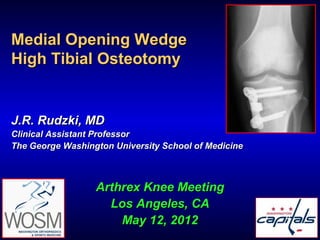
Medial Opening WedgeMedial Opening Wedge
High Tibial OsteotomyHigh Tibial Osteotomy
DisclosureDisclosure
Previous direct & indirect funding & support forPrevious direct & indirect funding & support for
research & education from:research & education from:
• Philips Medical ImagingPhilips Medical Imaging
• Bristol-Myers-SquibBristol-Myers-Squib
• Smith & NephewSmith & Nephew
• NIH (CT Chen)NIH (CT Chen)
• HSS Institute for Sports Medicine ResearchHSS Institute for Sports Medicine Research
• Major League BaseballMajor League Baseball
Arthrex – ConsultantArthrex – Consultant
AJSM, JBJS, CORR – ReviewerAJSM, JBJS, CORR – Reviewer
AAOS – Evaluation Committee, BOCAAOS – Evaluation Committee, BOC
Accelerated Rehab Technologies – BoardAccelerated Rehab Technologies – Board
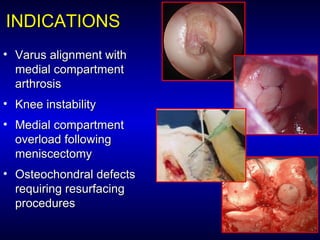
INDICATIONSINDICATIONS
• Varus alignment withVarus alignment with
medial compartmentmedial compartment
arthrosisarthrosis
• Knee instabilityKnee instability
• Medial compartmentMedial compartment
overload followingoverload following
meniscectomymeniscectomy
• Osteochondral defectsOsteochondral defects
requiring resurfacingrequiring resurfacing
proceduresprocedures
Sagital Plane StabilitySagital Plane Stability
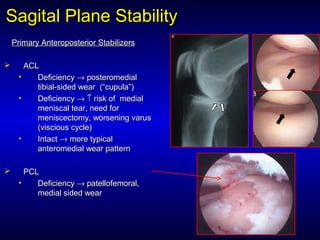
Primary Anteroposterior StabilizersPrimary Anteroposterior Stabilizers
 ACLACL
• DeficiencyDeficiency →→ posteromedialposteromedial
tibial-sided wear (“tibial-sided wear (“cupulacupula””))
• DeficiencyDeficiency →→ ↑↑ risk of medialrisk of medial
meniscal tear, need formeniscal tear, need for
meniscectomy, worsening varusmeniscectomy, worsening varus
(viscious cycle)(viscious cycle)
• IntactIntact →→ more typicalmore typical
anteromedial wear patternanteromedial wear pattern
 PCLPCL
• DeficiencyDeficiency →→ patellofemoral,patellofemoral,
medial sided wearmedial sided wear
ROLE OF SLOPEROLE OF SLOPE
RADIOGRAPHIC DATARADIOGRAPHIC DATA
 Bonnin, 1990Bonnin, 1990
• Every 10Every 10°° increase in posterior tibial slopeincrease in posterior tibial slope →→ 6mm increase in6mm increase in
anterior tibial translation (ATT)anterior tibial translation (ATT)
 DeJour, 2000DeJour, 2000
• Direct linear relationship between slope and ATTDirect linear relationship between slope and ATT
• Hypothesis: Reduce posterior slopeHypothesis: Reduce posterior slope →→ reduce AP instability,reduce AP instability,
improve symptomsimprove symptoms
 Hohmann, 2006; Cullu 2005Hohmann, 2006; Cullu 2005
• Lateral closing wedge, Dome HTOLateral closing wedge, Dome HTO →→ ↓↓ posterior tibial slopeposterior tibial slope
 Marti , 2004; Sterett, 2009Marti , 2004; Sterett, 2009
• Medial opening HTO inadvertentlyMedial opening HTO inadvertently →→ ↑↑ posterior tibial slopeposterior tibial slope
• But no relation to outcomes/Lysholm scores (Sterett)But no relation to outcomes/Lysholm scores (Sterett)
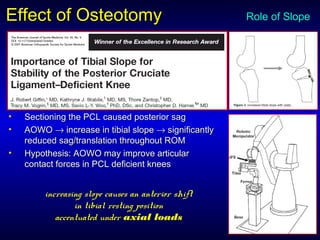
• Sectioning the PCL caused posterior sagSectioning the PCL caused posterior sag
• AOWOAOWO →→ increase in tibial slopeincrease in tibial slope →→ significantlysignificantly
reduced sag/translation throughout ROMreduced sag/translation throughout ROM
• Hypothesis: AOWO may improve articularHypothesis: AOWO may improve articular
contact forces in PCL deficient kneescontact forces in PCL deficient knees
Effect of OsteotomyEffect of Osteotomy
increasing slope causes an anterior shift
in tibial resting position
accentuated under axial loads
Role of Slope
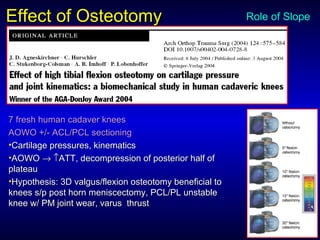
Effect of OsteotomyEffect of Osteotomy
7 fresh human cadaver knees7 fresh human cadaver knees
AOWO +/- ACL/PCL sectioningAOWO +/- ACL/PCL sectioning
•Cartilage pressures, kinematicsCartilage pressures, kinematics
•AOWOAOWO →→ ↑↑ATT, decompression of posterior half ofATT, decompression of posterior half of
plateauplateau
•Hypothesis: 3D valgus/flexion osteotomy beneficial toHypothesis: 3D valgus/flexion osteotomy beneficial to
knees s/p post horn meniscectomy, PCL/PL unstableknees s/p post horn meniscectomy, PCL/PL unstable
knee w/ PM joint wear, varus thrustknee w/ PM joint wear, varus thrust
Role of Slope
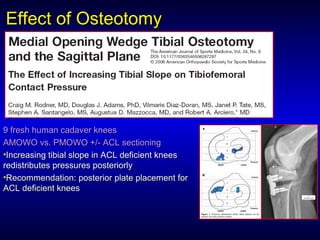
Effect of OsteotomyEffect of Osteotomy
9 fresh human cadaver knees9 fresh human cadaver knees
AMOWO vs. PMOWO +/- ACL sectioningAMOWO vs. PMOWO +/- ACL sectioning
•Increasing tibial slope in ACL deficient kneesIncreasing tibial slope in ACL deficient knees
redistributes pressures posteriorlyredistributes pressures posteriorly
•Recommendation: posterior plate placement forRecommendation: posterior plate placement for
ACL deficient kneesACL deficient knees
Effect of OsteotomyEffect of Osteotomy
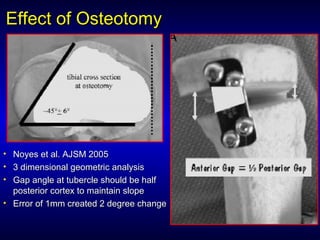
• Noyes et al. AJSM 2005Noyes et al. AJSM 2005
• 3 dimensional geometric analysis3 dimensional geometric analysis
• Gap angle at tubercle should be halfGap angle at tubercle should be half
posterior cortex to maintain slopeposterior cortex to maintain slope
• Error of 1mm created 2 degree changeError of 1mm created 2 degree change
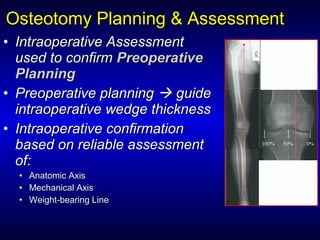
• Intraoperative AssessmentIntraoperative Assessment
used to confirmused to confirm PreoperativePreoperative
PlanningPlanning
• Preoperative planningPreoperative planning  guideguide
intraoperative wedge thicknessintraoperative wedge thickness
• Intraoperative confirmationIntraoperative confirmation
based on reliable assessmentbased on reliable assessment
of:of:
• Anatomic AxisAnatomic Axis
• Mechanical AxisMechanical Axis
• Weight-bearing LineWeight-bearing Line
Osteotomy Planning & AssessmentOsteotomy Planning & Assessment
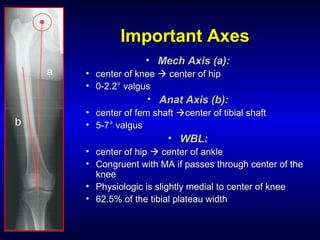
Important AxesImportant Axes
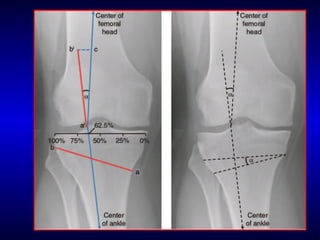
• Mech Axis (a):Mech Axis (a):
• center of kneecenter of knee  center of hipcenter of hip
• 0-2.20-2.2° valgus° valgus
• Anat Axis (b):Anat Axis (b):
• center of fem shaftcenter of fem shaft center of tibial shaftcenter of tibial shaft
• 5-75-7° valgus° valgus
• WBL:WBL:
• center of hipcenter of hip  center of anklecenter of ankle
• Congruent with MA if passes through center of theCongruent with MA if passes through center of the
kneeknee
• Physiologic is slightly medial to center of kneePhysiologic is slightly medial to center of knee
• 62.5% of the tibial plateau width62.5% of the tibial plateau width
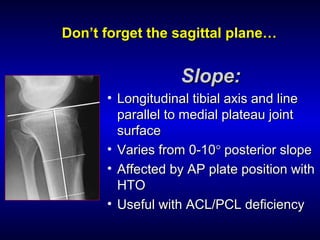
DonDon’t forget the sagittal plane…’t forget the sagittal plane…
Slope:Slope:
• Longitudinal tibial axis and lineLongitudinal tibial axis and line
parallel to medial plateau jointparallel to medial plateau joint
surfacesurface
• Varies from 0-10Varies from 0-10°° posterior slopeposterior slope
• Affected by AP plate position withAffected by AP plate position with
HTOHTO
• Useful with ACL/PCL deficiencyUseful with ACL/PCL deficiency
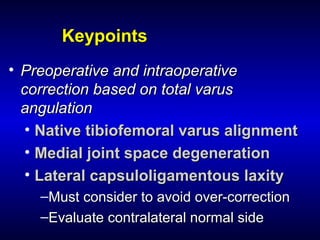
KeypointsKeypoints
• Preoperative and intraoperativePreoperative and intraoperative
correction based on total varuscorrection based on total varus
angulationangulation
• Native tibiofemoral varus alignmentNative tibiofemoral varus alignment
• Medial joint space degenerationMedial joint space degeneration
• Lateral capsuloligamentous laxityLateral capsuloligamentous laxity
–Must consider to avoid over-correctionMust consider to avoid over-correction
–Evaluate contralateral normal sideEvaluate contralateral normal side
Avoiding overcorrection…Avoiding overcorrection…
• Rosenberg (WB Bilateral in 45° flexion)Rosenberg (WB Bilateral in 45° flexion)
• MeasureMeasure ΔΔ in lateral joint separationin lateral joint separation
• Overcorrection angleOvercorrection angle
• = 76.4 x [(Δ lat joint)/total plateau width]= 76.4 x [(Δ lat joint)/total plateau width]
• Defines extent of varus due toDefines extent of varus due to
slack lateral restraintsslack lateral restraints
• per mm separation ~ 1 deg ofper mm separation ~ 1 deg of
angular deformity on WB filmangular deformity on WB film
• Subtract from correctionSubtract from correction
suggested by WB filmsuggested by WB film
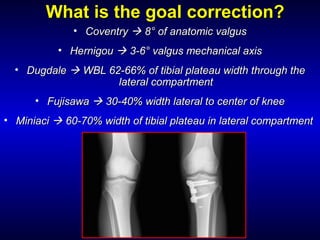
What is the goal correction?What is the goal correction?
• CoventryCoventry  88° of anatomic valgus° of anatomic valgus
• HernigouHernigou  3-6° valgus mechanical axis3-6° valgus mechanical axis
• DugdaleDugdale  WBL 62-66% of tibial plateau width through theWBL 62-66% of tibial plateau width through the
lateral compartmentlateral compartment
• FujisawaFujisawa  30-40% width lateral to center of knee30-40% width lateral to center of knee
• MiniaciMiniaci  60-70% width of tibial plateau in lateral compartment60-70% width of tibial plateau in lateral compartment
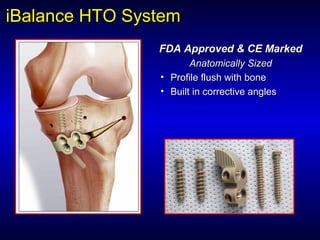
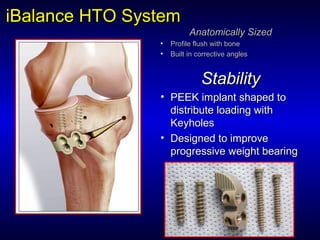
iBalanceiBalance HTO SystemHTO System
FDA Approved & CE MarkedFDA Approved & CE Marked
Anatomically SizedAnatomically Sized
• Profile flush with boneProfile flush with bone
• Built in corrective anglesBuilt in corrective angles
iBalanceiBalance HTO SystemHTO System
Anatomically SizedAnatomically Sized
• Profile flush with boneProfile flush with bone
• Built in corrective anglesBuilt in corrective angles
StabilityStability
• PEEK implant shaped toPEEK implant shaped to
distribute loading withdistribute loading with
KeyholesKeyholes
• Designed to improveDesigned to improve
progressive weight bearingprogressive weight bearing
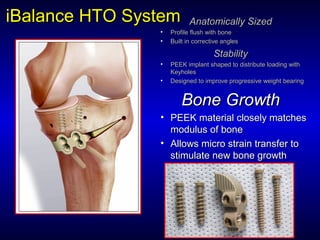
iBalanceiBalance HTO SystemHTO System Anatomically SizedAnatomically Sized
• Profile flush with boneProfile flush with bone
• Built in corrective anglesBuilt in corrective angles
StabilityStability
• PEEK implant shaped to distribute loading withPEEK implant shaped to distribute loading with
KeyholesKeyholes
• Designed to improve progressive weight bearingDesigned to improve progressive weight bearing
Bone GrowthBone Growth
• PEEK material closely matchesPEEK material closely matches
modulus of bonemodulus of bone
• Allows micro strain transfer toAllows micro strain transfer to
stimulate new bone growthstimulate new bone growth
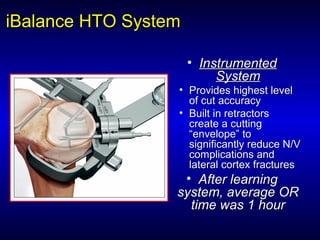
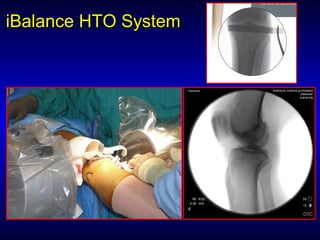
iBalanceiBalance HTO SystemHTO System
• InstrumentedInstrumented
SystemSystem
• Provides highest levelProvides highest level
of cut accuracyof cut accuracy
• Built in retractorsBuilt in retractors
create a cuttingcreate a cutting
“envelope” to“envelope” to
significantly reduce N/Vsignificantly reduce N/V
complications andcomplications and
lateral cortex fractureslateral cortex fractures
• After learningAfter learning
system, average ORsystem, average OR
time was 1 hourtime was 1 hour
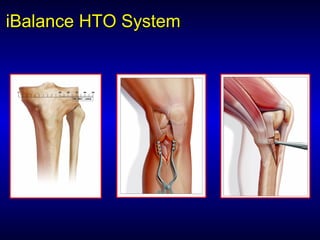
iBalanceiBalance HTO SystemHTO System
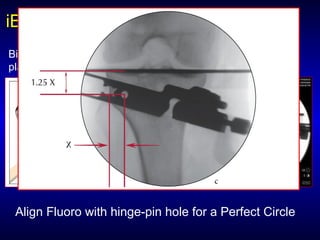
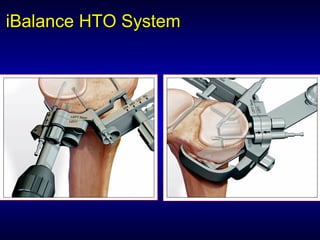
Biplanar Alignment Guide facilitates precise
placement of cutting guides
Align Fluoro with hinge-pin hole for a Perfect Circle
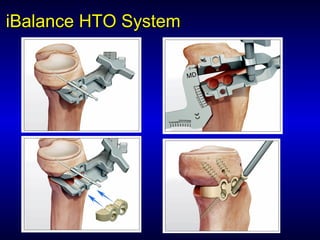
iBalanceiBalance HTO SystemHTO System
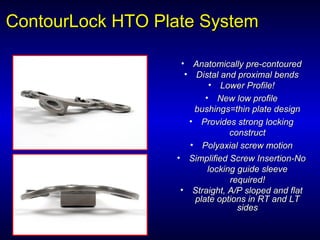
ContourLock HTO Plate SystemContourLock HTO Plate System
• Anatomically pre-contouredAnatomically pre-contoured
• Distal and proximal bendsDistal and proximal bends
• Lower Profile!Lower Profile!
• New low profileNew low profile
bushings=thin plate designbushings=thin plate design
• Provides strong lockingProvides strong locking
constructconstruct
• Polyaxial screw motionPolyaxial screw motion
• Simplified Screw Insertion-NoSimplified Screw Insertion-No
locking guide sleevelocking guide sleeve
required!required!
• Straight, A/P sloped and flatStraight, A/P sloped and flat
plate options in RT and LTplate options in RT and LT
sidessides
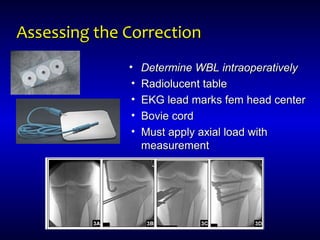
Assessing the CorrectionAssessing the Correction
• Determine WBL intraoperativelyDetermine WBL intraoperatively
• Radiolucent tableRadiolucent table
• EKG lead marks fem head centerEKG lead marks fem head center
• Bovie cordBovie cord
• Must apply axial load withMust apply axial load with
measurementmeasurement
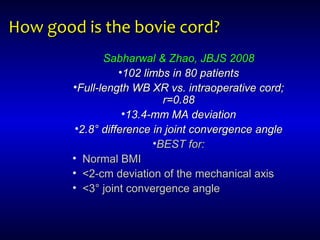
How good is the bovie cord?How good is the bovie cord?
Sabharwal & Zhao, JBJS 2008Sabharwal & Zhao, JBJS 2008
•102 limbs in 80 patients102 limbs in 80 patients
•Full-length WB XR vs. intraoperative cord;Full-length WB XR vs. intraoperative cord;
r=0.88r=0.88
•13.4-mm MA deviation13.4-mm MA deviation
•2.8° difference in joint convergence angle2.8° difference in joint convergence angle
•BEST for:BEST for:
• Normal BMINormal BMI
• <2-cm deviation of the mechanical axis<2-cm deviation of the mechanical axis
• <3° joint convergence angle<3° joint convergence angle
J.R. Rudzki, MDJ.R. Rudzki, MD
Clinical Assistant ProfessorClinical Assistant Professor
The George Washington University School of MedicineThe George Washington University School of Medicine
Arthrex Knee MeetingArthrex Knee Meeting
Los Angeles, CALos Angeles, CA
May 12, 2012May 12, 2012
Medial Opening WedgeMedial Opening Wedge
High Tibial OsteotomyHigh Tibial Osteotomy
Thank You
Other OptionsOther Options
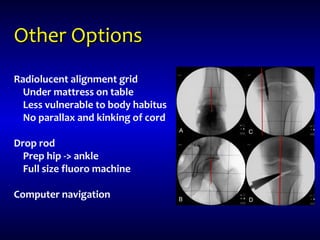
Radiolucent alignment grid
Under mattress on table
Less vulnerable to body habitus
No parallax and kinking of cord
Drop rod
Prep hip -> ankle
Full size fluoro machine
Computer navigation
Techniques (Miniaci)Techniques (Miniaci)
WBL
“Hinge” point at osteotomy site
Define arc of correction to center of
tibiotalar joint
Defines correction angle for opening
or closing wedge procedure
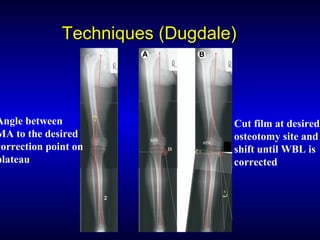
Techniques (Dugdale)Techniques (Dugdale)
Angle between
MA to the desired
correction point on
plateau
Cut film at desired
osteotomy site and
shift until WBL is
corrected
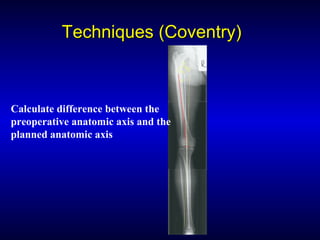
Techniques (Coventry)Techniques (Coventry)
Calculate difference between the
preoperative anatomic axis and the
planned anatomic axis
The common theme…The common theme…
• How do I translateHow do I translate
correction angle tocorrection angle to
useful intraoperativeuseful intraoperative
measures?measures?
• Wedge SizeWedge Size
• Varies with level ofVaries with level of
ConclusionsConclusions
•Preoperative planning is thePreoperative planning is the
MOST IMPORTANTMOST IMPORTANT
•Wedge geometry for HTO isWedge geometry for HTO is
complex –complex –
must adjust for bothmust adjust for both
How good is the bovieHow good is the bovie
cord?cord?
• Sabharwal & Zhao,Sabharwal & Zhao,
JBJS 2008JBJS 2008
• 102 limbs in 80102 limbs in 80
patientspatients
• Full-length WB XRFull-length WB XR
vs. intraoperativevs. intraoperative
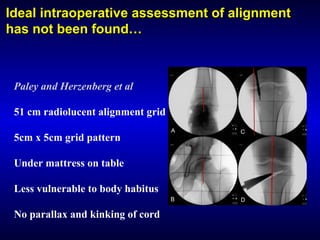
Ideal intraoperative assessment of alignmentIdeal intraoperative assessment of alignment
has not been found…has not been found…
Paley and Herzenberg et al
51 cm radiolucent alignment grid
5cm x 5cm grid pattern
Under mattress on table
Less vulnerable to body habitus
No parallax and kinking of cord
WhatWhat’s the point?’s the point?
• Preoperative planning is the MOST IMPORTANTPreoperative planning is the MOST IMPORTANT
• Wedge geometry for OW or CW is complex – mustWedge geometry for OW or CW is complex – must
adjust for coronal and sagittal plane!adjust for coronal and sagittal plane!
• Intraoperative tools are limited…Intraoperative tools are limited…
• Bovie cord OK for thin people with moderateBovie cord OK for thin people with moderate
correction as a confirmatory toolcorrection as a confirmatory tool
• Intraoperative grids or computer navigation may proveIntraoperative grids or computer navigation may prove
to be much better tools...to be much better tools...
Clinical Results/OutcomesClinical Results/Outcomes
PL Instability and/or Hyperextension ThrustPL Instability and/or Hyperextension Thrust
• Naudie, CORR 2004Naudie, CORR 2004
• 17 AMOWO in 16 pts w/ instability (Isolated PCL 4, PCL/PL 7,17 AMOWO in 16 pts w/ instability (Isolated PCL 4, PCL/PL 7,
ligamentous laxity 5)ligamentous laxity 5)
• 15/16 satisfied, all reported improvement in stability15/16 satisfied, all reported improvement in stability
• Post-op average coronal alignment: 6 degrees valgusPost-op average coronal alignment: 6 degrees valgus
• Mean increase in posterior slope: 8 degreesMean increase in posterior slope: 8 degrees
• However, 5 pts had subsequent PCL reconstruction surgery to gainHowever, 5 pts had subsequent PCL reconstruction surgery to gain
additional stabilityadditional stability
Clinical Results/OutcomesClinical Results/Outcomes
PL Instability and/or Hyperextension ThrustPL Instability and/or Hyperextension Thrust
• MacGillivray and Warren, Operative Techniques in Orthopedics,MacGillivray and Warren, Operative Techniques in Orthopedics,
19991999
• Valgus-producing HTO alone can provide sufficient relief ofValgus-producing HTO alone can provide sufficient relief of
chronic posterolateral instability symptomschronic posterolateral instability symptoms
• Not necessarily role for ligamentous reconstuction in all casesNot necessarily role for ligamentous reconstuction in all cases
• May be staged, with assessment of results of osteotomy guidingMay be staged, with assessment of results of osteotomy guiding
treatment plantreatment plan
Clinical Results/OutcomesClinical Results/Outcomes
ACL Deficient + VarusACL Deficient + Varus
• Dejour, CORR 2004Dejour, CORR 2004
• 50 patients w/ chronic ACL deficiency + acquired varus alignment50 patients w/ chronic ACL deficiency + acquired varus alignment
• Osteotomy (74% lateral closing wedge) + ACL reconstruction (BTB auto)Osteotomy (74% lateral closing wedge) + ACL reconstruction (BTB auto)
• All pts w/ slope >10All pts w/ slope >10°° had biplanar closing wedge (to decrease slope)had biplanar closing wedge (to decrease slope)
• Mean f/u 3.6 yrsMean f/u 3.6 yrs
• PT satisfaction 91%PT satisfaction 91%
• Contact/pivot sports 37% (pre-op)Contact/pivot sports 37% (pre-op) →→ 14% (post-op); Leisure sports 45%14% (post-op); Leisure sports 45%
(pre-op)(pre-op) →→ 60% (post-op)60% (post-op)
• No OA progressionNo OA progression
Clinical Results/OutcomesClinical Results/Outcomes
ACL Deficient, PL Instable + VarusACL Deficient, PL Instable + Varus
• Noyes, AJSM 2000Noyes, AJSM 2000
• 41 patients w/ ACL deficiency (15 pts, 19 prior ACL recon failures) , varying41 patients w/ ACL deficiency (15 pts, 19 prior ACL recon failures) , varying
degrees of PL deficiency + varus alignmentdegrees of PL deficiency + varus alignment
• Mean age 32 y/o (range, 16-47 y/o)Mean age 32 y/o (range, 16-47 y/o)
• 73% no medial meniscus, 65% marked OA73% no medial meniscus, 65% marked OA
• Lateral closing wedge osteotomy/fibular osteotomy + (staged, 8 mo) ACLLateral closing wedge osteotomy/fibular osteotomy + (staged, 8 mo) ACL
reconstruction (83%) +/- PL reconstruction (58%)reconstruction (83%) +/- PL reconstruction (58%)
• Heterogenous group in presentation/surgeryHeterogenous group in presentation/surgery
• Significant improvements in 2 yr f/u pain, swelling, giving waySignificant improvements in 2 yr f/u pain, swelling, giving way
• Cinncinati Knee Score (63Cinncinati Knee Score (63 →→ 82)82)
• Key to success: preservation of joint to allow for anatomic (PL)Key to success: preservation of joint to allow for anatomic (PL)
ligament/insertion lengths and prevent proximal fibular (head) migrationligament/insertion lengths and prevent proximal fibular (head) migration
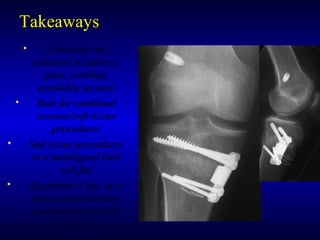
TakeawaysTakeaways
• Osteotomy hasOsteotomy has
potential to addresspotential to address
pain, swelling,pain, swelling,
instability at onceinstability at once
• Role for combinedRole for combined
osseous/soft tissueosseous/soft tissue
proceduresprocedures
• Soft tissue proceduresSoft tissue procedures
in a malaligned limbin a malaligned limb
will failwill fail
• Alignment is key, as isAlignment is key, as is
preop understandingpreop understanding
and plan for desiredand plan for desired
changeschanges
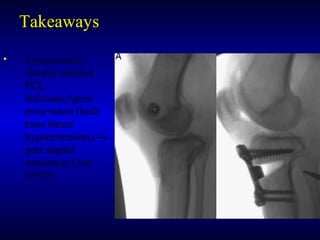
TakeawaysTakeaways
• SymptomaticSymptomatic
chronic isolatedchronic isolated
PCLPCL
deficiency/genudeficiency/genu
recurvatum (backrecurvatum (back
knee thrust/knee thrust/
hyperextension)hyperextension) →→
pure sagitalpure sagital
osteotomy (Antosteotomy (Ant
OWO)OWO)
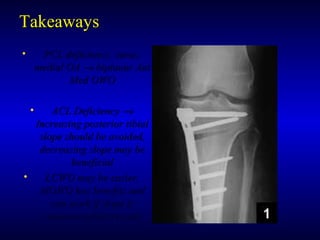
TakeawaysTakeaways
• PCL deficiency, varus,PCL deficiency, varus,
medial OAmedial OA →→ biplanar Antbiplanar Ant
Med OWOMed OWO
• ACL DeficiencyACL Deficiency →→
Increasing posterior tibialIncreasing posterior tibial
slope should be avoided,slope should be avoided,
decreasing slope may bedecreasing slope may be
beneficialbeneficial
• LCWO may be easier,LCWO may be easier,
MOWO has benefits andMOWO has benefits and
can work if slope iscan work if slope is
maintained/decreasedmaintained/decreased
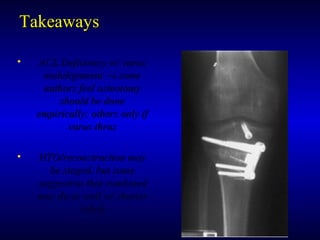
TakeawaysTakeaways
• ACL Deficiency w/ varusACL Deficiency w/ varus
malalignmentmalalignment →→ somesome
authors feel osteotomyauthors feel osteotomy
should be doneshould be done
empirically; others only ifempirically; others only if
varus thrusvarus thrus
• HTO/reconstruction mayHTO/reconstruction may
be staged, but somebe staged, but some
suggestion that combinedsuggestion that combined
may do as well w/ shortermay do as well w/ shorter
rehabrehab
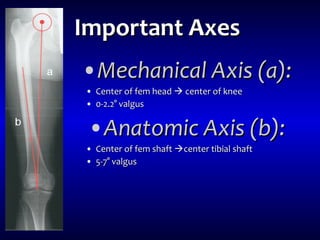
•Mechanical Axis (a):Mechanical Axis (a):
• Center of fem headCenter of fem head  center of kneecenter of knee
• 0-2.20-2.2° valgus° valgus
•Anatomic Axis (b):Anatomic Axis (b):
• Center of fem shaftCenter of fem shaft center tibial shaftcenter tibial shaft
• 5-75-7° valgus° valgus
Important AxesImportant Axes
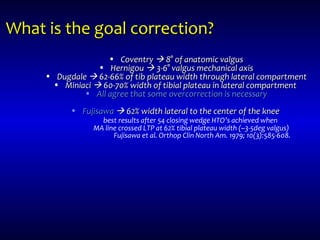
What is the goal correction?What is the goal correction?
• CoventryCoventry  88° of anatomic valgus° of anatomic valgus
• HernigouHernigou  3-6° valgus mechanical axis3-6° valgus mechanical axis
• DugdaleDugdale  62-66% of tib plateau width through lateral compartment62-66% of tib plateau width through lateral compartment
• MiniaciMiniaci  60-70% width of tibial plateau in lateral compartment60-70% width of tibial plateau in lateral compartment
• All agree that some overcorrection is necessaryAll agree that some overcorrection is necessary
• FujisawaFujisawa  62% width lateral to the center of the knee62% width lateral to the center of the knee
best results after 54 closing wedge HTO’s achieved when
MA line crossed LTP at 62% tibial plateau width (~3-5deg valgus)
Fujisawa et al. Orthop Clin North Am. 1979; 10(3):585-608.
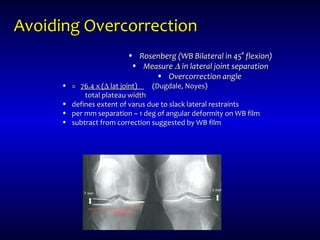
Avoiding OvercorrectionAvoiding Overcorrection
• Rosenberg (WB Bilateral in 45Rosenberg (WB Bilateral in 45° flexion)° flexion)
• MeasureMeasure ∆∆ in lateral joint separationin lateral joint separation
• Overcorrection angleOvercorrection angle
• == 76.4 x (76.4 x (∆∆ lat joint)lat joint) (Dugdale, Noyes)(Dugdale, Noyes)
total plateau widthtotal plateau width
• defines extent of varus due to slack lateral restraintsdefines extent of varus due to slack lateral restraints
• per mm separation ~ 1 deg of angular deformity on WB filmper mm separation ~ 1 deg of angular deformity on WB film
• subtract from correction suggested by WB filmsubtract from correction suggested by WB film
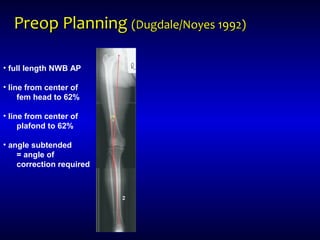
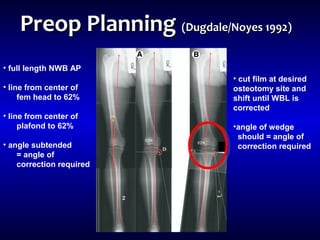
Preop PlanningPreop Planning (Dugdale/Noyes 1992)(Dugdale/Noyes 1992)
• full length NWB AP
• line from center of
fem head to 62%
• line from center of
plafond to 62%
• angle subtended
= angle of
correction required
• full length NWB AP
• line from center of
fem head to 62%
• line from center of
plafond to 62%
• angle subtended
= angle of
correction required
• cut film at desired
osteotomy site and
shift until WBL is
corrected
•angle of wedge
should = angle of
correction required
Preop PlanningPreop Planning (Dugdale/Noyes 1992)(Dugdale/Noyes 1992)
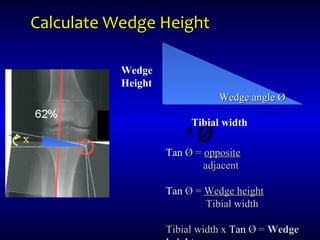
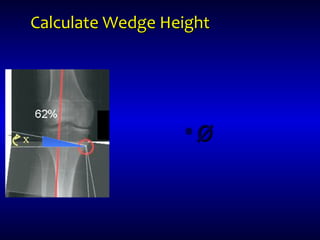
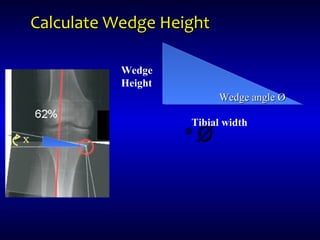
Calculate Wedge HeightCalculate Wedge Height
•ØØ
Calculate Wedge HeightCalculate Wedge Height
•ØØ
Tibial width
Wedge
Height
Wedge angle ØWedge angle Ø
Calculate Wedge HeightCalculate Wedge Height
•ØØ
Wedge angle ØWedge angle Ø
Tibial width
Wedge
Height
Tan Ø =Ø = oppositeopposite
adjacentadjacent
Tan Ø =Ø = Wedge heightWedge height
Tibial widthTibial width
Tibial width xTibial width x Tan Ø =Ø = WedgeWedge
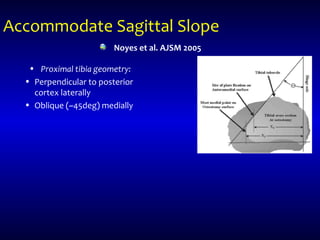
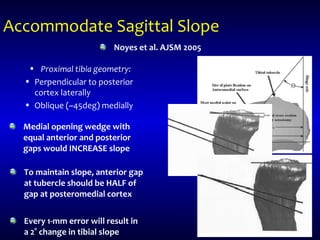
Accommodate Sagittal Slope
• Proximal tibia geometry:
• Perpendicular to posterior
cortex laterally
• Oblique (~45deg) medially
Noyes et al. AJSM 2005
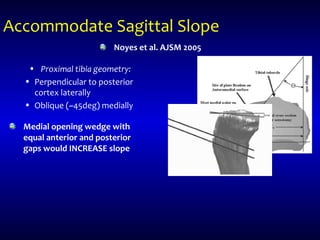
Accommodate Sagittal Slope
• Proximal tibia geometry:
• Perpendicular to posterior
cortex laterally
• Oblique (~45deg) medially
Noyes et al. AJSM 2005
Medial opening wedge with
equal anterior and posterior
gaps would INCREASE slope
Accommodate Sagittal Slope
• Proximal tibia geometry:
• Perpendicular to posterior
cortex laterally
• Oblique (~45deg) medially
Noyes et al. AJSM 2005
Medial opening wedge with
equal anterior and posterior
gaps would INCREASE slope
To maintain slope, anterior gap
at tubercle should be HALF of
gap at posteromedial cortex
Every 1-mm error will result in
a 2° change in tibial slope
Summary - Preop PlanningSummary - Preop Planning
•Determine desired
correction angle,
subtracting for soft-
tissue component
•Calculate anticipated
wedge size
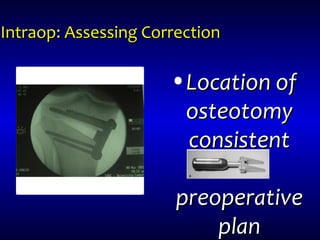
Intraop: Assessing CorrectionIntraop: Assessing Correction
•Location ofLocation of
osteotomyosteotomy
consistentconsistent
withwith
preoperativepreoperative
planplan
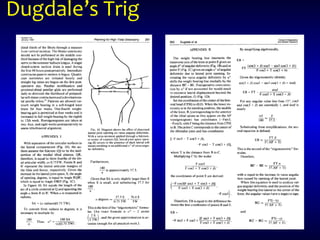
Dugdale’s Trig
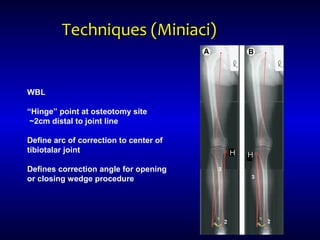
Techniques (Miniaci)Techniques (Miniaci)
WBL
“Hinge” point at osteotomy site
~2cm distal to joint line
Define arc of correction to center of
tibiotalar joint
Defines correction angle for opening
or closing wedge procedure
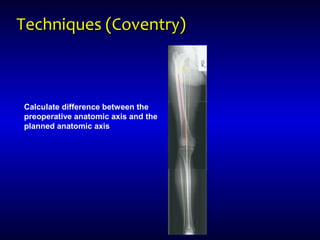
Techniques (Coventry)Techniques (Coventry)
Calculate difference between the
preoperative anatomic axis and the
planned anatomic axis
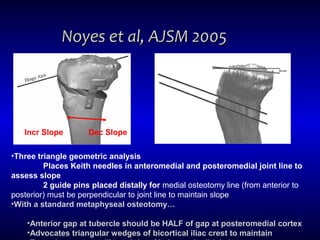
Noyes et al, AJSM 2005Noyes et al, AJSM 2005
•Three triangle geometric analysis
Places Keith needles in anteromedial and posteromedial joint line to
assess slope
2 guide pins placed distally for medial osteotomy line (from anterior to
posterior) must be perpendicular to joint line to maintain slope
•With a standard metaphyseal osteotomy…
•Anterior gap at tubercle should be HALF of gap at posteromedial cortex
•Advocates triangular wedges of bicortical iliac crest to maintain
Incr Slope Dec Slope
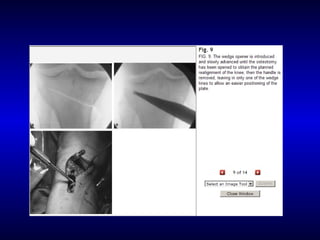
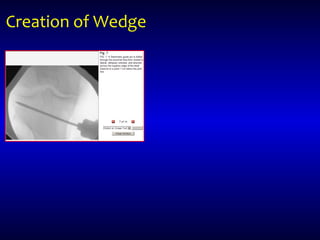
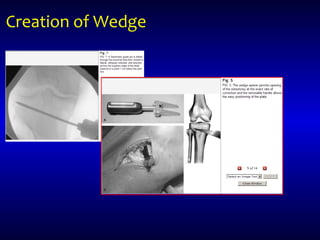
Creation of Wedge
Creation of Wedge
Creation of Wedge

Medial Opening Wedge High Tibial Osteotomy

  • 1.
    J.R. Rudzki, MDJ.R.Rudzki, MD Clinical Assistant ProfessorClinical Assistant Professor The George Washington University School of MedicineThe George Washington University School of Medicine Arthrex Knee MeetingArthrex Knee Meeting Los Angeles, CALos Angeles, CA May 12, 2012May 12, 2012 Medial Opening WedgeMedial Opening Wedge High Tibial OsteotomyHigh Tibial Osteotomy
  • 2.
    DisclosureDisclosure Previous direct &indirect funding & support forPrevious direct & indirect funding & support for research & education from:research & education from: • Philips Medical ImagingPhilips Medical Imaging • Bristol-Myers-SquibBristol-Myers-Squib • Smith & NephewSmith & Nephew • NIH (CT Chen)NIH (CT Chen) • HSS Institute for Sports Medicine ResearchHSS Institute for Sports Medicine Research • Major League BaseballMajor League Baseball Arthrex – ConsultantArthrex – Consultant AJSM, JBJS, CORR – ReviewerAJSM, JBJS, CORR – Reviewer AAOS – Evaluation Committee, BOCAAOS – Evaluation Committee, BOC Accelerated Rehab Technologies – BoardAccelerated Rehab Technologies – Board
  • 3.
    INDICATIONSINDICATIONS • Varus alignmentwithVarus alignment with medial compartmentmedial compartment arthrosisarthrosis • Knee instabilityKnee instability • Medial compartmentMedial compartment overload followingoverload following meniscectomymeniscectomy • Osteochondral defectsOsteochondral defects requiring resurfacingrequiring resurfacing proceduresprocedures
  • 4.
    Sagital Plane StabilitySagitalPlane Stability Primary Anteroposterior StabilizersPrimary Anteroposterior Stabilizers  ACLACL • DeficiencyDeficiency →→ posteromedialposteromedial tibial-sided wear (“tibial-sided wear (“cupulacupula””)) • DeficiencyDeficiency →→ ↑↑ risk of medialrisk of medial meniscal tear, need formeniscal tear, need for meniscectomy, worsening varusmeniscectomy, worsening varus (viscious cycle)(viscious cycle) • IntactIntact →→ more typicalmore typical anteromedial wear patternanteromedial wear pattern  PCLPCL • DeficiencyDeficiency →→ patellofemoral,patellofemoral, medial sided wearmedial sided wear
  • 5.
    ROLE OF SLOPEROLEOF SLOPE RADIOGRAPHIC DATARADIOGRAPHIC DATA  Bonnin, 1990Bonnin, 1990 • Every 10Every 10°° increase in posterior tibial slopeincrease in posterior tibial slope →→ 6mm increase in6mm increase in anterior tibial translation (ATT)anterior tibial translation (ATT)  DeJour, 2000DeJour, 2000 • Direct linear relationship between slope and ATTDirect linear relationship between slope and ATT • Hypothesis: Reduce posterior slopeHypothesis: Reduce posterior slope →→ reduce AP instability,reduce AP instability, improve symptomsimprove symptoms  Hohmann, 2006; Cullu 2005Hohmann, 2006; Cullu 2005 • Lateral closing wedge, Dome HTOLateral closing wedge, Dome HTO →→ ↓↓ posterior tibial slopeposterior tibial slope  Marti , 2004; Sterett, 2009Marti , 2004; Sterett, 2009 • Medial opening HTO inadvertentlyMedial opening HTO inadvertently →→ ↑↑ posterior tibial slopeposterior tibial slope • But no relation to outcomes/Lysholm scores (Sterett)But no relation to outcomes/Lysholm scores (Sterett)
  • 6.
    • Sectioning thePCL caused posterior sagSectioning the PCL caused posterior sag • AOWOAOWO →→ increase in tibial slopeincrease in tibial slope →→ significantlysignificantly reduced sag/translation throughout ROMreduced sag/translation throughout ROM • Hypothesis: AOWO may improve articularHypothesis: AOWO may improve articular contact forces in PCL deficient kneescontact forces in PCL deficient knees Effect of OsteotomyEffect of Osteotomy increasing slope causes an anterior shift in tibial resting position accentuated under axial loads Role of Slope
  • 7.
    Effect of OsteotomyEffectof Osteotomy 7 fresh human cadaver knees7 fresh human cadaver knees AOWO +/- ACL/PCL sectioningAOWO +/- ACL/PCL sectioning •Cartilage pressures, kinematicsCartilage pressures, kinematics •AOWOAOWO →→ ↑↑ATT, decompression of posterior half ofATT, decompression of posterior half of plateauplateau •Hypothesis: 3D valgus/flexion osteotomy beneficial toHypothesis: 3D valgus/flexion osteotomy beneficial to knees s/p post horn meniscectomy, PCL/PL unstableknees s/p post horn meniscectomy, PCL/PL unstable knee w/ PM joint wear, varus thrustknee w/ PM joint wear, varus thrust Role of Slope
  • 8.
    Effect of OsteotomyEffectof Osteotomy 9 fresh human cadaver knees9 fresh human cadaver knees AMOWO vs. PMOWO +/- ACL sectioningAMOWO vs. PMOWO +/- ACL sectioning •Increasing tibial slope in ACL deficient kneesIncreasing tibial slope in ACL deficient knees redistributes pressures posteriorlyredistributes pressures posteriorly •Recommendation: posterior plate placement forRecommendation: posterior plate placement for ACL deficient kneesACL deficient knees
  • 9.
    Effect of OsteotomyEffectof Osteotomy • Noyes et al. AJSM 2005Noyes et al. AJSM 2005 • 3 dimensional geometric analysis3 dimensional geometric analysis • Gap angle at tubercle should be halfGap angle at tubercle should be half posterior cortex to maintain slopeposterior cortex to maintain slope • Error of 1mm created 2 degree changeError of 1mm created 2 degree change
  • 10.
    • Intraoperative AssessmentIntraoperativeAssessment used to confirmused to confirm PreoperativePreoperative PlanningPlanning • Preoperative planningPreoperative planning  guideguide intraoperative wedge thicknessintraoperative wedge thickness • Intraoperative confirmationIntraoperative confirmation based on reliable assessmentbased on reliable assessment of:of: • Anatomic AxisAnatomic Axis • Mechanical AxisMechanical Axis • Weight-bearing LineWeight-bearing Line Osteotomy Planning & AssessmentOsteotomy Planning & Assessment
  • 11.
    Important AxesImportant Axes •Mech Axis (a):Mech Axis (a): • center of kneecenter of knee  center of hipcenter of hip • 0-2.20-2.2° valgus° valgus • Anat Axis (b):Anat Axis (b): • center of fem shaftcenter of fem shaft center of tibial shaftcenter of tibial shaft • 5-75-7° valgus° valgus • WBL:WBL: • center of hipcenter of hip  center of anklecenter of ankle • Congruent with MA if passes through center of theCongruent with MA if passes through center of the kneeknee • Physiologic is slightly medial to center of kneePhysiologic is slightly medial to center of knee • 62.5% of the tibial plateau width62.5% of the tibial plateau width
  • 13.
    DonDon’t forget thesagittal plane…’t forget the sagittal plane… Slope:Slope: • Longitudinal tibial axis and lineLongitudinal tibial axis and line parallel to medial plateau jointparallel to medial plateau joint surfacesurface • Varies from 0-10Varies from 0-10°° posterior slopeposterior slope • Affected by AP plate position withAffected by AP plate position with HTOHTO • Useful with ACL/PCL deficiencyUseful with ACL/PCL deficiency
  • 14.
    KeypointsKeypoints • Preoperative andintraoperativePreoperative and intraoperative correction based on total varuscorrection based on total varus angulationangulation • Native tibiofemoral varus alignmentNative tibiofemoral varus alignment • Medial joint space degenerationMedial joint space degeneration • Lateral capsuloligamentous laxityLateral capsuloligamentous laxity –Must consider to avoid over-correctionMust consider to avoid over-correction –Evaluate contralateral normal sideEvaluate contralateral normal side
  • 15.
    Avoiding overcorrection…Avoiding overcorrection… •Rosenberg (WB Bilateral in 45° flexion)Rosenberg (WB Bilateral in 45° flexion) • MeasureMeasure ΔΔ in lateral joint separationin lateral joint separation • Overcorrection angleOvercorrection angle • = 76.4 x [(Δ lat joint)/total plateau width]= 76.4 x [(Δ lat joint)/total plateau width] • Defines extent of varus due toDefines extent of varus due to slack lateral restraintsslack lateral restraints • per mm separation ~ 1 deg ofper mm separation ~ 1 deg of angular deformity on WB filmangular deformity on WB film • Subtract from correctionSubtract from correction suggested by WB filmsuggested by WB film
  • 16.
    What is thegoal correction?What is the goal correction? • CoventryCoventry  88° of anatomic valgus° of anatomic valgus • HernigouHernigou  3-6° valgus mechanical axis3-6° valgus mechanical axis • DugdaleDugdale  WBL 62-66% of tibial plateau width through theWBL 62-66% of tibial plateau width through the lateral compartmentlateral compartment • FujisawaFujisawa  30-40% width lateral to center of knee30-40% width lateral to center of knee • MiniaciMiniaci  60-70% width of tibial plateau in lateral compartment60-70% width of tibial plateau in lateral compartment
  • 17.
    iBalanceiBalance HTO SystemHTOSystem FDA Approved & CE MarkedFDA Approved & CE Marked Anatomically SizedAnatomically Sized • Profile flush with boneProfile flush with bone • Built in corrective anglesBuilt in corrective angles
  • 18.
    iBalanceiBalance HTO SystemHTOSystem Anatomically SizedAnatomically Sized • Profile flush with boneProfile flush with bone • Built in corrective anglesBuilt in corrective angles StabilityStability • PEEK implant shaped toPEEK implant shaped to distribute loading withdistribute loading with KeyholesKeyholes • Designed to improveDesigned to improve progressive weight bearingprogressive weight bearing
  • 19.
    iBalanceiBalance HTO SystemHTOSystem Anatomically SizedAnatomically Sized • Profile flush with boneProfile flush with bone • Built in corrective anglesBuilt in corrective angles StabilityStability • PEEK implant shaped to distribute loading withPEEK implant shaped to distribute loading with KeyholesKeyholes • Designed to improve progressive weight bearingDesigned to improve progressive weight bearing Bone GrowthBone Growth • PEEK material closely matchesPEEK material closely matches modulus of bonemodulus of bone • Allows micro strain transfer toAllows micro strain transfer to stimulate new bone growthstimulate new bone growth
  • 20.
    iBalanceiBalance HTO SystemHTOSystem • InstrumentedInstrumented SystemSystem • Provides highest levelProvides highest level of cut accuracyof cut accuracy • Built in retractorsBuilt in retractors create a cuttingcreate a cutting “envelope” to“envelope” to significantly reduce N/Vsignificantly reduce N/V complications andcomplications and lateral cortex fractureslateral cortex fractures • After learningAfter learning system, average ORsystem, average OR time was 1 hourtime was 1 hour
  • 21.
  • 22.
  • 23.
    iBalanceiBalance HTO SystemHTOSystem Biplanar Alignment Guide facilitates precise placement of cutting guides Align Fluoro with hinge-pin hole for a Perfect Circle
  • 24.
  • 25.
  • 26.
    ContourLock HTO PlateSystemContourLock HTO Plate System • Anatomically pre-contouredAnatomically pre-contoured • Distal and proximal bendsDistal and proximal bends • Lower Profile!Lower Profile! • New low profileNew low profile bushings=thin plate designbushings=thin plate design • Provides strong lockingProvides strong locking constructconstruct • Polyaxial screw motionPolyaxial screw motion • Simplified Screw Insertion-NoSimplified Screw Insertion-No locking guide sleevelocking guide sleeve required!required! • Straight, A/P sloped and flatStraight, A/P sloped and flat plate options in RT and LTplate options in RT and LT sidessides
  • 27.
    Assessing the CorrectionAssessingthe Correction • Determine WBL intraoperativelyDetermine WBL intraoperatively • Radiolucent tableRadiolucent table • EKG lead marks fem head centerEKG lead marks fem head center • Bovie cordBovie cord • Must apply axial load withMust apply axial load with measurementmeasurement
  • 28.
    How good isthe bovie cord?How good is the bovie cord? Sabharwal & Zhao, JBJS 2008Sabharwal & Zhao, JBJS 2008 •102 limbs in 80 patients102 limbs in 80 patients •Full-length WB XR vs. intraoperative cord;Full-length WB XR vs. intraoperative cord; r=0.88r=0.88 •13.4-mm MA deviation13.4-mm MA deviation •2.8° difference in joint convergence angle2.8° difference in joint convergence angle •BEST for:BEST for: • Normal BMINormal BMI • <2-cm deviation of the mechanical axis<2-cm deviation of the mechanical axis • <3° joint convergence angle<3° joint convergence angle
  • 29.
    J.R. Rudzki, MDJ.R.Rudzki, MD Clinical Assistant ProfessorClinical Assistant Professor The George Washington University School of MedicineThe George Washington University School of Medicine Arthrex Knee MeetingArthrex Knee Meeting Los Angeles, CALos Angeles, CA May 12, 2012May 12, 2012 Medial Opening WedgeMedial Opening Wedge High Tibial OsteotomyHigh Tibial Osteotomy Thank You
  • 30.
    Other OptionsOther Options Radiolucentalignment grid Under mattress on table Less vulnerable to body habitus No parallax and kinking of cord Drop rod Prep hip -> ankle Full size fluoro machine Computer navigation
  • 31.
    Techniques (Miniaci)Techniques (Miniaci) WBL “Hinge”point at osteotomy site Define arc of correction to center of tibiotalar joint Defines correction angle for opening or closing wedge procedure
  • 32.
    Techniques (Dugdale)Techniques (Dugdale) Anglebetween MA to the desired correction point on plateau Cut film at desired osteotomy site and shift until WBL is corrected
  • 33.
    Techniques (Coventry)Techniques (Coventry) Calculatedifference between the preoperative anatomic axis and the planned anatomic axis
  • 34.
    The common theme…Thecommon theme… • How do I translateHow do I translate correction angle tocorrection angle to useful intraoperativeuseful intraoperative measures?measures? • Wedge SizeWedge Size • Varies with level ofVaries with level of
  • 35.
    ConclusionsConclusions •Preoperative planning isthePreoperative planning is the MOST IMPORTANTMOST IMPORTANT •Wedge geometry for HTO isWedge geometry for HTO is complex –complex – must adjust for bothmust adjust for both
  • 36.
    How good isthe bovieHow good is the bovie cord?cord? • Sabharwal & Zhao,Sabharwal & Zhao, JBJS 2008JBJS 2008 • 102 limbs in 80102 limbs in 80 patientspatients • Full-length WB XRFull-length WB XR vs. intraoperativevs. intraoperative
  • 37.
    Ideal intraoperative assessmentof alignmentIdeal intraoperative assessment of alignment has not been found…has not been found… Paley and Herzenberg et al 51 cm radiolucent alignment grid 5cm x 5cm grid pattern Under mattress on table Less vulnerable to body habitus No parallax and kinking of cord
  • 39.
    WhatWhat’s the point?’sthe point? • Preoperative planning is the MOST IMPORTANTPreoperative planning is the MOST IMPORTANT • Wedge geometry for OW or CW is complex – mustWedge geometry for OW or CW is complex – must adjust for coronal and sagittal plane!adjust for coronal and sagittal plane! • Intraoperative tools are limited…Intraoperative tools are limited… • Bovie cord OK for thin people with moderateBovie cord OK for thin people with moderate correction as a confirmatory toolcorrection as a confirmatory tool • Intraoperative grids or computer navigation may proveIntraoperative grids or computer navigation may prove to be much better tools...to be much better tools...
  • 40.
    Clinical Results/OutcomesClinical Results/Outcomes PLInstability and/or Hyperextension ThrustPL Instability and/or Hyperextension Thrust • Naudie, CORR 2004Naudie, CORR 2004 • 17 AMOWO in 16 pts w/ instability (Isolated PCL 4, PCL/PL 7,17 AMOWO in 16 pts w/ instability (Isolated PCL 4, PCL/PL 7, ligamentous laxity 5)ligamentous laxity 5) • 15/16 satisfied, all reported improvement in stability15/16 satisfied, all reported improvement in stability • Post-op average coronal alignment: 6 degrees valgusPost-op average coronal alignment: 6 degrees valgus • Mean increase in posterior slope: 8 degreesMean increase in posterior slope: 8 degrees • However, 5 pts had subsequent PCL reconstruction surgery to gainHowever, 5 pts had subsequent PCL reconstruction surgery to gain additional stabilityadditional stability
  • 41.
    Clinical Results/OutcomesClinical Results/Outcomes PLInstability and/or Hyperextension ThrustPL Instability and/or Hyperextension Thrust • MacGillivray and Warren, Operative Techniques in Orthopedics,MacGillivray and Warren, Operative Techniques in Orthopedics, 19991999 • Valgus-producing HTO alone can provide sufficient relief ofValgus-producing HTO alone can provide sufficient relief of chronic posterolateral instability symptomschronic posterolateral instability symptoms • Not necessarily role for ligamentous reconstuction in all casesNot necessarily role for ligamentous reconstuction in all cases • May be staged, with assessment of results of osteotomy guidingMay be staged, with assessment of results of osteotomy guiding treatment plantreatment plan
  • 42.
    Clinical Results/OutcomesClinical Results/Outcomes ACLDeficient + VarusACL Deficient + Varus • Dejour, CORR 2004Dejour, CORR 2004 • 50 patients w/ chronic ACL deficiency + acquired varus alignment50 patients w/ chronic ACL deficiency + acquired varus alignment • Osteotomy (74% lateral closing wedge) + ACL reconstruction (BTB auto)Osteotomy (74% lateral closing wedge) + ACL reconstruction (BTB auto) • All pts w/ slope >10All pts w/ slope >10°° had biplanar closing wedge (to decrease slope)had biplanar closing wedge (to decrease slope) • Mean f/u 3.6 yrsMean f/u 3.6 yrs • PT satisfaction 91%PT satisfaction 91% • Contact/pivot sports 37% (pre-op)Contact/pivot sports 37% (pre-op) →→ 14% (post-op); Leisure sports 45%14% (post-op); Leisure sports 45% (pre-op)(pre-op) →→ 60% (post-op)60% (post-op) • No OA progressionNo OA progression
  • 43.
    Clinical Results/OutcomesClinical Results/Outcomes ACLDeficient, PL Instable + VarusACL Deficient, PL Instable + Varus • Noyes, AJSM 2000Noyes, AJSM 2000 • 41 patients w/ ACL deficiency (15 pts, 19 prior ACL recon failures) , varying41 patients w/ ACL deficiency (15 pts, 19 prior ACL recon failures) , varying degrees of PL deficiency + varus alignmentdegrees of PL deficiency + varus alignment • Mean age 32 y/o (range, 16-47 y/o)Mean age 32 y/o (range, 16-47 y/o) • 73% no medial meniscus, 65% marked OA73% no medial meniscus, 65% marked OA • Lateral closing wedge osteotomy/fibular osteotomy + (staged, 8 mo) ACLLateral closing wedge osteotomy/fibular osteotomy + (staged, 8 mo) ACL reconstruction (83%) +/- PL reconstruction (58%)reconstruction (83%) +/- PL reconstruction (58%) • Heterogenous group in presentation/surgeryHeterogenous group in presentation/surgery • Significant improvements in 2 yr f/u pain, swelling, giving waySignificant improvements in 2 yr f/u pain, swelling, giving way • Cinncinati Knee Score (63Cinncinati Knee Score (63 →→ 82)82) • Key to success: preservation of joint to allow for anatomic (PL)Key to success: preservation of joint to allow for anatomic (PL) ligament/insertion lengths and prevent proximal fibular (head) migrationligament/insertion lengths and prevent proximal fibular (head) migration
  • 44.
    TakeawaysTakeaways • Osteotomy hasOsteotomyhas potential to addresspotential to address pain, swelling,pain, swelling, instability at onceinstability at once • Role for combinedRole for combined osseous/soft tissueosseous/soft tissue proceduresprocedures • Soft tissue proceduresSoft tissue procedures in a malaligned limbin a malaligned limb will failwill fail • Alignment is key, as isAlignment is key, as is preop understandingpreop understanding and plan for desiredand plan for desired changeschanges
  • 45.
    TakeawaysTakeaways • SymptomaticSymptomatic chronic isolatedchronicisolated PCLPCL deficiency/genudeficiency/genu recurvatum (backrecurvatum (back knee thrust/knee thrust/ hyperextension)hyperextension) →→ pure sagitalpure sagital osteotomy (Antosteotomy (Ant OWO)OWO)
  • 46.
    TakeawaysTakeaways • PCL deficiency,varus,PCL deficiency, varus, medial OAmedial OA →→ biplanar Antbiplanar Ant Med OWOMed OWO • ACL DeficiencyACL Deficiency →→ Increasing posterior tibialIncreasing posterior tibial slope should be avoided,slope should be avoided, decreasing slope may bedecreasing slope may be beneficialbeneficial • LCWO may be easier,LCWO may be easier, MOWO has benefits andMOWO has benefits and can work if slope iscan work if slope is maintained/decreasedmaintained/decreased
  • 47.
    TakeawaysTakeaways • ACL Deficiencyw/ varusACL Deficiency w/ varus malalignmentmalalignment →→ somesome authors feel osteotomyauthors feel osteotomy should be doneshould be done empirically; others only ifempirically; others only if varus thrusvarus thrus • HTO/reconstruction mayHTO/reconstruction may be staged, but somebe staged, but some suggestion that combinedsuggestion that combined may do as well w/ shortermay do as well w/ shorter rehabrehab
  • 48.
    •Mechanical Axis (a):MechanicalAxis (a): • Center of fem headCenter of fem head  center of kneecenter of knee • 0-2.20-2.2° valgus° valgus •Anatomic Axis (b):Anatomic Axis (b): • Center of fem shaftCenter of fem shaft center tibial shaftcenter tibial shaft • 5-75-7° valgus° valgus Important AxesImportant Axes
  • 49.
    What is thegoal correction?What is the goal correction? • CoventryCoventry  88° of anatomic valgus° of anatomic valgus • HernigouHernigou  3-6° valgus mechanical axis3-6° valgus mechanical axis • DugdaleDugdale  62-66% of tib plateau width through lateral compartment62-66% of tib plateau width through lateral compartment • MiniaciMiniaci  60-70% width of tibial plateau in lateral compartment60-70% width of tibial plateau in lateral compartment • All agree that some overcorrection is necessaryAll agree that some overcorrection is necessary • FujisawaFujisawa  62% width lateral to the center of the knee62% width lateral to the center of the knee best results after 54 closing wedge HTO’s achieved when MA line crossed LTP at 62% tibial plateau width (~3-5deg valgus) Fujisawa et al. Orthop Clin North Am. 1979; 10(3):585-608.
  • 50.
    Avoiding OvercorrectionAvoiding Overcorrection •Rosenberg (WB Bilateral in 45Rosenberg (WB Bilateral in 45° flexion)° flexion) • MeasureMeasure ∆∆ in lateral joint separationin lateral joint separation • Overcorrection angleOvercorrection angle • == 76.4 x (76.4 x (∆∆ lat joint)lat joint) (Dugdale, Noyes)(Dugdale, Noyes) total plateau widthtotal plateau width • defines extent of varus due to slack lateral restraintsdefines extent of varus due to slack lateral restraints • per mm separation ~ 1 deg of angular deformity on WB filmper mm separation ~ 1 deg of angular deformity on WB film • subtract from correction suggested by WB filmsubtract from correction suggested by WB film
  • 51.
    Preop PlanningPreop Planning(Dugdale/Noyes 1992)(Dugdale/Noyes 1992) • full length NWB AP • line from center of fem head to 62% • line from center of plafond to 62% • angle subtended = angle of correction required
  • 52.
    • full lengthNWB AP • line from center of fem head to 62% • line from center of plafond to 62% • angle subtended = angle of correction required • cut film at desired osteotomy site and shift until WBL is corrected •angle of wedge should = angle of correction required Preop PlanningPreop Planning (Dugdale/Noyes 1992)(Dugdale/Noyes 1992)
  • 53.
    Calculate Wedge HeightCalculateWedge Height •ØØ
  • 54.
    Calculate Wedge HeightCalculateWedge Height •ØØ Tibial width Wedge Height Wedge angle ØWedge angle Ø
  • 55.
    Calculate Wedge HeightCalculateWedge Height •ØØ Wedge angle ØWedge angle Ø Tibial width Wedge Height Tan Ø =Ø = oppositeopposite adjacentadjacent Tan Ø =Ø = Wedge heightWedge height Tibial widthTibial width Tibial width xTibial width x Tan Ø =Ø = WedgeWedge
  • 56.
    Accommodate Sagittal Slope •Proximal tibia geometry: • Perpendicular to posterior cortex laterally • Oblique (~45deg) medially Noyes et al. AJSM 2005
  • 57.
    Accommodate Sagittal Slope •Proximal tibia geometry: • Perpendicular to posterior cortex laterally • Oblique (~45deg) medially Noyes et al. AJSM 2005 Medial opening wedge with equal anterior and posterior gaps would INCREASE slope
  • 58.
    Accommodate Sagittal Slope •Proximal tibia geometry: • Perpendicular to posterior cortex laterally • Oblique (~45deg) medially Noyes et al. AJSM 2005 Medial opening wedge with equal anterior and posterior gaps would INCREASE slope To maintain slope, anterior gap at tubercle should be HALF of gap at posteromedial cortex Every 1-mm error will result in a 2° change in tibial slope
  • 59.
    Summary - PreopPlanningSummary - Preop Planning •Determine desired correction angle, subtracting for soft- tissue component •Calculate anticipated wedge size
  • 60.
    Intraop: Assessing CorrectionIntraop:Assessing Correction •Location ofLocation of osteotomyosteotomy consistentconsistent withwith preoperativepreoperative planplan
  • 61.
  • 62.
    Techniques (Miniaci)Techniques (Miniaci) WBL “Hinge”point at osteotomy site ~2cm distal to joint line Define arc of correction to center of tibiotalar joint Defines correction angle for opening or closing wedge procedure
  • 63.
    Techniques (Coventry)Techniques (Coventry) Calculatedifference between the preoperative anatomic axis and the planned anatomic axis
  • 64.
    Noyes et al,AJSM 2005Noyes et al, AJSM 2005 •Three triangle geometric analysis Places Keith needles in anteromedial and posteromedial joint line to assess slope 2 guide pins placed distally for medial osteotomy line (from anterior to posterior) must be perpendicular to joint line to maintain slope •With a standard metaphyseal osteotomy… •Anterior gap at tubercle should be HALF of gap at posteromedial cortex •Advocates triangular wedges of bicortical iliac crest to maintain Incr Slope Dec Slope
  • 67.
  • 68.
  • 69.

Editor's Notes

  • #31 Parallax = the apparent shift of an object against a fixed background that is caused by a change in the observer&amp;apos;s position.
  • #51 defines amount of increased varus angulation resulting from separation of lateral tibiofemoral joint due to slack lateral restraints each millimeter of excessive joint space separation causes an apparent 1 deg of angular deformity on weightbearing x-ray
  • #52 SOHCAHTOA Angle between MA to the desired correction point on Plateau
  • #53 SOHCAHTOA Angle between MA to the desired correction point on Plateau
  • #68 guide pin (Steinmann) is drilled freehand through the proximal tibia from medial to lateral. This is obliquely oriented, starting approximately 4 cm distal to the joint line and directed across the superior edge of the tibial tubercle to a point 1 cm below the joint line guide pin (Steinmann) is drilled freehand through the proximal tibia from medial to lateral. This is obliquely oriented, starting approximately 4 cm distal to the joint line and directed across the superior edge of the tibial tubercle to a point 1 cm below the joint line guide pin (Steinmann) is drilled freehand through the proximal tibia from medial to lateral. This is obliquely oriented, starting approximately 4 cm distal to the joint line and directed across the superior edge of the tibial tubercle to a point 1 cm below the joint line
  • #69 guide pin (Steinmann) is drilled freehand through the proximal tibia from medial to lateral. This is obliquely oriented, starting approximately 4 cm distal to the joint line and directed across the superior edge of the tibial tubercle to a point 1 cm below the joint line guide pin (Steinmann) is drilled freehand through the proximal tibia from medial to lateral. This is obliquely oriented, starting approximately 4 cm distal to the joint line and directed across the superior edge of the tibial tubercle to a point 1 cm below the joint line guide pin (Steinmann) is drilled freehand through the proximal tibia from medial to lateral. This is obliquely oriented, starting approximately 4 cm distal to the joint line and directed across the superior edge of the tibial tubercle to a point 1 cm below the joint line
  • #70 guide pin (Steinmann) is drilled freehand through the proximal tibia from medial to lateral. This is obliquely oriented, starting approximately 4 cm distal to the joint line and directed across the superior edge of the tibial tubercle to a point 1 cm below the joint line guide pin (Steinmann) is drilled freehand through the proximal tibia from medial to lateral. This is obliquely oriented, starting approximately 4 cm distal to the joint line and directed across the superior edge of the tibial tubercle to a point 1 cm below the joint line guide pin (Steinmann) is drilled freehand through the proximal tibia from medial to lateral. This is obliquely oriented, starting approximately 4 cm distal to the joint line and directed across the superior edge of the tibial tubercle to a point 1 cm below the joint line