Meniscus Transplants Kevin R. Stone, MD Ann W. Walgenbach, RNNP  Wendy S. Adelson, MS Jonathan R. Pelsis, MHS Stone Research Foundation San Francisco
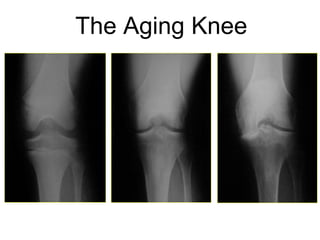
The Aging Knee Pediatric  Normal Adult  OA Adult
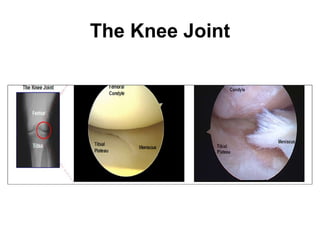
The Knee Joint
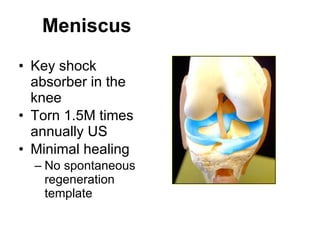
Meniscus   Key shock absorber in the knee Torn 1.5M times annually US Minimal healing No spontaneous regeneration template
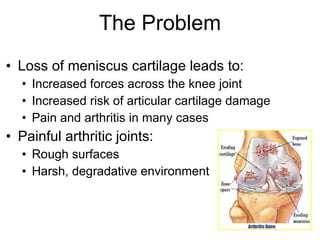
Loss of meniscus cartilage leads to: Increased forces across the knee joint Increased risk of articular cartilage damage Pain and arthritis in many cases Painful arthritic joints: Rough surfaces Harsh, degradative environment The Problem
Reduce pain and improve function Preserve the biology of the knee Restore a biomechanically favorable environment Provide a buffer to prevent  bone-on-bone contact and pain The Goal
Meniscus Transplantation:  Indications Traditional thought:   Meniscus Transplantation does not work in arthritic knees  ( Noyes & Barber-Westin 1995, Stollsteimer 2000, Rath 2001) Current thought:   Meniscus Transplantation  does  work in arthritic knees if damaged articular cartilage is treated as well  (van Arkel 2002, Noyes 2004, Verdonk 2005, Cole 2006, Stone 2006, Farr 2007, Rue 2008)
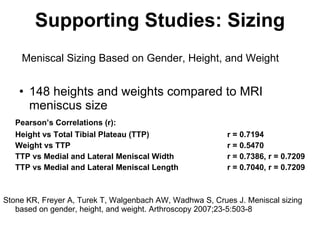
Supporting Studies: Sizing 148 heights and weights compared to MRI meniscus size Pearson’s Correlations (r):  Height vs Total Tibial Plateau (TTP) r = 0.7194 Weight vs TTP r = 0.5470  TTP vs Medial and Lateral Meniscal Width r = 0.7386, r = 0.7209 TTP vs Medial and Lateral Meniscal Length r =  0.7040, r = 0.7209 Stone KR, Freyer A, Turek T, Walgenbach AW, Wadhwa S, Crues J. Meniscal sizing based on gender, height, and weight. Arthroscopy 2007;23-5:503-8 Meniscal Sizing Based on Gender, Height, and Weight
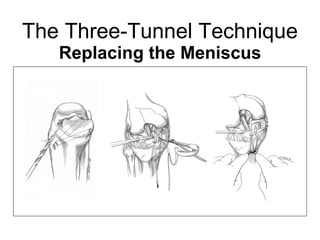
The Three-Tunnel Technique Replacing the Meniscus Stone KR, Walgenbach AW. “Meniscal Allografting: the Three-Tunnel Technique.”  Arthroscopy – The Journal of Arthroscopic and Related Surgery. 2003, 19(4):426-30.
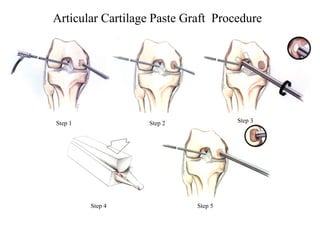
Articular Cartilage Paste Graft  Procedure Step 1 Step 5 Step 4 Step 3 Step 2
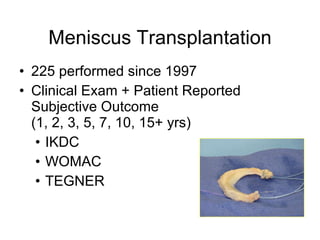
Meniscus Transplantation 225 performed since 1997 Clinical Exam + Patient Reported Subjective Outcome  (1, 2, 3, 5, 7, 10, 15+ yrs) IKDC WOMAC TEGNER
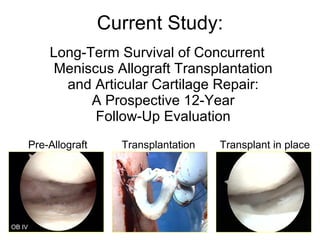
Current Study: Long-Term Survival of Concurrent  Meniscus Allograft Transplantation  and Articular Cartilage Repair:  A Prospective 12-Year  Follow-Up Evaluation  Pre-Allograft Transplant in place Transplantation OB IV
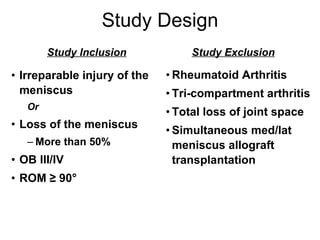
Study Design Study Inclusion Irreparable injury of the meniscus Or Loss of the meniscus More than 50% OB III/IV  ROM ≥ 90° Study Exclusion Rheumatoid Arthritis Tri-compartment arthritis Total loss of joint space Simultaneous med/lat meniscus allograft transplantation
Patient Selection Young patients with cartilage loss and pain Older patients with cartilage loss and focal pain who want to remain athletic and delay or avoid a knee arthroplasty. “Doc, isn’t there a shock absorber you can put in my knee?”
Surgical Technique Medial Meniscus Allograft Transplantation:  Performed utilizing periosteum, but not bone blocks, at the meniscus horns.  Lateral Meniscus Allograft Transplantation:  Preformed by preserving the bony block between the horns and inserting it into a bone trough.
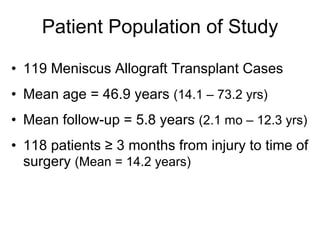
119 Meniscus Allograft Transplant Cases Mean age = 46.9 years  (14.1 – 73.2 yrs) Mean follow-up = 5.8 years  (2.1 mo – 12.3 yrs) 118 patients ≥ 3 months from injury to time of surgery  (Mean = 14.2 years) Patient Population of Study
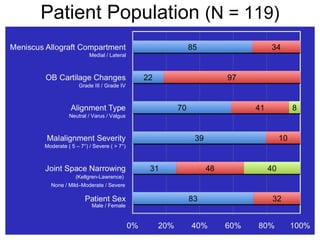
Patient Population  (N = 119) Neutral / Varus / Valgus Moderate ( 5 – 7°) / Severe ( > 7°) Grade III / Grade IV Medial / Lateral Male / Female None / Mild–Moderate / Severe (Kellgren-Lawrence)
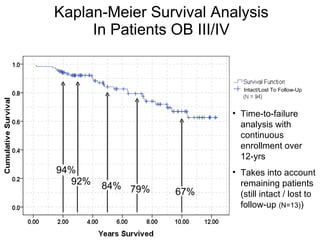
Results Procedure failure: Removal of allograft without revision  (N = 7) , or progression to knee arthroplasty  [N = 18 (TKA or UNI)].   94/119 allograft cases successful (79%) Of 25 failures, Mean time-to-failure:  4.65 ± 2.99 years Range: 2.1 months – 10.37 years Kaplan-Meier estimated mean survival time was 9.93 ± 0.40 years  [95%CI: 9.14,10.72] 13 patients were lost to follow-up
Complications 4 Early Postoperative Infections 3 Deep (1 Staphphylococcus Aures, 2 negative serologies) 1 Superficial (Staphylococcus Epidemis) All cases were treated arthroscopically with irrigation and debridement and IV antibiotics.  All cases resolved, but one deep infection case ultimately failed, with the allograft being removed 12.5 months later.
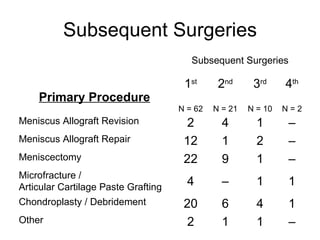
Subsequent Surgeries – 1 4 2 Meniscus Allograft Revision – 2 1 12 Meniscus Allograft Repair – 1 9 22 Meniscectomy 1 1 – 4 Microfracture / Articular Cartilage Paste Grafting 1 4 6 20 Chondroplasty / Debridement – 1 1 2 Other 4 th N = 2 3 rd N = 10 2 nd N = 21 1 st N = 62 Subsequent Surgeries Primary Procedure
Kaplan-Meier Survival Analysis In Patients OB III/IV Time-to-failure analysis with continuous enrollment over 12-yrs Takes into account remaining patients (still intact / lost to follow-up  (N=13) ) Intact/Lost To Follow-Up 94% 92% 84% 79% 67%
Cox Proportional Hazards Model What is it? A Cox model provides an estimate of a variable’s effect on survival after adjustment for other explanatory variables. In addition, it allows us to estimate the hazard (or risk) of procedure failure, given their prognostic variables.
What factors affect survival? Cox Proportional Hazards Model was used to explore the relationship between procedure failure and several covariates. Age (p = 0.026) Number of Previous Surgeries (p = 0.006)  Number of Additional Surgeries Osteotomy performed concomitantly Number of concomitant procedures Outerbridge Grade (III or IV) Medial v. Lateral Allograft Joint Space Narrowing Malalignment Severity Alignment Type Sex NOT RELATED RELATED
Cox Model - Related Hazards Independent of actual time-to-failure, increased number of previous surgeries (p = 0.026) and increased age at time of surgery (p = 0.006) increases the risk of meniscus allograft transplantation failure.
Effect of Age 53 patients over 50 (Mean = 56 yrs) KM mean survival = 8.84 years  [95% CI: 7.51,10.17] 71.7% (38/53) Success Rate 1 allograft removed 2 mo. post-op 14 progressed to Joint Arthroplasty @ mean 5.1 years 66 patients under 50 (Mean = 39 yrs) KM mean survival = 10.67 years  [95% CI: 9.76,11.58]  84.8% (56/66) Success Rate 6 allografts removed @ mean 4.0 years 4 Progressed to Joint Arthroplasty @ mean 5.2 years
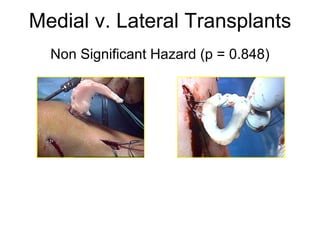
Medial v. Lateral Transplants Non Significant Hazard (p = 0.848) Medial (N = 85) KM mean survival: 9.91 ± 0.46 years Lateral (N = 34) KM mean survival: 10.17 ± 0.78 years
Malalignment Severity of Mal-Alignment  (p = 0.535) Severe Malalignment (>7º) (N = 10) Moderate Malalignment (5 – 7º) (N = 39) 7 Osteotomies –  71.4% Success Rate (5/7) –  2 UNI 3 NO Osteotomy –  66.7% Success Rate (2/3) –  1 UNI –  50% Success Rate (4/8) –  2 TKA, 1 UNI, 1 Removed 8  Osteotomies –  80.6% Success Rate (25/31) –  2 TKA, 2 UNI, 2 Removed 31 NO Osteotomy
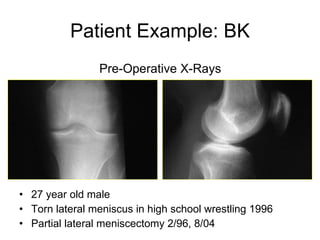
Patient Example: BK 27 year old male Torn lateral meniscus in high school wrestling 1996 Partial lateral meniscectomy 2/96, 8/04 Pre-Operative X-Rays
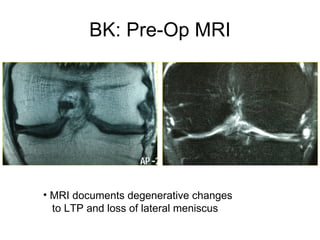
BK: Pre-Op MRI MRI documents degenerative changes   to LTP and loss of lateral meniscus
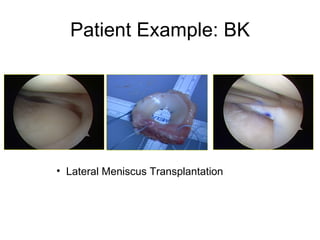
Patient Example: BK Lateral Meniscus Transplantation
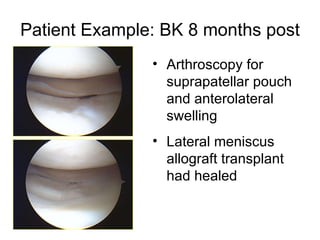
Patient Example: BK 8 months post  Arthroscopy for suprapatellar pouch and anterolateral swelling Lateral meniscus allograft transplant had healed
BK MRI 4 Years Post Op Lateral meniscus allograft appears normal and   well positioned Patient reports no pain - “It feels really good”
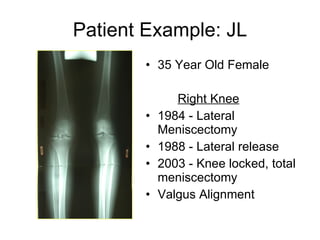
Patient Example: JL 35 Year Old Female Right Knee   1984 - Lateral Meniscectomy 1988 - Lateral release 2003 - Knee locked, total meniscectomy Valgus Alignment
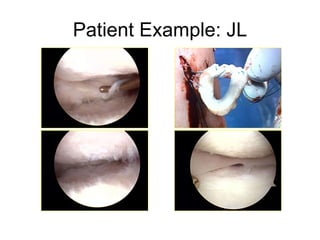
Patient Example: JL OB III/IV far-posterior aspect LFC, Microfracture LFC
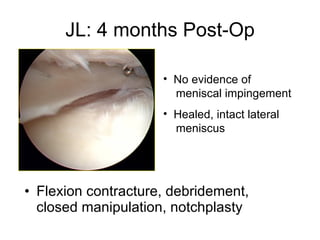
JL: 4 months Post-Op Flexion contracture, debridement, closed manipulation, notchplasty No evidence of   meniscal impingement Healed, intact lateral   meniscus
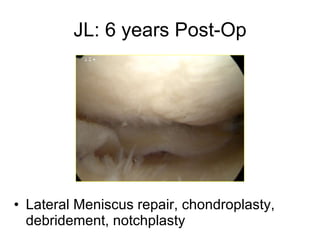
JL: 6 years Post-Op Lateral Meniscus repair, chondroplasty, debridement, notchplasty
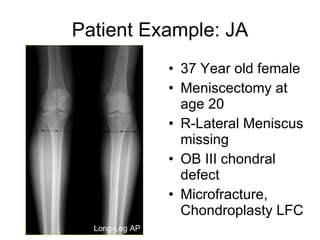
Patient Example: JA 37 Year old female Meniscectomy at age 20 R-Lateral Meniscus missing OB III chondral defect Microfracture, Chondroplasty LFC Long-Leg AP
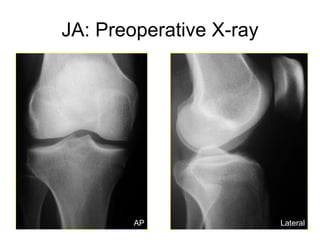
JA: Preoperative X-ray Lateral AP
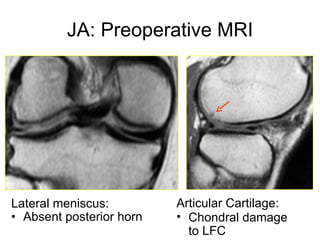
JA: Preoperative MRI Lateral meniscus: Absent posterior horn Articular Cartilage: Chondral damage to LFC
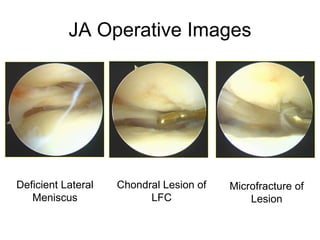
JA Operative Images A B C Deficient Lateral Meniscus Chondral Lesion of LFC Microfracture of Lesion
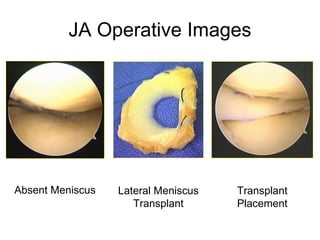
JA Operative Images A B C Absent Meniscus Lateral Meniscus Transplant Transplant Placement
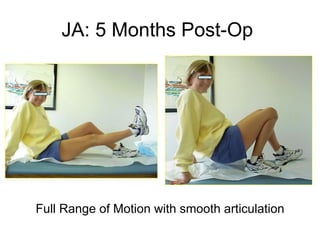
JA: 5 Months Post-Op  Full Range of Motion with smooth articulation
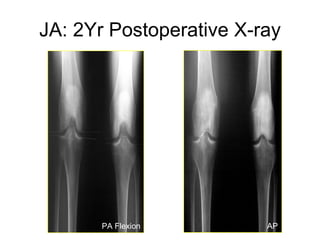
JA: 2Yr Postoperative X-ray PA Flexion AP
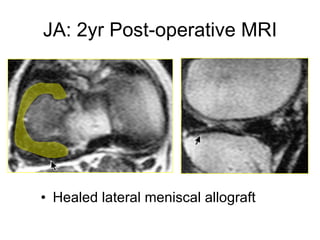
JA: 2yr Post-operative MRI Healed lateral meniscal allograft
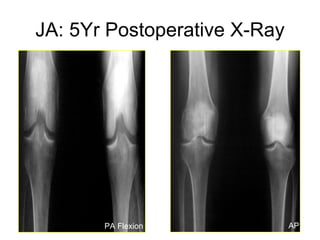
JA: 5Yr Postoperative X-Ray PA Flexion AP
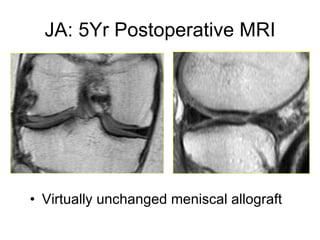
JA: 5Yr Postoperative MRI Virtually unchanged meniscal allograft
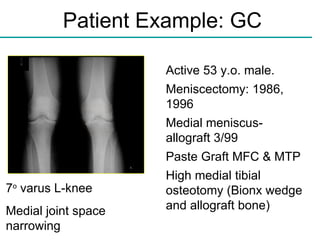
Patient Example: GC 7 o  varus L-knee Medial joint space narrowing Active 53 y.o. male. Meniscectomy: 1986, 1996 Medial meniscus-allograft 3/99  Paste Graft MFC & MTP High medial tibial osteotomy (Bionx wedge and allograft bone)
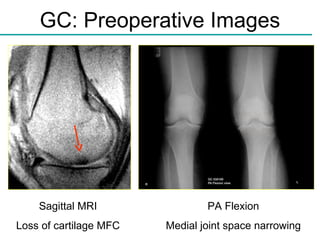
GC: Preoperative Images Sagittal MRI Loss of cartilage MFC PA Flexion Medial joint space narrowing
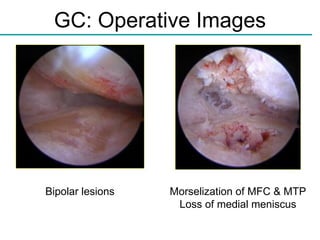
GC: Operative Images A B Bipolar   lesions Morselization of MFC & MTP Loss of medial meniscus
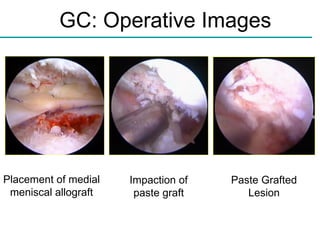
GC: Operative Images A B C Placement of medial meniscal allograft Impaction of paste graft Paste Grafted Lesion
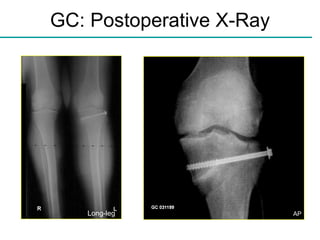
GC: Postoperative X-Ray Long-leg AP
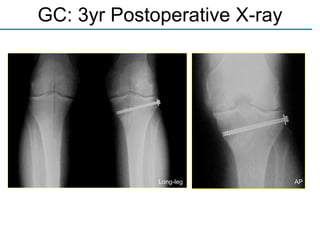
GC: 3yr Postoperative X-ray AP Long-leg
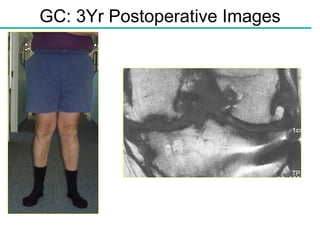
GC: 3Yr Postoperative Images 3 Years post-op L-medial allograft, osteotomy, & paste graft
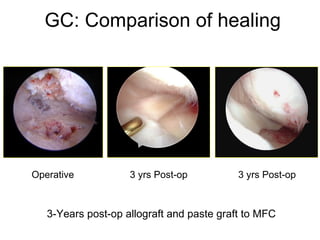
GC: Comparison of healing 3-Years post-op allograft and paste graft to MFC Operative 3 yrs Post-op 3 yrs Post-op
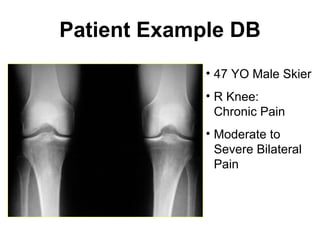
Patient Example DB 47 YO Male Skier R Knee:  Chronic Pain Moderate to Severe Bilateral Pain
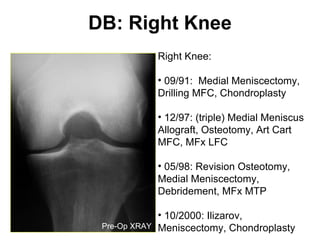
DB: Right Knee Right Knee:  09/91:  Medial Meniscectomy, Drilling MFC, Chondroplasty 12/97: (triple) Medial Meniscus Allograft, Osteotomy, Art Cart MFC, MFx LFC 05/98: Revision Osteotomy, Medial Meniscectomy, Debridement, MFx MTP 10/2000: Ilizarov, Meniscectomy, Chondroplasty Pre-Op XRAY
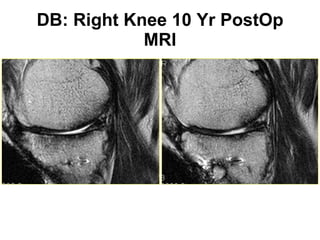
DB: Right Knee 10 Yr PostOp MRI
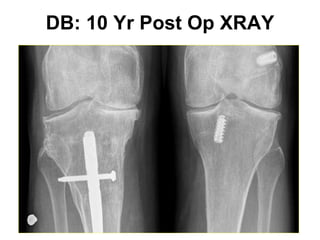
DB: 10 Yr Post Op XRAY
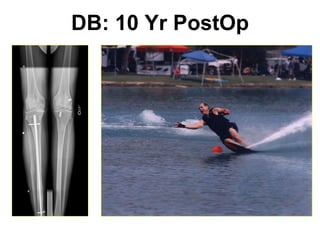
DB: 10 Yr PostOp 63 YO, Tegner = 6, Skis 30+ days/yr, Snow skis 50+ days/yr.
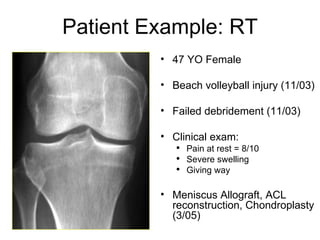
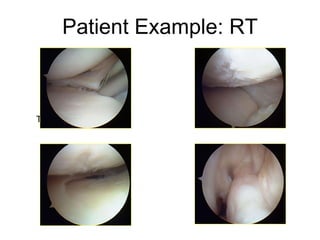
47 YO Female Beach volleyball injury (11/03) Failed debridement (11/03) Clinical exam: Pain at rest = 8/10 Severe swelling  Giving way Meniscus Allograft, ACL reconstruction, Chondroplasty (3/05) Patient Example: RT
RT: Pre-Operative MRI
Torn medial meniscus MFC chondral lesion LFC chondral lesion Torn ACL Patient Example: RT
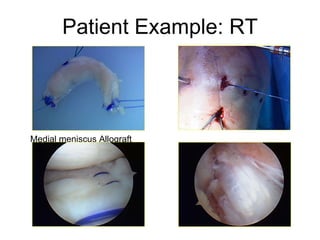
Medial meniscus Allograft Allograft Insertion Allograft placement ACL BTB allograft Patient Example: RT
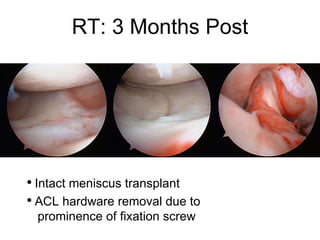
Intact meniscus transplant ACL hardware removal due to   prominence of fixation screw RT: 3 Months Post
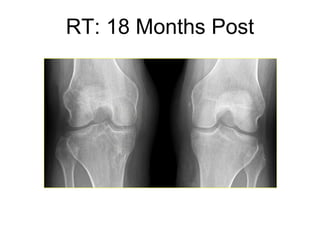
Excellent joint space, intact meniscus allograft and ACL, but right knee clicking and catching RT: 18 Months Post
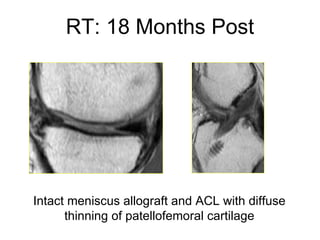
Intact meniscus allograft and ACL with diffuse thinning of patellofemoral cartilage RT: 18 Months Post
Surgery for catching due to chondral flap at patellofemoral joint Intact meniscus allograft and ACL RT: 18 Months Post
Conclusions Height and weight can be used to size meniscal allograft tissue. Three-tunnel Technique is necessary to fix meniscus allograft to tibial plateau, not the surrounding tissue, to avoid meniscus subluxation Improvements are maintained over the course of follow-up (2 – 12 yrs).

Meniscus Transplant

  • 1.
    Meniscus Transplants KevinR. Stone, MD Ann W. Walgenbach, RNNP Wendy S. Adelson, MS Jonathan R. Pelsis, MHS Stone Research Foundation San Francisco
  • 2.
    The Aging KneePediatric Normal Adult OA Adult
  • 3.
  • 4.
    Meniscus Key shock absorber in the knee Torn 1.5M times annually US Minimal healing No spontaneous regeneration template
  • 5.
    Loss of meniscuscartilage leads to: Increased forces across the knee joint Increased risk of articular cartilage damage Pain and arthritis in many cases Painful arthritic joints: Rough surfaces Harsh, degradative environment The Problem
  • 6.
    Reduce pain andimprove function Preserve the biology of the knee Restore a biomechanically favorable environment Provide a buffer to prevent bone-on-bone contact and pain The Goal
  • 7.
    Meniscus Transplantation: Indications Traditional thought: Meniscus Transplantation does not work in arthritic knees ( Noyes & Barber-Westin 1995, Stollsteimer 2000, Rath 2001) Current thought: Meniscus Transplantation does work in arthritic knees if damaged articular cartilage is treated as well (van Arkel 2002, Noyes 2004, Verdonk 2005, Cole 2006, Stone 2006, Farr 2007, Rue 2008)
  • 8.
    Supporting Studies: Sizing148 heights and weights compared to MRI meniscus size Pearson’s Correlations (r): Height vs Total Tibial Plateau (TTP) r = 0.7194 Weight vs TTP r = 0.5470 TTP vs Medial and Lateral Meniscal Width r = 0.7386, r = 0.7209 TTP vs Medial and Lateral Meniscal Length r = 0.7040, r = 0.7209 Stone KR, Freyer A, Turek T, Walgenbach AW, Wadhwa S, Crues J. Meniscal sizing based on gender, height, and weight. Arthroscopy 2007;23-5:503-8 Meniscal Sizing Based on Gender, Height, and Weight
  • 9.
    The Three-Tunnel TechniqueReplacing the Meniscus Stone KR, Walgenbach AW. “Meniscal Allografting: the Three-Tunnel Technique.” Arthroscopy – The Journal of Arthroscopic and Related Surgery. 2003, 19(4):426-30.
  • 10.
    Articular Cartilage PasteGraft Procedure Step 1 Step 5 Step 4 Step 3 Step 2
  • 11.
    Meniscus Transplantation 225performed since 1997 Clinical Exam + Patient Reported Subjective Outcome (1, 2, 3, 5, 7, 10, 15+ yrs) IKDC WOMAC TEGNER
  • 12.
    Current Study: Long-TermSurvival of Concurrent Meniscus Allograft Transplantation and Articular Cartilage Repair: A Prospective 12-Year Follow-Up Evaluation Pre-Allograft Transplant in place Transplantation OB IV
  • 13.
    Study Design StudyInclusion Irreparable injury of the meniscus Or Loss of the meniscus More than 50% OB III/IV ROM ≥ 90° Study Exclusion Rheumatoid Arthritis Tri-compartment arthritis Total loss of joint space Simultaneous med/lat meniscus allograft transplantation
  • 14.
    Patient Selection Youngpatients with cartilage loss and pain Older patients with cartilage loss and focal pain who want to remain athletic and delay or avoid a knee arthroplasty. “Doc, isn’t there a shock absorber you can put in my knee?”
  • 15.
    Surgical Technique MedialMeniscus Allograft Transplantation: Performed utilizing periosteum, but not bone blocks, at the meniscus horns. Lateral Meniscus Allograft Transplantation: Preformed by preserving the bony block between the horns and inserting it into a bone trough.
  • 16.
    119 Meniscus AllograftTransplant Cases Mean age = 46.9 years (14.1 – 73.2 yrs) Mean follow-up = 5.8 years (2.1 mo – 12.3 yrs) 118 patients ≥ 3 months from injury to time of surgery (Mean = 14.2 years) Patient Population of Study
  • 17.
    Patient Population (N = 119) Neutral / Varus / Valgus Moderate ( 5 – 7°) / Severe ( > 7°) Grade III / Grade IV Medial / Lateral Male / Female None / Mild–Moderate / Severe (Kellgren-Lawrence)
  • 18.
    Results Procedure failure:Removal of allograft without revision (N = 7) , or progression to knee arthroplasty [N = 18 (TKA or UNI)]. 94/119 allograft cases successful (79%) Of 25 failures, Mean time-to-failure: 4.65 ± 2.99 years Range: 2.1 months – 10.37 years Kaplan-Meier estimated mean survival time was 9.93 ± 0.40 years [95%CI: 9.14,10.72] 13 patients were lost to follow-up
  • 19.
    Complications 4 EarlyPostoperative Infections 3 Deep (1 Staphphylococcus Aures, 2 negative serologies) 1 Superficial (Staphylococcus Epidemis) All cases were treated arthroscopically with irrigation and debridement and IV antibiotics. All cases resolved, but one deep infection case ultimately failed, with the allograft being removed 12.5 months later.
  • 20.
    Subsequent Surgeries –1 4 2 Meniscus Allograft Revision – 2 1 12 Meniscus Allograft Repair – 1 9 22 Meniscectomy 1 1 – 4 Microfracture / Articular Cartilage Paste Grafting 1 4 6 20 Chondroplasty / Debridement – 1 1 2 Other 4 th N = 2 3 rd N = 10 2 nd N = 21 1 st N = 62 Subsequent Surgeries Primary Procedure
  • 21.
    Kaplan-Meier Survival AnalysisIn Patients OB III/IV Time-to-failure analysis with continuous enrollment over 12-yrs Takes into account remaining patients (still intact / lost to follow-up (N=13) ) Intact/Lost To Follow-Up 94% 92% 84% 79% 67%
  • 22.
    Cox Proportional HazardsModel What is it? A Cox model provides an estimate of a variable’s effect on survival after adjustment for other explanatory variables. In addition, it allows us to estimate the hazard (or risk) of procedure failure, given their prognostic variables.
  • 23.
    What factors affectsurvival? Cox Proportional Hazards Model was used to explore the relationship between procedure failure and several covariates. Age (p = 0.026) Number of Previous Surgeries (p = 0.006) Number of Additional Surgeries Osteotomy performed concomitantly Number of concomitant procedures Outerbridge Grade (III or IV) Medial v. Lateral Allograft Joint Space Narrowing Malalignment Severity Alignment Type Sex NOT RELATED RELATED
  • 24.
    Cox Model -Related Hazards Independent of actual time-to-failure, increased number of previous surgeries (p = 0.026) and increased age at time of surgery (p = 0.006) increases the risk of meniscus allograft transplantation failure.
  • 25.
    Effect of Age53 patients over 50 (Mean = 56 yrs) KM mean survival = 8.84 years [95% CI: 7.51,10.17] 71.7% (38/53) Success Rate 1 allograft removed 2 mo. post-op 14 progressed to Joint Arthroplasty @ mean 5.1 years 66 patients under 50 (Mean = 39 yrs) KM mean survival = 10.67 years [95% CI: 9.76,11.58] 84.8% (56/66) Success Rate 6 allografts removed @ mean 4.0 years 4 Progressed to Joint Arthroplasty @ mean 5.2 years
  • 26.
    Medial v. LateralTransplants Non Significant Hazard (p = 0.848) Medial (N = 85) KM mean survival: 9.91 ± 0.46 years Lateral (N = 34) KM mean survival: 10.17 ± 0.78 years
  • 27.
    Malalignment Severity ofMal-Alignment (p = 0.535) Severe Malalignment (>7º) (N = 10) Moderate Malalignment (5 – 7º) (N = 39) 7 Osteotomies – 71.4% Success Rate (5/7) – 2 UNI 3 NO Osteotomy – 66.7% Success Rate (2/3) – 1 UNI – 50% Success Rate (4/8) – 2 TKA, 1 UNI, 1 Removed 8 Osteotomies – 80.6% Success Rate (25/31) – 2 TKA, 2 UNI, 2 Removed 31 NO Osteotomy
  • 28.
    Patient Example: BK27 year old male Torn lateral meniscus in high school wrestling 1996 Partial lateral meniscectomy 2/96, 8/04 Pre-Operative X-Rays
  • 29.
    BK: Pre-Op MRIMRI documents degenerative changes to LTP and loss of lateral meniscus
  • 30.
    Patient Example: BKLateral Meniscus Transplantation
  • 31.
    Patient Example: BK8 months post Arthroscopy for suprapatellar pouch and anterolateral swelling Lateral meniscus allograft transplant had healed
  • 32.
    BK MRI 4Years Post Op Lateral meniscus allograft appears normal and well positioned Patient reports no pain - “It feels really good”
  • 33.
    Patient Example: JL35 Year Old Female Right Knee 1984 - Lateral Meniscectomy 1988 - Lateral release 2003 - Knee locked, total meniscectomy Valgus Alignment
  • 34.
    Patient Example: JLOB III/IV far-posterior aspect LFC, Microfracture LFC
  • 35.
    JL: 4 monthsPost-Op Flexion contracture, debridement, closed manipulation, notchplasty No evidence of meniscal impingement Healed, intact lateral meniscus
  • 36.
    JL: 6 yearsPost-Op Lateral Meniscus repair, chondroplasty, debridement, notchplasty
  • 37.
    Patient Example: JA37 Year old female Meniscectomy at age 20 R-Lateral Meniscus missing OB III chondral defect Microfracture, Chondroplasty LFC Long-Leg AP
  • 38.
  • 39.
    JA: Preoperative MRILateral meniscus: Absent posterior horn Articular Cartilage: Chondral damage to LFC
  • 40.
    JA Operative ImagesA B C Deficient Lateral Meniscus Chondral Lesion of LFC Microfracture of Lesion
  • 41.
    JA Operative ImagesA B C Absent Meniscus Lateral Meniscus Transplant Transplant Placement
  • 42.
    JA: 5 MonthsPost-Op Full Range of Motion with smooth articulation
  • 43.
    JA: 2Yr PostoperativeX-ray PA Flexion AP
  • 44.
    JA: 2yr Post-operativeMRI Healed lateral meniscal allograft
  • 45.
    JA: 5Yr PostoperativeX-Ray PA Flexion AP
  • 46.
    JA: 5Yr PostoperativeMRI Virtually unchanged meniscal allograft
  • 47.
    Patient Example: GC7 o varus L-knee Medial joint space narrowing Active 53 y.o. male. Meniscectomy: 1986, 1996 Medial meniscus-allograft 3/99 Paste Graft MFC & MTP High medial tibial osteotomy (Bionx wedge and allograft bone)
  • 48.
    GC: Preoperative ImagesSagittal MRI Loss of cartilage MFC PA Flexion Medial joint space narrowing
  • 49.
    GC: Operative ImagesA B Bipolar lesions Morselization of MFC & MTP Loss of medial meniscus
  • 50.
    GC: Operative ImagesA B C Placement of medial meniscal allograft Impaction of paste graft Paste Grafted Lesion
  • 51.
  • 52.
    GC: 3yr PostoperativeX-ray AP Long-leg
  • 53.
    GC: 3Yr PostoperativeImages 3 Years post-op L-medial allograft, osteotomy, & paste graft
  • 54.
    GC: Comparison ofhealing 3-Years post-op allograft and paste graft to MFC Operative 3 yrs Post-op 3 yrs Post-op
  • 55.
    Patient Example DB47 YO Male Skier R Knee: Chronic Pain Moderate to Severe Bilateral Pain
  • 56.
    DB: Right KneeRight Knee: 09/91: Medial Meniscectomy, Drilling MFC, Chondroplasty 12/97: (triple) Medial Meniscus Allograft, Osteotomy, Art Cart MFC, MFx LFC 05/98: Revision Osteotomy, Medial Meniscectomy, Debridement, MFx MTP 10/2000: Ilizarov, Meniscectomy, Chondroplasty Pre-Op XRAY
  • 57.
    DB: Right Knee10 Yr PostOp MRI
  • 58.
    DB: 10 YrPost Op XRAY
  • 59.
    DB: 10 YrPostOp 63 YO, Tegner = 6, Skis 30+ days/yr, Snow skis 50+ days/yr.
  • 60.
    47 YO FemaleBeach volleyball injury (11/03) Failed debridement (11/03) Clinical exam: Pain at rest = 8/10 Severe swelling Giving way Meniscus Allograft, ACL reconstruction, Chondroplasty (3/05) Patient Example: RT
  • 61.
  • 62.
    Torn medial meniscusMFC chondral lesion LFC chondral lesion Torn ACL Patient Example: RT
  • 63.
    Medial meniscus AllograftAllograft Insertion Allograft placement ACL BTB allograft Patient Example: RT
  • 64.
    Intact meniscus transplantACL hardware removal due to prominence of fixation screw RT: 3 Months Post
  • 65.
    Excellent joint space,intact meniscus allograft and ACL, but right knee clicking and catching RT: 18 Months Post
  • 66.
    Intact meniscus allograftand ACL with diffuse thinning of patellofemoral cartilage RT: 18 Months Post
  • 67.
    Surgery for catchingdue to chondral flap at patellofemoral joint Intact meniscus allograft and ACL RT: 18 Months Post
  • 68.
    Conclusions Height andweight can be used to size meniscal allograft tissue. Three-tunnel Technique is necessary to fix meniscus allograft to tibial plateau, not the surrounding tissue, to avoid meniscus subluxation Improvements are maintained over the course of follow-up (2 – 12 yrs).

Editor's Notes

  • #2 Kevin R. Stone, MD
  • #3 Kevin R. Stone, MD
  • #4 Kevin R. Stone, MD
  • #6 Kevin R. Stone, MD
  • #7 Kevin R. Stone, MD
  • #8 Kevin R. Stone, MD Rath = severe arthritis excluded
  • #9 Kevin R. Stone, MD
  • #10 Kevin R. Stone, MD
  • #11 Kevin R. Stone, MD The procedure step by step.
  • #12 Kevin R. Stone, MD
  • #23 Examine the coefficients for each explanatory variable. Positive Coefficient means that the hazard is higher WORSE PROGNOSIS Negative Coefficient implies a lower hazard BETTER PROGNOSIS
  • #29 Kevin R. Stone, MD Bryan Kelly
  • #38 Kevin R. Stone, MD
  • #39 Kevin R. Stone, MD
  • #40 Kevin R. Stone, MD
  • #41 Kevin R. Stone, MD
  • #42 Kevin R. Stone, MD
  • #43 Kevin R. Stone, MD
  • #44 Kevin R. Stone, MD
  • #45 Kevin R. Stone, MD
  • #46 Kevin R. Stone, MD
  • #47 Kevin R. Stone, MD
  • #48 Kevin R. Stone, MD
  • #49 Kevin R. Stone, MD A= MRI confirming articular cartilage loss of the MFC B= Long leg x-ray demonstrating varus deformity of (L-knee??? I think it should be the Right knee: see x-rays and chart notes ) of about 5-7 degrees C= PA Flexion view demonstrating medial joint space narrowing bialterally L worse than R (nearly bone on bone on the Left). 51 yo ♂ real estate broker both knees w/ problems L worse than R. He has a long hx/o degenerative changes in the medial compartment, loss of the medial meniscus and previous efforts at surgical debridement in order to relieve his medial compartment pain. Pre-operative x-rays revealed medial joint space narrowing and loss of articular cartilage. Pre-operative MRI confirmed loss of the medial meniscus and loss of the artircular cartilage of the medial compartment. He stood in varus. In view of his young age and atheletic activities he requested an effort at biological reconstruction of the medial compartment.   03/10/1999 L-med-Allo/ ArtCart-MFC & MTP/ Open high tib med wedge opening osteotomy using BionX implants and allograft bone/ chon-LFC/ debridement/   Sx: developed a “clicking soreness” on upper MFC thought to be scar tissue requested an effort at operative debridement   03/20/2002 L-knee arthros/ chon-troch/ partial (M)ectomy of Allo where at the posterior 1/3 there was a small flap tear
  • #50 Kevin R. Stone, MD A= Kissing lesion, MFC, MTP w/ loss of medial meniscus B= Morcellation of the MFC & MTP lesions and loss of medial meniscus
  • #51 Kevin R. Stone, MD A= Placement of medial meniscal allograft B&C= Articular cartilage paste grafting MFC.
  • #52 Kevin R. Stone, MD
  • #53 Kevin R. Stone, MD A= MRI (03/18/02) documenting site of medial meniscus allograft and cartilage paste graft B= Long-leg x-ray (03/14/02) demonstrating post-op alignment C= PA Flexion view (03/14/02) documenting previous osteotomy and preservation of some joint space.   03/14/02 Patient seen 3 years post-op. He noted that before surgery he was unable to do certain activities that he would like to do, and he noted that the knee just pops w/ squatting. He is otherwise quite happy. Px: He had 2 prominent bumps at the medial side of his femoral condyle that he is complaining about. He had patellofemoral crepitus. His pain level is minimal, and his activity level is high. Dx: Arthrofibrosis and bursitis of L-knee. Sx: developed a “clicking soreness” on upper MFC thought to be scar tissue requested an effort at operative debridement   03/20/2002 L-knee arthroscopy/ chond-troch/ partial (M)ectomy of Allo where at the posterior 1/3 there was a small flap tear
  • #54 Kevin R. Stone, MD
  • #55 Kevin R. Stone, MD A= Medial meniscus allograft 3 years S/P transplantation B= Medial meniscus allograft 3 years S/P transplantation C= Biopsy MFC 3 years S/P ArtCart
  • #56 Kevin R. Stone, MD Kevin R. Stone, Biological Knee Reconstruction Annual Joint Preserving Meeting, Johns Hopkins 2004
  • #57 Kevin R. Stone, MD Kevin R. Stone, Biological Knee Reconstruction Annual Joint Preserving Meeting, Johns Hopkins 2004
  • #58 Kevin R. Stone, MD Kevin R. Stone, Biological Knee Reconstruction Annual Joint Preserving Meeting, Johns Hopkins 2004
  • #59 Kevin R. Stone, MD Kevin R. Stone, Biological Knee Reconstruction Annual Joint Preserving Meeting, Johns Hopkins 2004
  • #60 Kevin R. Stone, MD Kevin R. Stone, Biological Knee Reconstruction Annual Joint Preserving Meeting, Johns Hopkins 2004
  • #61 Kevin R. Stone, MD Rhonda Topple
  • #63 Kevin R. Stone, MD Kevin R. Stone, Biological Knee Reconstruction Annual Joint Preserving Meeting, Johns Hopkins 2004 RT
  • #64 Kevin R. Stone, MD Kevin R. Stone, Biological Knee Reconstruction Annual Joint Preserving Meeting, Johns Hopkins 2004 RT
  • #65 Kevin R. Stone, MD Kevin R. Stone, Biological Knee Reconstruction Annual Joint Preserving Meeting, Johns Hopkins 2004 RT
  • #66 Kevin R. Stone, MD Kevin R. Stone, Biological Knee Reconstruction Annual Joint Preserving Meeting, Johns Hopkins 2004 RT
  • #67 Kevin R. Stone, MD Kevin R. Stone, Biological Knee Reconstruction Annual Joint Preserving Meeting, Johns Hopkins 2004 RT
  • #68 Kevin R. Stone, MD Kevin R. Stone, Biological Knee Reconstruction Annual Joint Preserving Meeting, Johns Hopkins 2004 RT
  • #69 Kevin R. Stone, MD